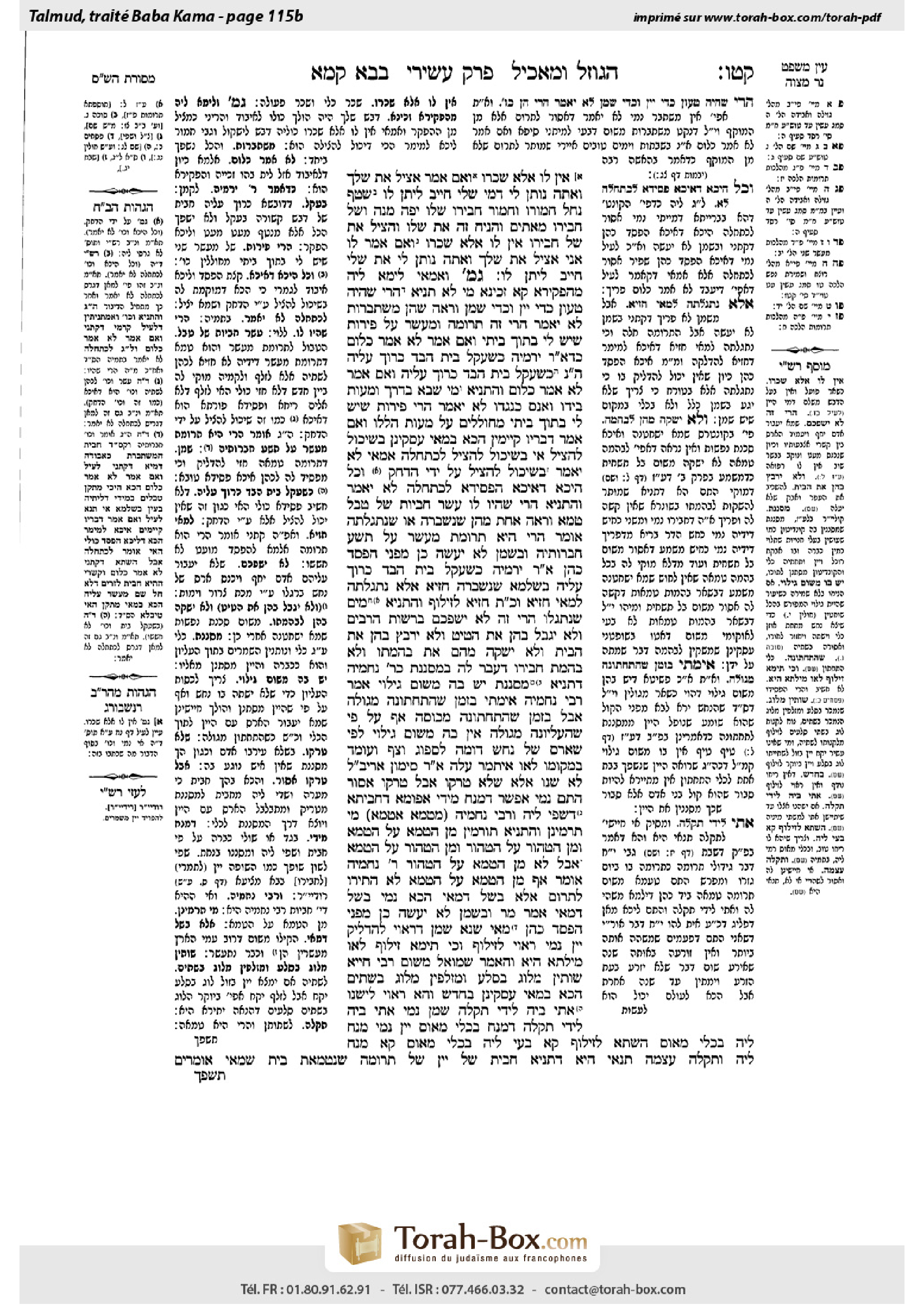
Bava Kamma 115b: Talmud study for Daf Yomi
Study the Talmud for Daf Yomi with scanned pages, Hebrew text, English translations from Sefaria and AI-generated French translations.
Passage selection and English or AI-generated French translation are available where the scan has annotations. Daf Study is independent of Torah-Box and Sefaria.
Browse Bava Kamma · בבא קמא · All tractatesBava Kamma 115b text and translations
This page of Bava Kamma includes the Aramaic text, an English translation and an AI-generated French translation, alongside the scan above.
בבא קמא קי״ה ב · Aramaic and Hebrew text
אֵין לוֹ אֶלָּא שְׂכָרוֹ. וְאִם אָמַר: ״אַצִּיל אֶת שֶׁלְּךָ, וְאַתָּה נוֹתֵן לִי דְּמֵי שֶׁלִּי״ – חַיָּיב לִיתֵּן לוֹ.
שָׁטַף נַחַל חֲמוֹרוֹ וַחֲמוֹר חֲבֵירוֹ, שֶׁלּוֹ יָפֶה מָנֶה וְשֶׁל חֲבֵירוֹ מָאתַיִם, וְהִנִּיחַ זֶה אֶת שֶׁלּוֹ וְהִצִּיל אֶת שֶׁל חֲבֵירוֹ – אֵין לוֹ אֶלָּא שְׂכָרוֹ. וְאִם אָמַר לוֹ: ״אֲנִי אַצִּיל אֶת שֶׁלְּךָ, וְאַתָּה נוֹתֵן לִי אֶת שֶׁלִּי״ – חַיָּיב לִיתֵּן לוֹ.
גְּמָ׳ וְאַמַּאי? לֵימָא לֵיהּ: מֵהֶפְקֵירָא קָא זָכֵינָא! מִי לָא תַּנְיָא: הֲרֵי שֶׁהָיָה טָעוּן כַּדֵּי יַיִן וְכַדֵּי שֶׁמֶן, וְרָאָה שֶׁהֵן מִשְׁתַּבְּרוֹת, לֹא יֹאמַר: ״הֲרֵי זֶה תְּרוּמָה וּמַעֲשֵׂר עַל פֵּירוֹת שֶׁיֵּשׁ לִי בְּתוֹךְ בֵּיתִי״, וְאִם אָמַר – לֹא אָמַר כְּלוּם?
כִּדְאָמַר רַבִּי יִרְמְיָה: כְּשֶׁעֵקֶל בֵּית הַבַּד כָּרוּךְ עָלֶיהָ; הָכִי נָמֵי, כְּשֶׁעֵקֶל בֵּית הַבַּד כָּרוּךְ עָלֶיהָ.
וְאִם אָמַר – לֹא אָמַר כְּלוּם? וְהָתַנְיָא: מִי שֶׁבָּא בַּדֶּרֶךְ וּמָעוֹת בְּיָדוֹ וְאַנָּס כְּנֶגְדּוֹ, לֹא יֹאמַר: ״הֲרֵי פֵּירוֹת שֶׁיֵּשׁ לִי בְּתוֹךְ בֵּיתִי מְחוּלָּלִים עַל מָעוֹת הַלָּלוּ״, וְאִם אָמַר – דְּבָרָיו קַיָּימִין!
הָכָא בְּמַאי עָסְקִינַן – בְּשֶׁיָּכוֹל לְהַצִּיל. אִי בְּשֶׁיָּכוֹל לְהַצִּיל, לְכַתְּחִלָּה אַמַּאי לֹא יֹאמַר? בְּשֶׁיָּכוֹל לְהַצִּיל עַל יְדֵי הַדְּחָק.
וְכֹל הֵיכָא דְּאִיכָּא הֶפְסֵידָא, לְכַתְּחִלָּה לֹא יֹאמַר? וְהָתַנְיָא: הֲרֵי שֶׁהָיוּ לוֹ עֶשֶׂר חָבִיּוֹת שֶׁל טֶבֶל טָמֵא, וְרָאָה אַחַת מֵהֶן שֶׁנִּשְׁבְּרָה אוֹ שֶׁנִּתְגַּלְּתָה, אוֹמֵר: ״הֲרֵי הִיא תְּרוּמַת מַעֲשֵׂר עַל תֵּשַׁע חַבְרוֹתֶיהָ״. וּבְשֶׁמֶן לֹא יַעֲשֶׂה כֵּן, מִפְּנֵי הֶפְסֵד כֹּהֵן!
אָמַר רַבִּי יִרְמְיָה: כְּשֶׁעֵקֶל בֵּית הַבַּד כָּרוּךְ עָלֶיהָ. בִּשְׁלָמָא שֶׁנִּשְׁבְּרָה – חַזְיָא, אֶלָּא נִתְגַּלְּתָה – לְמַאי חַזְיָא?
וְכִי תֵּימָא חַזְיָא לְזִילּוּף, וְהָתַנְיָא: מַיִם שֶׁנִּתְגַּלּוּ – הֲרֵי זֶה לֹא יִשְׁפְּכֵם בִּרְשׁוּת הָרַבִּים; וְלֹא יְגַבֵּל בָּהֶן אֶת הַטִּיט; וְלֹא יְרַבֵּץ בָּהֶן אֶת הַבַּיִת; וְלֹא יַשְׁקֶה מֵהֶם אֶת בְּהֶמְתּוֹ, וְלֹא בֶּהֱמַת חֲבֵירוֹ!
דְּעַבַּר לָהּ בִּמְסַנֶּנֶת, כְּרַבִּי נְחֶמְיָה – דְּתַנְיָא: מְסַנֶּנֶת, יֵשׁ בָּהּ מִשּׁוּם גִּילּוּי. אָמַר רַבִּי נְחֶמְיָה: אֵימָתַי – בִּזְמַן שֶׁהַתַּחְתּוֹנָה מְגוּלָּה, אֲבָל בִּזְמַן שֶׁהַתַּחְתּוֹנָה מְכוּסָּה – אַף עַל פִּי שֶׁהָעֶלְיוֹנָה מְגוּלָּה, אֵין בָּהּ מִשּׁוּם גִּילּוּי; לְפִי שֶׁאֶרֶס שֶׁל נָחָשׁ דּוֹמֶה לִסְפוֹג, וְצָף וְעוֹמֵד בִּמְקוֹמוֹ.
לָאו אִיתְּמַר עֲלַהּ, אָמַר רַבִּי סִימוֹן אָמַר רַבִּי יְהוֹשֻׁעַ בֶּן לֵוִי: לֹא שָׁנוּ אֶלָּא שֶׁלֹּא טְרָקוֹ, אֲבָל טְרָקוֹ – אָסוּר?
הָתָם נָמֵי, אֶפְשָׁר דְּמַנַּח מִידֵּי אַפּוּמָּא דְחָבִיתָא, (דְּשָׁפֵי) [וְשָׁפֵי] לֵיהּ.
וְרַבִּי נְחֶמְיָה – (מִטָּמֵא אַטָּמֵא) מִי תָּרְמִינַן?
וְהָתַנְיָא: תּוֹרְמִין מִן הַטָּמֵא עַל הַטָּמֵא, וּמִן הַטָּהוֹר עַל הַטָּהוֹר, וּמִן הַטָּהוֹר עַל הַטָּמֵא; אֲבָל לֹא מִן הַטָּמֵא עַל הַטָּהוֹר. רַבִּי נְחֶמְיָה אוֹמֵר: אַף מִן הַטָּמֵא עַל הַטָּמֵא לֹא הִתִּירוּ לִתְרוֹם, אֶלָּא בְּשֶׁל דְּמַאי! הָכָא נָמֵי בְּשֶׁל דְּמַאי.
אָמַר מָר: וּבְשֶׁמֶן לֹא יַעֲשֶׂה כֵּן, מִפְּנֵי הֶפְסֵד כֹּהֵן. מַאי שְׁנָא שֶׁמֶן – דְּרָאוּי לְהַדְלִיק? יַיִן נָמֵי רָאוּי לְזִילּוּף! וְכִי תֵּימָא זִילּוּף לָאו מִילְּתָא הִיא, וְהָאָמַר שְׁמוּאֵל מִשּׁוּם רַבִּי חִיָּיא: שׁוֹתִין מִלּוֹג בְּסֶלַע, וּמְזַלְּפִין מִלּוֹג בִּשְׁתַּיִם!
הָכָא בְּמַאי עָסְקִינַן – בְּחָדָשׁ. וְהָא רָאוּי לְיַשְּׁנוֹ! אָתֵי בֵּיהּ לִידֵי תַּקָּלָה.
שֶׁמֶן נָמֵי אָתֵי בֵּיהּ לִידֵי תַּקָּלָה! דְּמַנַּח [לֵיהּ] בִּכְלִי מָאוּס. יַיִן נָמֵי מַנַּח לֵיהּ בִּכְלִי מָאוּס! הַשְׁתָּא לְזִילּוּף קָא בָּעֵי לֵיהּ, בִּכְלִי מָאוּס קָא מַנַּח לֵיהּ?!
וְתַקָּלָה עַצְמָהּ תַּנָּאֵי הִיא – דְּתַנְיָא: חָבִית שֶׁל יַיִן שֶׁל תְּרוּמָה, שֶׁנִּטְמֵאת – בֵּית שַׁמַּאי אוֹמְרִים:
Bava Kamma 115b · English translation
the owner of the wine has the right to collect only his wage, i.e., compensation for the effort he put into salvaging the honey. He is not, however, entitled to compensation for the wine itself. But if the owner of the wine said: I will salvage your honey and you will pay me the value of my wine, the owner of the honey is obligated to pay him compensation for the wine.
Similarly, if a river washed away his donkey and the donkey of another, and his donkey was worth one hundred dinars and the donkey of the other was worth two hundred, and the individual with the less valuable donkey abandoned his donkey and instead salvaged the donkey of the other, he has the right to collect only his wage, i.e., compensation for the effort he put into salvaging his fellow’s donkey. But if he said to the owner of the more valuable donkey: I will salvage your donkey and you will pay me the monetary value of mine in exchange, the owner of the more valuable donkey is obligated to pay the rescuer compensation for his donkey.
GEMARA: And why does one who pours out wine have the right to collect only this wage? Let him say to the owner of the honey: I have acquired your honey from ownerless property. Isn’t it taught in a baraita: One who was laden with jugs of wine and jugs of oil and saw that they were breaking and their contents were leaking out should not say: This is hereby separated as teruma and tithe for the produce that I have in my house. And even if he said this, it is as though he did not say anything. The fact that one cannot separate produce that is about to be lost as teruma or tithe indicates that such property is considered ownerless.
The Gemara answers that it is as Rabbi Yirmeya says in a different context, that the ruling discussed there is referring to a case where the basket of the olive press was wrapped around it so that the barrel would not break completely, and some of the contents would remain inside. So too, here, the mishna issued its ruling only when the basket of the olive press was wrapped around the honey barrel so that it would not break completely, and the contents are therefore not rendered ownerless.
The Gemara challenges the baraita that stated: And even if he said that the wine or oil is separated as teruma or tithe, it is as though he did not say anything. But isn’t it taught in a different baraita: If one was traveling on the road and had money in his possession, and he saw a ruffian moving toward him, he should not say: The second-tithe produce that I have in my house is hereby desacralized onto these coins, i.e., the sanctity of the produce is hereby transferred to the coins. But if he said so, his statement stands, and the produce is desacralized while the coins attain the sanctity of the second tithe.
The Gemara answers: Here we are dealing with a case where he is capable of saving his money from the ruffian and that is why he may transfer the sanctity of the second tithe to the coins. The Gemara asks: If it is a case where he is capable of saving the money, why should he not say that the produce should be desacralized ab initio? The Gemara answers: It is a case where he is capable of saving the money only with difficulty. Consequently, he should not transfer the sanctity of the second tithe to the coins, as it may be lost; but if he does so, the transfer takes effect, as it is not certain that the money will be lost.
The Gemara asks: And is it so that wherever there is a potential loss one should not say that the sanctity is transferred to the money ab initio? But isn’t it taught otherwise in the following baraita: If one had ten barrels of ritually impure, untithed wine, i.e., first-tithe wine from which the teruma of the tithe had not yet been separated, and he saw that one of them had broken and that its contents were leaking out, or that it had been exposed and is forbidden for consumption, he may say: This barrel is hereby separated as the teruma of the tithe for the other nine barrels. But with regard to oil, he should not do so due to the priest’s loss.
The Gemara answers that Rabbi Yirmeya said: The baraita issued its ruling only when the basket of the olive press was wrapped around the barrel so that some of its contents would remain inside. The Gemara asks: Granted, this rationale applies to a barrel that was broken, as the remaining contents are still fit for use, but with regard to a barrel that was exposed, for what use is it fit?
And if you would say that the exposed wine is fit for sprinkling, in order to spread its pleasant aroma, isn’t it taught otherwise in the following baraita? With regard to water that was exposed, one may not pour it out in the public domain, nor mix clay with it, nor settle dust with it by sprinkling it in a house, nor give it to his animal to drink, nor give it to the animal of another. This proves that exposed liquids may not be used even for sprinkling.
The Gemara answers: The wine is fit for use because he passed it through a strainer, and it is in accordance with the opinion of Rabbi Neḥemya, as it is taught in a baraita: A vessel covered with a strainer is subject to the halakha of exposure if the vessel is left unsupervised. Rabbi Neḥemya said: When is this so? It is so when the lower vessel, in which the liquid collects after passing through the strainer, is exposed. But when the lower vessel is covered, even if the upper vessel is exposed, it is not subject to the halakha of exposure, because the venom of a snake is like a sponge in that it floats and stays in place.
The Gemara questions this explanation: Wasn’t it stated with regard to Rabbi Neḥemya’s ruling that Rabbi Simon says that Rabbi Yehoshua ben Levi says: They taught Rabbi Neḥemya’s ruling only where one did not mix it, but if one mixed the wine, any venom found in it becomes capable of penetrating the strainer? Consequently, the wine remains forbidden even if it is passed through a strainer.
The Gemara answers: There, too, it is possible to prevent the venom from mixing with the wine by placing something upon the mouth of a barrel that will filter it slowly so that the venom will not penetrate the strainer, and the wine may therefore be used.
It has now been established that the baraita, which states that if one’s barrel of untithed, impure wine is breaking, he may separate it as teruma of the tithe for other barrels of untithed, impure wine, may be explained in accordance with the opinion of Rabbi Neḥemya. The Gemara asks: And according to Rabbi Neḥemya, may we separate teruma from impure produce for other impure produce?
But isn’t it taught in another baraita: One may separate teruma from produce that is impure for other produce that is impure, and from produce that is pure for other produce that is pure, and from produce that is pure for produce that is impure, but not from produce that is impure for produce that is pure. Rabbi Neḥemya says: Even with regard to separating from produce that is impure for produce that is impure, the Sages permitted one to separate teruma in this manner only in the case of doubtfully tithed produce [demai]. Consequently, how can the aforementioned baraita unequivocally permit one to separate impure wine as teruma of the tithe for other impure wine? The Gemara answers: Here too, in the baraita, it is discussing a case of demai.
The Gemara discusses the continuation of the baraita cited previously: The Master said in the baraita: But with regard to oil, he should not do so, due to the priest’s loss. The Gemara asks: What is different about a leaking barrel of impure oil, which one may not separate as teruma, because if he does so the priest will suffer a loss? That case is different because the impure teruma oil is fit to be used to kindle a fire, and the priest will now not receive that oil. The Gemara challenges: But wine is also fit to be used, as the priest is able to sprinkle it in order to impart a pleasant aroma. Why is there is no concern that the priest will suffer a loss? And if you would say that sprinkling is nothing, i.e., it is insignificant, doesn’t Shmuel say in the name of Rabbi Ḥiyya: One drinks from a log of wine worth one sela, and one sprinkles from a log of wine worth two sela, which indicates that there is greater benefit in sprinkling wine than in drinking it?
The Gemara answers: Here we are dealing with new wine that has not yet developed an aroma and is therefore not fit for sprinkling. The Gemara counters: But isn’t it fit to allow it to age so that it will become fit for sprinkling? The Gemara responds: If one waits for it to age, he might come to experience a mishap with it, as he will forget that it is impure teruma, which is forbidden for consumption.
The Gemara asks: Oil should also be subject to the concern that one might come to experience a mishap with it, as he might forget that it is forbidden and mistakenly drink it. The Gemara explains: The halakha is that the priest must place the oil in a foul vessel, and there is no concern that he will consume it, as such oil is used only for kindling. The Gemara asks: Let the wine also be placed in a foul vessel, in which case there would be no concern that he would drink it. The Gemara responds: Now that he desires to use it for sprinkling, would he place it in a foul vessel? This would ruin its aroma. Consequently, the wine may not be kept due to concern over a possible mishap, while the oil may be kept.
The Gemara notes: And the concern with regard to a mishap itself is a dispute between tanna’im. As it is taught in a baraita: With regard to a barrel of teruma wine that became impure and is therefore forbidden for consumption, Beit Shammai say:
Bava Kamma 115b · Traduction française (IA)
L'propriétaire du vin a le droit de récupérer uniquement son salaire, c'est-à-dire une compensation pour l'effort qu'il a mis à sauver le miel. Il n'est cependant pas autorisé à demander une compensation pour le vin lui-même. Mais si l'propriétaire du vin a dit : Je vais sauver votre miel et vous me paierez la valeur de mon vin, l'propriétaire du miel est tenu de lui payer une compensation pour le vin.
De même, si un fleuve a emporté son âne et l'âne de quelqu'un d'autre, et que son âne valait cent drachmes et l'âne de l'autre deux cents, et que l'homme ayant l'âne moins cher a abandonné son âne et a au contraire sauvé l'âne de l'autre, il a le droit de récupérer uniquement son salaire, c'est-à-dire une compensation pour l'effort qu'il a mis à sauver l'âne de son camarade. Mais si il a dit à l'propriétaire de l'âne plus cher : Je vais sauver votre âne et vous me paierez la valeur de mon âne en échange, l'propriétaire de l'âne plus cher est tenu de payer au sauveteur une compensation pour son âne.
GUEMARA : Et pourquoi celui qui verse du vin a-t-il le droit de récupérer uniquement ce salaire ? Qu'il dise à l'propriétaire du miel : J'ai acquis votre miel à partir de propriété sans propriétaire. N'est-ce pas enseigné dans une baraïta : Celui qui était chargé de jarres de vin et de jarres d'huile et qui a vu qu'elles se brisaient et que leur contenu s'échappait ne doit pas dire : Cela est désormais séparé comme terouma et tithe pour les produits que j'ai chez moi. Et même s'il a dit cela, cela équivaut à ce qu'il n'ait pas dit quoi que ce soit. Le fait que l'on ne peut pas séparer des produits qui sont sur le point de être perdus comme terouma ou tithe indique que ces biens sont considérés comme propriété sans propriétaire.
La Guemara répond que c'est comme Rabbi Yirmeya dit dans un contexte différent, que la décision discutée là est relative à un cas où le panier de la presse d'olive était enveloppé autour du tonneau de sorte que celui-ci ne se briserait pas complètement, et que quelque chose de son contenu resterait à l'intérieur. De même, ici, la Michna a émis sa décision uniquement lorsque le panier de la presse d'olive était enveloppé autour du tonneau de miel de sorte qu'il ne se briserait pas complètement, et que les contenants ne sont donc pas considérés comme propriété sans propriétaire.
La Guemara conteste la baraïta qui a dit : Et même s'il a dit que le vin ou l'huile est séparé comme terouma ou tithe, cela équivaut à ce qu'il n'ait pas dit quoi que ce soit. Mais n'est-ce pas enseigné dans une autre baraïta : Si l'on voyageait sur la route et avait de l'argent en possession, et qu'il voyait un voleur s'approcher, il ne devrait pas dire : La production de la deuxième tithe que j'ai chez moi est désormais transférée à ces pièces, c'est-à-dire la sanctité de la production est désormais transférée aux pièces. Mais si il a dit cela, son déclaration est valable, et la production est désanctifiée tandis que les pièces acquièrent la sanctité de la deuxième tithe.
La Guemara répond : Ici, nous sommes dans un cas où il est capable de sauver son argent du voleur, et c'est pourquoi il peut transférer la sanctité de la deuxième tithe aux pièces. La Guemara demande : Si c'est un cas où il est capable de sauver l'argent, pourquoi ne devrait-il pas dire que la production est désanctifiée dès le début ? La Guemara répond : C'est un cas où il est capable de sauver l'argent seulement avec difficulté. Par conséquent, il ne devrait pas transférer la sanctité de la deuxième tithe aux pièces, car cela pourrait être perdu ; mais si il le fait, le transfert prend effet, car il n'est pas certain que l'argent sera perdu.
La Guemara demande : Et est-ce que c'est ainsi que partout où il y a un risque de perte, on ne devrait pas dire que la sanctité est transférée aux pièces dès le début ? Mais n'est-ce pas enseigné autrement dans la baraïta suivante : Si l'on avait dix barils de vin impur, non titré, c'est-à-dire du premier tithe dont la terouma du tithe n'avait pas encore été séparée, et qu'il voyait qu'un d'entre eux avait cassé et que son contenu s'échappait, ou qu'il avait été exposé et était interdit de consommation, il pouvait dire : Ce baril est désormais séparé comme la terouma du tithe pour les neuf autres barils. Mais concernant l'huile, il ne devrait pas le faire en raison de la perte du prêtre.
La Guemara répond que Rabbi Yirmeya a dit : La baraïta a émis sa décision uniquement lorsque le panier de la presse d'olive était enveloppé autour du baril de sorte que quelque chose de son contenu resterait à l'intérieur. La Guemara demande : D'accord, cette raison s'applique à un baril qui s'est brisé, car les contenants restants sont encore utilisables, mais concernant un baril qui s'est exposé, à quel usage est-il encore utilisable ?
Et si vous dites que le vin exposé est utilisable pour l'aspersement afin de répandre son agréable parfum, n'est-ce pas enseigné autrement dans la baraïta suivante ? Concernant l'eau exposée, on ne peut pas la jeter dans le domaine public, ni la mélanger avec de la terre, ni la faire descendre en poussant avec elle dans une maison, ni la donner à son animal à boire, ni la donner à l'animal de l'autre. Cela prouve que les liquides exposés ne peuvent pas être utilisés même pour l'aspersement.
La Guemara répond : Le vin est utilisable car il a été passé à travers un tamis, et cela correspond à l'opinion de Rabbi Neḥemya, comme il est enseigné dans une baraïta : Un récipient couvert d'un tamis est soumis à la halakha de l'exposition si le récipient est laissé sans surveillance. Rabbi Neḥemya a dit : Quand cela est-il ainsi ? C'est ainsi quand le récipient inférieur, dans lequel le liquide se réunit après avoir traversé le tamis, est exposé. Mais quand le récipient inférieur est couvert, même si le récipient supérieur est exposé, il n'est pas soumis à la halakha de l'exposition, car la venime d'un serpent est comme un chiffon dans le sens où elle flotte et reste en place.
La Guemara questionne cette explication : N'était-ce pas dit concernant la décision de Rabbi Neḥemya que Rabbi Simon dit que Rabbi Yehoshua ben Levi dit : Ils ont enseigné la décision de Rabbi Neḥemya uniquement là où l'on n'avait pas mélangé, mais si l'on avait mélangé le vin, toute venime trouvée dans celui-ci devient capable de pénétrer le tamis ? Par conséquent, le vin reste interdit même s'il est passé à travers un tamis.
Le Guemara répond : Il est également possible d'empêcher que le venin ne se mélange au vin en plaçant quelque chose sur la bouche d'une barrique qui le filtre lentement, de sorte que le venin ne pénètre pas dans le filtre, et le vin peut donc être utilisé.
Il a été établi que la baraïta, qui stipule que si la barrique de vin impur non titré de quelqu'un se brise, il peut en séparer comme terouma pour d'autres barriques de vin impur non titré, peut être expliquée selon l'opinion du Rabbi Néhémia. Le Guemara demande : Et selon l'opinion du Rabbi Néhémia, peut-on séparer terouma de produits impurs pour d'autres produits impurs ?
Mais n'est-il pas enseigné dans une autre baraïta : On peut séparer terouma de produits impurs pour d'autres produits impurs, et de produits purs pour d'autres produits purs, et de produits purs pour des produits impurs, mais pas de produits impurs pour des produits purs. Le Rabbi Néhémia dit : Même en ce qui concerne la séparation de produits impurs pour des produits impurs, les Sages ont permis cette séparation uniquement dans le cas de produits douteusement titrés [demai]. Par conséquent, comment la baraïta mentionnée précédemment permet-elle sans ambiguïté de séparer le vin impur comme terouma pour d'autres vins impurs ? Le Guemara répond : Ici aussi, dans la baraïta, il s'agit d'un cas de demai.
Le Guemara discute de la continuation de la baraïta citée précédemment : Le Maître dit dans la baraïta : Mais concernant l'huile, il ne doit pas le faire, en raison de la perte du prêtre. Le Guemara demande : Qu'est-ce qui diffère dans le cas d'une barrique d'huile impure qui fuit, qui ne peut pas être séparé comme terouma, car si l'on le fait, le prêtre subira une perte ? Ce cas est différent car l'huile impure de terouma est utilisable pour allumer un feu, et le prêtre ne recevra plus cette huile. Le Guemara conteste : Mais le vin est également utilisable, car le prêtre peut le pulvériser pour lui conférer une agréable odeur. Pourquoi n'y a-t-il pas de préoccupation que le prêtre subisse une perte ? Et si l'on dit que le pulvérisage est insignifiant, c'est-à-dire négligeable, n'est-ce pas que Shmuel, en nom de Rabbi Chiyaa, dit : On boit d'un tonneau de vin valant un sela, et on pulvérise d'un tonneau de vin valant deux sela, ce qui indique que le pulvérisage du vin procure un plus grand bénéfice que la boisson.
Le Guemara répond : Ici, nous parlons d'un vin nouveau qui n'a pas encore développé une odeur et qui n'est donc pas adapté au pulvérisage. Le Guemara conteste : Mais n'est-il pas adapté à être mis en vieillissement afin de devenir adapté au pulvérisage ? Le Guemara répond : Si l'on attend qu'il vieillisse, l'on pourrait avoir un accident avec lui, car l'on oublierait qu'il s'agit d'un terouma impur, interdit à la consommation.
Le Guemara demande : L'huile devrait aussi être soumise à la préoccupation qu'on puisse avoir un accident avec elle, car l'on pourrait oublier qu'elle est interdite et la boire par erreur. Le Guemara explique : La halakha est que le prêtre doit placer l'huile dans un récipient immonde, et il n'y a pas de préoccupation qu'il la consomme, car cette huile est utilisée uniquement pour allumer un feu. Le Guemara demande : Faisons aussi du vin être placé dans un récipient immonde, dans ce cas, il n'y aurait pas de préoccupation qu'il soit bu. Le Guemara répond : Maintenant qu'il désire l'utiliser pour le pulvérisage, voudrait-il le placer dans un récipient immonde ? Cela ruinerait son odeur. Par conséquent, le vin ne peut pas être conservé en raison de la préoccupation d'un possible accident, tandis que l'huile peut être conservée.
Le Guemara note : Et la préoccupation concernant un accident lui-même est un débat entre les tannaïm. Comme il est enseigné dans une baraïta : Concernant une barrique de vin de terouma devenu impur et donc interdit à la consommation, Beit Shammai disent :
Traduction française générée par IA à partir de l’édition anglaise de Sefaria. Vérifie toujours un passage avec le texte source.
Text from Sefaria: William Davidson Edition - Vocalized Aramaic (CC BY NC); William Davidson Edition - English (CC BY NC).