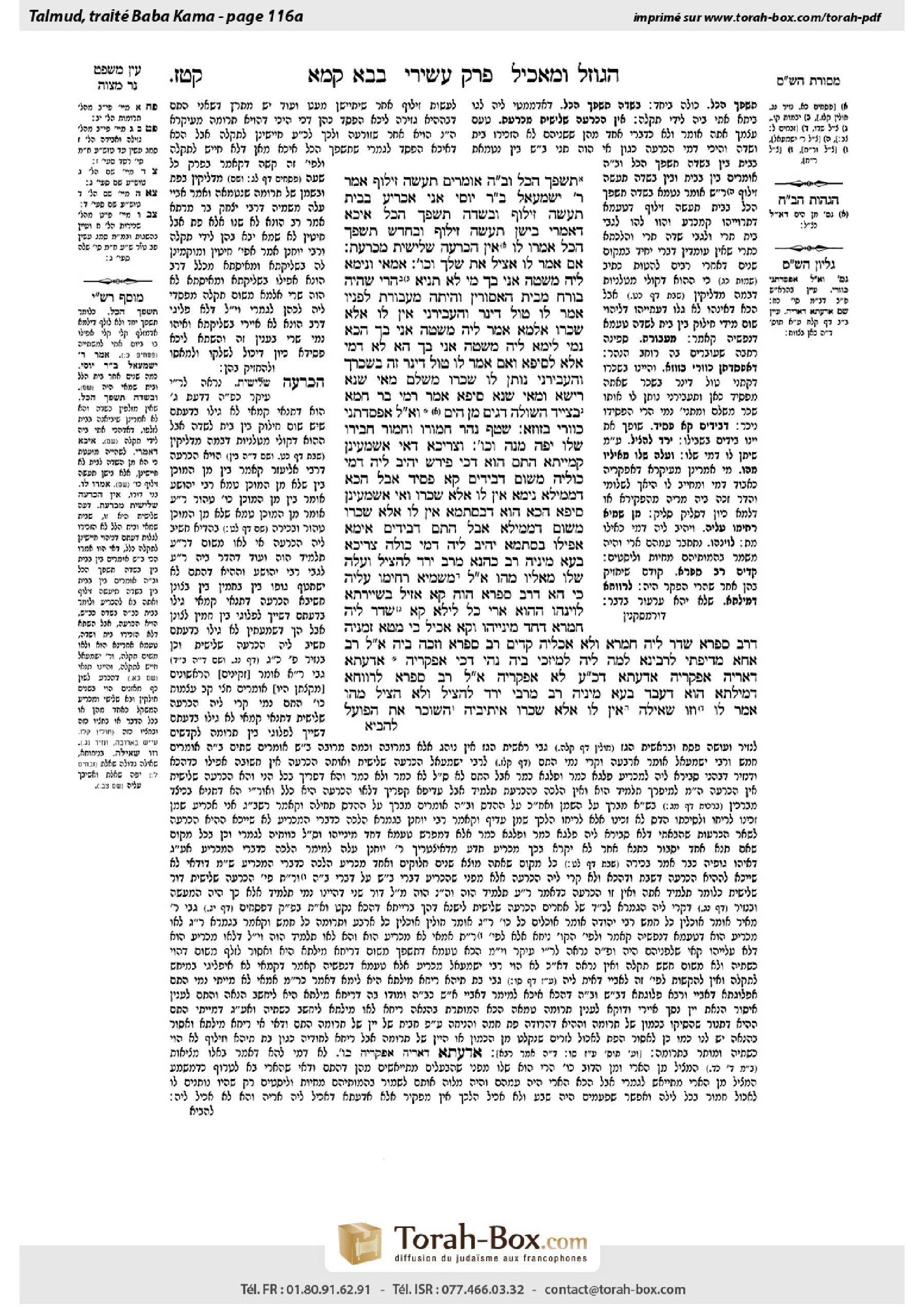
Bava Kamma 116a: Talmud study for Daf Yomi
Study the Talmud for Daf Yomi with scanned pages, Hebrew text, English translations from Sefaria and AI-generated French translations.
Passage selection and English or AI-generated French translation are available where the scan has annotations. Daf Study is independent of Torah-Box and Sefaria.
Browse Bava Kamma · בבא קמא · All tractatesBava Kamma 116a text and translations
This page of Bava Kamma includes the Aramaic text, an English translation and an AI-generated French translation, alongside the scan above.
בבא קמא קי״ו א · Aramaic and Hebrew text
תִּשָּׁפֵךְ הַכֹּל, וּבֵית הִלֵּל אוֹמְרִים: תֵּעָשֶׂה זִילּוּף. אָמַר רַבִּי יִשְׁמָעֵאל בְּרַבִּי יוֹסֵי: אֲנִי אַכְרִיעַ; בַּבַּיִת – תֵּעָשֶׂה זִילּוּף, וּבַשָּׂדֶה – תִּשָּׁפֵךְ הַכֹּל.
אִיכָּא דְּאָמְרִי: בְּיָשָׁן – תֵּעָשֶׂה זִילּוּף, וּבְחָדָשׁ – תִּשָּׁפֵךְ הַכֹּל. אָמְרוּ לוֹ: אֵין הַכְרָעָה שְׁלִישִׁית מַכְרַעַת.
אִם אָמַר לוֹ: ״אַצִּיל אֶת שֶׁלְּךָ וְכוּ׳״. אַמַּאי? וְנֵימָא לֵיהּ: ״מְשַׁטֶּה אֲנִי בָּךְ״!
מִי לָא תַּנְיָא: הֲרֵי שֶׁהָיָה בּוֹרֵחַ מִבֵּית הָאֲסוּרִין וְהָיְתָה מַעְבּוֹרֶת לְפָנָיו, אָמַר לוֹ: ״טוֹל דִּינָר, וְהַעֲבִירֵנִי״ – אֵין לוֹ אֶלָּא שְׂכָרוֹ. אַלְמָא אָמַר לֵיהּ: ״מְשַׁטֶּה אֲנִי בָּךְ״; הָכָא נָמֵי, לֵימָא לֵיהּ: ״מְשַׁטֶּה אֲנִי בָּךְ״!
הָא לָא דָּמֵי אֶלָּא לְסֵיפָא – וְאִם אָמַר לוֹ: ״טוֹל דִּינָר זֶה בִּשְׂכָרְךָ, וְהַעֲבִירֵנִי״ – נוֹתֵן לוֹ שְׂכָרוֹ מִשָּׁלֵם.
מַאי שְׁנָא רֵישָׁא וּמַאי שְׁנָא סֵיפָא? אָמַר רָמֵי בַּר חָמָא: בְּצַיָּיד הַשּׁוֹלֶה דָּגִים מִן הַיָּם, וְאָמַר לֵיהּ: אַפְסֵדְתַּנִי כְּווֹרֵי בְּזוּזָא.
שָׁטַף נָהָר חֲמוֹרוֹ וַחֲמוֹר חֲבֵירוֹ, שֶׁלּוֹ יָפֶה מָנֶה וְכוּ׳. וּצְרִיכָא; דְּאִי אַשְׁמְעִינַן קַמַּיְיתָא, הָתָם הוּא דְּכִי פֵּירֵשׁ יָהֵיב לֵיהּ דְּמֵי כּוּלֵּיהּ, מִשּׁוּם דִּבְיָדַיִם קָא פָסֵיד; אֲבָל הָכָא דְּמִמֵּילָא, נֵימָא: אֵין לוֹ אֶלָּא שְׂכָרוֹ.
וְאִי אַשְׁמְעִינַן סֵיפָא, הָכָא הוּא דְּבִסְתָמָא אֵין לוֹ אֶלָּא שְׂכָרוֹ, מִשּׁוּם דְּמִמֵּילָא; אֲבָל הָתָם, דִּבְיָדַיִם, אֵימָא אֲפִילּוּ בִּסְתָמָא יָהֵיב לֵיהּ דְּמֵי כּוּלֵּהּ; צְרִיכָא.
בְּעָא מִינֵּיהּ רַב כָּהֲנָא מֵרַב: יָרַד לְהַצִּיל, וְעָלָה שֶׁלּוֹ מֵאֵלָיו, מַהוּ? אֲמַר לֵיהּ: מִשְּׁמַיָּא רְחִימוּ עֲלֵיהּ.
כִּי הָא דְּרַב סָפְרָא הֲוָה קָא אָזֵיל בִּשְׁיָירְתָּא, לַוִּינְהוּ הָהוּא אֲרִי. כֹּל לֵילְיָא קָא (שַׁדַּר) [שָׁדוּ] לֵיהּ חֲמָרָא דְּחַד מִינַּיְיהוּ, וְקָא אָכֵיל. כִּי מְטָא זִמְנֵיהּ דְּרַב סָפְרָא, (שַׁדַּר) [שְׁדָא] לֵיהּ חֲמָרֵאּ וְלָא אַכְלֵיהּ. קְדֵים רַב סָפְרָא וּזְכָה בֵּיהּ.
אֲמַר לֵיהּ רַב אַחָא מִדִּיפְתִּי לְרָבִינָא: לְמָה לֵיהּ לְמִיזְכֵּי בֵּיהּ? נְהִי דְּכִי אַפְקְרֵיהּ – אַדַּעְתָּא דְאַרְיָה אַפְקְרֵיהּ, אַדַּעְתָּא דְּכוּלֵּי עָלְמָא לָא אַפְקְרֵיהּ! אֲמַר לֵיהּ: רַב סָפְרָא לְרַוְוחָא דְמִילְּתָא הוּא דַּעֲבַד.
בְּעָא מִינֵּיהּ רַב מֵרַבִּי: יָרַד לְהַצִּיל וְלֹא הִצִּיל, מַהוּ? אָמַר לוֹ: וְזוֹ שְׁאֵילָה, אֵין לוֹ אֶלָּא שְׂכָרוֹ.
אֵיתִיבֵיהּ: הַשּׂוֹכֵר אֶת הַפּוֹעֵל
Bava Kamma 116a · English translation
The wine must all be poured out in order to prevent a possible mishap. And Beit Hillel say: Let the wine be used for sprinkling. Rabbi Yishmael, son of Rabbi Yosei, said: I will decide the halakha by proposing an intermediate opinion: If the wine became impure in a house, it may be used for sprinkling, as it can be used immediately, but if it became impure in the field, it must all be poured out, as it is possible that by the time it is brought to the house and used for sprinkling, someone may drink it.
There are those who say that he decided the halakha as follows: With regard to aged wine, it may be used for sprinkling, as it is fit to be sprinkled immediately, but with regard to new wine, which does not yet have a pleasant aroma, it must all be poured out in order to prevent a possible mishap. They said to Rabbi Yishmael, son of Rabbi Yosei: A decision by a third party does not conclusively decide the halakha.
§ The mishna teaches that if the owner of the wine said to the owner of the honey: I will salvage your honey and you will pay me the value of my wine, the owner of the honey is obligated to give him compensation for the wine. The Gemara asks: Why is the stipulation binding? Let the owner of the honey say to him: I was merely fooling with you when I accepted your condition, and I did not agree to it at all.
Isn’t it taught in a baraita: In a case where one was fleeing from prison and there was a ferry before him, and he said to the ferryman: Take this entire dinar and take me across the river, the ferryman has the right to collect only his usual wage, but not the entire dinar. Apparently, the prisoner could have said to him: I was merely fooling with you and never intended to pay you a full dinar. Here also, let the owner of the honey say to the owner of the wine: I was merely fooling with you.
The Gemara answers: This case in the mishna is not comparable to the case cited above; rather, it is comparable to the latter clause of that same baraita, which states: And if he said to the ferryman: Take this dinar as your wage and take me across the river, the prisoner must give him his wage in the full amount, i.e., the entire dinar.
What is different in the first clause, which states that the ferryman receives only his regular wage, and what is different in the latter clause, which states that he receives the full dinar? Rami bar Ḥama said: The latter clause deals with a trapper who scoops fish from the sea, i.e., a fisherman, and he can say to the prisoner: You have caused me a loss of fish [kavrei] worth a dinar, which I would have caught had I not taken you across the river. Similarly, in the case in the mishna, the owner of the wine sustains a financial loss in order to save the honey, and therefore he is entitled to the compensation that the owner of the honey agreed to pay.
§ The mishna teaches: If a river washed away his donkey and the donkey of the other man, and his donkey is worth one hundred dinars, etc. The Gemara notes: And it is necessary to teach both the case of the barrels of wine and honey and the case of the donkeys, as if it had taught us only the first case, that of the wine and honey, it might be said that it is only there, in that case, that when the owner of the wine states his stipulation, the owner of the honey gives him the value of the entire loss. Why is this? It is because the wine is lost through the direct action of its owner. But here, in the case of the donkeys, since the donkey is lost by itself in the river, let us say: The one who salvages the donkey of his fellow has the right to only his wage, i.e., compensation for his labor.
And if the mishna had taught us only the case of the latter clause, it might be said: It is here, in the case of the donkeys, that if the intention of the one who saved the donkey was unspecified, i.e., he did not stipulate that the owner of the other donkey would compensate him for the loss of his own donkey, he has the right to only his wage, because the donkey is lost by itself. But there, where the barrel of wine is lost through the direct action of its owner, one might say: Even in a case where the intention of the owner of the wine was unspecified, the owner of the honey must give him the value of the entire barrel of wine. The Gemara concludes: Indeed, both cases are necessary.
The Gemara cites a relevant discussion. Rav Kahana raised a dilemma before Rav: If one descended into the river to rescue another’s donkey instead of his own after stipulating that he would be compensated for the loss of his own donkey, and his own donkey emerged from the river by itself, what is the halakha? Is the rescuer still entitled to payment from the owner of the donkey that he saved, despite the fact that he did not suffer a monetary loss? Rav said to him: The rescuer is still compensated because it was from Heaven that mercy was bestowed upon him, and his good fortune does not affect the stipulation.
This is like that case where Rav Safra was traveling in a caravan, and a certain lion followed them, accompanying them along the way. Every night, the travelers would send one of their donkeys to the lion, and the lion would eat it. When Rav Safra’s time arrived to provide the lion with prey, he sent it his donkey but the lion did not eat it. Rav Safra went ahead and acquired it back, as his donkey had become ownerless when he presented it to the lion. Although Rav Safra did not lose his donkey, he had fulfilled his obligation to provide the lion with a donkey, and his good fortune did not affect his obligation vis-à-vis the other travelers.
With regard to this episode, Rav Aḥa of Difti said to Ravina: Why was it necessary for him to acquire the donkey again? Although Rav Safra made it ownerless by sending it to the lion, it was made ownerless only with the intention that the lion would consume it, but it was not made ownerless with the intention that everyone else could acquire it. Accordingly, no one else could have acquired the donkey. Ravina said to him: Rav Safra did so as an added precaution.
Rav raised a dilemma before Rabbi Yehuda HaNasi: If one descended into the river in order to rescue another’s donkey instead of his own, but he did not manage to rescue it, what is the halakha? Does the stipulation still apply so that the owner of the donkey he attempted to rescue must compensate him for the loss of his own donkey? Rabbi Yehuda HaNasi said to him: And is this a question? It is clear that he has the right to collect only his wage, but he is not entitled to the value of his own donkey.
Rav raised an objection to Rabbi Yehuda HaNasi’s ruling from a baraita: In a case of one who hires a laborer
Bava Kamma 116a · Traduction française (IA)
Le vin doit être versé entièrement afin d'éviter tout incident possible. Beit Hillel disent : Utilisez le vin pour l'aspersion. Rabbi Yishmael, fils de Rabbi Yosei, dit : Je déciderai la halakha en proposant une opinion intermédiaire : Si le vin est devenu impur dans une maison, il peut être utilisé pour l'aspersion, car il peut être utilisé immédiatement, mais si le vin est devenu impur dans le champ, il doit être versé entièrement, car il est possible que lorsqu'on l'amène à la maison et qu'on l'utilise pour l'aspersion, quelqu'un boive le vin.
Certains disent qu'il a décidé la halakha ainsi : En ce qui concerne le vin âgé, il peut être utilisé pour l'aspersion, car il est propre à l'aspersion immédiatement, mais en ce qui concerne le vin nouveau, qui n'a pas encore un parfum agréable, il doit être versé entièrement afin d'éviter tout incident possible. On a dit à Rabbi Yishmael, fils de Rabbi Yosei : Une décision par un tiers ne détermine pas de manière définitive la halakha.
§ La mitsva enseigne que si l'propriétaire du vin a dit à l'propriétaire du miel : Je sauverai ton miel et tu me paieras la valeur de mon vin, l'propriétaire du miel est tenu de lui donner une compensation pour le vin. La Guemara demande : Pourquoi cette stipulation est-elle contraignante ? L'propriétaire du miel pourrait dire à lui : J'étais simplement en train de plaisanter quand j'ai accepté votre condition, et je n'ai pas vraiment accepté cela.
Ne serait-ce pas enseigné dans une baraïta : Dans un cas où l'on fuyait d'une prison et qu'il y avait un bateau devant lui, et qu'il a dit au batelier : Prends cette dinar entier et emmène-moi à travers le fleuve, le batelier a le droit de recevoir seulement son salaire habituel, mais pas la dinar entier. Apparemment, le prisonnier aurait pu dire au batelier : J'étais simplement en train de plaisanter avec toi et je n'avais pas l'intention de te payer un dinar entier. Ici aussi, laissez l'propriétaire du miel dire à l'propriétaire du vin : J'étais simplement en train de plaisanter avec toi.
La Guemara répond : Ce cas dans la mitsna n'est pas comparable à celui cité ci-dessus ; plutôt, il est comparable à la seconde partie de cette même baraïta, qui stipule : Et s'il a dit au batelier : Prends cette dinar comme rémunération et emmène-moi à travers le fleuve, le prisonnier doit lui donner sa rémunération en totalité, c'est-à-dire la dinar entier.
Qu'est-ce qui diffère dans la première partie, qui stipule que le batelier reçoit seulement son salaire habituel, et qu'est-ce qui diffère dans la seconde partie, qui stipule qu'il reçoit la dinar entier ? Rami bar Ḥama a dit : La seconde partie traite d'un pêcheur qui ramasse des poissons de la mer, c'est-à-dire un pêcheur, et il peut dire au prisonnier : Tu as causé une perte de poissons [kavrei] d'une dinar, que j'aurais attrapé si je n'avais pas pris toi à travers le fleuve. De même, dans le cas de la mitsna, l'propriétaire du vin subit une perte financière afin de sauver le miel, et donc il est dû à la compensation que l'propriétaire du miel a accepté de payer.
§ La mitsva enseigne : Si un fleuve a emporté son âne et l'âne de l'autre homme, et son âne vaut cent dinars, etc. La Guemara note : Il est nécessaire d'enseigner à la fois le cas des barils de vin et de miel et le cas des ânes, car si elle nous avait enseigné seulement le premier cas, celui du vin et du miel, on pourrait dire que c'est seulement là, dans ce cas, que lorsque l'owner du vin formule sa stipulation, l'owner du miel lui donne la valeur de la perte totale. Pourquoi ? C'est parce que le vin est perdu par l'action directe de son propriétaire. Mais ici, dans le cas des ânes, puisque l'âne est perdu par lui-même dans le fleuve, disons : Celui qui sauve l'âne de son voisin a le droit seulement à sa rémunération, c'est-à-dire une compensation pour son travail.
Et si la mitsva nous avait enseigné seulement le cas de la seconde partie, on pourrait dire : C'est ici, dans le cas des ânes, que si l'intention de celui qui a sauvé l'âne n'était pas spécifiée, c'est-à-dire s'il n'avait pas stipulé que l'owner de l'autre âne lui paie la perte de son propre âne, il a le droit seulement à sa rémunération, car l'âne est perdu par lui-même. Mais là, dans le cas des barils de vin, puisque le vin est perdu par l'action directe de son propriétaire, on pourrait dire : Même dans un cas où l'intention de l'owner du vin n'était pas spécifiée, l'owner du miel doit lui donner la valeur du baril de vin entier. La Guemara conclut : En effet, les deux cas sont nécessaires.
La Guemara cite une discussion pertinente. Rav Kahana a soulevé un dilemme devant Rav : Si l'on descendait dans le fleuve pour sauver l'âne d'un autre plutôt que le sien après avoir stipulé qu'on serait récompensé pour la perte de son propre âne, et que son propre âne sortait du fleuve par lui-même, quelle est la halakha ? Le sauveteur est-il encore dû à la compensation de l'propriétaire de l'âne qu'il a sauvé, malgré le fait qu'il n'ait pas subi une perte financière ? Rav a dit à lui : Le sauveteur est toujours récompensé car c'est de la miséricorde du Ciel qui a été accordée à lui, et sa bonne fortune n'affecte pas la stipulation.
C'est comme ce cas où Rav Safra voyageait dans une caravane, et un lion suivait les voyageurs, les accompagnant tout le long du chemin. Chaque nuit, les voyageurs envoyaient un de leurs ânes au lion, et le lion le mangeait. Lorsque le tour de Rav Safra est arrivé pour fournir une proie au lion, il a envoyé son âne mais le lion ne l'a pas mangé. Rav Safra est allé devant et l'a racheté, car son âne avait devenu sans propriétaire lorsqu'il l'avait présenté au lion. Bien que Rav Safra n'ait pas perdu son âne, il avait accompli son obligation de fournir un âne au lion, et sa bonne fortune n'affectait pas son obligation vis-à-vis des autres voyageurs.
En ce qui concerne cet épisode, Rav Aḥa de Difti a dit à Ravina : Pourquoi était-il nécessaire qu'il rachète l'âne à nouveau ? Bien que Rav Safra l'ait rendu sans propriétaire en l'envoyant au lion, il a été rendu sans propriétaire uniquement avec l'intention que le lion le consume, mais pas avec l'intention que tout le monde puisse l'acquérir. Ainsi, personne d'autre ne pouvait l'acquérir. Ravina a dit à lui : Rav Safra l'a fait comme mesure de précaution supplémentaire.
Rav posa une question à Rabbi Yehuda HaNasi : Si une personne descend dans le fleuve pour sauver un âne appartenant à un autre plutôt que le sien, mais qu'elle n'arrive pas à le sauver, quelle est la halakha ? La stipulation est-elle encore valable de sorte que l'propriétaire de l'âne qu'elle a tenté de sauver doive la compenser pour la perte de son propre âne ? Rabbi Yehuda HaNasi lui répondit : Et c'est une question ? Il est clair qu'elle a le droit de récupérer uniquement sa rémunération, mais elle n'est pas autorisée à prétendre la valeur de son propre âne.
Rav souleva un objection contre la décision de Rabbi Yehuda HaNasi, à partir d'une baraïta : Dans le cas d'une personne qui embauche un ouvrier
Traduction française générée par IA à partir de l’édition anglaise de Sefaria. Vérifie toujours un passage avec le texte source.
Text from Sefaria: William Davidson Edition - Vocalized Aramaic (CC BY NC); William Davidson Edition - English (CC BY NC).