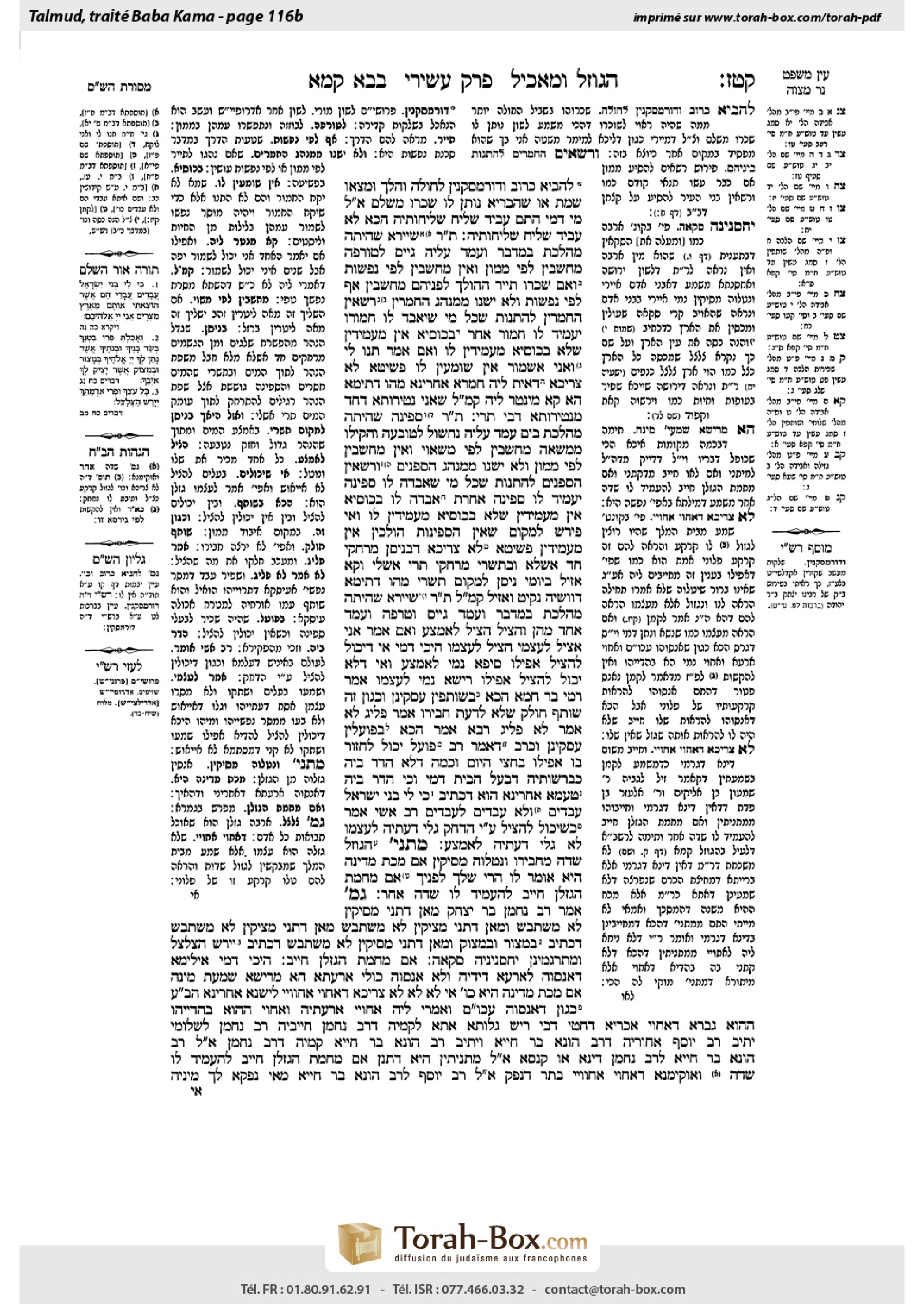
Bava Kamma 116b: Talmud study for Daf Yomi
Study the Talmud for Daf Yomi with scanned pages, Hebrew text, English translations from Sefaria and AI-generated French translations.
Passage selection and English or AI-generated French translation are available where the scan has annotations. Daf Study is independent of Torah-Box and Sefaria.
Browse Bava Kamma · בבא קמא · All tractatesBava Kamma 116b text and translations
This page of Bava Kamma includes the Aramaic text, an English translation and an AI-generated French translation, alongside the scan above.
בבא קמא קי״ו ב · Aramaic and Hebrew text
לְהָבִיא כְּרוּב וְדוּרְמַסְקָנִין לַחוֹלֶה, וְהָלַךְ וּמְצָאוֹ שֶׁמֵּת אוֹ שֶׁהִבְרִיא – נוֹתֵן לוֹ שְׂכָרוֹ מִשָּׁלֵם!
אֲמַר לֵיהּ: מִי דָּמֵי?! הָתָם עָבֵיד שָׁלִיחַ שְׁלִיחוּתֵיהּ, הָכָא לָא עָבֵיד שָׁלִיחַ שְׁלִיחוּתֵיהּ.
תָּנוּ רַבָּנַן: שְׁיָירָא שֶׁהָיְתָה מְהַלֶּכֶת בַּמִּדְבָּר, וְעָמַד עָלֶיהָ גַּיִיס לְטוֹרְפָהּ – מְחַשְּׁבִין לְפִי מָמוֹן, וְאֵין מְחַשְּׁבִין לְפִי נְפָשׁוֹת.
וְאִם שָׂכְרוּ תַּיָּיר הַהוֹלֵךְ לִפְנֵיהֶם – מְחַשְּׁבִין אַף לְפִי נְפָשׁוֹת; וְלֹא יְשַׁנּוּ מִמִּנְהַג הַחַמָּרִין.
רַשָּׁאִין הַחַמָּרִין לְהַתְנוֹת שֶׁכׇּל מִי שֶׁיֹּאבַד לוֹ חֲמוֹרוֹ נַעֲמִיד לוֹ חֲמוֹר אַחֵר. בְּכוּסְיָא – אֵין מַעֲמִידִין, שֶׁלֹּא בְּכוּסְיָא – מַעֲמִידִין לוֹ. וְאִם אָמַר: ״תְּנוּ לִי, וַאֲנִי אֶשְׁמוֹר״ – אֵין שׁוֹמְעִין לוֹ.
פְּשִׁיטָא! לָא צְרִיכָא, דְּאִית לֵיהּ חֲמָרָא אַחֲרִינָא. מַהוּ דְּתֵימָא: הָא קָא מְינַטַּר לֵיהּ; קָא מַשְׁמַע לַן – שָׁאנֵי נְטִירוּתָא דְחַד מִנְּטִירוּתָא דְבֵי תְרֵי.
תָּנוּ רַבָּנַן: סְפִינָה שֶׁהָיְתָה מְהַלֶּכֶת בַּיָּם; עָמַד עָלֶיהָ נַחְשׁוֹל לְטוֹבְעָהּ, וְהֵקֵילּוּ מִמַּשָּׂאָהּ – מְחַשְּׁבִין לְפִי מַשּׂאוֹי, וְאֵין מְחַשְּׁבִין לְפִי מָמוֹן; וְלֹא יְשַׁנּוּ מִמִּנְהַג הַסַּפָּנִים.
וְרַשָּׁאִין הַסַּפָּנִים לְהַתְנוֹת, שֶׁכׇּל מִי שֶׁאָבְדָה לוֹ סְפִינָה נַעֲמִיד לוֹ סְפִינָה אַחֶרֶת. אָבְדָה לוֹ בְּכוּסְיָא – אֵין מַעֲמִידִין, שֶׁלֹּא בְּכוּסְיָא – מַעֲמִידִין לוֹ. וְאִי פֵּירַשׁ לְמָקוֹם שֶׁאֵין הַסְּפִינוֹת הוֹלְכִין – אֵין מַעֲמִידִין.
פְּשִׁיטָא! לָא צְרִיכָא, דִּבְנִיסָן מְרַחֲקִי חַד אַשְׁלָא, וּבְתִשְׁרִי מְרַחֲקִי תְּרֵי אַשְׁלֵי, וְקָא אָזֵיל בְּיוֹמֵי נִיסָן לִמְקוֹם תִּשְׁרֵי; מַהוּ דְּתֵימָא: דַּוְושֵׁיהּ נָקֵיט וְאָזֵיל, קָא מַשְׁמַע לַן.
תָּנוּ רַבָּנַן: שְׁיָירָא שֶׁהָיְתָה מְהַלֶּכֶת בַּמִּדְבָּר וְעָמַד גַּיִיס וּטְרָפָהּ, וְעָמַד אֶחָד מֵהֶן וְהִצִּיל – הִצִּיל לָאֶמְצַע. וְאִם אָמַר: ״אֲנִי אַצִּיל לְעַצְמִי״ – הִצִּיל לְעַצְמוֹ.
הֵיכִי דָמֵי? אִי דְּיָכוֹל לְהַצִּיל, אֲפִילּוּ סֵיפָא נָמֵי לָאֶמְצַע! וְאִי דְּלֹא יָכוֹל לְהַצִּיל, אֲפִילּוּ רֵישָׁא נָמֵי לְעַצְמוֹ!
אָמַר רָמֵי בַּר חָמָא: הָכָא בְּשׁוּתָּפִין עָסְקִינַן, וּכְגוֹן זֶה – שׁוּתָּף חוֹלֵק שֶׁלֹּא לְדַעַת חֲבֵירוֹ; אֲמַר – פָּלֵיג, לָא אֲמַר – לָא פָּלֵיג.
רָבָא אָמַר: הָכָא בְּפוֹעֲלִין עָסְקִינַן, וּכְרַב – דְּאָמַר רַב: פּוֹעֵל יָכוֹל לַחֲזוֹר בּוֹ אֲפִילּוּ בַּחֲצִי הַיּוֹם.
וְכַמָּה דְּלָא הֲדַר בֵּיהּ – כְּבִרְשׁוּתֵיהּ דְּבַעַל הַבַּיִת דָּמֵי, וְכִי הָדַר בֵּיהּ – טַעְמָא אַחֲרִינָא הוּא, דִּכְתִיב: ״כִּי לִי בְנֵי יִשְׂרָאֵל עֲבָדִים״ – וְלֹא עֲבָדִים לַעֲבָדִים.
רַב אָשֵׁי אָמַר: כְּשֶׁיָּכוֹל לְהַצִּיל עַל יְדֵי הַדְּחָק. גַּלִּי דַּעְתֵּיהּ – לְעַצְמוֹ, לָא גַּלִּי דַּעְתֵּיהּ – לָאֶמְצַע.
מַתְנִי׳ הַגּוֹזֵל שָׂדֶה מֵחֲבֵירוֹ וּנְטָלוּהָ מַסִּיקִין, אִם מַכַּת מְדִינָה הִיא – אוֹמֵר לוֹ: ״הֲרֵי שֶׁלְּךָ לְפָנֶיךָ״; אִם מֵחֲמַת הַגַּזְלָן – חַיָּיב לְהַעֲמִיד לוֹ שָׂדֶה אַחֵר.
גְּמָ׳ אָמַר רַב נַחְמָן בַּר יִצְחָק: מַאן דְּתָנֵי ״מַסִּיקִין״ – לָא מִשְׁתַּבַּשׁ, וּמַאן דְּתָנֵי ״מַצִּיקִין״ – לָא מִשְׁתַּבַּשׁ. מַאן דְּתָנֵי ״מַצִּיקִין״ לָא מִשְׁתַּבַּשׁ, דִּכְתִיב: ״בְּמָצוֹר וּבְמָצוֹק״.
וּמַאן דְּתָנֵי ״מַסִּיקִין״ לָא מִשְׁתַּבַּשׁ, דִּכְתִיב: ״יְיָרֵשׁ הַצְּלָצַל״ – וּמְתַרְגְּמִינַן: יַחְסְנִינֵּיהּ סַקָּאָה.
אִם מֵחֲמַת הַגַּזְלָן – חַיָּיב. הֵיכִי דָמֵי? אִילֵּימָא דְּאַנְסוּהָ לְאַרְעָא דִידֵיהּ וְלָא אֲנַסוּה כּוּלֵּי אַרְעָתָא, הָא מֵרֵישָׁא שָׁמְעַתְּ מִינַּהּ: אִם מַכַּת מְדִינָה הִיא כּוּ׳, אִי לָא – לָא!
לָא צְרִיכָא, דְּאַחְוַי אַחְווֹיֵי. לִישָּׁנָא אַחֲרִינָא: הָכָא בְּמַאי עָסְקִינַן – כְּגוֹן דְּאַנְסוּהּ גּוֹיִים, (וְאָמְרִי) [וְאַחְוִי] לֵיהּ אַחְוֹיֵי אַרְעָתֵיהּ, וְאַחְוִי הָהִוא בַּהֲדַיְיהוּ.
הָהוּא גַּבְרָא דְּאַחְוִי אַכַּרְיָא דְחִטֵּי דְּבֵי רֵישׁ גָּלוּתָא. אֲתָא לְקַמֵּיהּ דְּרַב נַחְמָן, חַיְּיבֵיהּ רַב נַחְמָן לְשַׁלּוֹמֵי. יָתֵיב רַב יוֹסֵף אֲחוֹרֵיהּ דְּרַב הוּנָא בַּר חִיָּיא, וְיָתֵיב רַב הוּנָא בַּר חִיָּיא קַמֵּיהּ דְּרַב נַחְמָן, אֲמַר לֵיהּ רַב הוּנָא בַּר חִיָּיא לְרַב נַחְמָן: דִּינָא אוֹ קְנָסָא?
אֲמַר לֵיהּ: מַתְנִיתִין הִיא, דִּתְנַן: אִם מֵחֲמַת הַגַּזְלָן – חַיָּיב לְהַעֲמִיד לוֹ שָׂדֶה; וְאוֹקִימְנָא דְּאַחְוִי אַחְווֹיֵי. בָּתַר דִּנְפַק, אֲמַר לֵיהּ רַב יוֹסֵף לְרַב הוּנָא בַּר חִיָּיא: מַאי נָפְקָא לָךְ מִינֵּיהּ
Bava Kamma 116b · English translation
to bring cabbage and plums to an ill person, and he went and found that the patient had already died or recovered, the employer nevertheless gives the worker his entire wage. Evidently, one is paid for his efforts even if the desired result is not accomplished. Accordingly, the rescuer’s stipulation should apply, and one should be obligated to pay another for attempting to salvage his donkey even if he did not actually succeed in doing so.
Rabbi Yehuda HaNasi said to him: Are those two cases comparable? There, in the case of the ill person, the agent performed his assignment, as he procured and delivered the foods to the ill person, but here, in the case of the donkeys, the agent did not perform his assignment, as he was unable to rescue the animal from the river.
§ Apropos the episode involving Rav Safra, the Gemara discusses the division of expenses among travelers in a caravan. The Sages taught in a baraita: In the case of a caravan that was traveling in the desert and a troop of bandits stood over it in order to attack and pillage it, and the members of the caravan agreed to pay ransom to the bandits, they calculate each traveler’s contribution according to the amount of money he is carrying, and they do not calculate according to the number of souls in the caravan, i.e., the expense is not divided equally among the travelers.
But if they hired a scout who travels in front of them and leads them safely through the desert, the travelers calculate each one’s contribution to paying the scout’s wages even according to the number of souls. And they should not differ from the usual custom of donkey drivers, who often have set procedures for such situations.
The donkey drivers are permitted to stipulate that with regard to anyone whose donkey becomes lost, the caravan will provide him with a different donkey. If the donkey was lost through negligence, they do not provide him with another donkey, but if it was lost not through negligence, they provide him with another donkey. And if the individual whose donkey became lost said: Give me money instead of the donkey and I will guard the caravan along with everyone else, they do not listen to him.
The Gemara asks: Isn’t this obvious? No, it is necessary to teach this for a case where he already has another donkey, lest you say that he will guard the caravan for its sake. Since he still owns one donkey, he never lost his incentive to guard the caravan, and the other drivers should therefore give him money if he wishes. The baraita therefore teaches us that guarding one donkey is different from guarding two donkeys, and the driver will be more likely to guard the caravan properly if they supply him with another donkey.
§ The Gemara cites another baraita that discusses the division of expenses among a group. The Sages taught: In a case of a boat that was traveling on the sea when a gale arose and threatened to sink it, and the sailors lightened its load by throwing some of their belongings overboard, the sailors calculate the amount that each must throw out according to weight, but they do not calculate it according to how much money the items are worth. And they should not differ from the usual custom of sailors.
And if a number of boats are traveling together, the sailors are permitted to stipulate that with regard to anyone whose boat was lost, the others will provide him with a different boat. If his boat was lost through negligence, the other sailors do not provide him with another boat, but if it was lost not through negligence, the sailors provide him with another boat. And if the boat sailed to a place where the boats do not travel, the other sailors do not provide him with a different boat.
The Gemara asks: Isn’t this obvious? The Gemara answers: No, it is necessary because in the month of Nisan, the boats distance themselves from the shore by one rope length, and in the month of Tishrei, they distance themselves by two rope lengths. And in this case, the boat was traveling during Nisan and sailed to the place where boats sail during Tishrei. Lest you say that the sailor is not considered negligent because he is taking his usual route and traveling as he is accustomed to, the baraita teaches us that his actions are considered negligent.
The Sages taught in a baraita: In a case of a caravan that was traveling in the desert and a troop of bandits stood over it and pillaged it, and one of the travelers arose and rescued the caravan from the bandits, he has rescued the property for the common good, i.e., each member of the caravan receives back his property. And if he stated: I will rescue the property from the bandits for myself, then he has effectively rescued the items for himself, and he is now the legal owner of all the property.
The Gemara asks: What are the circumstances of the case? If each member of the caravan is able to rescue his property, then even in the latter clause, where the rescuer states that he is saving the property for himself, the halakha should also be that the possessions are rescued for the common good, as the other members of the caravan did not despair of retrieving their property. And if each member of the caravan is unable to rescue his property, they despair of retrieving their property and relinquish ownership of it. Consequently, even in the first clause, the halakha should also be that the possessions are saved for himself, so that he is their legal owner. Why is there a discrepancy between the halakha in the first clause and the halakha in the latter clause?
The Gemara answers: Rami bar Ḥama said: Here, in the case of the baraita, we are dealing with a caravan whose members are partners and jointly own the confiscated property, and in a case such as this, a partner may divide the property without the other partner’s consent. Therefore, if he said that he intends to save the property for himself, he has dissolved the partnership and divided the property so that if he is able to rescue only some of the property, the property he rescues is his share of the joint property. If he did not say that he intends to save the property for himself, he has not divided the property, and whatever he rescues is jointly owned by the partners.
Rava stated a different answer: Here, in the baraita, we are dealing with laborers who were hired to protect the caravan, and one of these guards saved the travelers’ property. And it is in accordance with the opinion of Rav, as Rav says: A laborer may retract his commitment to his employer even in the middle of the day.
The Gemara explains: As long as he did not retract his commitment, he is considered to be under the jurisdiction of the employer, so that anything he saves automatically belongs to the employer. And when he retracts his commitment, it is for a different reason that he is able to do so, as it is written: “For unto Me the children of Israel are servants” (Leviticus 25:55), indicating that Jews are servants of God, but not servants of servants, i.e., of other Jews. Consequently, it is permitted for a laborer to conclude his term of employment whenever he wants. Once he does so, if he saves property that the members of the caravan are unable to rescue, the property belongs to him.
Rav Ashi stated another answer: The baraita is discussing a case where the other members of the caravan are able to rescue the property with difficulty. Therefore, if he revealed his intention to rescue the property for himself and the other travelers did not protest, it is clear that they have despaired of recovering their property, and the rescuer has secured the property for himself. If he did not reveal his intention to rescue the property for himself, the status quo remains and the property has been rescued for the common good.
MISHNA: In a case of one who robs a field from another and thugs [massikin] subsequently take the field from the robber, the halakha is dependent upon the circumstances: If it is a regional disaster in which the thugs seize all the property in the region, the robber says to the owner of the field: That which is yours is before you, i.e., it is your prerogative to try to reclaim it from the thugs. No compensation is required since the thugs would have seized the property in any event. But if the thugs took that field alone due to the robber, the robber is obligated to provide the owner with a different field.
GEMARA: Rav Naḥman bar Yitzḥak said: One who teaches the mishna using the term massikin does not err, and one who teaches the mishna using the term matzikin also does not err, as both terms may be used to refer to thugs. One who teaches the mishna using the term matzikin does not err, as it is written: “In the siege and in the distress [matzok] with which your enemies shall distress you” (Deuteronomy 28:55). Consequently, matzikin are individuals who cause distress to others.
And one who teaches the mishna using the term massikin does not err, as it is written: “All your trees and the fruit of your land shall the locust consume” (Deuteronomy 28:42), and, in the standard Aramaic translation, we translate this phrase as: Shall the locust [sakke’a] consume. Consequently, massikin are those who consume the property of others.
§ The mishna teaches: If the thugs took the field due to the robber, the robber is obligated to provide the owner with a different field. The Gemara asks: What are the circumstances of the case in the latter clause of the mishna? If we say that they seized only his land, i.e., the robber’s land, and did not seize all the other lands in the region, you already learned this from the first clause of the mishna: If it is a regional disaster in which the thugs seize all the property in the region, the robber is not obligated to compensate the owner of the field, which indicates that if it is not a regional disaster, the robber is not exempt from payment. What novelty does the latter clause teach?
The Gemara explains: No, it is necessary for a case where the individual did not actually take control of the property before it was seized by the thugs, but rather showed the field to the thugs and thereby facilitated their occupation of the field. A different version of this answer is as follows: With what are we dealing here? A case where gentiles coerced someone and told him to show them his land for them to seize, and he showed them that field belonging to another, along with his own fields, and the thugs then seized all the land he showed them.
The Gemara recounts a related incident: There was a certain man who showed piles of wheat, belonging to the Exilarch’s household, to thugs, who seized them. The case came before Rav Naḥman for judgment, and Rav Naḥman deemed that man liable to pay the Exilarch for the stolen wheat. Rav Yosef was sitting behind Rav Huna bar Ḥiyya, and Rav Huna bar Ḥiyya was sitting before Rav Naḥman. Rav Huna bar Ḥiyya said to Rav Naḥman: Did you deem him liable to pay because that is the halakha, or was it a fine?
Rav Naḥman said to him: This individual’s liability is written explicitly in the mishna, i.e., it is the halakha, as we learned in the mishna: If thugs took the field due to the robber, he is obligated to provide the owner with a different field. And it was established that the mishna is referring to a case where an individual showed the field to thugs, who later seized it. So too, in this case, the one who showed the Exilarch’s wheat pile to the thugs is obligated to pay for them. After Rav Naḥman left, Rav Yosef said to Rav Huna bar Ḥiyya: What difference does it make to you
Bava Kamma 116b · Traduction française (IA)
Pour apporter des choux et des mirabelles à une personne malade, et il alla et trouva que le malade était déjà mort ou guéri, l'employeur verse tout de même à l'ouvrier son salaire entier. Évidemment, on est payé pour ses efforts même si le résultat souhaité n'est pas accompli. Ainsi, la stipulation du sauveteur devrait s'appliquer, et on devrait être tenu de payer un autre pour avoir tenté de sauver son âne même s'il n'a pas réussi à le faire.
Rabbi Yehuda HaNasi dit à lui : Ces deux cas sont-ils comparables ? Là, dans le cas de la personne malade, l'agent a accompli sa tâche, car il a obtenu et livré les aliments à la personne malade, mais ici, dans le cas des ânes, l'agent n'a pas accompli sa tâche, car il n'a pas réussi à sauver l'animal du fleuve.
§ À propos de l'incident impliquant Rav Safra, la Guemara discute de la répartition des dépenses parmi les voyageurs d'une caravane. Les Sages enseignent dans une baraïta : Dans le cas d'une caravane voyageant dans le désert et d'une bande de brigands se tenant sur elle pour l'attaquer et la piller, et que les membres de la caravane ont convenu de payer rançon aux brigands, ils calculent la contribution de chaque voyageur selon la quantité d'argent qu'il transporte, et non selon le nombre de personnes dans la caravane, c'est-à-dire que les dépenses ne sont pas divisées de manière égale parmi les voyageurs.
Mais si on a engagé un espion qui voyage en tête et qui conduit les voyageurs en sécurité à travers le désert, les voyageurs calculent la contribution de chacun pour payer les salaires de l'espion, même selon le nombre de personnes. Et ils ne devraient pas différer de la coutume habituelle des conducteurs de mulets, qui ont souvent des procédures définies pour de tels cas.
Les conducteurs de mulets sont autorisés à stipuler que concernant quiconque dont le mulet est perdu, la caravane lui fournira un autre mulet. Si le mulet a été perdu par négligence, ils ne lui fournissent pas un autre mulet, mais si la perte n'a pas été due à la négligence, ils lui fournissent un autre mulet. Et si l'individu dont le mulet est perdu dit : Donnez-moi de l'argent à la place du mulet et je garderai la caravane avec tout le monde, ils ne l'écoutent pas.
La Guemara pose la question : Ce n'est pas évident ? Non, il est nécessaire d'enseigner cela pour un cas où il possède déjà un autre mulet, de peur que l'on dise qu'il gardera la caravane à cause de cela. Puisqu'il possède encore un mulet, il n'a jamais perdu son incitation à garder la caravane, et les autres conducteurs devraient donc lui donner de l'argent s'il le souhaite. La baraïta enseigne donc que garder un mulet est différent de garder deux mulets, et le conducteur sera plus susceptible de garder la caravane correctement s'ils lui fournissent un autre mulet.
§ La Guemara cite une autre baraïta qui discute de la répartition des dépenses parmi un groupe. Les Sages enseignent : Dans le cas d'un bateau voyageant sur la mer lorsque une tempête s'est levée et menaçait de le couler, et que les marins ont allégé sa charge en jetant certains de leurs biens à l'eau, les marins calculent la quantité que chacun doit jeter selon le poids, mais ils ne le calculent pas selon la valeur des objets. Et ils ne devraient pas différer de la coutume habituelle des marins.
Et si plusieurs bateaux voyageaient ensemble, les marins sont autorisés à stipuler que concernant quiconque dont le bateau a été perdu, les autres lui fourniront un autre bateau. Si son bateau a été perdu par négligence, les autres marins ne lui fournissent pas un autre bateau, mais si la perte n'a pas été due à la négligence, les marins lui fourniront un autre bateau. Et si le bateau a navigué vers un lieu où les bateaux ne naviguent pas, les autres marins ne lui fournissent pas un autre bateau.
La Guemara pose la question : Ce n'est pas évident ? La Guemara répond : Non, il est nécessaire car durant le mois de Nisan, les bateaux s'éloignent de la côte d'une longueur de corde, et durant le mois de Tishrei, ils s'éloignent de deux longueurs de corde. Et dans ce cas, le bateau naviguait durant Nisan et a navigué vers le lieu où les bateaux naviguent durant Tishrei. De peur que l'on dise que le marin n'est pas considéré comme négligent car il suit sa route habituelle et navigue comme il l'est habituellement, la baraïta nous enseigne que ses actions sont considérées comme négligentes.
Les Sages enseignent dans une baraïta : Dans le cas d'une caravane voyageant dans le désert et d'une bande de brigands qui se tiennent sur elle et la pillent, et qu'un des voyageurs s'est levé pour sauver la caravane des brigands, il a sauvé la propriété pour le bien commun, c'est-à-dire que chaque membre de la caravane récupère ses biens. Et s'il a déclaré : Je sauverai la propriété des brigands pour moi-même, alors il a effectivement sauvé les objets pour lui-même, et il est désormais le propriétaire légal de toute la propriété.
La Guemara pose la question : Quelles sont les circonstances du cas ? Si chaque membre de la caravane peut sauver ses biens, alors même dans la clause suivante, où le sauveteur déclare qu'il sauve la propriété pour lui-même, la halakha devrait également être que les biens sont sauvés pour le bien commun, car les autres membres de la caravane n'ont pas désespéré de récupérer leurs biens. Et si chaque membre de la caravane ne peut pas sauver ses biens, ils désespèrent de récupérer leurs biens et renoncent à leur propriété. Ainsi, même dans la première clause, la halakha devrait également être que les biens sont sauvés pour lui-même, de sorte qu'il est leur propriétaire légal. Pourquoi y a-t-il une différence entre la halakha dans la première clause et la halakha dans la clause suivante ?
Le Guemara répond : Rami bar Ḥama a dit : Ici, dans le cas de la baraïta, nous sommes en présence d’un convoi dont les membres sont associés et possèdent ensemble la propriété confisquée, et dans un cas tel que celui-ci, un associé peut diviser la propriété sans le consentement de l’autre associé. Ainsi, si il a dit qu’il veut sauvegarder la propriété pour lui-même, il a dissous l’association et divisé la propriété de sorte que si il peut sauver seulement une partie de la propriété, la partie qu’il sauve est sa part de la propriété commune. Si il n’a pas dit qu’il veut sauvegarder la propriété pour lui-même, il n’a pas divisé la propriété, et tout ce qu’il sauve appartient collectivement aux associés.
Rava a donné une autre réponse : Ici, dans la baraïta, nous sommes en présence de travailleurs engagés pour protéger le convoi, et l’un de ces gardes a sauvé la propriété des voyageurs. Et cela est selon l’opinion de Rav, car Rav dit : Un travailleur peut révoquer son engagement envers son employeur même au milieu de la journée.
Le Guemara explique : Tant qu’il n’a pas révoqué son engagement, il est considéré comme sous la juridiction de l’employeur, de sorte que tout ce qu’il sauve appartient automatiquement à l’employeur. Et lorsqu’il révoque son engagement, c’est pour une autre raison qu’il peut le faire, car il est écrit : « Pour Moi les enfants d’Israël sont des serviteurs » (Lévitique 25:55), indiquant que les Juifs sont des serviteurs de Dieu, mais pas des serviteurs de serviteurs, c’est-à-dire d’autres Juifs. Ainsi, il est permis à un travailleur de conclure la durée de son contrat d’emploi à tout moment. Une fois qu’il l’a fait, si il sauve une propriété que les membres du convoi ne peuvent pas sauver, la propriété appartient à lui.
Rav Ashi a donné une autre réponse : La baraïta discute d’un cas où les autres membres du convoi peuvent sauver la propriété avec difficulté. Ainsi, si l'on a révélé son intention de sauver la propriété pour soi-même et les autres voyageurs n'ont pas protesté, c'est clair qu'ils ont désespéré de récupérer leur propriété, et le sauveteur a sécurisé la propriété pour lui-même. Si l'on n'a pas révélé son intention de sauver la propriété pour soi-même, la situation reste inchangée et la propriété a été sauvegardée pour le bien commun.
MICHNA : Dans le cas d’un homme qui vole un champ à un autre et des voyous [massikin] prennent ensuite le champ du voleur, la halakha dépend des circonstances : Si c’est une catastrophe régionale où les voyous s’emparent de toute la propriété de la région, le voleur dit à l’propriétaire du champ : Ce qui est à toi est devant toi, c’est-à-dire que c’est à toi de tenter de le récupérer des voyous. Aucune compensation n’est requise, car les voyous auraient tout de même s’emparé de la propriété. Mais si les voyous ont pris ce champ seul en raison du voleur, le voleur est tenu de fournir à l’propriétaire un autre champ.
GUEMARA : Rav Naḥman bar Yitzḥak a dit : Celui qui enseigne la mishna en utilisant le terme massikin ne s’erreur pas, et celui qui enseigne la mishna en utilisant le terme matzikin ne s’erreur pas non plus, car les deux termes peuvent être utilisés pour désigner des voyous. Celui qui enseigne la mishna en utilisant le terme matzikin ne s’erreur pas, car il est écrit : « Dans la siège et dans la détresse [matzok] avec laquelle vos ennemis vous opprimeront » (Deutéronome 28:55). Ainsi, les matzikin sont des individus qui causent une détresse aux autres.
Et celui qui enseigne la Michna en utilisant le terme massikin ne s’erreur pas, car il est écrit : « Tous vos arbres et la fruits de votre terre seront dévorés par la locuste » (Deutéronome 28:42), et, dans la traduction araméenne standard, nous traduisons cette phrase par : Dévorera la locuste [sakke’a]. Ainsi, les massikin sont ceux qui dévorent la propriété des autres.
§ La Michna enseigne : Si les voyous ont pris le champ en raison du voleur, le voleur est tenu de fournir à l’owner un autre champ. Le Guemara demande : Quelles sont les circonstances du cas dans la dernière partie de la Michna ? Si nous disons qu’ils ont seulement s’emparé de sa terre, c’est-à-dire la terre du voleur, et n’ont pas s’emparé de toutes les autres terres de la région, vous avez déjà appris cela de la première partie de la Michna : Si c’est une catastrophe régionale où les voyous s’emparent de toute la propriété de la région, le voleur n’est pas tenu de compenser l’owner du champ, ce qui indique que si ce n’est pas une catastrophe régionale, le voleur n’est pas exempt de paiement. Quel est le nouveauté enseigné par la dernière partie ?
Le Guemara explique : Non, il est nécessaire d’un cas où l’individu n’a pas réellement pris le contrôle de la propriété avant qu’elle ne soit s’emparée par les voyous, mais plutôt a montré le champ aux voyous et a ainsi facilité leur occupation du champ. Une autre version de cette réponse est la suivante : Avec quels cas sommes-nous en présence ? Un cas où des non-Juifs ont contraint quelqu’un et lui ont demandé de montrer leur terre pour qu’ils s’emparent d’elle, et il a montré ce champ appartenant à un autre, ainsi que ses propres champs, et les voyous ont alors s’emparé de toute la terre qu’il a montré.
Le Guemara rapporte un incident lié : Il y avait un certain homme qui avait montré des tas de blé appartenant à la maison de l’Exilarch aux voyous, qui les avaient s’emparés. Le cas est venu devant Rav Naḥman pour jugement, et Rav Naḥman a estimé que cet homme était tenu de payer l’Exilarch pour le blé volé. Rav Yosef était assis derrière Rav Huna bar Ḥiyya, et Rav Huna bar Ḥiyya était assis devant Rav Naḥman. Rav Huna bar Ḥiyya a dit à Rav Naḥman : As-tu estimé qu’il était tenu de payer parce que c’est la halakha, ou était-ce une amende ?
Rav Naḥman a dit à lui : La responsabilité de cette personne est explicitement écrite dans la mishna, c’est-à-dire que c’est la halakha, car nous avons appris dans la mishna : Si les voyous ont pris le champ en raison du voleur, il est tenu de fournir à l’propriétaire un autre champ. Et il a été établi que la mishna fait référence à un cas où un individu a montré le champ aux voyous, qui ont ensuite s’emparé de celui-ci. De même, dans ce cas, celui qui a montré les tas de blé de l’Exilarch aux voyous est tenu de payer. Après que Rav Naḥman est parti, Rav Yosef a dit à Rav Huna bar Ḥiyya : Quelle différence cela fait-il pour toi ?
Traduction française générée par IA à partir de l’édition anglaise de Sefaria. Vérifie toujours un passage avec le texte source.
Text from Sefaria: William Davidson Edition - Vocalized Aramaic (CC BY NC); William Davidson Edition - English (CC BY NC).