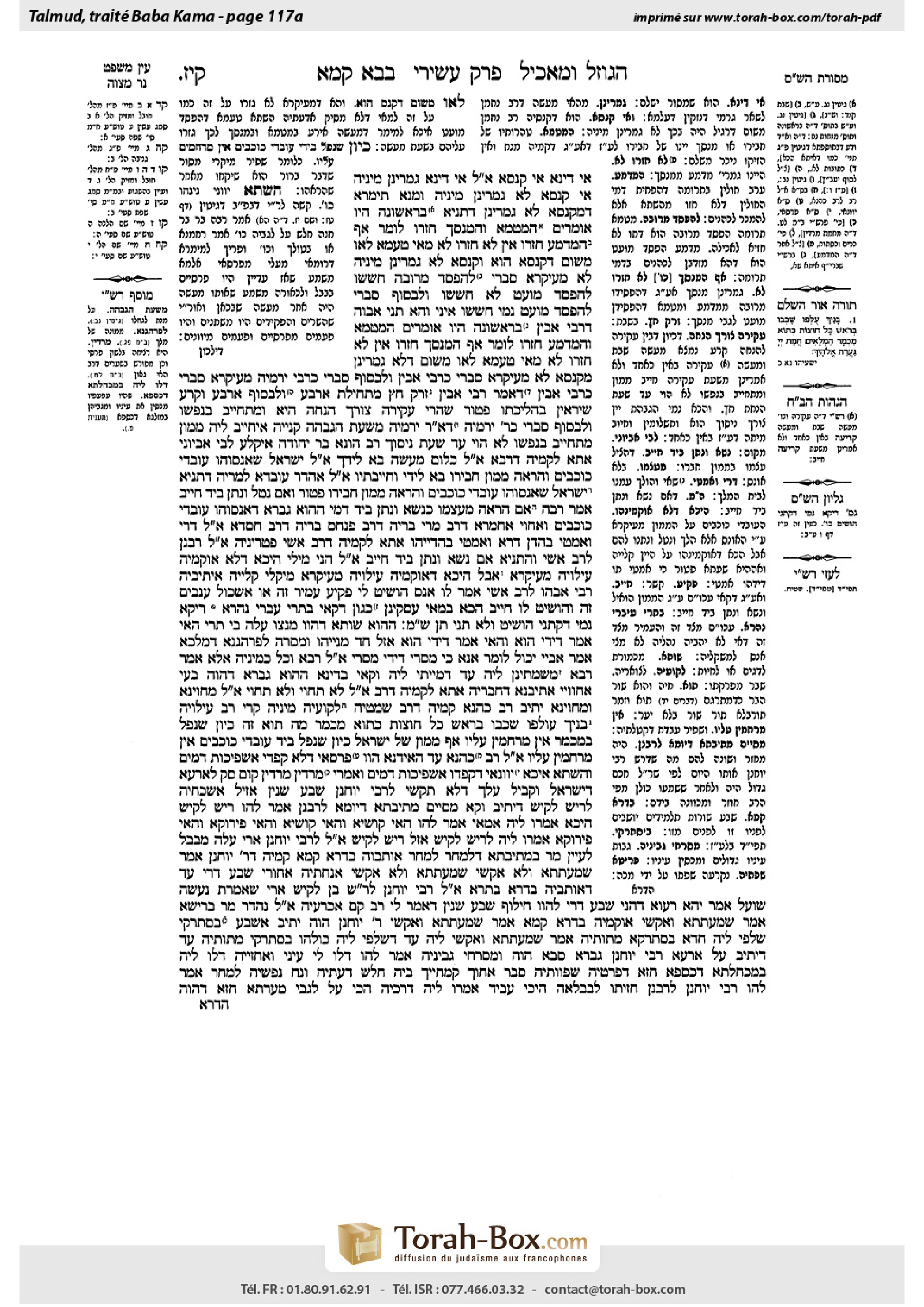
Bava Kamma 117a: Talmud study for Daf Yomi
Study the Talmud for Daf Yomi with scanned pages, Hebrew text, English translations from Sefaria and AI-generated French translations.
Passage selection and English or AI-generated French translation are available where the scan has annotations. Daf Study is independent of Torah-Box and Sefaria.
Browse Bava Kamma · בבא קמא · All tractatesBava Kamma 117a text and translations
This page of Bava Kamma includes the Aramaic text, an English translation and an AI-generated French translation, alongside the scan above.
בבא קמא קי״ז א · Aramaic and Hebrew text
אִי דִּינָא אִי קְנָסָא? אֲמַר לֵיהּ: אִי דִּינָא – גָּמְרִינַן מִינֵּיהּ, אִי קְנָסָא – לָא גָּמְרִינַן מִינֵּיהּ.
וּמְנָא תֵּימְרָא דְּמִקְּנָסָא לָא גָּמְרִינַן? דְּתַנְיָא, בָּרִאשׁוֹנָה הָיוּ אוֹמְרִים: הַמְטַמֵּא וְהַמְנַסֵּךְ; חָזְרוּ לוֹמַר: אַף הַמְדַמֵּעַ.
חָזְרוּ – אִין, לֹא חָזְרוּ – לָא; מַאי טַעְמָא? לָאו מִשּׁוּם דִּקְנָסָא הוּא, וּקְנָסָא לָא גָּמְרִינַן מִינֵּיהּ?
לָא; מֵעִיקָּרָא סָבְרִי: לְהֶפְסֵד מְרוּבֶּה חָשְׁשׁוּ, לְהֶפְסֵד מוּעָט לֹא חָשְׁשׁוּ; וּלְבַסּוֹף סָבְרִי: לְהֶפְסֵד מוּעָט נָמֵי חָשְׁשׁוּ.
אִינִי?! וְהָא תָּנֵי אֲבוּהּ דְּרַבִּי אָבִין, בָּרִאשׁוֹנָה הָיוּ אוֹמְרִים: הַמְטַמֵּא וְהַמְדַמֵּעַ; חָזְרוּ לוֹמַר: אַף הַמְנַסֵּךְ. חָזְרוּ – אִין, לֹא חָזְרוּ – לָא!
מַאי טַעְמָא? לָאו מִשּׁוּם דְּלָא גָּמְרִינַן מִקְּנָסָא?
לָא; מֵעִיקָּרָא סָבְרִי כְּרַבִּי אָבִין, וּלְבַסּוֹף סָבְרִי כְּרַבִּי יִרְמְיָה.
מֵעִיקָּרָא סָבְרִי כְּרַבִּי אָבִין – דְּאָמַר רַבִּי אָבִין: זָרַק חֵץ מִתְּחִילַּת אַרְבַּע לְסוֹף אַרְבַּע, וְקָרַע שִׁירָאִין בַּהֲלִיכָתוֹ – פָּטוּר; שֶׁהֲרֵי עֲקִירָה צוֹרֶךְ הַנָּחָה הִיא, וּמִתְחַיֵּיב בְּנַפְשׁוֹ.
וּלְבַסּוֹף סָבְרִי כְּרַבִּי יִרְמְיָה – דְּאָמַר רַבִּי יִרְמְיָה: מִשְּׁעַת הַגְבָּהָה קַנְיֵיהּ, אִיחַיַּיב לֵיהּ מָמוֹן; מִתְחַיֵּיב בְּנַפְשׁוֹ לָא הָוֵי עַד שְׁעַת נִיסּוּךְ.
רַב הוּנָא בַּר יְהוּדָה אִיקְּלַע לְבֵי אֶבְיוֹנֵי. אֲתָא לְקַמֵּיהּ דְּרָבָא, אֲמַר לֵיהּ: כְּלוּם מַעֲשֶׂה בָּא לִידָךְ? אֲמַר לֵיהּ: יִשְׂרָאֵל שֶׁאֲנָסוּהוּ גּוֹיִם וְהֶרְאָה מָמוֹן חֲבֵירוֹ בָּא לְיָדִי, וְחִיַּיבְתִּיו.
אֲמַר לֵיהּ: אַהְדַּר עוֹבָדָא לְמָרֵיהּ, דְּתַנְיָא: יִשְׂרָאֵל שֶׁאֲנָסוּהוּ גּוֹיִם וְהֶרְאָה מָמוֹן חֲבֵירוֹ – פָּטוּר, וְאִם נָטַל וְנָתַן בַּיָּד – חַיָּיב!
אָמַר רַבָּה: אִם הֶרְאָה מֵעַצְמוֹ, כְּנָשָׂא וְנָתַן בַּיָּד דָּמֵי.
הָהוּא גַּבְרָא דַּאֲנָסוּהוּ גּוֹיִם, וְאַחְוִי אַחַמְרָא דְּרַב מָרִי בְּרֵיהּ דְּרַב פִּנְחָס בְּרֵיהּ דְּרַב חִסְדָּא. אֲמַרוּ לֵיהּ: ״דְּרִי וְאַמְטִי בַּהֲדַן״, דְּרָא וְאַמְטִי בַּהֲדַיְיהוּ. אֲתָא לְקַמֵּיהּ דְּרַב אָשֵׁי, פַּטְרִינֵּיהּ.
אֲמַרוּ לֵיהּ רַבָּנַן לְרַב אָשֵׁי, וְהָתַנְיָא: אִם נָשָׂא וְנָתַן בַּיָּד – חַיָּיב! אֲמַר לְהוּ: הָנֵי מִילֵּי הֵיכָא דְּלָא אוֹקְמֵיהּ עִילָּוֵיהּ מֵעִיקָּרָא, אֲבָל הֵיכָא דְּאוֹקְמֵיהּ עִילָּוֵיהּ מֵעִיקָּרָא – מִיקְלֵי קַלְיֵיהּ.
אֵיתִיבֵיהּ רַבִּי אֲבָהוּ לְרַב אָשֵׁי: אָמַר לוֹ אַנָּס ״הוֹשֵׁיט לִי פְּקִיעַ עָמִיר זֶה, אוֹ אֶשְׁכּוֹל עֲנָבִים זֶה״, וְהוֹשִׁיט לוֹ – חַיָּיב! הָכָא בְּמַאי עָסְקִינַן – כְּגוֹן דְּקָאֵי בִּתְרֵי עֶבְרֵי נַהֲרָא.
דַּיְקָא נָמֵי, דְּקָתָנֵי ״הוֹשֵׁיט״ וְלָא תָּנֵי ״תֵּן״, שְׁמַע מִינַּהּ.
הָהוּא שׁוּתָא דַּהֲווֹ מִנְּצוּ עֲלַהּ בֵּי תְרֵי. הַאי אָמַר: דִּידִי הוּא, וְהַאי אָמַר: דִּידִי הוּא. אֲזַל חַד מִנַּיְיהוּ וּמַסְרַהּ לְפַרְהַגְ[בָּ]נָא דְמַלְכָּא. אָמַר אַבָּיֵי, יָכוֹל לוֹמַר: אֲנָא כִּי מְסַרִי – דִּידִי מְסַרִי. אֲמַר לֵיהּ רָבָא: וְכׇל כְּמִינֵּיהּ?! אֶלָּא אָמַר רָבָא: מְשַׁמְּתִינַן לֵיהּ עַד דְּמַיְיתֵי לֵיהּ וְקָאֵי בְּדִינָא.
הָהוּא גַּבְרָא דַּהֲוָה בָּעֵי אַחְווֹיֵי אַתִּיבְנָא דְחַבְרֵיהּ. אֲתָא לְקַמֵּיהּ דְּרַב, אֲמַר לֵיהּ: ״לָא תַּחְוֵי וְלָא תַּחְוֵי!״ אֲמַר לֵיהּ: ״מַחְוֵינָא וּמַחְוֵינָא!״ יָתֵיב רַב כָּהֲנָא קַמֵּיהּ דְּרַב, שַׁמְטֵיהּ לְקוֹעֵיהּ מִינֵּיהּ.
קָרֵי רַב עִילָּוֵיהּ: ״בָּנַיִךְ עֻלְּפוּ שָׁכְבוּ בְּרֹאשׁ כׇּל חוּצוֹת כְּתוֹא מִכְמָר״; מָה תּוֹא זֶה, כֵּיוָן שֶׁנָּפַל בְּמִכְמָר – אֵין מְרַחֲמִין עָלָיו; אַף מָמוֹן שֶׁל יִשְׂרָאֵל, כֵּיוָן שֶׁנָּפַל בְּיַד גּוֹיִם – אֵין מְרַחֲמִין עָלָיו.
אֲמַר לֵיהּ רַב: ״כָּהֲנָא, עַד הָאִידָּנָא הֲווֹ פָּרְסָאֵי – דְּלָא קָפְדִי אַשְּׁפִיכוּת דָּמִים, וְהַשְׁתָּא אִיכָּא יַוְונָאֵי – דְּקָפְדוּ אַשְּׁפִיכוּת דָּמִים, וְאָמְרִי ׳מַרְדִּין, מַרְדִּין׳. קוּם סַק לְאַרְעָא דְיִשְׂרָאֵל, וְקַבֵּיל עֲלָךְ דְּלָא תַּקְשֵׁי לְרַבִּי יוֹחָנָן שֶׁבַע שְׁנִין״.
אֲזַיל, אַשְׁכְּחֵיהּ לְרֵישׁ לָקִישׁ דְּיָתֵיב וְקָא מְסַיֵּים מְתִיבְתָּא דְיוֹמָא לְרַבָּנַן. אֲמַר לְהוּ: רֵישׁ לָקִישׁ הֵיכָא? אֲמַרוּ לֵיהּ: אַמַּאי? אֲמַר לְהוּ: הַאי קוּשְׁיָא וְהַאי קוּשְׁיָא, וְהַאי פֵּירוּקָא וְהַאי פֵּירוּקָא. אֲמַרוּ לֵיהּ לְרֵישׁ לָקִישׁ. אֲזַל רֵישׁ לָקִישׁ אֲמַר לֵיהּ לְרַבִּי יוֹחָנָן: ״אֲרִי עָלָה מִבָּבֶל, לְעַיֵּין מָר בִּמְתִיבְתָּא דְּלִמְחַר״.
לִמְחַר אוֹתְבוּהּ בְּדָרָא קַמָּא קַמֵּיהּ דְּרַבִּי יוֹחָנָן. אָמַר שְׁמַעְתְּתָא – וְלָא אַקְשִׁי, שְׁמַעְתְּתָא – וְלָא אַקְשִׁי; אַנְחֲתֵיהּ אֲחוֹרֵי שְׁבַע דָּרֵי, עַד דְּאוֹתְבֵיהּ בְּדָרָא בָּתְרָא. אֲמַר לֵיהּ רַבִּי יוֹחָנָן לְרַבִּי שִׁמְעוֹן בֶּן לָקִישׁ: ״אֲרִי שֶׁאָמַרְתָּ – נַעֲשָׂה שׁוּעָל!״
אָמַר: יְהֵא רַעֲוָא דְּהָנֵי שְׁבַע דָּרֵי לִהְווֹ חִילּוּף שְׁבַע שְׁנִין דַּאֲמַר לִי רַב. קָם אַכַּרְעֵיהּ, אֲמַר לֵיהּ: ״נֶהְדַּר מָר בְּרֵישָׁא״. אֲמַר שְׁמַעְתְּתָא, וְאַקְשִׁי. אוֹקְמֵיהּ בְּדָרָא קַמָּא. אָמַר שְׁמַעְתְּתָא, וְאַקְשִׁי.
רַבִּי יוֹחָנָן הֲוָה יָתֵיב אַשְּׁבַע בִּסְתַּרְקֵי, שָׁלְפִי לֵיהּ חֲדָא בִּסְתַּרְקָא מִתּוּתֵיהּ. אֲמַר שְׁמַעְתְּתָא – וְאַקְשִׁי לֵיהּ, עַד דְּשָׁלְפִי לֵיהּ כּוּלְּהוּ בִּסְתַּרְקֵי מִתּוּתֵיהּ, עַד דְּיָתֵיב עַל אַרְעָא. רַבִּי יוֹחָנָן גַּבְרָא סָבָא הֲוָה וּמְסָרְחִי גְּבִינֵיהּ, אֲמַר לְהוּ: דַּלּוֹ לִי עֵינַי וְאֶחְזְיֵיהּ. דַּלּוֹ לֵיהּ בְּמַכְחַלְתָּא דְכַסְפָּא.
חֲזָא דִּפְרִיטָה שִׂפְווֹתֵיהּ, סְבַר אַחוֹכֵי קָמְחַיֵּיךְ בֵּיהּ. חֲלַשׁ דַּעְתֵּיהּ, וְנָח נַפְשֵׁיהּ. לִמְחַר אֲמַר לְהוּ רַבִּי יוֹחָנָן לְרַבָּנַן: חָזֵיתוּ לְבַבְלָאָה הֵיכִי עָבֵיד? אֲמַרוּ לֵיהּ: דַּרְכֵּיהּ הָכִי. עָל לְגַבֵּי מְעָרְתָּא, חֲזָא דַּהֲוָה
Bava Kamma 117a · English translation
if it is the halakha or if it is a fine? Rav Huna bar Ḥiyya said to him: If it is the halakha, we learn from it and apply this ruling to other cases, but if it is a fine, we do not learn from it, as it is possible that Rav Naḥman had a specific reason to impose a fine in this case.
The Gemara asks: And from where do you say that we do not learn from the imposition of a fine in one case and apply the ruling in other cases? The Gemara answers that the source is as it is taught in a baraita: Initially, the Sages would say that one who renders another’s food ritually impure, thereby rendering it unfit for him to consume, and one who pours another’s wine as a libation for idol worship, thereby rendering it an item from which deriving benefit is prohibited, are liable to pay the owner for the financial loss they caused despite the fact that damage is not evident. Subsequently, they added to this list, to say that even one who intermingles teruma, the portion of the produce designated for the priest, with another’s non-sacred produce, thereby rendering the non-sacred food forbidden to non-priests, is liable to compensate the owner for the loss of value of the produce, as fewer people will be willing to buy it from him.
The Gemara comments: It may be inferred from the baraita that it is only because the Sages subsequently added to the list that yes, one who intermingles teruma with another’s non-sacred produce must compensate him. But if they had not subsequently added to the list, he would not be liable. What is the reason that we do not learn that he is liable from the cases of one who renders another’s food impure or pours wine as a libation for idol worship, as this is also a case in which one causes damage that is not evident? Is it not due to the fact that his payment is a fine, and with regard to a fine, we do not learn from one case that it may be imposed in other circumstances?
The Gemara answers: No, this is not the reason. Rather, initially the Sages maintained that they were concerned with regard to a large financial loss, e.g., the cases of one who renders another’s food impure or pours his wine as a libation for idol worship, but with regard to a small financial loss, e.g., one who intermingles teruma with another’s non-sacred produce, they were not concerned. And ultimately the Sages maintained that they were concerned with regard to a small loss as well and imposed liability.
The Gemara asks: Is that so? But didn’t the father of Rabbi Avin teach the baraita as follows: Initially they would say that one who renders another’s produce impure and one who intermingles teruma with another’s non-sacred produce are both liable to pay for the financial loss that they caused, despite the fact that the damage is not evident. Subsequently, they added to this list, to say that even one who pours another’s wine as a libation for idol worship is also liable to pay a fine for the loss that he caused. It may be inferred that it is only because the Sages subsequently added to the list, that yes, one who pours the libation is liable. But if they had not subsequently added to the list, he would not be liable.
The Gemara comments: Since one who offers libations for idol worship causes a large financial loss, the rationale offered previously cannot apply to this version of the baraita. Accordingly, what is the reason that the liability for pouring another’s wine as a libation could not be extrapolated from the fine imposed for rendering another’s food impure or intermingling it with teruma? Is it not due to the fact that we do not learn from the imposition of a fine in one case that a fine may be imposed in other cases?
The Gemara answers: No, this is not the reason. Rather, the reason is that initially the Sages held in accordance with the opinion of Rabbi Avin, and ultimately they held in accordance with the opinion of Rabbi Yirmeya.
The Gemara elaborates: Initially they held in accordance with the opinion of Rabbi Avin, as Rabbi Avin says: If one stood in the public domain on Shabbat and shot an arrow from the beginning of an area measuring four cubits to the end of an area measuring four cubits, and the arrow tore another’s silks [shira’in] in the course of its travel through the air, the one who threw it is exempt from paying for the cloth. The reason for this is that lifting an item is a necessity for placing it elsewhere, and therefore the entire process, from when one shoots the arrow until it comes to a rest, is considered to be a single act. The one performing it is liable to receive the death penalty for violating Shabbat. One who performs a single act for which he is liable to receive the death penalty and is also liable to pay money receives only the death penalty. Similarly, one who pours another’s wine as a libation for idol worship incurs the death penalty, and is therefore exempt from paying for the wine.
And ultimately they held that the liabilities are not incurred simultaneously, in accordance with the opinion of Rabbi Yirmeya, as Rabbi Yirmeya says: From the time of the lifting, the thief acquires the wine and is therefore immediately liable to pay money to the owner. But he is not liable to receive the death penalty until the time that he pours the libation. Once the Sages concluded that the liabilities are not incurred simultaneously, they ruled that one who pours another’s wine as a libation for idol worship is liable to reimburse him.
§ The Gemara returns to the matter of one who showed another’s field to thugs. Rav Huna bar Yehuda happened to come to the town of Bei Abiyonei and came before Rava, who said to him: Did any legal incident come to you for judgment recently? Rav Huna bar Yehuda said to him: There was a case of a Jew whom gentiles coerced and, as a result he showed them property belonging to another, which the gentiles later seized. He came to me for judgment, and I deemed him liable to compensate the owner for the loss.
Rava said to Rav Huna bar Yehuda: Reverse your decision in this case and return the money to its owner, i.e., the thug, as it is taught in a baraita: In the case of a Jew whom gentiles coerced and, as a result he showed them property belonging to another that the gentiles later seized, he is exempt from reimbursing the owner of the property. But if he actively took the property and gave it to the gentiles by his own hand, he is liable to compensate the owner.
The Gemara adds that Rabba says: If he showed the gentiles the property of his own volition, it is as though he actively took the property and gave it to the gentiles by his own hand, and he is liable to compensate the owner.
The Gemara recounts another incident: There was a certain man that gentiles had coerced and so he showed them the wine of Rav Mari, son of Rav Pineḥas, son of Rav Ḥisda, and the gentiles said to him: Carry the wine and bring it with us. Complying with the gentiles, he carried and brought it with them. The case came before Rav Ashi, and he exempted the man from compensating Rav Mari for the wine.
The Rabbis said to Rav Ashi: But isn’t it taught in a baraita: If he took the property and manually transferred it to the gentiles, he is liable to compensate the owner? Rav Ashi said to them: That statement applies only in a case where the Jew did not bring the gentiles to the property at the outset; but if he brought the gentiles to the property at the outset, it is as though he already burned it, as the gentiles then had access to the property. Since the damage inflicted by the Jew was committed by merely showing the wine to the gentiles, he is exempt from payment even though he later actively carried the wine with his hands.
Rabbi Abbahu raised an objection to the opinion of Rav Ashi from a baraita: In a case where a ruffian said to a Jew: Pass me this bundle of grain, or this cluster of grapes, and the Jew passed it to him, the Jew is liable to pay the owner of the grain or the grapes. Since the ruffian was already present, it is evident from this baraita that one who hands over another’s property to a third party is liable despite the fact that the latter already had access to it. Rav Ashi answered: With what are we dealing here? We are dealing with a case where the Jew and the ruffian were standing on two different sides of a river, so that the ruffian did not have access to the item when the Jew passed it to him.
The Gemara points out that the language of the baraita is also precise according to this explanation, as it teaches its ruling using the term: Pass, which indicates that the ruffian could not have reached the item himself, and it did not teach using the term: Give, which would indicate that the ruffian was standing next to the other individual. The Gemara concludes: Learn from the language of the baraita that Rav Ashi’s interpretation is correct.
The Gemara relates another incident: There was a certain fishing net over which two people were quarreling. This one said: It is mine, and that one said: It is mine. One of them went and gave it to an officer [lefarhagna] of the king. Abaye said: He is exempt from payment because he can say to the court: When I gave it to the official, I gave what is mine. Rava said to Abaye: And is it in his power to do so when the ownership of the net is the subject of dispute? Rather, Rava said: We excommunicate him until he brings the net back and stands in court for adjudication.
The Gemara relates another incident: There was a certain man who desired to show another individual’s straw to the gentile authorities, who would seize it. He came before Rav, who said to him: Do not show it and do not show it, i.e., you are absolutely prohibited from showing it. The man said to him: I will show it and I will show it, i.e., I will certainly show it. Rav Kahana was sitting before Rav, and, hearing the man’s disrespectful response, he dislodged the man’s neck from him, i.e., he broke his neck and killed him.
Seeing Rav Kahana’s action, Rav read the following verse about him: “Your sons have fainted, they lie at the head of all the streets, as an antelope in a net” (Isaiah 51:20). Just as with regard to this antelope, once it falls into the net, the hunter does not have mercy upon it, so too with regard to the money of a Jew, once it falls into the hand of gentiles, they do not have mercy upon him, i.e., the Jew. Since gentiles who seek a Jew’s money will kill him in order to seize the property, Rav Kahana acted appropriately when he broke the miscreant’s neck, as he protected the Jew’s property and, by extension, the Jew himself.
Rav then said to Rav Kahana: Kahana, until now there were Persian rulers who were not particular about bloodshed. But now there are Greeks who are particular about bloodshed, and they will say: Murder [meradin], murder, and they will press charges against you. Therefore, get up and ascend to Eretz Yisrael to study there under Rabbi Yoḥanan, and accept upon yourself that you will not raise any difficulties to the statements of Rabbi Yoḥanan for seven years.
Rav Kahana went to Eretz Yisrael and found Reish Lakish, who was sitting and reviewing Rabbi Yoḥanan’s daily lecture in the academy for the Rabbis, i.e., the students in the academy. When he finished, Rav Kahana said to the students: Where is Reish Lakish? They said to him: Why do you wish to see him? Rav Kahana said to them: I have this difficulty and that difficulty with his review of Rabbi Yoḥanan’s lecture, and this resolution and that resolution to the questions he raised. They told this to Reish Lakish. Reish Lakish then went and said to Rabbi Yoḥanan: A lion has ascended from Babylonia, and the Master ought to examine the discourse he will deliver in the academy tomorrow, as Rav Kahana may raise difficult questions about the material.
The next day, they seated Rav Kahana in the first row, in front of Rabbi Yoḥanan. Rabbi Yoḥanan stated a halakha and Rav Kahana did not raise a difficulty, in accordance with Rav’s instruction. Rabbi Yoḥanan stated another halakha and again, Rav Kahana did not raise a difficulty. As a result, they placed Rav Kahana further back by one row. This occurred until he had been moved back seven rows, until he was seated in the last row. Rabbi Yoḥanan said to Rabbi Shimon ben Lakish: The lion you mentioned has become a fox, i.e., he is not knowledgeable.
Rav Kahana said to himself: May it be God’s will that these seven rows I have been moved should replace the seven years that Rav told me to wait before raising difficulties to the statements of Rabbi Yoḥanan. He stood up on his feet and said to Rabbi Yoḥanan: Let the Master go back to the beginning of the discourse and repeat what he said. Rabbi Yoḥanan stated a halakha and Rav Kahana raised a difficulty. Therefore, they placed him in the first row, and again, Rav Yoḥanan stated a halakha, and he raised a difficulty.
Rabbi Yoḥanan was sitting upon seven cushions [bistarkei] so that he could be seen by all the students, and since he could not answer Rav Kahana’s questions, he removed one cushion from under himself to demonstrate that he was lowering himself out of respect for Rav Kahana. He then stated another halakha and Rav Kahana raised another difficulty. This happened repeatedly until Rabbi Yoḥanan removed all the cushions from underneath himself until he was sitting on the ground. Rabbi Yoḥanan was an old man and his eyebrows drooped over his eyes. He said to his students: Uncover my eyes for me and I will see Rav Kahana, so they uncovered his eyes for him with a silver eye brush.
Once his eyes were uncovered, Rabbi Yoḥanan saw that Rav Kahana’s lips were split and thought that Rav Kahana was smirking at him. As a result, Rabbi Yoḥanan was offended, and Rav Kahana died as punishment for the fact that he offended Rabbi Yoḥanan. The next day, Rabbi Yoḥanan said to the Rabbis, his students: Did you see how that Babylonian, Rav Kahana, behaved in such a disrespectful manner? They said to him: His usual manner of appearance is such, and he was not mocking you. Hearing this, Rabbi Yoḥanan went up to Rav Kahana’s burial cave and saw that it was
Bava Kamma 117a · Traduction française (IA)
Si c'est la halakha ou si c'est une amende ? Rav Huna bar Ḥiyya répondit à lui : Si c'est la halakha, nous en tirons une leçon et appliquons cette décision à d'autres cas, mais si c'est une amende, nous n'en tirons rien, car il est possible que Rav Naḥman ait eu une raison spécifique pour imposer une amende dans ce cas-ci.
La Guemara demande : Et d'où dis-tu que nous ne tirons pas d'enseignement de l'imposition d'une amende dans un cas et que nous l'appliquons à d'autres cas ? La Guemara répond que la source est comme il est enseigné dans une baraïta : Initialement, les Sages disaient qu'une personne qui rend la nourriture d'un autre impure, ce qui rend cette nourriture inutilisable, et une personne qui verse le vin d'un autre en offrande idolâtre, ce qui rend ce vin interdit à l'usage, sont tenus de réparer la perte financière causée à l'owner, même si le préjudice n'est pas évident. Par la suite, ils ont ajouté à cette liste, pour dire qu'une personne qui mélange la terouma, la part des récoltes réservée aux prêtres, avec les récoltes non sacrées d'un autre, ce qui rend la nourriture non sacrée interdite aux non-prêtres, est tenue de réparer la perte de valeur des récoltes, car moins de personnes seront prêtes à l'acheter.
La Guemara commente : On peut en déduire de la baraïta que c'est seulement parce que les Sages ont ajouté à la liste que oui, une personne qui mélange la terouma avec les récoltes non sacrées d'un autre doit réparer. Mais s'ils n'avaient pas ajouté à la liste, il ne serait pas tenu responsable. Quelle est la raison qui nous empêche d'en déduire qu'il est tenu responsable à partir des cas d'une personne qui rend la nourriture d'un autre impure ou qui verse du vin en offrande idolâtre, puisque c'est aussi un cas où l'on cause un préjudice non évident ? N'est-ce pas dû au fait que son paiement est une amende, et concernant une amende, nous ne tirons pas d'enseignement d'un cas pour l'appliquer à d'autres circonstances ?
La Guemara répond : Non, ce n'est pas la raison. Plutôt, initialement les Sages pensaient qu'ils étaient préoccupés par une perte financière importante, par exemple les cas d'une personne qui rend la nourriture d'un autre impure ou qui verse son vin en offrande idolâtre, mais concernant une perte financière mineure, par exemple une personne qui mélange la terouma avec les récoltes non sacrées d'un autre, ils ne s'inquiétaient pas. Et finalement, les Sages ont décidé qu'ils étaient préoccupés par une perte financière mineure également et imposaient la responsabilité.
La Guemara demande : Est-ce ainsi ? Mais n'avait-il pas le père de Rabbi Avin enseigné la baraïta comme suit : Initialement, ils disaient qu'une personne qui rend la production d'un autre impure et une personne qui mélange la terouma avec les récoltes non sacrées d'un autre sont toutes deux tenues de réparer la perte financière qu'ils ont causée, même si le préjudice n'est pas évident. Par la suite, ils ont ajouté à cette liste, pour dire qu'une personne qui verse le vin d'un autre en offrande idolâtre est aussi tenue de réparer la perte qu'elle a causée. On peut en déduire que c'est seulement parce que les Sages ont ajouté à la liste que oui, une personne qui verse l'offrande est tenue responsable. Mais s'ils n'avaient pas ajouté à la liste, il ne serait pas tenu responsable.
La Guemara commente : Puisque une personne qui offre des offrandes idolâtres cause une perte financière importante, la raison précédente ne s'applique pas à cette version de la baraïta. Ainsi, quelle est la raison qui empêche de déduire la responsabilité de verser le vin en offrande idolâtre à partir de l'amende imposée pour rendre la nourriture d'autrui impure ou mélanger la terouma ? N'est-ce pas dû au fait que nous ne tirons pas d'enseignement de l'imposition d'une amende dans un cas pour l'appliquer à d'autres cas ?
La Guemara répond : Non, ce n'est pas la raison. Plutôt, la raison est que initialement les Sages suivaient l'opinion de Rabbi Avin, et finalement ils suivaient l'opinion de Rabbi Yirmeya.
La Guemara développe : Initialement ils suivaient l'opinion de Rabbi Avin, car Rabbi Avin dit : Si une personne se tenait dans le domaine public le sabbat et lançait une flèche du début d'une zone mesurant quatre coudées à la fin d'une zone mesurant quatre coudées, et que la flèche déchirait les tissus d'une autre personne pendant son vol, la personne qui a lancé la flèche est exemptée de payer pour le tissu. La raison est que soulever un objet est une nécessité pour le placer ailleurs, et donc l'ensemble du processus, du moment où l'on lance la flèche jusqu'au moment où elle s'arrête, est considéré comme un seul acte. La personne qui le fait est tenue de recevoir la peine de mort pour avoir violé le sabbat. Une personne qui commet un seul acte pour lequel elle est tenue de recevoir la peine de mort et qui est aussi tenue de payer de l'argent reçoit seulement la peine de mort. De même, une personne qui verse le vin d'autrui en offrande idolâtre est tenue de la peine de mort et est donc exemptée de payer pour le vin.
Et finalement, ils ont conclu que les responsabilités ne sont pas simultanément incriminées, conformément à l'opinion de Rabbi Yirmeya, car Rabbi Yirmeya dit : À partir du moment où l'on soulève, le voleur acquiert le vin et est donc immédiatement tenu de payer à l'owner. Mais il n'est pas tenu de recevoir la peine de mort jusqu'au moment où l'on verse l'offrande. Une fois que les Sages ont conclu que les responsabilités ne sont pas simultanément incriminées, ils ont décidé qu'une personne qui verse le vin d'autrui en offrande idolâtre est tenu de réparer.
§ La Guemara reprend le sujet d'une personne qui a montré un champ d'autrui à des voyous. Rav Huna bar Yehuda est tombé par hasard dans la ville de Bei Abiyonei et s'est présenté devant Rava, qui lui a demandé : Y a-t-il eu récemment un cas à juger ? Rav Huna bar Yehuda a répondu : Il y avait un Juif qui avait été contraint par des non-Juifs, et en conséquence, il avait montré à ces non-Juifs une propriété appartenant à un autre, que les non-Juifs avaient ensuite soudoyé. Il est venu me demander un jugement, et j'ai estimé qu'il était tenu de réparer la perte.
Rava dit à Rav Huna bar Yehuda : Inversez votre décision dans ce cas et restituez l'argent à son propriétaire, c'est-à-dire au voyou, car cela est enseigné dans une baraïta : Dans le cas d'un Juif que des non-Juifs ont contraint et, en conséquence, il a montré à ces derniers une propriété appartenant à un autre que les non-Juifs ont ensuite saisie, il est exempt de rembourser le propriétaire de la propriété. Mais si ce dernier a activement pris la propriété et l'a donnée aux non-Juifs de sa propre main, il est tenu de compenser le propriétaire.
La Guemara ajoute que Rabba dit : Si l'homme a montré la propriété de son propre gré, c'est comme s'il avait activement pris la propriété et l'avait donnée aux non-Juifs de sa propre main, et il est tenu de compenser le propriétaire.
La Guemara rapporte un autre incident : Il y avait un certain homme que des non-Juifs avaient contraint et, par conséquent, il avait montré leur vin appartenant à Rav Mari, fils de Rav Pineḥas, fils de Rav Ḥisda, et les non-Juifs dirent à lui : Porte le vin et amène-le avec nous. En obéissant aux non-Juifs, il avait porté et amené le vin avec eux. Le cas fut porté devant Rav Ashi, et il exempta l'homme de compenser Rav Mari pour le vin.
Les Rabbins dirent à Rav Ashi : Mais n'est-ce pas enseigné dans une baraïta : Si l'homme a pris la propriété et l'a transférée manuellement aux non-Juifs, il est tenu de compenser le propriétaire ? Rav Ashi répondit à eux : Cette déclaration s'applique uniquement dans un cas où le Juif n'avait pas amené les non-Juifs à la propriété au départ ; mais si l'homme avait amené les non-Juifs à la propriété au départ, c'est comme s'il avait déjà brûlé la propriété, car les non-Juifs avaient alors accès à la propriété. Puisque le préjudice causé par le Juif a été commis en montrant simplement le vin aux non-Juifs, il est exempt de paiement même s'il a ensuite activement porté le vin avec ses mains.
Rabbi Abbahu souleva une objection contre l'opinion de Rav Ashi à partir d'une baraïta : Dans un cas où un voyou dit à un Juif : Donne-moi ce fagot de céréales, ou cette grappe de raisin, et le Juif lui donne, le Juif est tenu de payer le propriétaire des céréales ou des raisins. Puisque le voyou était déjà présent, il est évident à partir de cette baraïta que celui qui remet la propriété d'autrui à un tiers est tenu, même si le dernier avait déjà accès à la propriété. Rav Ashi répondit : Avec quoi sommes-nous en train de nous occuper ? Nous sommes en train de nous occuper d'un cas où le Juif et le voyou étaient debout de chaque côté d'un fleuve, de sorte que le voyou n'avait pas accès à l'objet lorsque le Juif lui avait donné.
La Guemara souligne que le langage de la baraïta est également précis selon cette explication, car il enseigne sa décision en utilisant le terme : Donne, ce qui indique que le voyou ne pouvait pas avoir atteint l'objet lui-même, et il ne l'enseigne pas en utilisant le terme : Transfère, ce qui indiquerait que le voyou était à côté de l'autre individu. La Guemara conclut : Apprenez à partir du langage de la baraïta que l'interprétation de Rav Ashi est correcte.
La Guemara rapporte un autre incident : Il y avait un certain filet de pêche sur lequel deux personnes s'entretenaient. L'un disait : C'est à moi, et l'autre disait : C'est à moi. L'un d'eux alla et le donna à un officier [lefarhagna] du roi. Abaye dit : Il est exempt de paiement car il peut dire au tribunal : Lorsque j'ai donné le filet à l'officier, c'était ce qui m'appartenait. Rava dit à Abaye : Et est-ce en son pouvoir de le faire lorsqu'il s'agit de la propriété du filet en dispute ? Plutôt, Rava dit : Nous l'excluons jusqu'à ce qu'il ramène le filet et se présente devant le tribunal pour une décision.
La Guemara rapporte un autre incident : Il y avait un certain homme qui voulait montrer aux autorités païennes la paille d'un autre individu, qui allait la saisir. Il vint devant Rav, qui dit à lui : N'y montrez pas et n'y montrez pas, c'est-à-dire que vous êtes absolument interdit de le montrer. L'homme dit à lui : Je le montrerai et je le montrerai, c'est-à-dire que je le montrerai certainement. Rav Kahana était assis devant Rav, et, en entendant la réponse impudique de l'homme, il fit tomber la tête de l'homme, c'est-à-dire qu'il brisa son cou et le tua.
En voyant l'action de Rav Kahana, Rav lut le verset suivant à son sujet : « Vos fils sont évanouis, ils reposent à la tête de toutes les rues, comme un gazelle dans un filet » (Yachout 51:20). Tout comme concernant ce gazelle, une fois qu'il tombe dans le filet, le chasseur n'a pas de pitié envers lui, de même concernant l'argent d'un Juif, une fois qu'il tombe entre les mains des païens, ils n'ont pas de pitié envers lui, c'est-à-dire le Juif. Puisque les païens qui cherchent l'argent d'un Juif tueront ce dernier pour s'approprier la propriété, Rav Kahana a agi correctement lorsqu'il a brisé le cou du mauvais sujet, car il a protégé la propriété du Juif et, par extension, le Juif lui-même.
Rav dit alors à Rav Kahana : Kahana, jusqu'à présent, il y avait des rois perses qui n'étaient pas particuliers en matière de meurtre. Mais maintenant, il y a des Grecs qui sont particuliers en matière de meurtre, et ils diront : Meurtre [meradin], meurtre, et ils porteront plainte contre vous. Donc, lève-toi et monte en Terre d'Israël pour y étudier sous Rabbi Yoḥanan, et accepte sur toi que tu ne soulèveras pas de difficultés aux déclarations de Rabbi Yoḥanan pendant sept ans.
Rav Kahana alla en Terre d'Israël et trouva Reish Lakish, qui était assis et révisait la leçon quotidienne de Rabbi Yoḥanan dans l'académie, c'est-à-dire les étudiants de l'académie. Lorsqu'il eut fini, Rav Kahana dit aux étudiants : Où est Reish Lakish ? Ils dirent à lui : Pourquoi veux-tu le voir ? Rav Kahana dit à eux : J'ai cette difficulté et celle-ci avec sa révision de la leçon de Rabbi Yoḥanan, et cette résolution et celle-ci pour les questions qu'il a soulevées. Ils dirent cela à Reish Lakish. Reish Lakish alla alors et dit à Rabbi Yoḥanan : Un lion est monté de Babylone, et le Maître devrait examiner le discours qu'il donnera demain dans l'académie, car Rav Kahana pourrait soulever des questions difficiles sur le matériel.
Le lendemain, on installa Rav Kahana dans la première rangée, devant Rabbi Yoḥanan. Rabbi Yoḥanan énonça une halakha et Rav Kahana ne posa pas d'objection, conformément à l'instruction de Rav. Rabbi Yoḥanan énonça une autre halakha et à nouveau, Rav Kahana ne posa pas d'objection. En conséquence, on le déplaça d'une rangée vers l'arrière. Cela continua jusqu'à ce qu'il fût déplacé de sept rangées, jusqu'à ce qu'il soit assis dans la dernière rangée. Rabbi Yoḥanan dit à Rabbi Shimon ben Lakish : Le lion que tu as mentionné est devenu un renard, c'est-à-dire qu'il n'est pas savant.
Rav Kahana se dit à lui-même : Que Dieu accomplisse sa volonté que ces sept rangées où j'ai été déplacé remplacent les sept ans que Rav m'avait ordonné d'attendre avant de poser des objections aux énoncés de Rabbi Yoḥanan. Il se leva et dit à Rabbi Yoḥanan : Que le Maître revienne au début du discours et répète ce qu'il a dit. Rabbi Yoḥanan énonça une halakha et Rav Kahana posa une objection. Par conséquent, on le replaça dans la première rangée, et à nouveau, Rabbi Yoḥanan énonça une halakha, et il posa une objection.
Rabbi Yoḥanan était assis sur sept coussins [bistarkei] afin qu'il puisse être vu par tous les étudiants, et puisqu'il ne pouvait pas répondre aux questions de Rav Kahana, il enleva un coussin sous lui pour montrer qu'il baissait son regard en signe de respect envers Rav Kahana. Il énonça alors une autre halakha et Rav Kahana posa une autre objection. Cela se répéta jusqu'à ce que Rabbi Yoḥanan enlève tous les coussins sous lui jusqu'à ce qu'il soit assis par terre. Rabbi Yoḥanan était un vieillard et ses sourcils tombaient sur ses yeux. Il dit à ses élèves : Dévoilez mes yeux pour que je puisse voir Rav Kahana, alors ils le dévoilèrent pour lui avec un pinceau à yeux en argent.
Une fois que ses yeux furent dévoilés, le rabbi Yoḥanan vit que les lèvres de Rav Kahana étaient fendues et pensa que Rav Kahana le taquinait. En conséquence, le rabbi Yoḥanan fut offensé, et Rav Kahana mourut en punition du fait qu'il avait offensé le rabbi Yoḥanan. Le lendemain, le rabbi Yoḥanan dit aux Rabbis, ses élèves : Avez-vous vu comment ce Babu, Rav Kahana, s'était comporté de manière si impolie ? Ils lui dirent : C'est sa manière habituelle d'apparaître, et il ne vous taquinait pas. En entendant cela, le rabbi Yoḥanan monta dans la grotte de sépulture de Rav Kahana et vit que c'était
Traduction française générée par IA à partir de l’édition anglaise de Sefaria. Vérifie toujours un passage avec le texte source.
Text from Sefaria: William Davidson Edition - Vocalized Aramaic (CC BY NC); William Davidson Edition - English (CC BY NC).