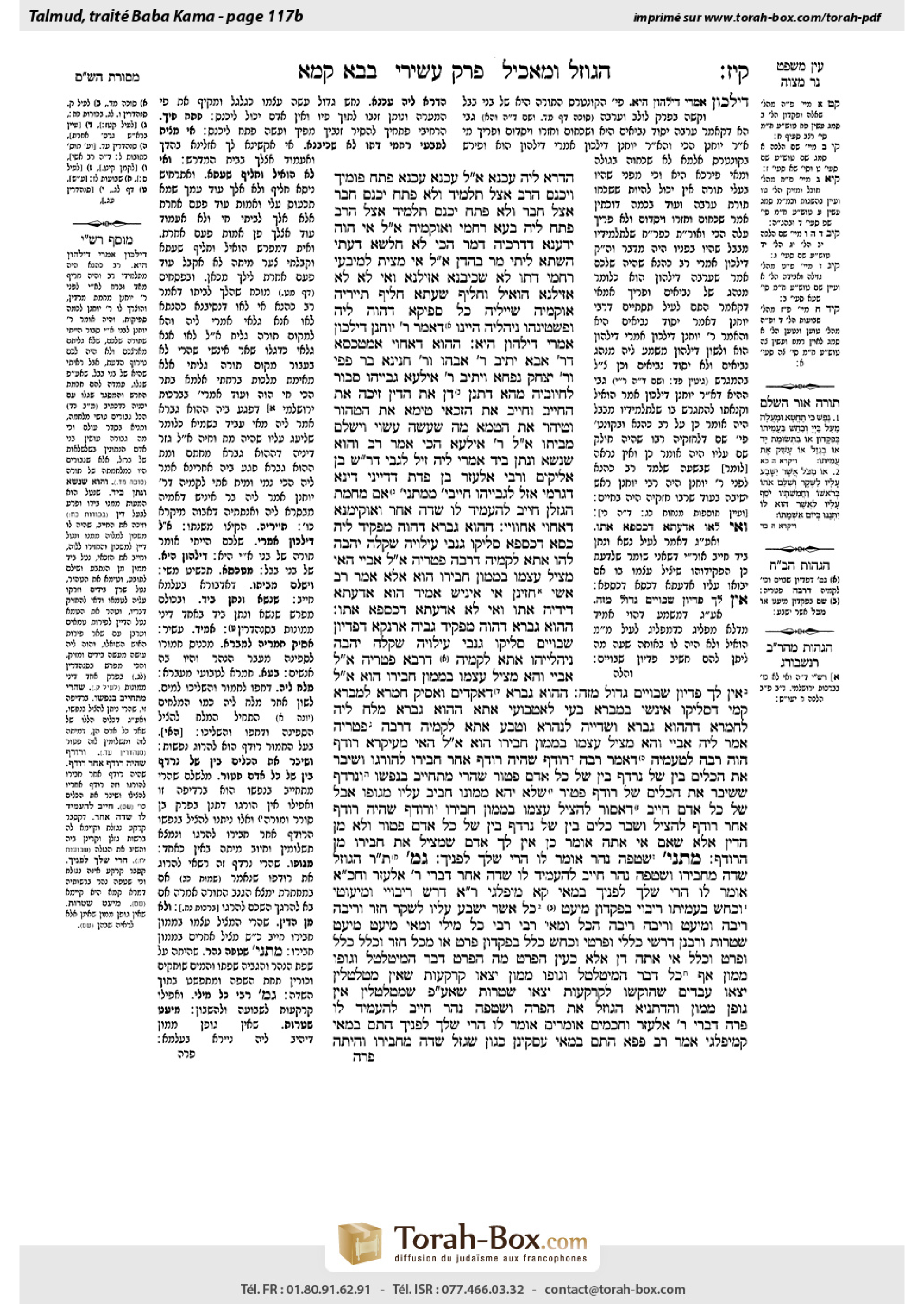
Bava Kamma 117b: Talmud study for Daf Yomi
Study the Talmud for Daf Yomi with scanned pages, Hebrew text, English translations from Sefaria and AI-generated French translations.
Passage selection and English or AI-generated French translation are available where the scan has annotations. Daf Study is independent of Torah-Box and Sefaria.
Browse Bava Kamma · בבא קמא · All tractatesBava Kamma 117b text and translations
This page of Bava Kamma includes the Aramaic text, an English translation and an AI-generated French translation, alongside the scan above.
בבא קמא קי״ז ב · Aramaic and Hebrew text
הָדְרָא לֵיהּ עַכְנָא. אֲמַר לֵיהּ: ״עַכְנָא, עַכְנָא, פְּתַח פּוּמָּיךְ וְיִכָּנֵס הָרַב אֵצֶל תַּלְמִיד״, וְלָא פְּתַח. ״יִכָּנֵס חָבֵר אֵצֶל חָבֵר״, וְלָא פְּתַח. ״יִכָּנֵס תַּלְמִיד אֵצֶל הָרַב״, פְּתַח לֵיהּ. בְּעָא רַחֲמֵי וְאוֹקְמֵיהּ.
אֲמַר לֵיהּ: ״אִי הֲוָה יָדַעְנָא דְּדַרְכֵּיהּ דְּמָר הָכִי, לָא חָלְשָׁא דַּעְתִּי; הַשְׁתָּא לֵיתֵי מָר בַּהֲדַן״. אֲמַר לֵיהּ: ״אִי מָצֵית לְמִיבְעֵי רַחֲמֵי דְּתוּ לָא שָׁכֵיבְנָא – אָזֵילְנָא, וְאִי לָא – לָא אָזֵילְנָא, הוֹאִיל וַחֲלֵיף שַׁעְתָּא, חֲלֵיף״.
תַּיְּירֵיהּ אוֹקְמֵיהּ. שַׁיְילֵיהּ כֹּל סְפֵיקָא דַּהֲוָה לֵיהּ, וּפַשְׁטִינְהוּ נִיהֲלֵיהּ. הַיְינוּ דְּאָמַר רַבִּי יוֹחָנָן: ״דִּילְכוֹן אֲמַרִי; דִּילְהוֹן הִיא״.
הָהוּא דְּאַחְוִי אַמְּטַכְסָא דְּרַבִּי אַבָּא. יְתֵיב רַבִּי אֲבָהוּ וְרַבִּי חֲנִינָא בַּר פַּפִּי וְרַבִּי יִצְחָק נַפָּחָא, וְיָתֵיב רַבִּי אִילְעָא גַּבַּיְיהוּ.
סְבוּר לְחַיּוֹבֵיהּ מֵהָא דִּתְנַן: דָּן אֶת הַדִּין – זִיכָּה אֶת הַחַיָּיב וְחִיֵּיב אֶת הַזַּכַּאי, טִימֵּא אֶת הַטָּהוֹר וְטִיהֵר אֶת הַטָּמֵא – מַה שֶּׁעָשָׂה עָשׂוּי, וִישַׁלֵּם מִבֵּיתוֹ.
אֲמַר לְהוּ רַבִּי אִילְעָא, הָכִי אָמַר רַב: וְהוּא שֶׁנָּשָׂא וְנָתַן בַּיָּד. אָמְרִי לֵיהּ: זִיל לְגַבֵּי דְּרַבִּי שִׁמְעוֹן בֶּן אֶלְיָקִים וְרַבִּי אֶלְעָזָר בֶּן פְּדָת, דְּדָיְינִי דִּינָא דִגְרָמֵי.
אֲזַל לְגַבַּיְיהוּ, חַיְּיבֵיהּ מִמַּתְנִיתִין – אִם מֵחֲמַת הַגַּזְלָן, חַיָּיב לְהַעֲמִיד לוֹ שָׂדֶה אַחֵר; וְאוֹקִימְנָא דְּאַחְוִי אַחְווֹיֵי.
הָהוּא גַּבְרָא דַּהֲוָה מִפְּקִיד לֵיהּ כָּסָא דְכַסְפָּא. סְלִיקוּ גַּנָּבֵי עִילָּוֵיהּ, שַׁקְלַהּ יַהֲבַהּ לְהוּ. אֲתָא לְקַמֵּיהּ דְּרַבָּה, פַּטְרֵיהּ. אֲמַר לֵיהּ אַבָּיֵי: הַאי מַצִּיל עַצְמוֹ בְּמָמוֹן חֲבֵירוֹ הוּא! אֶלָּא אָמַר רַב אָשֵׁי: חָזֵינַן; אִי אִינִישׁ אֲמִיד הוּא – אַדַּעְתָּא דִידֵיהּ אֲתוֹ, וְאִי לָא – אַדַּעְתָּא דְכַסְפָּא אֲתוֹ.
הָהוּא גַּבְרָא דַּהֲוָה מִפְּקִיד גַּבֵּיהּ אַרְנְקָא דְּפִדְיוֹן שְׁבוּיִים. סְלִיקוּ גַּנָּבֵי עִילָּוֵיהּ, שַׁקְלַהּ יַהֲבַהּ נִיהֲלַיְיהוּ. אֲתָא לְקַמֵּיהּ דְּרָבָא, פַּטְרֵיהּ. אֲמַר לֵיהּ אַבָּיֵי: וְהָא מַצִּיל עַצְמוֹ בְּמָמוֹן חֲבֵירוֹ הוּא! אֲמַר לֵיהּ: אֵין לְךָ פִּדְיוֹן שְׁבוּיִים גָּדוֹל מִזֶּה.
הָהוּא גַּבְרָא דְּאַקְדֵּים וְאַסֵּיק חֲמָרָא לְמַבָּרָא, קַמֵּי דִּסְלִיקוּ אִינָשֵׁי בְּמַבָּרָא. בָּעֵי לְאַטְבּוֹעֵי, אֲתָא הָהוּא גַּבְרָא, מְלַח לֵיהּ לַחֲמָרָא דְּהָהוּא גַּבְרָא וְשַׁדְיֵיהּ לְנַהֲרָא, וּטְבַע. אֲתָא לְקַמֵּיהּ דְּרַבָּה, פַּטְרֵיהּ. אֲמַר לֵיהּ אַבָּיֵי: וְהָא מַצִּיל עַצְמוֹ בְּמָמוֹן חֲבֵירוֹ הוּא! אֲמַר לֵיהּ: הַאי – מֵעִיקָּרָא רוֹדֵף הֲוָה.
רַבָּה לְטַעְמֵיהּ, דְּאָמַר רַבָּה: רוֹדֵף שֶׁהָיָה רוֹדֵף אַחַר חֲבֵירוֹ לְהוֹרְגוֹ, וְשִׁיבֵּר אֶת הַכֵּלִים, בֵּין שֶׁל נִרְדׇּף בֵּין שֶׁל כׇּל אָדָם – פָּטוּר, שֶׁהֲרֵי מִתְחַיֵּיב בְּנַפְשׁוֹ.
וְנִרְדׇּף שֶׁשִּׁיבֵּר אֶת הַכֵּלִים שֶׁל רוֹדֵף – פָּטוּר, שֶׁלֹּא יְהֵא מָמוֹנוֹ חָבִיב עָלָיו מִגּוּפוֹ. אֲבָל שֶׁל כׇּל אָדָם – חַיָּיב, דְּאָסוּר לְהַצִּיל עַצְמוֹ בְּמָמוֹן חֲבֵירוֹ.
וְרוֹדֵף שֶׁהָיָה רוֹדֵף אַחַר רוֹדֵף לְהַצִּיל, וְשִׁבֵּר כֵּלִים, בֵּין שֶׁל נִרְדׇּף בֵּין שֶׁל כׇּל אָדָם – פָּטוּר. וְלֹא מִן הַדִּין, אֶלָּא שֶׁאִם אִי אַתָּה אוֹמֵר כֵּן – אֵין לְךָ אָדָם שֶׁמַּצִּיל אֶת חֲבֵירוֹ מִן הָרוֹדֵף.
מַתְנִי׳ שְׁטָפָהּ נָהָר, אוֹמֵר לוֹ: ״הֲרֵי שֶׁלְּךָ לְפָנֶיךָ״.
גְּמָ׳ תָּנוּ רַבָּנַן: הַגּוֹזֵל שָׂדֶה מֵחֲבֵירוֹ וּשְׁטָפָהּ נָהָר – חַיָּיב לְהַעֲמִיד לוֹ שָׂדֶה אַחֵר, דִּבְרֵי רַבִּי אֶלְעָזָר. וַחֲכָמִים אוֹמְרִים, אוֹמֵר לוֹ: ״הֲרֵי שֶׁלְּךָ לְפָנֶיךָ״.
בְּמַאי קָא מִיפַּלְגִי? רַבִּי אֶלְעָזָר דָּרֵשׁ רִיבּוּיֵי וּמִיעוּטֵי; ״וְכִחֵשׁ בַּעֲמִיתוֹ״ – (רִיבּוּי) [רִיבָּה], ״בְּפִקָּדוֹן״ – מִיעֵט, ״כֹּל אֲשֶׁר יִשָּׁבַע עָלָיו לַשֶּׁקֶר״ – חָזַר וְרִיבָּה.
רִיבָּה וּמִיעֵט וְרִיבָּה – רִיבָּה הַכֹּל; וּמַאי רַבִּי? רַבִּי כֹּל מִילֵּי.
וּמַאי מִיעֵט? מִיעֵט שְׁטָרוֹת.
וְרַבָּנַן דָּרְשִׁי כְּלָלֵי וּפְרָטֵי; ״וְכִחֵשׁ״ – כָּלַל, ״בְּפִקָּדוֹן״ – פָּרַט, ״אוֹ מִכֹּל״ – חָזַר וְכָלַל. כְּלָל וּפְרָט וּכְלָל – אִי אַתָּה דָן אֶלָּא כְעֵין הַפְּרָט;
מָה הַפְּרָט – דָּבָר הַמִּיטַּלְטֵל וְגוּפוֹ מָמוֹן, אַף כֹּל דָּבָר הַמִּיטַּלְטֵל וְגוּפוֹ מָמוֹן. יָצְאוּ קַרְקָעוֹת – שֶׁאֵין מִטַּלְטְלִין; יָצְאוּ עֲבָדִים – שֶׁהוּקְּשׁוּ לְקַרְקָעוֹת; יָצְאוּ שְׁטָרוֹת – שֶׁאַף עַל פִּי שֶׁמִּטַּלְטְלִין, אֵין גּוּפָן מָמוֹן.
וְהָדְתַנְיָא: הַגּוֹזֵל אֶת הַפָּרָה וּשְׁטָפָהּ נָהָר – חַיָּיב לְהַעֲמִיד לוֹ פָּרָה, דִּבְרֵי רַבִּי אֶלְעָזָר. וַחֲכָמִים אוֹמְרִים, אוֹמֵר לוֹ: ״הֲרֵי שֶׁלְּךָ לְפָנֶיךָ״. הָתָם בְּמַאי קָמִיפַּלְגִי?
אָמַר רַב פָּפָּא: הָתָם בְּמַאי עָסְקִינַן – כְּגוֹן שֶׁגָּזַל שָׂדֶה מֵחֲבֵירוֹ וְהָיְתָה
Bava Kamma 117b · English translation
encircled by a serpent [akhna], which had placed its tail in its mouth, completely encircling the cave and blocking the entrance. Rabbi Yoḥanan said to it: Serpent, serpent, open your mouth and allow the teacher to enter and be near the disciple, but the serpent did not open its mouth to allow him entry. He then said: Allow a colleague to enter and be near his colleague, but still the serpent did not open its mouth. Rabbi Yoḥanan said: Allow the disciple to enter and be near the teacher, referring to Rav Kahana as his own teacher. The snake then opened its mouth for him to allow him entry. Rabbi Yoḥanan requested divine mercy from God and raised Rav Kahana from the dead.
Rabbi Yoḥanan said to Rav Kahana: Had I known that this was the Master’s manner of appearance, I would not have been offended. Now let the Master come with me to the study hall. Rav Kahana said to him: If you are able to request divine mercy so that I will not die again, I will go with you, and if not, I will not go with you. The Gemara comments: Since the time decreed for his death had passed, it had passed.
Rabbi Yoḥanan then completely awakened him and stood him up. Thereafter, he asked him about every uncertainty that he had, and Rav Kahana resolved each of them for him. And this is the background to that which Rabbi Yoḥanan says to his students on several occasions: What I said was yours is in fact theirs, i.e., I thought that the Torah scholars in Eretz Yisrael were the most advanced, but in fact the scholars of Babylonia are the most advanced, as evidenced by Rav Kahana’s knowledge.
§ The Gemara relates another incident pertaining to one who informed gentiles of the whereabouts of another Jew’s property. There was a certain individual who showed Rabbi Abba’s silk [ametakesa] to gentiles, who later seized it. Rabbi Abbahu and Rabbi Ḥanina bar Pappi and Rabbi Yitzḥak Nappaḥa sat together to determine whether Rabbi Abba was entitled to compensation from the informer, and Rabbi Ile’a sat next to them.
The judges thought to deem the informer liable to reimburse Rabbi Abba based upon that which we learned in a mishna (Bekhorot 28b): If a judge issued a judgment and erred, and he acquitted one who was in fact liable, or deemed liable one who should have in fact been acquitted, or if he ruled that a pure item is impure, or ruled that an impure item is pure, and by doing so he caused a litigant a monetary loss, what he did is done, i.e., the judgment stands, and the judge must pay damages from his home, i.e., from his personal funds. This indicates that one is liable to pay for a financial loss that he causes even if his involvement was only through speech.
Rabbi Ile’a said to them: This is what Rav says: And that mishna is discussing a case where the judge not only issued a ruling, but actively took the money from the one whom he found liable, and gave it to the other party by his own hand. Consequently, it cannot serve as a precedent to render the informer liable in this case. The Sages serving as judges said to Rabbi Abba: Go to Rabbi Shimon ben Elyakim and Rabbi Elazar ben Pedat, who rule that there is liability for damage caused by indirect action.
Rabbi Abba went to them, and they deemed the informer liable to reimburse Rabbi Abba, as it is taught in the mishna: If the thugs seized the field due to the robber, he is liable to provide the owner with a different field. And it was established that the mishna is referring to a case where an individual showed the field to thugs who later seized it. The halakha stated in the mishna would apply to this case as well.
The Gemara relates another incident: There was a certain man with whom a silver cup was deposited. Thieves came upon him in his home and he took the cup and gave it to them. The case came before Rabba, and Rabba exempted him from payment. Abaye said to him: This individual is saving himself with another’s property, and he should therefore be liable. Rather, Rav Ashi said, in explanation of Rabba’s ruling: We look at his financial status: If the bailee is a wealthy man, the thieves came with the intent to steal his property, and he is therefore liable to pay, as he saved himself from financial loss by handing over another’s property. And if he is not wealthy, the thieves presumably came with the intent to steal the silver cup, and he is therefore exempt from liability.
The Gemara relates another incident: There was a certain man with whom the purse containing funds collected for the redemption of captives was deposited. Thieves came upon him and he took the purse and gave it to them. The case came before Rabba, and Rabba exempted him from payment. Abaye said to him: But this individual is saving himself with another’s property, and he should therefore be liable to pay. Rabba said to him: You have no greater redemption of captives than this. Since the man used the money to avoid being harmed by the thieves, Rabba considered the money to have been used for its intended purpose.
The Gemara relates another incident: There was a certain man who hastened and brought his donkey onboard a ferry [lemavra] before other people boarded the ferry. The donkey began to move around and was about to cause the boat to sink. A certain other man came and pushed the donkey of that first man into the river, and it drowned. The case came before Rabba, and Rabba exempted him from payment. Abaye said to him: But this individual is saving himself with another’s property, and he should therefore be liable to pay. Rabba said to him: This owner of the donkey was considered a pursuer from the outset, as he endangered the other travelers. It is permitted to stop a pursuer by any means necessary, including by destroying his property.
The Gemara notes that Rabba conforms to his standard line of reasoning, as Rabba says: In the case of a pursuer who was chasing after another in order to kill him and the pursuer broke vessels during the chase, whether they belonged to the pursued party or to anyone else, he is exempt from reimbursing the owner of the vessels. This is because he is liable to receive the death penalty for attempted murder and is consequently exempt from any monetary liability he incurs simultaneously.
And a pursued individual who broke the vessels of the pursuer is also exempt from payment, as the pursuer’s property shall not be cherished more than his body, i.e., his life. Since it is permitted to kill the pursuer in order to save his intended victim, it is permitted to destroy his property for that purpose. But if he destroyed property belonging to anyone else, he is liable to reimburse them, as it is prohibited for him to save himself with another’s property.
And with regard to a pursuer who was chasing after another pursuer in order to save the latter’s intended victim, and he broke vessels during the chase, whether they belonged to the pursued individual, i.e., the individual attempting murder, or to anyone else, he is exempt from payment. The Gemara notes: And this is not the halakha by Torah law, but if you do not say so, you will not have any person that saves another from a pursuer. In order to encourage people to attempt to save the lives of others, the Sages instituted that one who damages another’s property in the process of saving a life is exempt from payment.
MISHNA: If a river flooded a misappropriated field, the robber may say to its owner: That which is yours is before you, and no compensation is required. Since the field would have been flooded in any case, the robber has not caused the damage to the field, and is therefore exempt.
GEMARA: The Sages taught: In the case of one who robbed a field from another and a river then flooded it, the robber is liable to provide the field’s owner with a different field. This is the statement of Rabbi Elazar. And the Rabbis say: He is exempt from doing so, as he can say to the owner: That which is yours is before you.
The Gemara analyzes this dispute: With regard to what do they disagree? The Gemara explains: Rabbi Elazar interpreted the verses: “If any one sin, and commit a trespass against the Lord, and deal falsely with his neighbor in a matter of deposit…or anything about which he has sworn falsely, he shall restore it in full” (Leviticus 5:21–24), according to the hermeneutical principle of amplifications and restrictions. The phrase: “If any one sin, and commit a trespass against the Lord, and deal falsely with his neighbor,” is an amplification. When the verse states: “In a matter of deposit,” it has restricted the halakha to the case of a deposit. When the verse then states: “Or anything about which he has sworn falsely, he shall restore it in full,” it has then amplified the halakha again.
Accordingly, as the Torah amplified and then restricted and then amplified again, it has amplified the halakha to include everything, with only a single exception. And what is included due to the fact that the verse has amplified the halakha? The verse has amplified the halakha to include everything that one steals.
And what is excluded due to the fact that the verse restricted the halakha? It restricted the halakha in order to exclude financial documents, which are dissimilar to a deposit in that their value is not intrinsic, but rather due to their function. Consequently, according to Rabbi Elazar, land that was stolen is included in the halakhot stated in these verses, and one who steals land must reimburse the field’s owner.
And the Rabbis interpreted these verses according to the hermeneutical principle of generalizations and details. The phrase: “And deal falsely with his neighbor,” is a generalization, while the subsequent phrase: “In a matter of deposit,” is a detail. When the verse then states: “Or anything about which he has sworn falsely, he shall restore it in full,” it has then generalized again. In a case of a generalization, and a detail, and a generalization, you may deduce that the verse is referring only to items similar to the detail.
Accordingly, just as the detail, i.e., a deposit, is movable property and has intrinsic monetary value, so too, the verse includes anything that is movable property and has intrinsic monetary value. Consequently, land has been excluded, as it is not movable property. Slaves have been excluded, as they are compared to land with regard to many areas of halakha. Financial documents have been excluded because, although they are movable property, they do not have intrinsic monetary value.
The Gemara asks: And there is that which is taught in a baraita: In the case of one who robbed another of a cow and a river washed it away, the robber is liable to provide the owner with another cow; this is the statement of Rabbi Elazar. And the Rabbis say: The robber can say to the owner: That which is yours is before you, and he would consequently be exempt. The Gemara asks: There, in the baraita, with regard to what do they disagree? The rationale offered previously cannot apply, as a cow is movable property and has intrinsic value, and yet Rabbi Elazar and the Rabbis still disagree.
Rav Pappa said: There, with what are we dealing? We are dealing with a case where he had robbed another of a field, and there was
Bava Kamma 117b · Traduction française (IA)
entouré par un serpent [akhna], qui avait mis sa queue dans sa bouche, entourant complètement la grotte et bloquant l'entrée. Rabbi Yoḥanan dit au serpent : Serpent, serpent, ouvre ta bouche et permet au maître d'entrer et d'être proche de son disciple, mais le serpent ne s'ouvrit pas la bouche pour le laisser entrer. Il dit alors : Permets à un collègue d'entrer et d'être proche de son collègue, mais le serpent ne s'ouvrit pas non plus la bouche. Rabbi Yoḥanan dit : Permets au disciple d'entrer et d'être proche du maître, faisant référence à Rav Kahana comme à son propre maître. Le serpent ouvrit alors sa bouche pour le laisser entrer. Rabbi Yoḥanan demanda la miséricorde divine à Dieu et ressuscita Rav Kahana.
Rabbi Yoḥanan dit à Rav Kahana : Si j'avais su que c'était la manière d'apparaître du Maître, je n'aurais pas été offensé. Maintenant, laisse le Maître venir avec moi dans la salle de étude. Rav Kahana dit à lui : Si tu peux demander la miséricorde divine afin que je ne meure plus, je vais avec toi, et si ce n'est pas le cas, je ne vais pas avec toi. La Guemara commente : Depuis que le temps décrété pour sa mort avait passé, il avait passé.
Rabbi Yoḥanan mit alors complètement en éveil et le dressa. Par la suite, il lui demanda sur chaque incertitude qu'il avait, et Rav Kahana résolut chacune d'entre elles pour lui. Et c'est le contexte de ce que Rabbi Yoḥanan dit à ses élèves à plusieurs reprises : Ce que j'ai dit est à toi, c'est en réalité à eux, c'est-à-dire que j'avais pensé que les savants de la Terre d'Israël étaient les plus avancés, mais en réalité les savants de Babylone sont les plus avancés, comme le montre la connaissance de Rav Kahana.
§ La Guemara rapporte un autre incident concernant une personne qui a informé des non-Juifs de la localisation d'une propriété d'un autre Juif. Il y avait un certain individu qui avait montré à des non-Juifs la soie de Rabbi Abba [ametakesa], qui fut ensuite saisie. Rabbi Abbahu, Rabbi Ḥanina bar Pappi et Rabbi Yitzḥak Nappaḥa s'assirent ensemble pour déterminer si Rabbi Abba avait droit à une compensation de l'informateur, et Rabbi Ile’a était assis à côté d'eux.
Les juges pensaient déclarer l'informateur responsable de réparer Rabbi Abba en se basant sur ce que nous avons appris dans une mitsna (Bekhorot 28b) : Si un juge a rendu un jugement et s'est trompé, et s'il a acquitté celui qui était en réalité responsable, ou s'il a déclaré responsable celui qui devrait être acquitté, ou s'il a jugé un objet pur comme impur, ou un objet impur comme pur, et en faisant cela il a causé à un litige une perte financière, ce qu'il a fait est fait, c'est-à-dire que le jugement reste, et le juge doit payer des dommages de son domicile, c'est-à-dire de ses fonds personnels. Cela indique que l'on est responsable de payer une perte financière qu'on cause même si son implication était uniquement par la parole.
Rabbi Ile’a dit à eux : C'est ce que Rav dit : Et cette mitsna est discutée dans un cas où le juge n'a pas seulement rendu un jugement, mais a activement pris l'argent de celui qu'il avait trouvé responsable et l'a donné à l'autre partie par sa propre main. Ainsi, cela ne peut pas servir de précédent pour rendre l'informateur responsable dans ce cas. Les Sages servant de juges dirent à Rabbi Abba : Va chez Rabbi Shimon ben Elyakim et Rabbi Elazar ben Pedat, qui jugent qu'il y a responsabilité pour les dommages causés par une action indirecte.
Rabbi Abba alla chez eux, et ils considérèrent l'informateur comme responsable de réparer Rabbi Abba, car il est enseigné dans la mitsna : Si les bandits saisirent le champ en raison du voleur, il est responsable de fournir à l'propriétaire un autre champ. Et il a été établi que la mitsna fait référence à un cas où un individu montra le champ aux bandits qui l'ont ensuite saisi. La halakha établie dans la mitsna s'appliquerait également à ce cas.
La Guemara rapporte un autre incident : Il y avait un certain homme avec lequel une tasse d'argent avait été déposée. Des voleurs entrèrent chez lui et il prit la tasse et la donna à eux. Le cas vint devant Rabba, et Rabba exempta lui de paiement. Abaye dit à lui : Cet individu se sauve avec la propriété d'autrui, et il devrait donc être responsable. Plutôt, Rav Ashi dit, en expliquant la décision de Rabba : Nous examinons son statut financier : Si le dépositaire est un homme riche, les voleurs sont venus avec l'intention de voler sa propriété, et il est donc responsable de payer, car il s'est sauvé de perte financière en donnant la propriété d'autrui. Et si il n'est pas riche, les voleurs ont probablement été venus avec l'intention de voler la tasse d'argent, et il est donc exempt de responsabilité.
La Guemara rapporte un autre incident : Il y avait un certain homme avec lequel la bourse contenant les fonds collectés pour la libération des captifs avait été déposée. Des voleurs entrèrent chez lui et il prit la bourse et la donna à eux. Le cas vint devant Rabba, et Rabba exempta lui de paiement. Abaye dit à lui : Mais cet individu se sauve avec la propriété d'autrui, et il devrait donc être responsable de payer. Rabba dit à lui : Tu n'as pas de plus grande libération des captifs que celle-ci. Puisque l'homme utilisa l'argent pour éviter d'être blessé par les voleurs, Rabba considéra que l'argent avait été utilisé à son intention.
La Guemara rapporte un autre incident : Il y avait un certain homme qui accéléra et emmena son âne à bord d'un ferry [lemavra] avant que d'autres personnes ne montent sur le ferry. L'âne commença à bouger et était sur le point de faire couler le bateau. Un autre homme vint et poussa l'âne de ce premier homme dans le fleuve, et il coula. Le cas vint devant Rabba, et Rabba exempta celui-ci de paiement. Abaye dit à Rabba : Mais cet individu se sauve avec la propriété d'autrui, et il devrait donc être responsable de payer. Rabba répondit : Cet propriétaire de l'âne était considéré comme un poursuivant dès le début, car il avait mis en danger les autres voyageurs. Il est permis d'arrêter un poursuivant par n'importe quel moyen, y compris en détruisant sa propriété.
La Guemara note que Rabba suit sa ligne de raisonnement habituelle, car Rabba dit : Dans le cas d’un poursuivant qui poursuivait quelqu’un afin de le tuer et qui brisait des objets pendant la poursuite, que ceux-ci appartenaient au poursuivi ou à quelqu’un d’autre, il est exempt de rembourser l’owner des objets. Cela est dû au fait qu’il est tenu responsable de recevoir la peine de mort pour tentative de meurtre et est donc exempt de toute responsabilité financière simultanée.
Et un individu poursuivi qui brise les objets du poursuivant est également exempt de paiement, car la propriété du poursuivant ne doit pas être chérie plus que son corps, c’est-à-dire sa vie. Puisque c’est permis de tuer le poursuivant afin de sauver sa victime prévue, il est permis de détruire sa propriété à cette fin. Mais si l’on détruisait une propriété appartenant à quelqu’un d’autre, l’on serait tenu de rembourser, car il est interdit de sauver soi-même en utilisant la propriété d’autrui.
Et concernant un poursuivant qui poursuivait un autre poursuivant afin de sauver la victime prévue de ce dernier, et qui brisait des objets pendant la poursuite, que ceux-ci appartenaient à l’individu poursuivi, c’est-à-dire celui qui commet l’acte de meurtre, ou à quelqu’un d’autre, il est exempt de paiement. La Guemara note : Et cela n’est pas la halakha selon la Torah, mais si l’on ne le disait pas, on n’aurait personne pour sauver un autre d’un poursuivant. Afin d’encourager les gens à tenter de sauver la vie des autres, les Sages ont institué que celui qui endommage la propriété d’un autre dans le processus de sauver une vie est exempt de paiement.
MICHNA : Si un fleuve inondait un champ volé, le voleur peut dire à son propriétaire : Ce qui est à toi est devant toi, et aucune compensation n’est requise. Puisque le champ aurait été inondé de toute façon, le voleur n’a pas causé de dommage au champ et est donc exempt.
GUEMARA : Les Sages enseignent : Dans le cas d’un voleur qui a volé un champ à un autre et qu’un fleuve l’a ensuite inondé, le voleur est tenu de fournir au propriétaire du champ un autre champ. C’est la déclaration de Rabbi Eléazar. Et les Rabbins disent : Il est exempt de le faire, car il peut dire au propriétaire : Ce qui est à toi est devant toi.
La Guemara analyse ce désaccord : Concernant quoi les Sages s’entendent-ils ? La Guemara explique : Rabbi Eléazar interprète les versets : « Si quelqu’un péche et commet un vol contre l’Éternel, et trompe son prochain dans une affaire de dépôt… ou sur toute chose à propos de laquelle il a juré faussement, il devra rendre en plein » (Lévitique 5:21–24), selon le principe herméneutique d’amplifications et de restrictions. La phrase : « Si quelqu’un péche et commet un vol contre l’Éternel, et trompe son prochain », est une amplification. Lorsque le verset mentionne : « Dans une affaire de dépôt », il restreint la halakha au cas d’un dépôt. Lorsque le verset mentionne ensuite : « Ou sur toute chose à propos de laquelle il a juré faussement, il devra rendre en plein », il amplifie à nouveau la halakha.
Ainsi, puisque la Torah a amplifié, puis restreint, puis amplifié à nouveau, elle a amplifié la halakha pour inclure tout, avec une seule exception. Et qu’est-ce qui est inclus en raison de l’amplification de la halakha ? La Torah a amplifié la halakha pour inclure tout ce qui est volé.
Et qu’est-ce qui est exclu en raison de la restriction de la halakha ? Elle a restreint la halakha afin d’exclure les documents financiers, qui sont différents d’un dépôt, car leur valeur n’est pas intrinsèque, mais plutôt due à leur fonction. Ainsi, selon Rabbi Eléazar, la terre volée est incluse dans les halakhot mentionnés dans ces versets, et celui qui vole la terre doit indemniser le propriétaire du champ.
Et les Rabbins interprètent ces versets selon le principe herméneutique de généralisation et de détails. La phrase : « Et trompe son prochain », est une généralisation, tandis que la phrase suivante : « Dans une affaire de dépôt », est un détail. Lorsque le verset mentionne ensuite : « Ou sur toute chose à propos de laquelle il a juré faussement, il devra rendre en plein », il généralise à nouveau. Dans un cas de généralisation, de détail et de généralisation, on peut déduire que le verset fait référence uniquement aux choses semblables au détail.
Ainsi, tout comme le détail, c’est-à-dire un dépôt, est un bien mobile et a une valeur monétaire intrinsèque, de même, le verset inclut tout ce qui est un bien mobile et a une valeur monétaire intrinsèque. Ainsi, la terre a été exclue, car elle n’est pas un bien mobile. Les esclaves ont été exclus, car ils sont comparés à la terre en ce qui concerne de nombreuses questions de halakha. Les documents financiers ont été exclus, car, bien qu’ils soient des biens mobiles, ils n’ont pas de valeur monétaire intrinsèque.
La Guemara pose une question : Et il y a ce qui est enseigné dans une baraïta : Dans le cas d’un voleur qui a volé un bœuf à un autre et qu’un fleuve l’a emporté, le voleur est tenu de fournir au propriétaire un autre bœuf ; c’est la déclaration de Rabbi Eléazar. Et les Rabbins disent : Le voleur peut dire au propriétaire : Ce qui est à toi est devant toi, et il serait donc exempt. La Guemara pose une question : Là, dans la baraïta, sur quoi s’entendent-ils ? La raison offerte précédemment ne peut pas s’appliquer, car un bœuf est un bien mobile et a une valeur intrinsèque, et pourtant Rabbi Eléazar et les Rabbins continuent de s’entendre.
Rav Pappa dit : Là, avec quoi sommes-nous en train de nous occuper ? Nous sommes en train de nous occuper d’un cas où il avait volé un champ à un autre, et il y avait
Traduction française générée par IA à partir de l’édition anglaise de Sefaria. Vérifie toujours un passage avec le texte source.
Text from Sefaria: William Davidson Edition - Vocalized Aramaic (CC BY NC); William Davidson Edition - English (CC BY NC).