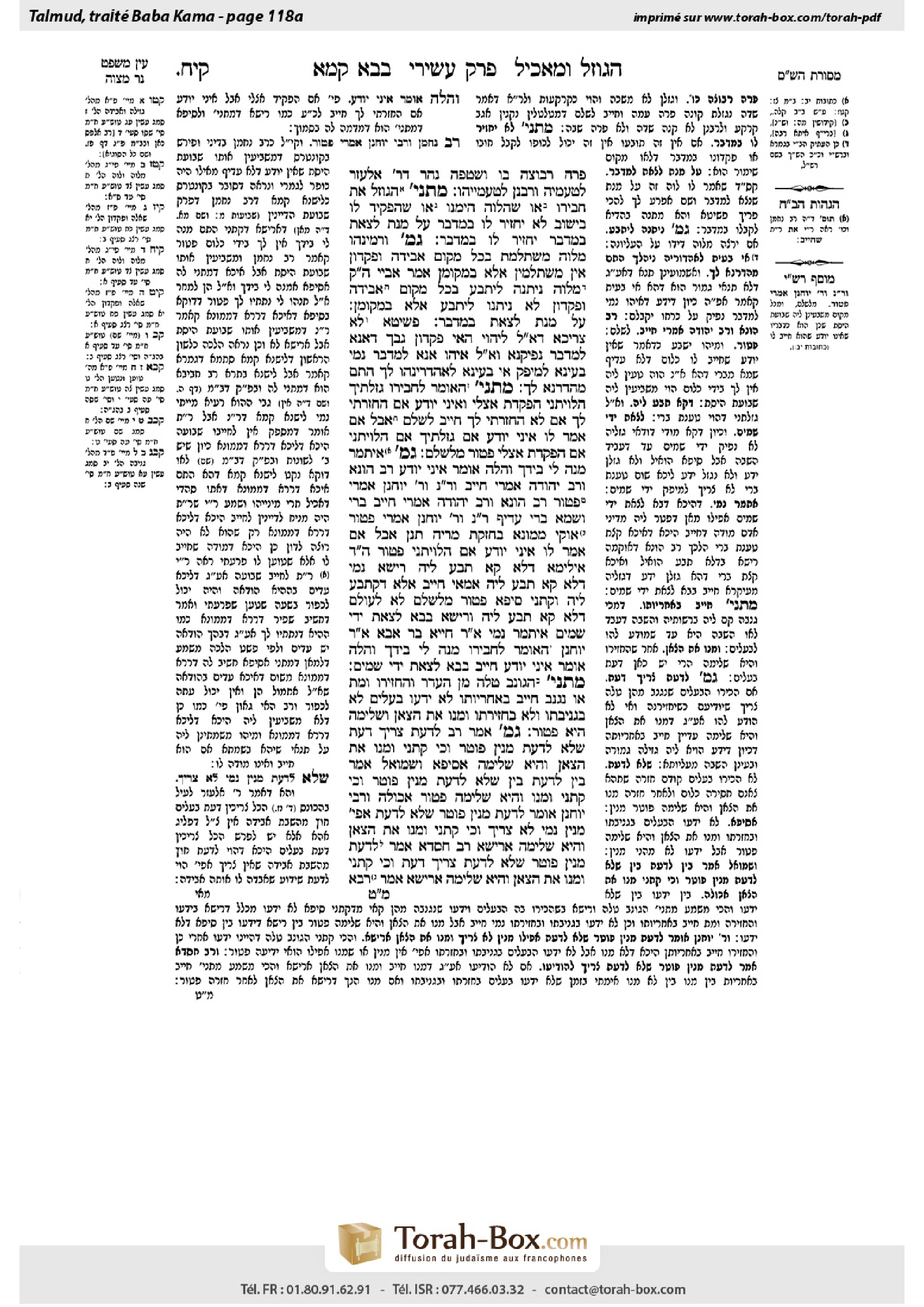
Bava Kamma 118a: Talmud study for Daf Yomi
Study the Talmud for Daf Yomi with scanned pages, Hebrew text, English translations from Sefaria and AI-generated French translations.
Passage selection and English or AI-generated French translation are available where the scan has annotations. Daf Study is independent of Torah-Box and Sefaria.
Browse Bava Kamma · בבא קמא · All tractatesBava Kamma 118a text and translations
This page of Bava Kamma includes the Aramaic text, an English translation and an AI-generated French translation, alongside the scan above.
בבא קמא קי״ח א · Aramaic and Hebrew text
פָּרָה רְבוּצָה בּוֹ, וּשְׁטָפָהּ נָהָר; דְּרַבִּי אֶלְעָזָר לְטַעְמֵיהּ, וְרַבָּנַן לְטַעְמַיְיהוּ.
מַתְנִי׳ הַגּוֹזֵל אֶת חֲבֵירוֹ אוֹ שֶׁהִלְוָה הֵימֶנּוּ אוֹ שֶׁהִפְקִיד לוֹ, בַּיִּשּׁוּב – לֹא יַחֲזִיר לוֹ בַּמִּדְבָּר. עַל מְנָת לָצֵאת בַּמִּדְבָּר – יַחֲזִיר לוֹ בַּמִּדְבָּר.
גְּמָ׳ וּרְמִינְהוּ: מִלְוָה מִשְׁתַּלֶּמֶת בְּכׇל מָקוֹם, אֲבֵידָה וּפִקָּדוֹן אֵין מִשְׁתַּלְּמִין אֶלָּא בִּמְקוֹמָן! אָמַר אַבָּיֵי, הָכִי קָאָמַר: מִלְוָה נִיתְּנָה לִיתָּבַע בְּכׇל מָקוֹם, אֲבֵידָה וּפִקָּדוֹן לֹא נִיתְּנוּ לִיתָּבַע אֶלָּא בִּמְקוֹמָן.
עַל מְנָת לָצֵאת בַּמִּדְבָּר. פְּשִׁיטָא! לָא צְרִיכָא, דַּאֲמַר לֵיהּ: ״לֶיהֱוֵי הַאי פִּקָּדוֹן גַּבָּךְ, דַּאֲנָא לְמִדְבָּר נָפֵיקְנָא״, וַאֲמַר לֵיהּ אִיהוּ: ״אֲנָא לְמִדְבָּר נָמֵי בָּעֵינָא לְמִיפַּק. אִי בָּעֵינָא לְאַהְדֹּרִינְהוּ לָךְ, הָתָם מַהְדַּרְנָא לָךְ״.
מַתְנִי׳ הָאוֹמֵר לַחֲבֵירוֹ: ״גְּזַלְתִּיךָ״; ״הִלְוִיתַנִי״; ״הִפְקַדְתָּ אֶצְלִי, וְאֵינִי יוֹדֵעַ אִם הֶחְזַרְתִּי לָךְ אִם לֹא הֶחְזַרְתִּי לָךְ״ – חַיָּיב לְשַׁלֵּם. אֲבָל אִם אָמַר לוֹ: ״אֵינִי יוֹדֵעַ אִם גְּזַלְתִּיךָ״; ״אִם הִלְוִיתַנִי״; ״אִם הִפְקַדְתָּ אֶצְלִי״ – פָּטוּר מִלְּשַׁלֵּם.
גְּמָ׳ אִיתְּמַר: ״מָנֶה לִי בְּיָדְךָ״, וְהַלָּה אוֹמֵר: ״אֵינִי יוֹדֵעַ״ – רַב הוּנָא וְרַב יְהוּדָה אָמְרִי: חַיָּיב, וְרַב נַחְמָן וְרַבִּי יוֹחָנָן אָמְרִי: פָּטוּר.
רַב הוּנָא וְרַב יְהוּדָה אָמְרִי חַיָּיב – בָּרִי וְשֶׁמָּא, בָּרִי עָדִיף. רַב נַחְמָן וְרַבִּי יוֹחָנָן אָמְרִי פָּטוּר – אוֹקִי מָמוֹנָא בְּחֶזְקַת מָרֵיהּ.
תְּנַן, אֲבָל אִם אָמַר לוֹ: ״אֵינִי יוֹדֵעַ אִם הִלְוִיתַנִי״ – פָּטוּר. הֵיכִי דָמֵי? אִילֵּימָא דְּלָא קָא תָבַע לֵיהּ – רֵישָׁא נָמֵי דְּלָא קָא תָבַע לֵיהּ; אַמַּאי חַיָּיב? אֶלָּא דְּקָתָבַע לֵיהּ, וְקָתָנֵי סֵיפָא: פָּטוּר מִלְּשַׁלֵּם!
לָא; לְעוֹלָם דְּלָא קָא תָבַע לֵיהּ, וְרֵישָׁא – בְּבָא לָצֵאת יְדֵי שָׁמַיִם.
אִיתְּמַר נָמֵי, אָמַר רַבִּי חִיָּיא בַּר אַבָּא אָמַר רַבִּי יוֹחָנָן: הָאוֹמֵר לַחֲבֵירוֹ ״מָנֶה לִי בְּיָדְךָ״, וְהַלָּה אוֹמֵר ״אֵינִי יוֹדֵעַ״ – חַיָּיב, בְּבָא לָצֵאת יְדֵי שָׁמַיִם.
מַתְנִי׳ הַגּוֹנֵב טָלֶה מִן הָעֵדֶר וְהֶחְזִירוֹ, וּמֵת אוֹ נִגְנַב – חַיָּיב בְּאַחְרָיוּתוֹ. לֹא יָדְעוּ בְּעָלִים לֹא בִּגְנֵיבָתוֹ וְלֹא בַּחֲזִירָתוֹ, וּמָנוּ אֶת הַצֹּאן וּשְׁלֵימָה הִיא – פָּטוּר.
גְּמָ׳ אָמַר רַב: לְדַעַת – צָרִיךְ דַּעַת. שֶׁלֹּא לְדַעַת – מִנְיָן פּוֹטֵר. וְכִי קָתָנֵי ״וּמָנוּ אֶת הַצֹּאן וְהִיא שְׁלֵימָה״ – אַסֵּיפָא.
וּשְׁמוּאֵל אָמַר: בֵּין לְדַעַת בֵּין שֶׁלֹּא לְדַעַת – מִנְיָן פּוֹטֵר, וְכִי קָתָנֵי: ״וּמָנוּ וְהִיא שְׁלֵימָה, פָּטוּר״ – אַכּוּלַּהּ.
וְרַבִּי יוֹחָנָן אוֹמֵר: לְדַעַת – מִנְיָן פּוֹטֵר, שֶׁלֹּא לְדַעַת – אֲפִילּוּ מִנְיָן נָמֵי לָא צְרִיךְ. וְכִי קָתָנֵי: ״וּמָנוּ אֶת הַצֹּאן וְהִיא שְׁלֵימָה״ – אַרֵישָׁא.
רַב חִסְדָּא אָמַר: לְדַעַת – מִנְיָן פּוֹטֵר, שֶׁלֹּא לְדַעַת – צָרִיךְ דַּעַת. וְכִי קָתָנֵי: ״וּמָנוּ אֶת הַצֹּאן וְהִיא שְׁלֵימָה״ – אַרֵישָׁא.
אָמַר רָבָא:
Bava Kamma 118a · English translation
a prone cow in it, and a river washed it away. Rabbi Elazar conforms to his standard line of reasoning, as he maintains that land is included in the category of items that are not subject to the halakhot of robbery. Consequently, the robber acquires the land and simultaneously becomes liable to return it. Since he acquires the land, he acquires the cow that is on the land as well, and is liable to compensate its owner when it gets washed away by the river. And the Rabbis conform to their standard line of reasoning, as they hold that land was excluded by the verse. Therefore, the robber does not acquire the land and also does not acquire the cow.
MISHNA: With regard to one who robs another or who borrowed money from him, or one with whom another had deposited an item, if any of these interactions took place in a settled area, he may not return the item to him in an unsettled area, where it is of little benefit to the owner and he cannot safeguard it. If the loan or deposit was given on the condition that the recipient may go out and return it to the owner in an unsettled area, he may return it to him in an unsettled area.
GEMARA: The Gemara raises a contradiction to the mishna from a baraita: A loan may be repaid in any location, while a lost item and a deposit are returned only in their location, i.e., the same type of place, settled or unsettled, where they were found or received. Abaye said: This is what the baraita is saying: A loan may be claimed by the creditor in any location. Yet, if the borrower initiates the process of repaying the loan in an unsettled area, the creditor may refuse to accept the repayment until they reach a settled area. Conversely, a lost item and a deposit may be claimed only in their location.
The mishna teaches that if the loan or deposit was given on the condition that the recipient may go out and return it to the owner in an unsettled area, he may do so. The Gemara asks: Isn’t it obvious that an explicit stipulation to this effect is binding? The Gemara answers: No, it is necessary, as the mishna is discussing a case where the depositor said to the bailee: Let this deposit be with you, as I am going out to an unsettled area, and the bailee said to him: I also need to go out to an unsettled area, so if I need to return the deposit to you there, I will return it to you there.
MISHNA: In the case of one who says to another: I robbed you, or: You lent me money, or: You deposited an item with me, and I do not know if I returned your property to you or if I did not return it to you, he is liable to pay the sum or item in question. But if he said to him: I do not know if I robbed you, or: I do not know if you lent me money, or: I do not know if you deposited an item with me, he is exempt from paying the sum or item in question.
GEMARA: The Gemara cites a related dispute: It was stated that if one individual says to another: I have one hundred dinars in your possession, and the other says: I do not know whether or not this is true, Rav Huna and Rav Yehuda say that he is liable to pay the plaintiff, and Rav Naḥman and Rabbi Yoḥanan say that he is exempt from paying.
The Gemara explains the reason for each opinion: Rav Huna and Rav Yehuda say that he is liable to pay, because when there is a certain claim and an uncertain claim, the certain claim is superior. Rav Naḥman and Rabbi Yoḥanan say that he is exempt from paying because of the principle: Establish the money in the possession of its owner, i.e., money is not taken from one’s possession without clear proof that he is liable to pay it.
The Gemara attempts to derive a proof: We learned in the mishna: But if he said to him: I do not know if you lent me money, he is exempt from paying. What are the circumstances? If we say that the mishna is discussing a case where the lender did not claim the money from him, the first clause must also discuss a situation where the lender did not claim the money from him. If so, why is the borrower liable to pay in the case discussed in the first clause? Rather, the mishna must be discussing a case where the lender did claim the money from him, and the latter clause nevertheless teaches that the borrower is exempt from paying, even though his claim is uncertain and that of the lender is certain. This supports the opinion of Rav Naḥman and Rabbi Yoḥanan.
The Gemara answers: No, actually the mishna is referring to a case where the lender did not claim the money from him, and the first clause is discussing a case where the borrower comes to fulfill his obligation to Heaven.
The Gemara adds that it was also stated: Rabbi Ḥiyya bar Abba says that Rabbi Yoḥanan says: In the case of one who says to another: I have one hundred dinars in your possession, and the other individual says: I do not know whether or not this is true, the latter is liable to pay. This applies where he comes to fulfill his obligation to Heaven even though he cannot be forced to pay. This statement is in accordance with the opinion of Rav Huna and Rav Yehuda.
MISHNA: In the case of one who stole a lamb from a flock and returned it without informing the owner that he had done so, and then it died or was stolen, the thief is liable to pay restitution for it. If the lamb’s owners did not know about the entire incident, i.e., they did not know that it was stolen and they did not know that it was returned, and they counted the flock of sheep and found it whole, the thief is exempt from paying.
GEMARA: The Gemara presents several ways to understand the mishna: Rav says: In a case where the owners had knowledge of the fact that their lamb was stolen, the thief is required to return it with the knowledge of the owners in order to be exempt from liability if the lamb is subsequently harmed. In a case where the owners had no knowledge that the lamb was taken, their count of the flock after the thief returned it exempts the thief from further liability. And when the mishna teaches: And they counted the flock of sheep and found it whole, it is referring specifically to the latter clause, i.e., the case where the owners were unaware that the lamb was stolen, as it is specifically in that case that the count exempts the thief from liability.
And Shmuel says: Whether the owners had knowledge of the theft or whether they did not have knowledge of it, their count of the flock exempts the thief from payment. And when the mishna teaches: And they counted the flock of sheep and found it whole, the thief is exempt, it is referring to the entire mishna, as this exempts the thief from liability in both cases mentioned in the mishna.
And Rabbi Yoḥanan says: In a case where the owners had knowledge of the theft, their count of the flock exempts the thief, and in a case where the owners had no knowledge of the theft, even counting is not required for the thief to be exempt. And when the mishna teaches: And they counted the flock of sheep and found it whole, it is referring specifically to the first clause of the mishna, as it is particularly in that case that the count is relevant.
Rav Ḥisda says: In a case where the owners had knowledge of the theft, their count of the flock exempts the thief. In a case where the owners had no knowledge of the theft, the thief is required to return the lamb with their knowledge in order to become exempt from liability for future damage. And when the mishna teaches: And they counted the flock of sheep and found it whole, it is referring specifically to the first clause of the mishna, where the owners were aware of the theft, as it is only in that case that counting the flock is sufficient to exempt the thief from further liability.
Rava says:
Bava Kamma 118a · Traduction française (IA)
Une vache allongée dans le champ, et un fleuve l'a emportée. Rabbi Eléazar suit sa ligne de raisonnement habituelle, car il affirme que la terre est incluse dans la catégorie des choses non soumises aux halakhot du vol. Par conséquent, le voleur acquiert la terre et est simultanément tenu de la restituer. Puisqu'il acquiert la terre, il acquiert aussi la vache qui se trouve sur la terre, et est tenu de compenser son propriétaire lorsqu'elle est emportée par le fleuve. Les Rabbins suivent leur ligne de raisonnement habituelle, car ils considèrent que la terre a été exclue par la parole. Ainsi, le voleur ne possède pas la terre et ne possède pas non plus la vache.
MICHNA : Concernant celui qui vole un autre ou qui emprunte de l'argent à un autre, ou celui avec qui un autre a déposé un objet, si l'une de ces interactions s'est déroulée dans une zone habitée, il ne peut pas rendre l'objet à son propriétaire dans une zone non habitée, où l'objet n'a peu de valeur pour le propriétaire et qu'il ne peut le garder en sécurité. Si le prêt ou la déposition a eu lieu sous la condition que le destinataire puisse sortir et rendre l'objet à son propriétaire dans une zone non habitée, il peut le rendre à son propriétaire dans une zone non habitée.
GUEMARA : La Guemara soulève une contradiction avec la Michna à partir d'une baraïta : Un prêt peut être remboursé n'importe où, tandis qu'un objet perdu et une déposition doivent être rendus à leur lieu, c'est-à-dire le même type de lieu, habitué ou non habitué, où ils ont été trouvés ou reçus. Abaye a dit : C'est ce que la baraïta dit : Un prêt peut être réclamé par le créancier n'importe où. Cependant, si le prêteur initie le processus de remboursement du prêt dans une zone non habitée, le créancier peut refuser d'accepter le remboursement jusqu'à ce qu'ils atteignent une zone habitée. À l'inverse, un objet perdu et une déposition peuvent être réclamés uniquement à leur lieu.
La Michna enseigne que si le prêt ou la déposition a eu lieu sous la condition que le destinataire puisse sortir et rendre l'objet à son propriétaire dans une zone non habitée, il peut le faire. La Guemara demande : N'est-ce pas évident que l'engagement explicite à cet égard est contraignant ? La Guemara répond : Non, il est nécessaire, car la Michna parle d'un cas où le déposant a dit au dépositaire : Laisse cet objet avec toi, car je vais sortir dans une zone non habitée, et le dépositaire a dit à lui : Je dois aussi sortir dans une zone non habitée, donc si j'ai besoin de rendre l'objet à toi là-bas, je le rendrai à toi là-bas.
MICHNA : Dans le cas où l'un dit à l'autre : J'ai volé, ou : Tu m'as prêté de l'argent, ou : Tu as déposé un objet avec moi, et il ne sait pas s'il a rendu la propriété à son propriétaire ou non, il est tenu de payer la somme ou l'objet en question. Mais si il a dit à lui : Je ne sais pas si j'ai volé, ou : Je ne sais pas si tu m'as prêté de l'argent, ou : Je ne sais pas si tu as déposé un objet avec moi, il est exempt de payer la somme ou l'objet en question.
GUEMARA : La Guemara cite un débat lié : Il a été dit que si une personne dit à une autre : J'ai cent dinars en votre possession, et l'autre dit : Je ne sais pas si c'est vrai, Rav Huna et Rav Yéhuda disent qu'il est tenu de payer le plaignant, et Rav Naḥman et Rabbi Yoḥanan disent qu'il est exempt de payer.
La Guemara explique la raison de chaque opinion : Rav Huna et Rav Yéhuda disent qu'il est tenu de payer, car lorsqu'il y a une revendication certaine et une revendication incertaine, la revendication certaine est supérieure. Rav Naḥman et Rabbi Yoḥanan disent qu'il est exempt de payer, car selon le principe : Établir l'argent dans la possession de son propriétaire, c'est-à-dire l'argent n'est pas pris de la possession d'une personne sans preuve claire qu'il est tenu de le payer.
La Guemara tente de tirer une preuve : Nous avons appris dans la Michna : Mais si il a dit à lui : Je ne sais pas si tu m'as prêté de l'argent, il est exempt de payer. Quelles sont les circonstances ? Si nous disons que la Michna parle d'un cas où le prêteur n'a pas réclamé l'argent à lui, la première clause doit aussi parler d'un cas où le prêteur n'a pas réclamé l'argent à lui. Si c'est ainsi, pourquoi le prêteur est-il tenu de payer dans le cas discuté dans la première clause ? Plutôt, la Michna doit parler d'un cas où le prêteur a réclamé l'argent à lui, et la seconde clause enseigne néanmoins que le prêteur est exempt de payer, même si sa revendication est incertaine et celle du prêteur est certaine. Cela soutient l'opinion de Rav Naḥman et Rabbi Yoḥanan.
La Guemara répond : Non, en réalité la Michna parle d'un cas où le prêteur n'a pas réclamé l'argent à lui, et la première clause est celle où le prêteur vient remplir son obligation envers Dieu.
La Guemara ajoute que cela a également été dit : Rabbi Ḥiyya bar Abba dit que Rabbi Yoḥanan dit : Dans le cas où l'un dit à l'autre : J'ai cent dinars en votre possession, et l'autre individu dit : Je ne sais pas si c'est vrai, le second est tenu de payer. Cela s'applique lorsque l'individu vient remplir son obligation envers Dieu même s'il ne peut être contraint de payer. Cette déclaration s'inscrit dans l'opinion de Rav Huna et Rav Yéhuda.
MICHNA : Dans le cas où l'on vole une agnelle d'une troupe et la rend sans informer le propriétaire qu'il l'avait fait, et ensuite l'agneau meurt ou est volé, le voleur est tenu de payer la réparation. Si les propriétaires de l'agneau ne savaient pas sur l'ensemble de l'incident, c'est-à-dire qu'ils ne savaient pas qu'il avait été volé et qu'ils ne savaient pas qu'il avait été rendu, et qu'ils comptaient les brebis et trouvaient la troupe entière, le voleur est exempt de payer.
GUEMARA : La Guemara présente plusieurs façons d'interpréter la Michna : Rav dit : Dans un cas où les propriétaires connaissaient le fait que leur agneau avait été volé, le voleur doit le rendre avec la connaissance des propriétaires afin d'être exempt de responsabilité en cas de dommage ultérieur à l'agneau. Dans un cas où les propriétaires ignoraient que l'agneau avait été emporté, leur dénombrement du troupeau après que le voleur l'ait rendu exempte le voleur de toute responsabilité supplémentaire. Et lorsque la Michna enseigne : Et ils comptaient le troupeau de brebis et le trouvèrent entier, elle fait référence spécifiquement à la seconde clause, c'est-à-dire au cas où les propriétaires ignoraient que l'agneau avait été volé, car c'est précisément dans ce cas que le dénombrement exempte le voleur de responsabilité.
Et Shmuel dit : Quoi que les propriétaires sachent du vol ou non, leur dénombrement du troupeau exempt le voleur de paiement. Et lorsque la Michna enseigne : Et ils comptaient le troupeau de brebis et le trouvèrent entier, le voleur est exempt, elle fait référence à l'ensemble de la Michna, car cela exempt le voleur de responsabilité dans les deux cas mentionnés dans la Michna.
Et Rabbi Yoḥanan dit : Dans un cas où les propriétaires connaissaient le vol, leur dénombrement du troupeau exempt le voleur, et dans un cas où les propriétaires ignoraient le vol, même le dénombrement n'est pas requis pour exempter le voleur. Et lorsque la Michna enseigne : Et ils comptaient le troupeau de brebis et le trouvèrent entier, elle fait référence spécifiquement à la première clause de la Michna, car c'est précisément dans ce cas que le dénombrement est pertinent.
Rav Ḥisda dit : Dans un cas où les propriétaires connaissaient le vol, leur dénombrement du troupeau exempt le voleur. Dans un cas où les propriétaires ignoraient le vol, le voleur doit rendre l'agneau avec leur connaissance afin d'être exempt de responsabilité pour les dommages futurs. Et lorsque la Michna enseigne : Et ils comptaient le troupeau de brebis et le trouvèrent entier, elle fait référence spécifiquement à la première clause de la Michna, où les propriétaires étaient conscients du vol, car c'est uniquement dans ce cas que le dénombrement du troupeau suffit à exempter le voleur de responsabilité supplémentaire.
Rava dit :
Traduction française générée par IA à partir de l’édition anglaise de Sefaria. Vérifie toujours un passage avec le texte source.
Text from Sefaria: William Davidson Edition - Vocalized Aramaic (CC BY NC); William Davidson Edition - English (CC BY NC).