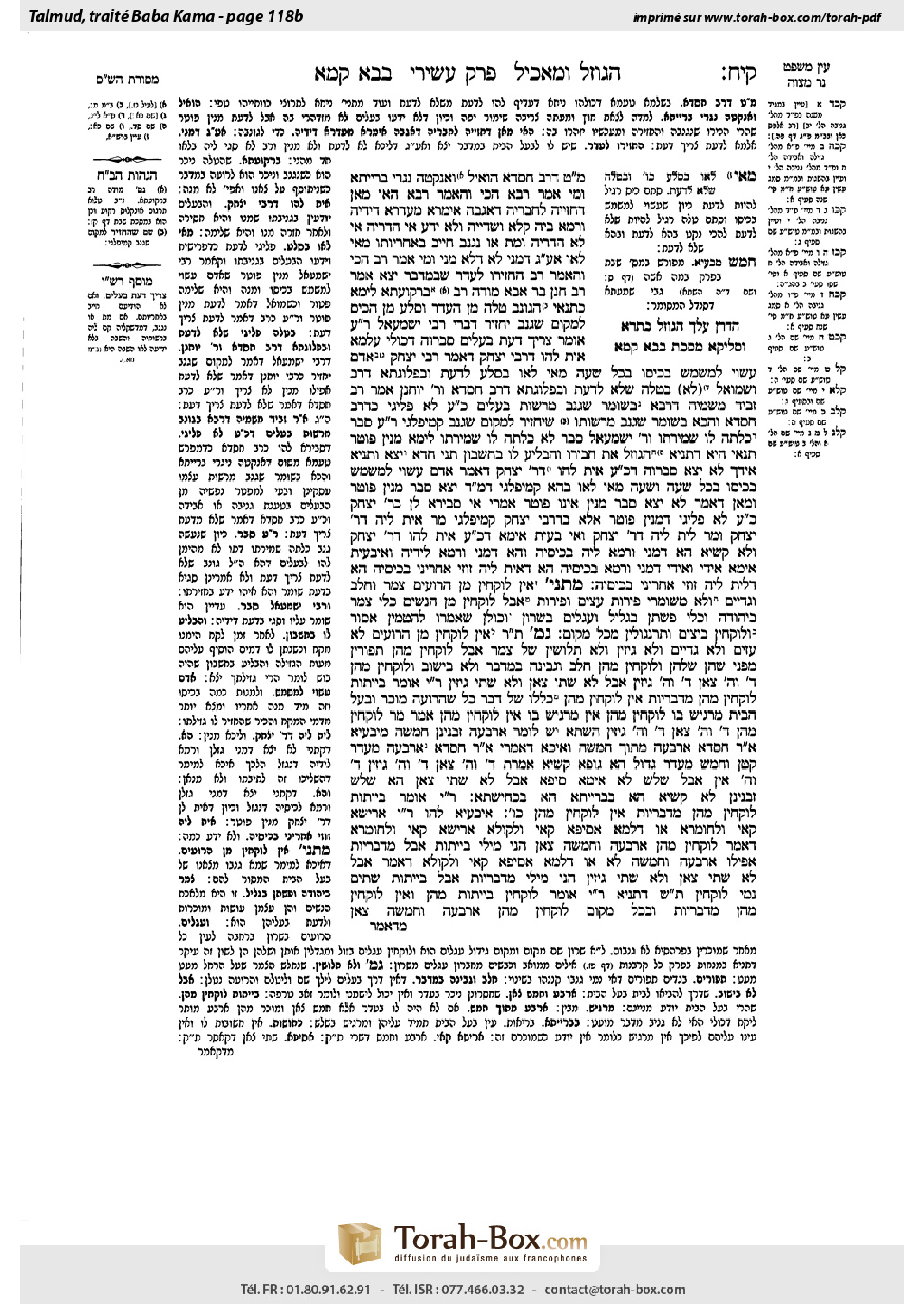
Bava Kamma 118b: Talmud study for Daf Yomi
Study the Talmud for Daf Yomi with scanned pages, Hebrew text, English translations from Sefaria and AI-generated French translations.
Passage selection and English or AI-generated French translation are available where the scan has annotations. Daf Study is independent of Torah-Box and Sefaria.
Browse Bava Kamma · בבא קמא · All tractatesBava Kamma 118b text and translations
This page of Bava Kamma includes the Aramaic text, an English translation and an AI-generated French translation, alongside the scan above.
בבא קמא קי״ח ב · Aramaic and Hebrew text
מַאי טַעְמָא דְּרַב חִסְדָּא? הוֹאִיל וְאַנְקְטַהּ נִגְרֵי בָּרָיָיתָא.
וּמִי אָמַר רָבָא הָכִי? וְהָאָמַר רָבָא: הַאי מַאן דְּחַזְיֵיהּ לְחַבְרֵיהּ דְּאַגְבַּהּ אִימְּרָא מֵעֶדְרָא דִידֵיהּ, וּרְמָא בֵּיהּ קָלָא וְשַׁדְיֵיהּ, וְלָא יְדַע אִי הֲדַרָה אִי לָא הֲדַרָה, וּמֵת אוֹ נִגְנַב – חַיָּיב בְּאַחְרָיוּתוֹ.
מַאי, לָאו אַף עַל גַּב דִּמְנִי? לָא, דְּלָא מְנִי.
וּמִי אָמַר רַב הָכִי? וְהָאָמַר רַב: הֶחְזִירוֹ לְעֵדֶר שֶׁבַּמִּדְבָּר – יָצָא! אָמַר רַב חָנָן בַּר אַבָּא: מוֹדֶה רַב בִּרְקוֹעָתָא.
לֵימָא כְּתַנָּאֵי: הַגּוֹנֵב טָלֶה מִן הָעֵדֶר, וְסֶלַע מִן הַכִּיס – לִמְקוֹם שֶׁגָּנַב יַחֲזִיר, דִּבְרֵי רַבִּי יִשְׁמָעֵאל. רַבִּי עֲקִיבָא אוֹמֵר: צָרִיךְ דַּעַת בְּעָלִים.
סַבְרוּהָ, דְּכוּלֵּי עָלְמָא אִית לְהוּ דְּרַבִּי יִצְחָק – דְּאָמַר רַבִּי יִצְחָק: אָדָם עָשׂוּי לְמַשְׁמֵשׁ בְּכִיסוֹ בְּכׇל שָׁעָה. מַאי, לָאו בְּסֶלַע לְדַעַת – וּבִפְלוּגְתָּא דְּרַב וּשְׁמוּאֵל?
לָא; בְּטָלֶה שֶׁלֹּא לְדַעַת, וּבִפְלוּגְתָּא דְּרַב חִסְדָּא וְרַבִּי יוֹחָנָן.
אָמַר רַב זְבִיד מִשְּׁמֵיהּ דְּרָבָא: בְּשׁוֹמֵר שֶׁגָּנַב מֵרְשׁוּת בְּעָלִים – כּוּלֵּי עָלְמָא לָא פְּלִיגִי, כִּדְרַב חִסְדָּא; וְהָכָא בְּשׁוֹמֵר שֶׁגָּנַב מֵרְשׁוּתוֹ, שֶׁיַּחֲזִיר לִמְקוֹם שֶׁגָּנַב קָמִיפַּלְגִי – רַבִּי עֲקִיבָא סָבַר: כָּלְתָה לוֹ שְׁמִירָתוֹ, וְרַבִּי יִשְׁמָעֵאל סָבַר: לֹא כָּלְתָה לוֹ שְׁמִירָתוֹ.
לֵימָא מִנְיָן פּוֹטֵר – תַּנָּאֵי הִיא? דְּתַנְיָא: הַגּוֹזֵל אֶת חֲבֵירוֹ, וְהִבְלִיעַ לוֹ בְּחֶשְׁבּוֹן – תָּנֵי חֲדָא: יָצָא, וְתַנְיָא אִידַּךְ: לֹא יָצָא.
סַבְרוּהָ, דְּכוּלֵּי עָלְמָא אִית לְהוּ דְּרַבִּי יִצְחָק, דְּאָמַר: אָדָם עָשׂוּי לְמַשְׁמֵשׁ בְּכִיסוֹ בְּכׇל שָׁעָה וְשָׁעָה. מַאי, לָאו בְּהָא קָמִיפַּלְגִי – דְּמַאן דְּאָמַר יָצָא, סָבַר: מִנְיָן פּוֹטֵר; וּמַאן דְּאָמַר לֹא יָצָא, סָבַר: מִנְיָן אֵינוֹ פּוֹטֵר?
אָמְרִי: אִי סְבִירָא לַן כְּרַבִּי יִצְחָק – כּוּלֵּי עָלְמָא לָא פְּלִיגִי דְּמִנְיָן פּוֹטֵר; אֶלָּא בִּדְרַבִּי יִצְחָק קָמִיפַּלְגִי – מָר אִית לֵיהּ דְּרַבִּי יִצְחָק, וּמָר לֵית לֵיהּ דְּרַבִּי יִצְחָק.
וְאִי בָּעֵית אֵימָא: דְּכוּלֵּי עָלְמָא אִית לְהוּ דְּרַבִּי יִצְחָק; וְלָא קַשְׁיָא, הָא דִּמְנִי וּרְמָא לֵיהּ בְּכִיסֵיהּ, וְהָא דִּמְנִי וּרְמָא לִידֵיהּ.
וְאִיבָּעֵית אֵימָא: אִידֵּי וְאִידֵּי דִּמְנִי וּרְמָא בְּכִיסֵיהּ; הָא דְּאִית לֵיהּ זוּזֵי אַחֲרִינֵי בְּכִיסֵיהּ, הָא דְּלֵית לֵיהּ זוּזֵי אַחֲרִינֵי בְּכִיסֵיהּ.
מַתְנִי׳ אֵין לוֹקְחִין מִן הָרוֹעִים – צֶמֶר וְחָלָב וּגְדָיִים, וְלֹא מִשּׁוֹמְרֵי פֵירוֹת – עֵצִים וּפֵירוֹת.
אֲבָל לוֹקְחִין מִן הַנָּשִׁים – כְּלֵי צֶמֶר בִּיהוּדָה, וּכְלֵי פִשְׁתָּן בַּגָּלִיל, וַעֲגָלִים בַּשָּׁרוֹן. וְכוּלָּן שֶׁאָמְרוּ לְהַטְמִין – אָסוּר. וְלוֹקְחִין בֵּיצִים וְתַרְנְגוֹלִין מִכׇּל מָקוֹם.
גְּמָ׳ תָּנוּ רַבָּנַן: אֵין לוֹקְחִין מִן הָרוֹעִים לֹא עִזִּים וְלֹא גְּדָיִים וְלֹא גִּיזִּין וְלֹא תְּלוּשִׁין שֶׁל צֶמֶר, אֲבָל לוֹקְחִין מֵהֶן תְּפוּרִין – מִפְּנֵי שֶׁהֵן שֶׁלָּהֶן. וְלוֹקְחִין מֵהֶן חָלָב וּגְבִינָה בַּמִּדְבָּר, וְלֹא בַּיִּשּׁוּב.
וְלוֹקְחִין מֵהֶן אַרְבַּע וְחָמֵשׁ צֹאן, אַרְבַּע וְחָמֵשׁ גִּיזִּין; אֲבָל לֹא שְׁתֵּי צֹאן וְלֹא שְׁתֵּי גִיזִּין.
רַבִּי יְהוּדָה אוֹמֵר: בַּיָּיתוֹת לוֹקְחִין מֵהֶן, מִדְבָּרִיּוֹת אֵין לוֹקְחִין מֵהֶן. כְּלָלוֹ שֶׁל דָּבָר: כֹּל שֶׁהָרוֹעֶה מוֹכֵר וּבַעַל הַבַּיִת מַרְגִּישׁ בּוֹ – לוֹקְחִין מֵהֶן, אֵין מַרְגִּישׁ בּוֹ – אֵין לוֹקְחִין מֵהֶן.
אָמַר מָר: לוֹקְחִין מֵהֶן אַרְבַּע וְחָמֵשׁ צֹאן, אַרְבַּע וְחָמֵשׁ גִּיזִּין. הַשְׁתָּא יֵשׁ לוֹמַר אַרְבַּע זָבְנִינַן, חָמֵשׁ מִיבַּעְיָא? אָמַר רַב חִסְדָּא: אַרְבַּע מִתּוֹךְ חָמֵשׁ. וְאִיכָּא דְּאָמְרִי, אָמַר רַב חִסְדָּא: אַרְבַּע מֵעֵדֶר קָטָן, וְחָמֵשׁ מֵעֵדֶר גָּדוֹל.
הָא גוּפָא קַשְׁיָא – אָמְרַתְּ: ״אַרְבַּע וְחָמֵשׁ צֹאן, אַרְבַּע וְחָמֵשׁ גִיזִּין״, אַרְבַּע וְחָמֵשׁ – אִין, אֲבָל שָׁלֹשׁ – לָא; אֵימָא סֵיפָא: ״אֲבָל לֹא שְׁתֵּי צֹאן״ – הָא שָׁלֹשׁ זָבְנִינַן!
לָא קַשְׁיָא; הָא בְּבָרְיָיתָא, הָא בִּכְחִישָׁתָא.
רַבִּי יְהוּדָה אוֹמֵר: בַּיָּיתוֹת לוֹקְחִין מֵהֶן, מִדְבָּרִיּוֹת אֵין לוֹקְחִין מֵהֶן כּוּ׳. אִיבַּעְיָא לְהוּ: רַבִּי יְהוּדָה – אַרֵישָׁא קָאֵי, וּלְחוּמְרָא; אוֹ דִלְמָא אַסֵּיפָא קָאֵי, וּלְקוּלָּא?
אַרֵישָׁא קָאֵי, וּלְחוּמְרָא – דְּאָמַר: ״לוֹקְחִין מֵהֶן אַרְבַּע וְחָמֵשׁ צֹאן״, הָנֵי מִילֵּי בַּיָּיתוֹת, אֲבָל מִדְבָּרִיּוֹת – אֲפִילּוּ אַרְבַּע וְחָמֵשׁ לֹא; אוֹ דִלְמָא אַסֵּיפָא קָאֵי, וּלְקוּלָּא – דְּאָמַר: ״אֲבָל לֹא שְׁתֵּי צֹאן וְלֹא שְׁתֵּי גִיזִּין״, הָנֵי מִילֵּי מִדְבָּרִיּוֹת, אֲבָל בַּיָּיתוֹת – שְׁתַּיִם נָמֵי לוֹקְחִין?
תָּא שְׁמַע: דְּתַנְיָא, רַבִּי יְהוּדָה אוֹמֵר: לוֹקְחִין בַּיָּיתוֹת מֵהֶן, וְאֵין לוֹקְחִין מֵהֶן מִדְבָּרִיּוֹת. וּבְכׇל מָקוֹם לוֹקְחִין מֵהֶן אַרְבַּע וְחָמֵשׁ צֹאן.
Bava Kamma 118b · English translation
What is the reasoning of Rav Ḥisda, who holds that the requirement to return the animal with the owner’s knowledge is in the case where the owners did not know about the theft? Since the thief taught the lamb to take steps outside, i.e., to leave the owners’ property, it will now require greater supervision, which the owners can provide only if they are aware of the situation.
The Gemara assumes that since Rava explained Rav Ḥisda’s reasoning, he accepts Rav Ḥisda’s ruling. The Gemara asks: But did Rava actually say this? Doesn’t Rava say that in the case of this person who saw another lift a lamb from his flock in order to steal it, and the owner then raised his voice at the thief, and the thief discarded it, but the owner did not know if the thief returned the lamb or if he did not return it, and the lamb then died or was stolen, the thief is to pay restitution for it?
The Gemara comments: What, is this statement of Rava not applicable even if the owner counted his flock after this incident? Accordingly, Rava rules that if the owner knew about the theft, the thief is rendered exempt from liability only if he returns the lamb with the owner’s knowledge, which is not in accordance with the ruling of Rav Ḥisda. The Gemara answers: No, Rava’s ruling applies only where the owner did not count the flock.
The Gemara examines Rav’s ruling. But did Rav actually say this? Doesn’t Rav say that if the thief returned the lamb to the owner’s flock that is in an unsettled area, he has fulfilled his obligation to return it? This indicates that the thief is exempt from further liability even though the thief did not inform the owner of the lamb’s return and the owner did not count the flock. The Gemara answers that Rav Ḥanan bar Abba said: Rav concedes that the thief is exempt in this case only where the lamb was spotted [birkuata]. Since the lamb’s spots are distinctive, the owner immediately becomes aware of its return.
The Gemara suggests: Let us say that the amoraic dispute cited previously is parallel to a dispute between tanna’im, as it is taught in a baraita: One who steals a lamb from a flock or a sela from a purse must return it to the place from where he stole it; this is the statement of Rabbi Yishmael. Rabbi Akiva says: The thief is required to return it with the knowledge of its owners.
The Gemara explains: The Sages discussing the matter assumed that everyone accepts the opinion of Rabbi Yitzḥak, as Rabbi Yitzḥak says: A person is prone to feel his purse constantly, and therefore becomes aware of the theft soon after it takes place. What, is it not a case where a sela was stolen with the owner’s knowledge, and the dispute of Rabbi Yishmael and Rabbi Akiva is parallel to the dispute of Rav and Shmuel? According to this explanation, Rav rules in accordance with the opinion of Rabbi Akiva, and Shmuel rules in accordance with the opinion of Rabbi Yishmael.
The Gemara responds: No, they disagree in the case of a lamb that was stolen without the knowledge of its owners, i.e., they did not know that it was stolen, and the dispute of Rabbi Yishmael and Rabbi Akiva is parallel to the dispute of Rav Ḥisda and Rabbi Yoḥanan. Rav Ḥisda rules in accordance with the opinion of Rabbi Akiva that the lamb must be returned with the owner’s knowledge, and Rabbi Yoḥanan rules in accordance with the opinion of Rabbi Yishmael that the owners do not need to become aware of the lamb’s return.
Rav Zevid said in the name of Rava: With regard to a bailee who stole a lamb from the owner’s domain, everyone, including Rabbi Yishmael, agrees that the halakha is in accordance with the opinion of Rav Ḥisda, and the owner must be aware of the animal’s return in order for the thief to become exempt from further liability. And here it is with regard to whether a bailee who stole from within his own domain may return what he stole to the place from where he stole it that they disagree. Rabbi Akiva holds: His safeguarding was terminated when he stole the lamb and he must therefore return it with the owner’s knowledge. And Rabbi Yishmael holds: His safeguarding was not terminated and he may return it to his own domain.
The Gemara suggests: Let us say that with regard to the dispute over whether the owner’s counting of his flock exempts a thief who returned a stolen lamb without notifying the owner, it is a dispute between tanna’im, as it is taught in a baraita: With regard to one who robbed another and then included the money he owed him for the robbery in the calculation of the payment for a different transaction, i.e., he compensated the owner by overpaying him for a different transaction, it is taught in one baraita: He has fulfilled his obligation to pay, and it is taught in another baraita: He has not fulfilled his obligation to pay.
The Sages discussing the matter assumed that everyone accepts the statement of Rabbi Yitzḥak, as Rabbi Yitzḥak says: A person is prone to feel his purse constantly, and therefore becomes aware that he has been compensated soon after the payment is made. What, is it not with regard to this following point that they disagree: The one who says that the robber has fulfilled his obligation holds that the counting of the property exempts a robber from further liability, and the one who says that the robber has not fulfilled his obligation holds that the counting does not exempt a robber from further liability.
The Gemara responds: One can say that if we held in accordance with the statement of Rabbi Yitzḥak, it would follow that everyone agrees that the counting of the property exempts a robber from further liability. Rather, it is with regard to the statement of Rabbi Yitzḥak itself that they disagree: One Sage accepts the statement of Rabbi Yitzḥak, and one Sage does not accept the statement of Rabbi Yitzḥak.
And if you wish, say instead that everyone accepts the statement of Rabbi Yitzḥak, and it is not difficult: This first baraita, which rules that the robber fulfilled his obligation, is discussing a case where the robber counted the money and placed it directly in the owner’s purse, which the owner will soon open and count. And that other baraita, which rules that the robber did not fulfill his obligation, is discussing a case where he counted the money and placed it in the owner’s hand. Consequently, it is possible that the owner will put the money directly into a container with other coins in it and will never realize that he was compensated for the theft.
And if you wish, say instead that both this baraita and that baraita are discussing a case where the robber counted the money and placed it in the owner’s purse. This baraita discusses a case where he has other dinars in his purse, but he did not know how many. Therefore, when he counts the money, he will not realize that the robber inserted an additional sum. Whereas that baraita is discussing a case where he does not have other dinars in his purse, so that when he counts the money he will realize that an additional sum has been included in the payment.
MISHNA: One may not purchase wool, milk, and kids from the shepherds who tend the flocks of others, due to the concern that they have stolen these items from the owners of the flocks. And similarly, one may not purchase wood and produce from produce watchmen.
But one may purchase from women woolen goods in Judea, and linen goods in the Galilee, and calves in the Sharon, as women in these locations often work with those commodities and it can be assumed that they are selling the items with the owner’s consent. And with regard to all these items, in a case where the seller told the buyer to conceal the purchase, it is prohibited, as there is good reason to suspect that the items are stolen. And one may purchase eggs and chickens from everywhere, as it is unlikely that one would steal and sell these commodities.
GEMARA: The Sages taught in a baraita (Tosefta 11:9): One may purchase from shepherds neither goats, nor kids, nor fleeces, nor torn pieces of wool, but one may purchase sewn garments from them, because they are presumed to be theirs. And one may purchase milk and cheese from them in an unsettled area, but not in a settled area.
And one may purchase from them four or five sheep or four or five fleeces at a time, because it is unlikely that a shepherd would risk stealing such a significant quantity at once. But one may not purchase two sheep, and similarly, one may not purchase two fleeces at a time, as it is reasonable to assume that the shepherd would attempt to steal this amount from the owner.
The baraita continues: Rabbi Yehuda says: One may purchase domesticated animals from them, as it is unlikely that the shepherds would steal them from their owner, who would notice if they did not return home. Conversely, one may not purchase desert, i.e., non-domesticated, animals from them, as it is more likely that a shepherd would steal these animals. The principle of the matter is that with regard to anything that the shepherd sells and the owner would perceive its absence if it were stolen, one may purchase it from them. But if the owner would not perceive its absence, one may not purchase it from them.
The Gemara examines the baraita: The Master said that one may purchase from them four or five sheep or four or five fleeces at a time. Now that it can be said that we may buy four sheep, as it is unlikely that the shepherd would steal such a large quantity at one time, is it necessary to state that we may buy five? The Gemara answers that Rav Ḥisda said: The meaning of the baraita is that one may purchase four sheep out of a flock consisting of five sheep, as it is reasonable to assume that the shepherd would not attempt to steal four-fifths of the owner’s flock. And there are those who say that Rav Ḥisda said as follows: Four sheep may be purchased from the shepherd of a small flock, and five may be purchased from the shepherd of a large flock.
The Gemara asks another question with regard to the baraita: This matter itself is difficult, as you said in the baraita: One may purchase from them four or five sheep or four or five fleeces at a time, which indicates that purchasing four or five, yes, it is permitted, but purchasing three, no, it is prohibited. Say the latter clause: But one may not purchase two sheep. This indicates that we may purchase three sheep at a time.
The Gemara answers that this is not difficult: This clause, which permits the purchase of three sheep, is discussing a case where the sheep are robust, and therefore the owner is more attentive to them and would notice if three were missing. Conversely, that clause, which prohibits the purchase of three sheep, is discussing a case where the sheep are frail. Consequently, the owner does not care about them as much, and it is possible that he would not notice if only three of them went missing.
The baraita teaches that Rabbi Yehuda says: One may purchase domesticated animals from them, but one may not purchase desert animals from them. A dilemma was raised before the Sages: Is the statement of Rabbi Yehuda referring to the first clause, and his statement is therefore a stringency? Or perhaps it is referring to the latter clause, and his statement is a leniency?
The Gemara elaborates: Is it referring to the first clause, and his statement is therefore a stringency, as he would be saying: One may purchase four or five sheep from them, and this statement applies only to domesticated animals, but with regard to desert animals, even four or five sheep may not be purchased? Or perhaps it is referring to the latter clause and it is a leniency, as he would be saying: But one may not purchase two sheep, and similarly, one may not purchase two fleeces, and this statement applies only to desert animals, but with regard to domesticated animals, one may purchase even two animals.
The Gemara presents an answer: Come and hear a resolution to the dilemma, as it is taught in a baraita that Rabbi Yehuda says: One may purchase domesticated animals from them, but one may not purchase desert animals from them. But one may always purchase four or five sheep from them.
Bava Kamma 118b · Traduction française (IA)
Quel est le raisonnement de Rav Ḥisda, qui affirme que la nécessité de rendre l'animal à l'owner avec son consentement s'applique dans le cas où les propriétaires ignoraient le vol ? Puisque le voleur a appris au mouton à marcher hors de la propriété, c'est-à-dire à quitter la propriété des propriétaires, il faudra désormais une surveillance accrue, que les propriétaires peuvent fournir uniquement s'ils sont informés de la situation.
La Guemara suppose que puisque Rava a expliqué le raisonnement de Rav Ḥisda, il accepte la décision de Rav Ḥisda. La Guemara pose la question : Mais Rava a-t-il vraiment dit cela ? N'est-ce pas que Rava dit que dans le cas d'une personne qui a vu un autre voler un mouton de son troupeau, et que l'owner a crié au voleur, et que le voleur a abandonné le mouton, mais que l'owner ne savait pas si le voleur avait rendu le mouton ou non, et que le mouton est ensuite mort ou volé, le voleur doit payer une compensation ?
La Guemara commente : Quoi, cette déclaration de Rava n'est-elle pas applicable même si l'owner a compté son troupeau après cet incident ? Ainsi, Rava décide que si l'owner savait du vol, le voleur est exempt de responsabilité uniquement s'il rend le mouton avec le consentement de l'owner, ce qui ne correspond pas à la décision de Rav Ḥisda. La Guemara répond : Non, la décision de Rava s'applique uniquement dans le cas où l'owner n'avait pas compté son troupeau.
La Guemara examine la décision de Rav. Mais Rav a-t-il vraiment dit cela ? N’est-ce pas que Rav dit que si le voleur rend le mouton au troupeau de l’propriétaire dans une zone non délimitée, il a accompli son devoir de le rendre ? Cela indique que le voleur est exempt de toute responsabilité supplémentaire même s’il n’a pas informé l’propriétaire de la restitution du mouton et que l’propriétaire n’a pas compté son troupeau. La Guemara répond que Rav Ḥanan bar Abba a dit : Rav reconnaît que le voleur est exempt dans ce cas uniquement si le mouton était identifiable [birkuata]. Puisque les marques du mouton sont distinctives, l’propriétaire devient immédiatement conscient de sa restitution.
La Guemara suggère : Disons que le débat entre les amoraïm cité précédemment est parallèle à un débat entre les tannaïm, comme il est enseigné dans une baraïta : Celui qui vole un mouton d’un troupeau ou une sela d’un sac doit le rendre à l’endroit d’où il l’a volé ; c’est la déclaration de Rabbi Yishmael. Rabbi Akiva dit : Le voleur doit le rendre avec la connaissance des propriétaires.
La Guemara explique : Les Sages discutant de la question supposent que tout le monde accepte l’opinion de Rabbi Yitzḥak, comme Rabbi Yitzḥak dit : Une personne est enclin à sentir constamment son sac, et donc devient conscient du vol peu après qu’il a eu lieu. Quoi, n’est-ce pas un cas où une sela a été volée avec la connaissance du propriétaire, et le débat de Rabbi Yishmael et Rabbi Akiva est parallèle au débat de Rav et Shmuel ? Selon cette explication, Rav décide conformément à l’opinion de Rabbi Akiva, et Shmuel décide conformément à l’opinion de Rabbi Yishmael.
La Guemara répond : Non, ils divergent dans le cas d'un mouton volé sans la connaissance des propriétaires, c'est-à-dire qu'ils ne savaient pas qu'il avait été volé, et le débat de Rabbi Yishmael et Rabbi Akiva est parallèle au débat de Rav Ḥisda et Rabbi Yoḥanan. Rav Ḥisda décide conformément à l'opinion de Rabbi Akiva que le mouton doit être rendu avec la connaissance des propriétaires, et Rabbi Yoḥanan décide conformément à l'opinion de Rabbi Yishmael que les propriétaires n'ont pas besoin de devenir conscients de la restitution du mouton.
Rav Zevid a dit en nom de Rava : Concernant un bailee qui a volé un mouton de la propriété de l'owner, tout le monde, y compris Rabbi Yishmael, est d'accord que la halakha suit l'opinion de Rav Ḥisda, et que l'owner doit être conscient de la restitution de l'animal pour que le voleur soit exempt de toute responsabilité supplémentaire. Et ici, il s'agit de savoir si un bailee qui a volé dans sa propre propriété peut rendre ce qu'il a volé à l'endroit d'où il l'a volé. Rabbi Akiva dit : Son garde était terminée lorsqu'il a volé le mouton et il doit donc le rendre avec la connaissance de l'owner. Rabbi Yishmael dit : Son garde n'était pas terminée et il peut le rendre dans sa propre propriété.
La Guemara suggère : Disons que le débat sur la question de savoir si le comptage de la propriété de l'owner exempt un voleur qui a rendu un mouton volé sans informer l'owner est un débat entre les tannaïm, comme il est enseigné dans une baraïta : Concernant celui qui a volé à un autre et a ensuite inclus la somme qu'il devait pour le vol dans le calcul du paiement d'une autre transaction, c'est-à-dire qu'il a compensé l'owner en payant davantage pour une autre transaction, il est enseigné dans une baraïta : Il a accompli son devoir de payer, et dans une autre baraïta : Il n'a pas accompli son devoir de payer.
Les Sages discutant de la question supposent que tout le monde accepte la déclaration de Rabbi Yitzḥak, car Rabbi Yitzḥak dit : Une personne est enclin à sentir constamment son sac, et donc devient conscient qu'il a été compensé peu après le paiement. Quoi, n'est-ce pas concernant ce point suivant qu'ils divergent : Celui qui dit que le voleur a accompli son devoir affirme que le comptage de la propriété exempt le voleur de toute responsabilité supplémentaire, et celui qui dit que le voleur n'a pas accompli son devoir affirme que le comptage ne exempt pas le voleur de toute responsabilité supplémentaire.
La Guemara répond : On peut dire que si nous avions suivi la déclaration de Rabbi Yitzḥak, il en résulterait que tout le monde est d'accord que le comptage de la propriété exempt le voleur de toute responsabilité supplémentaire. Cependant, c'est concernant la déclaration de Rabbi Yitzḥak elle-même que divergent : Un Sage accepte la déclaration de Rabbi Yitzḥak, et un autre Sage ne l'accepte pas.
Et si vous le souhaitez, dites plutôt que tout le monde accepte l'opinion du Rabbi Yitzḥak, et cela n'est pas difficile : cette première baraïta, qui établit que le voleur a accompli son obligation, discute d'un cas où le voleur a compté l'argent et l'a mis directement dans la bourse de l'owner, que l'owner ouvrira bientôt et comptera. Et cette autre baraïta, qui établit que le voleur n'a pas accompli son obligation, discute d'un cas où il a compté l'argent et l'a mis dans la main de l'owner. Ainsi, il est possible que l'owner mette directement l'argent dans un contenant avec d'autres pièces et ne réalise jamais qu'il a été compensé pour le vol.
Et si vous le souhaitez, dites plutôt que ces deux baraitas discutent toutes deux d'un cas où le voleur a compté l'argent et l'a mis dans la bourse de l'owner. Cette baraïta discute d'un cas où il possède d'autres dinars dans sa bourse, mais ne sait pas combien. Ainsi, lorsqu'il compte l'argent, il ne réalisera pas que le voleur a ajouté une somme supplémentaire. En revanche, cette autre baraïta discute d'un cas où il n'a pas d'autres dinars dans sa bourse, de sorte qu'il réalisera lorsqu'il compte l'argent que la somme supplémentaire a été incluse dans le paiement.
MICHNA : On ne peut pas acheter de laine, du lait et des agneaux aux bergers qui tiennent les troupeaux d'autrui, en raison de la crainte qu'ils aient volé ces objets aux propriétaires des troupeaux. De même, on ne peut pas acheter du bois et des produits agricoles aux gardiens de récoltes.
Mais on peut acheter des produits en laine en Judée auprès des femmes, et des tissus en Galilée, ainsi que des veaux en Sharon, car les femmes de ces lieux travaillent souvent avec ces produits et on peut supposer qu'elles les vendent avec le consentement de leurs propriétaires. Et concernant tous ces objets, dans le cas où le vendeur demande au acheteur de cacher l'achat, cela est interdit, car il y a de bonnes raisons de soupçonner que les objets sont volés. On peut acheter des œufs et des poulets partout, car il est peu probable qu'on vole et vend ces produits.
GUEMARA : Les Sages ont enseigné dans une baraïta (Tosefta 11:9) : On ne peut pas acheter de chèvres, d'agneaux, de toiles ou de morceaux de laine déchirés auprès des bergers, mais on peut acheter des vêtements cousus auprès d'eux, car on les suppose être leurs propriétés. On peut acheter du lait et du fromage auprès d'eux dans une région non habité, mais pas dans une région habité.
On peut acheter quatre ou cinq brebis ou quatre ou cinq toiles à la fois auprès d'eux, car il est peu probable qu'un berger risque de voler une telle quantité à la fois. Mais on ne peut pas acheter deux brebis, et de même, on ne peut pas acheter deux toiles à la fois, car on peut raisonnablement supposer que le berger tenterait de voler cette quantité à l'égard du propriétaire.
La baraïta continue : Rabbi Yéhuda dit : On peut acheter des animaux domestiques auprès d'eux, car il est peu probable que les bergers volent ces animaux de leur propriétaire, qui les remarquerait s'ils ne rentraient pas chez eux. À l'inverse, on ne peut pas acheter des animaux de brousse, c'est-à-dire non domestiques, auprès d'eux, car il est plus probable qu'un berger vole ces animaux. Le principe de la question est que concernant tout ce que le berger vend et dont le propriétaire percevrait l'absence s'il était volé, on peut l'acheter auprès d'eux. Mais si le propriétaire ne percevrait pas l'absence, on ne peut pas l'acheter auprès d'eux.
La Guemara examine la baraïta : Le Maître a dit qu'on peut acheter quatre ou cinq brebis ou quatre ou cinq toiles à la fois. Maintenant qu'on peut dire qu'on peut acheter quatre brebis, car il est peu probable que le berger vole une telle quantité à la fois, est-il nécessaire d'indiquer qu'on peut acheter cinq ? La Guemara répond que Rav Ḥisda a dit : Le sens de la baraïta est qu'on peut acheter quatre brebis d'une troupeau composé de cinq brebis, car on peut raisonnablement supposer que le berger ne tenterait pas de voler quatre cinquièmes du troupeau de l'owner. Et certains disent que Rav Ḥisda a dit comme suit : quatre brebis peuvent être achetées auprès du berger d'un petit troupeau, et cinq peuvent être achetées auprès du berger d'un grand troupeau.
La Guemara pose une autre question concernant la baraïta : cette question elle-même est difficile, car vous avez dit dans la baraïta : on peut acheter quatre ou cinq brebis ou quatre ou cinq toiles à la fois, ce qui indique que l'achat de quatre ou cinq est permis, mais l'achat de trois est interdit. Dites la dernière clause : mais on ne peut pas acheter deux brebis. Cela indique qu'on peut acheter trois brebis à la fois.
La Guemara répond que cela n'est pas difficile : cette clause, qui permet l'achat de trois brebis, discute d'un cas où les brebis sont robustes, et donc l'propriétaire les surveille davantage et remarquerait s'il en manquait trois. À l'inverse, cette clause, qui interdit l'achat de trois brebis, discute d'un cas où les brebis sont faibles. Ainsi, l'propriétaire ne s'en occupe pas autant, et il est possible qu'il ne remarque pas si seulement trois d'entre elles manquaient.
La baraïta enseigne que Rabbi Yéhuda dit : on peut acheter des animaux domestiques auprès d'eux, mais on ne peut pas acheter des animaux sauvages auprès d'eux. Un dilemme a été soulevé devant les Sages : la déclaration de Rabbi Yéhuda fait-elle référence à la première clause, et sa déclaration est donc une stricte interprétation ? Ou peut-être fait-elle référence à la seconde clause, et sa déclaration est une interprétation plus large ?
La Guemara développe : S'agit-il du premier verset, et sa déclaration est donc une stricte interprétation, car il dirait : On peut acheter quatre ou cinq brebis d'eux, et cette déclaration s'applique uniquement aux animaux domestiques, mais concernant les animaux des déserts, même quatre ou cinq brebis ne peuvent être achetés ? Ou peut-être s'agit-il du second verset et c'est une leniency, car il dirait : Mais on ne peut pas acheter deux brebis, et de même, on ne peut pas acheter deux pelotes, et cette déclaration s'applique uniquement aux animaux des déserts, mais concernant les animaux domestiques, on peut acheter même deux animaux.
La Guemara présente une réponse : Approchez-vous et écoutez une résolution à ce dilemme, car il est enseigné dans une baraïta que Rabbi Yéhuda dit : On peut acheter des animaux domestiques d'eux, mais on ne peut pas acheter des animaux des déserts d'eux. Mais on peut toujours acheter quatre ou cinq brebis d'eux.
Traduction française générée par IA à partir de l’édition anglaise de Sefaria. Vérifie toujours un passage avec le texte source.
Text from Sefaria: William Davidson Edition - Vocalized Aramaic (CC BY NC); William Davidson Edition - English (CC BY NC).