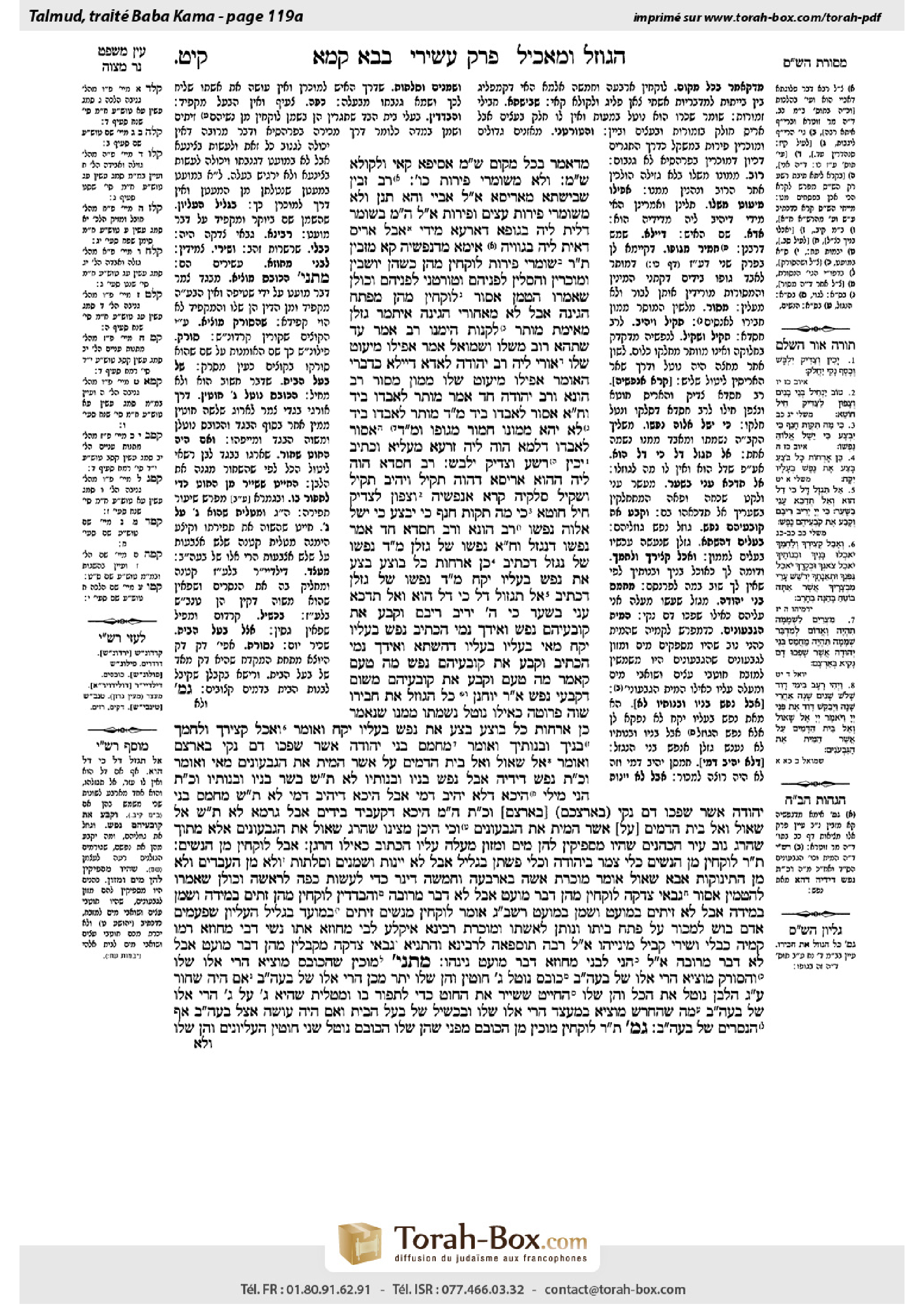
Bava Kamma 119a: Talmud study for Daf Yomi
Study the Talmud for Daf Yomi with scanned pages, Hebrew text, English translations from Sefaria and AI-generated French translations.
Passage selection and English or AI-generated French translation are available where the scan has annotations. Daf Study is independent of Torah-Box and Sefaria.
Browse Bava Kamma · בבא קמא · All tractatesBava Kamma 119a text and translations
This page of Bava Kamma includes the Aramaic text, an English translation and an AI-generated French translation, alongside the scan above.
בבא קמא קי״ט א · Aramaic and Hebrew text
מִדְּאָמַר ״בְּכׇל מָקוֹם״, שְׁמַע מִינַּהּ אַסֵּיפָא קָאֵי, וּלְקוּלָּא! שְׁמַע מִינַּהּ.
וְלֹא מִשּׁוֹמְרֵי פֵירוֹת כּוּ׳. רָבָא זָבֵין שְׁבִישָׁתָא מֵאֲרִיסָא. אֲמַר לֵיהּ אַבָּיֵי, וְהָא תְּנַן: וְלֹא מִשּׁוֹמְרֵי פֵירוֹת – עֵצִים וּפֵירוֹת! אֲמַר לֵיהּ: הָנֵי מִילֵּי בְּשׁוֹמֵר, דְּלֵית לֵיהּ בְּגוּפָא דְאַרְעָא מִידֵּי; אֲבָל אָרִיס, דְּאִית לֵיהּ בְּגַוֵּויהּ – אֵימָא מִדְּנַפְשֵׁיהּ קָא מְזַבֵּין.
תָּנוּ רַבָּנַן: שׁוֹמְרֵי פֵירוֹת – לוֹקְחִין מֵהֶן כְּשֶׁהֵן יוֹשְׁבִין וּמוֹכְרִין, וְהַסַּלִּין לִפְנֵיהֶם, וְטוּרְטָנֵי לִפְנֵיהֶם. וְכוּלָּן שֶׁאָמְרוּ: ״הַטְמֵן״ – אָסוּר. לוֹקְחִין מֵהֶן מִפֶּתַח הַגִּינָּה, אֲבָל לֹא מֵאֲחוֹרֵי הַגִּינָּה.
אִיתְּמַר: גַּזְלָן, מֵאֵימַת מוּתָּר לִקְנוֹת הֵימֶנּוּ? רַב אָמַר: עַד שֶׁתְּהֵא רוֹב מִשֶּׁלּוֹ, וּשְׁמוּאֵל אָמַר: אֲפִילּוּ מִיעוּט שֶׁלּוֹ.
אוֹרִי לֵיהּ רַב יְהוּדָה לְאַדָּא דַּיָּילָא כְּדִבְרֵי הָאוֹמֵר אֲפִילּוּ מִיעוּט שֶׁלּוֹ.
מָמוֹן מָסוֹר – רַב הוּנָא וְרַב יְהוּדָה; חַד אָמַר: מוּתָּר לְאַבְּדוֹ בַּיָּד, וְחַד אָמַר: אָסוּר לְאַבְּדוֹ בַּיָּד.
מַאן דְּאָמַר מוּתָּר לְאַבְּדוֹ בַּיָּד – לֹא יְהֵא מָמוֹנוֹ חָמוּר מִגּוּפוֹ. וּמַאן דְּאָמַר אָסוּר לְאַבְּדוֹ – דִּלְמָא הָוֵה לֵיהּ זַרְעָא מְעַלְּיָא, וּכְתִיב: ״יָכִין רָשָׁע וְצַדִּיק יִלְבַּשׁ״.
רַב חִסְדָּא הֲוָה לֵיהּ הָהוּא אֲרִיסָא, דַּהֲוָה תָּקֵיל וְיָהֵיב תָּקֵיל וְשָׁקֵיל. סַלְּקֵיהּ, קְרָא אַנַּפְשֵׁיהּ: ״וְצָפוּן לַצַּדִּיק חֵיל חוֹטֵא״.
״כִּי מַה תִּקְוַת חָנֵף כִּי יִבְצָע, כִּי יֵשֶׁל אֱלוֹהַּ נַפְשׁוֹ״ – רַב הוּנָא וְרַב חִסְדָּא; חַד אָמַר: נַפְשׁוֹ דְּנִגְזָל, וְחַד אָמַר: נַפְשׁוֹ שֶׁל גַּזְלָן.
מַאן דְּאָמַר נַפְשׁוֹ שֶׁל נִגְזָל – דִּכְתִיב: ״כֵּן אׇרְחוֹת כׇּל בֹּצֵעַ בָּצַע, אֶת נֶפֶשׁ בְּעָלָיו יִקָּח״. מַאן דְּאָמַר נַפְשׁוֹ שֶׁל גַּזְלָן – דִּכְתִיב: ״אַל תִּגְזׇל דַּל כִּי דַּל הוּא, וְאַל תְּדַכֵּא עָנִי בַשָּׁעַר. כִּי ה׳ יָרִיב רִיבָם, וְקָבַע אֶת קֹבְעֵיהֶם נָפֶשׁ״.
וְאִידַּךְ נָמֵי, הָכְתִיב: ״נֶפֶשׁ בְּעָלָיו יִקָּח״! מַאי ״בְּעָלָיו״ – בְּעָלָיו דְּהַשְׁתָּא.
וְאִידַּךְ נָמֵי, הָכְתִיב: ״וְקָבַע אֶת קֹבְעֵיהֶם נָפֶשׁ״! ״מָה טַעַם״ קָאָמַר – מָה טַעַם ״וְקָבַע אֶת קֹבְעֵיהֶם״? מִשּׁוּם דְּקָבְעִי נֶפֶשׁ.
אָמַר רַבִּי יוֹחָנָן: כׇּל הַגּוֹזֵל אֶת חֲבֵירוֹ שָׁוֶה פְּרוּטָה – כְּאִילּוּ נוֹטֵל נִשְׁמָתוֹ מִמֶּנּוּ, שֶׁנֶּאֱמַר: ״כֵּן אׇרְחוֹת כׇּל בּוֹצֵעַ בָּצַע, אֶת נֶפֶשׁ בְּעָלָיו יִקָּח״; וְאוֹמֵר: ״וְאָכַל קְצִירְךָ וְלַחְמֶךָ, בָּנֶיךָ וּבְנוֹתֶיךָ״.
וְאוֹמֵר: ״מֵחֲמַס בְּנֵי יְהוּדָה, אֲשֶׁר שָׁפְכוּ דָם נָקִי בְּאַרְצָם״; וְאוֹמֵר: ״אֶל שָׁאוּל וְאֶל בֵּית הַדָּמִים, עַל אֲשֶׁר הֵמִית אֶת הַגִּבְעֹנִים״.
מַאי ״וְאוֹמֵר״? וְכִי תֵּימָא נֶפֶשׁ דִּידֵיהּ, אֲבָל נֶפֶשׁ בָּנָיו וּבְנוֹתָיו לָא – תָּא שְׁמַע: ״בְּשַׂר בָּנָיו וּבְנוֹתָיו״.
וְכִי תֵּימָא, הָנֵי מִילֵּי הֵיכָא דְּלָא יָהֵיב דְּמֵי, אֲבָל הֵיכָא דְּיָהֵיב דְּמֵי לָא – תָּא שְׁמַע: ״מֵחֲמַס בְּנֵי יְהוּדָה, אֲשֶׁר שָׁפְכוּ דָם נָקִי (בְּאַרְצְכֶם) [בְּאַרְצָם]״.
וְכִי תֵּימָא, הָנֵי מִילֵּי הֵיכָא דְּקָעָבֵיד בְּיָדַיִם, אֲבָל גְּרָמָא לָא – תָּא שְׁמַע: ״אֶל שָׁאוּל וְאֶל בֵּית הַדָּמִים, [עַל] אֲשֶׁר הֵמִית אֶת הַגִּבְעֹנִים״; וְכִי הֵיכָן מָצִינוּ שֶׁהָרַג שָׁאוּל אֶת הַגִּבְעוֹנִים? אֶלָּא מִתּוֹךְ שֶׁהָרַג נוֹב עִיר הַכֹּהֲנִים שֶׁהָיוּ מַסְפִּיקִין לָהֶן מַיִם וּמָזוֹן, מַעֲלֶה עָלָיו הַכָּתוּב כְּאִילּוּ הֲרָגָן.
אֲבָל לוֹקְחִין מִן הַנָּשִׁים. תָּנוּ רַבָּנַן: לוֹקְחִין מִן הַנָּשִׁים כְּלֵי צֶמֶר בִּיהוּדָה וּכְלֵי פִשְׁתָּן בַּגָּלִיל, אֲבָל לֹא יֵינוֹת וּשְׁמָנִים וּסְלָתוֹת. וְלֹא מִן הָעֲבָדִים, וְלֹא מִן הַתִּינוֹקוֹת. אַבָּא שָׁאוּל אוֹמֵר: מוֹכֶרֶת אִשָּׁה בְּאַרְבָּעָה וַחֲמִשָּׁה דִּינָרִ[ין], כְּדֵי לַעֲשׂוֹת כִּפָּה לְרֹאשָׁהּ. וְכוּלָּן שֶׁאָמְרוּ לְהַטְמִין – אָסוּר.
גַּבָּאֵי צְדָקָה לוֹקְחִין מֵהֶן דָּבָר מוּעָט, אֲבָל לֹא דָּבָר מְרוּבֶּה.
וְהַבַּדָּדִין – לוֹקְחִין מֵהֶן זֵתִים בְּמִידָּה, וְשֶׁמֶן בְּמִידָּה. אֲבָל לֹא זֵיתִים בְּמוּעָט וְשֶׁמֶן בְּמוּעָט. רַבָּן שִׁמְעוֹן בֶּן גַּמְלִיאֵל אוֹמֵר: לוֹקְחִין מִנָּשִׁים זֵיתִים בְּמוּעָט בַּגָּלִיל הָעֶלְיוֹן, שֶׁפְּעָמִים אָדָם בּוֹשׁ לִמְכּוֹר עַל פֶּתַח בֵּיתוֹ, וְנוֹתֵן לְאִשְׁתּוֹ וּמוֹכֶרֶת.
רָבִינָא אִיקְּלַע לְבֵי מָחוֹזָא, אֲתוֹ נְשֵׁי דְּבֵי מָחוֹזָא רְמוֹ קַמֵּיהּ כַּבְלֵי וְשֵׁירֵי, קַבֵּיל מִינַּיְיהוּ. אֲמַר לֵיהּ רַבָּה תּוֹסְפָאָה לְרָבִינָא, וְהָתַנְיָא: גַּבָּאֵי צְדָקָה מְקַבְּלִין מֵהֶן דָּבָר מוּעָט, אֲבָל לֹא דָּבָר מְרוּבֶּה! אֲמַר לֵיהּ: הָנֵי, לִבְנֵי מָחוֹזָא דָּבָר מוּעָט נִינְהוּ.
מַתְנִי׳ מוֹכִין שֶׁהַכּוֹבֵס מוֹצִיא – הֲרֵי אֵלּוּ שֶׁלּוֹ, וְהַסּוֹרֵק מוֹצִיא – הֲרֵי אֵלּוּ שֶׁל בַּעַל הַבַּיִת. כּוֹבֵס נוֹטֵל שְׁלֹשָׁה חוּטִין – וְהֵן שֶׁלּוֹ, יָתֵר מִכֵּן – הֲרֵי אֵלּוּ שֶׁל בַּעַל הַבַּיִת. אִם הָיָה שָׁחוֹר עַל גַּבֵּי הַלָּבָן – נוֹטֵל אֶת הַכֹּל וְהֵן שֶׁלּוֹ.
הַחַיָּיט שֶׁשִּׁיֵּיר אֶת הַחוּט כְּדֵי לִתְפּוֹר בּוֹ, וּמַטְלֵית שֶׁהִיא שָׁלֹשׁ עַל שָׁלֹשׁ – הֲרֵי אֵלּוּ שֶׁל בַּעַל הַבַּיִת. מָה שֶׁהֶחָרָשׁ מוֹצִיא בְּמַעֲצָד – הֲרֵי אֵלּוּ שֶׁלּוֹ, וּבְכַשִּׁיל – שֶׁל בַּעַל הַבַּיִת. וְאִם הָיָה עוֹשֶׂה אֵצֶל בַּעַל הַבַּיִת – אַף הַנְּסָרִים שֶׁל בַּעַל הַבַּיִת.
גְּמָ׳ תָּנוּ רַבָּנַן: לוֹקְחִין מוֹכִין מִן הַכּוֹבֵס, מִפְּנֵי שֶׁהֵן שֶׁלּוֹ. הַכּוֹבֵס נוֹטֵל שְׁנֵי חוּטִין הָעֶלְיוֹנִים – וְהֵן שֶׁלּוֹ.
Bava Kamma 119a · English translation
From the fact that he stated that four or five animals may always be purchased, conclude from it that Rabbi Yehuda’s statement is referring to the latter clause, and his statement is a leniency. The Gemara affirms: Conclude from it that Rabbi Yehuda intended his statement as a leniency.
§ The mishna teaches: And similarly, one may not purchase wood and produce from produce watchmen. The Gemara relates that Rava purchased grapevine branches from a sharecropper. Abaye said to him: But didn’t we learn in the mishna: And similarly, one may not purchase wood and produce from produce watchmen? The same halakha should apply with regard to a sharecropper, who, like a watchman, is not the owner of the produce. Rav said to him: This statement applies only with regard to a watchman, as he has no share at all in the land itself. But with regard to a sharecropper, who does have a share in it, say: He is selling merchandise from his own share of the land. Since it is plausible that the sharecropper is selling his own property, it is permitted to buy it from him.
The Gemara cites a baraita which discusses purchasing items from watchmen: The Sages taught (Tosefta 11:8): With regard to produce watchmen, one may purchase produce from them when they are sitting and selling the produce, and the baskets are before them and the scales [veturtanei] are before them, as in these circumstances it is reasonable to assume that they are not selling stolen merchandise. But in all cases where they said to the buyer: Conceal your purchase, it is prohibited to purchase from them, as there is good reason to suspect that the merchandise is stolen. The baraita adds: One may purchase from a watchman from the entrance of the garden, but not from the back of the garden, because if the produce is being sold inconspicuously, there is a concern that it might have been stolen.
§ Having discussed the halakha pertaining to suspected theft, the Gemara proceeds to examine the halakha pertaining to purchasing items from a known robber. It was stated: With regard to a robber, from when is it permitted to purchase items from him? Rav says: It is prohibited until the majority of his possessions are from his own property, i.e., property that he obtained legally. And Shmuel says: It is permitted to purchase items from a known robber even if only a minority of his possessions are from his own property.
The Gemara notes that Rav Yehuda instructed Adda, his attendant, in accordance with the statement of the one who says: It is permitted to purchase items from a known robber even if only a minority of his possessions are from his own property, i.e., in accordance with the opinion of Shmuel.
With regard to the property of an informer, i.e., one who informs gentiles of the whereabouts of another’s property, facilitating its theft or misuse, there is a dispute between Rav Huna and Rav Yehuda. One says: It is permitted to physically destroy it, and one says: It is prohibited to physically destroy it.
The Gemara elaborates: The rationale of the one who says that it is permitted to physically destroy it is that an informer’s property should not be subject to a more stringent halakha than his body. Since it is permitted to physically harm or even kill an informer, it would be unreasonable to prohibit the destruction of his property. And the rationale of the one who says that it is prohibited to physically destroy it is that perhaps he will have good children, and it is written: The wicked may prepare it, but the just shall put it on (see Job 27:17).
The Gemara relates that Rav Ḥisda had a certain sharecropper who would weigh the field’s produce and give Rav Ḥisda his portion, and weigh the produce and take his own portion. Rav Ḥisda dismissed him, and read the following verse about him: “A good man leaves an inheritance to his children’s children; and the wealth of the sinner is laid up for the righteous” (Proverbs 13:22).
§ The Gemara examines various verses pertaining to robbers. “For what is the hope of the godless, though he profits, when God takes away his soul?” (Job 27:8). This verse is the subject of a dispute between Rav Huna and Rav Ḥisda. One says that the phrase “God takes away his soul” is referring to the soul of the robbed, and one says that it is referring to the soul of the robber.
The Gemara elaborates: The rationale of the one who says that the verse is referring to the soul of the robbed is as it is written: “So are the ways of every one that is greedy for profit; it takes away the life of the owner thereof” (Proverbs 1:19), which teaches that one who robs another of his property is considered as one who robbed him of his soul. And the rationale of the one who says that it is referring to the soul of the robber is as it is written: “Rob not the weak, because he is weak, neither crush the poor in the gate; for the Lord will plead their cause, and despoil of life those that despoil them” (Proverbs 22:22–23).
The Gemara questions each opinion: And according to the other opinion, i.e., the latter one, isn’t it also written: “It takes away the life of the owner thereof,” which indicates that the soul of the robbed is taken? The Gemara answers: What is the meaning of the phrase “the owner thereof”? It is referring to its current owner, i.e., the robber, who has acquired the stolen item.
And according to the other opinion, who said that the life of the robbed is taken, isn’t it also written: “And despoil of life those that despoil them,” which indicates that the soul of the robber is taken? The Gemara answers that the verse is saying: What is the reason. The verse teaches: What is the reason that God will despoil the life of those who despoil them? It is because they despoiled the soul of their victims.
Rabbi Yoḥanan says: Anyone who robs another of an item worth one peruta is considered as though he takes his soul from him, as it is stated: “So are the ways of every one that is greedy for profit; it takes away the life of the owner thereof” (Proverbs 1:19). And it states: “And they shall consume your harvest, and your bread, they shall consume your sons and your daughters” (Jeremiah 5:17). Since they will consume the harvest and bread, it is as though they consume one’s children as well because there will be no food to feed them.
And it states: “Egypt shall be a desolation, and Edom shall be a desolate wilderness, for the extortion of the children of Judah, because they have shed innocent blood in their land” (Joel 4:19). The verse here considers extortion like the shedding of innocent blood. And it states with regard to a famine: “And the Lord said: It is for Saul, and for his bloody house, because he put to death the Gibeonites” (II Samuel 21:1).
The Gemara asks: Since Rabbi Yoḥanan’s point was proven by the first verse, what was the purpose of adding each subsequent verse by saying: And it states? The Gemara answers: And if you would say that the robber takes only his, i.e., the victim’s, life, but the lives of his sons and daughters are not taken, come and hear the second verse, which mentions the flesh of his sons and daughters.
And if you would say: This matter applies only where the robber does not give his victim compensation for the stolen item, but where he gave compensation for the stolen item, it is not comparable to murder, come and hear the verse: “For the extortion of the children of Judah, because they have shed innocent blood in their land.” Extortion is referring to coercing someone to sell an item that he does not want to sell. It is a form of robbery, and the verse equates it with murder.
And if you would say: This matter applies only where he committed the robbery by direct action, but if he committed it through indirect action, the transgression is not as severe, come and hear the verse: “It is for Saul, and for his bloody house, because he put to death the Gibeonites.” And where did we ever find that Saul killed the Gibeonites? He did not do so. Rather, due to the fact that he killed the residents of Nob, the city of the priests, who would provide the Gibeonites with water (see I Samuel, chapter 22) and food, the verse ascribes him blame for their death as though he had killed the Gibeonites himself.
§ The mishna teaches: But one may purchase specific goods from women in certain places. The Sages taught in a baraita (Tosefta 11:5): One may purchase from women woolen goods in Judea, and linen goods in the Galilee, but not wines, oils, and flours, as these are not usually sold by women and there is a concern that perhaps the women stole them from their husbands. And no items may be purchased from slaves, or from children. Abba Shaul says: A woman may sell items for up to four and five dinars in order to make a cap [kippa] for her head, as it is assumed that her husband allows her to sell these items in order to purchase additional articles of clothing. And with regard to all of those cases, where they told the buyer to conceal his purchase, it is prohibited to enter into the transaction.
Charity collectors may take something worth a small amount from women, but not something worth a large amount, as it is possible that they do not have permission to give away expensive items.
And with regard to olive pressers, one may purchase from them olives in a substantial measure, and oil in a substantial measure, as there is no concern that they would steal such a large amount, but not olives in a small amount, and not oil in a small amount. Rabban Shimon ben Gamliel says: One may purchase olives in small amounts from women in the Upper Galilee, where olives are exceptionally expensive, as at times, a person is embarrassed to sell olives at the entrance of his house, and so he gives some olives to his wife, and she sells them. Since there is a reason to presume that the women have been given the right to sell the olives by their husbands, and it is unlikely that the women would sell them without permission, as even a small amount missing would be noticed due to their great value, it may be assumed that the olives are being sold with permission.
The Gemara relates: When Ravina arrived at Bei Meḥoza, the women of Bei Meḥoza came and tossed chains and bracelets before him so that he could distribute the jewelry as charity, and he accepted it from them. Rabba Tosfa’a said to Ravina: But isn’t it taught in the baraita: Charity collectors may accept something worth a small amount from women, but not something worth a large amount? How can you accept jewelry, which is worth a significant sum? Ravina said to him: For the residents of Meḥoza, these chains and bracelets are considered something small, and it is therefore permitted for me to accept them.
MISHNA: Strands of wool that the launderer removes from the garment belong to him, as it can be assumed that the customer is uninterested in them, but strands that the carder, i.e., one who prepares wool for use as a textile, removes belong to the customer, as it is assumed that the customer would want them, since the carder often removes a significant number of strands. A launderer takes three threads that were inserted at the edge of a garment, and they are his, but with regard to more threads than this, these additional threads belong to the customer. If these were black threads on a white garment, he takes all of them and they are his. As the removal of the threads improves the appearance of the garment, the customer does not want them.
In the case of a tailor who left enough thread attached to the cloth that it could be used in order to sew with it, or if there was a patch of cloth that is three fingerbreadths by three fingerbreadths left from the cloth given to the tailor by the customer, these items belong to the customer. That which a carpenter removes with an adze belongs to him, because an adze removes only small shavings of wood, which the customer is uninterested in; but what he removes with an ax [uvakashil] belongs to the customer. And if he was doing his work in the domain of the customer, then even the sawdust belongs to the customer.
GEMARA: The Sages taught in a baraita (Tosefta 11:13): One may purchase strands of wool from a launderer, because they are assumed to be his. A launderer may take the two upper threads of a garment, and they are his.
Bava Kamma 119a · Traduction française (IA)
Du fait qu'il a dit qu'on peut toujours acheter quatre ou cinq bêtes, on conclut que la déclaration de Rabbi Yéhuda fait référence à la clause ultérieure, et sa déclaration est une leniance. La Guemara affirme : on conclut que Rabbi Yéhuda a voulu que sa déclaration soit considérée comme une leniance.
§ La Michna enseigne : De même, on ne peut pas acheter du bois et des produits des gardiens de produits. La Guemara rapporte que Rava a acheté des branches de vigne à un cultivateur partageant. Abaye lui a dit : Mais n'avons-nous pas appris dans la Michna : De même, on ne peut pas acheter du bois et des produits des gardiens de produits ? La même halakha devrait s'appliquer à un cultivateur partageant, qui, comme un gardien, n'est pas propriétaire des produits. Rav a dit à lui : Cette déclaration s'applique uniquement aux gardiens, car ils n'ont aucun partage dans la terre elle-même. En ce qui concerne un cultivateur partageant, qui en a un partage, on dit : Il vend des marchandises de son propre partage de la terre. Puisque c'est plausible que le cultivateur partageant vende sa propre propriété, il est permis d'acheter auprès de lui.
La Guemara cite une baraïta qui discute de l'achat d'objets auprès des gardiens : Les Sages ont enseigné (Tosefta 11:8) : Auprès des gardiens de produits, on peut acheter des produits lorsqu'ils sont assis et vendent les produits, et que les paniers sont devant eux et les balances [veturtanei] sont devant eux, car dans ces circonstances, on peut raisonnablement supposer qu'ils ne vendent pas de marchandises volées. Mais dans tous les cas où ils ont dit à l'acheteur : Cachez votre achat, il est interdit d'acheter auprès d'eux, car il y a de bonnes raisons de soupçonner que les marchandises sont volées. La baraïta ajoute : On peut acheter auprès d'un gardien à l'entrée du jardin, mais pas à l'arrière du jardin, car si les produits sont vendus discrètement, il y a une crainte qu'ils aient été volés.
§ Ayant discuté de la halakha concernant le vol suspect, la Guemara passe à l'examen de la halakha concernant l'achat d'objets auprès d'un voleur connu. Il a été dit : Concernant un voleur, à partir de quel moment est-il permis d'acheter des objets auprès de lui ? Rav dit : C'est interdit jusqu'à ce que la majorité de ses biens provienne de ses propres biens, c'est-à-dire des biens acquis légalement. Et Shmuel dit : Il est permis d'acheter des objets auprès d'un voleur connu même si seulement une minorité de ses biens provient de ses propres biens.
La Guemara note que Rav Yéhuda a instruit Adda, son serviteur, conformément à la déclaration de celui qui dit : Il est permis d'acheter des objets auprès d'un voleur connu même si seulement une minorité de ses biens provient de ses propres biens, c'est-à-dire conformément à l'opinion de Shmuel.
Concernant la propriété d'un informateur, c'est-à-dire celui qui informe les non-Juifs de la localisation des biens d'autrui, facilitant ainsi leur vol ou leur mauvais usage, il y a un débat entre Rav Huna et Rav Yéhuda. L'un dit : Il est permis de détruire physiquement cette propriété, et l'autre dit : Il est interdit de détruire physiquement cette propriété.
La Guemara développe : La raison de celui qui dit que la destruction physique est permise est que la propriété d'un informateur ne devrait pas être soumise à une halakha plus stricte que son corps. Puisque la destruction physique ou même la mort d'un informateur est permise, il serait injuste de prohiber la destruction de ses biens. Et la raison de celui qui dit que la destruction physique est interdite est que peut-être il aura de bons enfants, et il est écrit : Le méchant peut préparer cela, mais le juste le mettra sur (voir Job 27:17).
La Guemara rapporte que Rav Ḥisda avait un cultivateur partageant qui pesait les produits du champ et donnait à Rav Ḥisda sa part, pesait les produits et prenait sa propre part. Rav Ḥisda l'a congédié et a lu le verset suivant à son sujet : « Un bon homme laisse une héritage à ses enfants et à leurs enfants ; et la richesse du méchant est mise à la disposition des justes » (Proverbes 13:22).
§ La Guemara examine divers versets concernant les voleurs. « Pour quoi est l'espoir du méchant, bien qu'il profite, quand Dieu prend son âme ? » (Job 27:8). Ce verset est l'objet d'un débat entre Rav Huna et Rav Ḥisda. L'un dit que la phrase « Dieu prend son âme » fait référence à l'âme du volé, et l'autre dit qu'elle fait référence à l'âme du voleur.
La Guemara développe : La raison de celui qui dit que le verset fait référence à l'âme du volé est comme il est écrit : « Ainsi sont les voies de tout celui qui est gourmand de gain ; il prend la vie de l'owner thereof » (Proverbes 1:19), ce qui enseigne que celui qui vole à un autre de ses biens est considéré comme celui qui lui a volé son âme. Et la raison de celui qui dit qu'il fait référence à l'âme du voleur est comme il est écrit : « Ne volez pas le faible, car il est faible, ni ne piétinez le pauvre à la porte ; car l'Éternel défendra leur cause, et détruirait de vie ceux qui détruisent eux » (Proverbes 22:22–23).
La Guemara questionne chaque opinion : Et selon l'autre opinion, c'est-à-dire l'ultérieure, n'est-il pas aussi écrit : « Il prend la vie de l'owner thereof », ce qui indique que l'âme du volé est prise ? La Guemara répond : Quelle est la signification de la phrase « l'owner thereof » ? Elle fait référence à son propriétaire actuel, c'est-à-dire le voleur, qui a acquis l'objet volé.
Et selon l'autre opinion, qui a dit que l'âme du volé est prise, n'est-il pas aussi écrit : « Et détruirait de vie ceux qui détruisent eux », ce qui indique que l'âme du voleur est prise ? La Guemara répond que le verset dit : Quel est le motif. Le verset enseigne : Quel est le motif pour que Dieu détruise la vie de ceux qui détruisent eux ? C'est parce qu'ils ont détruit l'âme de leurs victimes.
Rabbi Yoḥanan dit : Celui qui vole à un autre un objet valant un peruta est considéré comme s'il prenait son âme, car il est dit : « C'est ainsi que marchent tous ceux qui sont avides de gain ; ils ôtent la vie de leur propriétaire » (Proverbes 1:19). Et il est dit : « Et ils dévoreront votre récolte, votre pain, ils dévoreront vos fils et vos filles » (Jérémie 5:17). Puisque ces derniers dévorent la récolte et le pain, c'est comme s'ils dévoraient aussi les enfants, car il n'y aura plus de nourriture pour les nourrir.
Et il est dit : « Et l'Égypte sera un désert, et Edom un désert aride, à cause de l'extorsion des enfants de Juda, car ils ont versé du sang innocent sur leur terre » (Joël 4:19). La parabole considère l'extorsion comme le verser du sang innocent. Et il est dit concernant une famine : « Et l'Éternel dit : C'est pour Saul, et pour sa maison sanglante, car il a tué les Gibeonites » (II Samuel 21:1).
La Guemara demande : Puisque le point de Rabbi Yoḥanan a été prouvé par la première citation, à quoi servait d'ajouter chaque citation suivante en disant : « Et il est dit » ? La Guemara répond : Et si tu disais que le voleur prend seulement la vie de l'individu, c'est-à-dire du propriétaire, mais pas celle de ses enfants et de ses filles, viens écouter la seconde citation, qui mentionne la chair de ses enfants et de ses filles.
Et si tu disais : Cette affaire s'applique uniquement dans le cas où le voleur ne rembourse pas au propriétaire l'objet volé, mais s'il rembourse l'objet volé, cela n'est pas comparable à l'assassinat, viens écouter la parole : « À cause de l'extorsion des enfants de Juda, car ils ont versé du sang innocent sur leur terre. » L'extorsion désigne la contrainte d'une personne à vendre un objet qu'elle ne souhaite pas vendre. C'est une forme de vol, et la parole l'équilibre avec l'assassinat.
Et si tu disais : Cette affaire s'applique uniquement dans le cas où il a commis le vol par action directe, mais s'il a commis le vol par action indirecte, la transgression n'est pas aussi grave, viens écouter la parole : « C'est pour Saul, et pour sa maison sanglante, car il a tué les Gibeonites. » Et où avons-nous jamais trouvé que Saul a tué les Gibeonites ? Il ne l'a pas fait. Plutôt, en raison du fait qu'il avait tué les habitants de Nob, la ville des prêtres, qui fournissaient aux Gibeonites de l'eau (voir I Samuel, chapitre 22) et de la nourriture, la parole lui impute la responsabilité de leur mort comme s'il avait tué les Gibeonites lui-même.
§ La Michna enseigne : On peut acheter des marchandises spécifiques auprès des femmes dans certains lieux. Les Sages enseignent dans une baraïta (Tosefta 11:5) : On peut acheter auprès des femmes des produits en laine dans la Judée, et des produits en lin dans la Galilée, mais pas du vin, de l'huile et du blé, car ces derniers ne sont pas généralement vendus par les femmes et il y a un risque qu'ils aient été volés par les femmes à leurs maris. Aucun objet ne peut être acheté auprès des esclaves ou des enfants. Abba Shaul dit : Une femme peut vendre des objets jusqu'à quatre et cinq dinars afin de faire un chapeau [kippa] pour sa tête, car on suppose que son mari lui permet de vendre ces objets afin d'acheter d'autres vêtements. Et concernant tous ces cas, où on disait au acheteur de cacher son achat, il est interdit d'entrer dans la transaction.
Les collecteurs de charité peuvent prendre un objet de faible valeur auprès des femmes, mais pas un objet de grande valeur, car il est possible qu'elles n'aient pas la permission de donner des objets coûteux.
Et concernant les pressoirs d'olive, on peut acheter des olives en quantité considérable et de l'huile en quantité considérable, car il n'y a pas de risque qu'ils volent une telle quantité, mais pas des olives en quantité petite et pas de l'huile en quantité petite. Rabban Shimon ben Gamliel dit : On peut acheter des olives en quantité petite auprès des femmes du Galiléen supérieur, où les olives sont extrêmement coûteuses, car parfois, une personne est gêné à vendre des olives à l'entrée de sa maison, et il donne donc des olives à sa femme, et elle les vend. Puisque l'on peut supposer que les femmes ont été autorisées par leurs maris à vendre les olives, et qu'il est peu probable qu'elles les vendent sans permission, car même une petite quantité manquante serait remarquée en raison de leur grande valeur, on peut supposer que les olives sont vendues avec l'autorisation.
La Guemara rapporte : Lorsque Ravina est arrivé à Bei Meḥoza, les femmes de Bei Meḥoza sont venues lui jeter des chaînes et des bracelets devant lui afin qu'il puisse distribuer les bijoux en charité, et il les a acceptés. Rabba Tosfa’a a dit à Ravina : Mais n'est-il pas enseigné dans la baraïta : Les collecteurs de charité peuvent accepter un objet de faible valeur auprès des femmes, mais pas un objet de grande valeur ? Comment peux-tu accepter des bijoux, qui ont une valeur considérable ? Ravina a répondu à lui : Pour les habitants de Meḥoza, ces chaînes et bracelets sont considérés comme des objets de faible valeur, et il est donc permis pour moi de les accepter.
MICHNA : Les fils de laine que le lavandier retire d'un vêtement appartiennent à lui, car on peut supposer que le client n'en veut pas, mais les fils que le carder, c'est-à-dire celui qui prépare la laine pour l'utiliser comme tissu, retire appartiennent au client, car on peut supposer que le client les veut, car le carder retire souvent un grand nombre de fils. Un lavandier prend trois fils qui ont été insérés à l'extrémité d'un vêtement, et ils lui appartiennent, mais concernant plus de fils que cela, ces fils supplémentaires appartiennent au client. Si ces fils étaient des fils noirs sur un vêtement blanc, il prend tous les fils et ils lui appartiennent. Puisque l'élimination des fils améliore l'apparence du vêtement, le client n'en veut pas.
Dans le cas d’un tailleur qui a laissé suffisamment de fil attaché au tissu pour qu’il puisse être utilisé afin de coudre avec, ou s’il reste une pièce de tissu de trois doigts par trois doigts provenant du tissu donné par le client au tailleur, ces objets appartiennent au client. Ce que le charpentier retire avec un marteau de charpentier lui appartient, car le marteau retire seulement des copeaux de bois petits, que le client n’intéresse pas ; mais ce qu’il retire avec un marteau [uvakashil] appartient au client. Et si il faisait son travail dans le domaine du client, alors même la sciure appartient au client.
GUEMARA : Les Sages ont enseigné dans une baraïta (Tosefta 11:13) : On peut acheter des brins de laine à un blanchisseur, car ils sont considérés comme étant à lui. Un blanchisseur peut prendre les deux fils supérieurs d’un vêtement, et ils sont à lui.
Traduction française générée par IA à partir de l’édition anglaise de Sefaria. Vérifie toujours un passage avec le texte source.
Text from Sefaria: William Davidson Edition - Vocalized Aramaic (CC BY NC); William Davidson Edition - English (CC BY NC).