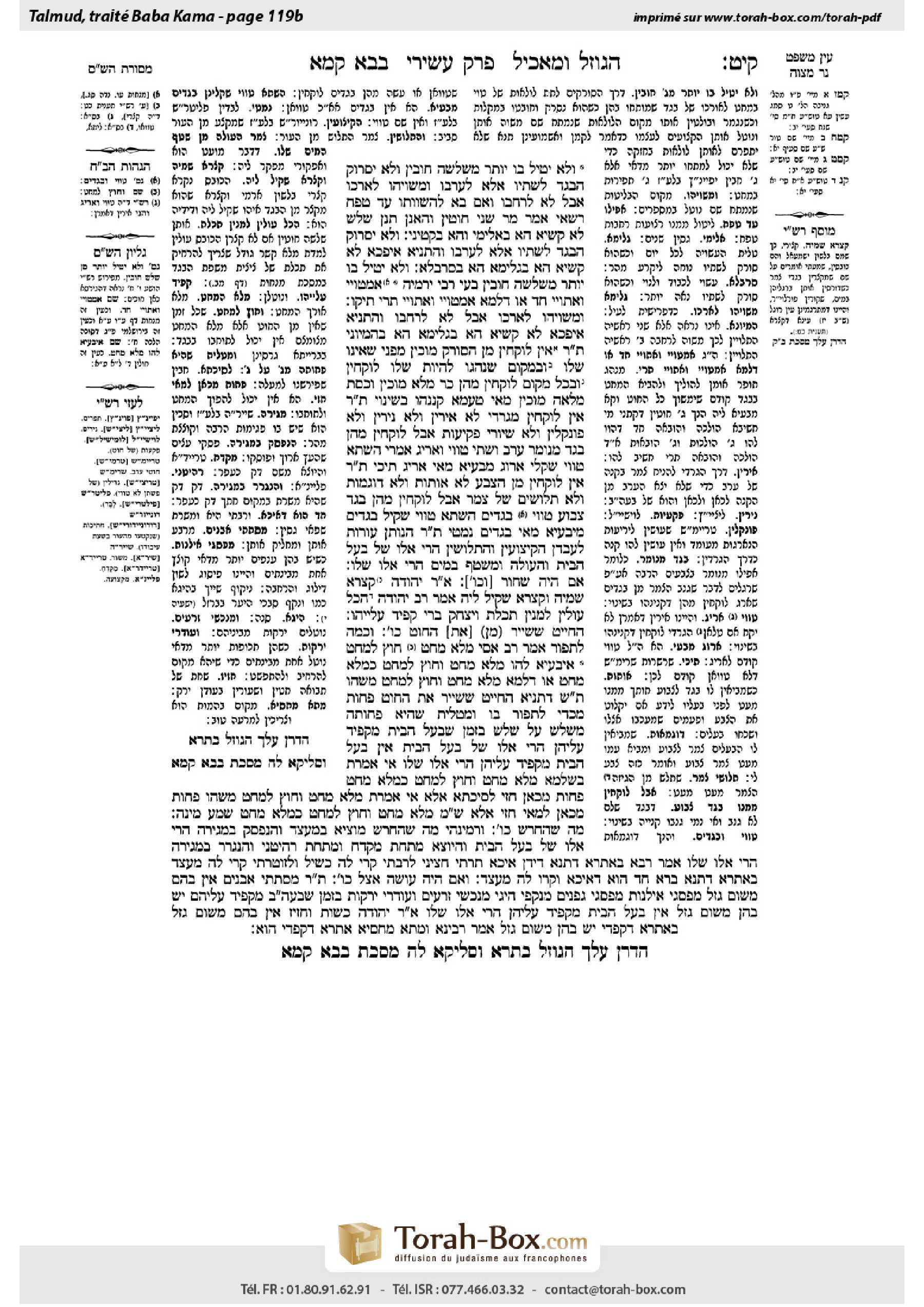
Bava Kamma 119b: Talmud study for Daf Yomi
Study the Talmud for Daf Yomi with scanned pages, Hebrew text, English translations from Sefaria and AI-generated French translations.
Passage selection and English or AI-generated French translation are available where the scan has annotations. Daf Study is independent of Torah-Box and Sefaria.
Browse Bava Kamma · בבא קמא · All tractatesBava Kamma 119b text and translations
This page of Bava Kamma includes the Aramaic text, an English translation and an AI-generated French translation, alongside the scan above.
בבא קמא קי״ט ב · Aramaic and Hebrew text
וְלֹא יָטִיל בּוֹ יוֹתֵר מִשְּׁלֹשָׁה חוּבִּין, וְלֹא יִסְרוֹק הַבֶּגֶד לְשִׁתְיוֹ אֶלָּא לְעֶרְבּוֹ. וּמַשְׁוֵיהוּ לְאׇרְכּוֹ, אֲבָל לֹא לְרׇחְבּוֹ. וְאִם בָּא לְהַשְׁווֹתוֹ עַד טֶפַח – רַשַּׁאי.
אָמַר מָר: שְׁנֵי חוּטִין. וְהָאֲנַן תְּנַן: שָׁלֹשׁ! לָא קַשְׁיָא; הָא בְּאַלִּימֵי, וְהָא בְּקַטִּינֵי.
וְלֹא יִסְרוֹק הַבֶּגֶד לְשִׁתְיוֹ, אֶלָּא לְעֶרְבּוֹ. וְהָתַנְיָא אִיפְּכָא! לָא קַשְׁיָא; הָא בִּגְלִימָא, הָא בְּסַרְבָּלָא.
וְלֹא יָטִיל בּוֹ יוֹתֵר מִשְּׁלֹשָׁה חוּבִּין. בָּעֵי רַבִּי יִרְמְיָה: אַמְטוֹיֵי וְאֵתוֹיֵי חַד, אוֹ דִּלְמָא אַמְטוֹיֵי וְאֵתוֹיֵי תְּרֵי? תֵּיקוּ.
וּמַשְׁוֵיהוּ לְאׇרְכּוֹ אֲבָל לֹא לְרׇחְבּוֹ. וְהָתַנְיָא אִיפְּכָא! לָא קַשְׁיָא; הָא בִּגְלִימָא, הָא בְּהֶמְיוֹנֵי.
תָּנוּ רַבָּנַן: אֵין לוֹקְחִין מִן הַסּוֹרֵק מוֹכִין, מִפְּנֵי שֶׁאֵינוֹ שֶׁלּוֹ. וּבִמְקוֹם שֶׁנָּהֲגוּ לִהְיוֹת שֶׁלּוֹ – לוֹקְחִין. וּבְכׇל מָקוֹם לוֹקְחִין מֵהֶן כַּר מָלֵא מוֹכִין וְכֶסֶת מְלֵאָה מוֹכִין. מַאי טַעְמָא? קְנָנְהוּ בְּשִׁינּוּי.
תָּנוּ רַבָּנַן: אֵין לוֹקְחִין מִגַּרְדִּי לֹא אִירִין, וְלֹא נִירִין, וְלֹא פּוּנְקָלִין, וְלֹא שִׁיּוּרֵי פַּקְיעִיּוֹת.
אֲבָל לוֹקְחִין מֵהֶן בֶּגֶד מְנוּמָּר, עֵרֶב, וּשְׁתִי, טְוִוי, וְאָרִיג.
אָמְרִי: הַשְׁתָּא טְוִוי שָׁקְלִי, אָרוּג מִבַּעְיָא? מַאי ״אָרִיג״ – תִּיכֵי.
תָּנוּ רַבָּנַן: אֵין לוֹקְחִין מִן הַצַּבָּע לֹא אוֹתוֹת וְלֹא דּוּגְמוֹת וְלֹא תְּלוּשִׁים שֶׁל צֶמֶר, אֲבָל לוֹקְחִין מֵהֶן בֶּגֶד צָבוּעַ, טְוִוי, בְּגָדִים. הַשְׁתָּא טְוִוי שָׁקֵיל, בְּגָדִים מִיבַּעְיָא? מַאי ״בְּגָדִים״ – נַמְטֵי.
תָּנוּ רַבָּנַן: הַנּוֹתֵן עוֹרוֹת לְעַבְּדָן; הַקִּיצּוּעִין וְהַתְּלוּשִׁין – הֲרֵי אֵלּוּ שֶׁל בַּעַל הַבַּיִת, וְהָעוֹלֶה וּמִשַּׁטֵּף בְּמַיִם – הֲרֵי אֵלּוּ שֶׁלּוֹ.
אִם הָיָה שָׁחוֹר [וְכוּ׳]. אָמַר רַב יְהוּדָה: קַצָּרָא שְׁמֵיהּ, וְקַצְרָא שָׁקֵיל לֵיהּ. אָמַר רַב יְהוּדָה: הַכֹּל עוֹלִין לְמִנְיַן תְּכֵלֶת; וְיִצְחָק בְּרִי קָפֵיד עֲלַיְיהוּ.
הַחַיָּיט שֶׁשִּׁיֵּיר (מִן) [אֶת] הַחוּט כּוּ׳. וְכַמָּה לִתְפּוֹר? אָמַר רַב אַסִּי: מְלֹא מַחַט חוּץ לַמַּחַט. אִיבַּעְיָא לְהוּ: מְלֹא מַחַט, וְחוּץ לַמַּחַט כִּמְלֹא מַחַט; אוֹ דִלְמָא מְלֹא מַחַט, וְחוּץ לַמַּחַט מַשֶּׁהוּ?
תָּא שְׁמַע, דְּתַנְיָא: הַחַיָּיט שֶׁשִּׁיֵּיר אֶת הַחוּט פָּחוֹת מִכְּדֵי לִתְפּוֹר בּוֹ, וּמַטְלֵית שֶׁהִיא פְּחוּתָה מִשָּׁלֹשׁ עַל שָׁלֹשׁ – בִּזְמַן שֶׁבַּעַל הַבַּיִת מַקְפִּיד עֲלֵיהֶן, הֲרֵי אֵלּוּ שֶׁל בַּעַל הַבַּיִת; אֵין בַּעַל הַבַּיִת מַקְפִּיד עֲלֵיהֶן, הֲרֵי אֵלּוּ שֶׁלּוֹ.
אִי אָמְרַתְּ בִּשְׁלָמָא מְלֹא מַחַט, וְחוּץ לַמַּחַט כִּמְלֹא מַחַט – פָּחוֹת מִכָּאן חֲזֵי לְסִיכְּתָא; אֶלָּא אִי אָמְרַתְּ מְלֹא מַחַט, וְחוּץ לַמַּחַט מַשֶּׁהוּ – פָּחוֹת מִכָּאן לְמַאי חֲזֵי?
אֶלָּא שְׁמַע מִינַּהּ: מְלֹא מַחַט, וְחוּץ לַמַּחַט כִּמְלֹא מַחַט. שְׁמַע מִינַּהּ.
מַה שֶּׁהֶחָרָשׁ כּוּ׳. וּרְמִינְהִי: מַה שֶּׁהֶחָרָשׁ מוֹצִיא בְּמַעֲצָד, וְהַנִּפְסָק בִּמְגֵירָה – הֲרֵי אֵלּוּ שֶׁל בַּעַל הַבַּיִת; וְהַיּוֹצֵא מִתַּחַת מַקְדֵּחַ וּמִתַּחַת רָהִיטְנֵי, וְהַנִּגְרָר בִּמְגֵירָה – הֲרֵי אֵלּוּ שֶׁלּוֹ!
אָמַר רָבָא: בְּאַתְרָא דְּתַנָּא דִּידַן אִיכָּא תַּרְתֵּי חֲצִינֵי, לְרַבָּתִי קָרֵי לַהּ ״כַּשִּׁיל״, וּלְזוּטַרְתִּי קָרֵי לַהּ ״מַעֲצָד״. בְּאַתְרָא דְּתַנָּא בָּרָא חַד הוּא דְּאִיכָּא, וְקָרוּ לַהּ ״מַעֲצָד״.
וְאִם הָיָה עוֹשֶׂה אֵצֶל כּוּ׳. תָּנוּ רַבָּנַן: מְסַתְּתֵי אֲבָנִים – אֵין בָּהֶם מִשּׁוּם גָּזֵל. מְפַסְּגֵי אִילָנוֹת, מְפַסְּגֵי גְפָנִים, מְנַקְּפֵי הִיגֵי, מְנַכְּשִׁי זְרָעִים וְעוֹדְרֵי יְרָקוֹת – בִּזְמַן שֶׁבַּעַל הַבַּיִת מַקְפִּיד עֲלֵיהֶם, יֵשׁ בָּהֶן מִשּׁוּם גָּזֵל; אֵין בַּעַל הַבַּיִת מַקְפִּיד עֲלֵיהֶן, הֲרֵי אֵלּוּ שֶׁלּוֹ.
אָמַר רַב יְהוּדָה: כְּשׁוּת וַחֲזִיז – אֵין בָּהֶם מִשּׁוּם גָּזֵל. בְּאַתְרָא דְּקָפְדִי – יֵשׁ בָּהֶן מִשּׁוּם גָּזֵל. אָמַר רָבִינָא: וּמָתָא מַחְסֵיָא – אַתְרָא דְּקָפְדִי הוּא.
הֲדַרַן עֲלָךְ הַגּוֹזֵל בָּתְרָא וּסְלִיקָא לַהּ מַסֶּכֶת בָּבָא קַמָּא
Bava Kamma 119b · English translation
And a carder should not place in a piece of cloth more than three stitches for each loop that he attaches to the cloth in order to stretch it out, as this causes the cloth to overstretch and require trimming. And he should not card the cloth along its warp, i.e., vertically, but along its weft, i.e., horizontally. And he may even out the cloth by cutting it along its length, but not along its width, and if he comes to even out the cloth by removing up to a handbreadth of material, it is permitted for him to do so.
The Gemara analyzes the baraita: The Master said in the baraita that the launderer may take two threads. But didn’t we learn in the mishna that the launderer may take three threads? The Gemara answers: This is not difficult: The ruling of this baraita, which allows only two threads, is stated with regard to thick threads, and the ruling of that mishna, which allows three threads, is stated with regard to thin ones.
It was also stated in the baraita: And he should not card the cloth along its warp but along its weft. The Gemara asks: But isn’t it taught in another baraita that the opposite is the halakha? The Gemara answers: This is not difficult: The ruling of this baraita, which prohibits carding along the warp, is stated with regard to an ordinary garment, which is designed for durability, and one should therefore avoid wearing out the material by carding along the warp. The ruling of that baraita, which allows one to card along the warp, is stated with regard to an elegant cape [besarbela], which is made for aesthetic appearance and is therefore improved by carding in this manner.
The Gemara examines the next clause of the baraita: And a carder should not place in a cloth more than three stitches for each loop. Rabbi Yirmeya raised a dilemma with regard to the definition of the term stitch in this context: Does drawing the needle in and out constitute one stitch, or perhaps does drawing the needle in and out constitute two stitches? The Gemara responds: The question shall stand unresolved.
It was further stated in the baraita: And he may even out the cloth by cutting it along its length, but not along its width. The Gemara asks: But isn’t it taught in another baraita that the opposite is true? The Gemara answers that this is not difficult: The statement of this baraita, which rules that one should even out the cloth along its length, is stated with regard to a garment, where an uneven length would be conspicuous. The statement of that baraita, which rules that one should even it out along its width, is stated with regard to a belt, as the width of a belt is more noticeable than its length while it is being worn.
§ The Gemara cites a baraita that discusses which items may be purchased from a carder. The Sages taught in a baraita (Tosefta 11:12): One may not purchase strands of thread from a carder, because it is assumed that they are not his. And in a place where the residents were accustomed to allow carders to retain strands, the strands may be presumed to be his and one may purchase them. And in every place, one may purchase from them a cushion full of stuffing made from strands, or a mattress full of stuffing made from strands. What is the reason that it is permitted? The reason is that even if the carder had stolen the strands, once he uses them to make a cushion or mattress, he has acquired them through a change of form.
§ Apropos the halakhot pertaining to weaving, the Gemara cites a baraita that discusses which items may be purchased from various craftsmen. The Sages taught in a baraita (Tosefta 11:11): One may purchase from a weaver neither woolen wads [irin], which are used to hold the bobbin in place on a shuttle, nor heddles [nirin], nor threads of the bobbin [punkalin], nor remnants of coils of thread that were left on the spool, as there is a concern that these items were taken from the customer without his consent.
But one may purchase a spotted garment from them, even though the design indicates that it was made from strands of different colors, which the weaver may have stolen from other garments that he was weaving. It is also permitted to purchase warp threads and weft threads from them, as well as wool that was spun into thread or woven. All of these items may be purchased from the weaver because they have undergone a physical change, and have therefore been acquired by the weaver even if he did steal them.
The Gemara asks: Say: Now that the baraita taught that one may purchase spun wool despite the fact that it has undergone only a minor physical change, is it necessary to teach that one may purchase woven wool, which has undergone a greater change of form? The Gemara answers: What does the baraita mean when it mentions woven wool? It is not referring to wool woven into a garment, but to wool that was twisted into chains, which is also a minor physical change.
The Gemara examines which items may be bought from a dyer. The Sages taught in a baraita: One may purchase from a dyer neither pieces of wool used for tests, nor pieces used as a color sample [dugmut], nor detached pieces of wool, as these might have been stolen. But one may purchase from him a colored garment, spun threads, and clothes fashioned from the aforementioned pieces of material. The Gemara asks: Now that the baraita taught that one may purchase spun threads from the dyer, is it necessary to teach that one may purchase clothes? It is obvious that one may purchase clothes, as the clothes themselves are made of spun threads. The Gemara explains: What does the baraita mean when it mentions clothes? It is referring to felt garments, which are not made of spun thread.
The Sages taught in a baraita (Tosefta 11:16): In the case of one who gives hides to a tanner, the trimmings of hide and the detached hairs belong to the customer, but the substance that comes up while being washed in water belongs to him, the tanner.
§ The mishna teaches that if the threads were black on a white garment, the launderer may take all of them. Rav Yehuda said: A launderer is called a katzra in Aramaic, and he takes the short [katzra] shreds of wool for himself. Rav Yehuda also said: All the threads, even those usually removed from the garment, are counted toward the minimum number of thumb-lengths between the hole through which the sky-blue wool is inserted for ritual fringes and the edge of the garment. But Yitzḥak, my son, is particular about these threads, and makes sure that the garment is of the proper measurement even if the threads were to be removed.
The mishna teaches: In the case of a tailor who left enough thread attached to the cloth in order to sew with it, this thread belongs to the customer. The Gemara asks: And how much thread is necessary in order to be able to sew? Rav Asi said: The length of a needle outside the needle. A dilemma was raised before the Sages: Did Rav Asi mean that the thread must be the size of the needle and that beyond the needle there must be an additional amount of thread equivalent to the size of the needle? Or perhaps he meant that it must be the size of the needle, and that beyond the needle there must be any minimal amount of additional string. In other words, was Rav Asi saying that the thread must be two needle lengths, or slightly more than one needle length?
The Gemara responds: Come and hear a resolution, as it is taught in a baraita: In the case of a tailor who left the thread attached to the cloth, but it was less than the length necessary in order to sew with it, or if there was a patch of cloth that is less than three fingerbreadths by three fingerbreadths left from the cloth given to the tailor by the customer, the halakha is dependent upon the customer’s inclination: When the customer is particular about such items, these items belong to the customer, but if the customer is not particular about them, these items belong to the tailor.
The Gemara analyzes the baraita to deduce the answer: Granted, if you say that Rav Asi meant to say that the thread must be the size of the needle and that beyond the needle there must be an additional amount of thread equivalent to the size of the needle, then the ruling in the baraita that a slightly shorter thread belongs to the customer if he wishes to keep it is reasonable, since a thread which is less than that length is still fit for use as the stitching of a loop. But if you say that Rav Asi meant that the thread must be the size of the needle and that beyond the needle there must be any amount of additional string, then with regard to a thread that is even less than that, for what use is it fit that the customer might wish to keep it?
Rather, learn from the baraita that Rav Asi meant that the thread must be the size of the needle and that beyond the needle there must be an additional amount of thread equivalent to the size of the needle, so that the thread must be a total of two needle lengths. The Gemara affirms: Conclude from the baraita that this is so.
§ The mishna teaches: That which the carpenter removes with an adze belongs to him, but what he removes with an ax belongs to the customer. The Gemara raises a contradiction to this ruling based upon a baraita: That which the carpenter removes with an adze and that which is severed with a saw belong to the customer. But with regard to that which comes out from under a drill or under a plane [rehitni], and that which is scraped by the saw, i.e., sawdust, these belong to the carpenter. Whereas the mishna rules that the carpenter may keep what is removed with an adze, the baraita rules that it belongs to the customer.
The Gemara presents an answer: Rava said: In the place of the tanna of our mishna, there are two kinds of blades used by carpenters: The larger blade is called an ax, and the smaller one is called an adze. By contrast, in the place of the tanna of the baraita, there is only one carpenter’s blade, and they called it an adze. Consequently, the adze referred to in the baraita is actually an ax and the rulings are therefore congruent.
The mishna teaches: And if he was doing his work in the domain of the customer, then even the sawdust belongs to the customer. The Sages taught in a baraita (Tosefta 11:18): Stone chiselers are not in violation of a transgression due to the prohibition against robbery if they take the leftover chips of rock. Furthermore, with regard to those who prune trees, those who prune vines, those who trim shrubs, those who weed plants, and those who hoe vegetables, the halakha is dependent upon the owner’s inclination: When the owner is particular about the plant trimmings, the workers are in violation of a transgression due to the prohibition against robbery if they take the trimmings, but if the owner is not particular about them, then these items belong to the workers.
Rav Yehuda says: Dodder [keshut] and green grain [veḥaziz], are not subject to the prohibition against robbery, as they grow on their own and no one tends to them. But in a place where people are particular about the ownership of dodder and green grain, they are subject to the prohibition against robbery. Ravina said: And the city of Meḥasya is a city where the residents are particular about dodder and green wheat.
Bava Kamma 119b · Traduction française (IA)
Et un carder ne doit pas placer dans un morceau de tissu plus de trois points pour chaque boucle qu'il attache au tissu afin de le tendre, car cela provoque un surtendage du tissu nécessitant un rabotage. Il ne doit pas carder le tissu le long de sa trame, c'est-à-dire verticalement, mais le long de sa chaîne, c'est-à-dire horizontalement. Il peut même niveler le tissu en le coupant le long de sa longueur, mais pas le long de sa largeur, et si l'on vient à niveler le tissu en retirant jusqu'à un tefach de matière, il est permis de le faire.
La Guemara analyse la baraïta : Le Maître a dit dans la baraïta que le lavandier peut prendre deux fils. Mais n'avons-nous pas appris dans la mishna que le lavandier peut prendre trois fils ? La Guemara répond : Ce n'est pas difficile : la décision de cette baraïta, qui permet seulement deux fils, est énoncée concernant des fils épais, et la décision de cette mishna, qui permet trois fils, est énoncée concernant des fils fins.
Il a également été dit dans la baraïta : Et il ne doit pas carder le tissu le long de sa trame mais le long de sa chaîne. La Guemara pose la question : Mais n'est-il pas enseigné dans une autre baraïta que l'inverse est la halakha ? La Guemara répond : Ce n'est pas difficile : la décision de cette baraïta, qui interdit de carder le long de la trame, est énoncée concernant un vêtement ordinaire, conçu pour la durabilité, et l'on doit donc éviter de user le tissu en le cardant le long de la trame. La décision de cette autre baraïta, qui permet de carder le long de la trame, est énoncée concernant un manteau élégant [besarbela], conçu pour l'aspect esthétique et amélioré par ce procédé.
La Guemara examine la prochaine clause de la baraïta : Et un carder ne doit pas placer dans un tissu plus de trois points pour chaque boucle. Rabbi Yirmeya a soulevé un dilemme concernant la définition du terme point dans ce contexte : Le fait de faire entrer et sortir le fil constitue-t-il un point, ou bien le fait de faire entrer et sortir le fil constitue-t-il deux points ? La Guemara répond : La question restera sans réponse.
Il a également été dit dans la baraïta : Et il peut niveler le tissu en le coupant le long de sa longueur, mais pas le long de sa largeur. La Guemara pose la question : Mais n'est-il pas enseigné dans une autre baraïta que l'inverse est vrai ? La Guemara répond que ce n'est pas difficile : la déclaration de cette baraïta, qui règle que l'on doit niveler le tissu le long de sa longueur, est énoncée concernant un vêtement, où une inégalité de longueur serait visible. La déclaration de cette autre baraïta, qui règle que l'on doit niveler le tissu le long de sa largeur, est énoncée concernant une ceinture, car la largeur d'une ceinture est plus visible que sa longueur lorsqu'elle est portée.
§ La Guemara cite une baraïta qui discute des objets qui peuvent être achetés auprès d'un carder. Les Sages ont enseigné dans une baraïta (Tosefta 11:12) : On ne peut pas acheter des fils de laine auprès d'un carder, car on suppose qu'ils ne sont pas à lui. Et dans un lieu où les habitants étaient habitués à permettre aux carders de conserver les fils, ces fils peuvent être considérés comme étant à lui et on peut les acheter. Et dans tout lieu, on peut acheter d'eux un coussin rempli de garniture faite de fils, ou un matelas rempli de garniture faite de fils. Quelle est la raison qui permet cela ? La raison est que même si le carder avait volé les fils, une fois qu'il les utilise pour faire un coussin ou un matelas, il les a acquis par un changement de forme.
§ En ce qui concerne les halakhot liées à la tisse, la Guemara cite une baraïta qui discute des objets qui peuvent être achetés auprès de divers artisans. Les Sages ont enseigné dans une baraïta (Tosefta 11:11) : On ne peut pas acheter auprès d'un tisseur ni les boulettes de laine [irin], utilisées pour maintenir la bobine sur la machine, ni les heddles [nirin], ni les fils de la bobine [punkalin], ni les restes de bobines de fil laissés sur la bobine, car il y a une crainte que ces objets aient été pris du client sans son accord.
Mais on peut acheter un vêtement rayé auprès d'eux, même si le design indique qu'il a été fait à partir de fils de différentes couleurs, qui le tisseur pourrait avoir volés à d'autres vêtements qu'il tissait. Il est également permis d'acheter des fils de trame et des fils de chaîne auprès d'eux, ainsi que de la laine tissée ou tournée. Tous ces objets peuvent être achetés auprès du tisseur car ils ont subi un changement physique, et ont donc été acquis par le tisseur même s'il les avait volés.
La Guemara pose la question : Disons : Maintenant que la baraïta a enseigné que l'on peut acheter de la laine tournée malgré le fait qu'elle ait subi un changement physique mineur, est-il nécessaire d'enseigner que l'on peut acheter de la laine tissée, qui a subi un changement de forme plus important ? La Guemara répond : Quelle est la signification de la baraïta lorsqu'elle mentionne la laine tissée ? Elle ne fait pas référence à la laine tissée en vêtement, mais à la laine tournée en chaînes, qui est également un changement physique mineur.
La Guemara examine quels objets peuvent être achetés auprès d'un teinturier. Les Sages ont enseigné dans une baraïta : On ne peut pas acheter auprès d'un teinturier ni des morceaux de laine utilisés pour des tests, ni des morceaux utilisés comme échantillon de couleur [dugmut], ni des morceaux détachés de laine, car ceux-ci pourraient avoir été volés. Mais on peut acheter auprès de lui un vêtement coloré, des fils tissés, et des vêtements faits à partir desdits morceaux de matière. La Guemara pose la question : Maintenant que la baraïta a enseigné que l'on peut acheter des fils tissés auprès du teinturier, est-il nécessaire d'enseigner que l'on peut acheter des vêtements ? Il est évident que l'on peut acheter des vêtements, car les vêtements eux-mêmes sont faits de fils tissés. La Guemara explique : Quelle est la signification de la baraïta lorsqu'elle mentionne les vêtements ? Elle fait référence aux vêtements en tissu de laine, qui ne sont pas faits de fils tissés.
Les Sages ont enseigné dans une baraïta (Tosefta 11:16) : Dans le cas d'une personne qui donne des peaux à un tannant, les rebords de peau et les poils détachés appartiennent au client, mais la matière qui sort lors du lavage dans l'eau appartient à lui, le tannant.
§ La michna enseigne que si les fils étaient noirs sur un vêtement blanc, le lavandier peut prendre tous les fils. Rav Yehuda a dit : Un lavandier est appelé un katzra en araméen, et il prend les petits morceaux de laine pour lui-même. Rav Yehuda a aussi dit : Tous les fils, même ceux habituellement retirés du vêtement, comptent pour le minimum de longueur de doigt entre l'ouverture par laquelle la laine bleue est insérée pour les franges rituelles et l'ourlet du vêtement. Mais Yitzḥak, mon fils, est particulier à l'égard de ces fils, et s'assure que le vêtement est de la bonne mesure même si les fils devaient être retirés.
La michna enseigne : Dans le cas d'un tailleur qui a laissé suffisamment de fil attaché au tissu pour coudre, ce fil appartient au client. La Guemara pose la question : Et combien de fil est nécessaire pour pouvoir coudre ? Rav Asi a dit : La longueur d'une aiguille en dehors de l'aiguille. Un dilemme a été soulevé devant les Sages : Rav Asi voulait-il dire que le fil doit être de la taille d'une aiguille et qu'il faut une quantité supplémentaire de fil égale à la taille d'une aiguille au-delà de l'aiguille ? Ou peut-être voulait-il dire que le fil doit être de la taille d'une aiguille, et qu'il faut une quantité minimale supplémentaire de fil au-delà de l'aiguille ? En d'autres termes, Rav Asi disait-il que le fil doit être de deux longueurs d'aiguille, ou légèrement plus d'une longueur d'aiguille ?
La Guemara répond : Viens écouter une résolution, car cela est enseigné dans une baraïta : Dans le cas d'un tailleur qui a laissé le fil attaché au tissu, mais qui était inférieur à la longueur nécessaire pour coudre, ou si il restait une pièce de tissu inférieure à trois doigts par trois doigts du tissu donné au tailleur par le client, la halakha dépend de l'attitude du client : Lorsque le client est particulier à l'égard de ces objets, ces objets appartiennent au client, mais si le client n'est pas particulier à leur égard, ces objets appartiennent au tailleur.
La Guemara analyse la baraïta pour déduire la réponse : Admettons que tu dises que Rav Asi voulait dire que le fil doit être de la taille d'une aiguille et qu'il faut une quantité supplémentaire de fil égale à la taille d'une aiguille au-delà de l'aiguille, alors la décision de la baraïta selon laquelle un fil légèrement plus court appartient au client s'il veut le garder est raisonnable, car un fil qui est inférieur à cette longueur est encore utilisable pour coudre un anneau. Mais si tu dises que Rav Asi voulait dire que le fil doit être de la taille d'une aiguille et qu'il faut une quantité minimale supplémentaire de fil au-delà de l'aiguille, alors à quoi bon est-ce que ce fil est utilisable pour que le client veuille le garder ?
Plutôt, apprends de la baraïta que Rav Asi voulait dire que le fil doit être de la taille d'une aiguille et qu'il faut une quantité supplémentaire de fil égale à la taille d'une aiguille au-delà de l'aiguille, de sorte que le fil doit être de deux longueurs d'aiguille. La Guemara affirme : Conclure de la baraïta que c'est ainsi.
§ La Michna enseigne : Ce que le charpentier retire avec un marteau appartient à lui, mais ce qu'il retire avec une hache appartient au client. La Guemara soulève une contradiction avec cette décision en se basant sur une baraïta : Ce que le charpentier retire avec un marteau et ce qui est coupé avec une scie appartiennent au client. Mais ce qui sort sous un perçage ou sous un rabot [rehitni], et ce qui est écorcé par la scie, c'est-à-dire la sciure, ces choses appartiennent au charpentier. Alors que la Michna déclare que le charpentier peut garder ce que retire avec un marteau, la baraïta déclare que cela appartient au client.
La Guemara présente une réponse : Rava a dit : Dans le lieu du tanna de notre Michna, il y a deux types de lames utilisés par les charpentiers : la lame plus grande est appelée une hache, et la lame plus petite est appelée un marteau. En revanche, dans le lieu du tanna de la baraïta, il n'y a qu'une seule lame de charpentier, et ils l'appellent un marteau. Ainsi, la lame mentionnée dans la baraïta est en réalité une hache et les décisions sont donc congruentes.
La Michna enseigne : Et si il faisait son travail dans le domaine du client, alors même la sciure appartient au client. Les Sages ont enseigné dans une baraïta (Tosefta 11:18) : Les tailleurs de pierre ne commettent pas une transgression en raison de l'interdiction de vol s'ils prennent les copeaux de pierre restants. De plus, concernant ceux qui taillent les arbres, ceux qui taillent les vignes, ceux qui taillent les buissons, ceux qui débarrassent les plantes, et ceux qui déterrent les légumes, la halakha dépend de l'attitude du propriétaire : Lorsque le propriétaire est particulier à l'égard des débris de végétation, les travailleurs commettent une transgression en raison de l'interdiction de vol s'ils prennent les débris, mais si le propriétaire n'est pas particulier à leur égard, ces objets appartiennent aux travailleurs.
Rav Yehuda dit : Le dodder [keshut] et le grain vert [veḥaziz], ne sont pas soumis à l'interdiction de vol, car ils poussent tout seuls et personne ne les cultive. Mais dans un lieu où les gens sont particuliers à l'égard de la propriété du dodder et du grain vert, ils sont soumis à l'interdiction de vol. Ravina a dit : Et la ville de Meḥasya est une ville où les habitants sont particuliers à l'égard du dodder et du blé vert.
Traduction française générée par IA à partir de l’édition anglaise de Sefaria. Vérifie toujours un passage avec le texte source.
Text from Sefaria: William Davidson Edition - Vocalized Aramaic (CC BY NC); William Davidson Edition - English (CC BY NC).