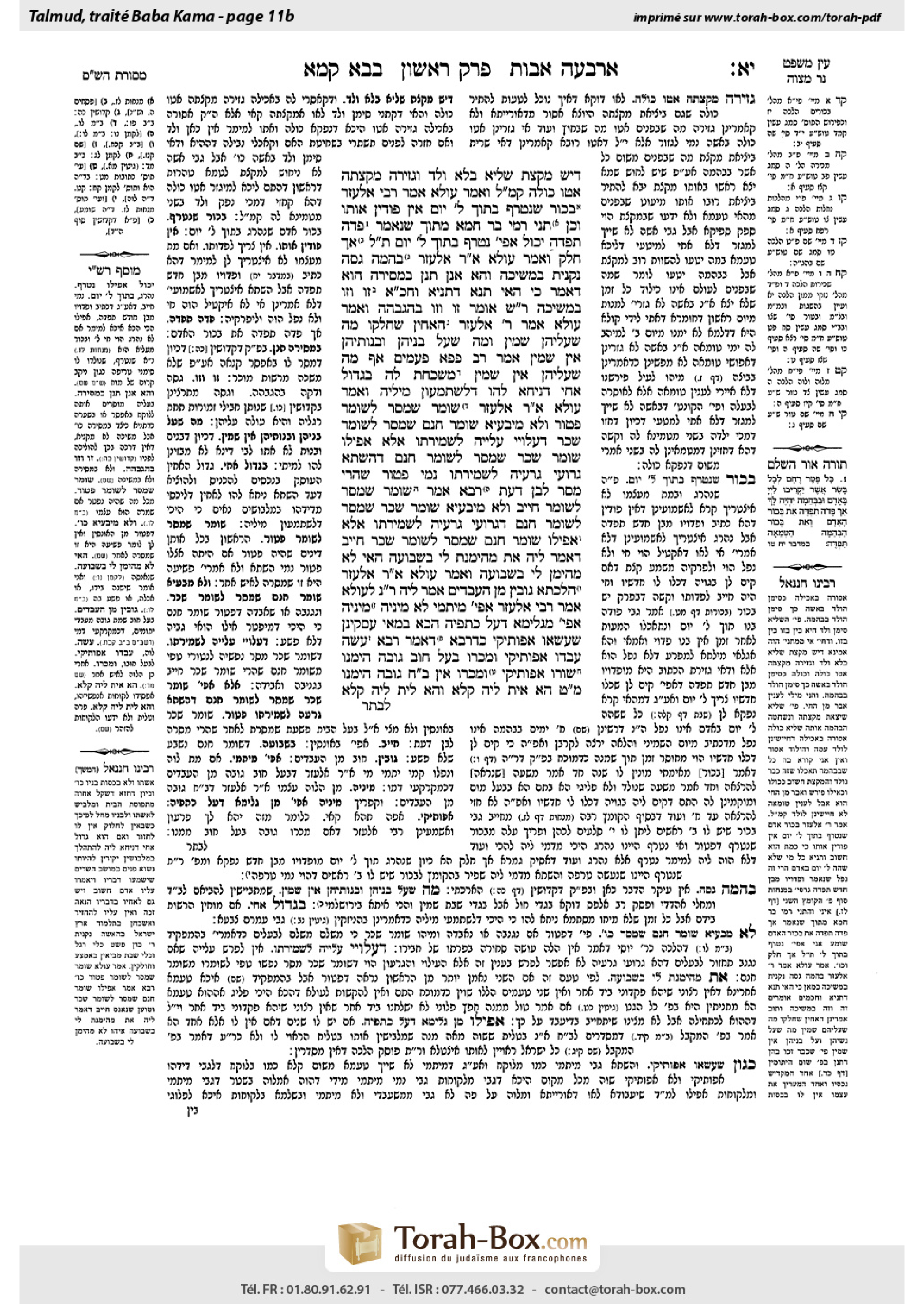
Bava Kamma 11b: Talmud study for Daf Yomi
Study the Talmud for Daf Yomi with scanned pages, Hebrew text, English translations from Sefaria and AI-generated French translations.
Passage selection and English or AI-generated French translation are available where the scan has annotations. Daf Study is independent of Torah-Box and Sefaria.
Browse Bava Kamma · בבא קמא · All tractatesBava Kamma 11b text and translations
This page of Bava Kamma includes the Aramaic text, an English translation and an AI-generated French translation, alongside the scan above.
בבא קמא י״א ב · Aramaic and Hebrew text
דְּיֵשׁ מִקְצָת שִׁלְיָא בְּלֹא וָלָד, וּגְזֵירָה מִקְצָתַהּ אַטּוּ כּוּלַּהּ; קָא מַשְׁמַע לַן.
וְאָמַר עוּלָּא אָמַר רַבִּי אֶלְעָזָר: בְּכוֹר שֶׁנִּטְרַף בְּתוֹךְ שְׁלֹשִׁים יוֹם – אֵין פּוֹדִין אוֹתוֹ.
וְכֵן תָּנֵי רָמֵי בַּר חָמָא, מִתּוֹךְ שֶׁנֶּאֱמַר: ״פָּדֹה תִפְדֶּה״, יָכוֹל אֲפִילּוּ נִטְרַף בְּתוֹךְ שְׁלֹשִׁים יוֹם? תַּלְמוּד לוֹמַר: ״אַךְ״ – חִלֵּק.
וְאָמַר עוּלָּא אָמַר רַבִּי אֶלְעָזָר: בְּהֵמָה גַּסָּה נִקְנֵית בִּמְשִׁיכָה.
וְהָא אֲנַן תְּנַן בִּמְסִירָה! הוּא דְּאָמַר – כִּי הַאי תַּנָּא: דְּתַנְיָא, וַחֲכָמִים אוֹמְרִים: זוֹ וָזוֹ בִּמְשִׁיכָה. רַבִּי שִׁמְעוֹן אוֹמֵר: זוֹ וָזוֹ בְּהַגְבָּהָה.
וְאָמַר עוּלָּא אָמַר רַבִּי אֶלְעָזָר: הָאַחִין שֶׁחָלְקוּ, מַה שֶּׁעֲלֵיהֶן – שָׁמִין, וּמַה שֶּׁעַל בְּנֵיהֶן וּבְנוֹתֵיהֶן – אֵין שָׁמִין.
אָמַר רַב פָּפָּא: פְּעָמִים אַף מַה שֶּׁעֲלֵיהֶן אֵין שָׁמִין – מַשְׁכַּחַתְּ לַהּ בִּגְדוֹל אַחֵי, דְּנִיחָא לְהוּ דְּלִשְׁתַּמְעוּן מִילֵּיהּ.
וְאָמַר עוּלָּא אָמַר רַבִּי אֶלְעָזָר: שׁוֹמֵר שֶׁמָּסַר לְשׁוֹמֵר – פָּטוּר. וְלָא מִיבַּעְיָא שׁוֹמֵר חִנָּם שֶׁמָּסַר לְשׁוֹמֵר שָׂכָר – דְּעַלּוֹיֵי עַלְּיַיהּ לִשְׁמִירָתוֹ; אֶלָּא אֲפִילּוּ שׁוֹמֵר שָׂכָר שֶׁמָּסַר לְשׁוֹמֵר חִנָּם – דְּהַשְׁתָּא גָּרוֹעֵי גָּרְעַיהּ לִשְׁמִירָתוֹ, נָמֵי פָּטוּר, שֶׁהֲרֵי מָסַר לְבֶן דַּעַת.
רָבָא אָמַר: שׁוֹמֵר שֶׁמָּסַר לְשׁוֹמֵר – חַיָּיב. וְלָא מִיבַּעְיָא שׁוֹמֵר שָׂכָר שֶׁמָּסַר לְשׁוֹמֵר חִנָּם – דְּגָרוֹעֵי גָּרְעַיהּ לִשְׁמִירָתוֹ; אֶלָּא אֲפִילּוּ שׁוֹמֵר חִנָּם שֶׁמָּסַר לְשׁוֹמֵר שָׂכָר – חַיָּיב,
דְּאָמַר לֵיהּ: אַתְּ מְהֵימְנַתְּ לִי בִּשְׁבוּעָה, הַאי לָא מְהֵימַן לִי בִּשְׁבוּעָה.
וְאָמַר עוּלָּא אָמַר רַבִּי אֶלְעָזָר, הִלְכְתָא: גּוֹבִין מִן הָעֲבָדִים.
אֲמַר לֵיהּ רַב נַחְמָן לְעוּלָּא: אָמַר רַבִּי אֶלְעָזָר אֲפִילּוּ מִיַּתְמֵי? לָא, מִינֵּיהּ. מִינֵּיהּ?! אֲפִילּוּ מִגְּלִימָא דְּעַל כַּתְפֵּיהּ!
הָכָא בְּמַאי עָסְקִינַן – שֶׁעֲשָׂאוֹ אַפּוֹתֵיקֵי. כִּדְרָבָא, דְּאָמַר רָבָא: עָשָׂה עַבְדּוֹ אַפּוֹתֵיקֵי, וּמְכָרוֹ – בַּעַל חוֹב גּוֹבֶה הֵימֶנּוּ. שׁוֹרוֹ אַפּוֹתֵיקֵי, וּמְכָרוֹ – אֵין בַּעַל חוֹב גּוֹבֶה הֵימֶנּוּ.
מַאי טַעְמָא? הָא אִית לֵיהּ קָלָא, וְהָא לֵית לֵיהּ קָלָא.
Bava Kamma 11b · English translation
that there is a possibility that part of the afterbirth will emerge without part of the fetus inside, and the reason that the Sages forbid eating the afterbirth is due to a rabbinic decree prohibiting a case where part of an afterbirth emerges from the womb and part of it remains inside, due to the possibility that one may confuse it with a case where all of the afterbirth emerges. Therefore, Ulla teaches us that, in fact, part of the afterbirth does not emerge without part of the fetus inside.
The Gemara cites another halakha taught by Ulla, citing Rabbi Elazar: And Ulla says that Rabbi Elazar says: With regard to a male firstborn child who was mauled by an animal within thirty days of his birth and died, one is not required to redeem him, as the requirement to do so, by paying five sela to a priest, applies only once the child is thirty days old (see Numbers 18:15–16).
And similarly, Rami bar Ḥama taught a baraita: Since it is stated: “Yet you shall redeem” (Numbers 18:15), one might have thought that even if a male firstborn child was mauled by an animal within thirty days of his birth one should redeem him. Therefore, the verse states “yet you shall redeem”; the addition of the word “yet” serves to differentiate and limit the requirement to redeem the firstborn male.
The Gemara cites another halakha taught by Ulla, citing Rabbi Elazar: And Ulla says that Rabbi Elazar says: A large animal, such as a cow or a horse, is acquired by the buyer pulling the animal.
The Gemara asks: But didn’t we learn in a mishna (Kiddushin 25b): A large animal is acquired by passing the reins of the animal to the buyer? The Gemara explains: Rabbi Elazar states his opinion in accordance with the opinion of that tanna, i.e., the Rabbis, as it is taught in a baraita: And the Rabbis say: This and that, i.e., both large and small animals, are acquired through the buyer pulling the animal. Rabbi Shimon says: This and that are acquired through the buyer lifting the animal.
The Gemara cites another halakha taught by Ulla, citing Rabbi Elazar: And Ulla says that Rabbi Elazar says: With regard to brothers who divide the estate they inherited, the court appraises whatever clothes are upon them if those clothes came from, or if they were purchased with money from, the deceased’s estate, and that sum is considered part of the portion they receive. But the court does not appraise whatever is upon their sons and daughters. In order to save the children from the humiliation of having to appear in court, the brothers waive their rights to the clothes the children are wearing.
Rav Pappa said: Sometimes, it does not even appraise whatever is upon the brothers. You find such a case with the eldest brother where the other brothers waive their rights to the value of his clothes, as it is beneficial for them to have the eldest brother appear well dressed in order that when he represents their interests in dealings with others, his words will be listened to and respected.
The Gemara cites another halakha taught by Ulla, citing Rabbi Elazar: And Ulla says that Rabbi Elazar says: In the case of a bailee who conveyed a deposit that was entrusted to him to another bailee, the first bailee is exempt for any occurrence for which he would have been exempt had he kept the deposit with him. The Gemara adds: And it is not necessary to state this in the case of an unpaid bailee who conveyed a deposit to a paid bailee, thereby increasing the level of its safeguarding, since the paid bailee has a greater level of accountability than an unpaid bailee. Rather, this is the halakha even in a case of a paid bailee who conveyed a deposit to an unpaid bailee, thereby decreasing the level of its safeguarding. In this case, the first bailee is exempt for any occurrence for which he would have been exempt had he kept the deposit with him, because he conveyed it to a mentally competent person and thereby fulfilled his responsibility to ensure the deposit is safeguarded.
Rava said: With regard to a bailee who conveyed a deposit to another bailee, the first bailee becomes liable to pay for any loss to the item, even for mishaps for which he would not have been liable had he kept the deposit with him. The Gemara adds: And it is not necessary to state this in a case of a paid bailee who conveyed a deposit to an unpaid bailee, thereby decreasing the level of its safeguarding. Rather, this is the halakha even in the case of an unpaid bailee who conveyed a deposit to a paid bailee, thereby increasing the level of its safeguarding; he is liable.
The reason he is liable is that the owner of the deposit can say to him: You are credible to me with regard to taking an oath, but this other bailee, to whom you conveyed my item, is not credible to me with regard to taking an oath. If an occurrence for which a bailee does not carry liability occurs, damaging the deposit, in order to release himself from an obligation to pay the bailee must take an oath to the item’s owner that none of the types of occurrences for which he bears liability occurred. Rava rules that the owner is required to accept an oath only from the bailee with whom he entrusted his item, but not from anyone else. Accordingly, since the first bailee was not present when the event occurred, he is unable to attest to what happened, and even if the second bailee takes an oath to that effect, the owner is not expected to accept his oath. Consequently, the first bailee bears full liability for any loss.
The Gemara cites another halakha taught by Ulla, citing Rabbi Elazar: And Ulla says that Rabbi Elazar says: The halakha is that one can collect from the debtor the slaves that he owns as payment for a debt.
Rav Naḥman said to Ulla: Did Rabbi Elazar say that this halakha applies even when collecting from a debtor’s orphans? A creditor can collect the debt from orphans only by taking the land the debtor bequeathed to his children. Rav Naḥman asked whether this also extends to collecting any slaves the children inherited. Ulla replied: No, a creditor collects a debt by taking slaves only when he collects directly from the debtor himself. Rav Naḥman challenges this: But when the creditor collects from him, he can collect the debt even from the cloak that is upon his shoulders, and therefore he can certainly also collect the debt by taking his slaves, so what is the novelty of this ruling?
Ulla explains: With what are we dealing here? We are dealing with a case in which the debtor set aside his slave as designated repayment [appoteiki]. Consequently, if the slave was subsequently sold to a third party and the debtor was later unable to repay the debt, the creditor can seize the slave from the third party as payment of the debt. Even though generally only land can be seized from a buyer as payment for the seller’s debt, a slave is considered to have similar status to land in this regard. This is in accordance with the opinion of Rava, as Rava says: If a master set aside his slave as designated repayment of a debt and then sold him, the master’s creditor collects the debt by taking the slave; but if one set aside his ox as designated repayment and then sold it, the creditor does not collect the debt by taking the ox.
The Gemara asks: What is the reason for this difference? The Gemara explains: The designation of this slave generates publicity, since a slave is significant and identifiable, therefore any prospective buyer is assumed to have been aware of the status of the slave and accepted the consequences of purchasing him. But the designation of this ox does not generate publicity, since one ox is not easily distinguishable from another, and a buyer cannot be assumed to be aware that the ox was set aside as designated repayment. Therefore it is unfair that one who purchases such an ox should have it seized from him. Therefore, the Sages enacted that a creditor cannot do so.
Bava Kamma 11b · Traduction française (IA)
il existe la possibilité qu'une partie du placenta sorte sans que la partie du fœtus ne sorte simultanément, et la raison pour laquelle les Sages interdisent de manger le placenta est due à un décret rabbinique interdisant un cas où une partie du placenta sort du ventre et une autre reste à l'intérieur, en raison de la possibilité qu'on puisse confondre ce cas avec celui où tout le placenta sort. Ainsi, Ulla nous enseigne que, en réalité, une partie du placenta ne sort sans que la partie du fœtus ne sorte simultanément.
Le Guemara cite une autre halakha enseignée par Ulla, en citant Rabbi Elazar : Et Ulla dit que Rabbi Elazar dit : Concernant un enfant mâle premier-né qui a été mordu par un animal dans les trente jours suivant sa naissance et est mort, on n'est pas tenu de le racheter, car la nécessité de le racheter, en payant cinq sela à un prêtre, s'applique uniquement lorsque l'enfant a trente jours (voir Nombres 18 : 15–16).
De même, Rami bar Ḥama enseigna une baraïta : Puisque cela est dit : « Et vous rachèterez » (Nombres 18 : 15), on pourrait penser que même si un enfant mâle premier-né a été mordu par un animal dans les trente jours suivant sa naissance, on devrait le racheter. Ainsi, la parole « et vous rachèterez » sert à distinguer et à limiter la nécessité de racheter le premier-né mâle.
Le Guemara cite une autre halakha enseignée par Ulla, en citant Rabbi Elazar : Et Ulla dit que Rabbi Elazar dit : Un grand animal, tel qu'un bœuf ou un cheval, est acquis par l'acheteur en tirant l'animal.
Le Guemara pose la question : Mais n'avons-nous pas appris dans une mishna (Kiddushin 25b) : Un grand animal est acquis en donnant les rênes de l'animal à l'acheteur ? Le Guemara explique : Rabbi Elazar exprime son opinion conformément à l'opinion de ce tanna, c'est-à-dire les Sages, comme il est enseigné dans une baraïta : Et les Sages disent : Cet et cela, c'est-à-dire les grands et les petits animaux, sont acquis par l'acheteur en tirant l'animal. Rabbi Shimon dit : Cet et cela sont acquis par l'acheteur en soulevant l'animal.
Le Guemara cite une autre halakha enseignée par Ulla, en citant Rabbi Elazar : Et Ulla dit que Rabbi Elazar dit : Concernant des frères qui divisent l'héritage qu'ils ont reçu, la cour évalue les vêtements qu'ils portent si ceux-ci proviennent, ou s'ils ont été achetés avec l'argent de l'héritage du défunt, et cette somme est considérée comme faisant partie de leur part. Mais la cour n'évalue pas ce qui est sur leurs enfants et leurs filles. Afin de sauver les enfants de l'humiliation de devoir apparaître devant la cour, les frères renoncent à leurs droits sur les vêtements que portent les enfants.
Rav Pappa dit : Parfois, la cour ne prend même pas en compte ce qui est sur les frères. Vous trouvez un tel cas avec le frère aîné où les autres frères renoncent à la valeur de ses vêtements, car c'est avantageux pour eux d'avoir le frère aîné bien habillé afin que, lorsqu'il représente leurs intérêts dans les affaires avec les autres, ses paroles soient écoutées et respectées.
Le Guemara cite une autre halakha enseignée par Ulla, en citant Rabbi Elazar : Et Ulla dit que Rabbi Elazar dit : Dans le cas d'un dépositaire qui a transmis un dépôt confié à lui à un autre dépositaire, le premier dépositaire est exempt de toute occurrence pour laquelle il aurait été exempt s'il avait gardé le dépôt chez lui. Le Guemara ajoute : Et il n'est pas nécessaire de mentionner cela dans le cas d'un dépositaire non rémunéré qui a transmis un dépôt à un dépositaire rémunéré, ce qui augmente le niveau de sa garde, car le dépositaire rémunéré a un niveau d'accountabilité plus élevé que le dépositaire non rémunéré. Au contraire, c'est la halakha même dans le cas d'un dépositaire rémunéré qui a transmis un dépôt à un dépositaire non rémunéré, ce qui diminue le niveau de sa garde. Dans ce cas, le premier dépositaire est exempt de toute occurrence pour laquelle il aurait été exempt s'il avait gardé le dépôt chez lui, car il a transmis le dépôt à une personne compétente et a ainsi rempli sa responsabilité de garantir la garde du dépôt.
Rava dit : Concernant un dépositaire qui a transmis un dépôt à un autre dépositaire, le premier dépositaire devient responsable de tout dommage au dépôt, même pour des accidents pour lesquels il ne serait pas responsable s'il avait gardé le dépôt chez lui. Le Guemara ajoute : Et il n'est pas nécessaire de mentionner cela dans le cas d'un dépositaire rémunéré qui a transmis un dépôt à un dépositaire non rémunéré, ce qui diminue le niveau de sa garde. Au contraire, c'est la halakha même dans le cas d'un dépositaire non rémunéré qui a transmis un dépôt à un dépositaire rémunéré, ce qui augmente le niveau de sa garde ; il est responsable.
La raison pour laquelle il est responsable est que le propriétaire du dépôt peut lui dire : Vous êtes crédible pour moi en ce qui concerne l'œuf, mais ce autre dépositaire, à qui vous avez transmis mon objet, n'est pas crédible pour moi en ce qui concerne l'œuf. Si un événement pour lequel un dépositaire ne porte pas de responsabilité survient, endommageant le dépôt, afin de se libérer de l'obligation de payer au dépositaire, il doit prendre un œuf devant le propriétaire de l'objet pour attester que aucun des types d'événements pour lesquels il porte responsabilité n'a eu lieu. Rava règle que le propriétaire est tenu d'accepter un œuf uniquement du dépositaire avec lequel il a confié son objet, mais pas d'une autre personne. Ainsi, puisque le premier dépositaire n'était pas présent lors de l'événement, il ne peut attester ce qui s'est passé, et même si le deuxième dépositaire prend un œuf à cet effet, le propriétaire n'est pas attendu à accepter son œuf. Par conséquent, le premier dépositaire porte pleine responsabilité pour tout dommage.
Le Guemara cite une autre halakha enseignée par Ulla, en citant Rabbi Elazar : Et Ulla dit que Rabbi Elazar dit : La halakha est que l'on peut récupérer du débiteur les esclaves qu'il possède comme paiement d'une dette.
Rav Naḥman a dit à Ulla : Rabbi Elazar a-t-il dit que cette halakha s'applique même lorsqu'on réclame un débiteur auprès des orphelins de ce dernier ? Un créancier peut réclamer le débit auprès des orphelins uniquement en prenant la terre que le débiteur a léguée à ses enfants. Rav Naḥman demande si cela s'applique également à la réclamation de toute servante héritée par les enfants. Ulla répond : Non, un créancier réclame un débit en prenant une servante uniquement lorsqu'il réclame directement auprès du débiteur lui-même. Rav Naḥman conteste cela : Mais lorsqu'on réclame auprès de lui, on peut réclamer le débit même à partir de la cape qui est sur ses épaules, et donc on peut certainement aussi réclamer le débit en prenant ses servantes, donc quelle est l'originalité de cette décision ?
Ulla explique : De quoi sommes-nous en train de parler ici ? Nous parlons d'un cas où le débiteur a désigné sa servante comme paiement désigné [appoteiki]. Ainsi, si la servante a ensuite été vendue à un tiers et que le débiteur n'a plus pu rembourser le débit, le créancier peut saisir la servante auprès du tiers comme paiement du débit. Même si, généralement, seul la terre peut être saisie auprès d'un acheteur comme paiement du débit du vendeur, la servante est considérée comme ayant un statut similaire à la terre à cet égard. Cela s'inscrit dans l'opinion de Rava, car Rava dit : Si un maître a désigné sa servante comme paiement désigné d'un débit et a ensuite vendu celle-ci, le créancier du maître saisit le débit en prenant la servante ; mais si l'on a désigné son bœuf comme paiement désigné et l'a ensuite vendu, le créancier ne saisit pas le débit en prenant le bœuf.
La Guemara pose la question : Quel est le motif de cette différence ? La Guemara explique : La désignation de ce serviteur génère une publicité, car un serviteur est significatif et identifiable, donc tout acheteur potentiel est supposé avoir été conscient du statut du serviteur et avoir accepté les conséquences de l'achat. En revanche, la désignation de ce bœuf ne génère pas de publicité, car un bœuf n'est pas facilement distingué d'un autre, et un acheteur ne peut pas être supposé être conscient que le bœuf avait été désigné comme paiement. Ainsi, il est injuste que celui qui achète un tel bœuf doive avoir celui-ci saisi. C'est pourquoi les Sages ont institué que le créancier ne peut pas le faire.
Traduction française générée par IA à partir de l’édition anglaise de Sefaria. Vérifie toujours un passage avec le texte source.
Text from Sefaria: William Davidson Edition - Vocalized Aramaic (CC BY NC); William Davidson Edition - English (CC BY NC).