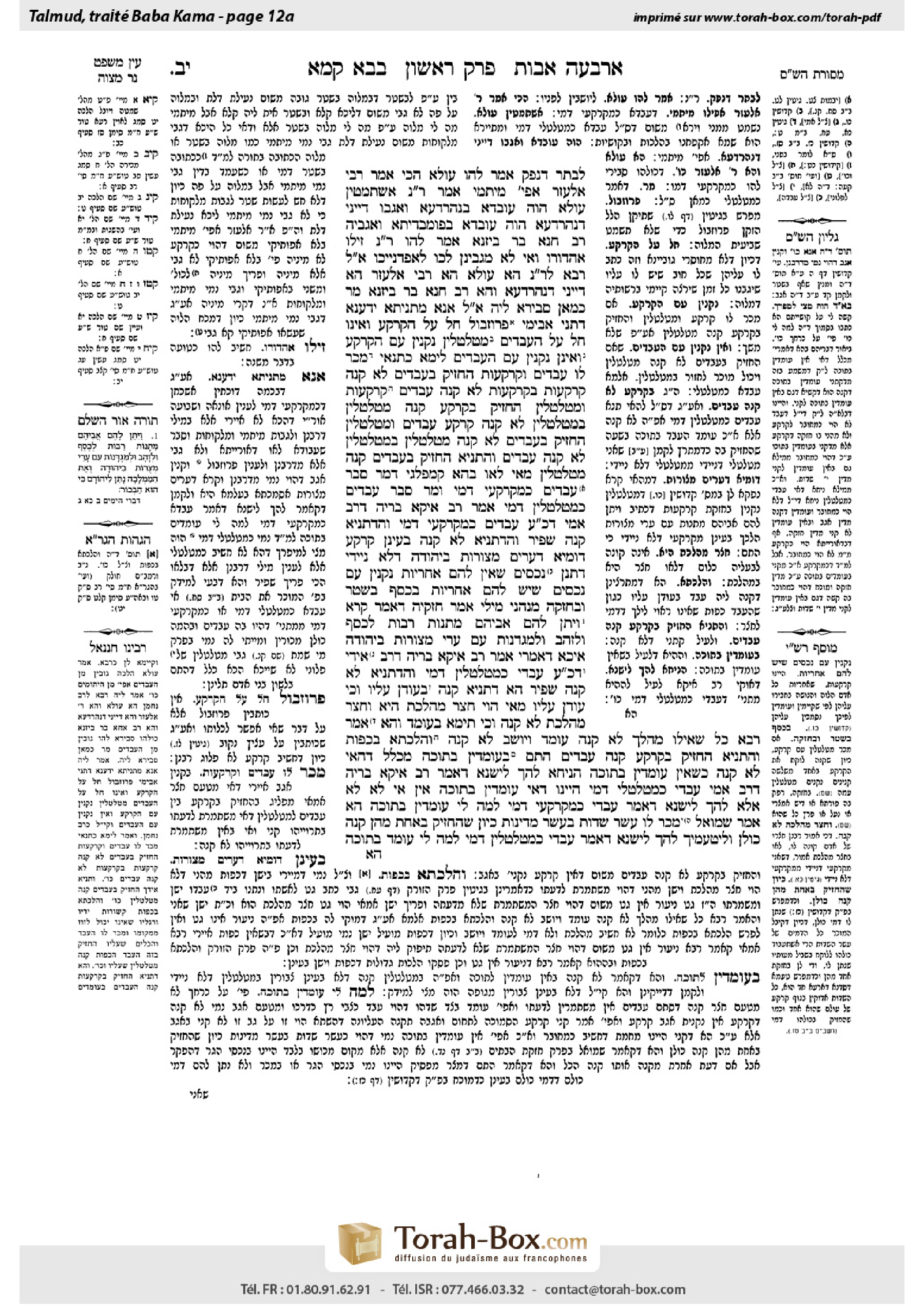
Bava Kamma 12a: Talmud study for Daf Yomi
Study the Talmud for Daf Yomi with scanned pages, Hebrew text, English translations from Sefaria and AI-generated French translations.
Passage selection and English or AI-generated French translation are available where the scan has annotations. Daf Study is independent of Torah-Box and Sefaria.
Browse Bava Kamma · בבא קמא · All tractatesBava Kamma 12a text and translations
This page of Bava Kamma includes the Aramaic text, an English translation and an AI-generated French translation, alongside the scan above.
בבא קמא י״ב א · Aramaic and Hebrew text
לְבָתַר דִּנְפַק, אֲמַר לְהוּ עוּלָּא, הָכִי אָמַר רַבִּי אֶלְעָזָר: אֲפִילּוּ מִיַּתְמֵי. אָמַר רַב נַחְמָן: אִשְׁתְּמִיטַן עוּלָּא.
הֲוָה עוֹבָדָא בִּנְהַרְדְּעָא, וְאַגְבּוֹ דַּיָּינֵי דִנְהַרְדְּעָא. הֲוָה עוֹבָדָא בְּפוּמְבְּדִיתָא, וְאַגְבְּיֵהּ רַב חָנָא בַּר בִּיזְנָא. אֲמַר לְהוּ רַב נַחְמָן: זִילוּ אַהֲדוּרוּ, וְאִי לָא – מַגְבִּינַן לְכוּ לְאַפַּדְנַיְיכוּ.
אֲמַר לֵיהּ רָבָא לְרַב נַחְמָן: הָא עוּלָּא, הָא רַבִּי אֶלְעָזָר, הָא דַּיָּינֵי דִנְהַרְדְּעָא וְהָא רַב חָנָא בַּר בִּיזְנָא; מָר – כְּמַאן סְבִירָא לֵיהּ?
אֲמַר לֵיהּ: אֲנָא מַתְנִיתָא יָדַעְנָא – דְּתָנֵי אֲבִימִי: פְּרוֹזְבּוּל חָל עַל הַקַּרְקַע, וְאֵינוֹ חָל עַל הָעֲבָדִים. מִטַּלְטְלִין נִקְנִין עִם הַקַּרְקַע, וְאֵינָן נִקְנִין עִם הָעֲבָדִים.
לֵימָא כְּתַנָּאֵי –
מָכַר לוֹ עֲבָדִים וְקַרְקָעוֹת; הֶחְזִיק בַּעֲבָדִים – לֹא קָנָה קַרְקָעוֹת, בְּקַרְקָעוֹת – לֹא קָנָה עֲבָדִים. קַרְקָעוֹת וּמִטַּלְטְלִין; הֶחְזִיק בְּקַרְקַע – קָנָה מִטַּלְטְלִין, בְּמִטַּלְטְלִין – לֹא קָנָה קַרְקַע. עֲבָדִים וּמִטַּלְטְלִין; הֶחְזִיק בַּעֲבָדִים – לֹא קָנָה מִטַּלְטְלִין, בְּמִטַּלְטְלִין – לֹא קָנָה עֲבָדִים.
וְהָתַנְיָא: הֶחְזִיק בַּעֲבָדִים – קָנָה מִטַּלְטְלִין!
מַאי, לָאו בְּהָא קָמִפַּלְגִי – דְּמָר סָבַר: עֲבָדִים כִּמְקַרְקְעֵי דָּמֵי, וּמָר סָבַר: עֲבָדִים כְּמִטַּלְטְלִין דָּמֵי?
אָמַר רַב אִיקָא בְּרֵיהּ דְּרַב אַמֵּי: דְּכוּלֵּי עָלְמָא – עֲבָדִים כִּמְקַרְקְעֵי דָּמֵי. וְהָדְתַנְיָא קָנָה – שַׁפִּיר; וְהָדְתַנְיָא לֹא קָנָה – בָּעֵינַן קַרְקַע דֻּומְיָא דְּ״עָרִים מְצוּרוֹת בִּיהוּדָה״ – דְּלָא נָיְידִי.
דִּתְנַן: נְכָסִים שֶׁאֵין לָהֶם אַחְרָיוּת נִקְנִין עִם נְכָסִים שֶׁיֵּשׁ לָהֶם אַחְרָיוּת – בְּכֶסֶף, בִּשְׁטָר וּבַחֲזָקָה. מְנָהָנֵי מִילֵּי? אָמַר חִזְקִיָּה, דְּאָמַר קְרָא: ״וַיִּתֵּן לָהֶם אֲבִיהֶם מַתָּנוֹת רַבּוֹת לְכֶסֶף וּלְזָהָב וּלְמִגְדָּנוֹת, עִם עָרֵי מְצֻרוֹת בִּיהוּדָה״.
אִיכָּא דְּאָמְרִי, אָמַר רַב אִיקָא בְּרֵיהּ דְּרַב אַמֵּי: דְּכוּלֵּי עָלְמָא – עַבְדֵי כְּמִטַּלְטְלִין דָּמֵי. וְהָדְתַנְיָא לֹא קָנָה – שַׁפִּיר; הָא דְּתַנְיָא קָנָה – בְּעוֹדָן עָלָיו.
וְכִי עוֹדָן עָלָיו מַאי הָוֵי? חָצֵר מְהַלֶּכֶת הִיא, וְחָצֵר מְהַלֶּכֶת – לֹא קָנָה! וְכִי תֵּימָא בְּעוֹמֵד, וְהָא אָמַר רָבָא: כֹּל שֶׁאִילּוּ מְהַלֵּךְ לֹא קָנָה – עוֹמֵד וְיוֹשֵׁב לֹא קָנָה!
וְהִלְכְתָא בְּכָפוּת.
וְהָתַנְיָא: הֶחְזִיק בְּקַרְקַע – קָנָה עֲבָדִים!
הָתָם בְּעוֹמְדִין בְּתוֹכָהּ.
מִכְּלָל דְּהַאי ״לֹא קָנָה״ – כְּשֶׁאֵין עוֹמְדִין בְּתוֹכָהּ?
הָנִיחָא לְהָךְ לִישָּׁנָא דְּאָמַר רַב אִיקָא בְּרֵיהּ דְּרַב אַמֵּי: עַבְדָּא כְּמִטַּלְטְלִי דָּמֵי; הַיְינוּ דְּאִי עוֹמְדִין בְּתוֹכָהּ – אִין, אִי לָא – לָא.
אֶלָּא לְהָךְ לִישָּׁנָא דְּאָמַר: עַבְדָּא כִּמְקַרְקְעֵי דָּמֵי; לְמָה לִי עוֹמְדִין בְּתוֹכָהּ? הָא אָמַר שְׁמוּאֵל: מָכַר לוֹ עֶשֶׂר שָׂדוֹת בְּעֶשֶׂר מְדִינוֹת, כֵּיוָן שֶׁהֶחְזִיק בְּאַחַת מֵהֶן – קָנָה כּוּלָּן!
וְלִיטַעְמָיךְ, לְהָךְ לִישָּׁנָא דְּאָמַר: עַבְדָּא כְּמִטַּלְטְלִין דָּמֵי; לְמָה לִי עוֹמֵד בְּתוֹכָהּ?
Bava Kamma 12a · English translation
The Gemara relates: After Rav Naḥman exited the study hall, Ulla said to the remaining Sages in the study hall: In truth, this is what Rabbi Elazar said: A slave can be collected as payment even when collecting from the debtor’s orphans. Generally, when collecting a debt from the debtor’s orphans the creditor can collect only from the land that they inherited from their father, which is liened to the debt. Rabbi Elazar rules that a creditor can also collect from the slaves they inherited, as he holds that in this regard, the legal status of slaves is like that of land. Ulla did not reveal this fact to Rav Naḥman, as he knew that Rav Naḥman disagreed and held that the legal status of slaves is like that of movable property. When he heard of Ulla’s revelation, Rav Naḥman said: Ulla evaded me, as had he told me Rabbi Elazar’s full opinion, I would have brought proofs against his opinion.
The Gemara relates: There was an incident in Neharde’a, and the judges of Neharde’a collected, on behalf of a creditor, slaves that orphans had inherited from the debtor. There was an incident in Pumbedita, and Rav Ḥana bar Bizna collected slaves from orphans as repayment for a debt. Rav Naḥman said to those judges: Go and return those slaves to the orphans, and if you do not do so, we will collect the value of the slaves from the proceeds of your own mansions in order to compensate the orphans for their loss, as you have made an elementary mistake in your ruling and therefore you are responsible to rectify it.
Rava said to Rav Naḥman: There is Ulla, there is Rabbi Elazar, there are the judges of Neharde’a, and there is Rav Ḥana bar Bizna, all of whom ruled based on the assumption that the legal status of slaves is like that of land. In accordance with whose opinion does the Master, i.e., you, Rav Naḥman, hold?
Rav Naḥman said to him: I know a baraita that supports my opinion, as Avimi teaches: A document that prevents the Sabbatical Year from abrogating an outstanding debt [prosbol] takes effect upon a debt assumed by one who owns land, but a prosbol does not take effect upon a debt assumed by one who owns slaves of the debtor. And movable property is acquired together with the land one acquires through the act of acquisition performed on the land, but movable property cannot be acquired together with the slaves that one acquires. Both halakhot assume that in these cases the legal status of slaves is not like that of land.
The Gemara suggests: Let us say that this issue is the subject of a dispute between tanna’im in the following baraitot.
One baraita teaches: If one sold slaves and land to a buyer and the buyer took possession of the slaves alone, he does not thereby acquire the land. If he took possession of the land alone, he does not thereby acquire the slaves. If one sold land and movable property to a buyer and the buyer took possession of the land alone, he thereby also acquires the movable property. If he took possession of the movable property alone, he does not thereby acquire the land. If one sold slaves and movable property to a buyer and the buyer took possession of the slaves alone, he does not thereby acquire the movable property. If he took possession of the movable property alone, he does not thereby acquire the slaves.
But isn’t it taught in another baraita: If the buyer took possession of the slaves alone, he thereby also acquires the movable property? This directly contradicts the ruling in the parallel clause of the previous baraita.
What, is it not the case that it is about this that they disagree, that one Sage, the tanna of the second baraita, holds that the legal status of slaves is like that of land, and the other Sage, the tanna of the first baraita, holds that the legal status of slaves is like that of movable property?
The Gemara rejects this: Rav Ika, son of Rav Ami, said: According to everyone, the legal status of slaves is generally like that of land, and therefore, that which is taught in the second baraita, that by taking possession of the slaves he also acquires the movable property, is properly understood. And that which is taught in the first baraita, that in such a case he does not acquire the movable property, the reason for this ruling is that the tanna of that baraita holds that in order for movable property to be acquired together with land, we require that he acquire land similar to “fortified cities in Judea” (II Chronicles 21:3), which do not move around. Slaves, even if their legal status is generally like that of land, do not fulfill this requirement.
The reason behind the need for land to be like the “fortified cities in Judea” is that the halakha that one can acquire movable property together with land is derived from this verse, as we learned in a mishna (Kiddushin 26a): Property that does not serve as a guarantee, i.e., movable property, is acquired together with property that does serve as a guarantee, i.e., land, be it through the buyer giving money to the seller, by the seller giving the buyer a bill of sale, or by the buyer performing an act of taking possession. The Gemara asks: From where is this matter derived? Ḥizkiyya said: As the verse states: “And their father gave them great gifts, of silver, and of gold, and of precious things, with fortified cities in Judea” (II Chronicles 21:3). The verse indicates that the acquisition of the movable property was done together with that of the cities of Judea.
There are those who say that Rav Ika stated a different answer: Rav Ika, son of Rav Ami, said: According to everyone, the legal status of slaves is generally like that of movable property, and therefore, that which is taught in the first baraita, that by taking possession of the slaves he does not also acquire the movable property, is properly understood. And that which is taught in the second baraita, that in such a case he acquires the movable property, applies to a case in which at the moment the slave was acquired, the movable property was still upon him, e.g., the slave was holding it, and it could therefore be acquired together with the slave. This is because one’s slave is considered like one’s courtyard, and any item that is placed within it is acquired for its owner.
The Gemara asks: But even if the movable property was still upon him, what of it? Even if one claims a slave is like a courtyard, he is a mobile courtyard, and a mobile courtyard does not acquire items placed upon it. And if you would say that the case is one where the slave is standing at the time of the transaction, that is still insufficient, as didn’t Rava say: Anything that does not acquire when moving also does not acquire when it is standing or sitting. The fact that the slave can move gives him the status of a mobile courtyard, regardless if he is currently moving or not.
The Gemara concludes: And the halakha is that where a slave is bound up and is unable to walk, his status is like that of an immobile courtyard, and his master will acquire anything that is placed upon him at that time.
The Gemara presents another contradiction to the first baraita cited above, which explicitly states that one cannot acquire slaves by taking possession of land: But isn’t it taught in another baraita: If he took possession of the land alone, he thereby also acquires the slaves?
The Gemara resolves the contradiction: There, in the baraita just cited, the case is one where the slaves are standing within the borders of the land that was acquired.
The Gemara notes: By inference, the ruling of this first baraita, which states that he does not acquire the slaves, is stated with regard to a case where they are not standing within the borders of the land that was acquired.
This works out well according to that second formulation of that which Rav Ika, son of Rav Ami, said, that the legal status of slaves is like that of movable property. This is the reason that if the slaves are standing within the borders of the land, yes, they are acquired together with the land, but if not, no, they are not acquired. The Gemara assumes that movable property is acquired together with land only if at the time of the acquisition it is placed upon the land.
But according to that first formulation of that which Rav Ika, son of Rav Ami, said, that the legal status of slaves is like that of land, why do I need the slaves to be standing within the borders of the land? As doesn’t Shmuel say: If someone sold him ten fields, located in ten different countries, once he takes possession of one of them, he has acquired all of them? If the legal status of slaves is like that of land, then the same principle should apply to them, and it should be unnecessary for them to be standing within the land’s borders.
The Gemara reconsiders: But even according to your reasoning, one can ask: According to the second formulation of that which Rav Ika, son of Rav Ami, said, that the legal status of slaves is like that of movable property, why do I need the slaves to be standing within the borders of the land?
Bava Kamma 12a · Traduction française (IA)
Le Guemara rapporte : Après que Rav Naḥman eut quitté la salle de study, Ulla dit aux Sages restants dans la salle de study : En vérité, c’est ce que Rabbi Elazar a dit : un esclave peut être réclamé comme paiement même lorsqu’on réclame auprès des orphelins du débiteur. Généralement, lorsqu’on réclame un créance auprès des orphelins du débiteur, le créancier peut récupérer uniquement la terre qu’ils ont héritée de leur père, qui est hypothéquée sur la dette. Rabbi Elazar considère que le créancier peut également récupérer les esclaves qu’ils ont hérités, car il considère que, dans ce cas, le statut juridique des esclaves est comme celui de la terre. Ulla n’a pas révélé ce fait à Rav Naḥman, car il savait que Rav Naḥman était d’un avis contraire et considérait que le statut juridique des esclaves est comme celui des biens mobiliers. Lorsqu’il apprit la révélation d’Ulla, Rav Naḥman dit : Ulla m’a évité, car s’il m’avait dit l’opinion complète de Rabbi Elazar, j’aurais apporté des preuves contre son opinion.
Le Guemara rapporte : Il y avait un incident à Neharde’a, et les juges de Neharde’a ont réclamé, au nom d’un créancier, des esclaves hérités par les orphelins du débiteur. Il y avait un incident à Pumbedita, et Rav Ḥana bar Bizna a réclamé des esclaves aux orphelins en paiement d’une dette. Rav Naḥman dit aux juges : Allez et restituez ces esclaves aux orphelins, et si vous ne le faites pas, nous collecterons la valeur des esclaves à partir des revenus de vos propres demeures afin de compenser la perte des orphelins, car vous avez commis une erreur élémentaire dans votre décision et vous êtes donc responsable de la corriger.
Rava dit à Rav Naḥman : Il y a Ulla, il y a Rabbi Elazar, il y a les juges de Neharde’a, et il y a Rav Ḥana bar Bizna, tous ont rendu des décisions en supposant que le statut juridique des esclaves est comme celui de la terre. Selon quel avis le Maître, c’est-à-dire toi, Rav Naḥman, tu tiens ?
Rav Naḥman dit à lui : Je connais un baraïta qui soutient mon avis, comme Avimi enseigne : Un document qui empêche l'année sabbatique de révoquer une dette en suspens [prosbul] prend effet sur une dette assumée par celui qui possède une terre, mais un prosbul ne prend effet sur une dette assumée par celui qui possède des esclaves du débiteur. Et les biens mobiliers sont acquis ensemble avec la terre que l'on acquiert par l'acte d'acquisition effectué sur la terre, mais les biens mobiliers ne peuvent pas être acquis ensemble avec les esclaves que l'on acquiert. Les deux halakhot supposent que dans ces cas, le statut juridique des esclaves n’est pas comme celui de la terre.
Le Guemara suggère : Disons que cette question est l’objet d’un débat entre tanna’im selon les baraitot suivantes.
Une baraïta enseigne : Si l’on vend des esclaves et de la terre à un acheteur et que l’acheteur prend possession des esclaves seul, il ne les acquiert donc pas ainsi. Si l’acheteur prend possession de la terre seul, il ne les acquiert donc pas ainsi. Si l’on vend de la terre et des biens mobiliers à un acheteur et que l’acheteur prend possession de la terre seul, il acquiert ainsi également les biens mobiliers. Si l’acheteur prend possession des biens mobiliers seul, il ne les acquiert donc pas ainsi. Si l’on vend des esclaves et des biens mobiliers à un acheteur et que l’acheteur prend possession des esclaves seul, il ne les acquiert donc pas ainsi. Si l’acheteur prend possession des biens mobiliers seul, il ne les acquiert donc pas ainsi.
Mais n’est-ce pas enseigné dans une autre baraïta : Si l’acheteur prend possession des esclaves seul, il acquiert ainsi également les biens mobiliers ? Cela contredit directement la décision dans la clause parallèle de la précédente baraïta.
Qu’est-ce que cela signifie, n’est-ce pas le cas que c’est à ce sujet qu’ils divergent, que l’un des Sages, le tanna de la deuxième baraïta, considère que le statut juridique des esclaves est comme celui de la terre, et l’autre Sage, le tanna de la première baraïta, considère que le statut juridique des esclaves est comme celui des biens mobiliers ?
Le Guemara rejette cela : Rav Ika, fils de Rav Ami, dit : Selon tout le monde, le statut juridique des esclaves est généralement comme celui de la terre, et donc, ce qui est enseigné dans la deuxième baraïta, que par la prise de possession des esclaves il acquiert également les biens mobiliers, est bien compris. Et ce qui est enseigné dans la première baraïta, que dans ce cas il ne les acquiert pas, la raison de cette décision est que le tanna de cette baraïta considère que pour que les biens mobiliers soient acquis avec la terre, nous exigeons qu’il acquière une terre semblable à « les villes fortifiées de Juda » (II Rois 21:3), qui ne se déplacent pas. Les esclaves, même si leur statut juridique est généralement comme celui de la terre, ne remplissent pas cette exigence.
La raison de la nécessité que la terre soit comme les « villes fortifiées de Juda » est que la halakha qui permet d’acquérir des biens mobiliers avec la terre est tirée de cette verset, comme nous l’avons appris dans une mitsva (Kiddushin 26a) : Les biens qui ne servent pas de garantie, c’est-à-dire les biens mobiliers, sont acquis avec les biens qui servent de garantie, c’est-à-dire la terre, qu’il soit par l’acheteur qui donne de l’argent au vendeur, par le vendeur qui donne à l’acheteur un contrat de vente, ou par l’acheteur qui effectue un acte de prise de possession. Le Guemara demande : D’où cette matière est-elle tirée ? Ḥizkiyya dit : Comme le verset dit : « Et leur père leur donna de grands présents, d’argent, d’or et de choses précieuses, avec les villes fortifiées de Juda » (II Rois 21:3). Le verset indique que l’acquisition des biens mobiliers a été faite ensemble avec celle des villes de Juda.
Il y a ceux qui disent que Rav Ika a donné une réponse différente : Rav Ika, fils de Rav Ami, a dit : Selon tous, le statut juridique des esclaves est généralement celui des biens mobiliers, et donc, ce qui est enseigné dans la première baraïta, à savoir que prendre possession des esclaves ne permet pas d'acquérir les biens mobiliers, est bien compris. Et ce qui est enseigné dans la seconde baraïta, à savoir qu'en tel cas on acquiert les biens mobiliers, s'applique à un cas où, au moment de l'acquisition des esclaves, les biens mobiliers étaient encore sur lui, par exemple, l'esclave les tenait, et pouvait donc être acquis ensemble avec l'esclave. Cela est dû au fait que l'esclave est considéré comme le courtil de son maître, et tout objet placé à l'intérieur est acquis pour son propriétaire.
La Guemara pose la question : Mais même si les biens mobiliers étaient encore sur lui, qu'y a-t-il ? Même si l'on affirme que l'esclave est comme un courtil, il s'agit d'un courtil mobile, et un courtil mobile ne peut pas acquérir les objets placés dessus. Et si l'on dit que le cas est celui où l'esclave est debout au moment de la transaction, cela reste insuffisant, car n'a-t-on pas dit Rava : Tout ce qui ne peut pas acquérir lorsqu'il est en mouvement ne peut pas non plus acquérir lorsqu'il est debout ou assis. Le fait que l'esclave puisse se mouvoir lui donne le statut d'un courtil mobile, indépendamment du fait qu'il soit actuellement en mouvement ou non.
La Guemara conclut : Et la halakha est que lorsque l'esclave est lié et ne peut pas marcher, son statut est celui d'un courtil immobile, et son maître acquiert tout ce qui est placé sur lui à ce moment-là.
La Guemara présente une autre contradiction avec la première baraïta citée ci-dessus, qui affirme explicitement que l'on ne peut pas acquérir des esclaves en prenant possession d'une terre : Mais n'est-il pas enseigné dans une autre baraïta : Si l'on prend possession de la terre seule, l'on acquiert ainsi les esclaves ?
La Guemara résout la contradiction : Là, dans la baraïta citée précédemment, le cas est celui où les esclaves sont situés à l'intérieur des limites de la terre acquise.
La Guemara note : Par déduction, la décision de cette première baraïta, qui affirme qu'on ne peut pas acquérir les esclaves, s'applique à un cas où ils ne sont pas situés à l'intérieur des limites de la terre acquise.
Cela s'explique bien selon cette seconde formulation de ce que Rav Ika, fils de Rav Ami, a dit, à savoir que le statut juridique des esclaves est celui des biens mobiliers. C'est la raison pour laquelle, si les esclaves sont situés dans les limites de la terre, oui, ils sont acquis ensemble avec la terre, mais si ce n'est pas le cas, non, ils ne sont pas acquis. La Guemara suppose que les biens mobiliers sont acquis avec la terre uniquement si, au moment de l'acquisition, ils sont placés sur la terre.
Mais selon cette première formulation de ce que Rav Ika, fils de Rav Ami, a dit, à savoir que le statut juridique des esclaves est celui de la terre, pourquoi ai-je besoin que les esclaves soient situés dans les limites de la terre ? Car n'a-t-on pas dit Shmuel : Si l'on vend à quelqu'un dix champs, situés dans dix pays différents, une fois qu'il prend possession d'un d'entre eux, il acquiert tous les autres ? Si le statut juridique des esclaves est celui de la terre, le même principe devrait s'appliquer à eux, et il ne serait pas nécessaire qu'ils soient situés dans les limites de la terre.
La Guemara reconsidère : Mais même selon votre raisonnement, on peut poser la question : Selon cette seconde formulation de ce que Rav Ika, fils de Rav Ami, a dit, à savoir que le statut juridique des esclaves est celui des biens mobiliers, pourquoi ai-je besoin que les esclaves soient situés dans les limites de la terre ?
Traduction française générée par IA à partir de l’édition anglaise de Sefaria. Vérifie toujours un passage avec le texte source.
Text from Sefaria: William Davidson Edition - Vocalized Aramaic (CC BY NC); William Davidson Edition - English (CC BY NC).