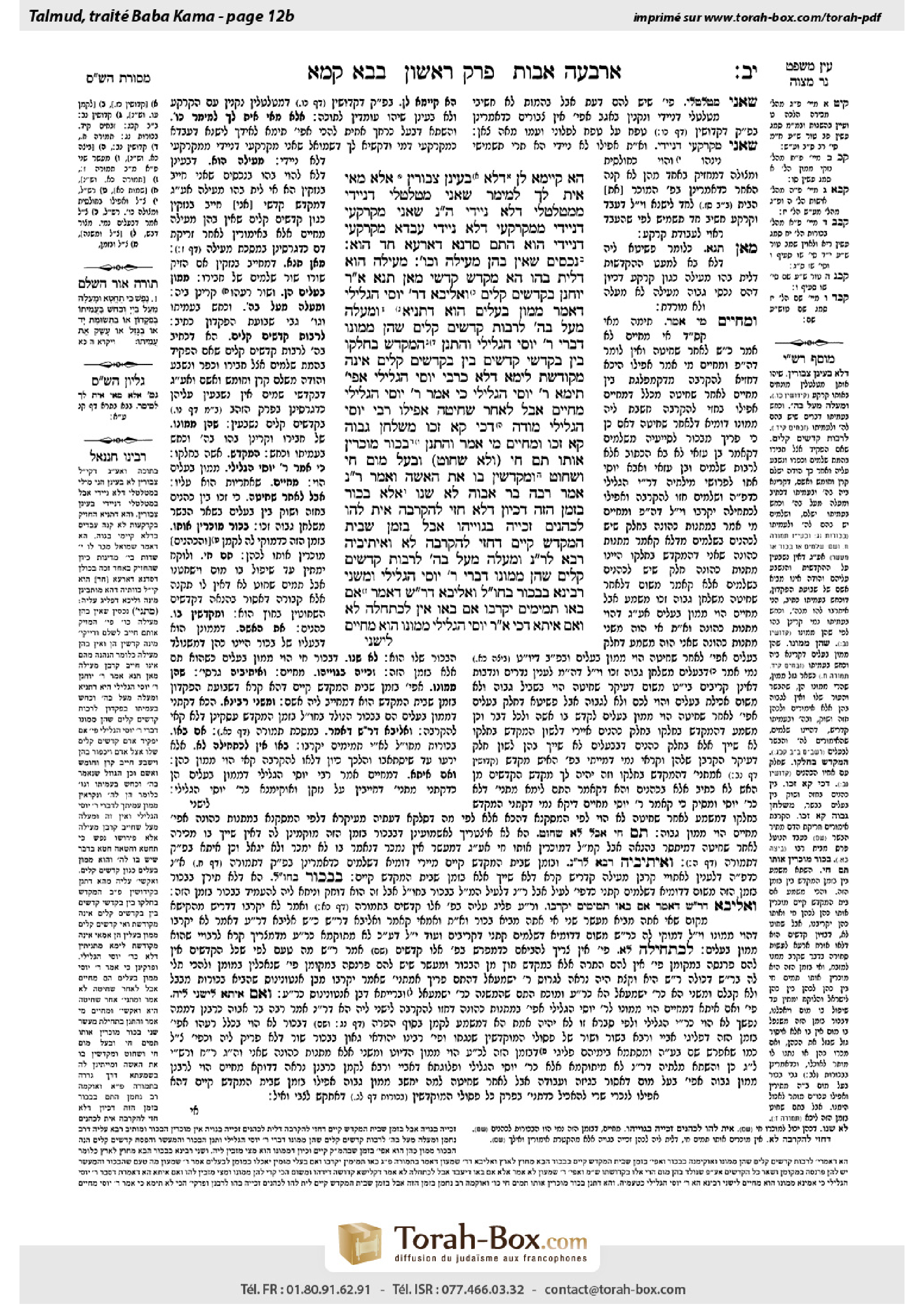
Bava Kamma 12b: Talmud study for Daf Yomi
Study the Talmud for Daf Yomi with scanned pages, Hebrew text, English translations from Sefaria and AI-generated French translations.
Passage selection and English or AI-generated French translation are available where the scan has annotations. Daf Study is independent of Torah-Box and Sefaria.
Browse Bava Kamma · בבא קמא · All tractatesBava Kamma 12b text and translations
This page of Bava Kamma includes the Aramaic text, an English translation and an AI-generated French translation, alongside the scan above.
בבא קמא י״ב ב · Aramaic and Hebrew text
הָא קַיְימָא לַן דְּלָא בָּעֵינַן צְבוּרִין!
אֶלָּא מַאי אִית לָךְ לְמֵימַר – שָׁאנֵי מִטַּלְטְלִי דְּנָיְידִי מִמִּטַּלְטְלִי דְּלָא נָיְידִי;
הָכָא נָמֵי, שָׁאנֵי מְקַרְקְעֵי דְּנָיְידִי מִמְּקַרְקְעֵי דְּלָא נָיְידִי. עַבְדָּא – מְקַרְקְעֵי דְּנָיְידִי הוּא, הָתָם – סַדָּנָא דְאַרְעָא חַד הוּא.
נְכָסִים שֶׁאֵין בָּהֶן מְעִילָה וְכוּ׳.
מְעִילָה הוּא דְּלֵית בְּהוּ, הָא מִקְדָּשׁ – קָדְשִׁי;
מַאן תַּנָּא? אָמַר רַבִּי יוֹחָנָן: בְּקָדָשִׁים קַלִּים – וְאַלִּיבָּא דְּרַבִּי יוֹסֵי הַגְּלִילִי, דְּאָמַר: מָמוֹן בְּעָלִים הוּא.
דְּתַנְיָא: ״וּמָעֲלָה מַעַל בַּה׳״ – לְרַבּוֹת קֳדָשִׁים קַלִּים שֶׁהֵן מָמוֹנוֹ, דִּבְרֵי רַבִּי יוֹסֵי הַגְּלִילִי.
וְהָתְנַן: הַמְקַדֵּשׁ בְּחֶלְקוֹ, בֵּין בְּקׇדְשֵׁי קֳדָשִׁים בֵּין בְּקָדָשִׁים קַלִּים – אֵינָהּ מְקוּדֶּשֶׁת. לֵימָא דְּלָא כְּרַבִּי יוֹסֵי הַגְּלִילִי?
אֲפִילּוּ תֵּימָא רַבִּי יוֹסֵי הַגְּלִילִי, כִּי אָמַר רַבִּי יוֹסֵי הַגְּלִילִי – מֵחַיִּים, אֲבָל לְאַחַר שְׁחִיטָה – אֲפִילּוּ רַבִּי יוֹסֵי הַגְּלִילִי מוֹדֶה, דְּכִי קָא זָכוּ – מִשֻּׁלְחַן גָּבוֹהַּ קָא זָכוּ.
וּמֵחַיִּים מִי אָמַר? וְהָתְנַן: בְּכוֹר, מוֹכְרִין אוֹתוֹ תָּם – חַי (וְלֹא שָׁחוּט), וּבַעַל מוּם – חַי וְשָׁחוּט. וּמְקַדְּשִׁין בּוֹ אֶת הָאִשָּׁה.
וְאָמַר רַב נַחְמָן אָמַר רַבָּה בַּר אֲבוּהּ: לֹא שָׁנוּ אֶלָּא בְּכוֹר בַּזְּמַן הַזֶּה – דְּכֵיוָן דְּלָא חֲזֵי לְהַקְרָבָה, אִית לְהוּ לְכֹהֲנִים זְכִיָּיה בְּגַוֵּייהּו; אֲבָל בִּזְמַן שֶׁבֵּית הַמִּקְדָּשׁ קַיָּים – דַּחֲזֵי לְהַקְרָבָה, לָא.
וְאֵיתִיבֵיהּ רָבָא לְרַב נַחְמָן: ״וּמָעֲלָה מַעַל בַּה׳״ – לְרַבּוֹת קֳדָשִׁים קַלִּים שֶׁהֵן מָמוֹנוֹ, דִּבְרֵי רַבִּי יוֹסֵי הַגְּלִילִי!
וּמְשַׁנֵּי רָבִינָא: בִּבְכוֹר בְּחוּצָה לָאָרֶץ, וְאַלִּיבָּא דְּרַבִּי שִׁמְעוֹן דְּאָמַר: אִם בָּאוּ תְּמִימִים – יִקְרְבוּ. אִם בָּאוּ – אִין, לְכַתְּחִלָּה – לָא.
וְאִם אִיתָא דְּכִי אָמַר רַבִּי יוֹסֵי הַגְּלִילִי מָמוֹנוֹ הוּא – מֵחַיִּים,
Bava Kamma 12b · English translation
Don’t we maintain that the halakha is that we do not need movable property to be piled up upon the land one acquires in order to acquire the movable property together with it?
Rather, what have you to say? Perforce, movable property that moves around by itself, such as slaves, is different from movable property that does not move around by itself, i.e., inanimate objects. The halakha that movable property does not need to be piled up upon the land applies only to the latter. Accordingly, in order to acquire slaves together with land, they must be standing within its borders.
Given this distinction, one can say that here, also, an entity legally classified as land that moves around, such as a slave, is different from land that does not move around. Accordingly, a slave, which is classified as land that moves around, is not included in Shmuel’s ruling, as in his ruling there, he refers only to acquiring multiple plots of land, which is possible only because the crust [sadna] of the earth is one block, and therefore each field is really only one part of a bigger whole. This rationale does not permit acquiring land and slaves together, as a slave is not attached to the earth and is separate from the land.
§ The mishna teaches: One is liable only with regard to damage caused to property for which, were he to use it for a non-sacred purpose, he would not be liable for the misuse of consecrated property.
The Gemara infers: The property in question does not have the prohibition of misuse of consecrated property, but it is consecrated property, yet one is still liable for causing damage to it.
The Gemara asks: Who is the tanna who holds like this? The Gemara answers: Rabbi Yoḥanan said: The mishna is referring to offerings of lesser sanctity and is in accordance with the opinion of Rabbi Yosei HaGelili, who says that such offerings, before they are slaughtered, are considered property of their owners, as opposed to property of Heaven. It is only once such an offering is slaughtered that it becomes subject to the halakhot of misuse of consecrated property.
As it is taught in a baraita that concerning one who steals another’s property and takes a false oath denying he has done so, incurring the obligation to bring a guilt-offering, the verse states: “And commits a trespass against the Lord, and deals falsely with his neighbor” (Leviticus 5:21). The verse serves to include a case in which one denies having in his possession offerings of lesser sanctity, which are property of their owners. This is the statement of Rabbi Yosei HaGelili.
The Gemara asks: But didn’t we learn in the mishna (Kiddushin 52b): In the case of a priest who betroths a woman with his portion of an offering, whether it is from offerings of the most sacred order or from offerings of lesser sanctity, she is not betrothed? Shall we say that this mishna is not in accordance with the opinion of Rabbi Yosei HaGelili?
The Gemara suggests: You can even say that it is in accordance with the opinion of Rabbi Yosei HaGelili, as when Rabbi Yosei HaGelili said that offerings of lesser sanctity are the property of their owners, that applies only when the animal is still alive. But after its slaughter, even Rabbi Yosei HaGelili concedes that the offering takes on a higher degree of sanctity and is now the property of Heaven. As when they receive their portions, they do not receive them because those portions belong to them; rather, they receive them from the table of the Most High, i.e., they have the right to partake of them, but do not own them.
The Gemara asks: But does he say his opinion only when the offering is still alive? But didn’t we learn in a mishna (Ma’aser Sheni 1:2): With regard to the male firstborn of a kosher animal, which is endowed upon its birth with the sanctity of an offering of lesser sanctity, a priest may sell it if it is unblemished and alive, but he may not sell it once it is slaughtered, as if an unblemished firstborn animal is slaughtered it is prohibited to derive benefit from it, and if it is blemished, one can sell it both when it is alive or after it is slaughtered, and one can betroth a woman with it. This mishna assumes that even when a firstborn animal is unblemished it is considered to be the property of the priest.
And Rav Naḥman says that Rabba bar Avuh says: They taught this only with regard to the status of a firstborn animal in the present; since it is not fit to be sacrificed, as there is no Temple, the priests have ownership of it. But when the Temple is standing, in which case the animal is fit to be sacrificed, no. When the Temple is standing a priest may slaughter and eat the firstborn only if it becomes blemished. Nowadays, since it is not possible to offer it as a sacrifice, it is certain that the animal will eventually develop a blemish and the priest will then be permitted to slaughter and eat it. Consequently, the priest is considered to have ownership of the firstborn even before it develops any blemish.
And Rava raised an objection to Rav Naḥman from the baraita cited above: The verse states: “A person who sins and commits a trespass against the Lord” (Leviticus 5:21). The verse serves to include a case in which one denies having in his possession offerings of lesser sanctity, as they are the property of their owners; this is the statement of Rabbi Yosei HaGelili. Rabbi Yosei HaGelili’s statement is clearly referring to a time when the Temple is standing, as it is based on a verse that continues to obligate one to bring a guilt-offering. Nevertheless, he states that offerings of lesser sanctity, of which a firstborn is an example, are considered to be the property of their owners even when they are unblemished.
And Ravina answered that Rabbi Yosei HaGelili’s statement is said with regard to a firstborn outside of Eretz Yisrael, and is in accordance with the opinion of Rabbi Shimon, who says: If firstborn animals came from outside of Eretz Yisrael to Eretz Yisrael and they are unblemished, they may be sacrificed on the altar. From Rabbi Shimon’s formulation it is apparent that if they came, then yes, they are sacrificed, but they should not be brought ab initio. Since the firstborn animals should not be brought to Eretz Yisrael, they are considered unfit to be sacrificed, and therefore they are considered to be the property of the priest even before they develop a blemish.
It is apparent that Ravina understood Rav Naḥman’s qualification to be true even according to Rabbi Yosei HaGelili. Therefore, the Gemara asks: And if it is so that when Rabbi Yosei HaGelili said that an offering of lesser sanctity is the property of its owner, that was referring only to a situation when they are still alive,
Bava Kamma 12b · Traduction française (IA)
Ne disons-nous pas que la halakha est que nous n'avons pas besoin de pileter des biens mobiliers sur la terre que l'on acquiert afin d'acquérir les biens mobiliers ensemble avec elle ?
Plutôt, que dis-tu ? En effet, les biens mobiliers qui se déplacent tout seuls, tels que les esclaves, sont différents des biens mobiliers qui ne se déplacent pas tout seuls, c'est-à-dire les objets inanimés. La halakha selon laquelle les biens mobiliers n'ont pas besoin d'être pilets sur la terre s'applique uniquement à ceux-ci. Ainsi, afin d'acquérir des esclaves avec la terre, ils doivent être stationnés à l'intérieur de ses limites.
Avec cette distinction, on peut dire que, dans ce cas également, une entité juridiquement classée comme terre qui se déplace, telle qu'un esclave, est différente de la terre qui ne se déplace pas. Ainsi, un esclave, qui est classé comme terre qui se déplace, n'est pas inclus dans la décision de Shmuel, car dans sa décision, il fait référence uniquement à l'acquisition de plusieurs parcelles de terre, ce qui est possible uniquement parce que la croûte [sadna] de la terre est un bloc unique, et donc chaque champ est en réalité une partie d'un tout plus grand. Ce raisonnement ne permet pas d'acquérir la terre et les esclaves ensemble, car l'esclave n'est pas attaché à la terre et est distinct de la terre.
§ La mitsna enseigne : On est responsable uniquement en ce qui concerne les dommages causés à un bien pour lequel, si l'on l'utilisait à un but non sacré, on ne serait pas responsable de l'abus de biens sacrés.
§ La Guemara déduit : Le bien en question n'a pas la prohibition de l'abus de biens sacrés, mais il est un bien sacré, et pourtant on est encore responsable des dommages causés à ce bien.
§ La Guemara pose la question : Qui est le tanna qui adopte cette opinion ? La Guemara répond : Rabbi Yoḥanan dit : La mitsna fait référence aux offrandes de moindre sanctité et correspond à l'opinion de Rabbi Yosei HaGelili, qui dit que ces offrandes, avant d'être immolées, sont considérées comme la propriété de leurs propriétaires, contrairement à la propriété du Ciel. C'est seulement une fois que ces offrandes sont immolées qu'elles deviennent soumises aux halakhot de l'abus de biens sacrés.
Comme il est enseigné dans une baraïta, concernant celui qui vole la propriété d'autrui et prend un faux serment en déniant avoir commis cela, en incurrent l'obligation de présenter un sacrifice de culpabilité, la Sainte Écriture dit : « Et il commet un péché contre l'Éternel, et il ment à son prochain » (Lévitique 5:21). La Sainte Écriture sert à inclure un cas où l'on nie avoir en sa possession des offrandes de moindre sanctité, qui sont la propriété de leurs propriétaires. C'est la déclaration de Rabbi Yosei HaGelili.
La Guemara pose la question : Mais n'avons-nous pas appris dans la Michna (Kiddushin 52b) : Dans le cas d'un prêtre qui fiance une femme avec sa part d'une offrande, qu'il s'agisse d'une offrande de l'ordre le plus sacré ou d'une offrande de moindre sanctité, elle n'est pas fiancée ? Devons-nous dire que cette Michna n'est pas en accord avec l'opinion de Rabbi Yosei HaGelili ?
La Guemara suggère : On peut même dire qu'elle est en accord avec l'opinion de Rabbi Yosei HaGelili, car lorsque Rabbi Yosei HaGelili dit que les offrandes de moindre sanctité sont la propriété de leurs propriétaires, cela s'applique uniquement lorsque l'animal est encore vivant. Mais après son immolation, même Rabbi Yosei HaGelili reconnaît que l'offrande acquiert un degré supérieur de sanctité et devient désormais la propriété du Ciel. Car lorsqu'ils reçoivent leurs parts, ils ne les reçoivent pas parce que ces parts leur appartiennent ; ils les reçoivent de la table du Très-Haut, c'est-à-dire qu'ils ont le droit de les consommer, mais ne les possèdent pas.
La Guemara pose la question : Mais ne dit-il cela que lorsque l'offrande est encore vivante ? Mais n'avons-nous pas appris dans une mitsva (Ma'aser Sheni 1:2) : Concernant le premier-né mâle d'un animal kasher, qui est doté à sa naissance de la sanctité d'une offrande de moindre sanctité, un prêtre peut le vendre s'il est sans tache et vivant, mais il ne peut pas le vendre une fois qu'il est immolé, car si un premier-né sans tache est immolé, il est interdit de tirer un bénéfice de lui, et si celui-ci est taché, on peut le vendre tant qu'il est vivant ou après son immolation, et on peut fiancer une femme avec lui. Cette mitsva suppose que même lorsque un premier-né est sans tache, il est considéré comme la propriété du prêtre.
Et Rav Naḥman dit que Rabba bar Avuh dit : Ils ont enseigné cela uniquement concernant le statut d'un premier-né à l'époque actuelle ; puisque celui-ci n'est pas adapté à être sacrifié, car il n'y a pas de Temple, les prêtres possèdent ce premier-né. Mais lorsque le Temple sera dressé, c'est-à-dire lorsque l'animal sera adapté à être sacrifié, non. Lorsque le Temple sera dressé, un prêtre peut sacrifier et manger le premier-né uniquement s'il est taché. Maintenant, puisque cela n'est pas possible de l'offrir en sacrifice, il est certain que l'animal développera une tache et le prêtre pourra alors sacrifier et manger l'animal. Ainsi, le prêtre est considéré comme possédant le premier-né même avant qu'il ne développe une tache.
Et Rava a soulevé une objection contre Rav Naḥman à partir de la baraïta citée ci-dessus : La Sainte Écriture dit : « Un homme qui péche et commet un péché contre l'Éternel » (Lévitique 5:21). La Sainte Écriture sert à inclure un cas où l'on nie avoir en sa possession des offrandes de moindre sanctité, car elles sont la propriété de leurs propriétaires ; c'est la déclaration de Rabbi Yosei HaGelili. La déclaration de Rabbi Yosei HaGelili fait clairement référence à une époque où le Temple est dressé, car elle s'appuie sur une Sainte Écriture qui impose encore l'obligation de présenter un sacrifice de culpabilité. Cependant, il dit que les offrandes de moindre sanctité, dont un premier-né est un exemple, sont considérées comme la propriété de leurs propriétaires même lorsqu'elles sont intactes.
Et Ravina a répondu que la déclaration de Rabbi Yosei HaGelili s'applique à un premier-né en dehors de la Terre d'Israël, et correspond à l'opinion de Rabbi Shimon, qui dit : Si des premiers-nés sont venus de l'extérieur de la Terre d'Israël vers la Terre d'Israël et qu'ils sont sans tache, ils peuvent être sacrifiés sur l'autel. À partir de la formulation de Rabbi Shimon, il est évident que si ils sont venus, alors oui, ils sont sacrifiés, mais ils ne devraient pas être amenés dès le début. Puisque les premiers-nés ne devraient pas être amenés en Terre d'Israël, ils sont considérés comme inadaptés à être sacrifiés, et par conséquent ils sont considérés comme appartenant au prêtre même avant qu'ils ne développent une tache.
Il est évident que Ravina a compris la qualification de Rav Naḥman comme étant vraie même selon l'opinion de Rabbi Yosei HaGelili. Ainsi, la Guemara pose la question : Et si c'est ainsi que lorsque Rabbi Yosei HaGelili a dit qu'un sacrifice de moindre sanctité appartient à son propriétaire, cela faisait référence uniquement à un cas où ils sont encore vivants,
Traduction française générée par IA à partir de l’édition anglaise de Sefaria. Vérifie toujours un passage avec le texte source.
Text from Sefaria: William Davidson Edition - Vocalized Aramaic (CC BY NC); William Davidson Edition - English (CC BY NC).