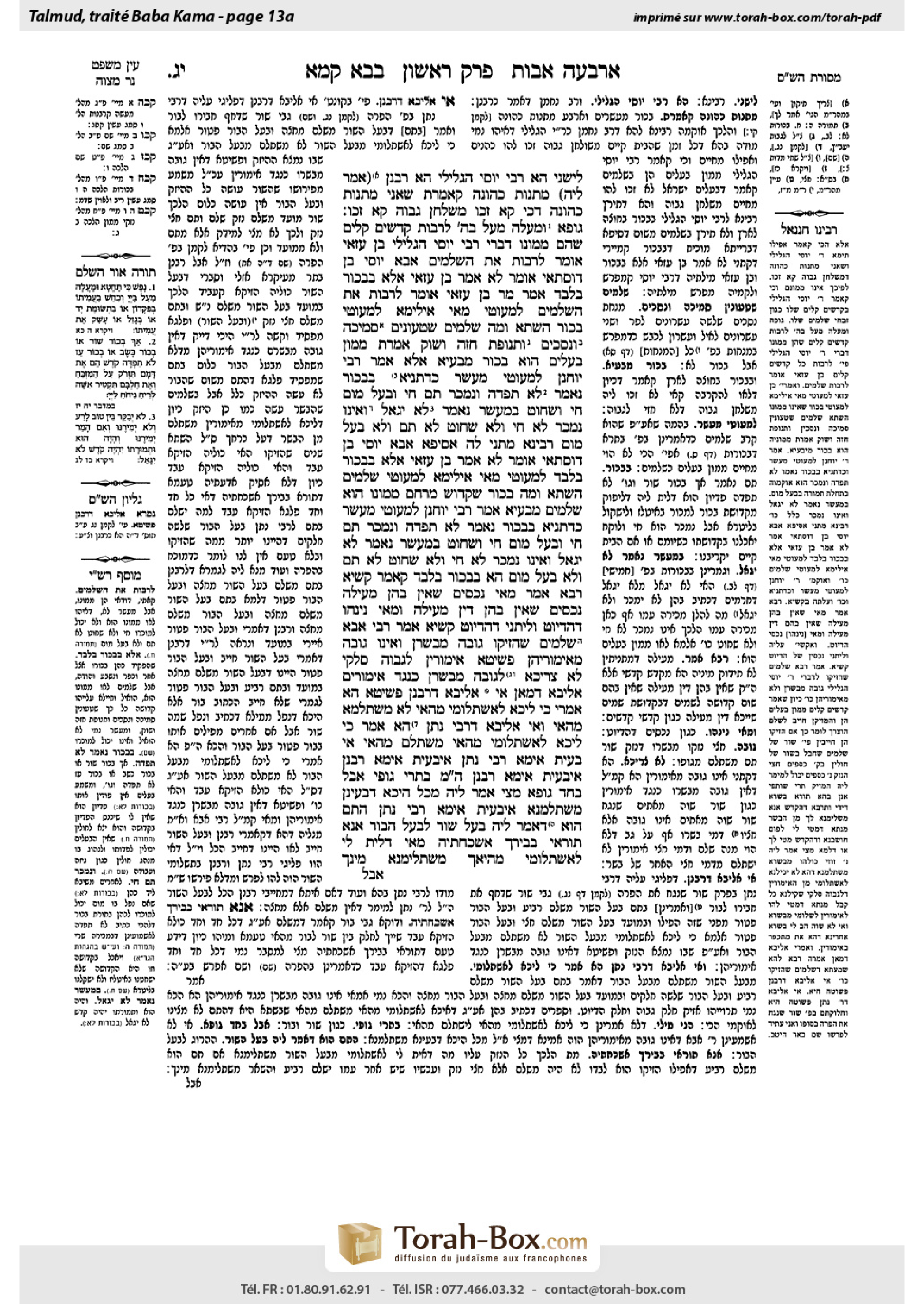
Bava Kamma 13a: Talmud study for Daf Yomi
Study the Talmud for Daf Yomi with scanned pages, Hebrew text, English translations from Sefaria and AI-generated French translations.
Passage selection and English or AI-generated French translation are available where the scan has annotations. Daf Study is independent of Torah-Box and Sefaria.
Browse Bava Kamma · בבא קמא · All tractatesBava Kamma 13a text and translations
This page of Bava Kamma includes the Aramaic text, an English translation and an AI-generated French translation, alongside the scan above.
בבא קמא י״ג א · Aramaic and Hebrew text
לִישַׁנֵּי: הָא רַבִּי יוֹסֵי הַגְּלִילִי, הָא רַבָּנַן!
(אֲמַר לֵיהּ), מַתְּנוֹת כְּהוּנָּה קָאָמְרַתְּ? שָׁאנֵי מַתְּנוֹת כְּהוּנָּה, דְּכִי קָא זָכוּ – מִשֻּׁלְחַן גָּבוֹהַּ קָא זָכוּ.
גּוּפָא: ״וּמָעֲלָה מַעַל בַּה׳״ – לְרַבּוֹת קֳדָשִׁים קַלִּים שֶׁהֵם מָמוֹנוֹ, דִּבְרֵי רַבִּי יוֹסֵי הַגְּלִילִי. בֶּן עַזַּאי אוֹמֵר: לְרַבּוֹת אֶת הַשְּׁלָמִים. אַבָּא יוֹסֵי בֶּן דּוֹסְתַּאי אוֹמֵר: לֹא אָמַר בֶּן עַזַּאי אֶלָּא בִּבְכוֹר בִּלְבָד.
אָמַר מָר, בֶּן עַזַּאי אוֹמֵר: לְרַבּוֹת אֶת הַשְּׁלָמִים. לְמַעוֹטֵי מַאי?
אִילֵּימָא לְמַעוֹטֵי בְּכוֹר, הַשְׁתָּא וּמָה שְׁלָמִים – שֶׁטְּעוּנִים סְמִיכָה וּנְסָכִים וּתְנוּפַת חָזֶה וָשׁוֹק, אָמְרַתְּ מָמוֹן בְּעָלִים הוּא; בְּכוֹר מִבַּעְיָא?
אֶלָּא אָמַר רַבִּי יוֹחָנָן: לְמַעוֹטֵי מַעֲשֵׂר –
כִּדְתַנְיָא: בִּבְכוֹר נֶאֱמַר ״לֹא תִפְדֶּה״, וְנִמְכָּר תָּם – חַי, וּבַעַל מוּם – חַי וְשָׁחוּט; בְּמַעֲשֵׂר נֶאֱמַר ״לֹא יִגָּאֵל״, וְאֵינוֹ נִמְכָּר לֹא חַי וְלֹא שָׁחוּט, לֹא תָּם וְלֹא בַּעַל מוּם.
רָבִינָא מַתְנֵי לַהּ אַסֵּיפָא – אַבָּא יוֹסֵי בֶּן דּוֹסְתַּאי אוֹמֵר: לֹא אָמַר בֶּן עַזַּאי, אֶלָּא בִּבְכוֹר בִּלְבָד. לְמַעוֹטֵי מַאי?
אִילֵּימָא לְמַעוֹטֵי שְׁלָמִים, הַשְׁתָּא וּמָה בְּכוֹר – שֶׁקָּדוֹשׁ מֵרֶחֶם, מָמוֹנוֹ הוּא; שְׁלָמִים מִבַּעְיָא?
אָמַר רַבִּי יוֹחָנָן: לְמַעוֹטֵי מַעֲשֵׂר.
כִּדְתַנְיָא: בִּבְכוֹר נֶאֱמַר ״לֹא תִפְדֶּה״, וְנִמְכָּר תָּם – חַי, וּבַעַל מוּם – חַי וְשָׁחוּט; בְּמַעֲשֵׂר נֶאֱמַר ״לֹא יִגָּאֵל״, וְאֵינוֹ נִמְכָּר לֹא חַי וְלֹא שָׁחוּט, לֹא תָּם וְלֹא בַּעַל מוּם.
הָא בִּבְכוֹר בִּלְבַד קָאָמַר! קַשְׁיָא.
רָבָא אָמַר: מַאי ״נְכָסִים שֶׁאֵין בָּהֶן מְעִילָה״ – נְכָסִים שֶׁאֵין בָּהֶן דִּין מְעִילָה. וּמַאי נִינְהוּ – דְּהֶדְיוֹט.
וְלִיתְנֵי דְּהֶדְיוֹט! קַשְׁיָא.
אָמַר רַבִּי אַבָּא: שְׁלָמִים שֶׁהִזִּיקוּ – גּוֹבֶה מִבְּשָׂרָן, וְאֵינוֹ גּוֹבֶה מֵאֵימוּרֵיהֶן.
פְּשִׁיטָא, אֵימוּרִין לְגָבוֹהַּ סָלְקִי!
לָא צְרִיכָא, לְגוֹבֶה מִבְּשָׂרָן כְּנֶגֶד אֵימוּרִים.
אַלִּיבָּא דְּמַאן?
אִי אַלִּיבָּא דְּרַבָּנַן – פְּשִׁיטָא! הָא אָמְרִי כִּי לֵיכָּא לְאִשְׁתַּלּוֹמֵי מֵהַאי, לָא מִשְׁתַּלַּם מֵהַאי!
וְאִי אַלִּיבָּא דְּרַבִּי נָתָן – הָא אָמַר: כִּי לֵיכָּא לְאִשְׁתַּלּוֹמֵי מֵהַאי, מִשְׁתַּלַּם מֵהַאי!
אִי בָּעֵית אֵימָא: רַבִּי נָתָן, אִיבָּעֵית אֵימָא: רַבָּנַן.
אִיבָּעֵית אֵימָא רַבָּנַן – הָנֵי מִילֵּי בִּתְרֵי גוּפֵי, אֲבָל בְּחַד גּוּפָא מָצֵי אָמַר לֵיהּ: ״מִכֹּל הֵיכָא דְּבָעֵינָא – מִשְׁתַּלַּמְנָא״.
אִיבָּעֵית אֵימָא רַבִּי נָתָן – הָתָם הוּא דַּאֲמַר לֵיהּ בַּעַל שׁוֹר לְבַעַל הַבּוֹר: ״אֲנָא תּוֹרַאי בְּבֵירָךְ אַשְׁכַּחְתֵּיהּ; מַאי דְּלֵית לִי לְאִשְׁתַּלּוֹמֵי מֵהַיְאךְ – מִשְׁתַּלַּימְנָא מִינָּךְ״;
Bava Kamma 13a · English translation
let Ravina answer Rava’s objection by saying: This baraita, which states that an offering of lesser sanctity is the property of its owner and may be sold even when the Temple stands, is in accordance with the opinion of Rabbi Yosei HaGelili, and it is referring to a case where the animal is still alive. And that qualification of the mishna by Rav Naḥman, that the sale of an unblemished firstborn animal when the Temple is standing is invalid, is in accordance with the opinion of the Rabbis, who dispute Rabbi Yosei HaGelili’s opinion.
The Gemara answers: He said to him that this is not difficult: Do you speak of gifts to which members of the priesthood are entitled, of which a firstborn animal is an example? Gifts of the priesthood are different from other offerings of lesser sanctity, as when the priests receive their portions, they receive them from the table of the Most High. Rabbi Yosei HaGelili claims that the act of consecration of an animal as an offering of lesser sanctity does not nullify one’s ownership of the animal. The sanctity of a firstborn offering takes effect with its birth, so it may be that it was never owned; rather, it is reasonable that the Torah provided the priest only with the right and the obligation to partake of it after it is sacrificed.
§ The Gemara considers the matter itself: The baraita teaches: Concerning one who steals another’s property and takes a false oath denying he has done so, incurring the obligation to bring a guilt-offering, the verse states: “And commits a trespass against the Lord, and deals falsely with his neighbor” (Leviticus 5:21). The verse serves to include a case in which one denies having in his possession offerings of lesser sanctity, which are the property of their owners, and are included in the phrase “and deals falsely with his neighbor.” This is the statement of Rabbi Yosei HaGelili. Ben Azzai says: This phrase serves to include peace-offerings. Abba Yosei ben Dostai says: Ben Azzai said this only with regard to a firstborn offering.
The Master said in the baraita: Ben Azzai says: This phrase serves to include peace-offerings. The Gemara asks: Ben Azzai’s interpretation of the phrase, limiting its interpretation to a reference only to peace-offerings, is to exclude what?
If we say it is to exclude a firstborn offering, because he holds that a firstborn is not the property of the priest, one could reject this, as the sanctity of a firstborn offering is a lesser sanctity than that of a peace-offering, as follows: Now, just as with regard to peace-offerings, which have a higher degree of sanctity such that they require placing hands on the head of the offering and are accompanied by libations and the waving of their breast and the right hind leg by the priest and owner together, you nevertheless say that it is the property of the owners, is it necessary to state that with regard to a firstborn offering, for which these halakhot do not apply, that the priest has ownership of it?
Rather, Rabbi Yoḥanan said: Ben Azzai mentioned peace-offerings in order to exclude an animal tithe offering, i.e., every tenth animal of one’s flock that is designated as tithe for those ten animals and is sacrificed as an offering of lesser sanctity. Animal tithes are excluded because ben Azzai holds that an animal tithe offering is not the property of the owner of the flock.
This is as it is taught in a baraita: With regard to a firstborn offering it is stated: “You shall not redeem” (Numbers 18:17), indicating that the owner can never fully redeem the offering, thereby removing its sanctity. And the firstborn offering can be sold when it is unblemished and alive, or when it is blemished and alive, or blemished and slaughtered. With regard to animal tithe offerings, it is stated: “It shall not be redeemed” (Leviticus 27:33), indicating that the one who designated it can never fully redeem an animal tithe offering, thereby removing its sanctity. And the animal tithe offering cannot be sold, not when it is alive and not when it is slaughtered, not when unblemished and not when blemished. The fact that the sale of an animal tithe offering is invalid demonstrates that it is not the property of the one who designated it.
Ravina taught the preceding discussion with regard to the last clause of the baraita: Abba Yosei ben Dostai says that ben Azzai said this only with regard to a firstborn offering. The Gemara asks: Abba Yosei ben Dostai’s interpretation of the phrase, limiting its interpretation to a reference only to a firstborn offering, is to exclude what?
If we say it is to exclude peace-offerings, because he holds that they are not the property of the one who consecrated them as offerings, one could reject this, as the sanctity of peace-offerings is a lesser sanctity than that of a firstborn offering, as follows: Now, just as with regard to a firstborn offering, which is already sanctified upon its emergence from the womb yet nevertheless is the property of the priest, is it necessary to state that peace-offerings are the property of those who consecrated them, where the animals were already the property of its owner before they were consecrated?
Rabbi Yoḥanan said: Abba Yosei ben Dostai mentioned peace-offerings in order to exclude an animal tithe offering. Animal tithes are excluded because Abba Yosei ben Dostai holds that an animal tithe offering is not the property of the owner of the flock.
This is as it is taught in a baraita: With regard to a firstborn offering it is stated: “You shall not redeem” (Numbers 18:17), indicating that the owner can never fully redeem the offering, thereby removing its sanctity. And the firstborn offering can be sold when it is unblemished and alive, or when it is blemished and alive, or blemished and slaughtered. With regard to animal tithe offerings, it is stated: “It shall not be redeemed” (Leviticus 27:33), indicating that the one who designated it can never fully redeem an animal tithe offering, thereby removing its sanctity. And the animal tithe offering cannot be sold, not when it is alive and not when it is slaughtered, not when unblemished and not when blemished. The fact that the sale of an animal tithe offering is invalid demonstrates that it is not the property of the one who designated it.
The Gemara asks: How can one claim that Abba Yosei ben Dostai holds that peace-offerings are also owned by those who consecrated them? Doesn’t Abba Yosei ben Dostai say: Ben Azzai said this only with regard to a firstborn offering. The Gemara concedes: This is difficult.
§ The Gemara cites an alternative explanation of the mishna’s statement: Rava said: What does the mishna mean when it says: One is liable only for damage caused to property for which, were one to use it for a mundane purpose, one would not be liable for the misuse of consecrated property? It is referring to property that is not at all subject to the halakhot of misuse of consecrated property, and what is that? It is referring to any property of an ordinary person, which has no sanctity at all.
The Gemara asks: But then let the mishna teach explicitly: One is liable only for damage caused to property of an ordinary individual. The Gemara concedes: This is difficult.
§ Rabbi Abba says: With regard to the case of an innocuous animal that was consecrated as a peace-offering and that caused damage, the injured party collects damages from its meat, i.e., from the portion of the offering that would have been eaten by its owners. This is in accordance with the general halakha that the payment for damage caused by an innocuous ox is collected exclusively from the proceeds of the sale of the body of the ox and not from any other property of its owner. But he does not collect the damages from the sacrificial portions.
The Gemara asks: Isn’t it obvious that one collects exclusively from the meat portion and not from the sacrificial portions, as those are to be offered up to God?
The Gemara answers: No, it is necessary for Rabbi Abba to teach that there is no collection from the owner’s meat portions corresponding to the sacrificial portions. Payment for damage caused by an innocuous animal is half the amount of the damages, and can be no more than the value of the animal itself. Rabbi Abba is teaching that when assessing the damage to determine the amount to be paid, one deems the owner responsible only according to his share of the animal, i.e., the meat portions, in relation to the animal as a whole.
Rabbi Natan and the Rabbis engage in a dispute concerning the halakha in a case in which an ox pushed another animal into a pit (see 53a). If it were an innocuous ox, for which the Torah limits the owner’s liability to half the damages, the Rabbis rule that liability is incurred exclusively by the owner of the ox, i.e., he pays half the value of the damage, and the owner of the pit is entirely exempt. Rabbi Natan holds that since the damage was caused jointly by the ox and the pit, the owner of the ox need pay only half of what he would pay if his animal had been solely responsible, i.e., a quarter of the damages. Rabbi Natan further rules that the remaining sum can then be fully recovered from the owner of the pit, i.e., he pays the remaining three-quarters of the damages. The Gemara asks: In accordance with whose opinion, of those tanna’im, does Rabbi Abba state his ruling?
If it is in accordance with the opinion of the Rabbis, then it is obvious and there is no need to state it, as didn’t the Rabbis say: Whenever, for whatever reason, the full cost of the damage cannot be recovered from this party, it is not recovered from that party, i.e., even though the injured party suffered the loss of the full value of his animal and recovered only half its value from the owner of the ox, he may not demand the remaining sum from the owner of the pit. So too, in this case, where the injured party cannot collect damages from the sacrificial portions, he cannot recover that loss from the meat portions of the one who brought the offering.
And if it is in accordance with the opinion of Rabbi Natan, doesn’t he say: Whenever the full cost of the damage cannot be recovered from this one, it is recovered from that one, i.e., since the owner of the ox pays only a quarter of the damages, the remaining sum can be recovered from the owner of the pit. So too, in this case, since the injured party cannot collect payment from the sacrificial portions, he should be able to recover that loss from the meat portions of the one who brought the offering, in contrast to the ruling of Rabbi Abba.
The Gemara explains: If you wish, say Rabbi Abba’s ruling is in accordance with Rabbi Natan, and if you wish, say his ruling is in accordance with the Rabbis.
The Gemara explains: If you wish, say Rabbi Abba’s ruling is in accordance with the Rabbis, as one might have thought that this matter, the ruling of the Rabbis, applies only where the damage is caused by two bodies, such as an ox and a pit. But where the damage is caused by one body, as in the case of damage caused by an animal consecrated as a peace-offering, the injured party can say to the owner of the animal: From anywhere that I want to, I will recover my losses, and accordingly, the injured party could collect the full cost of the damage from the meat portions of the one who brought the offering. Therefore, it is necessary for Rabbi Abba to teach that this is not the halakha.
And if you wish, say Rabbi Abba’s ruling is in accordance with Rabbi Natan: It is only there that the owner of the damaged ox can say to the owner of the pit: Since I found my ox in your pit, ultimately you bear responsibility for any damage, and therefore whatever I cannot recover from the other one, i.e., the owner of the ox, I will recover from you.
Bava Kamma 13a · Traduction française (IA)
Ravina répond à l'objection de Rava en disant : Ce baraïta, qui affirme qu'une offrande de moindre sanctité appartient à son propriétaire et peut être vendue même lorsque le Temple est debout, s'accorde avec l'opinion de Rabbi Yosei HaGelili, et il s'agit d'un cas où l'animal est encore vivant. Et la qualification de la Michna par Rav Naḥman, selon laquelle la vente d'un animal primitif non blemi lorsque le Temple est debout est invalide, s'accorde avec l'opinion des Rabbins, qui contestent l'opinion de Rabbi Yosei HaGelili.
Le Guemara répond : Il lui a dit que cela n'est pas difficile : parlez-vous de dons auxquels les membres du clergé ont droit, comme l'exemple d'un animal primitif ? Les dons du clergé diffèrent des autres offrandes de moindre sanctité, car lorsque les prêtres reçoivent leur part, ils la reçoivent de la table du Très-Haut. Rabbi Yosei HaGelili affirme que l'acte de consécration d'un animal comme offrande de moindre sanctité ne nul l'propriété de l'animal. La sanctité d'une offrande primitif s'applique à sa naissance, donc peut-être qu'il n'était jamais propriété ; plutôt, il est raisonnable que la Torah ait donné au prêtre seulement le droit et l'obligation de participer à son consommation après qu'il ait été sacrifié.
§ Le Guemara examine la question elle-même : le baraïta enseigne : concernant celui qui vole la propriété d'autrui et prend un faux serment en déniant avoir fait cela, entraînant l'obligation de présenter un sacrifice de culpabilité, la Sainte Écriture dit : « Et il commet un péché contre l'Éternel, et il ment à son prochain » (Lévitique 5:21). La Sainte Écriture sert à inclure un cas où l'on nie avoir en sa possession des offrandes de moindre sanctité, qui sont la propriété de leurs propriétaires, et qui sont incluses dans la phrase « et il ment à son prochain ». C'est l'opinion de Rabbi Yosei HaGelili. Ben Azzai dit : cette phrase sert à inclure les offrandes de paix. Abba Yosei ben Dostai dit : Ben Azzai a dit cela uniquement concernant une offrande de premier-né.
Le Maître a dit dans le baraïta : Ben Azzai dit : cette phrase sert à inclure les offrandes de paix. Le Guemara demande : l'interprétation de Ben Azzai de cette phrase, limitant son interprétation à une référence uniquement aux offrandes de paix, est-elle pour exclure quoi ?
Si nous disons qu'il s'agit d'exclure une offrande de premier-né, car il considère que la première-né n'appartient pas au prêtre, on pourrait rejeter cela, car la sanctité d'une offrande de premier-né est une sanctité moindre que celle d'une offrande de paix, comme suit : maintenant, tout comme pour les offrandes de paix, qui ont un degré plus élevé de sanctité tel qu'ils nécessitent de poser les mains sur la tête de l'offrande et sont accompagnés de libations et de la balayage du sein et de la patte arrière droite par le prêtre et l'propriétaire ensemble, vous dites toutefois qu'ils appartiennent à leurs propriétaires, est-il nécessaire de dire que pour une offrande de premier-né, pour laquelle ces halakhot ne s'appliquent pas, que le prêtre en est propriétaire ?
Plutôt, Rabbi Yoḥanan a dit : Ben Azzai a mentionné les offrandes de paix afin d'exclure l'offrande de dîme animale, c'est-à-dire chaque dixième animal de son troupeau désigné comme dîme pour ces dix animaux et sacrifié comme une offrande de moindre sanctité. Les dîmes animales sont exclues car Ben Azzai considère qu'une offrande de dîme animale n'appartient pas au propriétaire du troupeau.
C'est ce qui est enseigné dans un baraïta : concernant une offrande de premier-né, il est dit : « Vous ne pouvez pas racheter » (Nb 18:17), indiquant que le propriétaire ne peut jamais pleinement racheter l'offrande, ce qui enlève sa sanctité. Et l'offrande de premier-né peut être vendu lorsqu'il est non blemi et vivant, ou blemi et vivant, ou blemi et sacrifié. Concernant les offrandes de dîme animale, il est dit : « Il ne peut pas être racheté » (Lévitique 27:33), indiquant que celui qui l'a désigné ne peut jamais pleinement racheter une offrande de dîme animale, ce qui enlève sa sanctité. Et l'offrande de dîme animale ne peut pas être vendu, ni lorsqu'il est vivant ni lorsqu'il est sacrifié, ni lorsqu'il est non blemi ni lorsqu'il est blemi. Le fait que la vente d'une offrande de dîme animale soit invalide démontre qu'elle n'appartient pas à celui qui l'a désigné.
Ravina a enseigné la discussion précédente concernant la dernière phrase du baraïta : Abba Yosei ben Dostai dit que Ben Azzai a dit cela uniquement concernant une offrande de premier-né. Le Guemara demande : l'interprétation d'Abba Yosei ben Dostai de cette phrase, limitant son interprétation à une référence uniquement à une offrande de premier-né, est-elle pour exclure quoi ?
Si nous disons qu'il s'agit d'exclure les offrandes de paix, car il considère qu'elles n'appartiennent pas à celui qui les a consacrés comme offrandes, on pourrait rejeter cela, car la sanctité des offrandes de paix est une sanctité moindre que celle d'une offrande de premier-né, comme suit : maintenant, tout comme pour une offrande de premier-né, qui est déjà sanctifiée à sa naissance mais reste la propriété du prêtre, est-il nécessaire de dire que les offrandes de paix sont la propriété de ceux qui les ont consacrés, alors que les animaux étaient déjà la propriété de leur propriétaire avant d'être consacrés ?
Rabbi Yoḥanan a dit : Abba Yosei ben Dostai a mentionné les offrandes de paix afin d'exclure une offrande de dîme animale. Les dîmes animales sont exclues car Abba Yosei ben Dostai considère qu'une offrande de dîme animale n'appartient pas au propriétaire du troupeau.
C’est ce qui est enseigné dans une baraïta : concernant l’offrande de premier-né, il est dit : « Tu ne pourras pas racheter » (Nombres 18 : 17), ce qui indique que le propriétaire ne peut jamais pleinement racheter l’offrande, ce qui enlève sa sanctité. Et l’offrande de premier-né peut être vendue lorsqu’elle est intacte et vivante, ou lorsqu’elle est brouillée et vivante, ou brouillée et sacrifiée. Concernant les offrandes de dîme animale, il est dit : « Elle ne peut pas être rachetée » (Lévitique 27 : 33), ce qui indique que celui qui l’a désigné ne peut jamais pleinement racheter une offrande de dîme animale, ce qui enlève sa sanctité. Et l’offrande de dîme animale ne peut pas être vendue, ni lorsqu’elle est vivante, ni lorsqu’elle est sacrifiée, ni lorsqu’elle est intacte, ni lorsqu’elle est brouillée. Le fait que la vente d’une offrande de dîme animale soit invalide démontre qu’elle n’est pas la propriété de celui qui l’a désigné.
Le Guemara demande : Comment peut-on affirmer que Abba Yosei ben Dostai considère que les offrandes de paix sont également propriété de ceux qui les ont consacrés ? N’est-ce pas ce que dit Abba Yosei ben Dostai : Ben Azzai a dit cela uniquement concernant l’offrande de premier-né ? Le Guemara admet : Cela est difficile.
§ Le Guemara cite une autre explication de la déclaration de la mishna : Rava dit : Quelle est la signification de la mishna lorsqu’elle dit : On est responsable uniquement des dommages causés à un bien pour lequel, si l’on l’utilisait à des fins ordinaires, on ne serait pas responsable de l’abus d’un bien consacré ? Il s’agit d’un bien qui n’est pas du tout soumis aux halakhot de l’abus d’un bien consacré, et de quel genre ? Il s’agit de tout bien d’un individu ordinaire, qui n’a aucune sanctité.
Le Guemara demande : Mais alors pourquoi la Michna ne précise-t-elle pas explicitement : On est responsable uniquement des dommages causés à un bien d’un individu ordinaire ? Le Guemara admet : Cela est difficile.
§ Rabbi Abba dit : Concernant le cas d’un animal inoffensif consacré comme offrande de paix qui a causé des dommages, la partie blessée récupère les dommages à partir de la viande, c’est-à-dire de la portion de l’offrande qui aurait été mangée par ses propriétaires. Cela s’inscrit dans la halakha générale selon laquelle le paiement des dommages causés par un animal inoffensif est recueilli exclusivement des revenus de la vente du corps de l’animal et non d’aucun autre bien de son propriétaire. Mais il ne récupère pas les dommages à partir des parties sacrificielles.
Le Guemara demande : N’est-ce pas évident que l’on récupère exclusivement à partir de la portion viande et non des parties sacrificielles, puisque celles-ci sont offertes à Dieu ?
Le Guemara répond : Non, il est nécessaire que Rabbi Abba enseigne qu’il n’y a pas de réclamation à partir des portions viandes correspondant aux parties sacrificielles. Le paiement des dommages causés par un animal inoffensif est la moitié du montant des dommages et ne peut pas dépasser la valeur de l’animal lui-même. Rabbi Abba enseigne que lors de l’évaluation des dommages pour déterminer le montant à payer, on considère que le propriétaire est responsable uniquement selon sa part de l’animal, c’est-à-dire les portions viandes, par rapport à l’animal en tant que tout entier.
Rabbi Natan et les Rabbins s’engagent dans un débat concernant la halakha dans le cas où un bœuf poussait un autre animal dans un puits (voir 53a). Si c’était un bœuf inoffensif, pour lequel la Torah limite la responsabilité du propriétaire à la moitié des dommages, les Rabbins décident que la responsabilité incombe uniquement au propriétaire du bœuf, c’est-à-dire qu’il paie la moitié de la valeur des dommages, et le propriétaire du puits est entièrement exempt. Rabbi Natan considère que puisque les dommages ont été causés conjointement par le bœuf et le puits, le propriétaire du bœuf doit payer seulement la moitié de ce qu’il paierait si son animal avait été seul responsable, c’est-à-dire un quart des dommages. Rabbi Natan décide également que la somme restante peut alors être pleinement récupérée auprès du propriétaire du puits, c’est-à-dire qu’il paie les trois-quarts des dommages restants. Le Guemara demande : Selon l’opinion de quels tanna’im, Rabbi Abba exprime-t-il son jugement ?
Si c’est selon l’opinion des Rabbins, alors cela est évident et il n’y a pas besoin de le dire, car les Rabbins ont dit : Lorsque, pour quelque raison que ce soit, le coût complet des dommages ne peut pas être récupéré auprès de cette partie, il ne peut pas être récupéré auprès de celle-ci, c’est-à-dire même si la partie blessée a subi la perte de la valeur totale de son animal et a récupéré seulement la moitié de sa valeur auprès du propriétaire du bœuf, il ne peut pas exiger la somme restante auprès du propriétaire du puits. De même, dans ce cas, où la partie blessée ne peut pas récupérer des dommages à partir des parties sacrificielles, elle ne peut pas récupérer cette perte auprès des portions viandes du propriétaire de l’offrande.
Et si c’est selon l’opinion de Rabbi Natan, n’a-t-il pas dit : Lorsque le coût complet des dommages ne peut pas être récupéré auprès de cette personne, il est récupéré auprès de celle-ci, c’est-à-dire puisque le propriétaire du bœuf paie seulement un quart des dommages, la somme restante peut être récupérée auprès du propriétaire du puits. De même, dans ce cas, puisque la partie blessée ne peut pas récupérer le paiement à partir des parties sacrificielles, il devrait pouvoir récupérer cette perte auprès des portions viandes du propriétaire de l’offrande, contrairement au jugement de Rabbi Abba.
Le Guemara explique : Si vous le souhaitez, dites que le jugement de Rabbi Abba est selon Rabbi Natan, et si vous le souhaitez, dites que son jugement est selon les Rabbins.
Le Guemara explique : Si vous le souhaitez, dites que le jugement de Rabbi Abba est selon les Rabbins, car on pouvait penser que cette question, le jugement des Rabbins, s’applique uniquement dans le cas où les dommages sont causés par deux corps, tels qu’un bœuf et un puits. Mais dans le cas où les dommages sont causés par un seul corps, comme dans le cas de dommages causés par un animal consacré comme offrande de paix, la partie blessée peut dire au propriétaire de l’animal : De n’importe où que je veux, je récupère mes pertes, et ainsi, la partie blessée pourrait récupérer le coût complet des dommages à partir des portions viandes du propriétaire de l’offrande. Par conséquent, il est nécessaire que Rabbi Abba enseigne que cela n’est pas la halakha.
Et si tu le veux, dis que la décision du Rabbi Abba suit celle du Rabbi Natan : il s'agit seulement là que l'propriétaire de l'ox blessé puisse dire à l'propriétaire du puits : puisque j'ai trouvé mon ox dans votre puits, finalement vous portez la responsabilité de tout dommage, et par conséquent, tout ce que je ne puis récupérer auprès de l'autre, c'est-à-dire l'propriétaire de l'ox, je le récupère auprès de vous.
Traduction française générée par IA à partir de l’édition anglaise de Sefaria. Vérifie toujours un passage avec le texte source.
Text from Sefaria: William Davidson Edition - Vocalized Aramaic (CC BY NC); William Davidson Edition - English (CC BY NC).