Bava Kamma 13b: Talmud study for Daf Yomi
Study the Talmud for Daf Yomi with scanned pages, Hebrew text, English translations from Sefaria and AI-generated French translations.
Passage selection and English or AI-generated French translation are available where the scan has annotations. Daf Study is independent of Torah-Box and Sefaria.
Browse Bava Kamma · בבא קמא · All tractatesBava Kamma 13b text and translations
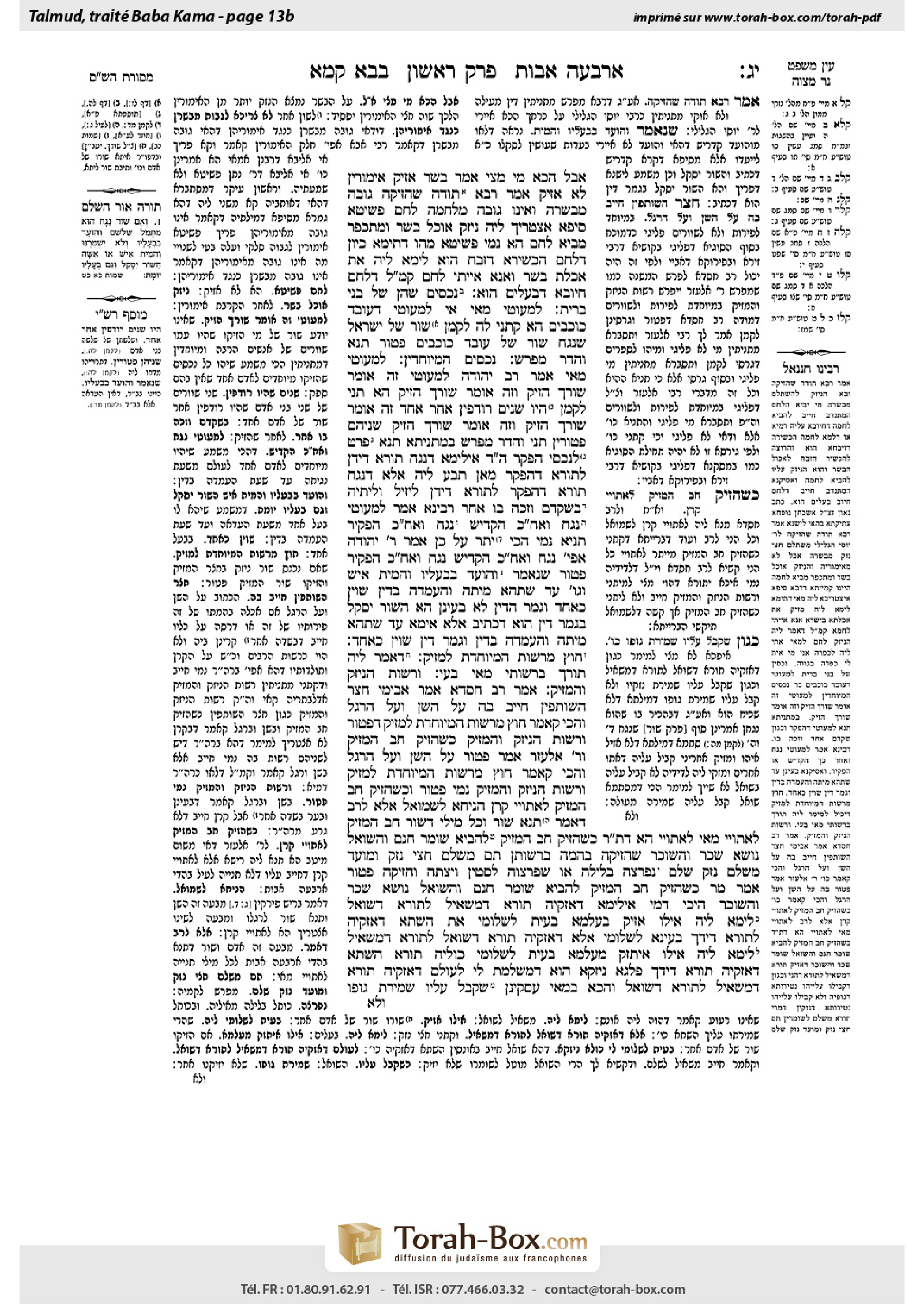
This page of Bava Kamma includes the Aramaic text, an English translation and an AI-generated French translation, alongside the scan above.
בבא קמא י״ג ב · Aramaic and Hebrew text
אֲבָל הָכָא, מִי מָצֵי אָמַר: ״בָּשָׂר אַזֵּיק, אֵימוּרִין לָא אַזִּיק״?!
אָמַר רָבָא: תּוֹדָה שֶׁהִזִּיקָה – גּוֹבֶה מִבְּשָׂרָהּ, וְאֵינוֹ גּוֹבֶה מִלַּחְמָהּ.
לֶחֶם – פְּשִׁיטָא!
סֵיפָא אִצְטְרִיךְ לֵיהּ – נִיזָּק אוֹכֵל בָּשָׂר, וּמִתְכַּפֵּר מֵבִיא לֶחֶם.
הָא נָמֵי פְּשִׁיטָא! מַהוּ דְּתֵימָא, כֵּיוָן דְּלֶחֶם הֶכְשֵׁירָא דְזֶבַח הוּא – לֵימָא לֵיהּ: אַתְּ אָכְלַתְּ בְּשַׂר, וַאֲנָא אַיְיתֵי לֶחֶם; קָא מַשְׁמַע לַן דְּלֶחֶם חִיּוּבָא דִּבְעָלִים הוּא.
נְכָסִים שֶׁהֵן שֶׁל בְּנֵי בְרִית.
לְמַעוֹטֵי מַאי? אִי לְמַעוֹטֵי דְּגוֹי – הָא קָתָנֵי לַהּ לְקַמַּן: שׁוֹר שֶׁל יִשְׂרָאֵל שֶׁנָּגַח שׁוֹר שֶׁל גּוֹי – פָּטוּר! תָּנֵי וַהֲדַר מְפָרֵשׁ.
נְכָסִים הַמְיוּחָדִין. לְמַעוֹטֵי מַאי? אָמַר רַב יְהוּדָה: לְמַעוֹטֵי זֶה אוֹמֵר ״שׁוֹרְךָ הִזִּיק״, וְזֶה אוֹמֵר ״שׁוֹרְךָ הִזִּיק״.
הָא תָּנֵי לְקַמַּן: הָיוּ שְׁנַיִם רוֹדְפִין אַחַר אֶחָד, זֶה אוֹמֵר: ״שׁוֹרְךָ הִזִּיק״, וְזֶה אוֹמֵר: ״שׁוֹרְךָ הִזִּיק״ – שְׁנֵיהֶם פְּטוּרִין! תָּנֵי וַהֲדַר מְפָרֵשׁ.
בְּמַתְנִיתָא תָּנָא: פְּרָט לְנִכְסֵי הֶפְקֵר. הֵיכִי דָמֵי? אִילֵּימָא דִּנְגַח תּוֹרָא דִידַן לְתוֹרָא דְהֶפְקֵר – מַאן תָּבַע לֵיהּ? אֶלָּא דִּנְגַח תּוֹרָא דְהֶפְקֵר לְתוֹרָא דִידַן –
לֵיזִיל וְלַיְתֵיהּ! בְּשֶׁקָּדַם וְזָכָה בּוֹ אַחֵר.
רָבִינָא אָמַר: לְמַעוֹטֵי נָגַח וְאַחַר כָּךְ הִקְדִּישׁ; נָגַח וְאַחַר כָּךְ הִפְקִיר.
תַּנְיָא נָמֵי הָכִי, יָתֵר עַל כֵּן אָמַר רַבִּי יְהוּדָה: אֲפִילּוּ נָגַח וְאַחַר כָּךְ הִקְדִּישׁ, נָגַח וְאַחַר כָּךְ הִפְקִיר – פָּטוּר, שֶׁנֶּאֱמַר: ״וְהוּעַד בִּבְעָלָיו וְהֵמִית אִישׁ וְגוֹ׳״ – עַד שֶׁתְּהֵא מִיתָה וְהַעֲמָדָה בַּדִּין שָׁוִין כְּאֶחָד.
וּגְמַר הַדִּין לָא בָּעֵינַן?! הָא ״הַשּׁוֹר יִסָּקֵל״ – בִּגְמַר דִּין הוּא דִּכְתִיב!
אֶלָּא אֵימָא: עַד שֶׁתְּהֵא מִיתָה וְהַעֲמָדָה בְּדִין וּגְמַר דִּין שָׁוִין כְּאֶחָד.
חוּץ מֵרְשׁוּת הַמְיוּחֶדֶת לַמַּזִּיק. דְּאָמַר לֵיהּ: תּוֹרָךְ בִּרְשׁוּתִי מַאי בָּעֵי?
וּרְשׁוּת הַנִּיזָּק וְהַמַּזִּיק.
אָמַר רַב חִסְדָּא אָמַר אֲבִימִי: חֲצַר הַשּׁוּתָּפִין – חַיָּיב בָּהּ עַל הַשֵּׁן וְעַל הָרֶגֶל. וְהָכִי קָאָמַר: ״חוּץ מֵרְשׁוּת הַמְיוּחֶדֶת לַמַּזִּיק״ – דְּפָטוּר; ״וּרְשׁוּת הַנִּיזָּק וְהַמַּזִּיק – כְּשֶׁהִזִּיק חָב הַמַּזִּיק״.
וְרַבִּי אֶלְעָזָר אָמַר: פָּטוּר עַל הַשֵּׁן וְעַל הָרֶגֶל. וְהָכִי קָאָמַר: ״חוּץ מֵרְשׁוּת הַמְיוּחֶדֶת לַמַּזִּיק, וּרְשׁוּת הַנִּיזָּק וְהַמַּזִּיק״ נָמֵי – פָּטוּר; ״וּכְשֶׁהִזִּיק חָב הַמַּזִּיק״ – לְאֵתוֹיֵי קֶרֶן.
הָנִיחָא לִשְׁמוּאֵל, אֶלָּא לְרַב דְּאָמַר: תְּנָא שׁוֹר וְכֹל מִילֵּי דְשׁוֹר, ״חָב הַמַּזִּיק״ לְאֵתוֹיֵי מַאי?
לְאֵתוֹיֵי הָא דְּתָנוּ רַבָּנַן: ״כְּשֶׁהִזִּיק חָב הַמַּזִּיק״ – לְהָבִיא שׁוֹמֵר חִנָּם וְהַשּׁוֹאֵל נוֹשֵׂא שָׂכָר וְהַשּׂוֹכֵר, שֶׁהִזִּיקָה בְּהֵמָה בִּרְשׁוּתָן; תָּם – מְשַׁלֵּם חֲצִי נֶזֶק, וּמוּעָד – מְשַׁלֵּם נֶזֶק שָׁלֵם. נִפְרְצָה בַּלַּיְלָה אוֹ שֶׁפְּרָצוּהָ לִסְטִין, וְיָצְתָה וְהִזִּיקָה – פָּטוּר.
אָמַר מָר: כְּשֶׁהִזִּיק חָב הַמַּזִּיק – לְהָבִיא שׁוֹמֵר חִנָּם וְהַשּׁוֹאֵל נוֹשֵׂא שָׂכָר וְהַשּׂוֹכֵר. הֵיכִי דָּמֵי?
אִילֵימָא דְּאַזְּקֵיהּ תּוֹרָא דְמַשְׁאִיל לְתוֹרָא דְשׁוֹאֵל – לֵימָא לֵיהּ: אִילּוּ אַזֵּיק בְּעָלְמָא – בָּעֵית לְשַׁלּוֹמֵי אַתְּ; הַשְׁתָּא דְּאַזְּקֵיהּ לְתוֹרָא דִידָךְ, בָּעֵינָא לְשַׁלּוֹמֵי?!
אֶלָּא דְּאַזְּקֵיהּ תּוֹרָא דְשׁוֹאֵל לְתוֹרָא דְמַשְׁאִיל – לֵימָא לֵיהּ: אִילּוּ אִיתַּזַּק מֵעָלְמָא – בָּעֵית לְשַׁלּוֹמֵי כּוּלֵּיהּ תּוֹרָא; הַשְׁתָּא דְּאַזְּקֵיהּ תּוֹרָא דִידָךְ, פַּלְגָא נִיזְקָא הוּא דִּמְשַׁלְּמַתְּ לִי?!
לְעוֹלָם דְּאַזְּקֵיהּ תּוֹרָא דְמַשְׁאִיל לְתוֹרָא דְשׁוֹאֵל, וְהָכָא בְּמַאי עָסְקִינַן – שֶׁקִּבֵּל עָלָיו שְׁמִירַת גּוּפוֹ,
Bava Kamma 13b · English translation
But here, in the case of damage caused by an animal consecrated as a peace-offering, is the injured party actually able to say: Only the meat of the animal caused damage but the sacrificial portions did not cause damage? Since the entire animal caused the damage, he does not collect the full cost of the damage from the meat portions of the one who brought the offering.
Rava says: In the case of an innocuous animal consecrated as a thanks-offering that caused damage, the injured party collects damages from its meat, i.e., from the portion of the offerings that would have been eaten by the one who brought the offering, but he does not collect from its bread, i.e., from the offering of forty loaves of bread that accompanies the sacrifice of the animal.
The Gemara asks: Isn’t it obvious that he does not collect from the bread? The bread is not part of the animal that caused damage.
The Gemara answers: It was necessary for Rava to state this because of the latter clause of his ruling, which states: The injured party eats the meat portions of the offering according to the value of the damages owed to him, but the one achieving atonement, i.e., the one bringing the offering, brings the bread.
The Gemara asks: Isn’t this also obvious? Why should anyone else bring the bread? The Gemara explains: Lest you say, since the bread is a necessary qualifying factor for the thanks-offering, as without it one does not fulfill one’s obligation, let the owner of the offering say to the one eating it, why should you eat the meat and I bring the bread? If you wish to eat, you should bring the bread. Therefore, Rava teaches us that the offering of the loaves of bread is the obligation of the owners of the offering.
§ The mishna teaches: One is liable only for damage caused to property that belongs to members of the covenant.
The Gemara asks: This clause serves to exclude what? If it serves to exclude the property of a gentile, isn’t that already explicitly taught in the mishna below (37b): In the case of an ox of a Jew that gored an ox of a gentile, the Jew is exempt. The Gemara answers: The tanna teaches this as a principle in the mishna here and then explains it in greater detail in the mishna below.
The mishna continues: One is liable only for assigned property. The Gemara asks: This clause serves to exclude what? Rav Yehuda said: This clause serves to exclude a case in which an animal is injured but it is unclear which of two oxen, owned by different people, caused the damage. The owner of this ox says to the owner of the other: Your ox caused the damage. And the owner of that ox says to the owner of the other: Your ox caused the damage. Since it cannot be proven which ox actually caused the damage, neither owner is liable. The intention of the mishna is that one is liable only where the belligerent ox is assigned to, i.e., is known to be the property of, a specific individual.
The Gemara asks: Isn’t that explicitly taught in the mishna below (35a): If two oxen were seen pursuing a single ox, and then the single ox is found to be injured, and the owner of this ox says to the owner of the other: Your ox caused the damage. And the owner of that ox says to the owner of the other: Your ox caused the damage. In such a case, both of them are exempt since it is uncertain which one is guilty. The Gemara answers: The tanna teaches this as a principle in the mishna here and then explains it in greater detail in the mishna below.
It was taught in a baraita in explanation of the mishna that the term assigned property serves to exclude ownerless property. The Gemara clarifies: What are the circumstances in which the mishna teaches that one is exempt? If we say it is referring to a case where an ox belonging to us, i.e., to a Jew, gored an ownerless ox, it is obvious that the owner bears no liability, as who is claiming damages from him? Rather, it must be referring to a case where an ownerless ox gored an ox belonging to us, and it teaches that the injured party does not have a right to damages.
The Gemara asks: What is the point of this halakha? If the injured party wishes to recover his losses, let him go and take the belligerent ox for himself, since it is currently ownerless. The Gemara explains: The mishna teaches that the injured party does not have any right to the ox, in order to teach that in a case where another person preceded him and acquired it, the injured party has no claim to it.
Ravina said an alternative interpretation of the mishna: The term assigned property serves to exclude a case in which an ox gored and subsequently its owner consecrated it, or where it gored and subsequently its owner declared it ownerless. Since the owners did not own the ox at the time the case was brought before the court, they are exempt from paying. Ravina explains that this is the intention of the mishna: That one is liable only when the property that caused the damage was owned by a responsible party both when it caused the damage and when it was tried. In this case, at the time of the court hearing it was not owned by a responsible party, as it was either consecrated or ownerless.
It is also taught in a baraita: The halakha is that an ox that kills a person is stoned to death. The mishna states (44b) that this does not apply to an ox consecrated to the Temple or an ownerless ox. Moreover, Rabbi Yehuda said: Even if an ox gored and its owner subsequently consecrated it to the Temple, or if an ox gored and its owner subsequently declared it ownerless, the owner is exempt from liability, as it is stated: “And if the ox was wont to gore in time past, and had been forewarned with its owner, and he had not guarded it in, and it killed a man or a woman; the ox shall be stoned, and also its owner shall be put to death” (Exodus 21:29). The repetition of the reference to the owner at the beginning and end of the verse indicates that the ox is not stoned unless the ox’s status as the owner’s property at the time of the death of the victim and at the time of the owner’s standing trial is the same, i.e., the ox is owned by a responsible party for both events.
The Gemara asks: But do we not also require that the ox’s status be the same at the time of the verdict? Isn’t the phrase: “The ox shall be stoned” written with regard to the time of the verdict?
Rather, say that the owner of the ox is exempt unless the ox’s status as the owner’s property at the time of the death of the victim and at the time of the owner’s standing trial and at the verdict is the same, i.e., the ox is owned by a responsible party for all three events.
§ The mishna teaches: One is liable for damage caused in any place except for a domain designated exclusively for the use of the one responsible for the damage. The Gemara explains the reason for this: This is because the one liable for the damage can say to the injured party: What did your ox want in my domain? One does not have to guard his ox from causing damage within his own property, since another person’s animal has no right to be there.
The mishna continues: And one is liable for damage caused in a domain designated for the joint use of the injured party and the one liable for the damage.
The Gemara cites a dispute concerning this case that results in two different ways of interpreting the mishna: Rav Ḥisda says that Avimi says: With regard to a courtyard designated for the joint use of two partners, either one of them is liable for damage caused by the ox of one partner to the property of the other partner while in it, both for the category of Eating and for the category of Trampling. And accordingly, this is what the mishna is saying: One is liable for damage caused in any place except for a domain designated exclusively for the use of the one responsible for the damage, as he is exempt there; but in a domain designated for the joint use of the injured party and the one responsible for the damage, when he causes damage, the one who is responsible for the damage is obligated to pay damages. The statement in the mishna concerning a domain designated for joint use is the beginning of the following clause and introduces a case in which one is liable for damage.
And Rabbi Elazar says: In a courtyard designated for joint use, one is exempt for one’s ox causing damage to the property of his partner in the category of Eating, and for one’s ox causing damage to the property of his partner in the category of Trampling. And accordingly, this is what the mishna is saying: One is liable for damage caused in any place except for a domain designated exclusively for the use of the one responsible for the damage, and one is also exempt for damage done in a domain designated for the joint use of the injured party and the one liable for the damage. The statement in the mishna about a domain designated for joint use is a continuation of the previous clause and adds an additional case in which one is exempt. And the following clause: When one causes damage, the one liable for the damage is obligated to pay damages, serves to add the fact that one is liable for damage in the framework of the category of Goring, which was not previously mentioned in the mishna.
This interpretation of the concluding clause of the mishna, as a reference to Goring, works out well according to Shmuel, in his dispute with Rav (3b) concerning the meaning of Ox and Maveh in the first mishna of this chapter. According to Shmuel they mean Trampling and Eating, respectively, and Goring has yet to be addressed. But according to Rav, who says: The term ox in the mishna includes damage caused by the ox and all matters involving damaging actions that are completed by an ox, including Goring, Eating, and Trampling, Goring is already addressed in the mishna. What is added by the clause: The one liable for the damage is obligated to pay damages?
The Gemara answers: It serves to add that which the Sages taught in a baraita that elucidates the mishna’s statement. The mishna states: When an animal or item one is responsible to safeguard causes damage, the one liable for the damage caused by insufficiently safeguarding it is obligated to pay payments of restitution for damage. This serves to include the cases of an unpaid bailee, a borrower, a paid bailee, and a renter, in which an animal, e.g., an ox, caused damage while in their possession. If the ox was innocuous, he pays half of the damages, and if it was forewarned, he pays the full damages. If the ox was safely enclosed and a wall broke open at night, or if bandits [listin] broke it open and the ox went out and caused damage, he is exempt from liability.
The Gemara analyzes the baraita: The Master said that the mishna states: When an animal or item one is responsible to safeguard causes damage, the one liable for the damage caused by insufficiently safeguarding it is obligated to pay payments of restitution for damage. This serves to include the cases of an unpaid bailee, a borrower, a paid bailee, and a renter. The Gemara asks: What are the circumstances?
If we say that the lender’s ox, which was under the watch of the borrower, injured the borrower’s ox, and the baraita is teaching that the lender is liable to pay the borrower, why is this so? Let the lender say to the borrower: If my ox had injured an ox in the world at large, i.e., someone else’s ox, you, the borrower, would be required to pay, as you were entrusted with safeguarding it. Now that my ox has injured your ox, should I be required to pay?
Rather, the case must be that the borrower’s ox injured the lender’s ox, and the baraita is teaching that the borrower is liable to pay. The Gemara asks: According to this interpretation, the baraita teaches that if the belligerent ox was innocuous, the borrower is liable to pay only half of the damages. But why? Let the lender say to the borrower: By borrowing my ox, you undertook full responsibility for it such that if my ox had been injured by an ox from the world at large, you would be required to pay me for the entire value of my ox, irrespective of whether the belligerent ox was considered innocuous or forewarned. Now that it is your ox that injured my ox, should you have to pay only half of the damages? This interpretation of the baraita is also difficult.
The Gemara explains: Actually, the case is where the lender’s ox injured the borrower’s ox, and with what are we dealing here? This is a case where the borrower undertook the responsibility of safeguarding the body of the lender’s ox from being injured,
Bava Kamma 13b · Traduction française (IA)
Mais ici, dans le cas d'un dommage causé par un animal consacré en sacrifice de culpabilité, l'individu blessé peut-il réellement dire : Seul la viande de l'animal a causé un dommage, mais les parties sacrées n'ont pas causé de dommage ? Puisque l'animal entier a causé le dommage, il ne peut récupérer le coût complet du dommage à partir des parties de viande de celui qui a offert le sacrifice.
Rava dit : Dans le cas d'un animal inoffensif consacré en sacrifice de gratitude qui a causé un dommage, l'individu blessé récupère les dommages à partir de sa viande, c'est-à-dire à partir de la part du sacrifice qui aurait été mangée par celui qui a offert le sacrifice, mais il ne récupère pas à partir de son pain, c'est-à-dire à partir de l'offrande de quarante pains qui accompagne le sacrifice de l'animal.
Le Guemara demande : N'est-ce pas évident que l'on ne récupère pas à partir du pain ? Le pain n'est pas partie de l'animal qui a causé le dommage.
Le Guemara répond : Il était nécessaire que Rava énonce cela à cause de la seconde partie de son jugement, qui stipule : L'individu blessé mange les parties du sacrifice selon la valeur des dommages dus à lui, mais celui qui obtient l'atonement, c'est-à-dire celui qui offre le sacrifice, apporte le pain.
Le Guemara demande : N'est-ce pas aussi évident ? Pourquoi un autre devrait-il apporter le pain ? Le Guemara explique : De peur que l'on dise, puisque le pain est un élément nécessaire pour l'offrande de gratitude, sans cela on ne rempli pas son obligation, laisse l'propriétaire de l'offrande dire à celui qui mange : pourquoi devrais-tu manger la viande et moi apporter le pain ? Si tu veux manger, apporte le pain. Ainsi, Rava nous enseigne que l'offrande des pains est l'obligation des propriétaires de l'offrande.
§ La mitsna enseigne : On est responsable uniquement des dommages causés à un bien appartenant aux membres de la alliance.
Le Guemara demande : Cette clause sert à exclure quoi ? Si elle sert à exclure la propriété d'un non-Juif, n'est-ce pas déjà explicitement enseigné dans la mitsna ci-dessous (37b) : Dans le cas d'un bœuf juif qui a blessé un bœuf de non-Juif, le Juif est exempt. Le Guemara répond : Le tanna enseigne cela comme un principe dans la mitsna ici et explique ensuite plus en détail dans la mitsna ci-dessous.
La mitsna continue : On est responsable uniquement des biens assignés. Le Guemara demande : Cette clause sert à exclure quoi ? Rav Yehuda dit : Cette clause sert à exclure un cas où un animal est blessé mais il est incertain de quel des deux bœufs, appartenant à des personnes différentes, a causé le dommage. Le propriétaire de ce bœuf dit au propriétaire de l'autre : Ton bœuf a causé le dommage. Et le propriétaire de ce dernier dit au propriétaire de l'autre : Ton bœuf a causé le dommage. Puisque cela ne peut être prouvé quel bœuf a réellement causé le dommage, aucun propriétaire n'est responsable. L'intention de la mitsna est que l'on soit responsable uniquement dans le cas où le bœuf agresseur est assigné, c'est-à-dire est connu comme appartenant à un individu spécifique.
Le Guemara demande : N'est-ce pas explicitement enseigné dans la mitsna ci-dessous (35a) : Si deux bœufs ont été vus poursuivant un seul bœuf, et ensuite le seul bœuf est trouvé blessé, et le propriétaire de ce bœuf dit au propriétaire de l'autre : Ton bœuf a causé le dommage. Et le propriétaire de ce dernier dit au propriétaire de l'autre : Ton bœuf a causé le dommage. Dans ce cas, les deux sont exemptés puisque c'est incertain qui est coupable. Le Guemara répond : Le tanna enseigne cela comme un principe dans la mitsna ici et explique ensuite plus en détail dans la mitsna ci-dessous.
Il a été enseigné dans une baraïta en explication de la mitsna que le terme « biens assignés » sert à exclure les biens sans propriétaire. Le Guemara clarifie : Quelles sont les circonstances où la mitsna enseigne que l'on est exempt ? Si l'on dit qu'il s'agit d'un cas où un bœuf appartenant à nous, c'est-à-dire à un Juif, a blessé un bœuf sans propriétaire, il est évident que le propriétaire ne supporte aucune responsabilité, puisque qui réclame des dommages contre lui ? Plutôt, il doit s'agir d'un cas où un bœuf sans propriétaire a blessé un bœuf appartenant à nous, et la mitsna enseigne que l'individu blessé n'a aucun droit aux dommages.
Le Guemara demande : Quel est le but de cette halakha ? Si l'individu blessé souhaite récupérer ses pertes, laisse-le aller et prendre le bœuf agresseur pour lui-même, puisqu'il est actuellement sans propriétaire. Le Guemara explique : La mitsva enseigne que l'individu blessé n'a aucun droit au bœuf, afin d'enseigner que dans un cas où une autre personne l'a précédé et l'a acquis, l'individu blessé n'a aucun droit à ce bœuf.
Ravina a dit une autre interprétation de la mitsva : Le terme « biens assignés » sert à exclure un cas où un bœuf a blessé et ensuite son propriétaire l'a consacré, ou où il a blessé et ensuite son propriétaire l'a déclaré sans propriétaire. Puisque les propriétaires n'ont pas possédé le bœuf au moment où le cas a été porté devant le tribunal, ils sont exemptés de payer. Ravina explique que c'est l'intention de la mitsva : que l'on soit responsable uniquement lorsque la propriété qui a causé le dommage était possédée par une personne responsable à la fois lorsqu'elle a causé le dommage et lorsqu'elle a été jugée. Dans ce cas, au moment de l'audience du tribunal, la propriété n'était pas possédée par une personne responsable, car elle était soit consacrée soit sans propriétaire.
Il est également enseigné dans une baraïta : La halakha est que l'ox qui tue une personne est lapidé. La mishna (44b) stipule que cela ne s'applique pas à un ox consacré au Temple ou à un ox sans propriétaire. De plus, Rabbi Yehuda dit : Même si un ox a percé et que son propriétaire l'a ensuite consacré au Temple, ou si un ox a percé et que son propriétaire l'a ensuite déclaré sans propriétaire, le propriétaire est exempt de responsabilité, car il est dit : « Et si l'ox était habitué à percer dans le passé, et avait été averti avec son propriétaire, et qu'il n'avait pas été gardé, et qu'il tua un homme ou une femme ; l'ox sera lapidé, et aussi son propriétaire sera tué » (Exode 21:29). La répétition de la mention du propriétaire au début et à la fin de la phrase indique que l'ox n'est pas lapidé sauf si le statut de l'ox comme propriété du propriétaire au moment de la mort de la victime et au moment du procès du propriétaire est le même, c'est-à-dire que l'ox est possédé par une personne responsable pour les deux événements.
Le Guemara demande : Mais ne devons-nous pas exiger également que le statut de l'ox soit le même au moment du verdict ? N'est-ce pas la phrase : « L'ox sera lapidé » qui est écrite concernant le moment du verdict ?
Plutôt, disons que le propriétaire de l'ox est exempt sauf si le statut de l'ox comme propriété du propriétaire au moment de la mort de la victime et au moment du procès du propriétaire et au verdict est le même, c'est-à-dire que l'ox est possédé par une personne responsable pour les trois événements.
§ La Michna enseigne : On est responsable des dommages causés en tout lieu sauf dans un domaine désigné exclusivement à l'usage de celui responsable des dommages. Le Guemara explique la raison de cela : Cela est parce que celui responsable des dommages peut dire à la partie blessée : Que voulait ton bœuf dans mon domaine ? On n'a pas à garder son bœuf de façon à ce qu'il ne cause pas de dommages dans sa propre propriété, car un animal d'une autre personne n'a pas le droit d'être là.
La Michna continue : Et on est responsable des dommages causés dans un domaine désigné pour l'usage commun de la partie blessée et de celui responsable des dommages.
Le Guemara cite un débat concernant ce cas qui aboutit à deux interprétations différentes de la Michna : Rav Ḥisda dit que Avimi dit : Concernant un courtil désigné pour l'usage commun de deux partenaires, soit l'un d'eux est responsable des dommages causés par le bœuf d'un partenaire à la propriété de l'autre partenaire alors qu'il y est, tous deux pour la catégorie de l'alimentation et pour la catégorie du piétinement. Et ainsi, c'est ce que la Michna dit : On est responsable des dommages causés en tout lieu sauf dans un domaine désigné exclusivement à l'usage de celui responsable des dommages, car il est exempt là ; mais dans un domaine désigné pour l'usage commun de la partie blessée et de celui responsable des dommages, lorsqu'il cause des dommages, celui responsable des dommages est tenu de payer des dommages. L'affirmation de la Michna concernant un domaine désigné pour l'usage commun est le début de la phrase suivante et introduit un cas où on est responsable des dommages.
Et Rabbi Elazar dit : Dans un courtil désigné pour l'usage commun, on est exempt pour que son bœuf cause des dommages à la propriété de son partenaire dans la catégorie de l'alimentation, et pour que son bœuf cause des dommages à la propriété de son partenaire dans la catégorie du piétinement. Et ainsi, c'est ce que la mishna dit : On est responsable des dommages causés en tout lieu sauf dans un domaine désigné exclusivement à l'usage de celui responsable des dommages, et on est également exempt pour les dommages causés dans un domaine désigné pour l'usage commun de la partie blessée et de celui responsable des dommages. L'affirmation de la mishna concernant un domaine désigné pour l'usage commun est une continuation de la phrase précédente et ajoute un cas supplémentaire où on est exempt. Et la phrase suivante : Lorsqu'on cause des dommages, celui responsable des dommages est tenu de payer des dommages, sert à ajouter le fait que l'on est responsable des dommages dans le cadre de la catégorie du percage, ce qui n'avait pas été mentionné précédemment dans la mishna.
Cette interprétation de la conclusion de la mishna, en tant que référence au percage, s'aligne bien avec Shmuel, dans son débat avec Rav (3b) concernant le sens de « bœuf » et « maveh » dans la première mishna de ce chapitre. Selon Shmuel, ils signifient respectivement le piétinement et l'alimentation, et le percage n'a pas encore été abordé. Mais selon Rav, qui dit : Le terme « bœuf » dans la mishna inclut les dommages causés par le bœuf et toutes les choses liées aux actions de dommage achevées par un bœuf, y compris le percage, l'alimentation et le piétinement, le percage est déjà abordé dans la mishna. Qu'est-ce qui est ajouté par la clause : Celui responsable des dommages est tenu de payer des dommages ?
Le Guemara répond : Cela sert à ajouter ce que les Sages ont enseigné dans une baraïta qui éclaire l'affirmation de la mishna. La mishna stipule : Lorsqu'un animal ou un objet dont on est tenu de garder cause des dommages, celui qui est responsable des dommages causés par un manque de garde est tenu de payer des dommages. Cela sert à inclure les cas d'un garde gratuit, d'un prêteur, d'un garde payé et d'un locataire, dans lesquels un animal, par exemple un bœuf, a causé des dommages pendant qu'il était en leur possession. Si le bœuf était inoffensif, il paie la moitié des dommages, et si on avait été averti, il paie les dommages complets. Si le bœuf était correctement enfermé et qu'une muraille s'était ouverte la nuit, ou si des voleurs [listin] l'avaient ouverte et que le bœuf était sorti et avait causé des dommages, il est exempt de responsabilité.
Le Guemara analyse la baraïta : Le Maître a dit que la mishna stipule : Lorsqu'un animal ou un objet dont on est tenu de garder cause des dommages, celui qui est responsable des dommages causés par un manque de garde est tenu de payer des dommages. Cela sert à inclure les cas d'un garde gratuit, d'un prêteur, d'un garde payé et d'un locataire. Le Guemara demande : Quelles sont les circonstances ?
Si nous disons que l’âne du prêteur, qui était sous la garde du presteur, a blessé l’âne du presteur, et que la baraïta enseigne que le prêteur est tenu de payer au presteur, pourquoi est-ce ainsi ? Que le prêteur dise au presteur : Si mon âne avait blessé un âne dans le monde entier, c'est-à-dire un âne d’un autre, tu, le presteur, aurais été tenu de payer, car tu étais chargé de le garder. Maintenant que mon âne a blessé ton âne, devrais-je être tenu de payer ?
En réalité, le cas doit être celui où l’âne du presteur a blessé l’âne du prêteur, et la baraïta enseigne que le presteur est tenu de payer. La Guemara demande : Selon cette interprétation, la baraïta enseigne que si l’âne belliqueux était inoffensif, le presteur est tenu de payer seulement la moitié des dommages. Mais pourquoi ? Que le prêteur dise au presteur : En empruntant mon âne, tu as pris toute la responsabilité à l’égard de celui-ci, tel que si mon âne avait été blessé par un âne du monde entier, tu aurais été tenu de me payer la valeur totale de mon âne, indépendamment de ce que l’âne belliqueux était considéré comme inoffensif ou averti. Maintenant que c’est ton âne qui a blessé mon âne, devrais-tu payer seulement la moitié des dommages ? Cette interprétation de la baraïta est également difficile.
La Guemara explique : En réalité, le cas est celui où l’âne du prêteur a blessé l’âne du presteur, et avec quel cas nous nous occupons ici ? C’est un cas où le presteur a pris la responsabilité de protéger le corps de l’âne du prêteur contre tout dommage,
Traduction française générée par IA à partir de l’édition anglaise de Sefaria. Vérifie toujours un passage avec le texte source.
Text from Sefaria: William Davidson Edition - Vocalized Aramaic (CC BY NC); William Davidson Edition - English (CC BY NC).