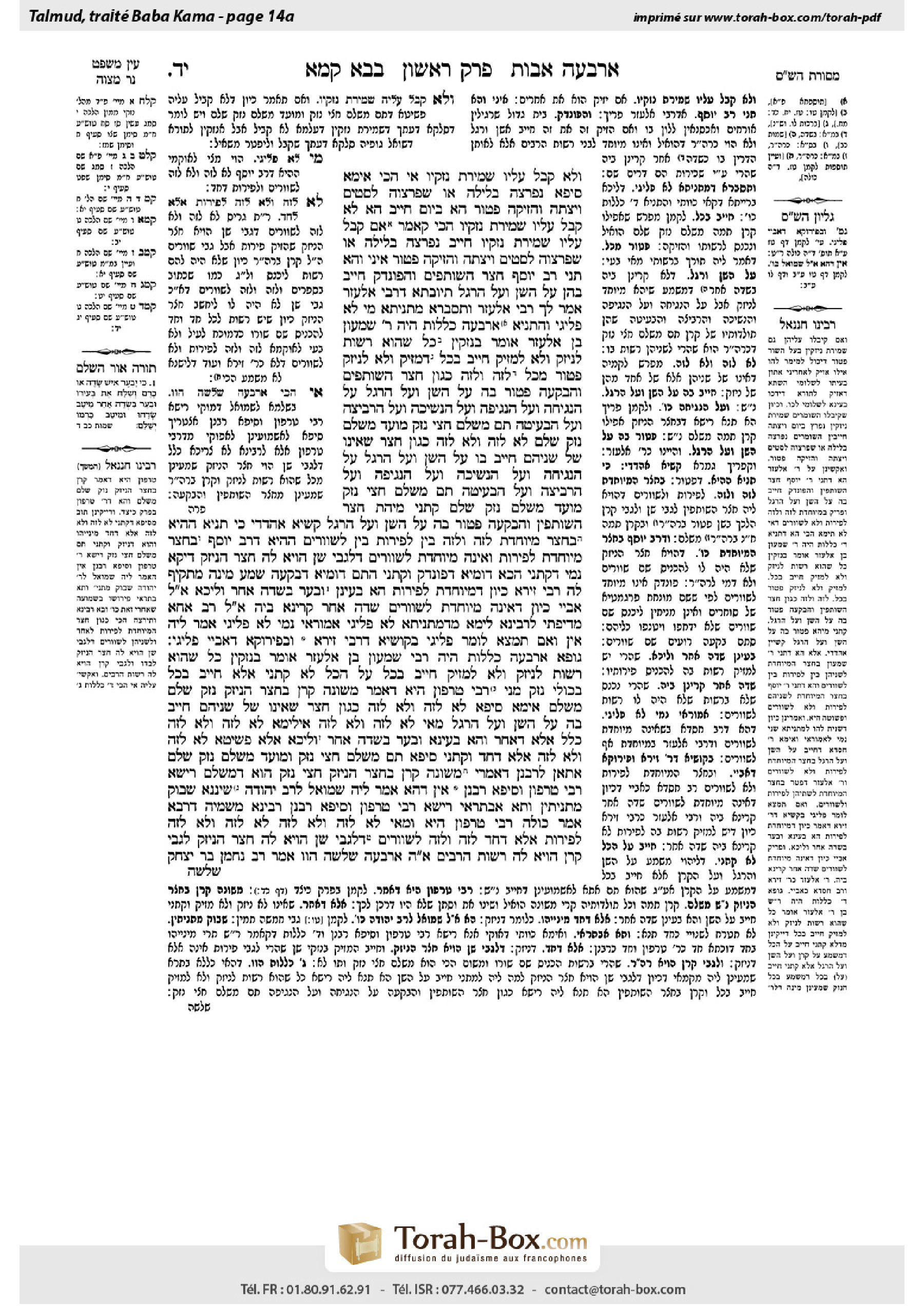
Bava Kamma 14a: Talmud study for Daf Yomi
Study the Talmud for Daf Yomi with scanned pages, Hebrew text, English translations from Sefaria and AI-generated French translations.
Passage selection and English or AI-generated French translation are available where the scan has annotations. Daf Study is independent of Torah-Box and Sefaria.
Browse Bava Kamma · בבא קמא · All tractatesBava Kamma 14a text and translations
This page of Bava Kamma includes the Aramaic text, an English translation and an AI-generated French translation, alongside the scan above.
בבא קמא י״ד א · Aramaic and Hebrew text
וְלֹא קִבֵּל עָלָיו שְׁמִירַת נְזָקָיו.
אִי הָכִי, אֵימָא סֵיפָא: נִפְרְצָה בַּלַּיְלָה אוֹ שֶׁפְּרָצוּהָ לִסְטִים, וְיָצְתָה וְהִזִּיקָה – פָּטוּר. הָא בַּיּוֹם – חַיָּיב? הָא לֹא קִבֵּל עָלָיו שְׁמִירַת נְזָקָיו!
הָכִי קָאָמַר: אִם קִבֵּל עָלָיו שְׁמִירַת נְזָקָיו – חַיָּיב. נִפְרְצָה בַּלַּיְלָה אוֹ שֶׁפְּרָצוּהָ לִסְטִים, וְיָצְתָה וְהִזִּיקָה – פָּטוּר.
אִינִי?! וְהָא תָּנֵי רַב יוֹסֵף: חֲצַר הַשּׁוּתָּפִים, וְהַפּוּנְדָּק – חַיָּיב בָּהֶן עַל הַשֵּׁן וְעַל הָרֶגֶל. תְּיוּבְתָּא דְּרַבִּי אֶלְעָזָר!
אָמַר לָךְ רַבִּי אֶלְעָזָר: וְתִסְבְּרַאּ?! מַתְנְיָתָא מִי לָא פְּלִיגִי? וְהָתַנְיָא, אַרְבָּעָה כְּלָלוֹת הָיָה רַבִּי שִׁמְעוֹן בֶּן אֶלְעָזָר אוֹמֵר בְּנִזָּקִין: כֹּל שֶׁהוּא רְשׁוּת לַנִּיזָּק וְלֹא לַמַּזִּיק – חַיָּיב בַּכֹּל. דְּמַזִּיק וְלֹא לַנִּיזָּק – פָּטוּר מִכֹּל.
לָזֶה וְלָזֶה, כְּגוֹן חֲצַר הַשּׁוּתָּפִים וְהַבִּקְעָה – פָּטוּר בָּהּ עַל הַשֵּׁן וְעַל הָרֶגֶל; עַל הַנְּגִיחָה וְעַל הַנְּגִיפָה וְעַל הַנְּשִׁיכָה וְעַל הָרְבִיצָה וְעַל הַבְּעִיטָה – תָּם מְשַׁלֵּם חֲצִי נֶזֶק, מוּעָד מְשַׁלֵּם נֶזֶק שָׁלֵם.
לֹא לָזֶה וְלֹא לָזֶה, כְּגוֹן חָצֵר שֶׁאֵינוֹ שֶׁל שְׁנֵיהֶם – חַיָּיב בּוֹ עַל הַשֵּׁן וְעַל הָרֶגֶל; עַל הַנְּגִיחָה וְעַל הַנְּשִׁיכָה וְעַל הַנְּגִיפָה וְעַל הָרְבִיצָה וְעַל הַבְּעִיטָה – תָּם מְשַׁלֵּם חֲצִי נֶזֶק, מוּעָד מְשַׁלֵּם נֶזֶק שָׁלֵם.
קָתָנֵי מִיהַת, חֲצַר הַשּׁוּתָּפִין וְהַבִּקְעָה – פָּטוּר בָּהּ עַל הַשֵּׁן וְעַל הָרֶגֶל;
קַשְׁיָא אַהֲדָדֵי!
כִּי תַּנְיָא הָהִיא – בְּחָצֵר מְיוּחֶדֶת לָזֶה וְלָזֶה בֵּין לְפֵירוֹת בֵּין לִשְׁווֹרִים. הָהִיא דְּרַב יוֹסֵף – בְּחָצֵר מְיוּחֶדֶת לְפֵירוֹת, וְאֵינָהּ מְיוּחֶדֶת לִשְׁווֹרִים; דִּלְגַבֵּי שֵׁן – הָוְיָא לַהּ חֲצַר הַנִּיזָּק.
דַּיְקָא נָמֵי – דְּקָתָנֵי הָכָא דּוּמְיָא דְפוּנְדָּק, וְקָתָנֵי הָתָם דּוּמְיָא דְבִקְעָה; שְׁמַע מִינַּהּ.
מַתְקֵיף לַהּ רַבִּי זֵירָא: כֵּיוָן דִּמְיוּחֶדֶת לְפֵירוֹת?! הָא בָּעֵינַן ״וּבִעֵר בִּשְׂדֵה אַחֵר״, וְלֵיכָּא!
אֲמַר לֵיהּ אַבָּיֵי: כֵּיוָן דְּאֵינָהּ מְיוּחֶדֶת לִשְׁווֹרִים, ״שְׂדֵה אַחֵר״ קָרֵינָא בֵּיהּ.
אֲמַר לֵיהּ רַב אַחָא מִדִּיפְתִּי לְרָבִינָא: לֵימָא מִדְּמַתְנְיָתָא לָא פְּלִיגִי, אָמוֹרָאֵי נָמֵי לָא פְּלִיגִי?
אֲמַר לֵיהּ: אִין. וְאִם תִּמְצָא לוֹמַר פְּלִיגִי – בְּקוּשְׁיָא דְּרַבִּי זֵירָא וּבְפֵירוּקָא דְאַבָּיֵי פְּלִיגִי.
גּוּפָא – אַרְבָּעָה כְּלָלוֹת הָיָה רַבִּי שִׁמְעוֹן בֶּן אֶלְעָזָר אוֹמֵר בְּנִזָּקִין: כֹּל שֶׁהוּא רְשׁוּת לַנִּיזָּק וְלֹא לַמַּזִּיק – חַיָּיב בַּכֹּל.
״עַל הַכֹּל״ לָא קָתָנֵי, אֶלָּא ״חַיָּיב בַּכֹּל״ – בְּכוּלֵּי[הּ] נֶזֶק;
מַנִּי – רַבִּי טַרְפוֹן הִיא, דְּאָמַר: מְשׁוּנֶּה קֶרֶן בַּחֲצַר הַנִּיזָּק, נֶזֶק שָׁלֵם מְשַׁלֵּם.
אֵימָא סֵיפָא: לֹא לָזֶה וְלֹא לָזֶה, כְּגוֹן חָצֵר שֶׁאֵינוֹ שֶׁל שְׁנֵיהֶם – חַיָּיב בָּהּ עַל הַשֵּׁן וְעַל הָרֶגֶל.
מַאי ״לֹא לָזֶה וְלֹא לָזֶה״? אִילֵּימָא לֹא לָזֶה וְלֹא לָזֶה כְּלָל – אֶלָּא דְּאַחֵר; וְהָא בָּעֵינָא ״וּבִעֵר בִּשְׂדֵה אַחֵר״, וְלֵיכָּא!
אֶלָּא פְּשִׁיטָא, לֹא לָזֶה וְלֹא לָזֶה – אֶלָּא דְּחַד; וְקָתָנֵי סֵיפָא: תָּם מְשַׁלֵּם חֲצִי נֶזֶק, וּמוּעָד מְשַׁלֵּם נֶזֶק שָׁלֵם;
אֲתָאן לְרַבָּנַן, דְּאָמְרִי: מְשׁוּנֶּה קֶרֶן בַּחֲצַר הַנִּיזָּק, חֲצִי נֶזֶק הוּא דִּמְשַׁלֵּם!
רֵישָׁא רַבִּי טַרְפוֹן, וְסֵיפָא רַבָּנַן?!
אִין; דְּהָא אֲמַר לֵיהּ שְׁמוּאֵל לְרַב יְהוּדָה: שִׁינָּנָא, שְׁבוֹק מַתְנִיתִין וְתָא אַבַּתְרַאי – רֵישָׁא רַבִּי טַרְפוֹן, וְסֵיפָא רַבָּנַן.
רָבִינָא מִשְּׁמֵיהּ דְּרָבָא אָמַר: כּוּלַּהּ רַבִּי טַרְפוֹן הִיא; וּמַאי לֹא לָזֶה וְלֹא לָזֶה – לֹא לָזֶה וְלֹא לָזֶה לְפֵירוֹת, אֶלָּא דְּחַד; לָזֶה וְלָזֶה לִשְׁווֹרִים.
דִּלְגַבֵּי שֵׁן – הָוְיָא לַהּ חֲצַר הַנִּיזָּק, לְגַבֵּי קֶרֶן – הָוְיָא לַהּ רְשׁוּת הָרַבִּים.
אִי הָכִי, אַרְבָּעָה?! שְׁלֹשָׁה הָווּ!
אָמַר רַב נַחְמָן בַּר יִצְחָק:
Bava Kamma 14a · English translation
but he did not undertake the responsibility of safeguarding the lender’s ox to prevent it from causing damage. Accordingly, the lender remains responsible for his ox, and if it caused damage to the borrower’s ox the lender is liable, as in any other case in which his ox caused damage.
The Gemara asks: If that is so, say, and try to explain accordingly, the latter clause of the baraita: If the ox was safely enclosed and a wall broke open at night, or if bandits broke it open and the ox went out and caused damage, the bailee is exempt from liability. The Gemara infers: If it broke open during the day and then caused damage, he is liable. The Gemara asks: According to the interpretation offered in explanation of the previous clause, the baraita concerns a case in which one borrowed an ox but did not undertake the responsibility to prevent it from causing damage. If so, how can the latter clause imply that there are cases in which he is liable? If he did not undertake the responsibility of safeguarding the lender’s ox to prevent it from causing damage, he should never be liable for the damage that it caused.
The Gemara answers that the latter clause of the baraita concerns a different case than that of the previous clause. This is what the latter clause of the baraita is saying: If, by contrast, the borrower did undertake the responsibility of safeguarding the lender’s ox to prevent it from causing damage, if it causes damage, the borrower is liable. But if the ox was safely enclosed and the wall enclosing it broke open at night, or if bandits broke it open and the ox went out and caused damage, he is exempt.
The Gemara returns to its prior discussion of the mishna’s statement concerning property designated for the joint use of the injured party and the one liable for the damage. The Gemara cited Rabbi Elazar’s opinion that each partner is exempt from liability for any damage that falls within the categories of Trampling or Eating that their ox caused to the other partner’s property. The Gemara challenges his opinion: Is that so? But didn’t Rav Yosef teach in a baraita: In a courtyard designated for the joint use of partners, or in an inn [pundak], one is liable for Eating and for Trampling caused by an ox of one partner to the property of the other. It would appear that this baraita is a conclusive refutation of the opinion of Rabbi Elazar.
The Gemara answers: Rabbi Elazar could have said to you: But how can you understand that this baraita provides a refutation of my opinion? Are there not baraitot that disagree with regard to this issue? And it is taught in accordance with my opinion in a baraita in the Tosefta (1:9): Rabbi Shimon ben Elazar would state four principles with regard to the liability incurred based on where the damage occurs. With regard to any location that is the property of the injured party and is not the property of the one liable for the damage, the owner of an animal that causes damage is liable for all the damage caused there. If a place is the property of the one liable for the damage and is not the property of the injured party, the owner of an animal that causes damage is exempt for all the damage caused there.
If a place is the property of both this one and that one, e.g., a courtyard designated for the joint use of partners or a field in the valley that is used by the public, the owner of an animal that causes damage is exempt for Eating and for Trampling performed by his animal in that place. But for goring, and for pushing, and for biting, and for crouching upon items in order to damage them, and for kicking, which are all subcategories of the primary category of Goring, if the ox is innocuous, the owner pays half the value of the damage, and if it is forewarned, he pays the full cost of the damage.
If a place where the damage occurs is the property of neither this one nor that one, e.g., a courtyard that is not owned by either of the two of them, the owner of an animal that causes damage is liable for Eating and for Trampling performed by his animal in that place. But for goring, and for pushing, and for biting, and for crouching upon items in order to damage them, and for kicking, which are all subcategories of the primary category of Goring, if the ox is innocuous, the owner pays half the value of the damage, and if it is forewarned, he pays the full cost of the damage.
The Gemara notes that in any event the baraita teaches that in a courtyard designated for the joint use of partners or a field in the valley that is jointly owned, the owner of an animal that causes damage is exempt for Eating and for Trampling performed by his animal in that place. This baraita supports Rabbi Elazar’s opinion.
The Gemara comments: These baraitot are difficult, as they seem to contradict one another.
The Gemara explains: When that baraita is taught, it is with regard to a jointly owned courtyard, which under the terms of their partnership is designated for the use of both this one and that one, i.e., as partners, for bringing both produce and oxen there. Since both partners have a right to keep their oxen there, they are not liable for any damage their oxen cause in the jointly owned space. That baraita of Rav Yosef is taught with regard to a jointly owned courtyard, which under the terms of their partnership is designated for the purpose of bringing their produce there, but it is not designated for bringing oxen there. Accordingly, with regard to damage of the category of Eating caused by one partner’s ox to the other’s produce, it is equivalent to a courtyard owned exclusively by the injured party, and therefore he is liable.
The Gemara notes: In accordance with this explanation, the language of each of these baraitot is also precise, as it teaches here, in the baraita of Rav Yosef, the case of a courtyard that is similar to an inn, where oxen are usually not allowed to be brought, and it teaches there, in the second baraita, the case of a courtyard that is similar to a field in the valley, where oxen are usually allowed to enter. Conclude from it that the Gemara’s distinction between the two baraitot is correct.
Rabbi Zeira objects to this interpretation of Rav Yosef’s baraita: Since the courtyard is designated for both of them to keep their produce there, they should not be liable for damage caused by their oxen there, as in order for one to be liable don’t we need a case that fits the depiction of the verse: “And it consumed in a field of another” (Exodus 22:4), and since they both have the right to use the courtyard it does not fulfill this condition.
Abaye said to him: Since it is not designated for them to keep oxen there, that is sufficient for it to be termed “a field of another.”
Given the distinction between the cases discussed in the baraitot, the Gemara reconsiders the dispute between Rav Ḥisda and Rabbi Elazar concerning the mishna’s statement about property whose use is designated for both the injured party and the one liable for the damage. Rav Aḥa of Difti said to Ravina: Let us say that from the fact that the baraitot do not disagree, as they are referring to different cases, so too, the amora’im, i.e., Rav Ḥisda and Rabbi Elazar, also do not disagree, as they are similarly referring to these different cases.
Ravina said to him: Yes, that is correct. And even if you say that they disagree, their dispute does not concern every case of a jointly owned courtyard, as the Gemara had assumed; rather, their dispute concerns specifically a courtyard designated for the use of their produce, but not the use of their oxen. And they disagree whether to accept the difficulty raised by Rabbi Zeira, that such a courtyard cannot be considered “a field of another,” or whether to accept the resolution of Abaye, that it can be considered “a field of another.”
§ The Gemara returns to the matter itself and analyzes the baraita in the Tosefta cited above. It states: Rabbi Shimon ben Elazar would state four principles with regard to the liability incurred based on where the damage was caused. With regard to any location that is the property of the injured party and is not the property of the one liable for the damage, the owner of an animal that causes damage is liable for all the damage caused there.
The Gemara infers: The baraita does not teach: One is liable for any [al hakkol] damage caused there, which would suggest that one is liable for all types of damage. Rather, it teaches: One is liable for all [bakkol] the damage caused, which can be translated as: For the full cost of the damage. This indicates that even were one’s ox considered to be innocuous and caused damage of the category of Goring, which would generally incur liability for half the value of the damage, in this case the owner is liable for the full cost of the damage.
Whose opinion is this? It is in accordance with the opinion of Rabbi Tarfon, who says: The halakha of cases of Goring performed by an innocuous animal, which is atypical, done in the courtyard of the injured party, is that the owner of the ox pays the full cost of the damage even if the ox is innocuous.
If this is so, say, and try to explain accordingly, the latter clause of the baraita: If a place where the damage occurs is the property of neither this one nor that one, e.g., a courtyard that is not owned by either of the two of them, the owner of an animal that causes damage is liable for Eating and for Trampling performed by his animal in that place.
The Gemara asks: What does the baraita mean by saying the property is of neither this one nor that one? If we say the intention of the baraita is that the property is of neither this one nor that one at all, but rather it belongs to another person, why should either partner be liable? But don’t I need a case that fits the depiction of the verse: “And it consumed in a field of another” (Exodus 22:4), which is understood to mean that the consumed produce belongs to the owner of the field in which the act of consumption occurred; and since the injured party does not have any rights to this place it does not fulfill this condition?
Rather, it is obvious that the intention of the baraita is that the property is of neither this one nor that one together; rather, it belongs to only one of them, i.e., the injured party, and the latter clause teaches: If the ox is innocuous, the owner pays half the value of the damage, and if it is forewarned, he pays the full cost of the damage.
If so, in the latter clause we arrive at the opinion of the Rabbis, who say: The halakha of cases of Goring performed by an innocuous animal, which is atypical, occurring in the courtyard of the injured party, is that the owner of the ox pays half the value of the damage.
The Gemara asks: Could it be that the first clause of the baraita is in accordance with the opinion of Rabbi Tarfon and the last clause is in accordance with the opinion of the Rabbis?
The Gemara answers: Yes, that is as Shmuel said to Rav Yehuda with regard to another mishna (15b): Shinnana, leave the mishna and follow after me and my interpretation that the first clause of the mishna is in accordance with the opinion of Rabbi Tarfon and the last clause is in accordance with the opinion of the Rabbis. In this baraita as well, the different clauses are taught in accordance with different Sages’ opinions.
The Gemara presents a different interpretation of the baraita: Ravina said in the name of Rava: The entire baraita is in accordance with the opinion of Rabbi Tarfon, and what does it mean by saying that the property is of neither this one nor that one? The property does not belong both to this one and that one; rather, it is designated for the use of only one of them, for him to keep his produce there. Only the injured party has the right to keep his produce there. But it is designated both for this one and for that one, for them to keep their oxen there, as both have this right.
Accordingly, with regard to damage of the category of Eating, the property is considered to be the courtyard of the injured party; therefore, the one responsible for the damage is liable to pay for the damage. By contrast, with regard to damage of the category of Goring, since they both have the right to keep their oxen there, the property is considered to be like a public domain, and therefore even Rabbi Tarfon agrees that if one’s innocuous ox causes damage there one is liable for only half the value of the damage.
The Gemara asks: If that is so, does the baraita list four principles? There are only three. In other words, according to the way Ravina explains the latter clause, i.e., the fourth principle, it does not teach anything that is not already known from the first three principles, as the fact that one is liable for Eating and Trampling in property designated for the use of the injured party is explicitly stated in the first principle, and the fact that one is liable for only half the cost of the damage in a case of Goring in a jointly owned courtyard is expressed in the third principle.
Rav Naḥman bar Yitzḥak said:
Bava Kamma 14a · Traduction française (IA)
mais il n'a pas assumé la responsabilité de garder l'ox du prêteur afin de l'empêcher de causer des dommages. Ainsi, le prêteur reste responsable de son ox, et si celui-ci a causé des dommages à l'ox du prêteur, il est tenu responsable, comme dans tout autre cas où son ox a causé des dommages.
Le Guemara pose la question : Si c'est ainsi, disons et essayons d'expliquer ainsi, la dernière clause de la baraïta : Si l'ox était correctement enfermé et que la muraille s'est ouverte la nuit, ou si des bandits l'ont forcée et que l'ox est sorti et a causé des dommages, le gardien est exempt de responsabilité. Le Guemara déduit : Si la muraille s'est ouverte pendant la journée et qu'ensuite l'ox a causé des dommages, il est tenu responsable. Le Guemara pose la question : Selon l'interprétation offerte pour expliquer la clause précédente, la baraïta concerne un cas où l'on a emprunté un ox mais n'a pas assumé la responsabilité de l'empêcher de causer des dommages. Si c'est ainsi, comment la dernière clause peut-elle impliquer qu'il y a des cas où il est tenu responsable ? Si l'on n'a pas assumé la responsabilité de garder l'ox du prêteur afin de l'empêcher de causer des dommages, il ne devrait jamais être tenu responsable des dommages qu'il a causés.
Le Guemara répond que la dernière clause de la baraïta concerne un cas différent de celui de la clause précédente. C'est ce que la dernière clause de la baraïta dit : Si, au contraire, le prêteur a assumé la responsabilité de garder l'ox du prêteur afin de l'empêcher de causer des dommages, si celui-ci cause des dommages, le prêteur est tenu responsable. Mais si l'ox était correctement enfermé et que la muraille l'entourant s'est ouverte la nuit, ou si des bandits l'ont forcée et que l'ox est sorti et a causé des dommages, il est exempt.
Le Guemara reprend sa discussion précédente sur l'affirmation de la mitsna concernant la propriété désignée pour l'usage commun de la personne blessée et de celle responsable des dommages. Le Guemara cite l'opinion de Rabbi Elazar selon laquelle chaque partenaire est exempt de responsabilité pour tout dommage qui relève des catégories de piétinement ou de consommation causés par son bœuf à la propriété de l'autre partenaire. Le Guemara conteste son opinion : Est-ce ainsi ? Mais n'a-t-il pas enseigné Rav Yosef dans une baraïta : Dans un courtil désigné pour l'usage commun des partisans, ou dans un pundak, on est tenu responsable de la consommation et du piétinement causés par un bœuf d'un partenaire à la propriété de l'autre. Il semble que cette baraïta soit une réfutation définitive de l'opinion de Rabbi Elazar.
Le Guemara répond : Rabbi Elazar pourrait avoir dit à vous : Mais comment pouvez-vous comprendre que cette baraïta fournit une réfutation de mon opinion ? Ne sont-il pas des baraitot qui s'opposent à ce sujet ? Et il est enseigné selon mon opinion dans une baraïta de la Tosefta (1:9) : Rabbi Shim'on ben Elazar affirmait quatre principes concernant la responsabilité liée à l'endroit où le dommage s'est produit. Concernant tout lieu qui est la propriété de la personne blessée et non la propriété de celui responsable du dommage, l'propriétaire d'un animal qui cause des dommages est tenu responsable de tous les dommages causés là. Si un lieu est la propriété de celui responsable du dommage et non la propriété de la personne blessée, l'propriétaire d'un animal qui cause des dommages est exempt de toute responsabilité pour les dommages causés là.
Si un lieu où le dommage s'est produit est la propriété des deux, par exemple, un courtil désigné pour l'usage commun des partenaires ou un champ dans la vallée utilisé par le public, l'propriétaire d'un animal qui cause des dommages est exempt de la consommation et du piétinement causés par son animal dans ce lieu. Mais pour le bêlement, le poussage, la morsure et le repos sur des objets pour les endommager, ainsi que le coup de sabot, qui sont toutes des sous-catégories de la catégorie principale du bêlement, si l'ox est inoffensif, l'propriétaire paie la moitié de la valeur du dommage, et si l'ox est averti, il paie le coût complet du dommage.
Si un lieu où le dommage s'est produit n'est pas la propriété de l'un ni de l'autre, par exemple, un courtil qui n'appartient à aucun des deux, l'propriétaire d'un animal qui cause des dommages est tenu responsable de la consommation et du piétinement causés par son animal dans ce lieu. Mais pour le bêlement, le poussage, la morsure et le repos sur des objets pour les endommager, ainsi que le coup de sabot, qui sont toutes des sous-catégories de la catégorie principale du bêlement, si l'ox est inoffensif, l'propriétaire paie la moitié de la valeur du dommage, et si l'ox est averti, il paie le coût complet du dommage.
Le Guemara note que, dans tous les cas, la baraïta enseigne que dans un courtil désigné pour l'usage commun des partenaires ou un champ dans la vallée qui est partagé, l'propriétaire d'un animal qui cause des dommages est exempt de la consommation et du piétinement causés par son animal dans ce lieu. Cette baraïta soutient l'opinion de Rabbi Elazar.
Le Guemara observe : Ces baraitot sont difficiles, car elles semblent s'opposer les unes aux autres.
Le Guemara explique : Lorsque cette baraïta est enseignée, elle concerne un courtil partagé, qui, selon les termes de leur partage, est désigné à l'usage des deux, c'est-à-dire en tant que partenaires, pour y apporter à la fois les récoltes et les bœufs. Puisque les deux partenaires ont le droit de garder leurs bœufs là, ils ne sont pas responsables de tout dommage causé par leurs bœufs dans cet espace partagé. Cette baraïta de Rav Yosef est enseignée concernant un courtil partagé, qui, selon les termes de leur partage, est désigné pour l'apport de leurs récoltes, mais pas pour l'apport de bœufs. Ainsi, concernant le dommage de la catégorie de la consommation causé par un bœuf d'un partenaire à la récolte de l'autre, il est équivalent à un courtil exclusivement possédé par la personne blessée, et donc il est tenu responsable.
La Guemara note que, selon cette explication, la formulation de chaque baraïta est aussi précise, car elle enseigne ici, dans la baraïta de R. Yosef, le cas d'un jardin similaire à une auberge, où les bœufs ne sont généralement pas autorisés à entrer, et elle enseigne là, dans la deuxième baraïta, le cas d'un jardin similaire à un champ en vallée, où les bœufs sont généralement autorisés à entrer. Concluez-en que la distinction de la Guemara entre ces deux baraitot est correcte.
Rabbi Zéira s'oppose à cette interprétation de la baraïta de R. Yosef : Puisque le jardin est désigné pour que les deux y conservent leurs récoltes, ils ne devraient pas être tenus responsables des dommages causés par leurs bœufs là, car pour qu'une personne soit tenue responsable, n'avons-nous pas besoin d'un cas correspondant à la description du verset : « Et il a dévoré dans un champ d'autrui » (Exode 22:4), et puisque les deux ont le droit d'utiliser le jardin, cela ne remplit pas cette condition.
Abaye dit à lui : Puisque ce jardin n'est pas désigné pour qu'on y conserve des bœufs, cela suffit à le qualifier de « champ d'autrui ».
Étant donné la distinction entre les cas discutés dans les baraitot, la Guemara reconsidère le débat entre Rav Ḥisda et Rabbi Elazar concernant l'affirmation de la mitsna concernant la propriété dont l'utilisation est désignée pour les deux parties, l'aggravé et celui responsable du dommage. Rav Aḥa de Difti dit à Ravina : Disons que du fait que les baraitot ne s'opposent pas, car ils parlent de cas différents, de même, les amoraïm, c'est-à-dire Rav Ḥisda et Rabbi Elazar, ne s'opposent pas non plus, car ils parlent également de ces cas différents.
Ravina dit à lui : Oui, c'est correct. Et même si vous dites qu'ils s'opposent, leur débat ne concerne pas chaque cas d'un jardin partagé, comme la Guemara l'avait supposé ; plutôt, leur débat concerne spécifiquement un jardin désigné pour l'utilisation de leurs récoltes, mais pas pour l'utilisation de leurs bœufs. Et ils s'opposent à savoir s'accepter la difficulté soulevée par Rabbi Zeira, que ce jardin ne peut être considéré comme « un champ d'autrui », ou s'accepter la résolution d'Abaye, que cela peut être considéré comme « un champ d'autrui ».
§ La Guemara retourne à la question elle-même et analyse la baraïta citée dans la Tosefta ci-dessus. Elle dit : Rabbi Shimon ben Elazar affirmait quatre principes concernant la responsabilité encourue en fonction de l'endroit où le dommage a été causé. Concernant tout lieu qui est la propriété de l'aggravé et non la propriété de celui responsable du dommage, l'propriétaire d'un animal qui cause un dommage est responsable de tout le dommage causé là.
La Guemara déduit : La baraïta ne dit pas : On est responsable de tout dommage causé là, ce qui suggérerait que l'on est responsable de tous les types de dommages. Plutôt, elle dit : On est responsable de tout le dommage causé, ce qui peut être traduit comme : Pour le coût complet du dommage. Cela indique que même si l'ox de quelqu'un est considéré comme inoffensif et a causé un dommage de la catégorie de l'attaque, qui entraînerait généralement une responsabilité pour la moitié de la valeur du dommage, dans ce cas, l'propriétaire est responsable du coût complet du dommage.
De quel opinion est-ce ? C'est selon l'opinion de R. Tarphon, qui dit : La halakha concernant les cas d'attaque commis par un animal inoffensif, qui est atypique, accompli dans le jardin de l'aggravé, est que l'propriétaire de l'ox paie le coût complet du dommage même si l'ox est inoffensif.
Si c'est ainsi, dis, et essaie d'expliquer en conséquence, la dernière clause de la baraïta : Si le lieu où le dommage a lieu n'appartient ni à celui-ci ni à celui-là, par exemple un jardin qui n'appartient à aucun des deux, l'propriétaire d'un animal qui cause un dommage est responsable de l'ingestion et de l'écrasement accomplis par son animal là.
La Guemara demande : Que signifie la baraïta en disant que la propriété n'appartient ni à celui-ci ni à celui-là ? Si nous disons que l'intention de la baraïta est que la propriété n'appartient ni à celui-ci ni à celui-là du tout, mais plutôt qu'elle appartient à une autre personne, pourquoi l'un des partenaires serait-il responsable ? Mais n'ai-je pas besoin d'un cas correspondant à la description du verset : « Et il a dévoré dans un champ d'autrui » (Exode 22:4), qui est compris comme signifiant que les produits dévorés appartiennent à l'propriétaire du champ où l'acte de dévoration s'est produit ; et puisque l'aggravé n'a aucun droit à ce lieu, cela ne remplit pas cette condition ?
Plutôt, il est évident que l'intention de la baraïta est que la propriété n'appartient ni à celui-ci ni à celui-là ensemble ; plutôt, elle appartient à l'un d'eux, c'est-à-dire à l'aggravé, et la dernière clause enseigne : Si l'ox est inoffensif, l'propriétaire paie la moitié de la valeur du dommage, et si il est averti, il paie le coût complet du dommage.
Si c'est ainsi, dans la dernière clause nous arrivons à l'opinion des Rabbins, qui disent : La halakha concernant les cas d'attaque commis par un animal inoffensif, qui est atypique, survenant dans le jardin de l'aggravé, est que l'propriétaire de l'ox paie la moitié de la valeur du dommage.
La Guemara demande : Pourrait-il être que la première clause de la baraïta soit selon l'opinion de R. Tarfon et la dernière clause selon l'opinion des Rabbins ?
La Guemara répond : Oui, c'est ce que Shmuel a dit à R. Yéhuda concernant une autre mitsva (15b) : Shinnana, laisse la mitsva et suis-moi et mon interprétation que la première clause de la mitsva est selon l'opinion de R. Tarphon et la dernière clause selon l'opinion des Rabbins. De même, dans cette baraïta, les différentes clauses sont enseignées selon les opinions de différents Sages.
La Guemara présente une autre interprétation de la baraïta : Ravina, dans le nom de Rava, dit : toute la baraïta est selon l'opinion de Rabbi Tarfon, et que signifie-t-il en disant que la propriété n'appartient ni à celui-ci ni à celui-là ? La propriété n'appartient pas à la fois à celui-ci et à celui-là ; elle est désignée à l'usage d'un seul d'entre eux, afin qu'il y conserve ses récoltes. Seul le partie blessée a le droit de conserver ses récoltes là. Mais elle est désignée à la fois pour celui-ci et pour celui-là, afin qu'ils y conservent leurs bœufs, car les deux ont ce droit.
Ainsi, concernant les dommages de la catégorie de l'ingestion, la propriété est considérée comme le courtil de la partie blessée ; par conséquent, celui responsable du dommage est tenu de payer le dommage. En revanche, concernant les dommages de la catégorie de l'attaque, puisque les deux ont le droit de conserver leurs bœufs là, la propriété est considérée comme un domaine public, et par conséquent même Rabbi Tarfon est d'accord pour dire que si un bœuf inoffensif de l'un cause un dommage là, l'individu est tenu de payer seulement la moitié de la valeur du dommage.
La Guemara demande : Si c'est ainsi, la baraïta énumère-t-elle quatre principes ? Il n'y en a que trois. En d'autres termes, selon la manière dont Ravina explique la dernière clause, c'est-à-dire le quatrième principe, elle ne transmet rien qui n'ait déjà été établi par les trois premiers principes, car le fait que l'on soit tenu de payer pour l'ingestion et l'écrasement dans une propriété désignée à l'usage de la partie blessée est explicitement mentionné dans le premier principe, et le fait que l'on soit tenu de payer seulement la moitié du coût du dommage dans le cas d'une attaque dans un courtil partagé est exprimé dans le troisième principe.
Rav Naḥman bar Yitzḥak dit :
Traduction française générée par IA à partir de l’édition anglaise de Sefaria. Vérifie toujours un passage avec le texte source.
Text from Sefaria: William Davidson Edition - Vocalized Aramaic (CC BY NC); William Davidson Edition - English (CC BY NC).