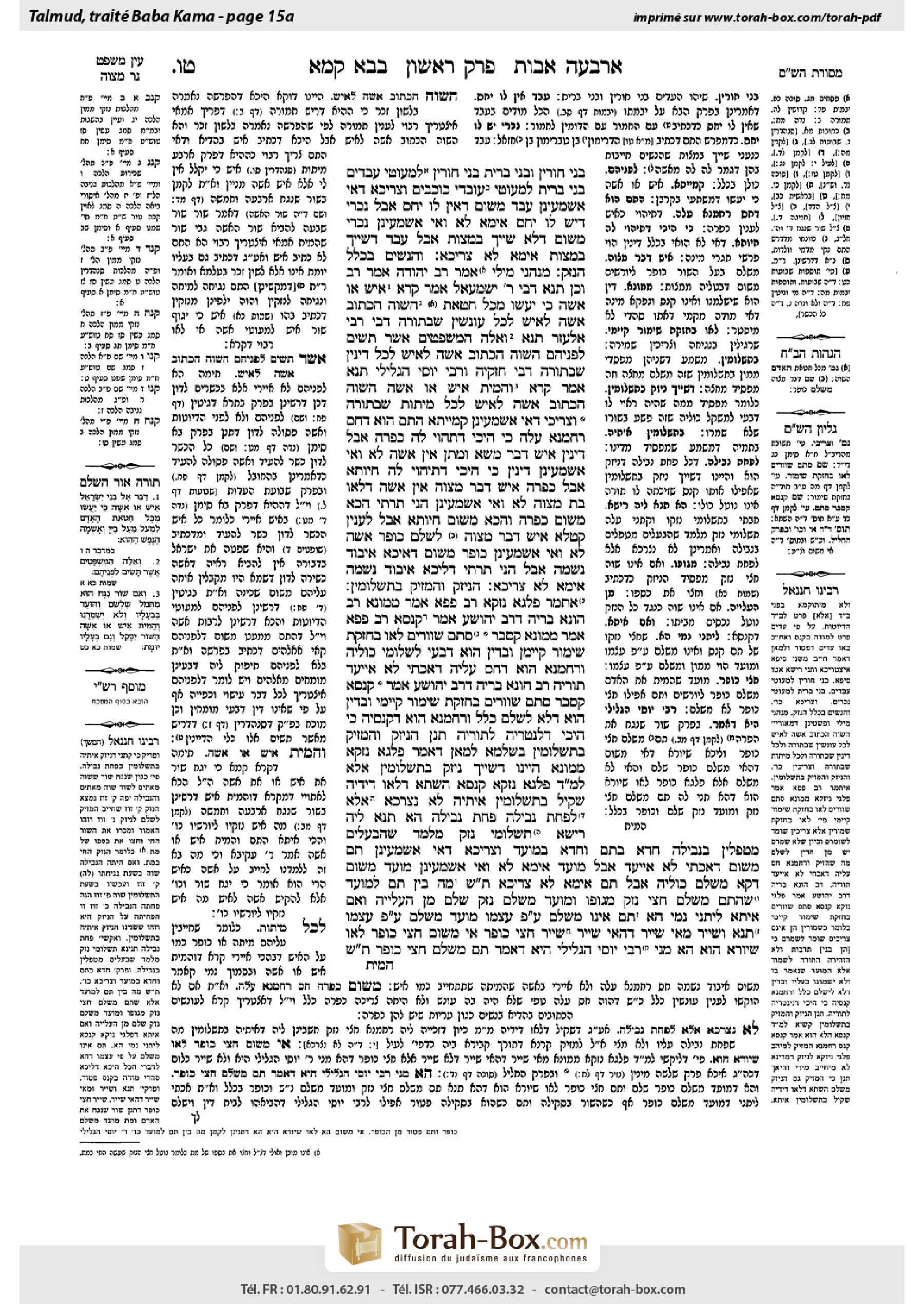
Bava Kamma 15a: Talmud study for Daf Yomi
Study the Talmud for Daf Yomi with scanned pages, Hebrew text, English translations from Sefaria and AI-generated French translations.
Passage selection and English or AI-generated French translation are available where the scan has annotations. Daf Study is independent of Torah-Box and Sefaria.
Browse Bava Kamma · בבא קמא · All tractatesBava Kamma 15a text and translations
This page of Bava Kamma includes the Aramaic text, an English translation and an AI-generated French translation, alongside the scan above.
בבא קמא י״ה א · Aramaic and Hebrew text
״בְּנֵי חוֹרִין וּבְנֵי בְרִית״. ״בְּנֵי חוֹרִין״ – לְמַעוֹטֵי עֲבָדִים, ״בְּנֵי בְרִית״ – לְמַעוֹטֵי גּוֹיִם.
וּצְרִיכָא; דְּאִי אַשְׁמְעִינַן עֶבֶד – מִשּׁוּם דְּאֵין לוֹ חַיִיס, אֲבָל גּוֹי – דְּיֵשׁ לוֹ חַיִיס, אֵימָא לָא; וְאִי אַשְׁמְעִינַן גּוֹי – מִשּׁוּם דְּלָא שָׁיֵיךְ בְּמִצְוֹת, אֲבָל עֶבֶד – דְּשָׁיֵיךְ בְּמִצְוֹת, אֵימָא לָא; צְרִיכָא.
וְהַנָּשִׁים בִּכְלַל הַנֶּזֶק. מְנָהָנֵי מִילֵּי?
אָמַר רַב יְהוּדָה אָמַר רַב, וְכֵן תָּנָא דְּבֵי רַבִּי יִשְׁמָעֵאל, אָמַר קְרָא: ״אִישׁ אוֹ אִשָּׁה כִּי יַעֲשׂוּ מִכׇּל חַטֹּאת״ – הִשְׁוָה הַכָּתוּב אִשָּׁה לְאִישׁ לְכׇל עוֹנָשִׁין שֶׁבַּתּוֹרָה.
דְּבֵי רַבִּי אֶלְעָזָר תָּנָא: ״וְאֵלֶּה הַמִּשְׁפָּטִים אֲשֶׁר תָּשִׂים לִפְנֵיהֶם״ – הִשְׁוָה הַכָּתוּב אִשָּׁה לְאִישׁ לְכׇל דִּינִין שֶׁבַּתּוֹרָה.
דְּבֵי חִזְקִיָּה וְרַבִּי יוֹסֵי הַגְּלִילִי תָּנָא, אָמַר קְרָא: ״וְהֵמִית אִישׁ אוֹ אִשָּׁה״ – הִשְׁוָה הַכָּתוּב אִשָּׁה לְאִישׁ לְכׇל מִיתוֹת שֶׁבַּתּוֹרָה.
וּצְרִיכִי; דְּאִי אַשְׁמְעִינַן קַמַּיְיתָא – הָתָם הוּא דְּחָס רַחֲמָנָא עֲלַהּ, כִּי הֵיכִי דְּתֶהְוֵי לַהּ כַּפָּרָה; אֲבָל דִּינִין – אִישׁ, דְּבַר מַשָּׂא וּמַתָּן – אִין, אִשָּׁה – לָא.
וְאִי אַשְׁמְעִינַן דִּינִין – כִּי הֵיכִי דְּתִיהְוֵי לַהּ חַיּוּתָא; אֲבָל כַּפָּרָה – אִישׁ, דְּבַר מִצְוָה – אִין; אִשָּׁה, דְּלָאו בַּת מִצְוָה – לָא.
וְאִי אַשְׁמְעִינַן הָנֵי תַּרְתֵּי – הָכָא מִשּׁוּם כַּפָּרָה, וְהָכָא מִשּׁוּם חַיּוּתָא; אֲבָל לְעִנְיַן קְטָלָא – אִישׁ, דְּבַר מִצְוָה – לְשַׁלֵּם כּוֹפֶר; אִשָּׁה – לָא.
וְאִי אַשְׁמְעִינַן כּוֹפֶר – מִשּׁוּם דְּאִיכָּא אִיבּוּד נְשָׁמָה; אֲבָל הָנֵי תַּרְתֵּי, דְּלֵיכָּא אִיבּוּד נְשָׁמָה – אֵימָא לָא; צְרִיכָא.
הַנִּיזָּק וְהַמַּזִּיק בְּתַשְׁלוּמִין.
אִתְּמַר: פַּלְגָא נִזְקָא – רַב פָּפָּא אָמַר: מָמוֹנָא, רַב הוּנָא בְּרֵיהּ דְּרַב יְהוֹשֻׁעַ אָמַר: קְנָסָא.
רַב פָּפָּא אָמַר מָמוֹנָא – קָסָבַר: סְתָם שְׁווֹרִים לָאו בְּחֶזְקַת שִׁימּוּר קָיְימִי, וּבְדִין הוּא דְּבָעֵי לְשַׁלּוֹמֵי כּוּלֵּיהּ; וְרַחֲמָנָא הוּא דְּחָס עֲלֵיהּ, דְּאַכַּתִּי לָא אִיַּיעַד תּוֹרֵיהּ.
רַב הוּנָא בְּרֵיהּ דְּרַב יְהוֹשֻׁעַ אָמַר קְנָסָא – קָסָבַר: סְתָם שְׁווֹרִים בְּחֶזְקַת שִׁימּוּר קָיְימִי, וּבְדִין הוּא דְּלָא לְשַׁלֵּם כְּלָל; וְרַחֲמָנָא הוּא דְּקַנְסֵיהּ, כִּי הֵיכִי דְּלִנְטְרֵיהּ לְתוֹרֵיהּ.
תְּנַן: הַנִּיזָּק וְהַמַּזִּיק בְּתַשְׁלוּמִין. בִּשְׁלָמָא לְמַאן דְּאָמַר פַּלְגָא נִזְקָא מָמוֹנָא – הַיְינוּ דְּשָׁיֵיךְ נִיזָּק בְּתַשְׁלוּמִין; אֶלָּא לְמַאן דְּאָמַר פַּלְגָא נִזְקָא קְנָסָא – הַשְׁתָּא דְּלָאו דִּידֵיהּ שָׁקֵיל, בְּתַשְׁלוּמִין אִיתֵיהּ?!
לֹא נִצְרְכָא אֶלָּא לִפְחַת נְבֵילָה.
פְּחַת נְבֵילָה – הָא תְּנָא לֵיהּ רֵישָׁא: ״תַּשְׁלוּמֵי נֶזֶק״ – מְלַמֵּד שֶׁהַבְּעָלִים מִטַּפְּלִין בִּנְבֵילָה!
חֲדָא בְּתָם, וַחֲדָא בְּמוּעָד.
וּצְרִיכָא, דְּאִי אַשְׁמְעִינַן תָּם – מִשּׁוּם דְּאַכַּתִּי לָא אִיַּיעַד, אֲבָל מוּעָד אֵימָא לָא. וְאִי אַשְׁמְעִינַן מוּעָד – מִשּׁוּם דְּקָא מְשַׁלֵּם כּוּלֵּיהּ, אֲבָל תָּם אֵימָא לָא; צְרִיכָא.
תָּא שְׁמַע: מָה בֵּין תָּם לְמוּעָד? שֶׁהַתָּם מְשַׁלֵּם חֲצִי נֶזֶק – מִגּוּפוֹ, וּמוּעָד מְשַׁלֵּם נֶזֶק שָׁלֵם – מִן הָעֲלִיָּיה.
וְאִם אִיתָא, לִיתְנֵי נָמֵי הָא – תָּם אֵינוֹ מְשַׁלֵּם עַל פִּי עַצְמוֹ, מוּעָד מְשַׁלֵּם עַל פִּי עַצְמוֹ!
תְּנָא וְשַׁיַּיר. מַאי שַׁיַּיר דְּהַאי שַׁיַּיר?
שַׁיַּיר חֲצִי כוֹפֶר.
אִי מִשּׁוּם חֲצִי כוֹפֶר – לָאו שִׁיּוּרָא הוּא; הָא מַנִּי – רַבִּי יוֹסֵי הַגְּלִילִי הִיא, דְּאָמַר: תָּם מְשַׁלֵּם חֲצִי כוֹפֶר.
תָּא שְׁמַע:
Bava Kamma 15a · English translation
free men and members of the covenant. The mishna states: Free men, to exclude Canaanite slaves from being valid witnesses, and it states: Members of the covenant, to exclude gentiles.
The Gemara notes: And it is necessary to teach both exceptions, as had the Torah taught us only about a slave, I might have presumed that he is disqualified from serving as a witness because he has no lineage, i.e., the child of a Canaanite slave is not legally considered to be his child in any sense; but a free gentile, who has lineage, I might say no, he is qualified. And similarly, had the Torah taught us only about a gentile, I might have presumed that he is disqualified from serving as a witness because he has no connection to the mitzvot of the Torah; but with regard to a Canaanite slave, who does have a connection to the mitzvot, as he is obligated to keep the mitzvot that a woman is obligated to keep, I might say no, he is qualified. Therefore, it is necessary to teach both exceptions.
§ The mishna continues: And women are included in the halakhot of damages in the same way as men. The Gemara asks: From where is this matter derived?
The Gemara presents three sources for this halakha. Rav Yehuda says that Rav says, and similarly, the school of Rabbi Yishmael taught: The verse states with regard to the liability of one who takes a false oath that he had not stolen: “When a man or woman shall commit any of the sins of a person” (Numbers 5:6). The verse equates a woman with a man with regard to all punishments in the Torah.
The school of Rabbi Elazar taught: The verse states with regard to the civil laws given following the revelation at Sinai: “And these are the civil laws that you shall set before them” (Exodus 21:1). The reference to “them” in the verse is referring to all those who stood at the revelation, both men and women. The verse thereby equates a woman with a man with regard to all civil laws in the Torah.
The school of Ḥizkiyya and Rabbi Yosei HaGelili taught: The verse states with regard to liability in a case where one’s ox kills a person: “And it killed a man or a woman” (Exodus 21:29). The verse thereby equates a woman with a man with regard to all killings in the Torah, i.e., the liability incurred is the same whether the person killed was a man or a woman.
The Gemara notes: And all three sources are necessary, as had the Torah taught us only the first source, one might have said that it is there that men and women are equated, as the Merciful One had pity upon a woman and made her liable in order that she should achieve atonement through paying restitution. But with regard to civil law, one might say that for a man, who is involved in business dealings, yes, the civil laws apply to him, but to a woman, who generally is not involved in business dealings, the laws do not apply.
And had the Torah taught us only that men and women are equated in civil law, one might have said that this is in order that she should be able to sustain herself by engaging in business dealings. If civil laws did not apply to a woman, one would be wary about conducting business with her. But with regard to obligating a woman to achieve atonement, one might have said that a man, who is obligated in mitzvot, yes, he is similarly obligated to achieve atonement; but a woman, who is not obligated in all the mitzvot to the same extent as a man, no, the obligation does not apply to her.
And had the Torah taught us only these first two sources, one might have limited the fact that a woman and man are equated to these two cases, here due to the fact that she also needs atonement, and there due to the fact that she needs to be able to sustain herself. But with regard to one’s liability for his ox killing a person, one might have said that only for killing a man, who is obligated in all mitzvot, yes, the owner of the ox is liable to pay a ransom; but for killing a woman, who is not obligated in all mitzvot, one might say he is not liable.
And had the Torah taught us only the equivalence of a man and woman with regard to a ransom, one might have thought that this is because it is a very serious matter as there is a loss of life, but in these first two sources, where there is not a loss of life, I would say no, a woman is not included. Accordingly, it is necessary to have all three sources.
§ The mishna continues: And both the injured party and the one liable for the damage are involved in the payment.
An amoraic dispute was stated with regard to the payment of half the cost of the damage made when one’s innocuous ox gores another’s animal. Rav Pappa says: It is monetary restitution for the injured party’s loss. Rav Huna, son of Rav Yehoshua, says: It is a fine.
The Gemara elucidates: Rav Pappa says: The payment is monetary restitution, as he holds that even ordinary oxen, which have not been forewarned with regard to Goring, are not presumed to be safeguarded, as their nature does not prevent them from acting in a belligerent manner. Therefore, the owner is responsible to safeguard them, to prevent them from doing so. Accordingly, if an ox causes damage by goring, by right it should have been that the owner needs to pay the full cost of the damage. Nevertheless, the Merciful One had pity upon him, as his ox had not yet been forewarned and he was not fully aware of the possibility that it might gore, and accordingly, the Torah reduced the extent of his liability.
Rav Huna, son of Rav Yehoshua, says: It is a fine, as he holds that ordinary oxen are presumed to be safeguarded, as their nature prevents them from acting in a belligerent manner. Therefore, the owner is not responsible for safeguarding them to prevent them from doing so. Accordingly, if an ox causes damage by goring, by right it should have been that the owner does not pay at all. Nevertheless, the Merciful One penalized him in order that he will safeguard his ox, even before it is forewarned, and decreed that the fine should be given to the injured party even though he is not really entitled to be compensated for his loss.
We learned in the mishna: Both the injured party and the one liable for the damage are involved in the payment. Granted, according to the one who says that the payment of half the cost of the damage is monetary restitution, this assumes that the injured party is theoretically entitled to receive the full value of his damaged animal but in practice receives only half. This is what the mishna means by saying that the injured party is also involved in the payment, because it is as though he is compelled to forgo half of the cost of the damage that by right he should be paid. But according to the one who says that the payment of half the cost of the damage is a fine, which assumes that the injured party is not really entitled to be compensated for his loss, now that even the money that he takes is not his by right, is it accurate to describe him as being involved in the payment?
The Gemara explains: The mishna’s statement is necessary only with regard to the fact that the injured party is the one who absorbs the loss due to the diminishing value of the carcass between the animal’s death and the time that the case is brought before the court. Since he must absorb this financial loss, it may be said that he is involved in the payment.
The Gemara asks: How can one claim that the mishna is referring to the diminishing value of the carcass? Isn’t it already taught in the first clause of the mishna, which by using the term: Payments of restitution for damage, teaches that the owner of the injured animal attends to, i.e., retains ownership of, the animal carcass? And therefore it follows that he bears any depreciation in its value, as the Gemara (10b) explained above.
The Gemara explains why the mishna needs to teach this principle twice: One mention is made with regard to an innocuous ox and the other one is made with regard to a forewarned ox.
And it is necessary to state both cases, because if it would teach us the principle only with regard to an innocuous ox, I might say that only there does the Torah limit the liability of the owner of the ox, because it has not yet been forewarned. But with regard to a forewarned ox, I would say the Torah does not limit the owner’s liability at all and the owner must also bear the loss due to the diminishing value of the carcass. And similarly, if it would teach us the principle only with regard to a forewarned ox, I might say that only there does the Torah limit the owner’s liability because he is paying the full cost of the damage, so the Torah does not overly burden him. But with regard to an innocuous ox, where he is liable for only half of the damage, I would say the Torah does not limit his liability any further, so he must bear the loss of the diminishing value of the carcass. Therefore, it is necessary to state the principle in both cases.
The Gemara attempts to prove whether the payment of half the cost of the damage is considered to be monetary restitution or a fine: Come and hear a proof from a mishna (16b): What is the difference between the liability incurred for damage caused by an innocuous ox and that caused by a forewarned ox? The difference is that the owner of an innocuous ox pays half the cost of the damage exclusively from proceeds of the sale of its body, and the owner of a forewarned ox pays the full cost of the damage from his superior-quality property.
The Gemara explains the challenge posed by the mishna: And if it is so, that payment for damage caused by an innocuous ox is considered a fine, let the mishna also teach this additional distinction: The owner of an innocuous ox does not pay based on his own admission, in accordance with the halakha that one does not pay a fine based on one’s own admission, whereas the owner of a forewarned ox pays based on his own admission.
The Gemara answers: The tanna could have taught this distinction; however, he taught only certain distinctions and omitted others, including this one. The Gemara asks: What else did he omit that he omitted this? A tanna would never omit just a single case, perforce there must be another halakha he omitted.
The Gemara answers: He omitted the halakha that if an innocuous ox kills someone, its owner does not pay even half of the ransom payment, whereas if the ox is forewarned, he pays the full ransom.
The Gemara rejects this: If one claims that the mishna omits the halakha of one who admits his liability due to the fact that it also omits the halakha that the owner of an innocuous ox does not pay even half of the ransom, that is a flawed claim, as this is not an omission, because one could say: In accordance with whose opinion is this mishna? It is in accordance with the opinion of Rabbi Yosei HaGelili, who says that when an innocuous ox kills a person, one pays half the ransom, and therefore the distinction between an innocuous and forewarned ox is included in the mishna’s ruling that the owner of an innocuous ox pays half the cost of the damage. Accordingly, no proof can be adduced from the mishna.
The Gemara suggests another proof: Come and hear a proof from a mishna (Ketubot 41a):
Bava Kamma 15a · Traduction française (IA)
Des hommes libres et des membres du pacte. La mitsna dit : Des hommes libres, pour exclure les esclaves cananéens de la validité des témoins, et elle dit : Des membres du pacte, pour exclure les non-juifs.
La Guemara note : Il est nécessaire d'enseigner les deux exceptions, car si la Torah nous avait enseigné seulement sur un esclave, j'aurais pu penser qu'il était disqualifié pour être témoin car il n'avait pas de lignage, c'est-à-dire que l'enfant d'un esclave cananéen n'est pas considéré comme son enfant en aucun sens ; mais un non-juif libre, qui a un lignage, j'aurais pu dire non, il est qualifié. De même, si la Torah nous avait enseigné seulement sur un non-juif, j'aurais pu penser qu'il était disqualifié pour être témoin car il n'avait pas de lien avec les mitsvot de la Torah ; mais concernant un esclave cananéen, qui a un lien avec les mitsvot, puisque il est tenu de respecter les mitsvot que la femme est tenu de respecter, j'aurais pu dire non, il est qualifié. Par conséquent, il est nécessaire d'enseigner les deux exceptions.
§ La mitsna continue : Et les femmes sont incluses dans les halakhot des dommages de la même manière que les hommes. La Guemara demande : D'où cette matière est-elle dérivée ?
La Guemara présente trois sources pour cette halakha. Rav Yehuda dit que Rav a dit, et de même, l'école de Rabbi Yishmael enseigna : La versette indique concernant la responsabilité d'une personne qui prend une fausse serment qu'il n'avait pas volé : « Quand un homme ou une femme commettra l'une des péchés d'une personne » (Nombres 5:6). La versette établit l'égalité d'une femme avec un homme concernant toutes les sanctions dans la Torah.
L'école de Rabbi Elazar enseigna : La parole dit concernant les lois civiles données après la révélation au Sinaï : « Et ces sont les lois civiles que vous placerez devant eux » (Exode 21:1). La référence à « eux » dans la parole désigne tous ceux qui ont assisté à la révélation, hommes et femmes. La parole établit ainsi l'égalité d'une femme avec un homme concernant toutes les lois civiles de la Torah.
L'école de Ḥizkiyya et Rabbi Yosei HaGelili enseigna : La parole dit concernant la responsabilité dans le cas où l'ox d'une personne tue une personne : « Et il tua un homme ou une femme » (Exode 21:29). La parole établit ainsi l'égalité d'une femme avec un homme concernant toutes les tueries dans la Torah, c'est-à-dire que la responsabilité encourue est la même que la personne tuée soit un homme ou une femme.
La Guemara note : Et les trois sources sont nécessaires, car si la Torah nous avait enseigné seulement la première source, on aurait pu dire que c'est là que les hommes et les femmes sont égaux, car l'Éternel avait pitié d'une femme et l'avait rendue responsable afin qu'elle obtienne la rédemption par le paiement de la réparation. Mais concernant les lois civiles, on aurait pu dire que pour un homme, qui est impliqué dans les affaires, oui, les lois civiles s'appliquent à lui, mais pour une femme, qui n'est généralement pas impliquée dans les affaires, les lois ne s'appliquent pas.
Et si la Torah nous avait enseigné seulement que les hommes et les femmes sont égaux en matière de lois civiles, on aurait pu dire que c'est afin qu'elle puisse subsister en engageant dans des affaires. Si les lois civiles ne s'appliquaient pas à une femme, on aurait eu peur de faire des affaires avec elle. Mais concernant l'obligation d'une femme de s'attirer la rédemption, on aurait pu dire qu'un homme, qui est obligé des mitsvot, oui, il est également obligé de s'attirer la rédemption ; mais une femme, qui n'est pas obligée de toutes les mitsvot dans la même mesure qu'un homme, non, l'obligation ne s'applique pas à elle.
Et si la Torah nous avait enseigné seulement ces deux premières sources, on aurait pu limiter le fait que les hommes et les femmes sont égaux à ces deux cas, ici en raison du fait qu'elle a besoin de rédemption, et là en raison du fait qu'elle a besoin de subsister. Mais concernant la responsabilité pour l'ox qui tue une personne, on aurait pu dire que cela est seulement pour tuer un homme, qui est obligé de toutes les mitsvot, oui, le propriétaire de l'ox est responsable de payer une rançon ; mais pour tuer une femme, qui n'est pas obligée de toutes les mitsvot, on aurait pu dire qu'il n'est pas responsable.
Et si la Torah nous avait enseigné seulement l'égalité d'un homme et d'une femme concernant la rançon, on aurait pu penser que c'est en raison d'une affaire très grave, car il y a une perte de vie, mais dans ces deux premières sources, où il n'y a pas de perte de vie, je dirais non, la femme n'est pas incluse. Par conséquent, il est nécessaire d'avoir les trois sources.
§ La Michna continue : Et à la fois la partie blessée et la personne responsable du dommage sont impliquées dans le paiement.
Un débat entre les amoraim fut énoncé concernant le paiement de la moitié du coût du dommage causé lorsque l'ox inoffensif d'une personne blesse l'animal d'un autre. Rav Pappa dit : C'est une réparation monétaire pour la perte de la partie blessée. Rav Huna, fils de Rav Yehoshua, dit : C'est une amende.
La Guemara explique : Rav Pappa dit : Le paiement est une réparation monétaire, car il considère que même les taureaux ordinaires, qui n'ont pas été avertis concernant le bêlement, ne sont pas supposés être protégés, car leur nature ne les empêche pas d'agir de manière belliqueuse. Par conséquent, le propriétaire est responsable de les protéger afin de les empêcher d'agir ainsi. Ainsi, si un taureau cause un dommage en bêlant, par droit il devrait payer le coût complet du dommage. Cependant, l'Éternel a eu pitié de lui, car son taureau n'avait pas encore été averti et il n'était pas pleinement conscient de la possibilité qu'il bêle, et par conséquent, la Torah a réduit l'étendue de sa responsabilité.
Rav Huna, fils de Rav Yéhoshua, dit : C'est une amende, car il considère que les bœufs ordinaires sont supposés être en sécurité, car leur nature les empêche d'agir de manière belliqueuse. Ainsi, le propriétaire n'est pas tenu de les garder pour les empêcher de le faire. Par conséquent, si un bœuf cause un préjudice en chargeant, par droit il devrait être que le propriétaire ne paie pas du tout. Cependant, le Tout-Puissant a pénalisé celui-ci afin qu'il garde son bœuf, même avant qu'il ne soit averti, et a décrété que l'amende devrait être donnée à la victime, même si celle-ci n'est pas réellement dûment indemnisée pour sa perte.
Nous avons appris dans la mitsva : à la fois la victime et celui responsable du préjudice sont impliqués dans le paiement. En effet, selon celui qui dit que le paiement de la moitié du coût du préjudice est une réparation monétaire, cela suppose que la victime est théoriquement dûment indemnisée pour la valeur de son animal blessé, mais en pratique reçoit seulement la moitié. C'est ce que la mitsva signifie en disant que la victime est également impliquée dans le paiement, car cela semble comme si elle était contrainte de renoncer à la moitié du coût du préjudice qu'elle devrait normalement recevoir. Mais selon celui qui dit que le paiement de la moitié du coût du préjudice est une amende, qui suppose que la victime n'est pas réellement dûment indemnisée pour sa perte, maintenant que même l'argent qu'elle reçoit n'est pas dû, est-il correct de décrire cela comme une implication dans le paiement ?
La Guemara explique : La déclaration de la mitsva est nécessaire uniquement en ce qui concerne le fait que la victime est celle qui absorbe la perte due à la baisse de valeur du cadavre entre la mort de l'animal et le moment où l'affaire est portée devant le tribunal. Puisqu'il doit absorber cette perte financière, on peut dire qu'il est impliqué dans le paiement.
La Guemara pose une question : Comment peut-on affirmer que la Michna fait référence à la baisse de valeur du cadavre ? N'est-ce pas déjà enseigné dans la première partie de la Michna, qui utilise le terme : Réparation monétaire pour le préjudice, enseignant que le propriétaire de l'animal blessé s'occupe de, c'est-à-dire garde, le cadavre ? Et donc il suit que c'est lui qui supporte toute dépréciation de sa valeur, comme l'a expliqué la Guemara (10b) ci-dessus.
La Guemara explique pourquoi la Michna a besoin de nous enseigner ce principe deux fois : une mention est faite concernant un bœuf inoffensif et l'autre concernant un bœuf averti.
Et il est nécessaire d'énoncer les deux cas, car si la Michna nous enseignait ce principe uniquement concernant un bœuf inoffensif, je pourrais dire que c'est seulement là que la Torah limite la responsabilité du propriétaire du bœuf, car il n'a pas encore été averti. Mais concernant un bœuf averti, je dirais que la Torah ne limite pas la responsabilité du propriétaire du tout et que le propriétaire doit également supporter la perte due à la baisse de valeur du cadavre. De même, si la Michna nous enseignait ce principe uniquement concernant un bœuf averti, je pourrais dire que c'est seulement là que la Torah limite la responsabilité du propriétaire, car il paie le coût complet du préjudice, donc la Torah ne le charge pas excessivement. Mais concernant un bœuf inoffensif, où il est responsable de la moitié du préjudice, je dirais que la Torah ne limite pas davantage sa responsabilité, donc il doit supporter la perte de la baisse de valeur du cadavre. Par conséquent, il est nécessaire d'énoncer ce principe dans les deux cas.
La Guemara tente de déterminer si le paiement de la moitié du coût du préjudice est considéré comme une réparation monétaire ou une amende : Viens écouter une preuve tirée d'une mitsva (16b) : Quelle est la différence entre la responsabilité encourue pour un préjudice causé par un bœuf inoffensif et celui causé par un bœuf averti ? La différence est que le propriétaire d'un bœuf inoffensif paie exclusivement la moitié du coût du préjudice à partir des recettes de la vente de son corps, tandis que le propriétaire d'un bœuf averti paie le coût complet du préjudice à partir de ses biens de qualité supérieure.
La Guemara explique le défi posé par la mitsva : Et si c'est ainsi, que le paiement pour un préjudice causé par un bœuf inoffensif est considéré comme une amende, la mitsva devrait aussi enseigner cette distinction supplémentaire : Le propriétaire d'un bœuf inoffensif ne paie pas en vertu de son propre aveu, conformément à la halakha qui stipule qu'on ne paie pas une amende en vertu de son propre aveu, tandis que le propriétaire d'un bœuf averti paie en vertu de son propre aveu.
La Guemara répond : Le tanna aurait pu enseigner cette distinction ; cependant, il a enseigné seulement certaines distinctions et a omis d'autres, y compris celle-ci. La Guemara pose une question : Quel autre cas a-t-il omis ? Un tanna ne omettrait jamais qu'un seul cas, par conséquent il doit y avoir une autre halakha qu'il a omis.
La Guemara répond : Il a omis la halakha selon laquelle si un bœuf inoffensif tue une personne, son propriétaire ne paie même pas la moitié de la rançon, tandis que si le bœuf est averti, il paie la rançon complète.
La Guemara rejette cela : Si l'on affirme que la mitsva omet la halakha concernant l'aveu de la responsabilité, en raison du fait qu'elle omet aussi la halakha selon laquelle le propriétaire d'un bœuf inoffensif ne paie même pas la moitié de la rançon, c'est une affirmation erronée, car cela n'est pas une omission, car on pourrait dire : Selon quel avis est cette mitsva ? C'est selon l'avis de Rabbi Yosei HaGelili, qui dit que lorsque un bœuf inoffensif tue une personne, on paie la moitié de la rançon, et donc la distinction entre un bœuf inoffensif et un bœuf averti est incluse dans la décision de la mitsva selon laquelle le propriétaire d'un bœuf inoffensif paie la moitié du coût du préjudice. Ainsi, aucun argument ne peut être tiré de la mitsva.
La Guemara suggère une autre preuve : Viens écouter une preuve d'une mitsva (Ketubot 41a) :
Traduction française générée par IA à partir de l’édition anglaise de Sefaria. Vérifie toujours un passage avec le texte source.
Text from Sefaria: William Davidson Edition - Vocalized Aramaic (CC BY NC); William Davidson Edition - English (CC BY NC).