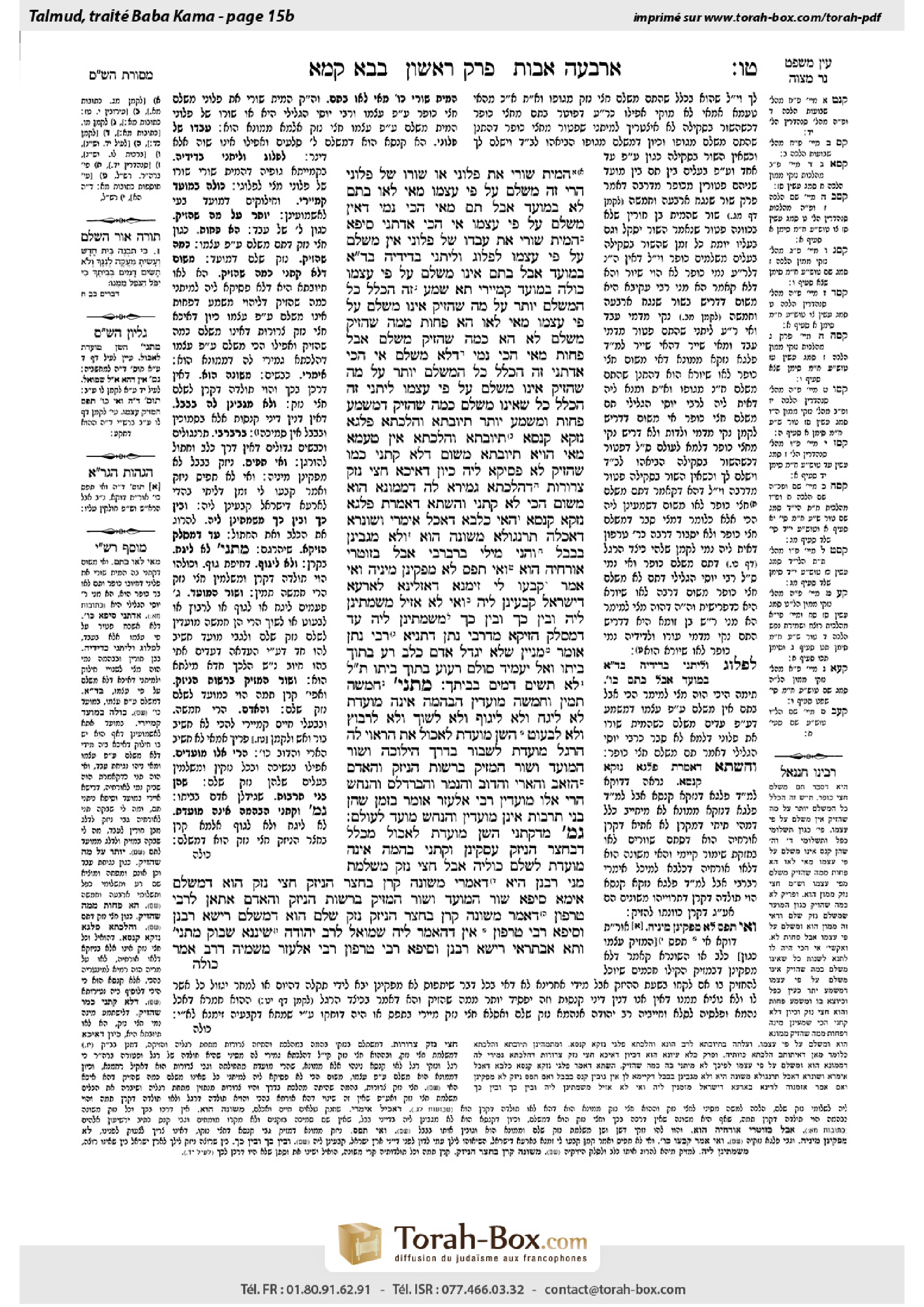
Bava Kamma 15b: Talmud study for Daf Yomi
Study the Talmud for Daf Yomi with scanned pages, Hebrew text, English translations from Sefaria and AI-generated French translations.
Passage selection and English or AI-generated French translation are available where the scan has annotations. Daf Study is independent of Torah-Box and Sefaria.
Browse Bava Kamma · בבא קמא · All tractatesBava Kamma 15b text and translations
This page of Bava Kamma includes the Aramaic text, an English translation and an AI-generated French translation, alongside the scan above.
בבא קמא י״ה ב · Aramaic and Hebrew text
״הֵמִית שׁוֹרִי אֶת פְּלוֹנִי״ אוֹ ״שׁוֹרוֹ שֶׁל פְּלוֹנִי״ – הֲרֵי זֶה מְשַׁלֵּם עַל פִּי עַצְמוֹ.
מַאי, לָאו בְּתָם?
לָא, בְּמוּעָד. אֲבָל תָּם מַאי – הָכִי נָמֵי דְּאֵין מְשַׁלֵּם עַל פִּי עַצְמוֹ? אִי הָכִי, אַדְּתָנֵי סֵיפָא ״הֵמִית שׁוֹרִי אֶת עַבְדּוֹ שֶׁל פְּלוֹנִי״ – אֵין מְשַׁלֵּם עַל פִּי עַצְמוֹ, לִפְלוֹג וְלִיתְנֵי בְּדִידֵיהּ:
בַּמֶּה דְּבָרִים אֲמוּרִים – בְּמוּעָד, אֲבָל בְּתָם – אֵינוֹ מְשַׁלֵּם עַל פִּי עַצְמוֹ!
כּוּלָּהּ בְּמוּעָד קָמַיְירֵי.
תָּא שְׁמַע: זֶה הַכְּלָל, כׇּל הַמְשַׁלֵּם יוֹתֵר עַל מַה שֶּׁהִזִּיק – אֵינוֹ מְשַׁלֵּם עַל פִּי עַצְמוֹ. מַאי, לָאו הָא פָּחוֹת מִמַּה שֶׁהִזִּיק – מְשַׁלֵּם?
לָא, הָא כְּמָה שֶׁהִזִּיק – מְשַׁלֵּם.
אֲבָל פָּחוֹת מַאי – הָכִי נָמֵי דְּלָא מְשַׁלֵּם? אִי הָכִי, אַדְּתָנֵי: זֶה הַכְּלָל, כׇּל הַמְשַׁלֵּם יוֹתֵר עַל מַה שֶּׁהִזִּיק – אֵינוֹ מְשַׁלֵּם עַל פִּי עַצְמוֹ; לִיתְנֵי: זֶה הַכְּלָל, כֹּל שֶׁאֵינוֹ מְשַׁלֵּם כְּמָה שֶׁהִזִּיק – דְּמַשְׁמַע פָּחוֹת, וּמַשְׁמַע יוֹתֵר! תְּיוּבְתָּא.
וְהִלְכְתָא: פַּלְגָא נִזְקָא – קְנָסָא.
תְּיוּבְתָּא וְהִלְכְתָא?!
אִין, טַעְמָא מַאי הָוְיָא תְּיוּבְתָּא – מִשּׁוּם דְּלָא קָתָנֵי כְּמוֹ שֶׁהִזִּיק;
לָא פְּסִיקָא לֵיהּ. כֵּיוָן דְּאִיכָּא חֲצִי נֶזֶק צְרוֹרוֹת, דְּהִלְכְתָא גְּמִירִי לַהּ דְּמָמוֹנָא הוּא; מִשּׁוּם הָכִי לָא קָתָנֵי.
וְהַשְׁתָּא דְּאָמְרַתְּ פַּלְגָא נִזְקָא קְנָסָא, הַאי כַּלְבָּא דַּאֲכַל אִימְּרֵי, וְשׁוּנָּרָא דַּאֲכַלה תַּרְנְגוֹלָא – מְשׁוּנֶּה הוּא, וְלָא מַגְבֵּינַן בְּבָבֶל.
וְהָנֵי מִילֵּי בְּרַבְרְבֵי, אֲבָל בְּזוּטְרֵי – אוֹרְחֵיהּ הוּא.
וְאִי תְּפַס – לָא מַפְּקִינַן מִינֵּיהּ.
וְאִי אָמַר: קִבְעוּ לִי זִימְנָא, דְּאָזֵילְנָא לְאַרְעָא דְּיִשְׂרָאֵל – קָבְעִינַן לֵיהּ. וְאִי לָא אָזֵיל – מְשַׁמְּתִינַן לֵיהּ.
וּבֵין כָּךְ וּבֵין כָּךְ, מְשַׁמְּתִינַן לֵיהּ עַד דִּמְסַלֵּק הֶזֵּיקָא –
מִדְּרַבִּי נָתָן. דְּתַנְיָא, רַבִּי נָתָן אוֹמֵר: מִנַּיִין שֶׁלֹּא יְגַדֵּל אָדָם כֶּלֶב רַע בְּתוֹךְ בֵּיתוֹ, וְאַל יַעֲמִיד סוּלָּם רָעוּעַ בְּתוֹךְ בֵּיתוֹ? תַּלְמוּד לוֹמַר: ״לֹא תָשִׂים דָּמִים בְּבֵיתֶךָ״.
מַתְנִי׳ חֲמִשָּׁה תַּמִּין וַחֲמִשָּׁה מוּעָדִין –
הַבְּהֵמָה אֵינָהּ מוּעֶדֶת לֹא לִיגַּח, וְלֹא לִיגּוֹף, וְלֹא לִשּׁוֹךְ, וְלֹא לִרְבּוֹץ, וְלֹא לִבְעוֹט.
הַשֵּׁן – מוּעֶדֶת לֶאֱכוֹל אֶת הָרָאוּי לָהּ; הָרֶגֶל – מוּעֶדֶת לִשְׁבּוֹר בְּדֶרֶךְ הִילּוּכָהּ; וְשׁוֹר הַמּוּעָד; וְשׁוֹר הַמַּזִּיק בִּרְשׁוּת הַנִּיזָּק; וְהָאָדָם.
הַזְּאֵב וְהָאֲרִי וְהַדּוֹב וְהַנָּמֵר וְהַבַּרְדְּלָס וְהַנָּחָשׁ – הֲרֵי אֵלּוּ מוּעָדִין. רַבִּי אֶלְעָזָר אוֹמֵר: בִּזְמַן שֶׁהֵן בְּנֵי תַרְבּוּת – אֵינָן מוּעָדִין. וְהַנָּחָשׁ מוּעָד לְעוֹלָם.
גְּמָ׳ מִדְּקָתָנֵי הַשֵּׁן מוּעֶדֶת לֶאֱכוֹל – מִכְּלָל דְּבַחֲצַר הַנִּיזָּק עָסְקִינַן; וְקָתָנֵי בְּהֵמָה אֵינָהּ מוּעֶדֶת לְשַׁלֵּם כּוּלֵּיהּ – אֲבָל חֲצִי נֶזֶק מְשַׁלֶּמֶת,
מַנִּי – רַבָּנַן הִיא, דְּאָמְרִי: מְשׁוּנֶּה קֶרֶן בַּחֲצַר הַנִּיזָּק, חֲצִי נֶזֶק הוּא דִּמְשַׁלֵּם.
אֵימָא סֵיפָא: שׁוֹר הַמּוּעָד, וְשׁוֹר הַמַּזִּיק בִּרְשׁוּת הַנִּיזָּק, וְהָאָדָם – אֲתָאן לְרַבִּי טַרְפוֹן, דְּאָמַר: מְשׁוּנֶּה קֶרֶן בַּחֲצַר הַנִּיזָּק, נֶזֶק שָׁלֵם הוּא דִּמְשַׁלֵּם!
רֵישָׁא רַבָּנַן, וְסֵיפָא רַבִּי טַרְפוֹן?!
אִין, דְּהָאָמַר לֵיהּ שְׁמוּאֵל לְרַב יְהוּדָה: שִׁינָּנָא, שְׁבוֹק מַתְנִיתִין וְתָא אַבַּתְרַאי – רֵישָׁא רַבָּנַן וְסֵיפָא רַבִּי טַרְפוֹן.
רַבִּי אֶלְעָזָר מִשְּׁמֵיהּ דְּרַב אָמַר:
Bava Kamma 15b · English translation
If one admits: My ox killed so-and-so, or my ox killed so-and-so’s ox, then this person pays based on his own admission.
The Gemara analyzes the mishna: What, is the halakha of the mishna not stated with regard to an innocuous ox? If so, this mishna proves that one is required to pay for half the cost of the damage even based on one’s own admission, which demonstrates that the payment is monetary restitution and not a fine.
The Gemara rejects the proof: No, the halakha of the mishna is stated with regard to a forewarned ox. The Gemara asks: But according to this explanation, if it had been an innocuous ox that gored, what would be the halakha? Would one say that indeed, he does not pay based on his own admission? But if so, rather than teaching in the latter clause of the mishna in Ketubot: If one admits: My ox killed so-and-so’s Canaanite slave, he does not pay based on his own admission, let the mishna differentiate and teach the distinction with regard to the case raised in the first clause itself. The reason for the distinction between the cases when one’s ox kills a Jew or a Canaanite slave is that in the first one pays monetary restitution, while in the second one pays a fine. If the mishna wishes to demonstrate the difference between a fine and monetary restitution with regard to admission, then instead of introducing a new case, the mishna would have modified the case of the previous clause.
The mishna would have continued: In what case is this statement in the first clause said? It is said with regard to a forewarned ox, but with regard to an admission that one’s innocuous ox gored, he does not pay based on his own admission. The fact that the mishna does not do so suggests that in fact one is required to pay for half the cost of the damage based on one’s own admission that his innocuous ox gored. Evidently, the payment is considered to be monetary restitution.
The Gemara rejects this: The reason the mishna did not raise the distinction between an innocuous and a forewarned ox is not because that distinction is not a valid one, but because the entire mishna speaks only of cases of a forewarned ox. Accordingly, no proof can be adduced from the mishna.
The Gemara suggests further: Come and hear a proof from the concluding clause of the mishna just cited: This is the principle: Anyone who pays more than the cost of that which he damaged does not pay based on his own admission. The Gemara infers: What, is it not that were he liable to pay less than the cost of that which he damaged, he would pay based on his own admission? Since when an innocuous ox gores, its owner is liable to pay more than the cost of the damage, the payment is clearly not monetary restitution, and this is why it is not payable based on one’s own admission.
The Gemara rejects the inference: No, one should infer only that were he liable to pay as much as the cost of that which he damaged, he pays based on his own admission. If the sum to be paid is more or less than the cost of that which he damaged, he would not pay based on his own admission.
The Gemara asks. But according to that opinion, where one is liable to pay less than the cost of the damage, what would be the halakha? Would one say that, indeed, he does not pay based on his own admission? If so, instead of teaching: This is the principle: Anyone who pays more than the cost of that which he damaged does not pay based on his own admission, let the mishna teach instead: This is the principle: Anyone who does not pay as much as the cost of that which he damaged does not pay based on his own admission. As that statement indicates cases where one is liable to pay more than the cost of that which he damaged and it also indicates cases where one is liable to pay less than the cost of that which he damaged. Evidently, the mishna holds that where one’s liability is for less than the cost of the damage, it is payable based on one’s own admission. This therefore provides a conclusive refutation of the opinion that the payment for half the cost of the damage is a fine.
The Gemara adds: And the halakha is that the payment for half the cost of the damage is a fine.
The Gemara notes the obvious inconsistency: How can it be that the Gemara offers a conclusive refutation of the opinion that the payment for half the cost of the damage is a fine and then state that the halakha is in accordance with that opinion?
The Gemara explains: Yes, the halakha may be in accordance with that opinion because of the following resolution of the refutation. What is the reason that the Gemara held that there is a conclusive refutation of the opinion that the payment for half the cost of the damage is a fine? Because the mishna does not teach: Anyone who does not pay as much as the cost of that which he damaged does not pay based on his own admission. This is not, in fact, a conclusive refutation, as even if one holds that the payment of half the cost of the damage for an innocuous ox is considered monetary restitution, one can still explain why the mishna doesn’t discuss cases where one is liable for less than the cost of the damage.
This is because the tanna cannot make an absolute statement about such cases, that one never pays based on one’s own admission. Since there is an obligation for one to pay for half the cost of the damage resulting from pebbles inadvertently propelled by the foot of a walking animal, which, through tradition it is learned that this payment is monetary restitution, and it is due to that reason that the mishna does not teach cases where one’s liability is valued at less than the cost of the damage.
The Gemara considers the ramifications of this halakha: And now that you have said that the halakha is that the payment of half the cost of the damage is a fine, with regard to this innocuous dog that ate lambs or this innocuous cat that ate a chicken, which is atypical behavior for dogs and cats, we do not collect the payment for these acts in the courts in Babylonia. Since it is not common for these animals to eat those animals, these acts are classified as Goring, irrespective of the fact that the animal gained pleasure from the damage, for which it would normally be classified in the category of Eating. Therefore, in cases where these animals had not performed this act of damaging before, and were therefore considered innocuous, the owner is liable for only half the cost of the damage, which is a fine. Since the collection of fines may be imposed only by judges who have been ordained, and ordination is given only in Eretz Yisrael, these payments are not collected in Babylonia.
The Gemara adds: And this matter applies only where they attacked large animals, as it is atypical behavior for them; but where they attacked small animals, since that is their typical manner of behavior, it is classified as Eating, for which the owner pays the full cost of the damage, which is certainly considered monetary restitution. Accordingly, the payment is collected by the courts in Babylonia.
And even in a case where the payment is considered a fine, if the injured party seized the property of the owner of the belligerent animal in order to cover his loss, we do not reclaim it from him since he is entitled to it.
And also, if the injured party said to the court: Fix a time for me to go to Eretz Yisrael to present the case before ordained judges, we fix a time for him and require the owner of the belligerent animal to go to the court in Eretz Yisrael at that time. And if he does not go, we excommunicate him for disobeying the orders of the court.
And either way, we excommunicate the owner of the belligerent animal until he removes the danger, e.g., by killing the animal or otherwise neutralizing the danger.
The justification for this is from the ruling of Rabbi Natan, as it is taught in a baraita: Rabbi Natan says: From where is it derived that one may not raise a vicious dog in his house, and one may not set up an unstable ladder in his house? The verse states: “You shall not bring blood into your house” (Deuteronomy 22:8), i.e., one may not allow a hazardous situation or item to remain in one’s house. As long as the hazard remains, the owner is in violation of this verse and therefore the court may excommunicate him for failing to remove the danger.
MISHNA: There are five damage-causing acts that an animal can perform twice and remain innocuous even when its owner was warned each time to prevent it from doing so. After the third time, the animal is rendered forewarned. In such cases, the owner is liable to pay only half of the damages. And there are five damage-causing acts for which an animal is considered forewarned, at times even if it had never caused damage in that manner. In such cases the owner is liable to pay the full cost of the damage.
An animal is not considered forewarned with regard to Goring, i.e., not for goring with its horns, nor for pushing with its body, nor for biting, nor for crouching upon items in order to damage them, nor for kicking. In these cases the animal is considered to be innocuous and its owner is liable for only half of the damages.
Concerning acts of damage performed with the tooth, the animal is considered forewarned with regard to eating that which is fitting for it to eat. Concerning acts of damage performed with the foot, the animal is considered forewarned with regard to breaking items while walking. And there is a forewarned ox, which gored three times and each time his owner was warned to safeguard his ox from doing so. And there is an ox that causes damage to the property of the injured party while on the property of the injured party. And there is the person, i.e., any damage done by a person. In all of these cases the one who caused the damage is considered to be forewarned, resulting in the obligation to pay the full cost of the damage.
The mishna presents the halakha for wild animals: The wolf; the lion; the bear; the leopard; the bardelas, the meaning of which the Gemara will discuss; and the snake. These are considered forewarned even if they had never previously caused damage. Rabbi Elazar says: When these animals are domesticated they are not considered forewarned. But the snake is always considered forewarned.
GEMARA: From the fact that the mishna teaches in its latter clause: Concerning acts of damage performed with the tooth, the animal is considered forewarned with regard to eating that which is fitting for it to eat, we learn, by inference, that we are dealing throughout the mishna with cases of damage done in the courtyard of the injured party, as one is exempt from liability for acts of damage classified as Eating if they occur in the public domain. And yet the first clause teaches: An animal is not considered forewarned with regard to Goring. Stating that it is not forewarned indicates that the liability of its owner is limited only with regard to paying the full cost of the damage, but the owner pays half the cost of the damage.
The Gemara asks: Who is it that holds that when damage classified as Goring is done within the property of the injured party the owner of the belligerent animal is liable for only half of the damages? It is the Rabbis, who say: The halakha of cases of Goring performed by an innocuous animal, which is atypical behavior, done in the courtyard of the injured party, is that the owner of the ox pays half the cost of the damage.
But then say, and try to explain accordingly, the next part of the latter clause of the mishna: And there is a forewarned ox that gored three times, and each time his owner was warned to safeguard his ox from doing so. And there is an ox that causes damage to the property of the injured party while on the property of the injured party. And there is the person. In these cases, the responsible party pays full damages. With this clause we arrive at the opinion of Rabbi Tarfon, who says: The halakha of cases of Goring performed by an innocuous animal, which is atypical, done in the courtyard of the injured party, is that the owner of the ox pays the full cost of the damage even if the ox is innocuous.
The Gemara asks: Could it be that the first part of the latter clause of the mishna is in accordance with the opinion of the Rabbis and the next part of the latter clause is in accordance with the opinion of Rabbi Tarfon?
The Gemara answers: Yes, as Shmuel said to Rav Yehuda: Large-toothed one, leave the mishna and follow after me and my interpretation that the first part of the latter clause of the mishna is in accordance with the opinion of the Rabbis and the next part of the latter clause is in accordance with the opinion of Rabbi Tarfon.
The Gemara presents a different interpretation of the mishna: Rabbi Elazar said in the name of Rav:
Bava Kamma 15b · Traduction française (IA)
Si l'on admet : Mon bœuf a tué tel ou tel, ou mon bœuf a tué le bœuf de tel ou tel, alors cette personne paie selon son propre aveu.
La Guemara analyse la michna : Quoi, la halakha de la michna n'est-elle pas énoncée concernant un bœuf inoffensif ? Si c'est le cas, cette michna démontre que l'on est tenu de payer la moitié du coût des dommages même selon son propre aveu, ce qui montre que le paiement est une réparation monétaire et non une amende.
La Guemara rejette cette démonstration : Non, la halakha de la michna est énoncée concernant un bœuf averti. La Guemara demande : Mais selon cette explication, si c'était un bœuf inoffensif qui avait blessé, quelle serait la halakha ? Dirait-on qu'en effet, il ne paie pas selon son propre aveu ? Mais si c'est le cas, plutôt que d'enseigner dans la clause finale de la michna dans Ketubot : Si l'on admet : Mon bœuf a tué l'esclave cananéen de tel ou tel, il ne paie pas selon son propre aveu, la michna aurait dû distinguer et enseigner la différence concernant le cas évoqué dans la première clause elle-même. La raison de la distinction entre les cas où un bœuf tue un Juif ou un esclave cananéen est que dans le premier cas, on paie une réparation monétaire, tandis que dans le second, on paie une amende. Si la michna souhaite démontrer la différence entre une amende et une réparation monétaire concernant l'aveu, alors au lieu d'introduire un nouveau cas, la michna aurait modifié le cas de la clause précédente.
La michna aurait continué : Dans quel cas cette déclaration de la première clause est-elle énoncée ? Elle est énoncée concernant un bœuf averti, mais concernant un aveu que son bœuf inoffensif a blessé, il ne paie pas selon son propre aveu. Le fait que la michna ne le fasse pas suggère que, en réalité, l'on est tenu de payer la moitié du coût des dommages selon son propre aveu. Évidemment, le paiement est considéré comme une réparation monétaire.
La Guemara rejette cela : La raison pour laquelle la michna n'a pas évoqué la distinction entre un bœuf inoffensif et un bœuf averti n'est pas que cette distinction n'est pas valable, mais que toute la michna parle uniquement des cas de bœufs avertis. Ainsi, aucune démonstration ne peut être tirée de la michna.
La Guemara suggère davantage : Viens écouter une démonstration à partir de la clause finale de la michna citée précédemment : C'est le principe : Quiconque paie plus que le coût de ce qu'il a endommagé ne paie pas selon son propre aveu. La Guemara déduit : Quoi, n'est-ce pas que s'il était tenu de payer moins que le coût de ce qu'il a endommagé, il paierait selon son propre aveu ? Puisque lorsqu'un bœuf inoffensif blessé, son propriétaire est tenu de payer plus que le coût des dommages, le paiement est clairement non une réparation monétaire, et c'est pourquoi il n'est pas payable selon son propre aveu.
La Guemara rejette cette déduction : Non, on devrait déduire seulement que s'il était tenu de payer autant que le coût de ce qu'il a endommagé, il paie selon son propre aveu. Si la somme à payer est plus ou moins que le coût de ce qu'il a endommagé, il ne paie pas selon son propre aveu.
La Guemara demande : Mais selon cet avis, où l'on est tenu de payer moins que le coût des dommages, quelle serait la halakha ? Dirait-on qu'en effet, il ne paie pas selon son propre aveu ? Si c'est le cas, plutôt que d'enseigner : C'est le principe : Quiconque paie plus que le coût de ce qu'il a endommagé ne paie pas selon son propre aveu, la michna aurait dû enseigner plutôt : C'est le principe : Quiconque ne paie pas autant que le coût de ce qu'il a endommagé ne paie pas selon son propre aveu. Cette déclaration indique les cas où l'on est tenu de payer plus que le coût des dommages et aussi ceux où l'on est tenu de payer moins que le coût des dommages. Évidemment, la michna considère que lorsque la responsabilité est inférieure au coût des dommages, le paiement est payable selon son propre aveu. Cela fournit donc une réfutation concluante de l'avis selon lequel le paiement pour la moitié du coût des dommages est une amende.
La Guemara ajoute : Et la halakha est que le paiement pour la moitié du coût des dommages est une amende.
La Guemara note la contradiction évidente : Comment peut-il être que la Guemara offre une réfutation concluante de l'avis selon lequel le paiement pour la moitié du coût des dommages est une amende et puis affirme que la halakha est en conformité avec cet avis ?
La Guemara explique : Oui, la halakha peut être en conformité avec cet avis en raison de la résolution suivante de la réfutation. Quelle est la raison pour laquelle la Guemara a considéré qu'il y a une réfutation concluante de l'avis selon lequel le paiement pour la moitié du coût des dommages est une amende ? C'est parce que la michna ne dit pas : Quiconque ne paie pas autant que le coût de ce qu'il a endommagé ne paie pas selon son propre aveu. Ce n'est pas, en effet, une réfutation concluante, car même si l'on considère que le paiement de la moitié du coût des dommages pour un bœuf inoffensif est considéré comme une réparation monétaire, on peut encore expliquer pourquoi la michna ne discute pas des cas où la responsabilité est inférieure au coût des dommages.
C'est parce que le tanna ne peut pas énoncer une déclaration absolue concernant ces cas, que l'on ne paie jamais selon son propre aveu. Il y a une obligation de payer la moitié du coût des dommages résultant des pierres propulsées accidentellement par le pied d'un animal marchant, ce qui, par tradition, est appris que ce paiement est une réparation monétaire, et c'est pour cette raison que la michna ne discute pas des cas où la responsabilité est évaluée à moins que le coût des dommages.
La Guemara examine les conséquences de cette halakha : Et maintenant que vous avez dit que la halakha est que le paiement de la moitié du coût des dommages est une amende, concernant ce chien inoffensif qui a mangé des agneaux ou ce chat inoffensif qui a mangé un poulet, comportement atypique pour les chiens et les chats, nous ne réclamons pas ce paiement devant les tribunaux en Babylonie. Puisque ce n'est pas courant que ces animaux mangent ces bêtes, ces actes sont classés comme un écrasement, indépendamment du fait que l'animal ait trouvé du plaisir dans les dommages, ce qui normalement le classerait dans la catégorie de la consommation. Ainsi, dans les cas où ces animaux n'ont pas commis cet acte de dommage auparavant et étaient donc considérés comme inoffensifs, le propriétaire est tenu responsable de la moitié du coût des dommages, ce qui est une amende. Puisque la collecte des amendes peut être imposée uniquement par des juges ordonnés, et que l'ordination est donnée uniquement en Terre d'Israël, ces paiements ne sont pas collectés en Babylonie.
La Guemara ajoute : Et cette affaire s'applique uniquement lorsqu'ils attaquent des grands animaux, car c'est un comportement atypique pour eux ; mais lorsqu'ils attaquent des petits animaux, puisque c'est leur mode de comportement typique, il est classé comme une consommation, pour laquelle le propriétaire paie le coût complet des dommages, ce qui est certainement considéré comme une restitution monétaire. Ainsi, le paiement est collecté devant les tribunaux en Babylonie.
Et même dans le cas où le paiement est considéré comme une amende, si la partie blessée s'empare des biens du propriétaire de l'animal agressif afin de couvrir ses pertes, nous ne le récupérons pas, puisqu'il est autorisé à le faire.
Et de plus, si la partie blessée dit au tribunal : Fixez un délai pour que je parte en Terre d'Israël présenter mon affaire devant des juges ordonnés, nous fixons un délai pour lui et exigeons que le propriétaire de l'animal agressif parte devant le tribunal en Terre d'Israël à cette date. Et si celui-ci n'y va pas, nous l'excluons de la communauté pour avoir enfreint les ordres du tribunal.
Et de toute façon, nous excluons le propriétaire de l'animal agressif jusqu'à ce qu'il élimine le danger, par exemple en tuant l'animal ou autrement en neutralisant le danger.
La justification de cela vient du jugement du maître Natan, comme il est enseigné dans une baraïta : Le maître Natan dit : D'où dérive-t-il que l'on ne doit pas dresser un chien méchant dans sa maison, et qu'on ne doit pas poser une échelle instable dans sa maison ? La Sainte Écriture dit : « Vous ne mettrez pas de sang dans votre maison » (Deutéronome 22:8), c'est-à-dire qu'on ne doit pas permettre un objet ou une situation dangereuse de rester dans sa maison. Tant que le danger persiste, le propriétaire enfreint cette Sainte Écriture et donc le tribunal peut l'exclure de la communauté pour avoir négligé d'éliminer le danger.
MICHNA : Il y a cinq actes de dommage que l'animal peut commettre deux fois et rester inoffensif même si son propriétaire l'avait averti chaque fois pour l'empêcher de le faire. Après la troisième fois, l'animal est considéré comme averti. Dans ces cas, le propriétaire est tenu responsable de la moitié des dommages. Et il y a cinq actes de dommage pour lesquels l'animal est considéré comme averti, parfois même s'il n'avait jamais causé de dommage de cette manière. Dans ces cas, le propriétaire est tenu responsable du coût complet des dommages.
L'animal n'est pas considéré comme averti concernant l'écrasement, c'est-à-dire pas pour l'écrasement avec ses cornes, ni pour pousser avec son corps, ni pour mordre, ni pour s'installer sur des objets afin de les endommager, ni pour frapper. Dans ces cas, l'animal est considéré comme inoffensif et son propriétaire est tenu responsable de la moitié des dommages.
Concernant les actes de dommage commis avec les dents, l'animal est considéré comme averti concernant la consommation de ce qui convient à sa consommation. Concernant les actes de dommage commis avec le pied, l'animal est considéré comme averti concernant la destruction d'objets en marchant. Et il y a un taureau averti, qui a écrasé trois fois et chaque fois son propriétaire l'avait averti de le protéger contre ce comportement. Et il y a un taureau qui cause des dommages aux biens de la partie blessée sur la propriété de celle-ci. Et il y a la personne, c'est-à-dire tout dommage causé par une personne. Dans tous ces cas, celui qui a causé le dommage est considéré comme averti, entraînant l'obligation de payer le coût complet des dommages.
La mishna présente la halakha concernant les animaux sauvages : le loup ; le lion ; l'ours ; le léopard ; le bardelas, dont la signification sera discutée par la Guemara ; et le serpent. Ces animaux sont considérés comme avertis même s'ils n'avaient jamais causé de dommage auparavant. Rabbi Elazar dit : Lorsque ces animaux sont domestiqués, ils ne sont pas considérés comme avertis. Mais le serpent est toujours considéré comme averti.
GUEMARA : À partir du fait que la mishna enseigne dans sa dernière clause : concernant les actes de dommage commis avec les dents, l'animal est considéré comme averti concernant la consommation de ce qui convient à sa consommation, nous en déduisons, par inférence, que nous traitons tout au long de la mishna des cas de dommage sur la cour de la partie blessée, car l'on est exempt de responsabilité pour les actes de dommage classés comme consommation si ceux-ci se produisent dans le domaine public. Et pourtant, la première clause enseigne : l'animal n'est pas considéré comme averti concernant l'écrasement. Énoncer qu'il n'est pas averti indique que la responsabilité du propriétaire est limitée uniquement concernant le paiement du coût complet des dommages, mais le propriétaire paie la moitié du coût des dommages.
La Guemara demande : Qui est-ce qui affirme que lorsqu'un dommage classé comme écrasement est commis sur la propriété de la partie blessée, le propriétaire de l'animal agressif est tenu responsable de la moitié des dommages ? C'est les Rabbins, qui disent : la halakha concernant les cas d'écrasement commis par un animal inoffensif, comportement atypique, commis dans la cour de la partie blessée, est que le propriétaire du taureau paie la moitié du coût des dommages.
Mais alors dis, et essaie d'expliquer en conséquence, la suite de la dernière clause de la mitsna : Il y a un bœuf averti qui a renversé trois fois, et chaque fois son propriétaire a été averti de le garder pour qu'il ne le fasse pas. Il y a un bœuf qui cause des dommages aux biens de la partie blessée alors qu'il est sur la propriété de la partie blessée. Il y a la personne. Dans ces cas, la partie responsable paie les dommages complets. Avec cette clause, nous arrivons à l'opinion de Rabbi Tarfon, qui dit : La halakha des cas de renversement commis par un animal inoffensif, qui est atypique, accompli dans le courtil de la partie blessée, est que le propriétaire du bœuf paie le coût complet des dommages même si le bœuf est inoffensif.
La Guemara demande : Pourrait-il être que la première partie de la dernière clause de la mitsna soit selon l'opinion des Rabbins et que la suite de la dernière clause soit selon l'opinion de Rabbi Tarfon ?
La Guemara répond : Oui, comme Shmuel a dit à Rav Yehuda : Grand-denté, laisse la mitsna et suis-moi et mon interprétation que la première partie de la dernière clause de la mitsna est selon l'opinion des Rabbins et que la suite de la dernière clause est selon l'opinion de Rabbi Tarfon.
La Guemara présente une autre interprétation de la Michna : Rabbi Elazar a dit en nom de Rav :
Traduction française générée par IA à partir de l’édition anglaise de Sefaria. Vérifie toujours un passage avec le texte source.
Text from Sefaria: William Davidson Edition - Vocalized Aramaic (CC BY NC); William Davidson Edition - English (CC BY NC).