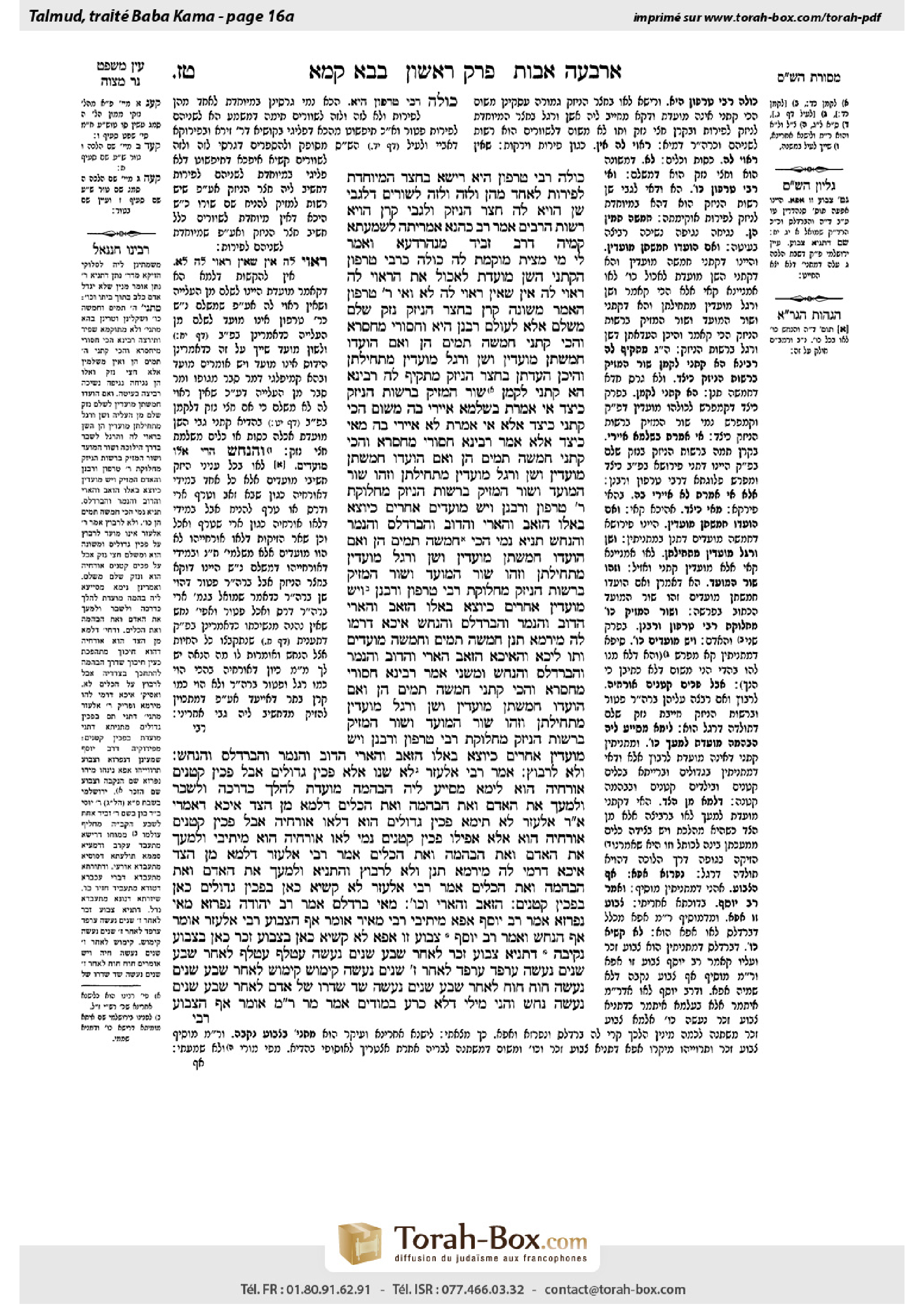
Bava Kamma 16a: Talmud study for Daf Yomi
Study the Talmud for Daf Yomi with scanned pages, Hebrew text, English translations from Sefaria and AI-generated French translations.
Passage selection and English or AI-generated French translation are available where the scan has annotations. Daf Study is independent of Torah-Box and Sefaria.
Browse Bava Kamma · בבא קמא · All tractatesBava Kamma 16a text and translations
This page of Bava Kamma includes the Aramaic text, an English translation and an AI-generated French translation, alongside the scan above.
בבא קמא י״ו א · Aramaic and Hebrew text
כּוּלַּהּ רַבִּי טַרְפוֹן הִיא; רֵישָׁא – בְּחָצֵר הַמְיוּחֶדֶת לְפֵירוֹת לְאֶחָד מֵהֶן, וְלָזֶה וְלָזֶה לִשְׁוָרִים; דִּלְגַבֵּי שֵׁן הָוְיָא לַהּ חֲצַר הַנִּיזָּק. וּלְגַבֵּי קֶרֶן הָוְיָא רְשׁוּת הָרַבִּים.
אָמַר רַב כָּהֲנָא: אַמְרִיתַהּ לִשְׁמַעְתָּא קַמֵּיהּ דְּרַב זְבִיד מִנְּהַרְדְּעָא, וַאֲמַר לִי: מִי מָצֵית מוֹקְמַתְּ לַהּ כּוּלַּהּ כְּרַבִּי טַרְפוֹן?! הָקָתָנֵי: ״הַשֵּׁן מוּעֶדֶת לֶאֱכוֹל אֶת הָרָאוּי לָהּ״; רָאוּי לָהּ – אִין, שֶׁאֵין רָאוּי לָהּ – לָא;
וְאִי רַבִּי טַרְפוֹן, הָאָמַר: מְשׁוּנֶּה קֶרֶן בַּחֲצַר הַנִּיזָּק נֶזֶק שָׁלֵם מְשַׁלֵּם!
אֶלָּא לְעוֹלָם רַבָּנַן הִיא; וְחַסּוֹרֵי מְחַסְּרָא, וְהָכִי קָתָנֵי: חֲמִשָּׁה תַּמִּים הֵן, וְאִם הוּעֲדוּ – חֲמִשְׁתָּן מוּעָדִין.
וְשֵׁן וָרֶגֶל מוּעָדִין מִתְּחִילָּתָן. וְהֵיכָן הֶעָדָתָן? בַּחֲצַר הַנִּיזָּק.
מַתְקֵיף לַהּ רָבִינָא, הָא קָתָנֵי לְקַמַּן: ״שׁוֹר הַמַּזִּיק בִּרְשׁוּת הַנִּיזָּק כֵּיצַד״. אִי אָמְרַתְּ בִּשְׁלָמָא אַיְירִי בַּהּ, מִשּׁוּם הָכִי קָתָנֵי ״כֵּיצַד״. אֶלָּא אִי אָמְרַתְּ לָא אַיְירִי בַּהּ, מַאי ״כֵּיצַד״?
אֶלָּא אָמַר רָבִינָא: חַסּוֹרֵי מְחַסְּרָא, וְהָכִי קָתָנֵי: חֲמִשָּׁה תַּמִּים הֵן. וְאִם הוּעֲדוּ – חֲמִשְׁתָּן מוּעָדִין;
וְשֵׁן וָרֶגֶל – מוּעָדִין מִתְּחִילָּתָן; וְזֶהוּ שׁוֹר הַמּוּעָד. וְשׁוֹר הַמַּזִּיק בִּרְשׁוּת הַנִּיזָּק – מַחְלוֹקֶת רַבִּי טַרְפוֹן וְרַבָּנַן. וְיֵשׁ מוּעָדִים אֲחֵרִים כַּיּוֹצֵא בְּאֵלּוּ – הַזְּאֵב, וְהָאֲרִי, וְהַדּוֹב, וְהַבַּרְדְּלָס, וְהַנָּמֵר, וְהַנָּחָשׁ.
תַּנְיָא נָמֵי הָכִי: חֲמִשָּׁה תַּמִּים הֵן. וְאִם הוּעֲדוּ – חֲמִשְׁתָּן מוּעָדִין; וְשֵׁן וָרֶגֶל – מוּעָדִין מִתְּחִילָּתָן; וְזֶהוּ שׁוֹר הַמּוּעָד. וְשׁוֹר הַמַּזִּיק בִּרְשׁוּת הַנִּיזָּק – מַחְלוֹקֶת רַבִּי טַרְפוֹן וְרַבָּנַן. וְיֵשׁ מוּעָדִין אֲחֵרִים כַּיּוֹצֵא בְּאֵלּוּ – הַזְּאֵב, וְהָאֲרִי, הַדּוֹב, וְהַנָּמֵר, וְהַבַּרְדְּלָס, וְהַנָּחָשׁ.
אִיכָּא דְּרָמוּ לַהּ מִירְמָא – תְּנַן: חֲמִשָּׁה תַּמִּים וַחֲמִשָּׁה מוּעָדִים. וְתוּ לֵיכָּא?! וְהָאִיכָּא הַזְּאֵב, הָאֲרִי, וְהַדּוֹב, וְהַנָּמֵר, וְהַבַּרְדְּלָס, וְהַנָּחָשׁ!
וּמְשַׁנֵּי, אָמַר רָבִינָא: חַסּוֹרֵי מְחַסְּרָא, וְהָכִי קָתָנֵי: חֲמִשָּׁה תַּמִּים הֵן. וְאִם הוּעֲדוּ – חֲמִשְׁתָּן מוּעָדִין; וְשֵׁן וָרֶגֶל מוּעָדִין מִתְּחִילָּתָן; וְזֶהוּ שׁוֹר הַמּוּעָד. וְשׁוֹר הַמַּזִּיק בִּרְשׁוּת הַנִּיזָּק – מַחְלוֹקֶת רַבִּי טַרְפוֹן וְרַבָּנַן. וְיֵשׁ מוּעָדִין אֲחֵרִים כַּיּוֹצֵא בְּאֵלּוּ – הַזְּאֵב, וְהָאֲרִי, הַדּוֹב, וְהַנָּמֵר, וְהַבַּרְדְּלָס, וְהַנָּחָשׁ.
וְלֹא לִרְבּוֹץ. אָמַר רַבִּי אֶלְעָזָר: לֹא שָׁנוּ אֶלָּא פַּכִּין גְּדוֹלִים, אֲבָל פַּכִּין קְטַנִּים – אוֹרְחֵיהּ הוּא.
לֵימָא מְסַיַּיע לֵיהּ: הַבְּהֵמָה מוּעֶדֶת לְהַלֵּךְ כְּדַרְכָּהּ, וּלְשַׁבֵּר וּלְמַעֵךְ אֶת הָאָדָם וְאֶת הַבְּהֵמָה וְאֶת הַכֵּלִים.
דִּלְמָא מִן הַצַּד.
אִיכָּא דְּאָמְרִי, אָמַר רַבִּי אֶלְעָזָר: לָא תֵּימָא פַּכִּין גְּדוֹלִים הוּא דְּלָאו אוֹרְחֵיהּ, אֲבָל פַּכִּין קְטַנִּים אוֹרְחֵיהּ הוּא; אֶלָּא אֲפִילּוּ פַּכִּין קְטַנִּים נָמֵי לָאו אוֹרְחֵיהּ הוּא.
מֵיתִיבִי: וּלְמַעֵךְ אֶת הָאָדָם וְאֶת הַבְּהֵמָה וְאֶת הַכֵּלִים!
אָמַר רַבִּי אֶלְעָזָר: דִּלְמָא מִן הַצַּד.
אִיכָּא דְּרָמֵי לַהּ מִירְמָא – תְּנַן: וְלֹא לִרְבּוֹץ. וְהָתַנְיָא: וּלְמַעֵךְ אֶת הָאָדָם וְאֶת הַבְּהֵמָה וְאֶת הַכֵּלִים! אָמַר רַבִּי אֶלְעָזָר: לָא קַשְׁיָא; כָּאן בְּפַכִּין גְּדוֹלִים, כָּאן בְּפַכִּין קְטַנִּים.
הַזְּאֵב וְהָאֲרִי וְכוּ׳. מַאי בַּרְדְּלָס? אָמַר רַב יְהוּדָה: נַפְרְזָא. מַאי נַפְרְזָא? אָמַר רַב יוֹסֵף: אַפָּא.
מֵיתִיבִי, רַבִּי מֵאִיר אוֹמֵר: אַף הַצָּבוֹעַ. רַבִּי אֶלְעָזָר אוֹמֵר: אַף הַנָּחָשׁ. וְאָמַר רַב יוֹסֵף: צָבוֹעַ זוֹ אַפָּא!
לָא קַשְׁיָא, כָּאן בְּצָבוֹעַ זָכָר, כָּאן בְּצָבוֹעַ נְקִיבָה.
דְּתַנְיָא: צָבוֹעַ זָכָר לְאַחַר שֶׁבַע שָׁנִים נַעֲשֶׂה עֲטַלֵּף, עֲטַלֵּף לְאַחַר שֶׁבַע שָׁנִים נַעֲשֶׂה עַרְפָּד, עַרְפָּד לְאַחַר שֶׁבַע שָׁנִים נַעֲשֶׂה קִימּוֹשׂ, קִימּוֹשׂ לְאַחַר שֶׁבַע שָׁנִים נַעֲשֶׂה חוֹחַ, חוֹחַ לְאַחַר שֶׁבַע שָׁנִים נַעֲשֶׂה שֵׁד. שִׁדְרוֹ שֶׁל אָדָם – לְאַחַר שֶׁבַע שָׁנִים נַעֲשֶׂה נָחָשׁ. וְהָנֵי מִילֵּי דְּלָא כָּרַע בְּ״מוֹדִים״.
אָמַר מָר, רַבִּי מֵאִיר אוֹמֵר: אַף הַצָּבוֹעַ.
Bava Kamma 16a · English translation
The entire mishna is in accordance with the opinion of Rabbi Tarfon; the first part of the latter clause is stated with regard to a jointly owned courtyard, which under the terms of their partnership is designated for the use of one of them, i.e., the injured party, to keep his produce there, and for this one and for that one to keep their oxen there. Accordingly, with regard to damage of the category of Eating caused by one partner’s ox to the injured party’s produce in that courtyard, it is equivalent to the case of a courtyard owned exclusively by the injured party, and the ox’s owner is liable for all the damage. But with regard to damage of the category of Goring, since they are both allowed to keep oxen there, the courtyard is equivalent to a public domain, and if one’s innocuous ox causes damage there, one is liable for only half the cost of the damage.
Rav Kahana said: I stated this teaching of Rabbi Elazar before Rav Zevid of Neharde’a, and he said to me: Are you really able to interpret that the entire mishna is in accordance with the opinion of Rabbi Tarfon? But doesn’t the mishna teach: Concerning acts of damage performed with the tooth, the animal is considered forewarned with regard to eating that which is fitting for it to eat. This indicates that only if what it eats is fitting for it, then yes, one is liable for the full cost of the damage, but if it eats something that is not fitting for it, the owner would not be liable for the full cost of the damage, but only for half the cost of the damage.
Rav Kahana explains his difficulty: And if the mishna is in accordance with the opinion of Rabbi Tarfon, the owner should be liable to pay the full cost of the damage even if his animal ate something not fitting for it, as doesn’t Rabbi Tarfon say: The halakha of cases of Goring performed by an innocuous animal, which is atypical, done in the courtyard of the injured party, is that the owner of the ox pays the full cost of the damage even if the ox is innocuous.
Rather, Rav Kahana said: Actually it must be that the entire mishna is in accordance with the opinion of the Rabbis and the mishna is incomplete and this is what it is teaching: The opening clause should be understood as saying: There are five damage-causing acts that animals can perform twice and remain innocuous, but if they were warned for performing those acts three times, with regard to the five acts they are considered forewarned, i.e., the mishna is not referring to two different sets of damages, five acts for which the animal is considered innocuous and five for which it is considered forewarned. Rather, both statements in the initial clause of the mishna are referring to the same five acts of Goring, and they teach that although the animal is initially considered innocuous with regard to these five acts, it can become forewarned.
The next part of the mishna then provides another halakha: But for damage of the categories of Eating and Trampling, an animal is considered forewarned from the outset. The next two items in the mishna: A forewarned ox and an ox that causes damage on the property of the injured party, should be understood as a question and an answer: And where does their forewarned status with regard to these acts apply? It applies in the courtyard of the injured party. According to Rav Kahana’s explanation, the statement: In the courtyard of the injured party, refers only to cases of Eating or Trampling, not to acts classified as Goring, and therefore it is true even according to the opinion of the Rabbis.
Ravina objects to this explanation: Doesn’t the mishna below (24b) teach: With regard to the case of an ox that causes damage to the property of the injured party on the property of the injured party, stated in the mishna here (15b), how so, i.e., what are the circumstances in which one is liable to pay the full cost of the damage? The mishna below (24b) proceeds to list acts of damage classified as Goring. Ravina states his objection: Granted, if you say that the mishna here (15b) discusses that case, i.e., that it is referring to Goring, it is due to that ruling that the mishna below teaches: How so, and proceeds to discuss one’s liability for Goring, as it is elucidating the case mentioned in the mishna here. But if you say, as Rav Zevid suggests, that the mishna here (15b) does not discuss Goring, what is the meaning of the mishna below when it asks: How so, and then proceeds to discuss one’s liability for Goring?
Rather, Ravina said: The mishna is incomplete and this is what it is teaching: There are five damage-causing acts that animals can perform twice and remain innocuous, but if they were warned for performing those acts three times with regard to the five acts, they are considered forewarned.
The next part of the mishna then provides another halakha: But for damage of the categories of Eating and Trampling, an animal is considered forewarned from the outset, and this is a case in which all agree that the animal is classified as a forewarned ox. And there is the case of an ox that causes damage to the property of the injured party, on the property of the injured party, which is subject to a dispute between Rabbi Tarfon and the Rabbis. And there are other cases similar to these in which animals are considered forewarned from the outset, namely: The wolf, the lion, the bear, the leopard, the bardelas, and the snake.
The Gemara notes: This interpretation of the mishna is also taught in a baraita: There are five damage-causing acts that animals can perform twice and remain innocuous, but if they were warned for performing those acts three times with regard to the five acts, they are considered forewarned. The next part of the mishna then provides another halakha: But for damage of the categories of Eating and Trampling, an animal is considered forewarned from the outset, and this is a case in which all agree that the animal is classified as a forewarned ox. And there is the case of an ox that causes damage to the property of the injured party, on the property of the injured party, which is subject to a dispute between Rabbi Tarfon and the Rabbis. And there are other cases similar to these in which animals are considered forewarned from the outset, namely: The wolf, the lion, the bear, the leopard, the bardelas, and the snake.
There are those who raise this issue as a contradiction and through doing so arrived at the same conclusions, as follows: We learned in the opening clause of the mishna: There are five damage-causing acts that animals can perform twice and remain innocuous, and there are five damage-causing acts for which an animal is considered forewarned. With regard to this, one can ask: But is there nothing else? But aren’t there the cases mentioned in the continuation of the mishna: The wolf, the lion, the bear, the leopard, the bardelas, and the snake? These are considered to be forewarned even if they had never caused damage before.
And they resolve the contradiction through that which Ravina said: The mishna is incomplete and this is what it is teaching: There are five damage-causing acts that animals can perform twice and remain innocuous, but if they were warned for performing those acts three times with regard to the five acts, they are considered forewarned. The next part of the mishna then provides another halakha: But for damage of the categories of Eating and Trampling, an animal is considered forewarned from the outset, and this is a case in which all agree that the animal is classified as a forewarned ox. And there is the case of an ox that causes damage to the property of the injured party, on the property of the injured party, which is subject to a dispute between Rabbi Tarfon and the Rabbis. And there are other cases similar to these in which animals are considered forewarned from the outset, namely: The wolf, the lion, the bear, the leopard, the bardelas, and the snake.
§ The mishna teaches: An animal is not considered forewarned with regard to Goring, i.e., not for goring with its horns, nor for pushing with its body, nor for biting, nor for crouching upon items in order to damage them. Rabbi Elazar says: They taught this only with regard to large vessels, as it is atypical for an animal to crouch upon them, and therefore the act is classified as a subcategory of Goring. But if the animal crouched upon small vessels, since that is its typical manner of behavior, it is classified as a subcategory of Trampling, for which the animal is considered forewarned from the outset.
The Gemara suggests: Let us say that the following baraita supports the opinion of Rabbi Elazar: An animal is considered forewarned, from the outset, to walk in its typical manner and to break or crush a person, or an animal, or vessels. The baraita indicates that an animal’s typical manner is to crush vessels, presumably by crouching down upon them. This would seem to contradict the mishna that states that such behavior is atypical. It would appear the only resolution to this contradiction is if one accepts the distinction made by Rabbi Elazar that the mishna concerns large vessels and the baraita concerns small vessels.
The Gemara rejects this: Perhaps the baraita concerns a case where the animal pushed against the utensils from the side and crushed them against a wall, but it does not concern a case where it crouched upon them.
There are those who say a different version of this discussion, as follows: Rabbi Elazar says: Do not say that the mishna’s ruling refers only to large vessels, as it is atypical for an animal to crouch upon them, but if the animal crouched upon small vessels, that is its typical manner and for that type of damage the animal is considered forewarned. Rather, the mishna refers even to small vessels, as it is atypical for an animal to crouch upon them.
The Gemara raises an objection from a baraita: An animal is considered forewarned, from the outset, to walk in its typical manner and to break or crush a person, or an animal, or vessels.
Rabbi Elazar said: Perhaps the baraita concerns only a case where the animal pushed against the utensils from the side and crushed them against a wall.
There are those who raise this issue as a contradiction: We learned in the mishna: An animal is not considered forewarned with regard to Goring, i.e., not for goring with its horns, nor for pushing with its body, nor for biting, nor for crouching upon items in order to damage them. But isn’t it taught in a baraita: An animal is considered forewarned, from the outset, to walk in its typical manner and to break or crush a person, or an animal, or vessels? In order to resolve this contradiction, Rabbi Elazar said: It is not difficult; here, in the mishna, the reference is to large vessels, while there, in the baraita, the reference is to small vessels.
§ The mishna teaches: The wolf, the lion, the bear, the leopard, the bardelas, and the snake; these are considered to be forewarned even if they had never caused damage before. The Gemara asks: What is a bardelas? Rav Yehuda said: It is a nafreza. The Gemara asks: What is a nafreza? Rav Yosef said: It is an appa.
The Gemara raises an objection from a baraita: In addition to the list of animals that are considered forewarned, Rabbi Meir says: Also the hyena [tzavo’a]. Rabbi Elazar says: Also the snake. And Rav Yosef said in explanation of the baraita: The hyena mentioned by Rabbi Meir, this is the animal called an appa. If Rav Yosef understands a hyena to be an appa, how could he also claim, above, that it is a bardelas?
The Gemara explains: It is not difficult: Here, in the baraita, Rabbi Meir is referring to a male hyena, and there, in the mishna, the reference is to a female hyena.
And it is apparent that a male hyena is distinct from a female one, as it is taught in a baraita: A male hyena after seven years metamorphoses into an insectivorous bat [atalef ]; an insectivorous bat after seven years metamorphoses into a herbivorous bat [arpad]; a herbivorous bat after seven years metamorphoses into a thistle [kimosh]; a thistle after seven years metamorphoses into a briar [ḥo’aḥ]; and a briar after seven years metamorphoses into a demon. Similarly, a person’s spine, seven years after his death, metamorphoses into a snake. The Gemara qualifies the last statement: And this matter applies only to a case where that person did not bow during the blessing of thanksgiving, the eighteenth blessing of the Amida prayer.
The Gemara analyzes the baraita: The Master says above: In addition to the list of animals that are considered forewarned, Rabbi Meir says: Also the hyena.
Bava Kamma 16a · Traduction française (IA)
L'intégralité de la mitsna est selon l'opinion de Rabbi Tarfon ; la première partie de la dernière clause est dite concernant un cour d'entrée partagé, qui, selon les termes de leur partage, est désigné pour l'usage de l'un d'eux, à savoir le partie blessé, afin de garder ses récoltes là, et pour que celui-ci et celui-là gardent leurs bœufs là. Ainsi, concernant les dommages de la catégorie d'Alimentation causés par le bœuf d'un partenaire au récoltes du partie blessé dans ce cour d'entrée, cela équivaut au cas d'un cour d'entrée exclusivement possédé par le partie blessé, et l'propriétaire du bœuf est tenu responsable de tous les dommages. Mais concernant les dommages de la catégorie de Bêla, puisque les deux sont autorisés à garder des bœufs là, le cour d'entrée équivaut à un domaine public, et si le bœuf inoffensif d'une personne cause des dommages là, l'individu est tenu responsable seulement de la moitié des dommages.
Rav Kahana a dit : J'ai exposé cette enseignement de Rabbi Elazar devant Rav Zevid de Neharde’a, et il m'a dit : Est-ce que tu es vraiment capable d'interpréter que toute la mitsva est selon l'opinion de Rabbi Tarfon ? Mais ne dit pas la mitsva : Concernant les actes de dommage accomplis avec les dents, l'animal est considéré comme averti concernant l'alimentation qui convient à son espèce. Cela indique que seulement si ce qu'il mange convient à son espèce, alors oui, l'propriétaire est tenu responsable du coût complet des dommages, mais si il mange quelque chose qui ne convient pas à son espèce, l'propriétaire ne serait pas tenu responsable du coût complet des dommages, mais seulement de la moitié du coût des dommages.
Rav Kahana explique sa difficulté : Et si la mitsva est selon l'opinion de Rabbi Tarfon, l'propriétaire devrait être tenu responsable du coût complet des dommages même si son animal a mangé quelque chose qui ne convient pas à son espèce, car Rabbi Tarfon ne dit-il pas : La halakha des cas de Goring accomplis par un animal inoffensif, qui est atypique, accomplis dans le cour d'entrée de la partie blessée, est que l'propriétaire du bœuf paie le coût complet des dommages même si l'animal est inoffensif.
Plutôt, Rav Kahana a dit : En réalité, il faut que toute la mitsva soit selon l'opinion des Rabbins et que la mitsva soit incomplète, et c'est ce qu'elle enseigne : La première clause devrait être comprise comme disant : Il y a cinq actes de dommage que les animaux peuvent accomplir deux fois et rester inoffensifs, mais si ils ont été avertis pour accomplir ces actes trois fois, concernant les cinq actes ils sont considérés comme avertis, à savoir la mitsva ne fait pas référence à deux ensembles différents de dommages, cinq actes pour lesquels l'animal est considéré comme inoffensif et cinq pour lesquels il est considéré comme averti. Plutôt, les deux déclarations dans la première clause de la mitsva font référence aux mêmes cinq actes de Goring, et elles enseignent que bien que l'animal soit initialement considéré comme inoffensif concernant ces cinq actes, il peut devenir averti.
La partie suivante de la mitsva enseigne alors une autre halakha : Mais concernant les dommages des catégories d'Alimentation et de Tâtonnement, l'animal est considéré comme averti dès le départ. Les deux items suivants de la mitsva : Un bœuf averti et un bœuf qui cause des dommages sur la propriété du partie blessé, devraient être compris comme une question et une réponse : Et où s'applique leur statut d'animal averti concernant ces actes ? Cela s'applique dans le cour d'entrée de la propriété du partie blessé. Selon l'explication de Rav Kahana, la déclaration : Dans le cour d'entrée de la propriété du partie blessé, fait référence uniquement aux cas d'Alimentation ou de Tâtonnement, pas aux actes classés comme Bêla, et par conséquent cela est vrai même selon l'opinion des Rabbins.
Ravina s'oppose à cette explication : Ne dit pas la mitsva suivante (24b) : Concernant le cas d'un bœuf qui cause des dommages sur la propriété du partie blessé sur la propriété du partie blessé, déclaré dans la mitsva ici (15b), comment cela est-il, à savoir quels sont les circonstances dans lesquelles l'individu est tenu responsable du coût complet des dommages ? La mitsva suivante (24b) poursuit en listant des actes de dommage classés comme Bêla. Ravina déclare son objection : Bien sûr, si tu dis que la mitsva ici (15b) discute ce cas, à savoir qu'elle fait référence à Bêla, c'est en raison de cette décision que la mitsva suivante enseigne : Comment cela est-il, et poursuit en discutant la responsabilité pour Bêla, comme elle éclaire le cas mentionné dans la mitsva ici. Mais si tu dis, comme suggère Rav Zevid, que la mitsva ici (15b) ne discute pas Bêla, quelle est la signification de la mitsva suivante lorsqu'elle demande : Comment cela est-il, et puis poursuit en discutant la responsabilité pour Bêla ?
Plutôt, Ravina a dit : La mitsva est incomplète et c'est ce qu'elle enseigne : Il y a cinq actes de dommage que les animaux peuvent accomplir deux fois et rester inoffensifs, mais si ils ont été avertis pour accomplir ces actes trois fois concernant les cinq actes, ils sont considérés comme avertis.
La partie suivante de la Michna enseigne alors une autre halakha : Mais concernant les dommages des catégories d'Alimentation et de Tâtonnement, l'animal est considéré comme averti dès le départ, et c'est un cas où tous s'accordent sur le fait que l'animal est classé comme un bœuf averti. Et il y a le cas d'un bœuf qui cause des dommages à la propriété du partie blessé, sur la propriété du partie blessé, qui est sujet à un débat entre Rabbi Tarfon et les Rabbins. Et il y a d'autres cas similaires à ces où les animaux sont considérés comme avertis dès le départ, à savoir : Le loup, le lion, l'ours, le léopard, le bardelas et le serpent.
La Guemara note : Cette interprétation de la mitsna est également enseignée dans une baraïta : Il existe cinq actes nuisibles que les animaux peuvent accomplir deux fois et rester sans danger, mais s'ils ont été avertis pour avoir accompli ces actes trois fois concernant les cinq actes, ils sont considérés comme avertis. La suite de la mitsna fournit alors une autre halakha : Mais pour les dommages des catégories d'Alimentation et d'Écrasement, l'animal est considéré comme averti dès le départ, et c'est un cas où tous s'unissent à l'idée que l'animal est classé comme un bœuf averti. Il y a aussi le cas d'un bœuf qui cause des dommages aux biens de la partie blessée, sur les biens de la partie blessée, ce qui est sujet à un débat entre Rabbi Tarfon et les Sages. Et il y a d'autres cas similaires où les animaux sont considérés comme avertis dès le départ, à savoir : le loup, le lion, l'ours, le léopard, le bardelas et le serpent.
Certains soulevent cette question comme une contradiction et, en le faisant, ont abouti aux mêmes conclusions, comme suit : Nous avons appris dans la première partie de la mitsna : Il existe cinq actes nuisibles que les animaux peuvent accomplir deux fois et rester sans danger, et il existe cinq actes nuisibles pour lesquels l'animal est considéré comme averti. En ce qui concerne cela, on peut demander : Mais n'y a-t-il pas autre chose ? Mais ne sont-ce pas les cas mentionnés dans la suite de la mitsna : le loup, le lion, l'ours, le léopard, le bardelas et le serpent ? Ces cas sont considérés comme avertis même s'ils n'avaient jamais causé de dommage auparavant.
Et ils résolvent la contradiction grâce à ce que Ravina a dit : La mitsna est incomplète et c'est ce qu'elle enseigne : Il existe cinq actes nuisibles que les animaux peuvent accomplir deux fois et rester sans danger, mais s'ils ont été avertis pour avoir accompli ces actes trois fois concernant les cinq actes, ils sont considérés comme avertis. La suite de la mitsna fournit alors une autre halakha : Mais pour les dommages des catégories d'Alimentation et d'Écrasement, l'animal est considéré comme averti dès le départ, et c'est un cas où tous s'unissent à l'idée que l'animal est classé comme un bœuf averti. Il y a aussi le cas d'un bœuf qui cause des dommages aux biens de la partie blessée, sur les biens de la partie blessée, ce qui est sujet à un débat entre Rabbi Tarfon et les Sages. Et il y a d'autres cas similaires où les animaux sont considérés comme avertis dès le départ, à savoir : le loup, le lion, l'ours, le léopard, le bardelas et le serpent.
§ La mitsna enseigne : L'animal n'est pas considéré comme averti concernant l'attaque, c'est-à-dire pas pour l'attaque avec ses cornes, ni pour pousser avec son corps, ni pour mordre, ni pour s'accroupir sur des objets afin de les endommager. Rabbi Eléazar dit : Ils ont enseigné cela uniquement concernant les grands récipients, car il est inhabituel pour un animal de s'accroupir sur eux, et par conséquent, cet acte est classé comme une sous-catégorie de l'attaque. Mais si l'animal s'accroupissait sur des petits récipients, puisque cela est son mode de comportement habituel, il est classé comme une sous-catégorie de l'Écrasement, pour lequel l'animal est considéré comme averti dès le départ.
La Guemara suggère : Disons que la baraïta suivante soutient l'opinion de Rabbi Eléazar : L'animal est considéré comme averti dès le départ pour marcher selon son mode de comportement habituel et pour briser ou écraser une personne, un animal ou des récipients. La baraïta indique que le mode de comportement habituel de l'animal est d'écraser des récipients, probablement en s'accroupissant sur eux. Cela semble contredire la mitsva qui affirme que ce comportement est inhabituel. Il semble que la seule résolution à cette contradiction soit d'accepter la distinction faite par Rabbi Eléazar selon laquelle la mitsva concerne les grands récipients et la baraïta concerne les petits récipients.
La Guemara rejette cela : Peut-être que la baraïta concerne un cas où l'animal poussait contre les ustensiles du côté et les écrasait contre un mur, mais elle ne concerne pas un cas où il s'accroupissait sur eux.
Certains disent une version différente de cette discussion, comme suit : Rabbi Eléazar dit : N'entendez pas que la décision de la mitsva se réfère uniquement aux grands récipients, car il est inhabituel pour un animal de s'accroupir sur eux, mais si l'animal s'accroupissait sur des petits récipients, cela est son mode de comportement habituel et pour ce type de dommage, l'animal est considéré comme averti. Plutôt, la mitsva se réfère même aux petits récipients, car il est inhabituel pour un animal de s'accroupir sur eux.
La Guemara soulève une objection tirée d'une baraïta : Un animal est considéré comme averti dès le départ pour marcher selon son mode de comportement habituel et pour briser ou écraser une personne, un animal ou des récipients.
Rabbi Eléazar dit : Peut-être que la baraïta concerne uniquement un cas où l'animal poussait contre les ustensiles du côté et les écrasait contre un mur.
Certains soulevèrent cette question comme une contradiction : Nous avons appris dans la mitsna : Un animal n'est pas considéré comme averti concernant l'attaque, c'est-à-dire pas pour l'attaque avec ses cornes, ni pour pousser avec son corps, ni pour mordre, ni pour s'accroupir sur des objets afin de les endommager. Mais n'est-il pas enseigné dans une baraïta : Un animal est considéré comme averti dès le départ pour marcher selon son mode de comportement habituel et pour briser ou écraser une personne, un animal ou des récipients ? Afin de résoudre cette contradiction, Rabbi Eléazar dit : Ce n'est pas difficile ; ici, dans la mitsna, la référence est aux grands récipients, tandis que là, dans la baraïta, la référence est aux petits récipients.
§ La mitsna enseigne : Le loup, le lion, l'ours, le léopard, le bardelas et le serpent ; ces animaux sont considérés comme avertis même s'ils n'avaient jamais causé de dommage auparavant. La Guemara demande : Qu'est-ce qu'un bardelas ? Rav Yéhuda dit : C'est un nafreza. La Guemara demande : Qu'est-ce qu'un nafreza ? Rav Yosef dit : C'est un appa.
La Guemara soulève un objet d’opposition tiré d’une baraïta : En plus de la liste des animaux considérés comme avertis, le maître Rabbi Meïr dit : L’hyène [tzavo’a] également. Rabbi Eléazar dit : Le serpent également. Et Rav Yosef a expliqué cette baraïta en disant : L’hyène mentionnée par Rabbi Meïr, c’est l’animal appelé appa. Si Rav Yosef comprend l’hyène comme étant un appa, comment peut-il aussi affirmer, ci-dessus, qu’il s’agit d’un bardelas ?
La Guemara explique : Ce n’est pas difficile : ici, dans la baraïta, Rabbi Meïr fait référence à un mâle hyène, et là, dans la mitsna, la référence est à une femelle hyène.
Et il est évident que le mâle hyène est distinct de la femelle, comme il est enseigné dans une baraïta : Un mâle hyène, après sept ans, se métamorphose en chauve-souris insectivore [atalef] ; une chauve-souris insectivore, après sept ans, se métamorphose en chauve-souris herbivore [arpad] ; une chauve-souris herbivore, après sept ans, se métamorphose en chardonnat [kimosh] ; un chardonnat, après sept ans, se métamorphose en buis [ḥo’aḥ] ; et un buis, après sept ans, se métamorphose en démon. De même, la colonne vertébrale d’un homme, sept ans après sa mort, se métamorphose en serpent. La Guemara précise cette dernière affirmation : Et cela s’applique uniquement dans le cas où cette personne n’a pas incliné la tête lors de la prière de gratitude, dix-huitième bénédiction de la prière de standing.
La Guemara examine la baraïta : Le Maître dit ci-dessus : En plus de la liste des animaux considérés comme avertis, Rabbi Meïr dit : L’hyène également.
Traduction française générée par IA à partir de l’édition anglaise de Sefaria. Vérifie toujours un passage avec le texte source.
Text from Sefaria: William Davidson Edition - Vocalized Aramaic (CC BY NC); William Davidson Edition - English (CC BY NC).