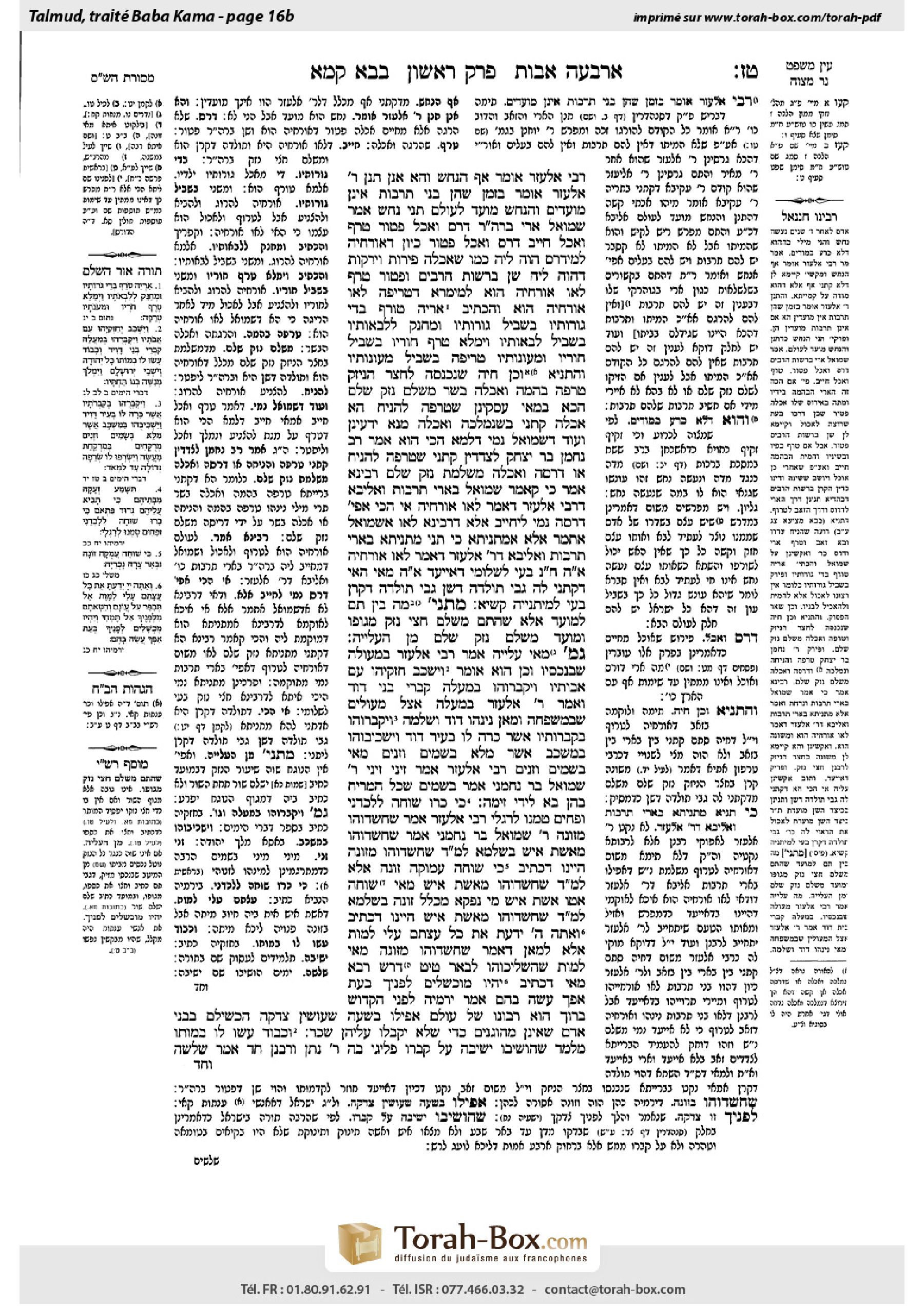
Bava Kamma 16b: Talmud study for Daf Yomi
Study the Talmud for Daf Yomi with scanned pages, Hebrew text, English translations from Sefaria and AI-generated French translations.
Passage selection and English or AI-generated French translation are available where the scan has annotations. Daf Study is independent of Torah-Box and Sefaria.
Browse Bava Kamma · בבא קמא · All tractatesBava Kamma 16b text and translations
This page of Bava Kamma includes the Aramaic text, an English translation and an AI-generated French translation, alongside the scan above.
בבא קמא י״ו ב · Aramaic and Hebrew text
רַבִּי אֶלְעָזָר אוֹמֵר: אַף הַנָּחָשׁ. וְהָא אֲנַן תְּנַן, רַבִּי אֶלְעָזָר אוֹמֵר: בִּזְמַן שֶׁהֵן בְּנֵי תַרְבּוּת – אֵינָן מוּעָדִים; וְהַנָּחָשׁ מוּעָד לְעוֹלָם!
תְּנִי: נָחָשׁ.
אָמַר שְׁמוּאֵל: אֲרִי בִּרְשׁוּת הָרַבִּים; דָּרַס וְאָכַל – פָּטוּר. טָרַף וְאָכַל – חַיָּיב.
דָּרַס וְאָכַל פָּטוּר – כֵּיוָן דְּאוֹרְחֵיהּ לְמִידְרַס, הָוֵה לֵיהּ כְּמוֹ שֶׁאָכְלָה פֵּירוֹת וִירָקוֹת, דְּהָוֵי לֵיהּ שֵׁן בִּרְשׁוּת הָרַבִּים, וּפָטוּר. טָרַף – לָאו אוֹרְחֵיהּ הוּא.
לְמֵימְרָא דִּטְרֵיפָה לָאו אוֹרְחֵיהּ הוּא? וְהָכְתִיב ״אַרְיֵה טֹרֵף בְּדֵי גֹרוֹתָיו״! בִּשְׁבִיל גּוֹרוֹתָיו. ״וּמְחַנֵּק לְלִבְאֹתָיו״! בִּשְׁבִיל לִבְאוֹתָיו. ״וַיְמַלֵּא טֶרֶף חֹרָיו״! בִּשְׁבִיל חוֹרָיו. ״וּמְעֹנֹתָיו טְרֵפָה״! בִּשְׁבִיל מְעוֹנוֹתָיו.
וְהָתַנְיָא: וְכֵן חַיָּה שֶׁנִּכְנְסָה לַחֲצַר הַנִּיזָּק, טָרְפָה בְּהֵמָה וְאָכְלָה בָּשָׂר – מְשַׁלֵּם נֶזֶק שָׁלֵם!
הָכָא בְּמַאי עָסְקִינַן – שֶׁטָּרְפָה לְהַנִּיחַ. הָא ״אָכְלָה״ קָתָנֵי! בְּשֶׁנִּמְלְכָה וְאָכְלָה.
מְנָא יָדְעִינַן? וְעוֹד, דִּשְׁמוּאֵל נָמֵי – דִּלְמָא הָכִי הוּא?
אָמַר רַב נַחְמָן בַּר יִצְחָק, לִצְדָדִין קָתָנֵי: שֶׁטָּרְפָה לְהַנִּיחַ, אוֹ דָרְסָה וְאָכְלָה – מְשַׁלֶּמֶת נֶזֶק שָׁלֵם.
רָבִינָא אָמַר: כִּי קָאָמַר שְׁמוּאֵל – בַּאֲרִי תַּרְבּוּת, וְאַלִּיבָּא דְּרַבִּי אֶלְעָזָר – דְּאָמַר: לָאו אוֹרְחֵיהּ.
אִי הָכִי, אֲפִילּוּ דָּרְסָה נָמֵי לִיחַיַּיב!
אֶלָּא דְּרָבִינָא לָאו אַשְּׁמוּאֵל אִתְּמַר, אֶלָּא אַמַּתְנִיתָא; כִּי תָּנֵי מַתְנִיתָא – בַּאֲרִי תַּרְבּוּת, וְאַלִּיבָּא דְּרַבִּי אֶלְעָזָר דְּאָמַר: לָאו אוֹרְחֵיהּ.
אִי הָכִי, חֲצִי נֶזֶק בָּעֵי לְשַׁלּוֹמֵי! דְּאִיַּיעַד.
אִי הָכִי, מַאי הַאי דְּקָתָנֵי לַהּ גַּבֵּי תּוֹלָדָה דְשֵׁן? גַּבֵּי תּוֹלָדָה דְקֶרֶן בָּעֵי לְמִיתְנְיַיהּ! קַשְׁיָא.
מַתְנִי׳ מָה בֵּין תָּם לְמוּעָד?
אֶלָּא שֶׁהַתָּם מְשַׁלֵּם חֲצִי נֶזֶק מִגּוּפוֹ, וּמוּעָד מְשַׁלֵּם נֶזֶק שָׁלֵם מִן הָעֲלִיָּיה.
גְּמָ׳ מַאי ״עֲלִיָּיה״? אָמַר רַבִּי אֶלְעָזָר: בִּמְעוּלֶּה שֶׁבִּנְכָסָיו.
וְכֵן הוּא אוֹמֵר: ״וַיִּשְׁכַּב חִזְקִיָּהוּ עִם אֲבֹתָיו, וַיִּקְבְּרֻהוּ בְּמַעֲלֵה קִבְרֵי בְנֵי דָוִיד״, וְאָמַר רַבִּי אֶלְעָזָר: ״בְּמַעֲלֵה״ – אֵצֶל מְעוּלִּים שֶׁבַּמִּשְׁפָּחָה, וּמַאן נִינְהוּ – דָּוִד וּשְׁלֹמֹה.
״וַיִּקְבְּרֻהוּ בְקִבְרֹתָיו אֲשֶׁר כָּרָה לוֹ בְּעִיר דָּוִיד, וַיַּשְׁכִּיבֻהוּ בַּמִּשְׁכָּב אֲשֶׁר מִלֵּא בְּשָׂמִים וּזְנִים״ – מַאי ״בְּשָׂמִים וּזְנִים״? רַבִּי אֶלְעָזָר אָמַר: זְינֵי זְינֵי. רַבִּי שְׁמוּאֵל בַּר נַחְמָנִי אָמַר: בְּשָׂמִים שֶׁכׇּל הַמֵּרִיחַ בָּהֶן בָּא לִידֵי זִימָּה.
״כִּי כָרוּ שׁוּחָה לְלׇכְדֵנִי, וּפַחִים טָמְנוּ לְרַגְלָי״ – רַבִּי אֶלְעָזָר אָמַר: שֶׁחֲשָׁדוּהוּ מִזּוֹנָה. רַבִּי שְׁמוּאֵל בַּר נַחְמָנִי אָמַר: שֶׁחֲשָׁדוּהוּ מֵאֵשֶׁת אִישׁ.
בִּשְׁלָמָא לְמַאן דְּאָמַר שֶׁחֲשָׁדוּהוּ מִזּוֹנָה – הַיְינוּ דִּכְתִיב: ״כִּי שׁוּחָה עֲמֻקָּה זוֹנָה״. אֶלָּא לְמַאן דְּאָמַר שֶׁחֲשָׁדוּהוּ מֵאֵשֶׁת אִישׁ, מַאי ״שׁוּחָה״? אַטּוּ אֵשֶׁת אִישׁ מִי נָפְקָא מִכְּלַל זוֹנָה?
בִּשְׁלָמָא לְמַאן דְּאָמַר שֶׁחֲשָׁדוּהוּ מֵאֵשֶׁת אִישׁ – הַיְינוּ דִּכְתִיב: ״וְאַתָּה ה׳ יָדַעְתָּ אֶת כׇּל עֲצָתָם עָלַי לַמָּוֶת״. אֶלָּא לְמַאן דְּאָמַר שֶׁחֲשָׁדוּהוּ מִזּוֹנָה, מַאי ״לַמָּוֶת״? שֶׁהִשְׁלִיכוּהוּ לִבְאֵר טִיט.
דָּרֵשׁ רָבָא, מַאי דִּכְתִיב: ״יִהְיוּ מֻכְשָׁלִים לְפָנֶיךָ, בְּעֵת אַפְּךָ עֲשֵׂה בָּהֶם״? אָמַר יִרְמְיָה לִפְנֵי הַקָּדוֹשׁ בָּרוּךְ הוּא: רִבּוֹנוֹ שֶׁל עוֹלָם, אֲפִילּוּ בְּשָׁעָה שֶׁעוֹשִׂין צְדָקָה – הַכְשִׁילֵם בִּבְנֵי אָדָם שֶׁאֵינָן מְהוּגָּנִים, כְּדֵי שֶׁלֹּא יְקַבְּלוּ עֲלֵיהֶן שָׂכָר.
״וְכָבוֹד עָשׂוּ לוֹ בְמוֹתוֹ״ – מְלַמֵּד שֶׁהוֹשִׁיבוּ יְשִׁיבָה עַל קִבְרוֹ.
פְּלִיגִי בַּהּ רַבִּי נָתָן וְרַבָּנַן, חַד אָמַר שְׁלֹשָׁה,
Bava Kamma 16b · English translation
Rabbi Elazar says: Also the snake. By using the term also, Rabbi Elazar suggests he considers a snake to be forewarned to the same extent as the other animals in the mishna’s list, which, according to his opinion, are not considered to be forewarned if they are domesticated. The Gemara asks: But didn’t we learn in the mishna: Rabbi Elazar says: When these animals are domesticated they are not considered to be forewarned, but the snake is always considered forewarned?
The Gemara answers: Emend and teach the baraita as saying that Rabbi Elazar says: A snake, instead of saying: Also a snake. Accordingly, the baraita is teaching that he holds that only a snake is considered to be forewarned under all circumstances because he holds that even if it is domesticated it is still prone to cause damage.
§ The Gemara considers cases of damage caused by a lion: Shmuel says: With regard to a lion that kills an animal in the public domain, if it clawed its prey and ate it, the lion’s owner is exempt from liability. But if it first tore apart its prey with its teeth in order to kill it, and only then ate it, the owner is liable for the damage.
The Gemara elucidates: If it clawed its prey and ate it, the owner is exempt, since it is its typical manner to claw its prey and eat it, and it is therefore equivalent to the case of an animal that eats fruit and vegetables belonging to someone else. Therefore, it is classified as Eating done in a public domain, and the owner of the lion is exempt. But if the lion first tore apart its prey to kill it, since this is not its typical manner, the act is classified as Goring, for which an owner is liable even in a public thoroughfare.
The Gemara asks: Is this to say that tearing apart its prey is not the typical manner of a lion? But isn’t it written: “The lion tears apart for its young, and it strangles for its lionesses, and it fills its caves with prey, and its den with that which was torn apart” (Nahum 2:13). The description in the verse clearly indicates that it is the typical manner of a lion to tear apart its prey. The Gemara answers that each phrase of this verse is referring not to a situation where the lion catches prey for its own immediate use, but to one where it provides food for its young, as it says: “The lion tears apart for its young”; to provide food for its lionesses: “And it strangles for its lionesses”; to provide food for the young cubs in its lair: “And it filled its lair with prey”; and to provide food for the young cubs in its den: “And its den with that which was torn apart.” Therefore, we cannot learn from this verse that it is the typical manner of a lion to tear apart prey for its own immediate use.
The Gemara asks: But isn’t it taught in a baraita concerning acts classified as Eating: And similarly, in the case of a wild animal, including a lion, that entered the courtyard of the injured party and tore apart the courtyard owner’s animal and ate its meat, the owner of the wild animal pays the full cost of the damage.
The Gemara answers: With what are we dealing here? This is a case where it tore apart the animal in order to leave it for later consumption. Since this is typical behavior for a lion, the lion is considered forewarned with regard to it. The Gemara asks: Doesn’t the baraita teach: And ate its meat? The Gemara answers: This is a case where the lion initially killed the animal to leave it for later consumption but then reconsidered and ate it.
The Gemara questions this understanding: How can we know what the animal’s initial intentions were? And furthermore, if one accepts this claim, then the ruling of Shmuel is also called into question, as perhaps the case he ruled on is a case like this, where the lion initially intended to leave the prey he killed for later consumption, and therefore the owner should be exempt. The Gemara therefore rejects this understanding.
Rav Naḥman bar Yitzḥak said: The baraita teaches two cases disjunctively and should be understood as teaching two halakhot: With regard to a lion that tore apart an animal in order to leave it for later consumption, or a lion that clawed its prey and ate it, since each acted in the typical manner of a lion, the owner pays the full cost of the damage.
Ravina said: It is the typical manner of a wild lion to kill its prey and then eat it, and therefore such damage is classified as Eating. Accordingly, if the damage was done in the public domain, the lion’s owner is exempt from any liability. When Shmuel says that an owner is liable if his lion does so, that was with regard to a domesticated lion and in accordance with the opinion of Rabbi Elazar, who says it is not the typical manner of a domesticated wild animal to attack. Accordingly, the act is classified as being of the category of Goring, for which one is liable even in a public thoroughfare.
The Gemara asks: If so, then even when the lion clawed its prey and ate it, the owner should be liable for any damage it causes in a public domain, since according to Rabbi Elazar such behavior is atypical for a domesticated lion. Why then does Shmuel rule that in such a case the owner is exempt?
The Gemara concedes that its presentation of Ravina’s opinion is untenable: Rather, Ravina’s explanation was not stated in reference to Shmuel’s ruling, but rather in reference to the baraita, cited above, that discusses a case where a lion causes damage in the courtyard of the injured party. Accordingly, Ravina’s statement should be understood as follows: When the baraita teaches that one is liable if one’s lion tore apart an animal and ate it, that was with regard to a domesticated lion and in accordance with the opinion of Rabbi Elazar, who says it is not the typical manner of a domesticated wild animal to attack.
The Gemara asks: If that is so, since the act is atypical behavior for a lion, it should be classified as Goring, and the owner should be required to pay for only half the cost of the damage. The Gemara answers: The baraita is referring to a case where the lion was forewarned.
The Gemara questions further: If that is so, what is the reason that the baraita teaches this among the subcategories of Eating? It should have taught it among the subcategories of Goring. The Gemara concedes: This is a difficulty with this explanation.
MISHNA: What is the difference between the liability incurred for damage caused by an ox that is considered innocuous and the liability incurred for damage caused by an ox that is forewarned?
The only differences are that for damage caused by an innocuous ox, the owner pays half the cost of the damage exclusively from proceeds of the sale of the body of the ox, and for a forewarned ox he pays the full cost of the damage from his higher property.
GEMARA: What does the mishna mean by saying he pays from his higher [aliyya] property? Rabbi Elazar says: It means that he pays with the superior-quality [bame’ulla] items of his property.
And similarly, the fact that the word aliyya is referring to superior-quality property is indicated by the verse that states: “And Hezekiah lay with his ancestors, and they buried him in the best [bema’ale] of the sepulchers of the descendants of David” (II Chronicles 32:33), and Rabbi Elazar says: The term bema’ale means beside the best of the family. And who are they? David and Solomon.
The Gemara offers an interpretation of another verse about the burial of a king of Judea, King Asa: “And they buried him in his own sepulchers, which he had hewn out for himself in the city of David, and laid him in the resting place, which was filled with perfumes and spices [zenim] prepared by the perfumers’ art” (II Chronicles 16:14). What is meant by “perfumes and spices”? Rabbi Elazar says: It means many different types [zinei] of perfumes. Rabbi Shmuel bar Naḥmani says: The word zenim sounds similar to the word zenut, licentiousness, and should therefore be understood about types of perfumes that anyone who smells them is led to licentiousness.
The Gemara cites another dispute between Rabbi Elazar and Rabbi Shmuel bar Naḥmani: Jeremiah requested of God to punish those who hounded him: “For they have dug a pit to trap me and they have set snares for my feet” (Jeremiah 18:22). In what way did they dig a pit to trap him? Rabbi Elazar says: They cast suspicion upon him of engaging in intercourse with a woman who had engaged in sexual intercourse with a man forbidden to her by the Torah [zona]. Rabbi Shmuel bar Naḥmani says: They cast suspicion upon him of engaging in intercourse with a married woman.
The Gemara asks: Granted, according to the one who says that they cast suspicion upon him of engaging in intercourse with a zona, this is because the word “pit” is used as a metaphor for a zona, as it is written: “For a zona is a deep pit” (Proverbs 23:27). But according to the one who says that they cast suspicion upon him of engaging in intercourse with a married woman, for what reason did Jeremiah use the word “pit”? The Gemara answers: Due to the fact that she is a married woman, should she be excluded from the category of a zona? If she commits adultery she is also termed a zona, and the term “pit” can justifiably be applied to her.
The Gemara asks: Granted, according to the one who says that they cast suspicion upon him of engaging in intercourse with a married woman, this is consistent with that which is written: “You, Lord, know all their plans to kill me” (Jeremiah 18:23). By claiming he engaged in intercourse with a married woman, they implicated him in a prohibition punishable by the death penalty. But according to the one who says that they suspected him of engaging in intercourse with a zona, what did he mean by saying “to kill me” when there is no court-imposed capital punishment for doing so? The Gemara answers: Jeremiah was referring to the fact that they cast him into a pit of mire.
Rava interpreted a verse homiletically: What is the meaning of that which is written: “Let them be made to stumble before You; deal with them in the time of Your anger” (Jeremiah 18:23)? It means that Jeremiah said before the Holy One, Blessed be He: Master of the Universe, even at a time when they try to perform acts of charity, make them stumble by ensuring that they do so with people who are unworthy of charity in order that they should not receive the reward for helping them.
The Gemara, above, cited a verse concerning King Hezekiah’s burial. The Gemara cites the continuation of that verse: “And they afforded him honor in his death” (II Chronicles 32:33). This teaches that they established a yeshiva at his grave to study Torah there.
Rabbi Natan and the Rabbis disagree with regard to this yeshiva: One said: They studied there for three days.
Bava Kamma 16b · Traduction française (IA)
Rabbi Elazar dit : également le serpent. En utilisant le terme « également », Rabbi Elazar suggère qu’il considère le serpent comme averti au même degré que les autres animaux de la liste de la mitsna, qui, selon son avis, ne sont pas considérés comme avertis s’ils sont domestiqués. La Guemara pose la question : Mais n’avons-nous pas appris dans la mitsna : Rabbi Elazar dit : Lorsque ces animaux sont domestiqués, ils ne sont pas considérés comme avertis, mais le serpent est toujours considéré comme averti ?
La Guemara répond : Corrigez et enseignez la baraïta en disant que Rabbi Elazar dit : Le serpent, au lieu de dire : également le serpent. Ainsi, la baraïta enseigne qu’il considère que seul le serpent est considéré comme averti dans tous les cas, car il considère que même s’il est domestiqué, il reste susceptible de causer des dommages.
§ La Guemara examine les cas de dommages causés par un lion : Shmuel dit : En ce qui concerne un lion qui tue un animal dans le domaine public, si il a déchiré sa proie avec ses dents et l’a mangé, le propriétaire du lion est exempt de responsabilité. Mais si il a d’abord griffé sa proie et l’a mangé, le propriétaire est responsable du dommage.
La Guemara explique : Si le lion a griffé sa proie et l’a mangé, le propriétaire est exempt, car c’est sa manière habituelle de griffer sa proie et de la manger, et cela équivaut au cas d’un animal qui mange des fruits et légumes appartenant à quelqu’un d’autre. Par conséquent, il est classé comme « manger dans le domaine public », et le propriétaire du lion est exempt. Mais si le lion a d’abord déchiré sa proie pour la tuer, puis l’a mangée, car cela n’est pas sa manière habituelle, l’acte est classé comme « cornage », pour lequel le propriétaire est responsable même dans une rue publique.
La Guemara pose la question : Est-ce que cela signifie que déchirer sa proie n’est pas la manière habituelle d’un lion ? Mais n’est-il pas écrit : « Le lion déchire pour ses petits, et il étrangle pour ses lionnes, et il remplit ses grottes de proie, et son terrier de ce qui a été déchiré » (Nahum 2:13). La description du verset indique clairement que c’est la manière habituelle d’un lion de déchirer sa proie. La Guemara répond que chaque phrase de ce verset ne fait référence pas à un cas où le lion attrape de la proie pour son propre usage immédiat, mais à un cas où il fournit de la nourriture à ses petits, comme il dit : « Le lion déchire pour ses petits » ; pour nourrir ses lionnes : « Et il étrangle pour ses lionnes » ; pour nourrir les petits dans son terrier : « Et il remplit son terrier de proie » ; et pour nourrir les petits dans son grotte : « Et son grotte avec ce qui a été déchiré ». Par conséquent, nous ne pouvons pas apprendre de ce verset que c’est la manière habituelle d’un lion de déchirer de la proie pour son propre usage immédiat.
La Guemara pose la question : Mais n’est-il pas enseigné dans une baraïta concernant les actes classés comme « manger » : Et de même, dans le cas d’un animal sauvage, y compris un lion, qui est entré dans la cour de la personne blessée et a déchiré l’animal de son propriétaire et mangé sa chair, le propriétaire de l’animal sauvage paie le coût complet du dommage.
La Guemara répond : Avec quels cas sommes-nous en train de parler ? C’est un cas où l’animal a été déchiré pour le laisser pour plus tard. Puisque c’est le comportement typique d’un lion, le lion est considéré comme averti concernant cela. La Guemara pose la question : N’est-ce pas que la baraïta enseigne : Et a mangé sa chair ? La Guemara répond : C’est un cas où le lion a d’abord tué l’animal pour le laisser pour plus tard, mais a ensuite changé d’avis et l’a mangé.
La Guemara questionne cette compréhension : Comment pouvons-nous savoir quel était l’intention initiale de l’animal ? Et de plus, si l’on accepte cette affirmation, alors la décision de Shmuel est également mise en doute, car peut-être le cas qu’il a jugé est un cas comme celui-ci, où le lion avait l’intention de laisser la proie qu’il avait tuée pour plus tard, et par conséquent le propriétaire devrait être exempt. La Guemara rejette donc cette compréhension.
Rav Naḥman bar Yitzḥak dit : La baraïta enseigne deux cas disjoints et devrait être comprise comme enseignant deux halakhot : En ce qui concerne un lion qui a déchiré un animal pour le laisser pour plus tard, ou un lion qui a griffé sa proie et l’a mangé, puisque chaque action est typique d’un lion, le propriétaire paie le coût complet du dommage.
Ravina dit : C’est la manière habituelle d’un lion sauvage de tuer sa proie et ensuite de la manger, et par conséquent, ce dommage est classé comme « manger ». Ainsi, si le dommage a été causé dans le domaine public, le propriétaire du lion est exempt de toute responsabilité. Lorsque Shmuel dit que le propriétaire est responsable si son lion agit ainsi, cela était en référence à un lion domestiqué et selon l’opinion de Rabbi Elazar, qui dit que ce n’est pas la manière habituelle d’un animal sauvage domestiqué d’attaquer. Ainsi, l’acte est classé dans la catégorie de « cornage », pour lequel on est responsable même dans une rue publique.
La Guemara pose la question : Si c’est ainsi, alors même lorsque le lion a griffé sa proie et l’a mangé, le propriétaire devrait être responsable de tout dommage qu’il cause dans le domaine public, car selon Rabbi Elazar, ce comportement est atypique pour un lion domestiqué. Pourquoi alors Shmuel décide-t-il que dans ce cas le propriétaire est exempt ?
La Guemara reconnaît que la présentation de l’opinion de Ravina est inacceptable : Plutôt, l’explication de Ravina n’a pas été formulée en référence à la décision de Shmuel, mais plutôt en référence à la baraïta, citée ci-dessus, qui discute d’un cas où un lion cause un dommage dans la cour de la personne blessée. Ainsi, l’affirmation de Ravina devrait être comprise comme suit : Lorsque la baraïta enseigne que l’on est responsable si l’on a déchiré un animal et l’a mangé, cela était en référence à un lion domestiqué et selon l’opinion de Rabbi Elazar, qui dit que ce n’est pas la manière habituelle d’un animal sauvage domestiqué d’attaquer.
La Guemara pose la question : Si c’est ainsi, puisque l’acte est un comportement atypique pour un lion, il devrait être classé comme un écrasement, et l’propriétaire devrait être tenu de payer uniquement la moitié du coût des dommages. La Guemara répond : La baraïta fait référence à un cas où le lion avait été averti.
La Guemara questionne davantage : Si c’est ainsi, quelle est la raison pour laquelle la baraïta enseigne cela parmi les sous-catégories de l’alimentation ? Il devrait avoir été enseigné parmi les sous-catégories d’écrasement. La Guemara reconnaît : C’est une difficulté avec cette explication.
MICHNA : Quelle est la différence entre la responsabilité encourue pour les dommages causés par un bœuf considéré comme inoffensif et la responsabilité encourue pour les dommages causés par un bœuf averti ?
Les seules différences sont que pour les dommages causés par un bœuf inoffensif, l'propriétaire paie la moitié du coût des dommages exclusivement à partir des recettes de la vente du corps du bœuf, et pour un bœuf averti, il paie le coût complet des dommages à partir de ses biens supérieurs.
GUEMARA : Quelle est la signification que la mishna donne en disant qu'il paie à partir de ses biens supérieurs [aliyya] ? Rabbi Eléazar dit : Cela signifie qu'il paie avec les objets de qualité supérieure de ses biens.
De même, le fait que le mot aliyya fasse référence aux biens de qualité supérieure est indiqué par la parole qui dit : « Et Hizqiaq mourut avec ses ancêtres, et on le mit dans la meilleure [bema’ale] des sépultures des descendants de David » (II Chroniques 32:33), et Rabbi Eléazar dit : Le terme bema’ale signifie à côté de la meilleure de la famille. Et qui sont-ils ? David et Salomon.
La Guemara propose une interprétation d’une autre parole concernant la sépulture d’un roi de Juda, le roi Asa : « Et on le mit dans sa propre sépulture, celle qu’il avait fait creuser pour lui dans la ville de David, et on le mit dans le lieu de repos, qui était rempli de parfums et d’encens [zenim] préparés par l’art des parfumeurs » (II Chroniques 16:14). Quelle est la signification des « parfums et encens » ? Rabbi Eléazar dit : Cela signifie divers types [zinei] de parfums. Rabbi Shmuel bar Naḥmani dit : Le mot zenim sonne comme le mot zenut, la luxure, et devrait donc être compris comme des parfums qui conduisent à la luxure lorsqu’on les sent.
La Guemara cite une autre dispute entre Rabbi Eléazar et Rabbi Shmuel bar Naḥmani : Jérémie demanda à Dieu de punir ceux qui le persécutaient : « Car ils ont creusé un puits pour m’attraper et ils ont mis des pièges pour mes pieds » (Jérémie 18:22). Dans quel sens ils ont-ils creusé un puits pour l’attraper ? Rabbi Eléazar dit : Ils ont suscité des soupçons contre lui d’avoir eu des relations avec une femme ayant eu des relations sexuelles avec un homme interdit par la Torah [zona]. Rabbi Shmuel bar Naḥmani dit : Ils ont suscité des soupçons contre lui d’avoir eu des relations avec une femme mariée.
La Guemara pose la question : Admis que celui qui dit qu’ils ont suscité des soupçons contre lui d’avoir eu des relations avec une zona, cela est dû au fait que le mot « puits » est utilisé comme métaphore pour une zona, comme il est écrit : « Une zona est un puits profond » (Proverbes 23:27). Mais selon celui qui dit qu’ils ont suscité des soupçons contre lui d’avoir eu des relations avec une femme mariée, pourquoi Jérémie a-t-il utilisé le mot « puits » ? La Guemara répond : En raison du fait qu’elle est une femme mariée, devrait-elle être exclue de la catégorie de zona ? Si elle commet l’adultère, elle est également appelée zona, et le terme « puits » peut justement s’appliquer à elle.
La Guemara pose la question : Admis que celui qui dit qu’ils ont suscité des soupçons contre lui d’avoir eu des relations avec une femme mariée, cela est cohérent avec ce qui est écrit : « Vous, Seigneur, savez tous leurs projets de me tuer » (Jérémie 18:23). En affirmant qu’il avait eu des relations avec une femme mariée, ils l’impliquaient dans une prohibition punissable par la peine de mort. Mais selon celui qui dit qu’ils soupçonnaient qu’il avait eu des relations avec une zona, à quoi faisait-il référence en disant « pour me tuer » lorsqu’il n’y a pas de peine de mort imposée par la justice ? La Guemara répond : Jérémie faisait référence au fait qu’ils l’avaient jeté dans un puits de boue.
Rava interpréta une parole de manière allégorique : Quelle est la signification de ce qui est écrit : « Faites-les trébucher devant toi ; traitez-les à l’époque de ta colère » (Jérémie 18:23) ? Cela signifie que Jérémie a dit devant le Saint, le Très Haut : Seigneur, Maître du Monde, même lorsqu’ils essaient de faire des actes de charité, faites-les trébucher en veillant à ce qu’ils le fassent avec des personnes indignes de charité afin qu’ils ne reçoivent pas la récompense de les aider.
La Guemara, ci-dessus, cita une parole concernant la sépulture du roi Hizqiaq. La Guemara cite la continuation de cette parole : « Et on lui fit honneur en sa mort » (II Chroniques 32:33). Cela enseigne qu’ils établirent une yeshiva à son tombeau pour étudier la Torah là.
Rabbi Natan et les Rabbis s’opposent à ce sujet concernant cette yeshiva : L’un dit : Ils y étudièrent trois jours.
Traduction française générée par IA à partir de l’édition anglaise de Sefaria. Vérifie toujours un passage avec le texte source.
Text from Sefaria: William Davidson Edition - Vocalized Aramaic (CC BY NC); William Davidson Edition - English (CC BY NC).