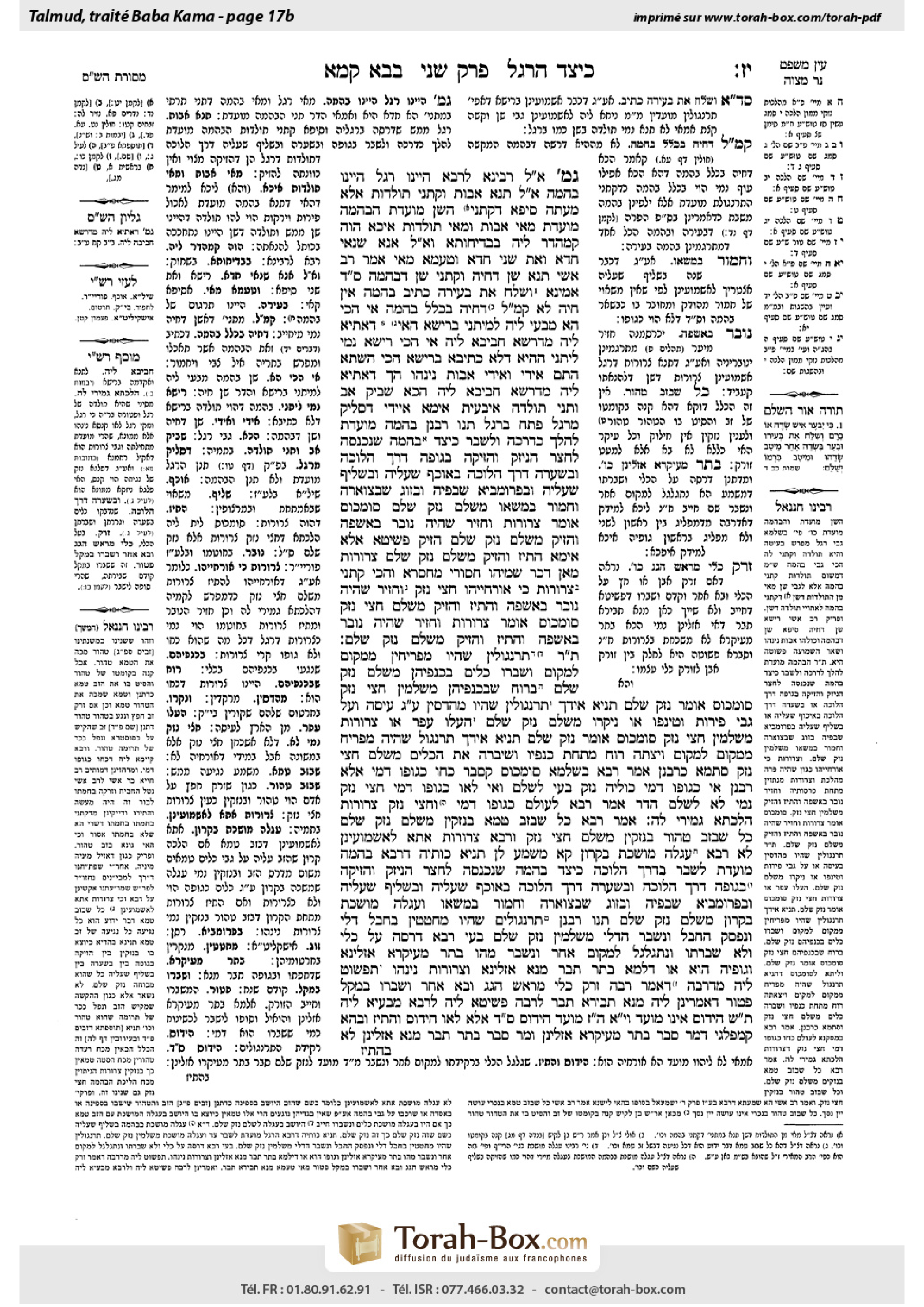
Bava Kamma 17b: Talmud study for Daf Yomi
Study the Talmud for Daf Yomi with scanned pages, Hebrew text, English translations from Sefaria and AI-generated French translations.
Passage selection and English or AI-generated French translation are available where the scan has annotations. Daf Study is independent of Torah-Box and Sefaria.
Browse Bava Kamma · בבא קמא · All tractatesBava Kamma 17b text and translations
This page of Bava Kamma includes the Aramaic text, an English translation and an AI-generated French translation, alongside the scan above.
בבא קמא י״ז ב · Aramaic and Hebrew text
גְּמָ׳ אֲמַר לֵיהּ רָבִינָא לְרָבָא: הַיְינוּ רֶגֶל הַיְינוּ בְּהֵמָה! אֲמַר לֵיהּ: תְּנָא אָבוֹת, וְקָתָנֵי תּוֹלָדוֹת.
אֶלָּא מֵעַתָּה, סֵיפָא דְּקָתָנֵי: ״הַשֵּׁן מוּעֶדֶת״ ״הַבְּהֵמָה מוּעֶדֶת״, מַאי אָבוֹת וּמַאי תּוֹלָדוֹת אִיכָּא? הֲוָה קָמַהְדַּר לֵיהּ בִּבְדִיחוּתָא, וַאֲמַר לֵיהּ: אֲנָא שַׁנַּאי חֲדָא, וְאַתְּ שַׁנִּי חֲדָא.
וְטַעְמָא מַאי? אָמַר רַב אָשֵׁי: תַּנָּא שֵׁן דְּחַיָּה, וְקָתָנֵי שֵׁן דִּבְהֵמָה. סָלְקָא דַּעְתָּךְ אָמֵינָא: ״וְשִׁלַּח אֶת בְּעִירֹה״ כְּתִיב, בְּהֵמָה – אִין, חַיָּה – לָא; קָא מַשְׁמַע לַן דְּחַיָּה בִּכְלַל בְּהֵמָה.
אִי הָכִי, הָא מִבְּעֵי לֵיהּ לְמִיתְנֵי בְּרֵישָׁא! הַאי דְּאָתְיָא לֵיהּ מִדְּרָשָׁא – חֲבִיבָא לֵיהּ.
אִי הָכִי, רֵישָׁא נָמֵי – לִיתְנֵי הָהִיא דְּלָא כְּתִיבָא בְּרֵישָׁא! הָכִי הַשְׁתָּא?! הָתָם – אִידֵּי וְאִידֵּי אָבוֹת נִינְהוּ, הָךְ דְּאָתְיָא לֵיהּ מִדְּרָשָׁא – חֲבִיבָא לֵיהּ. הָכָא – שָׁבֵיק אָב, וְתָנֵי תּוֹלָדָה?!
אִיבָּעֵית אֵימָא: אַיְּידֵי דְּסָלֵיק מֵרֶגֶל, פָּתַח בָּרֶגֶל.
תָּנוּ רַבָּנַן: בְּהֵמָה מוּעֶדֶת לְהַלֵּךְ כְּדַרְכָּהּ וּלְשַׁבֵּר. כֵּיצַד? בְּהֵמָה שֶׁנִּכְנְסָה לַחֲצַר הַנִּיזָּק – וְהִזִּיקָה בְּגוּפָהּ דֶּרֶךְ הִלּוּכָהּ, וּבִשְׂעָרָהּ דֶּרֶךְ הִלּוּכָהּ; בָּאוּכָּף שֶׁעָלֶיהָ, וּבִשְׁלִיף שֶׁעָלֶיהָ, וּבִפְרוּמְבְּיָא שֶׁבְּפִיהָ, וּבְזוֹג שֶׁבְּצַוָּארָהּ; וַחֲמוֹר בְּמַשָּׂאוֹ – מְשַׁלֵּם נֶזֶק שָׁלֵם. סוֹמְכוֹס אוֹמֵר: צְרוֹרוֹת, וַחֲזִיר שֶׁהָיָה נוֹבֵר בָּאַשְׁפָּה וְהִזִּיק – מְשַׁלֵּם נֶזֶק שָׁלֵם.
הִזִּיק – פְּשִׁיטָא! אֶלָּא אֵימָא: הִתִּיז וְהִזִּיק – מְשַׁלֵּם נֶזֶק שָׁלֵם.
צְרוֹרוֹת מַאן דְּכַר שְׁמַיְהוּ? חַסּוֹרֵי מְחַסְּרָא, וְהָכִי קָתָנֵי: צְרוֹרוֹת כִּי אוֹרְחַיְיהוּ – חֲצִי נֶזֶק. וַחֲזִיר שֶׁהָיָה נוֹבֵר בָּאַשְׁפָּה, וְהִתִּיז וְהִזִּיק – מְשַׁלֵּם חֲצִי נֶזֶק. סוֹמְכוֹס אוֹמֵר: צְרוֹרוֹת, וַחֲזִיר שֶׁהָיָה נוֹבֵר בָּאַשְׁפָּה וְהִתִּיז וְהִזִּיק – מְשַׁלֵּם נֶזֶק שָׁלֵם.
תָּנוּ רַבָּנַן: תַּרְנְגוֹלִין שֶׁהָיוּ מַפְרִיחִין מִמָּקוֹם לְמָקוֹם, וְשָׁבְרוּ כֵּלִים בְּכַנְפֵיהֶן – מְשַׁלֵּם נֶזֶק שָׁלֵם. בְּרוּחַ שֶׁבְּכַנְפֵיהֶן – מְשַׁלְּמִין חֲצִי נֶזֶק. סוֹמְכוֹס אוֹמֵר: נֶזֶק שָׁלֵם. תַּנְיָא אִידַּךְ: תַּרְנְגוֹלִין שֶׁהָיוּ מְהַדְּסִין עַל גַּבֵּי עִיסָּה וְעַל גַּבֵּי פֵּירוֹת, וְטִינְּפוּ אוֹ נִיקְּרוּ – מְשַׁלֵּם נֶזֶק שָׁלֵם. הֶעֱלוּ עָפָר אוֹ צְרוֹרוֹת – מְשַׁלְּמִין חֲצִי נֶזֶק. סוֹמְכוֹס אוֹמֵר: נֶזֶק שָׁלֵם.
תַּנְיָא אִידַּךְ: תַּרְנְגוֹל שֶׁהָיָה מַפְרִיחַ מִמָּקוֹם לְמָקוֹם, וְיָצְתָה רוּחַ מִתַּחַת כְּנָפָיו וְשִׁיבְּרָה אֶת הַכֵּלִים – מְשַׁלֵּם חֲצִי נֶזֶק. סְתָמָא כְּרַבָּנַן.
אָמַר רָבָא: בִּשְׁלָמָא סוֹמְכוֹס – קָסָבַר: כֹּחוֹ כְּגוּפוֹ דָּמֵי. אֶלָּא רַבָּנַן, אִי כְּגוּפוֹ דָּמֵי – כּוּלֵּיהּ נֶזֶק בָּעֵי לְשַׁלֵּם; וְאִי לָאו כְּגוּפוֹ דָּמֵי, חֲצִי נֶזֶק נָמֵי לָא לְשַׁלֵּם!
הֲדַר אָמַר רָבָא: לְעוֹלָם כְּגוּפוֹ דָּמֵי, וַחֲצִי נֶזֶק צְרוֹרוֹת – הִלְכְתָא גְּמִירִי לַהּ.
אָמַר רָבָא: כֹּל שֶׁבַּזָּב טָמֵא – בְּנִזָּקִין מְשַׁלֵּם נֶזֶק שָׁלֵם. כֹּל שֶׁבַּזָּב טָהוֹר – בְּנִזָּקִין מְשַׁלֵּם חֲצִי נֶזֶק.
וְרָבָא, צְרוֹרוֹת אֲתָא לְאַשְׁמוֹעִינַן?! לֹא; רָבָא – עֶגְלָה מוֹשֶׁכֶת בַּקָּרוֹן קָא מַשְׁמַע לַן.
תַּנְיָא כְּוָתֵיהּ דְּרָבָא: בְּהֵמָה מוּעֶדֶת לְשַׁבֵּר בְּדֶרֶךְ הִלּוּכָהּ. כֵּיצַד? בְּהֵמָה שֶׁנִּכְנְסָה לַחֲצַר הַנִּיזָּק – וְהִזִּיקָה בְּגוּפָהּ דֶּרֶךְ הִלּוּכָהּ, וּבִשְׂעָרָהּ דֶּרֶךְ הִלּוּכָהּ; בָּאוּכָּף שֶׁעָלֶיהָ, וּבִשְׁלִיף שֶׁעָלֶיהָ, וּבִפְרוּמְבְּיָא שֶׁבְּפִיהָ, וּבְזוֹג שֶׁבְּצַוָּארָהּ; וַחֲמוֹר בְּמַשָּׂאוֹ, וְעֶגְלָה מוֹשֶׁכֶת בְּקָרוֹן – מְשַׁלֵּם נֶזֶק שָׁלֵם.
תָּנוּ רַבָּנַן: תַּרְנְגוֹלִים שֶׁהָיוּ מְחַטְּטִין בְּחֶבֶל דְּלִי, וְנִפְסַק הַחֶבֶל וְנִשְׁבַּר הַדְּלִי – מְשַׁלְּמִין נֶזֶק שָׁלֵם.
בָּעֵי רָבָא: דָּרְסָה עַל כְּלִי וְלֹא שְׁבָרַתּוּ, וְנִתְגַּלְגֵּל לְמָקוֹם אַחֵר וְנִשְׁבַּר, מַהוּ? בָּתַר מֵעִיקָּרָא אָזְלִינַן – וְגוּפֵיהּ הוּא, אוֹ דִלְמָא בָּתַר תְּבַר מָנָא אָזְלִינָא – וּצְרוֹרוֹת נִינְהוּ?
תִּפְשׁוֹט לֵיהּ מִדְּרַבָּה – דְּאָמַר רַבָּה: זָרַק כְּלִי מֵרֹאשׁ הַגָּג, וּבָא אַחֵר וּשְׁבָרוֹ בְּמַקֵּל – פָּטוּר; דְּאָמְרִינַן לֵיהּ: מָנָא תְּבִירָא תְּבַר! לְרַבָּה – פְּשִׁיטָא לֵיהּ, לְרָבָא – מִבַּעְיָא לֵיהּ.
תָּא שְׁמַע: הִידּוּס – אֵינוֹ מוּעָד. וְיֵשׁ אוֹמְרִים: הֲרֵי זֶה מוּעָד.
הִידּוּס סָלְקָא דַּעְתָּךְ?! אֶלָּא לָאו הִידּוּס וְהִתִּיז, וּבְהָא קָמִפַּלְגִי – דְּמָר סָבַר: בָּתַר מֵעִיקָּרָא אָזְלִינַן, וּמָר סָבַר: בָּתַר תְּבַר מְנָא אָזְלִינַן?
לָא;
Bava Kamma 17b · English translation
GEMARA: The Gemara analyzes the mishna: Ravina said to Rava: In the context of the category of Trampling, damage caused by an animal trampling an object with its foot is the same as damage caused by an animal breaking an object with its body. Why does the mishna repeat the same halakha twice? Rava said to him: First, the tanna teaches the primary categories of damage, namely the category of Trampling with an animal’s foot, which is mentioned explicitly in the Torah, and then he teaches the subcategories of those primary categories, i.e., the animal is deemed forewarned with regard to causing damage with other parts of its body in the course of its walking.
Ravina challenges this explanation: If that is so, the latter clause of the mishna (19b), which teaches, concerning the primary category of Eating: For what damage caused by Eating is the animal deemed forewarned? It is deemed forewarned with regard to eating food items fit for its consumption, i.e., the animal is deemed forewarned with regard to eating fruits and vegetables. Ravina asks: What primary categories and what subcategories are there in that context? No subcategories of Eating are enumerated there, and nevertheless, the phrase: The animal is deemed forewarned, is repeated. Rava responded to Ravina with a humorous response and said to him: I resolved the difficulty in one mishna, now you resolve the difficulty in one mishna.
And what is the reason for the apparent redundancy in the mishna with regard to Eating? Rav Ashi said: First the tanna teaches the halakha of Eating by an undomesticated animal and then he teaches the halakha of Eating by a domesticated animal. And it was necessary to state both, as it enters your mind to say that since it is written: “And he set his animal loose” (Exodus 22:4), with regard to domesticated animals, yes, the primary category of Eating applies, but with regard to undomesticated animals, no, the primary category of Eating does not apply. Therefore, the tanna teaches us that undomesticated animals are included in the category of domesticated animals in this regard and the owner of an undomesticated animal is liable for damage caused by his animal eating another person’s produce.
The Gemara asks: If so, the tanna should have taught the halakha with regard to a domesticated animal first and only afterward taught the halakha with regard to an undomesticated animal, as the latter is included in the category of the former. The Gemara answers: On the contrary, that halakha, which is derived from an interpretation, is dear to him, and therefore the tanna preferred to begin with the derived halakha and only then proceed to the explicit halakha.
The Gemara asks: If so, then with regard to the first clause, in this mishna too, let the tanna teach that which is not explicitly written first, as that which is derived from an interpretation is dear to him. The Gemara distinguishes between the cases: How can they be compared? There, with regard to Eating, this damage caused by a domesticated animal and that damage caused by an undomesticated animal are primary categories of damage; therefore, the tanna taught first that halakha, which is derived from an interpretation, is dear to him. But here, with regard to Trampling, would he leave aside the primary category of Trampling, done with the animal’s foot, and teach a subcategory first?
If you wish, say instead that the reason that in this mishna the tanna begins with that which is written explicitly in the Torah and only then proceeds to teach that which is derived through an interpretation is as follows: Since the tanna concluded the discussion in the final mishna in the previous chapter (15b) with the primary category of Trampling by teaching the clause: The foot of an animal is deemed forewarned with regard to trampling objects and breaking them in the course of its walking, therefore, he began the first mishna in the second chapter with the primary category of Trampling.
§ The Sages taught: An animal is deemed forewarned with regard to walking in its typical manner and, while doing so, breaking objects in the course of its walking. How so? If an animal entered into the courtyard of the injured party and it damaged an object with its body in the course of its walking; or if it caused damage with its hair in the course of its walking; or with the saddle that is on it; or with the packed saddlebag [shalif ] that is on it; or with the halter in its mouth; or with the bell [zog] around its neck; or if it was a donkey that caused damage with its burden; in all these cases the owner pays the full cost of the damage. Sumakhos says: In the case of pebbles propelled by an animal in the course of its walking, or in the case of a pig that was burrowing in the garbage heap and caused damage, the owner of the animal pays the full cost of the damage.
The Gemara asks: If a pig caused damage, it is obvious that its owner must pay the full cost of the damage. What novel element is Sumakhos introducing? The Gemara answers: Rather, say: If it propelled pebbles and thereby caused damage, the owner pays the full cost of the damage.
The Gemara asks: Pebbles, who mentioned anything about it? The Gemara answers: The baraita is incomplete and this is what it is teaching: For damage caused by pebbles that were propelled by animals walking in their typical manner, the owner pays half the cost of the damage, and for damage caused by a pig that was burrowing in the garbage heap and propelled pebbles and that damaged an object, its owner pays half the cost of the damage. Sumakhos says: Both in the case of pebbles that were propelled and in the case of a pig that was burrowing in the garbage heap and propelled pebbles and damaged an object, the owner pays the full cost of the damage. Sumakhos does not accept the halakha that the owner pays only half the cost of the damage caused by pebbles inadvertently propelled by the foot of an animal in the course of its walking, i.e., in its typical manner. He holds that since the damage results from the animal’s typical behavior, the owner pays the full cost of the damage.
The Sages taught (Tosefta 2:1): If chickens were flying from place to place and broke vessels with their wings, their owner pays the full cost of the damage as this is a subcategory of Trampling. By contrast, if the damage was caused by the wind generated by their wings, the owner pays half the cost of the damage, in accordance with the halakha in the case of pebbles. Sumakhos says: The owner pays the full cost of the damage. It is taught in another baraita: If chickens were hopping upon dough or upon produce and they sullied it with their feet, or if they pecked at it and caused damage, their owner pays the full cost of the damage. If in the course of their hopping they stirred up dust or propelled pebbles, the owner pays half the cost of the damage. Sumakhos says: He pays the full cost of the damage.
It is taught in another baraita: If a chicken was flying from place to place and wind emerged from beneath its wings and the wind caused vessels to break, the owner pays half the cost of the damage. The Gemara notes: This unattributed baraita is in accordance with the opinion of the Rabbis, who disagree with Sumakhos and hold that the owner pays half the cost of the damage in these cases, just as he does in the case of pebbles propelled by the feet of an animal.
Rava analyzed the baraita and said: Granted, the opinion of Sumakhos is understood, as he holds that the status of damage resulting from a force generated by the animal’s action is like that of damage directly caused by the animal itself, and therefore the owner pays the full cost of the damage in both cases. But the opinion of the Rabbis is difficult, as if they hold that the status of damage resulting from a force generated by the animal’s action is like that of damage directly caused by the animal itself, the owner should be required to pay the full cost of the damage. And if they hold that the status of damage resulting from a force generated by the animal’s action is not like that of damage directly caused by the animal itself, and is not attributed to the animal, then the owner should not be required to pay even half the cost of the damage.
Then Rava said: Actually, the Rabbis hold that the status of damage resulting from a force generated by the animal’s action is like that of damage directly caused by the animal itself, and in principle the owner should be required to pay the full cost of the damage. And the liability to pay for half the cost of the damage caused by pebbles is because the Rabbis learned this halakha through tradition, and it does not correspond to the standard halakhot of damages.
§ Rava says: With regard to any type of action which, when a zav interacts with a vessel in that manner, he renders it ritually impure, if the same type of action was done by an animal, resulting in damage, the owner of the animal is liable to pay the full cost of the damage. Conversely, with regard to any type of action which, when a zav interacts with a vessel in that manner, he leaves it ritually pure, e.g., where the contact is indirect, if the same type of action was done by an animal, resulting in damage, the owner of the animal is liable to pay only half the cost of the damage.
The Gemara asks: And Rava, did he come to teach us the halakha of pebbles? The substance of Rava’s statement is that for damage caused by the indirect action of an animal, its owner pays half the cost of the damage. That is identical to the halakha of pebbles articulated in the baraitot cited earlier. The Gemara answers: No, Rava teaches us the halakha in the case of a calf pulling a cart [karon]. Just as with regard to a zav, the status of a vessel that a zav moves is like that of a vessel with which he came into contact, so too, the status of damage caused by the cart pulled by the animal is like that of damage caused by the animal’s body, and it is not considered indirect damage like in the case of pebbles.
It is taught in a baraita in accordance with the opinion of Rava: An animal is deemed forewarned with regard to breaking objects in the course of its walking. How so? If an animal entered into the courtyard of the injured party, and it damaged an object with its body in the course of its walking; or with its hair in the course of its walking; or with the saddle that is on it; or with the packed saddlebag that is on it; or with the halter that is in its mouth; or with the bell that is around its neck; or if a donkey caused damage with its burden; or if a calf caused damage while pulling a cart; in all these cases the owner pays the full cost of the damage.
§ The Sages taught: In a case where chickens were pecking at the rope tied to a bucket and the rope was severed and the bucket fell and broke, their owner pays the full cost of the damage.
Rava raises a dilemma: If an animal trod upon a vessel but did not break it and the vessel then rolled to another place and broke there, what is the halakha? Rava elaborates: In determining one’s liability for causing damage, do we follow the initial action that ultimately led to the damage and this case is regarded as damage caused by the animal itself? Accordingly, the owner would pay the full cost of the damage as he would in any case classified under the primary category of Trampling. Or perhaps do we follow the breaking of the vessel and therefore this case is regarded as similar to the case of pebbles propelled by the foot of an animal in the course of its walking, since the vessel was not broken by a direct action of the animal, but rather, as an indirect result of the animal’s action?
The Gemara suggests: Resolve Rava’s dilemma from the statement of Rabba, as Rabba says: If one threw a vessel from a roof and another came and broke it with a stick as it was falling, the one who hit it with the stick is exempt from all liability as we say to him that he broke a broken vessel. From the moment the vessel was tossed from the roof it was inevitable that it would break. Consequently, breaking it with a stick as it was falling had no real effect. Apparently, the initial action is the decisive factor in determining liability for damages. The same should be the halakha in a case where a vessel was trod upon by an animal but it did not break, and the vessel then rolled to another place and broke there. The liability should be determined based on the initial action that caused the damage. The Gemara rejects this proof: The halakha in this case is clear to Rabba, who ruled as he did, but it remains a dilemma to Rava. One cannot prove the opinion of one amora from the opinion of another.
The Gemara suggests: Come and hear the resolution of this dilemma from a baraita: With regard to hopping, a chicken is not deemed forewarned. And some say that it is forewarned.
The Gemara questions the formulation of the baraita: Does it enter your mind to raise the possibility that a chicken is not forewarned with regard to hopping? Hopping is the typical manner of movement for chickens. Rather, is it not that the reference in the baraita is to a case where the chicken was hopping and the hopping propelled the vessel to roll to another place, and the vessel was broken there? And they disagree with regard to this: One Sage holds that we follow the initial action that ultimately led to the damage, and since hopping is typical manner of movement for a chicken, its owner is responsible for any damage that resulted from its hopping. And one Sage holds: We follow the breaking of the vessel, and since there was an additional factor that broke the vessel, the owner of the chicken is not liable.
The Gemara rejects the parallel between the dispute and the dilemma: No, the dispute in the baraita can be explained differently.
Bava Kamma 17b · Traduction française (IA)
GUEMARA : La Guemara analyse la michna : Ravina dit à Rava : Dans le contexte de la catégorie du piétinement, les dommages causés par un animal qui piétine un objet avec son pied sont identiques à ceux causés par un animal qui casse un objet avec son corps. Pourquoi la michna répète-t-elle la même halakha deux fois ? Rava répond à lui : D'abord, le tanna enseigne les catégories principales de dommages, à savoir la catégorie du piétinement avec le pied de l'animal, qui est mentionnée explicitement dans la Torah, puis il enseigne les sous-catégories de ces catégories principales, à savoir l'animal est considéré comme averti en ce qui concerne la cause de dommages avec d'autres parties de son corps lors de sa marche.
Ravina conteste cette explication : Si c'est ainsi, la clause finale de la michna (19b), qui enseigne, concernant la catégorie principale de la consommation : Pour quels dommages causés par la consommation l'animal est-il considéré comme averti ? Il est considéré comme averti en ce qui concerne la consommation d'aliments adaptés à sa consommation, c'est-à-dire l'animal est considéré comme averti en ce qui concerne la consommation de fruits et légumes. Ravina demande : Quelles sont les catégories principales et quels sont les sous-catégories dans ce contexte ? Il n'y a pas d'énumération de sous-catégories de la consommation là-bas, et pourtant, la phrase : L'animal est considéré comme averti, est répétée. Rava répondit à Ravina avec une réponse humoristique et dit à lui : J'ai résolu la difficulté dans une michna, maintenant vous résolvez la difficulté dans une michna.
Et quelle est la raison de la répétition apparente dans la michna concernant la consommation ? Rav Ashi dit : D'abord, le tanna enseigne la halakha de la consommation par un animal sauvage, puis il enseigne la halakha de la consommation par un animal domestiqué. Il était nécessaire d'énoncer les deux, car il peut entrer en vous l'idée que puisque cela est écrit : « Et il relâcha son animal » (Exode 22:4), concernant les animaux domestiqués, oui, la catégorie principale de la consommation s'applique, mais concernant les animaux sauvages, non, la catégorie principale de la consommation ne s'applique pas. Par conséquent, le tanna nous enseigne que les animaux sauvages sont inclus dans la catégorie des animaux domestiqués en ce qui concerne cela et que le propriétaire d'un animal sauvage est responsable des dommages causés par son animal dans la consommation des produits d'autrui.
La Guemara demande : Si c'est ainsi, le tanna aurait dû enseigner la halakha concernant l'animal domestiqué d'abord et seulement ensuite celle concernant l'animal sauvage, car le second est inclus dans la catégorie du premier. La Guemara répond : Au contraire, cette halakha, qui est dérivée d'une interprétation, est chère à lui, et par conséquent, le tanna a préféré commencer avec la halakha dérivée et seulement ensuite aborder la halakha explicite.
La Guemara demande : Si c'est ainsi, alors concernant la première clause, dans cette michna également, le tanna aurait dû enseigner d'abord ce qui n'est pas explicitement écrit, car ce qui est dérivé d'une interprétation est chère à lui. La Guemara distingue entre les cas : Comment peuvent-ils être comparés ? Là-bas, concernant la consommation, ce dommage causé par un animal domestiqué et ce dommage causé par un animal sauvage sont des catégories principales de dommages ; par conséquent, le tanna a enseigné d'abord cette halakha, qui est dérivée d'une interprétation, est chère à lui. Mais ici, concernant le piétinement, aurait-il laissé de côté la catégorie principale du piétinement, faite avec le pied de l'animal, et enseigné d'abord une sous-catégorie ?
Si vous le souhaitez, dites plutôt que la raison pour laquelle, dans cette michna, le tanna commence par ce qui est écrit explicitement dans la Torah et ne procède ensuite qu'après à enseigner ce qui est dérivé d'une interprétation est la suivante : Puisque le tanna a conclu la discussion dans la dernière michna du chapitre précédent (15b) avec la catégorie principale du piétinement en enseignant la clause : Le pied d'un animal est considéré comme averti en ce qui concerne le piétinement d'objets et leur cassure lors de sa marche, par conséquent, il a commencé la première michna du deuxième chapitre avec la catégorie principale du piétinement.
§ Les Sages enseignent : L'animal est considéré comme averti en ce qui concerne sa marche typique et, en marchant ainsi, il endommage des objets. Comment cela se passe-t-il ? Si un animal entre dans la cour de la personne blessée et qu'il endommage un objet avec son corps lors de sa marche ; ou s'il cause des dommages avec ses poils lors de sa marche ; ou avec la selle qui est sur lui ; ou avec le sac de charge [shalif] qui est sur lui ; ou avec la bride dans sa bouche ; ou avec la cloche [zog] autour de son cou ; ou s'il s'agit d'un âne qui cause des dommages avec son fardeau ; dans tous ces cas, le propriétaire paie le coût complet des dommages. Sumakhos dit : Dans le cas de pierres propulsées par un animal lors de sa marche, ou dans le cas d'un porc qui creusait dans la décharge et a causé des dommages, le propriétaire de l'animal paie le coût complet des dommages.
La Guemara demande : Si un porc a causé des dommages, il est évident que son propriétaire doit payer le coût complet des dommages. Quel élément nouveau Sumakhos introduit-il ? La Guemara répond : Plutôt, disons : Si des pierres ont été propulsées et ont causé des dommages, le propriétaire paie le coût complet des dommages.
La Guemara demande : Les pierres, qui a mentionné quoi que ce soit à ce sujet ? La Guemara répond : La baraïta est incomplète et voici ce qu'elle enseigne : Pour les dommages causés par des pierres propulsées par des animaux marchant dans leur manière habituelle, le propriétaire paie la moitié du coût des dommages, et pour les dommages causés par un porc qui creusait dans la décharge et a propulsé des pierres et a endommagé un objet, son propriétaire paie la moitié du coût des dommages. Sumakhos dit : Dans les deux cas, celui des pierres propulsées et celui du porc qui creusait dans la décharge et a propulsé des pierres et a endommagé un objet, le propriétaire paie le coût complet des dommages. Sumakhos ne reconnaît pas la halakha selon laquelle le propriétaire paie seulement la moitié du coût des dommages causés par des pierres accidentellement propulsées par le pied d'un animal lors de sa marche habituelle, c'est-à-dire en marchant normalement. Il considère que puisque le dommage résulte du comportement habituel de l'animal, le propriétaire paie le coût complet des dommages.
Les Sages enseignent (Tosefta 2:1) : Si des poulets volaient d'un endroit à un autre et brisaient des objets avec leurs ailes, leur propriétaire paie le coût complet des dommages, car cela constitue une sous-catégorie de l'écrasement. À l'inverse, si les dommages ont été causés par le vent généré par leurs ailes, le propriétaire paie la moitié du coût des dommages, conformément à la halakha dans le cas des cailloux. Sumakhos dit : Le propriétaire paie le coût complet des dommages. Il est enseigné dans une autre baraïta : Si des poulets sautaient sur de la pâte ou sur des produits et souillaient ces derniers avec leurs pieds, ou si ils picoraient et causaient des dommages, leur propriétaire paie le coût complet des dommages. Si, en cours de leurs sauts, ils soulevaient de la poussière ou projetaient des cailloux, le propriétaire paie la moitié du coût des dommages. Sumakhos dit : Le propriétaire paie le coût complet des dommages.
Il est enseigné dans une autre baraïta : Si un poulet volait d'un endroit à un autre et que du vent sortait sous ses ailes et que ce vent causait la rupture d'objets, le propriétaire paie la moitié du coût des dommages. La Guemara note : Cette baraïta non attribuée correspond à l'opinion des Rabbins, qui s'opposent à Sumakhos et considèrent que le propriétaire paie la moitié du coût des dommages dans ces cas, tout comme il le fait dans le cas des cailloux projetés par les pieds d'un animal.
Rava a analysé la baraïta et a dit : Cela est compris, l'opinion de Sumakhos, car il considère que le statut des dommages causés par une force générée par l'action de l'animal est comparable à celui des dommages causés directement par l'animal lui-même, et par conséquent, le propriétaire paie le coût complet des dommages dans les deux cas. Mais l'opinion des Rabbins est difficile, car si ils considèrent que le statut des dommages causés par une force générée par l'action de l'animal est comparable à celui des dommages causés directement par l'animal lui-même, le propriétaire devrait être tenu de payer le coût complet des dommages. Et si ils considèrent que le statut des dommages causés par une force générée par l'action de l'animal n'est pas comparable à celui des dommages causés directement par l'animal lui-même et n'est pas imputé à l'animal, alors le propriétaire ne devrait pas être tenu de payer même la moitié du coût des dommages.
Rava a ensuite dit : En réalité, les Rabbins considèrent que le statut des dommages causés par une force générée par l'action de l'animal est comparable à celui des dommages causés directement par l'animal lui-même, et en principe, le propriétaire devrait être tenu de payer le coût complet des dommages. Et la responsabilité de payer la moitié du coût des dommages causés par des cailloux est due au fait que les Rabbins ont appris cette halakha par tradition, et cela ne correspond pas aux halakhot standard des dommages.
Rava dit : Concernant toute action qui, lorsqu'un zav entre en contact avec un objet de cette manière, le rend impur rituellement, si la même action est faite par un animal, entraînant des dommages, le propriétaire de l'animal est tenu de payer le coût complet des dommages. À l'inverse, concernant toute action qui, lorsqu'un zav entre en contact avec un objet de cette manière, le laisse pur rituellement, par exemple, lorsqu'il s'agit d'un contact indirect, si la même action est faite par un animal, entraînant des dommages, le propriétaire de l'animal est tenu de payer seulement la moitié du coût des dommages.
La Guemara pose la question : Et Rava, voulait-il nous enseigner la halakha des cailloux ? La substance de son discours est que pour les dommages causés par l'action indirecte d'un animal, son propriétaire paie la moitié du coût des dommages. Cela correspond exactement à la halakha des cailloux évoquée dans les baraitot cités plus tôt. La Guemara répond : Non, Rava enseigne la halakha dans le cas d'un veau tirant une charrette [karon]. Tout comme, concernant un zav, le statut d'un objet que le zav déplace est comparable à celui d'un objet avec lequel il a eu contact, de même, le statut des dommages causés par la charrette tirée par l'animal est comparable à celui des dommages causés par le corps de l'animal, et il n'est pas considéré comme un dommage indirect comme dans le cas des cailloux.
Il est enseigné dans une baraïta conformément à l'opinion de Rava : Un animal est considéré comme averti concernant la rupture d'objets lors de sa marche. Comment cela se produit-il ? Si un animal entre dans la cour de la personne blessée et endommage un objet avec son corps lors de sa marche ; ou avec ses poils lors de sa marche ; ou avec la selle qui est sur lui ; ou avec le sac de selle qui est sur lui ; ou avec la bride qui est dans sa bouche ; ou avec la cloche qui est autour de son cou ; ou si un âne cause des dommages avec son fardeau ; ou si un veau cause des dommages en tirant une charrette ; dans tous ces cas, le propriétaire paie le coût complet des dommages.
Les Sages enseignent : Dans le cas où des poulets picoraient la corde attachée à un seau et que la corde fut coupée, le seau tomba et se brisa, leur propriétaire paie le coût complet des dommages.
Rava soulève un dilemme : Si un animal marche sur un objet mais ne le brise pas et que l'objet roule ensuite vers un autre endroit et se brise là, quelle est la halakha ? Rava précise : En déterminant la responsabilité d'un dommage causé, suivons-nous l'action initiale qui a finalement conduit au dommage et ce cas est-il considéré comme un dommage causé directement par l'animal ? Dans ce cas, le propriétaire paierait le coût complet des dommages, comme dans tout cas classé sous la catégorie principale de l'écrasement. Ou bien suivons-nous la brisure de l'objet et donc ce cas est-il considéré comme comparable au cas des cailloux projetés par les pieds d'un animal lors de sa marche, puisque l'objet n'a pas été brisé par une action directe de l'animal, mais plutôt comme un effet indirect de l'action de l'animal ?
La Guemara suggère : Résolvez la difficulté de Rava à partir de la déclaration de Rabba, car Rabba dit : Si quelqu'un jette un récipient d'un toit et un autre vient le briser avec un bâton alors qu'il tombe, celui qui l'a frappé avec le bâton est exempt de toute responsabilité, car nous disons à lui qu'il a brisé un récipient déjà cassé. Dès que le récipient a été lancé du toit, il était inévitable qu'il se brise. Par conséquent, le fait de le briser avec un bâton alors qu'il tombait n'avait pas d'effet réel. Apparemment, l'action initiale est le facteur décisif pour déterminer la responsabilité en matière de dommages. La même chose devrait être la halakha dans le cas où un récipient a été foulé par un animal mais ne s'est pas brisé, et ensuite a roulé ailleurs et s'est brisé là. La responsabilité devrait être déterminée en fonction de l'action initiale qui a causé le dommage. La Guemara rejette cette preuve : La halakha dans ce cas est claire pour Rabba, qui a rendu ce jugement, mais il reste une difficulté pour Rava. On ne peut pas prouver l'opinion d'un amora à partir de l'opinion d'un autre.
La Guemara suggère : Venez écouter la résolution de cette difficulté à partir d'une baraïta : En ce qui concerne le saut, un poulet n'est pas considéré comme averti. Et certains disent qu'il est averti.
La Guemara questionne la formulation de la baraïta : Est-ce que cela entre dans votre esprit de soulever la possibilité qu'un poulet ne soit pas averti en ce qui concerne le saut ? Le saut est la manière normale de mouvement des poulets. Plutôt, n'est-ce pas que la référence dans la baraïta est à un cas où le poulet sautait et que le saut a fait rouler le récipient ailleurs, et que le récipient s'est brisé là ? Et ils s'opposent sur cela : Un sage affirme que nous suivons l'action initiale qui a finalement causé le dommage, et puisque le saut est la manière normale de mouvement d'un poulet, son propriétaire est responsable de tout dommage résultant de son saut. Et un autre sage affirme : Nous suivons la cassure du récipient, et puisque l'existence d'un facteur supplémentaire a cassé le récipient, le propriétaire du poulet n'est pas responsable.
La Guemara rejette la comparaison entre le débat et la difficulté : Non, le débat dans la baraïta peut être expliqué différemment.
Traduction française générée par IA à partir de l’édition anglaise de Sefaria. Vérifie toujours un passage avec le texte source.
Text from Sefaria: William Davidson Edition - Vocalized Aramaic (CC BY NC); William Davidson Edition - English (CC BY NC).