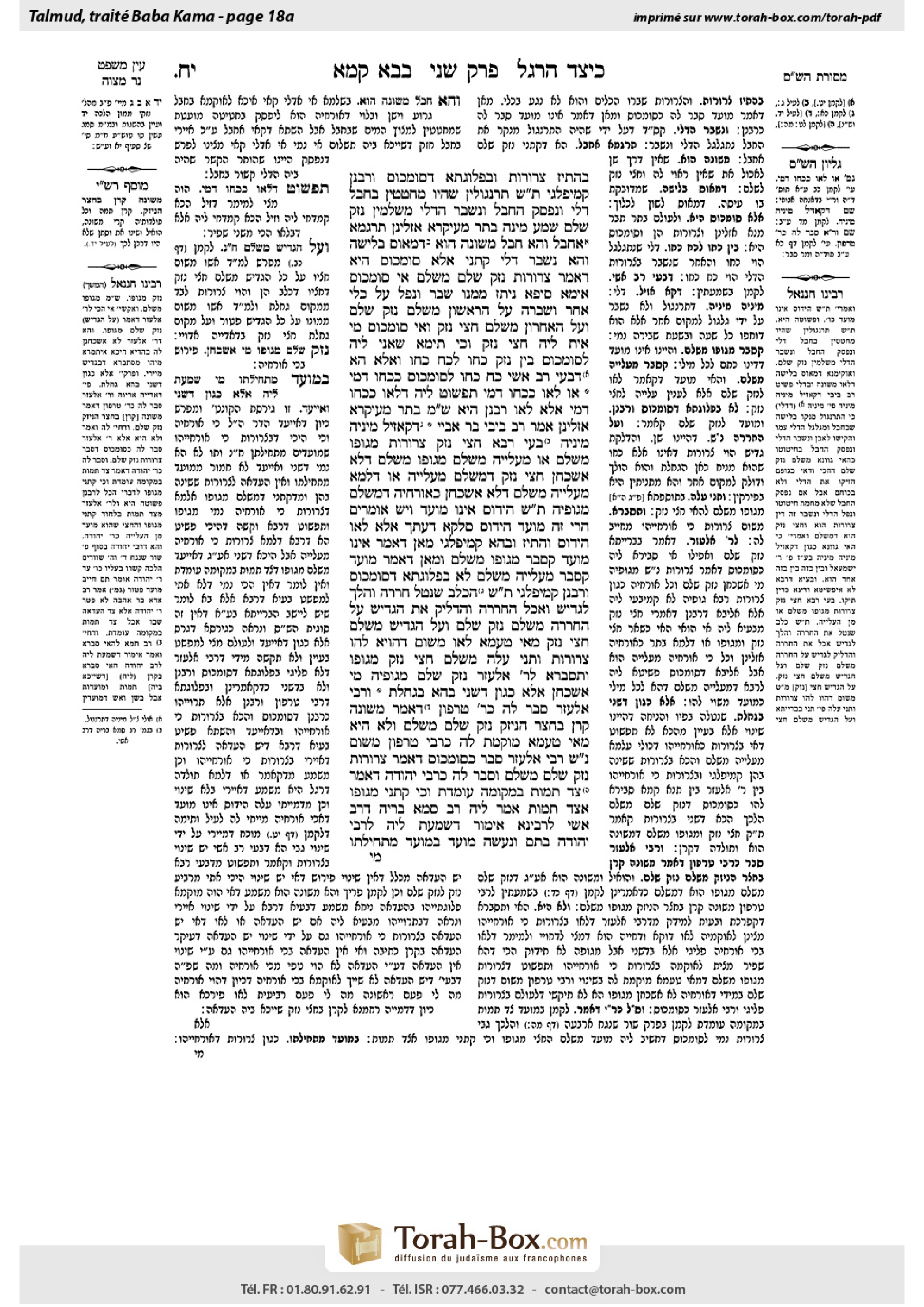
Bava Kamma 18a: Talmud study for Daf Yomi
Study the Talmud for Daf Yomi with scanned pages, Hebrew text, English translations from Sefaria and AI-generated French translations.
Passage selection and English or AI-generated French translation are available where the scan has annotations. Daf Study is independent of Torah-Box and Sefaria.
Browse Bava Kamma · בבא קמא · All tractatesBava Kamma 18a text and translations
This page of Bava Kamma includes the Aramaic text, an English translation and an AI-generated French translation, alongside the scan above.
בבא קמא י״ח א · Aramaic and Hebrew text
בְּהִתִּיז צְרוֹרוֹת, וּבִפְלוּגְתָּא דְּסוֹמְכוֹס וְרַבָּנַן קָמִיפַּלְגִי.
תָּא שְׁמַע: תַּרְנְגוֹלִין שֶׁהָיוּ מְחַטְּטִין בְּחֶבֶל דְּלִי, וְנִפְסַק הַחֶבֶל וְנִשְׁבַּר הַדְּלִי – מְשַׁלְּמִין נֶזֶק שָׁלֵם. שְׁמַע מִינַּהּ, בָּתַר מֵעִיקָּרָא אָזְלִינַן! תַּרְגְּמַהּ אַחֶבֶל.
וְהָא חֶבֶל מְשׁוּנֶּה הוּא! דְּמָאוּס בְּלִישָׁה: וְהָא ״נִשְׁבַּר דְּלִי״ קָתָנֵי! אֶלָּא סוֹמְכוֹס הִיא, דְּאָמַר: צְרוֹרוֹת – נֶזֶק שָׁלֵם מְשַׁלֵּם.
אִי סוֹמְכוֹס, אֵימָא סֵיפָא: נִיתַּז מִמֶּנּוּ שֶׁבֶר, וְנָפַל עַל כְּלִי אַחֵר וּשְׁבָרָהּ – עַל הָרִאשׁוֹן מְשַׁלֵּם נֶזֶק שָׁלֵם, וְעַל הָאַחֲרוֹן מְשַׁלֵּם חֲצִי נֶזֶק. וְאִי סוֹמְכוֹס, מִי אִית לֵיהּ חֲצִי נֶזֶק?
וְכִי תֵּימָא שָׁאנֵי לֵיהּ לְסוֹמְכוֹס בֵּין נֶזֶק כֹּחוֹ לְכֹחַ כֹּחוֹ; וְאֶלָּא הָא דְּבָעֵי רַב אָשֵׁי: כֹּחַ כֹּחוֹ לְסוֹמְכוֹס, כְּכֹחוֹ דָּמֵי אוֹ לָאו כְּכֹחוֹ דָּמֵי?
תִּפְשׁוֹט לֵיהּ דְּלָאו כְּכֹחוֹ דָּמֵי!
אֶלָּא לָאו רַבָּנַן הִיא? שְׁמַע מִינַּהּ בָּתַר מֵעִיקָּרָא אָזְלִינַן!
אָמַר רַב בִּיבִי בַּר אַבָּיֵי: דְּקָאָזֵיל מִינֵּיהּ מִינֵּיהּ.
בָּעֵי רָבָא: חֲצִי נֶזֶק צְרוֹרוֹת – מִגּוּפוֹ מְשַׁלֵּם, אוֹ מֵעֲלִיָּיה מְשַׁלֵּם? מִגּוּפוֹ מְשַׁלֵּם – דְּלָא אַשְׁכְּחַן חֲצִי נֶזֶק דִּמְשַׁלֵּם מֵעֲלִיָּיה, אוֹ דִלְמָא מֵעֲלִיָּיה מְשַׁלֵּם – דְּלָא אַשְׁכְּחַן כְּאוֹרְחֵיהּ דִּמְשַׁלֵּם מִגּוּפֵיהּ?
תָּא שְׁמַע: הִידּוּס – אֵינוֹ מוּעָד. וְיֵשׁ אוֹמְרִים: הֲרֵי זֶה מוּעָד. הִידּוּס סָלְקָא דַּעְתָּךְ?! אֶלָּא לָאו הִידּוּס וְהִתִּיז,
וּבְהָא קָמִיפַּלְגִי: מַאן דְּאָמַר אֵינוֹ מוּעָד – קָסָבַר מִגּוּפוֹ מְשַׁלֵּם, וּמַאן דְּאָמַר מוּעָד – קָסָבַר מֵעֲלִיָּיה מְשַׁלֵּם?
לָא; בִּפְלוּגְתָּא דְּסוֹמְכוֹס וְרַבָּנַן קָמִיפַּלְגִי.
תָּא שְׁמַע: הַכֶּלֶב שֶׁנָּטַל חֲרָרָה וְהָלַךְ לְגָדִישׁ, וְאָכַל הַחֲרָרָה וְהִדְלִיק אֶת הַגָּדִישׁ – עַל הַחֲרָרָה מְשַׁלֵּם נֶזֶק שָׁלֵם, וְעַל הַגָּדִישׁ מְשַׁלֵּם חֲצִי נֶזֶק.
מַאי טַעְמָא – לָאו מִשּׁוּם דְּהָוְיָא לְהוּ צְרוֹרוֹת? וְתָנֵי עֲלַהּ: מְשַׁלֵּם חֲצִי נֶזֶק – מִגּוּפוֹ!
וְתִסְבְּרָא?! לְרַבִּי אֶלְעָזָר – נֶזֶק שָׁלֵם מִגּוּפֵיהּ מִי אַשְׁכְּחַן?
אֶלָּא כְּגוֹן דְּשַׁנִּי בְּהָא גַּחֶלֶת, וְרַבִּי אֶלְעָזָר סָבַר לַהּ כְּרַבִּי טַרְפוֹן, דְּאָמַר: מְשׁוּנֶּה קֶרֶן בַּחֲצַר הַנִּיזָּק, נֶזֶק שָׁלֵם מְשַׁלֵּם.
וְלָא הִיא; מַאי טַעְמָא מוֹקְמַתְּ לַהּ כְּרַבִּי טַרְפוֹן – מִשּׁוּם נֶזֶק שָׁלֵם?
רַבִּי אֶלְעָזָר סָבַר כְּסוֹמְכוֹס, דְּאָמַר: צְרוֹרוֹת – נֶזֶק שָׁלֵם מְשַׁלֵּם; וְסָבַר לַהּ כְּרַבִּי יְהוּדָה, דְּאָמַר: צַד תַּמּוּת בִּמְקוֹמָהּ עוֹמֶדֶת. וְכִי קָתָנֵי מִגּוּפוֹ – אַצַּד תַּמּוּת.
אֲמַר לֵיהּ רַב סַמָּא בְּרֵיהּ דְּרַב אָשֵׁי לְרָבִינָא: אֵימוֹר דְּשָׁמְעַתְּ לֵיהּ לְרַבִּי יְהוּדָה, בְּתָם וְנַעֲשָׂה מוּעָד; בְּמוּעָד מִתְּחִילָּתוֹ
Bava Kamma 18a · English translation
The dispute concerns a case where the chicken propelled pebbles from underfoot as it was hopping, and it is with regard to the issue that is the subject of the dispute of Sumakhos and the Rabbis, cited earlier, that the tanna’im in the baraita disagree. One tanna holds that the owner pays the full cost of the damage for pebbles propelled by an animal in the course of its walking, and the other tanna holds that its owner pays half the cost of the damage.
The Gemara suggests: Come and hear an additional attempt to resolve the dilemma from a baraita: In a case where chickens were pecking at the rope tied to a bucket and the rope was severed and the bucket fell and broke, the owner of the chickens pays the full cost of the damage. Conclude from the baraita that we follow the initial action that ultimately led to the damage in determining liability for damage. The Gemara rejects this conclusion, and one cannot adduce proof from the baraita. Interpret instead that the reference in the baraita is to the damage caused to the rope, while the owner pays only half the cost of the damage for breaking the bucket.
The Gemara asks: But isn’t eating a rope atypical behavior for a chicken, and therefore it should be classified within the primary category of Goring, not the primary category of Eating? Why then must the owner of the chicken pay the full cost of the damage? The Gemara answers: The reference in the baraita is to a case where the rope was filthy [ma’us] with kneaded dough, and in those circumstances it is typical for a chicken to peck at it. The Gemara asks: But doesn’t the tanna teach in the baraita: And the bucket broke, indicating that the dispute is with regard to damage done to the bucket, not to the rope? The Gemara explains: Rather, this baraita is in accordance with the opinion of Sumakhos, who says: In the case of pebbles propelled by an animal, the owner pays the full cost of the damage.
The Gemara asks: If it is in accordance with the opinion of Sumakhos, say the latter clause of the baraita: If a shard was propelled from the bucket broken by a chicken and it fell upon another vessel and broke it, the owner of the chicken pays the full cost of the damage for the first vessel, and half the cost of the damage for the second one. And if the baraita is in accordance with the opinion of Sumakhos, is he of the opinion that one pays half the cost of the damage caused by pebbles?
And if you would say that there is a difference, according to Sumakhos, between damage resulting from a force generated by the animal’s action, e.g., pebbles, and damage caused by a force generated by a force generated by its action, e.g., damage caused by the shard of the bucket, and in the latter case Sumakhos concedes that the owner pays half the cost of the damage, that would result in a difficulty. The Gemara asks: But what of this dilemma raised by Rav Ashi: According to the opinion of Sumakhos, what is the halakha with regard to damage caused by a force generated by a force generated by the animal’s action? Is the status of that secondary force like that of damage caused by a force generated by its action, in which case the owner is liable, or is its status not like that of damage caused by a force generated by its action?
Why did Rav Ashi state his dilemma; why did he not resolve the dilemma and conclude that according to Sumakhos its status is not like that of damage caused by a force generated by its action? Since Rav Ashi does not resolve the dilemma based on this baraita, apparently, Sumakhos does not distinguish between the two types of force.
The Gemara suggests: Rather, is it not so that this baraita is in accordance with the opinion of the Rabbis, and conclude from the baraita that we follow the initial action that ultimately led to the damage when determining one’s liability for the damage. Therefore, an owner is liable for any damage resulting from his animal’s typical behavior, and he pays the full cost of the damage done to the bucket even if the damage took place in another location.
Rav Beivai bar Abaye said: There is no proof from the baraita, as it could be explained that the reference in the baraita is to a case where the bucket is continually propelled from the impetus of the chicken, who caused the bucket to break. That is why the ruling in the baraita is that the owner of the chicken pays the full cost of the damage. The dilemma with regard to the case where an animal treads upon a vessel that rolls away and breaks elsewhere remains unresolved.
§ Rava raises a dilemma: With regard to one’s liability to pay half the cost of the damage caused by pebbles inadvertently propelled by the foot of a walking animal, does the owner of the animal pay restitution exclusively from the body of the animal, just as one pays half the cost of the damage caused by an innocuous ox with regard to damage categorized under the primary category of Goring? Or does he pay restitution from his superior-quality land, as he does for other forms of damage? The Gemara elaborates: Does he pay restitution exclusively from the body of the animal, as we do not find any case where one pays half the cost of the damage from his superior-quality land? Or perhaps he pays restitution from his superior-quality land, as we do not find any case where an animal causes damage in its typical manner where the owner pays restitution exclusively from the body of his animal?
The Gemara suggests: Come and hear a resolution to this dilemma from a baraita: With regard to hopping, a chicken is not deemed forewarned. And some say that it is forewarned. The Gemara questions the formulation of the baraita: Does it enter your mind to raise the possibility that a chicken is not forewarned with regard to hopping? Hopping is the typical manner of movement for chickens. Rather, is it not that the reference in the baraita is to a case where the chicken was hopping and propelled pebbles that caused the damage?
And it is with regard to this matter that they disagree: The one who says that the chicken is not deemed forewarned holds that its owner pays restitution from the body of the animal, as is the halakha when an innocuous animal gores, while the one who says that the chicken is forewarned holds that he pays restitution from his superior-quality land, as is the halakha when a forewarned animal causes damage. According to this analysis, Rava’s dilemma is the subject of a tannaitic dispute.
The Gemara rejects this: No, perhaps the dispute in the baraita is with regard to the issue that is the subject of the dispute of Sumakhos and the Rabbis with regard to the legal status of damage caused by a force generated by the animal’s action. It is with regard to the similarity of damage caused by an action performed by an animal’s body to the case where the chicken was hopping and propelled pebbles that caused the damage that the tanna’im in the baraita disagree.
The Gemara suggests: Come and hear a resolution of this dilemma from a mishna (21b): If the dog took a loaf [ḥarara] that was baking on hot coals and went to a stack of grain to eat the loaf, and the dog ate the loaf and ignited the stack of grain with one of the coals attached to the loaf, the owner of the dog pays the full cost of the damage for the damage to the loaf, as it is classified in the primary category of Eating, and he pays half the cost of the damage for the damage to the stack of grain. Rabbi Elazar says: He pays the full cost of the damage for the damage to the stack of grain as well.
What is the reason that the first tanna holds that the owner pays half the cost of the damage caused to the stack of grain? Is it not due to the fact that it is analogous to propelling pebbles, as the coal fell from the loaf held in its mouth and ignited the grain? And it is taught in a baraita in that regard that when the first tanna said that he pays half the cost of the damage, he pays restitution exclusively from proceeds of the sale of the body of his animal. Apparently, half the cost of the damage caused by pebbles is paid from the body of the animal that caused the damage.
The Gemara rejects this explanation: And can you understand the baraita in that way? According to that understanding, with regard to Rabbi Elazar, who disagrees with the first tanna and holds that the owner of the dog pays the full cost of the damage caused to the grain, do we find anywhere that according to Rabbi Elazar one pays restitution exclusively from proceeds of the sale of the body of his animal?
Rather, the baraita can be explained in a case where the dog acted atypically with this coal with which he lit the stack of grain. Since the dog’s behavior was atypical, the damage is classified under the primary category of Goring, not under the category of Eating. And Rabbi Elazar holds in accordance with the opinion of Rabbi Tarfon, who says in a mishna (24b): The halakha of Goring in the courtyard of the injured party is atypical, as there, the owner of the ox pays the full cost of the damage, in contrast to half the cost of the damage that he pays when it transpires in the public domain. Nevertheless, since it was an innocuous animal that caused the damage, restitution is paid from its body.
The Gemara rejects that explanation: But that is not so. What is the reason that you interpreted that the baraita is in accordance with the opinion of Rabbi Tarfon? It is due to the difficulty presented by the halakha that he pays the full cost of the damage exclusively from proceeds of the sale of the body of the animal, which would not be so according to Rabbi Elazar.
The Gemara suggests: There is an alternative explanation. Rabbi Elazar holds in accordance with the opinion of Sumakhos, who says that one pays the full cost of the damage caused by pebbles, and he also holds in accordance with the opinion of Rabbi Yehuda, who says with regard to a forewarned ox: The aspect of innocuousness, which dictates that the owner pays half the cost of the damage from the body of the ox, remains intact. According to Rabbi Yehuda, the owner of a forewarned ox pays half the cost of the damage from the body of his ox and half the cost of the damage from his superior-quality land. And when the tanna of the baraita teaches that the owner pays restitution from the body of his animal, the reference is to the aspect of innocuousness, i.e., half the cost of the damage. He pays the other half from his superior-quality land as he would in the case of any forewarned animal.
Rav Samma, son of Rav Ashi, said to Ravina: Say that you heard that Rabbi Yehuda stated that the aspect of innocuousness remains intact with regard to damage categorized under the primary category of Goring, where the ox was initially innocuous and then became forewarned. In the case of propelled pebbles, which is a subcategory of Trampling, where the ox is forewarned from the outset,
Bava Kamma 18a · Traduction française (IA)
Le débat porte sur un cas où un poulet propulse des cailloux sous le pied alors qu'il saute, et il s'agit de la question soulevée par Sumakhos et les Rabbins, cités précédemment, sur laquelle les tannaïm dans la baraïta s'entendent différemment. Un tanna affirme que l'propriétaire paie le coût complet des dégâts causés par des cailloux propulsés par un animal en marche, tandis que l'autre tanna affirme qu'il paie la moitié du coût des dégâts.
La Guemara suggère : Approchez-vous d'une autre tentative de résoudre ce dilemme à partir d'une baraïta : Dans un cas où des poulets picoraient la corde attachée à un seau, la corde fut coupée et le seau tomba et se brisa, l'propriétaire des poulets paie le coût complet des dégâts. Concluez de la baraïta que nous suivons l'action initiale qui a finalement causé les dégâts pour déterminer la responsabilité en matière de dégâts. La Guemara rejette cette conclusion et on ne peut tirer de preuve de la baraïta. Interprétez plutôt que la référence dans la baraïta est au dégât causé à la corde, tandis que l'propriétaire paie seulement la moitié du coût des dégâts pour la casse du seau.
La Guemara pose la question : Mais n'est-ce pas un comportement atypique pour un poulet de manger une corde, et devrait-il donc être classé dans la catégorie principale de l'attaque, et non dans celle de la consommation ? Pourquoi alors l'propriétaire du poulet paie-t-il le coût complet des dégâts ? La Guemara répond : La référence dans la baraïta est à un cas où la corde était sale [ma'us] avec de la pâte, et dans ces circonstances, il est typique pour un poulet de picorer. La Guemara pose la question : Mais ne dit pas le tanna dans la baraïta : Et le seau s'est brisé, indiquant que le débat porte sur les dégâts causés au seau, et non à la corde ? La Guemara explique : Plutôt, cette baraïta est en conformité avec l'opinion de Sumakhos, qui dit : Dans le cas de cailloux propulsés par un animal, l'propriétaire paie le coût complet des dégâts.
La Guemara pose la question : Si c'est selon l'opinion de Sumakhos, dites la seconde partie de la baraïta : Si un fragment a été propulsé du seau brisé par un poulet et est tombé sur un autre récipient et l'a brisé, l'propriétaire du poulet paie le coût complet des dégâts pour le premier récipient, et la moitié du coût des dégâts pour le second. Et si la baraïta est selon l'opinion de Sumakhos, est-ce qu'il est de l'avis que l'on paie la moitié du coût des dégâts causés par des cailloux ?
Et si vous dites qu'il y a une différence, selon Sumakhos, entre les dégâts causés par une force générée par l'action de l'animal, par exemple des cailloux, et les dégâts causés par une force générée par une force générée par son action, par exemple les dégâts causés par le fragment du seau, et dans ce dernier cas Sumakhos reconnaît que l'propriétaire paie la moitié du coût des dégâts, cela entraînerait une difficulté. La Guemara pose la question : Mais qu'en est-il de ce dilemme soulevé par Rav Ashi : Selon l'opinion de Sumakhos, quelle est la halakha concernant les dégâts causés par une force générée par une force générée par l'action de l'animal ? La force secondaire est-elle considérée comme celle causée par une force générée par son action, dans ce cas l'propriétaire est responsable, ou son statut n'est-il pas celui des dégâts causés par une force générée par son action ?
Pourquoi Rav Ashi a-t-il formulé ce dilemme ; pourquoi ne pas avoir résolu le dilemme et conclu que selon Sumakhos, son statut n'est pas celui des dégâts causés par une force générée par son action ? Puisque Rav Ashi ne résout pas le dilemme à partir de cette baraïta, apparemment, Sumakhos ne distingue pas entre les deux types de force.
La Guemara suggère : Plutôt, n'est-ce pas ainsi que cette baraïta est conforme à l'opinion des Rabbins, et conclure de la baraïta que nous suivons l'action initiale qui a finalement causé les dégâts lors de la détermination de la responsabilité en matière de dégâts. Ainsi, un propriétaire est responsable de tout dégât résultant du comportement typique de son animal, et il paie le coût complet des dégâts causés au seau même si le dégât s'est produit dans un autre lieu.
Rav Beivai bar Abaye a dit : Il n'y a pas de preuve à tirer de la baraïta, car elle pourrait être expliquée comme faisant référence à un cas où le seau est constamment propulsé par l'impulsion du poulet, qui a causé la casse du seau. C'est pourquoi la décision dans la baraïta est que l'propriétaire du poulet paie le coût complet des dégâts. Le dilemme concernant le cas où un animal marche sur un récipient qui roule et se brise ailleurs reste sans résolution.
§ Rava soulève un dilemme : Concernant la responsabilité de payer la moitié du coût des dégâts causés par des cailloux accidentellement propulsés par le pied d'un animal marchant, l'propriétaire de l'animal paie-t-il exclusivement la réparation à partir du corps de l'animal, comme on paie la moitié du coût des dégâts causés par un taureau inoffensif concernant les dégâts classés dans la catégorie principale de l'attaque ? Ou paie-t-il la réparation à partir de ses terres de qualité supérieure, comme on le fait pour d'autres formes de dégâts ? La Guemara développe : Paie-t-il exclusivement la réparation à partir du corps de l'animal, comme nous ne trouvons aucun cas où l'on paie la moitié du coût des dégâts à partir de ses terres de qualité supérieure ? Ou peut-être paie-t-il la réparation à partir de ses terres de qualité supérieure, comme nous ne trouvons aucun cas où un animal cause des dégâts dans son comportement typique où l'propriétaire paie exclusivement la réparation à partir du corps de son animal ?
La Guemara suggère : Approchez-vous d'une résolution à ce dilemme à partir d'une baraïta : Concernant le saut, un poulet n'est pas considéré comme averti. Et certains disent qu'il l'est. La Guemara questionne la formulation de la baraïta : Entrez-vous dans l'idée de soulever la possibilité qu'un poulet ne soit pas averti concernant le saut ? Le saut est le mode de mouvement typique des poulets. Plutôt, n'est-ce pas que la référence dans la baraïta est à un cas où le poulet sautait et propulsait des cailloux qui ont causé les dégâts ?
Et c'est à propos de cette question que les parties s'opposent : celui qui affirme que le poulet n'est pas averti considère que son propriétaire indemnisera la perte à partir du corps de l'animal, comme c'est la halakha lorsque l'animal inoffensif blesse, tandis que celui qui affirme que le poulet est averti considère qu'il indemnisera la perte à partir de ses terres de qualité supérieure, comme c'est la halakha lorsque l'animal averti cause un préjudice. Selon cette analyse, la difficulté de Rava est l'objet d'un débat tannaitique.
La Guemara refuse cette interprétation : Non, peut-être le débat dans la baraïta est-il concernant la question qui est l'objet du débat entre Sumakhos et les Rabbins concernant le statut juridique des préjudices causés par une force générée par l'action de l'animal. C'est à propos de la similitude entre les préjudices causés par une action effectuée par le corps de l'animal et le cas où le poulet sautait et projetait des cailloux causant le préjudice que les tannaïm dans la baraïta s'opposent.
La Guemara suggère : Viens écouter une résolution de cette difficulté à partir d'une mitsva (21b) : Si le chien a pris un pain [ḥarara] qui cuisait sur des braises et est allé à un tas de blé pour manger le pain, et que le chien a mangé le pain et a allumé le tas de blé avec l'une des braises attachées au pain, le propriétaire du chien paie le coût complet du préjudice pour le préjudice au pain, car il est classé dans la catégorie principale de l'alimentation, et il paie la moitié du coût du préjudice pour le préjudice au tas de blé. Rabbi Elazar dit : Il paie le coût complet du préjudice pour le préjudice au tas de blé également.
Quelle est la raison pour laquelle le premier tanna considère que le propriétaire paie la moitié du coût du préjudice causé au tas de blé ? N'est-ce pas en raison de la similitude avec le cas des cailloux, comme la braise tomba du pain tenu dans sa bouche et alluma le blé ? Et il est enseigné dans une baraïta à ce sujet que lorsque le premier tanna dit qu'il paie la moitié du coût du préjudice, il indemnisera exclusivement à partir des revenus de la vente du corps de son animal. Apparemment, la moitié du coût du préjudice causé par les cailloux est payée à partir du corps de l'animal qui a causé le préjudice.
La Guemara rejette cette explication : Et pouvez-vous comprendre la baraïta ainsi ? Selon cette interprétation, concernant Rabbi Elazar, qui s'oppose au premier tanna et considère que le propriétaire du chien paie le coût complet du préjudice causé au blé, trouvons-nous quelque part que selon Rabbi Elazar, l'indemnité est payée exclusivement à partir des revenus de la vente du corps de son animal ?
Plutôt, la baraïta peut être expliquée dans un cas où le chien a agi de manière atypique avec cette braise avec laquelle il a allumé le tas de blé. Puisque le comportement du chien était atypique, le préjudice est classé dans la catégorie principale de l'attaque, pas dans la catégorie de l'alimentation. Et Rabbi Elazar considère selon l'opinion de Rabbi Tarfon, qui dit dans une mitsva (24b) : La halakha de l'attaque dans le jardin de la victime est atypique, car là, le propriétaire de l'ox paie le coût complet du préjudice, contrairement à la moitié du coût du préjudice qu'il paie lorsqu'il se produit dans le domaine public. Cependant, puisque c'était un animal inoffensif qui a causé le préjudice, l'indemnité est payée à partir de son corps.
La Guemara refuse cette explication : Mais ce n'est pas ainsi. Quelle est la raison pour laquelle vous avez interprété que la baraïta est selon l'opinion de Rabbi Tarfon ? C'est en raison de la difficulté posée par la halakha qui stipule qu'on paie le coût complet du préjudice exclusivement à partir des revenus de la vente du corps de l'animal, ce qui ne serait pas le cas selon Rabbi Elazar.
La Guemara suggère : Il existe une autre explication. Rabbi Elazar considère selon l'opinion de Sumakhos, qui affirme qu'on paie le coût complet du préjudice causé par les cailloux, et il considère également selon l'opinion de Rabbi Yehuda, qui affirme concernant un ox averti : L'aspect d'inoffensivité, qui détermine que le propriétaire paie la moitié du coût du préjudice à partir du corps de l'ox, reste intact. Selon Rabbi Yehuda, le propriétaire d'un ox averti paie la moitié du coût du préjudice à partir du corps de son ox et la moitié du coût du préjudice à partir de ses terres de qualité supérieure. Et lorsque le tanna de la baraïta enseigne que le propriétaire indemnisera à partir du corps de son animal, il fait référence à l'aspect d'inoffensivité, c'est-à-dire la moitié du coût du préjudice. Il paie l'autre moitié à partir de ses terres de qualité supérieure comme il le ferait dans le cas d'un animal averti.
Rav Samma, fils de Rav Ashi, a dit à Ravina : Dis que tu as entendu que Rabbi Yehuda a affirmé que l'aspect d'inoffensivité reste intact concernant les préjudices classés dans la catégorie principale de l'attaque, où l'ox était initialement inoffensif et est ensuite devenu averti. Dans le cas des cailloux projetés, qui est une sous-catégorie de l'écrasement, où l'ox est averti dès le départ,
Traduction française générée par IA à partir de l’édition anglaise de Sefaria. Vérifie toujours un passage avec le texte source.
Text from Sefaria: William Davidson Edition - Vocalized Aramaic (CC BY NC); William Davidson Edition - English (CC BY NC).