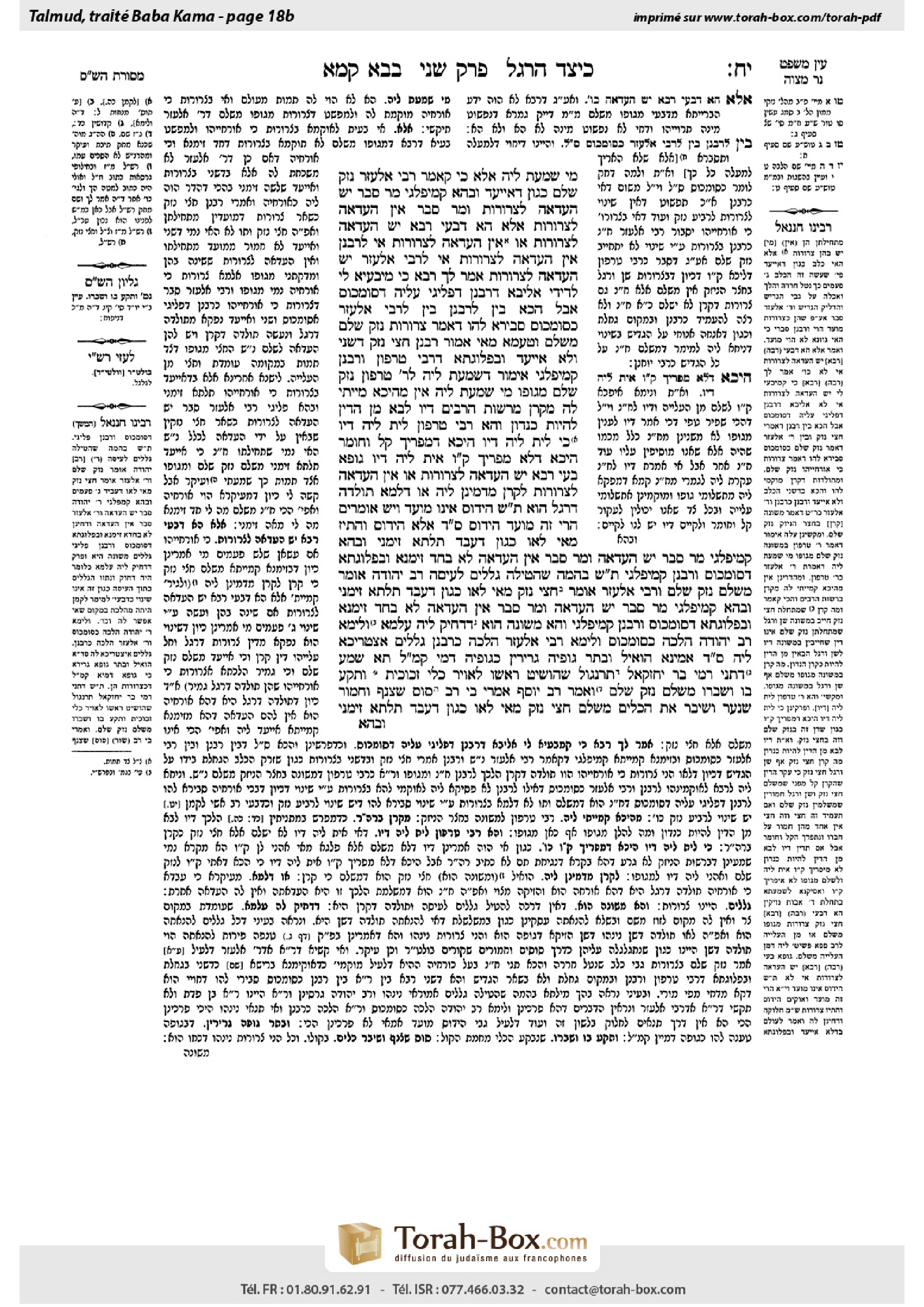
Bava Kamma 18b: Talmud study for Daf Yomi
Study the Talmud for Daf Yomi with scanned pages, Hebrew text, English translations from Sefaria and AI-generated French translations.
Passage selection and English or AI-generated French translation are available where the scan has annotations. Daf Study is independent of Torah-Box and Sefaria.
Browse Bava Kamma · בבא קמא · All tractatesBava Kamma 18b text and translations
This page of Bava Kamma includes the Aramaic text, an English translation and an AI-generated French translation, alongside the scan above.
בבא קמא י״ח ב · Aramaic and Hebrew text
מִי שָׁמְעַתְּ לֵיהּ?
אֶלָּא כִּי קָאָמַר רַבִּי אֶלְעָזָר נֶזֶק שָׁלֵם – כְּגוֹן דְּאִיַּיעַד; וּבְהָא קָמִיפַּלְגִי – מָר סָבַר יֵשׁ הַעֲדָאָה לִצְרוֹרוֹת, וּמַר סָבַר אֵין הַעֲדָאָה לִצְרוֹרוֹת.
אֶלָּא הָא דְּבָעֵי רָבָא: יֵשׁ הַעֲדָאָה לִצְרוֹרוֹת, אוֹ אֵין הַעֲדָאָה לִצְרוֹרוֹת? אִי לְרַבָּנַן – אֵין הַעֲדָאָה לִצְרוֹרוֹת, אִי לְרַבִּי אֶלְעָזָר – יֵשׁ הַעֲדָאָה לִצְרוֹרוֹת!
אָמַר לָךְ רָבָא: כִּי מִיבַּעְיָא לִי לְדִידִי, אַלִּיבָּא דְּרַבָּנַן דִּפְלִיגִי עֲלֵיהּ דְּסוֹמְכוֹס; אֲבָל הָכָא, בֵּין לְרַבָּנַן בֵּין לְרַבִּי אֶלְעָזָר – כְּסוֹמְכוֹס סְבִירָא לְהוּ, דְּאָמַר: צְרוֹרוֹת – נֶזֶק שָׁלֵם מְשַׁלֵּם.
וְטַעְמָא מַאי אֲמוּר רַבָּנַן חֲצִי נֶזֶק – דְּשַׁנִּי וְלָא אִיַּיעַד; וּבִפְלוּגְתָּא דְּרַבִּי טַרְפוֹן וְרַבָּנַן קָמִיפַּלְגִי.
אֵימוֹר דְּשָׁמְעַתְּ לֵיהּ לְרַבִּי טַרְפוֹן – נֶזֶק שָׁלֵם; מִגּוּפוֹ מִי שָׁמְעַתְּ לֵיהּ?
אִין; מֵהֵיכָא מַיְיתֵי לַהּ – מִקֶּרֶן מֵרְשׁוּת הָרַבִּים;
דַּיּוֹ לַבָּא מִן הַדִּין לִהְיוֹת כַּנִּדּוֹן.
וְהָא רַבִּי טַרְפוֹן לֵית לֵיהּ ״דַּיּוֹ״!
כִּי לֵית לֵיהּ ״דַּיּוֹ״ – הֵיכָא דְּמִפְּרִיךְ קַל וָחוֹמֶר; הֵיכָא דְּלָא מִפְּרִיךְ קַל וָחוֹמֶר – אִית לֵיהּ ״דַּיּוֹ״.
גּוּפָא – בָּעֵי רָבָא: יֵשׁ הַעֲדָאָה לִצְרוֹרוֹת, אוֹ אֵין הַעֲדָאָה לִצְרוֹרוֹת? לְקֶרֶן מְדַמֵּינַן לֵיהּ, אוֹ דִלְמָא תּוֹלָדָה דְרֶגֶל הוּא?
תָּא שְׁמַע: הִידּוּס – אֵינוֹ מוּעָד. וְיֵשׁ אוֹמְרִים: הֲרֵי זֶה מוּעָד. הִידּוּס סָלְקָא דַּעְתָּךְ?! אֶלָּא הִידּוּס וְהִתִּיז.
מַאי, לָאו כְּגוֹן דַּעֲבַד תְּלָתָא זִימְנֵי – וּבְהָא קָמִיפַּלְגִי: מָר סָבַר יֵשׁ הַעֲדָאָה, וּמַר סָבַר אֵין הַעֲדָאָה? לָא, בְּחַד זִימְנָא; וּבִפְלוּגְתָּא דְּסוֹמְכוֹס וְרַבָּנַן קָמִיפַּלְגִי.
תָּא שְׁמַע: בְּהֵמָה שֶׁהֵטִילָה גְּלָלִים לְעִיסָּה, רַב יְהוּדָה אוֹמֵר: מְשַׁלֵּם נֶזֶק שָׁלֵם, וְרַבִּי אֶלְעָזָר אוֹמֵר: חֲצִי נֶזֶק. מַאי, לָאו כְּגוֹן דַּעֲבַד תְּלָתָא זִימְנֵי – וּבְהָא קָמִיפַּלְגִי: מָר סָבַר יֵשׁ הַעֲדָאָה, וּמַר סָבַר אֵין הַעֲדָאָה?
לָא; בְּחַד זִימְנָא, וּבִפְלוּגְתָּא דְּסוֹמְכוֹס וְרַבָּנַן קָמִיפַּלְגִי. וְהָא מְשׁוּנֶּה הוּא! דִּדְחִיק לֵיהּ עָלְמָא.
וְלֵימָא רַב יְהוּדָה: הֲלָכָה כְּסוֹמְכוֹס, וְלֵימָא רַבִּי אֶלְעָזָר: הֲלָכָה כְּרַבָּנַן! גְּלָלִים אִצְטְרִיכָא לֵיהּ; סָלְקָא דַּעְתָּךְ אָמֵינָא, הוֹאִיל וּבָתַר גּוּפֵיהּ גְּרִירִין – כְּגוּפֵיהּ דָּמֵי; קָא מַשְׁמַע לַן.
תָּא שְׁמַע, דְּתָנֵי רָמֵי בַּר יְחֶזְקֵאל: תַּרְנְגוֹל שֶׁהוֹשִׁיט רֹאשׁוֹ לַאֲוִיר כְּלִי זְכוּכִית, וְתָקַע בּוֹ וּשְׁבָרוֹ – מְשַׁלֵּם נֶזֶק שָׁלֵם. וְאָמַר רַב יוֹסֵף, אָמְרִי בֵּי רַב: סוּס שֶׁצָּנַף וַחֲמוֹר שֶׁנָּעַר, וְשִׁיבֵּר אֶת הַכֵּלִים – מְשַׁלֵּם חֲצִי נֶזֶק.
מַאי, לָאו כְּגוֹן דַּעֲבַד תְּלָתָא זִימְנֵי –
Bava Kamma 18b · English translation
did you hear him distinguish between the different parts of the payment? There is no aspect of innocuousness in the case of pebbles.
Rather, when Rabbi Elazar says that the owner of the dog pays the full cost of the damage in a case that is similar to one of propelled pebbles, he was referring to a case where the owner of the animal was forewarned with regard to this matter. And they disagree about this point: One Sage, Rabbi Elazar, holds that there is forewarning with regard to propelling pebbles; therefore, if there was testimony given in court that a particular animal regularly propels pebbles in the course of its walking, the animal is deemed forewarned and its owner pays the full cost of the damage. And one Sage, the first tanna, holds that there is no forewarning with regard to pebbles. Apparently, payment for damage caused by pebbles is paid from the body of the animal.
The Gemara asks: But if this is the case, then the dilemma raised by Rava concerning whether there is forewarning for propelling pebbles or there is no forewarning for propelling pebbles, can be resolved from this dispute. If the dilemma is raised according to the Rabbis, i.e., the first tanna, there is no forewarning for propelling pebbles. If the dilemma is raised according to Rabbi Elazar, there is forewarning for propelling pebbles.
The Gemara answers that Rava could have said to you: When I raise the dilemma, I do so specifically according to the opinion of the Rabbis who disagree with Sumakhos and hold that one pays half the cost of the damage in the case of pebbles; but here in this baraita, both the Rabbis, i.e., the first tanna, and Rabbi Elazar hold in accordance with the opinion of Sumakhos, who says that in the case of pebbles, one pays the full cost of the damage.
And what is the reason that the Rabbis say that one pays half the cost of the damage in the case of pebbles? It is that in the case of pebbles the animal acted atypically and was not forewarned. And in this baraita, concerning the dog that lit the stack of grain, the dispute between the first tanna and Rabbi Elazar is with regard to the issue that is the subject of the dispute between Rabbi Tarfon and the Rabbis, i.e., the halakha in the case of damage caused by an innocuous ox on the property of the injured party.
The Gemara rejects the parallel between the opinion of Rabbi Elazar and the opinion of Rabbi Tarfon. Say that you heard that according to Rabbi Tarfon the owner pays the full cost of the damage; but did you hear that according to Rabbi Tarfon restitution is paid only from the body of the animal that caused the damage?
The Gemara answers: Yes, Rabbi Tarfon holds that restitution is paid only from the body of the animal that caused the damage. From where does Rabbi Tarfon derive the halakha that when damage is caused by an innocuous ox on the property of the injured party its owner is liable to pay the full cost of the damage and not merely half? He derives it via an a fortiori inference from damage categorized as Goring that is caused in the public domain, as explained in the mishna (24b).
His ruling is based on the principle: It is sufficient for the conclusion that emerges from an a fortiori inference to be like its source, i.e., a halakha derived from an a fortiori inference cannot be more stringent than the source of that derivation. Since restitution for damage categorized as Goring that is caused in the public domain is paid only from the body of the damaging animal, the same is true with regard to restitution for damage categorized as Goring that is caused on the property of the injured party.
The Gemara asks: But isn’t it clear from that mishna that Rabbi Tarfon does not accept the principle: It is sufficient for the conclusion that emerges from an a fortiori inference to be like its source, as, if he accepted that principle, not only would he hold that payment is only from the body of the animal, he would also require payment of half the cost of the damage.
The Gemara answers: He does not reject the principle. When he does not accept the principle: It is sufficient for the conclusion that emerges from an a fortiori inference to be like its source, it is in a case where the result of rejecting the principle is that the a fortiori inference is refuted. But in a case where the result of rejecting the principle is that the a fortiori inference is not refuted, but will be applied in a more limited fashion, he accepts the principle: It is sufficient for the conclusion that emerges from an a fortiori inference to be like its source. Therefore, in this case the payment of the full cost of the damage, which is derived by means of the a fortiori inference, is paid only from the body of the animal based on the principle: It is sufficient for the conclusion that emerges from an a fortiori inference to be like its source.
§ The Gemara discusses the matter itself, cited earlier. Rava raises a dilemma: Is there forewarning for propelling pebbles, so that the owner would pay the full cost of the damage if he had been forewarned three times, or is there no forewarning for propelling pebbles, and he will always pay half the cost of the damage? The Gemara elaborates: Do we liken the case of propelled pebbles to damage categorized as Goring? Accordingly, when an innocuous ox causes damage by propelling pebbles its owner pays half the cost of the damage, and when a forewarned ox does so the owner pays the full cost of the damage. Or perhaps, is it a subcategory of the primary category of Trampling, which is deemed forewarned from the outset? Accordingly, the owner would always pay half the cost of the damage, as there is no change in status after the third warning.
The Gemara suggests: Come and hear the resolution of this dilemma from a baraita: With regard to hopping, a chicken is not deemed forewarned. And some say that it is forewarned. The Gemara questions the formulation of the baraita: Does it enter your mind to raise the possibility that a chicken is not forewarned with regard to hopping? Hopping is the typical manner of movement for chickens. Rather, is it not that the reference in the baraita is to a case where the chicken was hopping and propelled pebbles that caused damage?
What, is it not referring to a case where the chicken has done so three times? And it is with regard to this that they disagree: One Sage holds: There is forewarning for pebbles, and one Sage holds: There is no forewarning for pebbles. According to this analysis, Rava’s dilemma is the subject of a tannaitic dispute. The Gemara rejects this resolution: No, perhaps the reference in the baraita is to a case where the chicken hopped only one time. And the tanna’im disagree with regard to the issue that is the subject of the dispute between Sumakhos and the Rabbis, concerning the compensation for damage caused by pebbles.
The Gemara suggests: Come and hear the resolution to the dilemma from an amoraic dispute: If an animal dropped excrement onto dough and damaged it, Rav Yehuda says: The owner of the animal pays the full cost of the damage, and Rabbi Elazar says: He pays half the cost of the damage. What, is it not referring to a case where the animal has done so three times? And it is with regard to this that they disagree, as one Sage holds: There is forewarning for pebbles, and one Sage holds: There is no forewarning for pebbles.
The Gemara rejects this resolution: No, perhaps the reference in the baraita is to a case where the animal dropped excrement only one time. And the tanna’im disagree with regard to the issue that is the subject of the dispute between Sumakhos and the Rabbis, concerning compensation for damage caused by pebbles. The Gemara asks: But isn’t this atypical behavior of the animal, and since all behavior that deviates from the norm is classified within the category of Goring, the owner should be liable to pay only half the cost of the damage? The Gemara answers: The case is one where the animal was forced into a narrow place and had no alternative to relieving itself onto the dough; therefore, it does not constitute atypical behavior.
The Gemara asks: But if the amoraic dispute parallels the tannaitic dispute, let Rav Yehuda say: The halakha is in accordance with the opinion of Sumakhos, and let Rabbi Elazar say: The halakha is in accordance with the opinion of the Rabbis, instead of stating their dispute in the context of the particular case of the animal and the dough. The Gemara answers: It was necessary for them to state their dispute in this case, as there is a novel element concerning excrement. It would enter your mind to say: Since the excrement is drawn after the body of the animal, its legal status is like that of damage caused by its body, not like pebbles propelled by the animal. Therefore, their stating the dispute with regard to excrement teaches us that its status is like that of propelling pebbles. Therefore, the dispute between Rav Yehuda and Rabbi Elazar can be explained as parallel to the dispute between Sumakhos and the Rabbis with regard to pebbles.
The Gemara suggests: Come and hear the resolution to the dilemma from a baraita: Rami bar Yeḥezkel taught: In the case of a rooster that extended its head into the airspace of a glass vessel and crowed in the vessel and broke it with the sound waves, its owner pays the full cost of the damage. And Rav Yosef said that the Sages from the school of Rav say: If a horse neighed or a donkey brayed and the sound waves broke vessels, the owner pays half the cost of the damage. These are cases similar to the case of pebbles, and there is a dispute between the Sages with regard to these cases.
What, is it not referring to a case where the rooster or animal has done so three times?
Bava Kamma 18b · Traduction française (IA)
As-tu entendu qu'il distingue les différentes parties du paiement ? Il n'y a pas de côté d'innocuité dans le cas des cailloux.
En réalité, lorsque Rabbi Eléazar dit que l'propriétaire du chien paie le coût complet des dommages dans un cas similaire à celui des cailloux propulsés, il faisait référence à un cas où l'propriétaire de l'animal avait été averti à ce sujet. Et ils divergent sur ce point : un Sage, Rabbi Eléazar, considère qu'il y a un avertissement concernant les cailloux propulsés ; donc, si témoignage a été donné devant le tribunal selon lequel un animal particulier propulse régulièrement des cailloux lors de sa marche, l'animal est considéré comme averti et son propriétaire paie le coût complet des dommages. Un autre Sage, le premier tanna, considère qu'il n'y a pas d'avertissement concernant les cailloux. Apparemment, le paiement des dommages causés par des cailloux est effectué à partir du corps de l'animal.
Le Guemara pose la question : Mais si c'est le cas, alors le dilemme soulevé par Rava concernant s'il y a un avertissement pour les cailloux propulsés ou non peut être résolu à partir de ce désaccord. Si le dilemme est soulevé selon les Rabbins, c'est-à-dire le premier tanna, il n'y a pas d'avertissement pour les cailloux propulsés. Si le dilemme est soulevé selon Rabbi Eléazar, il y a un avertissement pour les cailloux propulsés.
Le Guemara répond que Rava aurait pu dire à toi : Lorsque je soulève ce dilemme, je le fais spécifiquement selon l'opinion des Rabbins qui s'opposent à celle de Sumakhos et qui considèrent que l'on paie la moitié du coût des dommages dans le cas des cailloux ; mais ici, dans ce baraïta, à la fois les Rabbins, c'est-à-dire le premier tanna, et Rabbi Eléazar suivent l'opinion de Sumakhos, qui dit que dans le cas des cailloux, l'on paie le coût complet des dommages.
Et quelle est la raison pour laquelle les Rabbins disent que l'on paie la moitié du coût des dommages dans le cas des cailloux ? C'est que dans le cas des cailloux, l'animal agissait de manière atypique et n'était pas averti. Et dans ce baraïta, concernant le chien qui a allumé la pile de blé, le désaccord entre le premier tanna et Rabbi Eléazar concerne la question qui est au centre du désaccord entre Rabbi Tarfon et les Rabbins, c'est-à-dire la halakha dans le cas de dommages causés par un taureau inoffensif sur la propriété de la personne blessée.
Le Guemara rejette la comparaison entre l'opinion de Rabbi Eléazar et celle de Rabbi Tarfon. Dis que tu as entendu que selon Rabbi Tarfon, l'propriétaire paie le coût complet des dommages ; mais as-tu entendu que selon Rabbi Tarfon, la réparation est payée uniquement à partir du corps de l'animal qui a causé les dommages ?
Le Guemara répond : Oui, Rabbi Tarfon considère que la réparation est payée uniquement à partir du corps de l'animal qui a causé les dommages. D'où Rabbi Tarfon dérive la halakha selon laquelle, lorsqu'un dommage est causé par un taureau inoffensif sur la propriété de la personne blessée, l'propriétaire est tenu de payer le coût complet des dommages et non seulement la moitié ? Il en dérive par une inférence a fortiori à partir d'un dommage classé comme Goring causé dans le domaine public, comme expliqué dans la mishna (24b).
Son jugement s'appuie sur le principe : Il suffit que la conclusion tirée d'une inférence a fortiori soit semblable à sa source, c'est-à-dire qu'une halakha dérivée d'une inférence a fortiori ne peut pas être plus stricte que la source de cette dérivation. Puisque la réparation pour un dommage classé comme Goring causé dans le domaine public est payée uniquement à partir du corps de l'animal causant le dommage, la même chose s'applique à la réparation pour un dommage classé comme Goring causé sur la propriété de la personne blessée.
Le Guemara pose la question : Mais n'est-ce pas clair à partir de cette mishna que Rabbi Tarfon ne reconnaît pas le principe : Il suffit que la conclusion tirée d'une inférence a fortiori soit semblable à sa source, car, s'il acceptait ce principe, non seulement il considérerait que le paiement est uniquement à partir du corps de l'animal, mais il exigerait aussi le paiement de la moitié du coût des dommages.
Le Guemara répond : Il ne rejette pas ce principe. Lorsqu'il ne reconnait pas ce principe, c'est dans un cas où le résultat de rejeter ce principe est que l'inférence a fortiori est réfutée. Mais dans un cas où le résultat de rejeter ce principe est que l'inférence a fortiori n'est pas réfutée, mais sera appliquée de manière plus limitée, il accepte ce principe : Il suffit que la conclusion tirée d'une inférence a fortiori soit semblable à sa source. Ainsi, dans ce cas, le paiement du coût complet des dommages, qui est dérivé par l'inférence a fortiori, est payé uniquement à partir du corps de l'animal selon le principe : Il suffit que la conclusion tirée d'une inférence a fortiori soit semblable à sa source.
§ Le Guemara discute la question elle-même, citée plus tôt. Rava soulève un dilemme : Y a-t-il un avertissement pour les cailloux propulsés, de sorte que l'propriétaire paie le coût complet des dommages s'il avait été averti trois fois, ou n'y a-t-il pas d'avertissement pour les cailloux propulsés, et il paie toujours la moitié du coût des dommages ? Le Guemara développe : Comparons-nous le cas des cailloux propulsés au cas de Goring ? Ainsi, lorsque un taureau inoffensif cause des dommages en propulsant des cailloux, son propriétaire paie la moitié du coût des dommages, et lorsque un taureau averti fait cela, son propriétaire paie le coût complet des dommages. Ou peut-être est-ce une sous-catégorie de la catégorie principale de l'écrasement, qui est considérée comme avertie dès le départ ? Ainsi, le propriétaire paie toujours la moitié du coût des dommages, car il n'y a pas de changement d'état après le troisième avertissement.
La Guemara suggère : Viens écouter la résolution de ce dilemme à partir d'une baraïta : En ce qui concerne le saut, un poulet n'est pas considéré comme averti. Et certains disent qu'il est averti. La Guemara questionne la formulation de la baraïta : Est-ce que tu penses à évoquer la possibilité qu'un poulet ne soit pas averti en ce qui concerne le saut ? Le saut est la manière habituelle de mouvement des poulets. Plutôt, n'est-ce pas que la référence dans la baraïta est à un cas où le poulet sautait et projetait des cailloux qui ont causé un préjudice ?
Qu'est-ce que cela ne signifie pas par un cas où le poulet l'a fait trois fois ? Et c'est à ce sujet que les sages s'opposent : un sage affirme qu'il y a avertissement pour les cailloux, et un autre sage affirme qu'il n'y a pas d'avertissement pour les cailloux. Selon cette analyse, le dilemme de Rava est l'objet d'un débat tannaitique. La Guemara rejette cette résolution : Non, peut-être la référence dans la baraïta est-elle à un cas où le poulet a sauté une seule fois. Et les tannaïm s'opposent à propos de l'objet du débat entre Sumakhos et les Sages, concernant la réparation du préjudice causé par les cailloux.
La Guemara suggère : Viens écouter la résolution du dilemme à partir d'un débat des amoraïm : Si un animal a projeté des déjections sur de la pâte et a causé un préjudice, Rav Yehuda dit : L'propriétaire de l'animal paie le coût complet du préjudice, et Rabbi Elazar dit : Il paie la moitié du coût du préjudice. Qu'est-ce que cela ne signifie pas par un cas où l'animal l'a fait trois fois ? Et c'est à ce sujet que les sages s'opposent, comme un sage affirme qu'il y a avertissement pour les cailloux, et un autre sage affirme qu'il n'y a pas d'avertissement pour les cailloux.
La Guemara rejette cette résolution : Non, peut-être la référence dans la baraïta est-elle à un cas où l'animal a excreté une seule fois. Et les tannaïm s'opposent sur la question qui est au centre du débat entre Sumakhos et les Sages, concernant la réparation du préjudice causé par les cailloux. La Guemara demande : Mais n'est-ce pas un comportement atypique de l'animal, et puisque tout comportement qui s'écarte de la norme est classé dans la catégorie de l'attaque, l'animal devrait être tenu responsable de la moitié du coût du préjudice ? La Guemara répond : Le cas est celui où l'animal était contraint dans un lieu étroit et n'avait pas d'autre choix que de se soulager sur la pâte ; par conséquent, cela ne constitue pas un comportement atypique.
La Guemara demande : Mais si le débat des amoraïm correspond au débat tannaitique, que Rav Yehuda dise : La halakha suit l'opinion de Sumakhos, et que Rabbi Elazar dise : La halakha suit l'opinion des Sages, au lieu de présenter leur débat dans le contexte du cas particulier de l'animal et de la pâte. La Guemara répond : Il était nécessaire de présenter leur débat dans ce cas, car il y a un élément nouveau concernant les déjections. Il pourrait entrer en considération de dire : Puisque les déjections sont projetées après le corps de l'animal, leur statut juridique est celui d'un préjudice causé par son corps, pas celui des cailloux projetés par l'animal. Par conséquent, leur déclaration du débat concernant les déjections nous apprend que leur statut est celui des cailloux projetés. Par conséquent, le débat entre Rav Yehuda et Rabbi Elazar peut être expliqué comme parallèle au débat entre Sumakhos et les Sages concernant les cailloux.
La Guemara suggère : Viens écouter la résolution du dilemme à partir d'une baraïta : Rami bar Yéhézqel enseigna : Dans le cas d'un coq qui a tendu sa tête dans l'espace de verre d'un récipient et a crié dans le récipient et a brisé celui-ci par les ondes sonores, son propriétaire paie le coût complet du préjudice. Et Rav Yosef dit que les Sages de la maison de Rav disent : Si un cheval hennit ou un âne mugit et les ondes sonores brisent des récipients, le propriétaire paie la moitié du coût du préjudice. Ces cas sont semblables à ceux des cailloux, et il y a un débat entre les Sages concernant ces cas.
Qu'est-ce que cela ne signifie pas par rapport à un cas où le coq ou l'animal l'a fait trois fois ?
Traduction française générée par IA à partir de l’édition anglaise de Sefaria. Vérifie toujours un passage avec le texte source.
Text from Sefaria: William Davidson Edition - Vocalized Aramaic (CC BY NC); William Davidson Edition - English (CC BY NC).