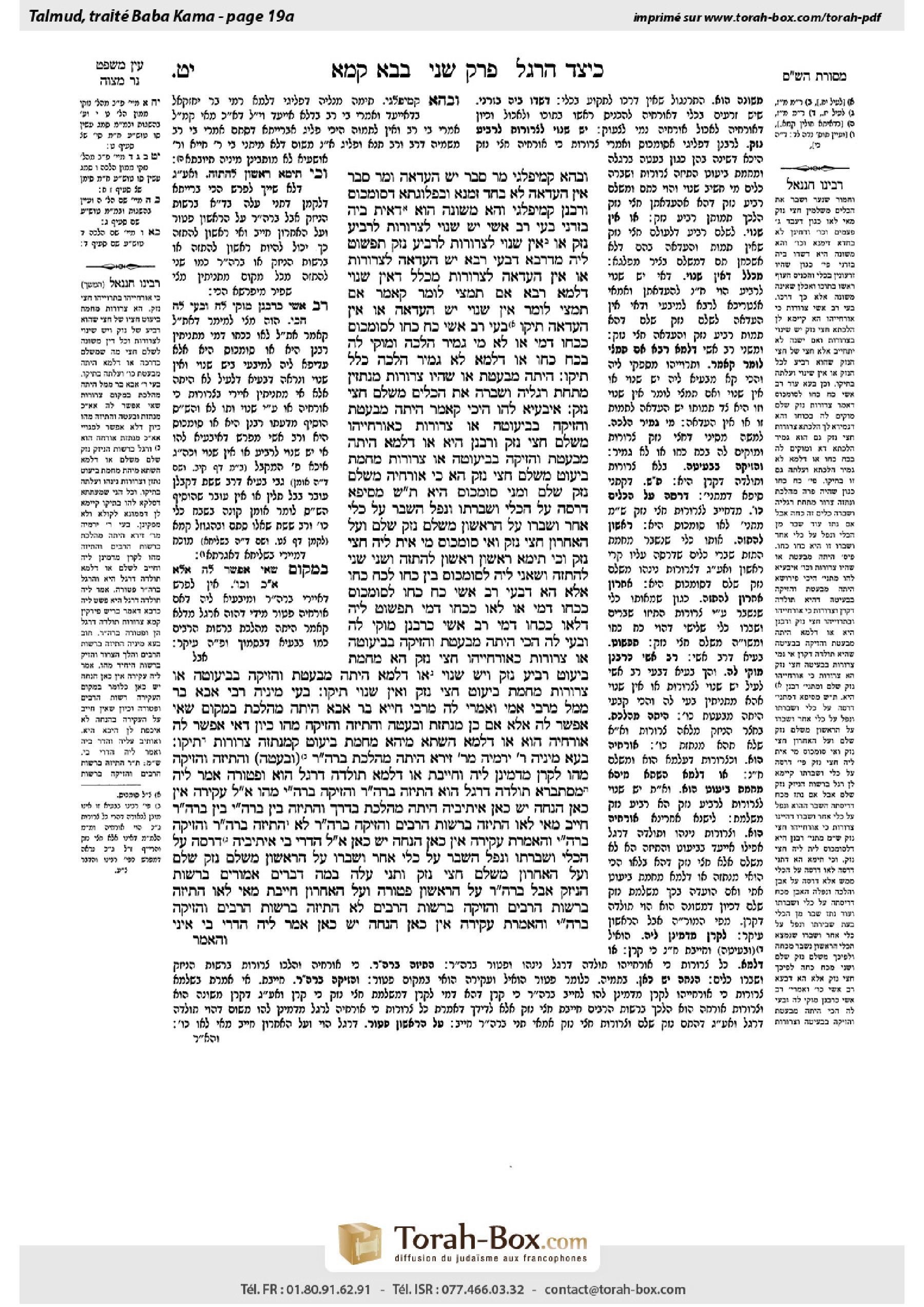
Bava Kamma 19a: Talmud study for Daf Yomi
Study the Talmud for Daf Yomi with scanned pages, Hebrew text, English translations from Sefaria and AI-generated French translations.
Passage selection and English or AI-generated French translation are available where the scan has annotations. Daf Study is independent of Torah-Box and Sefaria.
Browse Bava Kamma · בבא קמא · All tractatesBava Kamma 19a text and translations
This page of Bava Kamma includes the Aramaic text, an English translation and an AI-generated French translation, alongside the scan above.
בבא קמא י״ט א · Aramaic and Hebrew text
וּבְהָא קָמִיפַּלְגִי: מָר סָבַר יֵשׁ הַעֲדָאָה, וּמַר סָבַר אֵין הַעֲדָאָה?
לָא; בְּחַד זִמְנָא, וּבִפְלוּגְתָּא דְּסוֹמְכוֹס וְרַבָּנַן קָמִיפַּלְגִי. וְהָא מְשׁוּנֶּה הוּא! דְּאִית בֵּיהּ בִּזְרָנֵי.
בָּעֵי רַב אָשֵׁי: יֵשׁ שִׁנּוּי לִצְרוֹרוֹת לִרְבִיעַ נֶזֶק, אוֹ אֵין שִׁנּוּי לִצְרוֹרוֹת לִרְבִיעַ נֶזֶק?
תִּפְשׁוֹט לֵיהּ מִדְּרָבָא, דְּבָעֵי רָבָא: יֵשׁ הַעֲדָאָה לִצְרוֹרוֹת, אוֹ אֵין הַעֲדָאָה לִצְרוֹרוֹת? מִכְּלָל דְּאֵין שִׁנּוּי.
דִּלְמָא רָבָא ״אִם תִּמְצֵי לוֹמַר״ קָאָמַר – אִם תִּמְצֵי לוֹמַר אֵין שִׁנּוּי, יֵשׁ הַעֲדָאָה, אוֹ אֵין הַעֲדָאָה? תֵּיקוּ.
בָּעֵי רַב אָשֵׁי: כֹּחַ כֹּחוֹ לְסוֹמְכוֹס, כְּכֹחוֹ דָּמֵי אוֹ לָא?
מִי גְּמִיר הֲלָכָה – וּמוֹקֵי לַהּ בְּכֹחַ כֹּחוֹ, אוֹ דִלְמָא לָא גְּמִיר הֲלָכָה כְּלָל? תֵּיקוּ.
הָיְתָה מְבַעֶטֶת, אוֹ שֶׁהָיוּ צְרוֹרוֹת מְנַתְּזִין מִתַּחַת רַגְלֶיהָ, וְשָׁבְרָה אֶת הַכֵּלִים – מְשַׁלֵּם חֲצִי נֶזֶק. אִיבַּעְיָא לְהוּ: הֵיכִי קָאָמַר?
הָיְתָה מְבַעֶטֶת וְהִזִּיקָה בְּבִיעוּטָהּ, אוֹ צְרוֹרוֹת כְּאוֹרְחַיְיהוּ – מְשַׁלֵּם חֲצִי נֶזֶק, וְרַבָּנַן הִיא; אוֹ דִלְמָא, הָיְתָה מְבַעֶטֶת וְהִזִּיקָה בְּבִיעוּטָהּ, אוֹ צְרוֹרוֹת מֵחֲמַת בִּיעוּט – מְשַׁלֵּם חֲצִי נֶזֶק, הָא כִּי אוֹרְחֵיהּ – מְשַׁלֵּם נֶזֶק שָׁלֵם, וּמַנִּי – סוֹמְכוֹס הִיא?
תָּא שְׁמַע מִסֵּיפָא: דָּרְסָה עַל הַכְּלִי וּשְׁבָרַתּוּ, וְנָפַל הַשֶּׁבֶר עַל כְּלִי אַחֵר וּשְׁבָרוֹ – עַל הָרִאשׁוֹן מְשַׁלֵּם נֶזֶק שָׁלֵם, וְעַל הָאַחֲרוֹן חֲצִי נֶזֶק. וְאִי סוֹמְכוֹס, מִי אִית לֵיהּ חֲצִי נֶזֶק?
וְכִי תֵּימָא ״רִאשׁוֹן״ – רִאשׁוֹן לְהַתָּזָה, וְ״שֵׁנִי״ – שֵׁנִי לְהַתָּזָה; וְשָׁאנֵי לֵיהּ לְסוֹמְכוֹס בֵּין כֹּחוֹ לְכֹחַ כֹּחוֹ;
אֶלָּא הָא דְּבָעֵי רַב אָשֵׁי: כֹּחַ כֹּחוֹ לְסוֹמְכוֹס, כְּכֹחוֹ דָּמֵי אוֹ לָאו כְּכֹחוֹ דָּמֵי? תִּפְשׁוֹט לֵיהּ דְּלָאו כְּכֹחוֹ דָּמֵי!
רַב אָשֵׁי כְּרַבָּנַן מוֹקֵי לַהּ, וּבָעֵי לַהּ הָכִי – הָיְתָה מְבַעֶטֶת וְהִזִּיקָה בְּבִיעוּטָהּ, אוֹ צְרוֹרוֹת כְּאוֹרְחַיְיהוּ – חֲצִי נֶזֶק. הָא מֵחֲמַת בִּיעוּט – רְבִיעַ נֶזֶק, וְיֵשׁ שִׁנּוּי;
אוֹ דִלְמָא, הָיְתָה מְבַעֶטֶת וְהִזִּיקָה בְּבִיעוּטָהּ, אוֹ צְרוֹרוֹת מֵחֲמַת בִּיעוּט – חֲצִי נֶזֶק, וְאֵין שִׁנּוּי? תֵּיקוּ.
בָּעֵי מִינֵּיהּ רַבִּי אַבָּא בַּר מֶמֶל מֵרַבִּי אַמֵּי, וְאָמְרִי לַהּ מֵרַבִּי חִיָּיא בַּר אַבָּא: הָיְתָה מְהַלֶּכֶת בְּמָקוֹם שֶׁאִי אֶפְשָׁר לָהּ אֶלָּא אִם כֵּן מְנַתֶּזֶת, וּבִעֲטָה וְהִתִּיזָה וְהִזִּיקָה, מַהוּ? כֵּיוָן דְּאִי אֶפְשָׁר לַהּ – אוֹרְחַיהּ הוּא; אוֹ דִלְמָא, הַשְׁתָּא מִיהָא מֵחֲמַת בִּיעוּט קָמְנַתְּזָה צְרוֹרוֹת? תֵּיקוּ.
בְּעָא מִינֵּיהּ רַבִּי יִרְמְיָה מֵרַבִּי זֵירָא: הָיְתָה מְהַלֶּכֶת בִּרְשׁוּת הָרַבִּים, וּבִעֲטָה וְהִתִּיזָה וְהִזִּיקָה, מַהוּ? לְקֶרֶן מְדַמֵּינַן לֵיהּ – וְחַיֶּיבֶת, אוֹ דִלְמָא תּוֹלָדָה דְרֶגֶל הוּא – וּפְטוּרָה? אֲמַר לֵיהּ: מִסְתַּבְּרָא, תּוֹלָדָה דְרֶגֶל הוּא.
הִתִּיזָה בִּרְשׁוּת הָרַבִּים וְהִזִּיקָה בִּרְשׁוּת הַיָּחִיד, מַהוּ? אֲמַר לֵיהּ: עֲקִירָה אֵין כָּאן, הַנָּחָה יֵשׁ כָּאן?!
אֵיתִיבֵיהּ: הָיְתָה מְהַלֶּכֶת בַּדֶּרֶךְ וְהִתִּיזָה, בֵּין בִּרְשׁוּת הַיָּחִיד בֵּין בִּרְשׁוּת הָרַבִּים – חַיָּיב. מַאי, לָאו הִתִּיזָה בִּרְשׁוּת הָרַבִּים, וְהִזִּיקָה בִּרְשׁוּת הָרַבִּים? לָא, הִתִּיזָה בִּרְשׁוּת הָרַבִּים, וְהִזִּיקָה בִּרְשׁוּת הַיָּחִיד. וְהָאָמְרַתְּ: עֲקִירָה אֵין כָּאן, הַנָּחָה יֵשׁ כָּאן! אֲמַר לֵיהּ: הֲדַרִי בִּי.
אֵיתִיבֵיהּ: דָּרְסָה עַל הַכְּלִי וּשְׁבָרַתּוּ, וְנָפַל הַשֶּׁבֶר עַל כְּלִי אַחֵר וּשְׁבָרוֹ – עַל הָרִאשׁוֹן מְשַׁלֵּם נֶזֶק שָׁלֵם, וְעַל הָאַחֲרוֹן מְשַׁלֵּם חֲצִי נֶזֶק. וְתָנֵי עֲלַהּ: בַּמֶּה דְּבָרִים אֲמוּרִים – בִּרְשׁוּת הַנִּיזָּק, אֲבָל בִּרְשׁוּת הָרַבִּים – עַל הָרִאשׁוֹן פְּטוּרָה וְעַל הָאַחֲרוֹן חַיֶּיבֶת. מַאי, לָאו הִתִּיזָה בִּרְשׁוּת הָרַבִּים, וְהִזִּיקָה בִּרְשׁוּת הָרַבִּים?
לֹא, הִתִּיזָה בִּרְשׁוּת הָרַבִּים וְהִזִּיקָה בִּרְשׁוּת הַיָּחִיד. וְהָאָמְרַתְּ עֲקִירָה אֵין כָּאן הַנָּחָה יֵשׁ כָּאן! אֲמַר לֵיהּ: הֲדַרִי בִּי.
אִינִי?!
Bava Kamma 19a · English translation
And it is with regard to this that they disagree: One Sage, the first tanna in the baraita cited by Rami bar Yeḥezkel, holds: There is forewarning for pebbles, and one Sage, Rav Yosef, holds: There is no forewarning for pebbles.
The Gemara rejects this resolution: No, perhaps the reference in the baraita is to a case where the rooster or animal damaged the vessel one time. And the tanna’im disagree with regard to the issue that is the subject of the dispute between Sumakhos and the Rabbis, concerning compensation for damage caused by pebbles. The Gemara asks: But isn’t it atypical behavior for an animal to insert its head into a glass vessel, and isn’t all atypical behavior classified within the category of Goring, meaning that the owner should be liable to pay only half the cost of the damage? The Gemara answers: The case is one where there were seeds in the vessel, and therefore the rooster extending its head into the vessel is considered typical behavior.
Rav Ashi raises a dilemma: Is there any halakhic significance to deviation from typical behavior with regard to propelling pebbles, and therefore if an animal propelled pebbles in an atypical manner its owner is liable to pay one-quarter of the damage, i.e., half the restitution for damage caused by pebbles? Or, is there no halakhic significance to deviation from typical behavior with regard to propelling pebbles, resulting in its owner being liable to pay only one-quarter of the damage, and therefore, even in an atypical case, the owner pays the standard restitution of half the cost of the damage?
The Gemara answers: Resolve Rav Ashi’s dilemma from Rava’s dilemma, as Rava raises a dilemma: Is there forewarning for pebbles, or is there no forewarning for pebbles? Based on that dilemma, one may conclude by inference that there is no halakhic significance to deviation from typical behavior with regard to pebbles propelled by an animal, resulting in its owner being liable to pay only one-quarter of the damage, as, were that the case, forewarning would lead to an animal owner’s liability to pay half the cost of the damage.
The Gemara rejects this: Perhaps Rava stated his dilemma employing the style of: If you say. If you say that there is no halakhic significance to deviation from typical behavior with regard to propelling pebbles, resulting in its owner being liable to pay only one-quarter of the damage, and the owner pays half the cost of the damage in every case, is there forewarning for pebbles, meaning that after three incidents the owner pays the full cost of the damage, or is there no forewarning for pebbles? According to that understanding, the halakha with regard to Rav Ashi’s dilemma cannot be inferred from Rava’s dilemma. Rav Ashi’s dilemma shall stand unresolved.
Rav Ashi raises another dilemma with regard to pebbles: According to the opinion of Sumakhos, that one pays the full cost of the damage in the case of propelled pebbles, what is the halakha with regard to damage caused by a force generated by a force generated by the animal’s action? Is the status of that secondary force like that of damage caused by a force generated by its action, in which case the owner is liable, or is its status not like that of damage caused by a force generated by its action?
The Gemara elaborates: Did Sumakhos learn the halakha that one pays half the cost of the damage caused by pebbles as a tradition transmitted to Moses at Sinai, and he interprets that tradition as applying in a case where the damage was caused by a force generated by a force generated by the action of an animal? By contrast, in a typical case of damage caused by pebbles, which is an example of a force generated by the action of an animal, the owner pays the full cost of the damage, as it is a subcategory of Trampling. Or perhaps he did not learn any halakha as a tradition in this regard at all, and therefore even in a case where the damage was caused by a force generated by a force generated by the action of an animal, the owner pays the full cost of the damage, as it is a subcategory of Trampling. The Gemara concludes: This dilemma, too, shall stand unresolved.
§ The mishna teaches: If the animal was kicking while it was walking, or it occurred that pebbles were inadvertently propelled from under its feet and those pebbles broke vessels, the owner of the animal pays half the cost of the damage. A dilemma was raised before the Sages: With regard to what case is the tanna of the mishna speaking?
The Gemara elaborates: Is the tanna saying that if the animal was kicking and caused damage directly with its kick, which is a subcategory of Goring, or if the animal was walking and propelled pebbles in its typical manner, the owner of the animal pays half the cost of the damage, and, accordingly, the mishna is in accordance with the opinion of the Rabbis, who hold that one pays half the cost of damage caused by pebbles? Or perhaps the tanna is saying: If the animal was kicking and caused damage directly with its kick, or if the animal propelled pebbles due to its kick and the pebbles caused damage, the owner of the animal pays half the cost of the damage. Accordingly, one may infer: But if the animal propelled pebbles as it was walking in its typical manner, the owner pays the full cost of the damage, and if so, in accordance with whose opinion is the mishna? It is in accordance with the opinion of Sumakhos.
The Gemara suggests: Come and hear a resolution to this dilemma from the latter clause of the mishna: If an animal trod upon a vessel and broke it and then a shard of that vessel fell upon a second vessel and broke it, the owner pays the full cost of the damage for the first vessel, and he pays half the cost of the damage for the latter vessel. And if the mishna is in accordance with the opinion of Sumakhos, does he hold that one pays half the cost of the damage caused by pebbles?
And if you would say that the mishna is in accordance with the opinion of Sumakhos, and can be understood as follows: The first vessel, concerning which the owner of the animal pays the full cost of the damage, is the first vessel damaged following the propelling of shards from the vessel upon which the animal trod, i.e., the second vessel that was broken. And the second vessel, concerning which the owner of the animal pays half the cost of the damage, is the second vessel following the propelling of shards from the vessel upon which the animal trod, i.e., the third vessel that was broken by shards from the second vessel. And the reason for the difference in liability is that there is a difference, according to Sumakhos, between damage caused by a force generated by the action of an animal, for which the owner pays the full cost of the damage, and damage caused by a force generated by a force generated by its action, for which he pays for only half the cost of the damage.
But if one were to say this explanation, what can be said of that dilemma which Rav Ashi raised: According to the opinion of Sumakhos, that one pays the full cost of the damage in the case of propelled pebbles, what is the halakha with regard to damage caused by a force generated by a force generated by the animal’s action? Is the status of that secondary force like that of damage caused by a force generated by its action, in which case the owner is liable, or is its status not like that of damage caused by a force generated by its action? Why does he have a dilemma? Let him resolve from here that its status is not like that of damage caused by a force generated by its action.
The Gemara answers: Perhaps Rav Ashi interprets the mishna in accordance with the opinion of the Rabbis, that one pays half the cost of the damage in the case of propelled pebbles, and he raises this dilemma: If the animal was kicking and caused damage directly with its kick, which is a subcategory of Goring, or if the animal was walking and propelled pebbles in its typical manner, the owner of the animal pays half the cost of the damage. Accordingly, one may infer: But if the pebbles were propelled due to a kick, the owner pays one-quarter of the damage. And there is halakhic significance to deviation from typical behavior with regard to a case of pebbles, resulting in its owner being liable to pay only one-quarter of the damage.
Or perhaps the tanna is saying: If the animal was kicking and caused damage directly with its kick or if the animal propelled pebbles due to its kick and the pebbles caused damage, the owner of the animal pays half the cost of the damage. And there is no halakhic significance to deviation from typical behavior with regard to a case of pebbles. The Gemara concludes: Rav Ashi’s dilemma shall stand unresolved.
§ Rabbi Abba bar Memel raised a dilemma before Rabbi Ami, and some say that it was before Rabbi Ḥiyya bar Abba: If the animal was walking in a place where it is impossible for it to walk without propelling pebbles as it proceeds, and it kicked and propelled pebbles and caused damage, what is the halakha? The Gemara elaborates: Does one say that since it is impossible for it to walk without propelling pebbles, propelling pebbles is its typical manner in that situation and the halakha in this case would be the same as any case of pebbles? Or perhaps, since now, in any event, the pebbles were propelled due to a kick, it is different. The Gemara concludes: Rabbi Abba bar Memel’s dilemma shall stand unresolved.
§ Rabbi Yirmeya raised a dilemma before Rabbi Zeira: If the animal was walking in the public domain and it kicked and propelled pebbles and caused damage, what is the halakha? The Gemara elaborates: Do we liken the damage in this instance to Goring, since the action was performed with intent, and therefore the owner of the animal is liable even though the incident transpired in the public domain? Or perhaps, since this is a case of pebbles, it is classified as a subcategory of Trampling and the owner is exempt from liability in the public domain. Rabbi Zeira said to him: It stands to reason that it is a subcategory of Trampling.
Rabbi Yirmeya continued and asked Rabbi Zeira another question: If an animal propelled pebbles in the public domain and caused damage on private property, what is the halakha? Rabbi Zeira said to him, employing terminology from the halakhot of Shabbat: If there is no act of lifting here, is there an act of placing here? Since the animal propelled the pebbles in the public domain, the owner is exempt from liability for any damage that it causes. The fact that the damage occurred on private property is not relevant.
Rabbi Yirmeya raised an objection to Rabbi Zeira’s first statement, that one is exempt from liability for one’s animal propelling pebbles in the public domain because it is classified as a subcategory of Trampling, from a baraita: If an animal was walking along the way and it propelled pebbles, whether it was on private property and whether it was in the public domain, the owner is liable to pay damages. What, is it not a case where the pebbles were propelled in the public domain and caused damage in the public domain? Rabbi Zeira replied: No, the reference is to a case where the animal propelled the pebbles in the public domain and caused damage on private property. Rabbi Yirmeya asked him: But didn’t you say: If there is no act of lifting here, is there an act of placing here? Rabbi Zeira said to him: I retract my previous statement, as there is proof from the baraita that there is liability in that case.
Rabbi Yirmeya raised an objection to Rabbi Zeira’s first statement from the mishna: If an animal trod upon a vessel and broke it and then a shard of that vessel fell upon a second vessel and broke it, the owner pays the full cost of the damage for the first vessel, as its action is classified under the primary category of Trampling, and he pays half the cost of the damage for the latter vessel. And it is taught in a baraita with regard to this halakha: In what case is this statement said? It is said in a case where the incident transpired on the private property of the injured party; but if it transpired in the public domain, the owner of the animal is exempt from liability for the first vessel, as it is classified as a subcategory of Trampling, and he is liable for the damage to the second vessel. What, is it not that the animal propelled the pebbles in the public domain and it caused damage in the public domain, indicating that one does not pay for damage caused by pebbles in the public domain?
Rabbi Zeira replied: No, perhaps the reference in the mishna is to a case where the animal propelled the pebbles in the public domain and it caused damage on private property. Rabbi Yirmeya said: But didn’t you say: If there is no act of lifting here, is there an act of placing here? Rabbi Zeira said to him: I retract my previous statement.
Rabbi Yirmeya raises an additional objection to Rabbi Zeira’s statement: Is that so? Is the owner of the animal exempt from liability for pebbles propelled by his animal in the public domain?
Bava Kamma 19a · Traduction française (IA)
Et c'est à propos de cela qu'ils divergent : un sage, le premier tanna du baraïta cité par Rami bar Yéhézqel, affirme : il y a avertissement pour les cailloux, et un autre sage, Rav Yosef, affirme : il n'y a pas d'avertissement pour les cailloux.
La Guemara rejette cette solution : Non, peut-être la référence dans le baraïta est-elle à un cas où le coq ou l'animal a endommagé le récipient une seule fois. Et les tannaïm divergent concernant la question qui est au centre du débat entre Sumakhos et les Rabbins, concernant la réparation des dommages causés par des cailloux. La Guemara demande : Mais n'est-ce pas un comportement atypique qu'un animal insère sa tête dans un récipient en verre, et n'est-ce pas tout comportement atypique classé dans la catégorie de l'attaque, ce qui signifie que le propriétaire est tenu responsable de la moitié du coût des dommages ? La Guemara répond : le cas est celui où il y avait des graines dans le récipient, et donc le coq qui étire sa tête dans le récipient est considéré comme un comportement typique.
Rav Ashi soulève un dilemme : y a-t-il une signification halakhique à la déviation du comportement typique concernant le lancement de cailloux, et donc si un animal lance des cailloux de manière atypique, son propriétaire est tenu responsable de un quart des dommages, c'est-à-dire la moitié de la réparation des dommages causés par des cailloux ? Ou, n'y a-t-il pas de signification halakhique à la déviation du comportement typique concernant le lancement de cailloux, ce qui entraînerait que son propriétaire soit tenu responsable de un quart des dommages, et donc, même dans un cas atypique, le propriétaire paie la réparation standard de la moitié du coût des dommages ?
La Guemara répond : résolvez le dilemme de Rav Ashi à partir du dilemme de Rava, car Rava soulève un dilemme : y a-t-il un avertissement pour les cailloux, ou pas ? À partir de ce dilemme, on peut conclure par déduction que la déviation du comportement typique concernant les cailloux lancés par un animal n'a pas de signification halakhique, ce qui entraîne que son propriétaire soit tenu responsable de un quart des dommages, car, si c'était le cas, l'avertissement entraînerait la responsabilité du propriétaire à payer la moitié du coût des dommages.
La Guemara rejette cela : peut-être Rava a-t-il formulé son dilemme en utilisant le style : Si tu dis. Si tu dis qu'il n'y a pas de signification halakhique à la déviation du comportement typique concernant le lancement de cailloux, ce qui entraîne que son propriétaire soit tenu responsable de un quart des dommages, et que le propriétaire paie la moitié du coût des dommages dans tous les cas, y a-t-il un avertissement pour les cailloux, c'est-à-dire que après trois incidents le propriétaire paie le coût complet des dommages, ou pas ? Selon cette interprétation, la halakha concernant le dilemme de Rav Ashi ne peut pas être déduite à partir du dilemme de Rava. Le dilemme de Rav Ashi restera donc sans solution.
Rav Ashi soulève un autre dilemme concernant les cailloux : selon l'opinion de Sumakhos, qui affirme que l'on paie le coût complet des dommages dans le cas des cailloux lancés, quelle est la halakha concernant les dommages causés par une force générée par une force générée par l'action de l'animal ? Le statut de cette force secondaire est-il comme celui des dommages causés par une force générée par son action, dans ce cas le propriétaire est responsable, ou son statut n'est-il pas comme celui des dommages causés par une force générée par son action ?
La Guemara développe : A-t-il appris Sumakhos la halakha selon laquelle l'on paie la moitié du coût des dommages causés par des cailloux comme une tradition transmise à Moïse au Sinaï, et l'interprète comme s'appliquant à un cas où les dommages ont été causés par une force générée par l'action d'un animal ? À l'inverse, dans un cas typique de dommages causés par des cailloux, qui est un exemple d'une force générée par l'action d'un animal, le propriétaire paie le coût complet des dommages, car il s'agit d'une sous-catégorie de l'écrasement. Ou peut-être n'a-t-il pas appris aucune halakha en ce sens, et donc même dans un cas où les dommages ont été causés par une force générée par l'action d'un animal, le propriétaire paie le coût complet des dommages, car il s'agit d'une sous-catégorie de l'écrasement. La Guemara conclut : ce dilemme, également, restera sans solution.
§ La Michna enseigne : Si l'animal était en train de frapper en marchant, ou s'il s'est produit que des cailloux ont été accidentellement lancés sous ses pieds et que ces cailloux ont brisé des récipients, le propriétaire de l'animal paie la moitié du coût des dommages. Un dilemme a été soulevé devant les Sages : concernant quel cas la tanna de la Michna parle-t-elle ?
La Guemara développe : La tanna dit-il que si l'animal frappait et causait des dommages directement avec son coup, ce qui est une sous-catégorie de l'attaque, ou si l'animal marchait et lançait des cailloux de manière typique, le propriétaire de l'animal paie la moitié du coût des dommages, et donc, en conséquence, la mitsna est en accord avec l'opinion des Rabbins, qui affirment que l'on paie la moitié du coût des dommages causés par des cailloux ? Ou peut-être la tanna dit-il : Si l'animal frappait et causait des dommages directement avec son coup, ou si l'animal lançait des cailloux en raison de son coup et que ces cailloux causaient des dommages, le propriétaire de l'animal paie la moitié du coût des dommages. Ainsi, on peut en déduire : mais si l'animal lançait des cailloux en marchant de manière typique, le propriétaire paie le coût complet des dommages, et si c'est le cas, selon quel avis la mitsna est-elle ? Elle est en accord avec l'opinion de Sumakhos.
La Guemara suggère : Viens écouter une solution à ce dilemme à partir de la dernière clause de la mitsna : Si un animal a foulé un récipient et l'a brisé, et ensuite un fragment de ce récipient est tombé sur un deuxième récipient et l'a brisé, le propriétaire paie le coût complet des dommages pour le premier récipient, et il paie la moitié du coût des dommages pour le second récipient. Et si la mitsna est en accord avec l'opinion de Sumakhos, ne tient-il pas qu'il paie la moitié du coût des dommages causés par des cailloux ?
Et si l'on disait que la michna est selon l'opinion de Sumakhos, et qu'on peut la comprendre ainsi : Le premier récipient, concernant lequel l'propriétaire de l'animal paie le coût complet des dommages, est le premier récipient endommagé suivant la projection de fragments du récipient sur lequel l'animal a marché, c'est-à-dire le deuxième récipient brisé. Et le deuxième récipient, concernant lequel l'propriétaire de l'animal paie la moitié du coût des dommages, est le deuxième récipient endommagé suivant la projection de fragments du récipient sur lequel l'animal a marché, c'est-à-dire le troisième récipient brisé par les fragments du deuxième récipient. Et la raison de la différence de responsabilité est que, selon Sumakhos, il y a une différence entre les dommages causés par une force générée par l'action de l'animal, pour lesquels l'propriétaire paie le coût complet des dommages, et les dommages causés par une force générée par une force générée par son action, pour lesquels il paie seulement la moitié du coût des dommages.
Mais si l'on dit cette explication, que peut-on dire de ce dilemme que Rav Ashi a soulevé : Selon l'opinion de Sumakhos, que l'on paie le coût complet des dommages dans le cas de pierres projetées, quelle est la halakha concernant les dommages causés par une force générée par une force générée par l'action de l'animal ? Le statut de cette force secondaire est-il comme celui des dommages causés par une force générée par son action, dans ce cas l'propriétaire est responsable, ou son statut n'est-il pas comme celui des dommages causés par une force générée par son action ? Pourquoi a-t-il un dilemme ? Laissons-le résoudre d'ici que son statut n'est pas comme celui des dommages causés par une force générée par son action.
La Guemara répond : Peut-être que Rav Ashi interprète la Michna selon l'opinion des Rabbins, que l'on paie la moitié du coût des dommages dans le cas de pierres projetées, et il soulève ce dilemme : Si l'animal a frappé et a causé des dommages directement avec son coup, ce qui est une sous-catégorie de Goring, ou si l'animal marchait et projetait des pierres dans son mode habituel, l'propriétaire de l'animal paie la moitié du coût des dommages. Ainsi, on peut en déduire : Mais si les pierres ont été projetées en raison d'un coup, l'propriétaire paie un quart des dommages. Et il y a une signification halakhique de la déviation du comportement habituel concernant un cas de pierres, ce qui entraîne que l'propriétaire est tenu de payer seulement un quart des dommages.
Ou peut-être que le tanna dit : Si l'animal a frappé et a causé des dommages directement avec son coup ou si l'animal a projeté des pierres en raison de son coup et les pierres ont causé des dommages, l'propriétaire de l'animal paie la moitié du coût des dommages. Et il n'y a pas de signification halakhique de la déviation du comportement habituel concernant un cas de pierres. La Guemara conclut : Le dilemme de Rav Ashi restera sans résolution.
§ Rabbi Abba bar Memel a soulevé un dilemme devant Rabbi Ami, et certains disent que c'était devant Rabbi Ḥiyya bar Abba : Si l'animal marchait dans un lieu où il est impossible qu'il marche sans projeter des pierres en marchant, et qu'il a frappé et projeté des pierres et causé des dommages, quelle est la halakha ? La Guemara développe : Dit-on que puisque c'est impossible qu'il marche sans projeter des pierres, projeter des pierres est son mode habituel dans ce cas et la halakha dans ce cas serait la même qu'un cas de pierres ? Ou peut-être, puisque maintenant, de toute évidence, les pierres ont été projetées en raison d'un coup, c'est différent. La Guemara conclut : Le dilemme de Rabbi Abba bar Memel restera sans résolution.
§ Rabbi Yirmeya a soulevé un dilemme devant Rabbi Zeira : Si l'animal marchait dans le domaine public et avait frappé et projeté des pierres et causé des dommages, quelle est la halakha ? La Guemara développe : Est-ce que l'on compare les dommages dans ce cas à ceux de Goring, puisque l'action a été faite avec l'intention, et donc l'propriétaire de l'animal est responsable même si l'incident s'est produit dans le domaine public ? Ou peut-être, puisque c'est un cas de pierres, il est classé comme une sous-catégorie de Trampling et l'propriétaire est exempt de responsabilité dans le domaine public. Rabbi Zeira a dit à lui : Il est logique qu'il soit une sous-catégorie de Trampling.
Rabbi Yirmeya a continué et a posé une autre question à Rabbi Zeira : Si un animal a projeté des pierres dans le domaine public et a causé des dommages sur une propriété privée, quelle est la halakha ? Rabbi Zeira a dit à lui, en utilisant le vocabulaire des halakhot de Shabbat : Si il n'y a pas d'acte de levée ici, y a-t-il un acte de placement ici ? Puisque l'animal a projeté les pierres dans le domaine public, l'propriétaire est exempt de responsabilité pour tout dommage qu'il cause. Le fait que le dommage s'est produit sur une propriété privée n'est pas pertinent.
Rabbi Yirmeya souleva une objection contre la première déclaration de Rabbi Zeira, selon laquelle l'on est exempt de responsabilité pour l'animal projetant des pierres dans le domaine public, car il est classé comme une sous-catégorie de l'écrasement, à partir d'une baraïta : Si un animal marchait sur la route et projetait des pierres, qu'il soit sur une propriété privée ou dans le domaine public, l'owner est tenu de payer les dommages. Qu'est-ce que cela n'est pas un cas où les pierres ont été projetées dans le domaine public et ont causé des dommages dans le domaine public ? Rabbi Zeira répondit : Non, la référence est à un cas où l'animal a projeté les pierres dans le domaine public et a causé des dommages sur une propriété privée. Rabbi Yirmeya demanda : Mais n'as-tu pas dit : Si il n'y a pas d'acte de levée ici, y a-t-il un acte de placement ici ? Rabbi Zeira dit à lui : Je retire ma déclaration précédente, car il y a une preuve dans la baraïta que l'on est tenu de responsabilité dans ce cas.
Rabbi Yirmeya souleva une objection contre la première déclaration de Rabbi Zeira tirée de la mitsna : Si un animal marche sur un récipient et le brise, et ensuite un fragment de ce récipient tombe sur un deuxième récipient et le brise, l'propriétaire paie le coût complet des dommages pour le premier récipient, car son action est classée sous la catégorie principale de la foulée, et il paie la moitié du coût des dommages pour le second récipient. Et il est enseigné dans une baraïta concernant cette halakha : Dans quel cas cette déclaration est-elle dite ? Elle est dite dans un cas où l'incident s'est produit sur la propriété privée de la personne blessée ; mais si l'incident s'est produit dans le domaine public, l'propriétaire de l'animal est exempt de responsabilité pour le premier récipient, car il est classé comme une sous-catégorie de la foulée, et il est responsable des dommages causés au second récipient. Qu'est-ce que cela ne signifie pas que l'animal a propulsé des cailloux dans le domaine public et a causé des dommages dans le domaine public, indiquant que l'on ne paie pas pour les dommages causés par des cailloux dans le domaine public ?
Rabbi Zeira répondit : Non, peut-être que la référence dans la mitsna est à un cas où l'animal a propulsé des cailloux dans le domaine public et a causé des dommages sur la propriété privée. Rabbi Yirmeya dit : Mais n'avez-vous pas dit : S'il n'y a pas d'acte de levée ici, y a-t-il un acte de placement ici ? Rabbi Zeira dit à lui : Je retire ma déclaration précédente.
Rabbi Yirmeya soulève une autre objection contre la déclaration de Rabbi Zeira : Est-ce que cela est vrai ? L'propriétaire de l'animal est-il exempt de responsabilité pour les cailloux propulsés par son animal dans le domaine public ?
Traduction française générée par IA à partir de l’édition anglaise de Sefaria. Vérifie toujours un passage avec le texte source.
Text from Sefaria: William Davidson Edition - Vocalized Aramaic (CC BY NC); William Davidson Edition - English (CC BY NC).