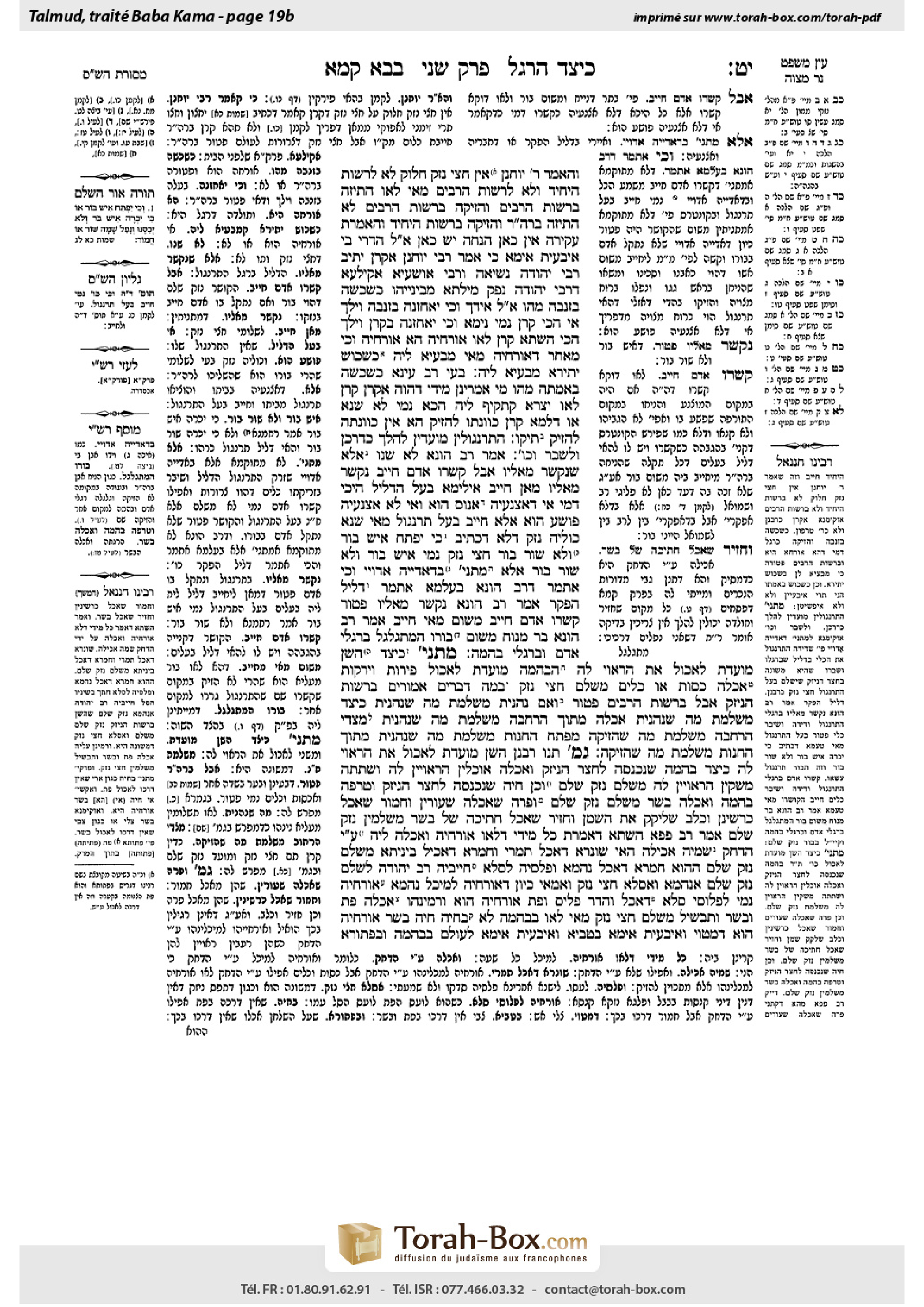
Bava Kamma 19b: Talmud study for Daf Yomi
Study the Talmud for Daf Yomi with scanned pages, Hebrew text, English translations from Sefaria and AI-generated French translations.
Passage selection and English or AI-generated French translation are available where the scan has annotations. Daf Study is independent of Torah-Box and Sefaria.
Browse Bava Kamma · בבא קמא · All tractatesBava Kamma 19b text and translations
This page of Bava Kamma includes the Aramaic text, an English translation and an AI-generated French translation, alongside the scan above.
בבא קמא י״ט ב · Aramaic and Hebrew text
וְהָאָמַר רַבִּי יוֹחָנָן: אֵין חֲצִי נֶזֶק חָלוּק לֹא לִרְשׁוּת הַיָּחִיד וְלֹא לִרְשׁוּת הָרַבִּים. מַאי, לָאו הִתִּיזָה בִּרְשׁוּת הָרַבִּים, וְהִזִּיקָה בִּרְשׁוּת הָרַבִּים? לָא; הִתִּיזָה בִּרְשׁוּת הָרַבִּים, וְהִזִּיקָה בִּרְשׁוּת הַיָּחִיד.
וְהָאָמְרַתְּ: עֲקִירָה אֵין כָּאן, הַנָּחָה יֵשׁ כָּאן! אֲמַר לֵיהּ: הֲדַרִי בִּי. אִיבָּעֵית אֵימָא: כִּי אֲמַר רַבִּי יוֹחָנָן – אֲקַרַן.
יָתֵיב רַבִּי יְהוּדָה נְשִׂיאָה וְרַבִּי אוֹשַׁעְיָא אַקִּילְעָא דְּרַבִּי יְהוּדָה, נְפַק מִילְּתָא מִבֵּינַיְיהוּ: כִּשְׁכְּשָׁה בִּזְנָבָהּ, מַהוּ? אֲמַר לֵיהּ אִידַּךְ: וְכִי יֹאחֲזֶנָּה בִּזְנָבָהּ וְיֵלֵךְ?! אִי הָכִי, קֶרֶן נָמֵי, נֵימָא: וְכִי יֹאחֲזֶנָּה בְּקֶרֶן וְיֵלֵךְ?!
הָכִי הַשְׁתָּא?! קֶרֶן לָאו אוֹרְחֵיהּ, הָא אוֹרְחַיהּ.
וְכִי מֵאַחַר דְּאוֹרְחַיהּ, מַאי מִבַּעְיָא לֵיהּ? כִּשְׁכּוּשׁ יַתִּירָא מִבַּעְיָא לֵיהּ.
בָּעֵי רַב עֵינָא: כִּשְׁכְּשָׁה בְּאַמָּתָהּ מַהוּ? מִי אָמְרִינַן מִידֵּי דְּהָוֵה אַקֶּרֶן – קֶרֶן לָאו יִצְרָא קָתָקֵיף לֵיהּ? הָכָא נָמֵי לָא שְׁנָא; אוֹ דִלְמָא, קֶרֶן כַּוּוֹנָתוֹ לְהַזִּיק, הָא אֵין כַּוּוֹנָתָהּ לְהַזִּיק? תֵּיקוּ.
הַתַּרְנְגוֹלִין מוּעָדִין לְהַלֵּךְ כְּדַרְכָּן וּלְשַׁבֵּר וְכוּ׳. אָמַר רַב הוּנָא: לֹא שָׁנוּ אֶלָּא שֶׁנִּקְשַׁר מֵאֵלָיו, אֲבָל קְשָׁרוֹ אָדָם – חַיָּיב.
נִקְשַׁר מֵאֵלָיו – מַאן חַיָּיב? אִילֵימָא בַּעַל הַדְּלִיל, הֵיכִי דָמֵי? אִי דְּאַצְנְעֵיהּ – אָנוּס הוּא! וְאִי לָא אַצְנְעֵיהּ – פּוֹשֵׁעַ הוּא!
אֶלָּא חַיָּיב בַּעַל תַּרְנְגוֹל? מַאי שְׁנָא כּוּלֵּיהּ נֶזֶק דְּלָא – דִּכְתִיב: ״כִּי יִפְתַּח אִישׁ בּוֹר״ – וְלֹא שׁוֹר בּוֹר; חֲצִי נֶזֶק נָמֵי, ״אִישׁ בּוֹר״ – וְלֹא שׁוֹר בּוֹר!
אֶלָּא מַתְנִיתִין בִּדְאַדְּיֵיהּ אַדּוֹיֵי. וְכִי אִתְּמַר דְּרַב הוּנָא – בְּעָלְמָא אִתְּמַר. דְּלִיל הֶפְקֵר – אָמַר רַב הוּנָא: נִקְשַׁר מֵאֵלָיו – פָּטוּר, קְשָׁרוֹ אָדָם – חַיָּיב.
מִשּׁוּם מַאי חַיָּיב? אָמַר רַב הוּנָא בַּר מָנוֹחַ: מִשּׁוּם בּוֹרוֹ הַמִּתְגַּלְגֵּל בְּרַגְלֵי אָדָם וּבְרַגְלֵי בְהֵמָה.
מַתְנִי׳ כֵּיצַד הַשֵּׁן מוּעֶדֶת? לֶאֱכוֹל אֶת הָרָאוּי לָהּ. הַבְּהֵמָה מוּעֶדֶת לֶאֱכוֹל פֵּירוֹת וִירָקוֹת. אָכְלָה כְּסוּת אוֹ כֵלִים – מְשַׁלֵּם חֲצִי נֶזֶק. בַּמֶּה דְּבָרִים אֲמוּרִים – בִּרְשׁוּת הַנִּיזָּק, אֲבָל בִּרְשׁוּת הָרַבִּים – פָּטוּר.
וְאִם נֶהֱנֵית – מְשַׁלֶּמֶת מַה שֶּׁנֶּהֱנֵית.
כֵּיצַד מְשַׁלֶּמֶת מַה שֶּׁנֶּהֱנֵית? אָכְלָה מִתּוֹךְ הָרְחָבָה – מְשַׁלֶּמֶת מַה שֶּׁנֶּהֱנֵית, מִצִּדֵּי הָרְחָבָה – מְשַׁלֶּמֶת מַה שֶּׁהִזִּיקָה. מִפֶּתַח הַחֲנוּת – מְשַׁלֶּמֶת מַה שֶּׁנֶּהֱנֵית, מִתּוֹךְ הַחֲנוּת – מְשַׁלֶּמֶת מַה שֶּׁהִזִּיקָה.
גְּמָ׳ תָּנוּ רַבָּנַן: הַשֵּׁן מוּעֶדֶת לֶאֱכוֹל אֶת הָרָאוּי לָהּ – כֵּיצַד? בְּהֵמָה שֶׁנִּכְנְסָה לַחֲצַר הַנִּיזָּק, וְאָכְלָה אוֹכָלִין הָרְאוּיִין לָהּ וְשָׁתְתָה מַשְׁקִין הָרְאוּיִין לָהּ – מְשַׁלֵּם נֶזֶק שָׁלֵם. וְכֵן חַיָּה שֶׁנִּכְנְסָה לַחֲצַר הַנִּיזָּק, וְטָרְפָה בְּהֵמָה וְאָכְלָה בָּשָׂר – מְשַׁלֵּם נֶזֶק שָׁלֵם.
וּפָרָה שֶׁאָכְלָה שְׂעוֹרִין, וַחֲמוֹר שֶׁאָכַל כַּרְשִׁינִין, וְכֶלֶב שֶׁלִּיקֵּק אֶת הַשֶּׁמֶן, וַחֲזִיר שֶׁאָכַל חֲתִיכָה שֶׁל בָּשָׂר – מְשַׁלְּמִין נֶזֶק שָׁלֵם. אָמַר רַב פָּפָּא, הַשְׁתָּא דְּאָמְרַתְּ: כֹּל מִידֵּי דְּלָאו אוֹרְחֵיהּ, וְאָכְלָה לֵיהּ עַל יְדֵי הַדְּחָק – שְׁמֵיהּ אֲכִילָה; הַאי שׁוּנָּרָא דַּאֲכַל תַּמְרֵי, וַחֲמָרָא דַּאֲכַיל בִּינִיתָא – מְשַׁלֵּם נֶזֶק שָׁלֵם.
הָהוּא חַמְרָא דַּאֲכַל נַהֲמָא וּפַלְּסֵיהּ לְסַלָּא, חַיְּיבֵיהּ רַב יְהוּדָה לְשַׁלֵּם נֶזֶק שָׁלֵם אַנַּהֲמָא, וְאַסַּלָּא חֲצִי נֶזֶק. וְאַמַּאי? כֵּיוָן דְּאוֹרְחֵיהּ לְמֵיכַל נַהֲמָא – אוֹרְחֵיהּ נָמֵי לְפַלּוֹסֵי סַלָּא! דַּאֲכַל וַהֲדַר פַּלֵּיס.
וּפַת אוֹרְחֵיהּ הוּא?! וּרְמִינְהוּ: אָכְלָה פַּת וּבָשָׂר וְתַבְשִׁיל – מְשַׁלֵּם חֲצִי נֶזֶק. מַאי, לָאו בִּבְהֵמָה? לֹא, בְּחַיָּה.
חַיָּה – בָּשָׂר אוֹרְחֵיהּ הוּא! דְּמִטְּוֵי. וְאִיבָּעֵית אֵימָא: בְּטַבְיָא. וְאִיבָּעֵית אֵימָא: לְעוֹלָם בִּבְהֵמָה, וּבְפָתוּרָא.
Bava Kamma 19b · English translation
But doesn’t Rabbi Yoḥanan say: Payment of half the cost of the damage is not differentiated between private and public domains, as there is no exemption from payment neither for damage on private property nor for damage in the public domain? What, is this principle not stated even in a case where the animal propelled pebbles in the public domain and caused damage in the public domain? Rabbi Zeira said to him: No, Rabbi Yoḥanan stated this principle in a case where the animal propelled pebbles in the public domain and caused damage on private property.
Rabbi Yirmeya said to him: But didn’t you say: If there is no act of lifting here, is there an act of placing here? Rabbi Zeira said to him: I retract my previous statement. Or, if you wish, say instead: When Rabbi Yoḥanan said that payment of half the cost of the damage is not differentiated between private and public domains, and there is no exemption from payment neither for damage on private property nor for damage in the public domain, he said it only with regard to damage in the category of Goring, but not with regard to the case of propelled pebbles, for which one is exempt in the public domain.
§ The Gemara relates that Rabbi Yehuda Nesia and Rabbi Oshaya sat in the antechamber [akil’a] of Rabbi Yehuda Nesia. A matter emerged from among them and one of them raised a dilemma: If an animal swung its tail and thereby caused damage, what is the halakha? The other Sage said to him: Must the owner grasp its tail and walk to prevent the animal from causing damage? Since this is typical behavior for the animal, the owner should be exempt from liability. The Gemara asks: If so, with regard to damage in the category of Goring, too, let us say: Must the owner grasp its horn and walk to prevent the animal from causing damage? Nevertheless, the halakha is that the owner is liable for damage in the category of Goring.
The Gemara rejects this: How can these cases be compared? Damage in the category of Goring is not caused in the course of the typical behavior of the animal. Consequently, the owner is required to prevent his animal from causing damage in that manner. This damage caused by the swinging of an animal’s tail is caused in the course of its typical behavior, and one cannot hold the owner responsible for an animal's normal behavior.
The Gemara asks: And since that is its typical behavior, what is the dilemma that he raised? Obviously one has no liability for the damage caused by the typical behavior of his animal in the public domain. The Gemara answers: He raised a dilemma with regard to a case of excessive tail swinging; is excessive tail swinging considered typical behavior?
Rav Eina raises a dilemma: If an animal swung its penis and caused damage, what is the halakha? The Gemara elaborates: Do we say just as it is with regard to Goring: Is it not so in a case of Goring that the animal’s inclination overcame it and caused it to gore? Here too, it is no different: The animal’s inclination overcame it and that is why it caused damage. Or perhaps the cases are different, as in the case of damage in the category of Goring the objective of its action is to cause damage, whereas in this case the objective of its action is not to cause damage. The Gemara concludes: This dilemma shall stand unresolved.
§ The mishna teaches: Chickens are deemed forewarned with regard to walking in their typical manner and breaking objects. If there was a string tied to a chicken’s leg and it broke a vessel, or if the chicken was hopping in an atypical manner and breaking vessels, its owner pays half the cost of the damage. Rav Huna says: They taught that one pays half the cost of the damage only in a case where the string was tied to the leg of the chicken on its own, i.e., a string became entangled on the leg of a chicken without the involvement of the owner and an item was broken by the string; but if a person tied the string to the chicken, he is liable to pay the full cost of the damage, as the string is in the category of Pit.
The Gemara asks: If the string was tied on its own, who is liable to pay half the cost of the damage? If we say it is the owner of the string who pays, as the damage was caused by the string, what are the circumstances? If it is a case where the owner of the string concealed the string in a secure place and the chicken became entangled in it, the owner of the string is a victim of circumstances beyond his control and would be exempt from payment. And if he did not conceal it and instead left it exposed where it could become entangled in the feet of a passing chicken, he is negligent and liable as though he actually tied the string to the chicken.
Rather, the case in the mishna is one where the owner of the string concealed it and is exempt from liability, and Rav Huna means that the owner of the chicken is liable. Here too, the question arises: What is different in this case where one is not obligated to pay the full cost of the damage, as it is written (Exodus 21:33): “If a man shall open a pit, or if a man shall dig a pit and not cover it, and an ox or a donkey fall therein,” he pays the damage, and it is not written: If an ox shall open a pit. This indicates that if an ox opens a pit, the owner of the ox is exempt from liability. With regard to the payment of half the cost of the damage as well, the owner should be exempt from liability, as it is written: “If a man shall open a pit,” and it is not written: If an ox shall open a pit.
Rather, the case in the mishna is one where the chicken moved the string and thereby caused damage. Since the chicken did not cause damage with its body, the owner pays half the cost of the damage, as he does in a case of pebbles. And when Rav Huna’s distinction between whether the string was tied on its own or by a person was stated, it was stated in a general sense, and not with regard to the halakha in the mishna. With regard to an ownerless string tied to the leg of a chicken, Rav Huna says: If the string was tied to the leg of the chicken on its own, the owner of the chicken is exempt; but if a person tied the string to the chicken, he is liable to pay the full cost of the damage.
The Gemara asks: Due to what primary category of damage is he liable? Rav Huna bar Manoaḥ says: He is liable due to the fact that although the string is not stationary, as in the standard obstacle in the primary category of Pit, this is an example of his pit that is rolled at the feet of a person and at the hooves of an animal, and that too is a subcategory of Pit.
MISHNA: Within the context of the primary category of Eating, for what damage caused with the tooth is an animal deemed forewarned? It is deemed forewarned with regard to eating food items fit for its consumption. The domesticated animal is deemed forewarned with regard to eating fruits and vegetables. If the animal ate garments or vessels, the owner pays half the cost of the damage. As these are not items fit for its consumption, the animal is not deemed forewarned in this case. In what case is this statement applied, that one pays the full value of the food eaten by the animal? It is a case where the animal ate the food on the property of the injured party; but if the animal ate food in the public domain, the owner of the animal is exempt from liability.
And even if the animal ate food in the public domain, if the animal derives benefit from eating another’s produce in the public domain, the owner pays for the benefit that it derives, just not for the full cost of the food.
Under what circumstances does the owner of the animal pay for the benefit that it derives? If the animal ate produce in the public square in the area before the storefronts, the owner of the animal pays for the benefit that it derives. If the animal ate from food placed at the side of the public square, which is not a public thoroughfare, the owner of the animal pays for what it damaged, as the legal status of that area is like that of the property of the injured party. If the animal ate produce from the entrance of the store, its owner pays for the benefit that it derives, as the status of a store entrance is like that of the public domain. If the animal ate produce from inside the store, its owner pays for what it damaged.
GEMARA: The Sages taught: Eating is deemed forewarned in that an animal tends to eat that which is fit for it to eat. How is this applied? In the case of a domesticated animal that entered the courtyard of the injured party and it ate food fit for it to eat, or if it drank drinks fit for it to drink, the owner of the animal must pay the full cost of the damage. And similarly, in the case of an undomesticated animal that entered the courtyard of the injured party and tore apart a domesticated animal and ate its meat there, the owner must pay the full cost of the damage.
And in the case of a cow that ate barley, although this is not normally a food that a cow would eat, or in the case of a donkey that ate vetches, i.e., legumes which are usually fed to cows but not to donkeys, or in the case of a dog that licked oil or a pig that ate meat, the owner of the animal must pay the full cost of the damage. Although these animals do not ordinarily consume these items, doing so is not a significant deviation from the animal’s typical behavior. Rav Pappa said: Now that you said that eating anything that is not typical for an animal to eat but it eats it under duress is considered an ordinary act of eating, it can be deduced that in the case of a cat that eats dates or a donkey that is eating fish, the owner must pay the full cost of the damage, despite the fact that these animals do not ordinarily eat these items.
The Gemara relates: There was a certain donkey that ate bread and while eating it also broke the basket in which the bread was stored. Rav Yehuda obligated the owner to pay the full cost of the damage for the loss of the bread and half the cost of the damage to the basket. The Gemara asks: But why? Since it is typical for a donkey to eat bread, it is also typical for it to break the basket in which the bread is stored; therefore, the owner should pay the full cost of the damage for the basket as well. The Gemara answers: This case is one where the donkey ate the bread and then afterward broke the basket, a sequence which demonstrates that its intent was to cause damage. The breaking of the basket is therefore a subcategory of Goring, and the owner is liable to pay only half the cost of the damage.
The Gemara asks: But is it typical for a donkey to eat bread? The Gemara raises a contradiction against this based on a baraita: If it ate bread or meat or a cooked dish, its owner must pay for half the cost of the damage. What, is it not referring to a domesticated animal and thereby implying that it is not typical for a domesticated animal to eat bread? The Gemara rejects this: No, it is discussing an undomesticated animal, which does not typically eat bread, but a domesticated animal does eat bread.
The Gemara questions this explanation: If the baraita is discussing an undomesticated animal, then it is typical for it to eat meat. The Gemara clarifies: The baraita is referring meat that is roasted, and it is not typical for an undomesticated animal to eat roasted meat. Or, if you wish, say instead that the halakha of the baraita is not stated with regard to an undomesticated predator, but with regard to a deer, which does not ordinarily eat meat and bread. Or, if you wish, say that actually it is discussing a domesticated animal, but it is discussing a case where the animal ate at the table, and this is not typical behavior for an animal.
Bava Kamma 19b · Traduction française (IA)
Mais n’est-ce pas que Rabbi Yoḥanan dit : Le paiement de la moitié du coût des dommages ne distingue pas entre propriété privée et domaine public, car il n’y a pas d’exonération du paiement, ni pour les dommages sur la propriété privée, ni pour les dommages dans le domaine public ? Qu’est-ce que cela signifie, ce principe n’est-il pas énoncé même dans un cas où l’animal lançait des cailloux dans le domaine public et causait des dommages dans le domaine public ? Rabbi Zeira répondit à lui : Non, Rabbi Yoḥanan a énoncé ce principe dans un cas où l’animal lançait des cailloux dans le domaine public et causait des dommages sur la propriété privée.
Rabbi Yirmeya répondit à lui : Mais n’avez-vous pas dit : S’il n’y a pas d’acte de levée ici, y a-t-il un acte de placement ici ? Rabbi Zeira répondit à lui : Je retire ma déclaration précédente. Ou, si vous préférez, dites plutôt : Lorsque Rabbi Yoḥanan a dit que le paiement de la moitié du coût des dommages ne distingue pas entre propriété privée et domaine public, et qu’il n’y a pas d’exonération du paiement, ni pour les dommages sur la propriété privée, ni pour les dommages dans le domaine public, il l’a dit uniquement concernant les dommages dans la catégorie de l’attaque, mais pas concernant le cas des cailloux lancés, pour lesquels l’on est exempt dans le domaine public.
§ Le Guemara rapporte que Rabbi Yehuda Nesia et Rabbi Oshaya s’asseyaient dans l’antichambre [akil’a] de Rabbi Yehuda Nesia. Une affaire émergea entre eux et l’un d’eux posa un dilemme : Si un animal balayait sa queue et causait ainsi des dommages, quelle est la halakha ? L’autre Sage répondit à lui : Faut-il que l’propriétaire tienne sa queue et marche pour empêcher l’animal de causer des dommages ? Puisque c’est un comportement typique de l’animal, l’propriétaire devrait être exempt de responsabilité. Le Guemara demande : Si c’est ainsi, concernant les dommages dans la catégorie de l’attaque, disons-nous aussi : Faut-il que l’propriétaire tienne son cornet et marche pour empêcher l’animal de causer des dommages ? Cependant, la halakha est que l’propriétaire est responsable des dommages dans la catégorie de l’attaque.
Le Guemara rejette cette comparaison : Comment peuvent ces cas être comparés ? Les dommages dans la catégorie de l’attaque ne sont pas causés dans le cours du comportement typique de l’animal. Par conséquent, l’owner est tenu de prévenir son animal de causer des dommages ainsi. Ce dommage causé par le balayage de la queue d’un animal est causé dans le cours de son comportement typique, et l’on ne peut tenir l’owner responsable du comportement normal de l’animal.
Le Guemara demande : Et puisque c’est son comportement typique, quelle est la difficulté qu’il a posée ? Évidemment, on n’est pas responsable des dommages causés par le comportement typique de son animal dans le domaine public. Le Guemara répond : Il a posé une difficulté concernant un cas de balayage excessif de la queue ; est-ce que le balayage excessif est considéré comme un comportement typique ?
Rav Eina pose une difficulté : Si un animal balayait son pénis et causait des dommages, quelle est la halakha ? Le Guemara développe : Disons-nous comme dans le cas de l’attaque : N’est-ce pas dans le cas d’une attaque que l’inclination de l’animal l’a emporté et l’a fait attaquer ? Ici aussi, c’est pareil : L’inclination de l’animal l’a emporté et c’est pourquoi il a causé des dommages. Ou peut-être les cas sont différents, car dans le cas des dommages dans la catégorie d’attaque, l’objectif de son action est de causer des dommages, tandis que dans ce cas, l’objectif de son action n’est pas de causer des dommages. Le Guemara conclut : Cette difficulté restera sans solution.
§ La mitsva enseigne : Les poulets sont considérés comme avertis concernant leur comportement typique et la cassure d’objets. Si une corde était attachée à la patte d’un poulet et qu’elle brisait un vase, ou si le poulet sautait de manière atypique et brisait des vases, son propriétaire paie la moitié du coût des dommages. Rav Huna dit : Ils ont enseigné que l’on paie la moitié du coût des dommages uniquement dans un cas où la corde était attachée à la patte du poulet de manière indépendante, c’est-à-dire une corde s’est enroulée autour de la patte d’un poulet sans la participation du propriétaire et un objet a été brisé par la corde ; mais si un homme a attaché la corde au poulet, il est responsable de payer le coût complet des dommages, car la corde est dans la catégorie de la fosse.
Le Guemara demande : Si la corde était attachée de manière indépendante, qui est tenu responsable de payer la moitié du coût des dommages ? Si nous disons que c’est le propriétaire de la corde qui paie, car les dommages ont été causés par la corde, quels sont les circonstances ? Si c’est un cas où le propriétaire de la corde a caché la corde dans un lieu sécurisé et le poulet s’est enroulé autour d’elle, le propriétaire de la corde est une victime des circonstances hors de son contrôle et serait exempt de paiement. Et si ce n’est pas le cas, c’est-à-dire s’il n’a pas caché la corde et l’a laissée exposée où elle pouvait s’enrouler autour des pieds d’un poulet passant, il est négligent et responsable comme s’il avait effectivement attaché la corde au poulet.
Plutôt, le cas dans la mitsna est celui où l'propriétaire de la corde a caché la corde et est exempt de responsabilité, et Rav Huna signifie que l'propriétaire du poulet est responsable. Ici aussi, la question se pose : Qu'est-ce qui diffère dans ce cas où l'on n'est pas tenu de payer le coût complet des dommages, comme il est écrit (Exode 21:33) : "Si un homme ouvre un puits, ou si un homme creuse un puits et ne le recouvre pas, et un bœuf ou un âne tombe dedans", il paie le dommage, et il n'est pas écrit : Si un bœuf ouvre un puits. Cela indique que si un bœuf ouvre un puits, l'propriétaire du bœuf est exempt de responsabilité. En ce qui concerne le paiement de la moitié du coût des dommages également, l'propriétaire devrait être exempt de responsabilité, comme il est écrit : "Si un homme ouvre un puits", et il n'est pas écrit : Si un bœuf ouvre un puits."
Plutôt, le cas dans la mitsna est celui où le poulet a déplacé la corde et a causé des dommages. Puisque le poulet n'a pas causé de dommages avec son corps, l'propriétaire paie la moitié du coût des dommages, comme dans le cas des cailloux. Et lorsque la distinction de Rav Huna entre le fait que la corde était attachée de manière indépendante ou par une personne a été énoncée, elle a été énoncée dans un sens général, et non concernant la halakha dans la mitsna. En ce qui concerne une corde sans propriétaire attachée à la patte d'un poulet, Rav Huna dit : Si la corde était attachée à la patte du poulet de manière indépendante, l'propriétaire du poulet est exempt ; mais si une personne a attaché la corde au poulet, il est responsable de payer le coût complet des dommages.
Le Guemara pose la question : Pour quelle catégorie principale de dommage est-il responsable ? Rav Huna bar Manoaḥ dit : Il est responsable du fait que, bien que la corde ne soit pas immobile, comme dans l'obstacle standard de la catégorie principale de la fosse, c'est un exemple de sa fosse qui roule aux pieds d'un homme et aux sabots d'un animal, et cela aussi est une sous-catégorie de la fosse.
MICHNA : Dans le contexte de la catégorie principale de la consommation, pour quel dommage causé par les dents un animal est-il considéré comme averti ? Il est considéré comme averti en ce qui concerne la consommation d'aliments adaptés à sa consommation. L'animal domestiqué est considéré comme averti en ce qui concerne la consommation de fruits et légumes. Si l'animal a mangé des vêtements ou des objets, le propriétaire paie la moitié du coût du dommage. Comme ces objets ne sont pas adaptés à sa consommation, l'animal n'est pas considéré comme averti dans ce cas. Dans quel cas cette déclaration s'applique-t-elle, à savoir qu'on paie la valeur totale des aliments mangés par l'animal ? C'est le cas où l'animal a mangé les aliments sur la propriété de la personne blessée ; mais si l'animal a mangé des aliments dans le domaine public, le propriétaire de l'animal est exempt de responsabilité.
Et même si l'animal a mangé des aliments dans le domaine public, si l'animal tire un bénéfice de la consommation des produits d'autrui dans le domaine public, le propriétaire paie le bénéfice qu'il en tire, mais pas le coût total des aliments.
Dans quelles circonstances le propriétaire de l'animal paie-t-il le bénéfice qu'il en tire ? Si l'animal a mangé des produits dans la place publique dans la zone avant les boutiques, le propriétaire de l'animal paie le bénéfice qu'il en tire. Si l'animal a mangé des aliments placés aux côtés de la place publique, qui n'est pas une voie publique, le propriétaire de l'animal paie le dommage qu'il a causé, car le statut juridique de cette zone est comme celui de la propriété de la personne blessée. Si l'animal a mangé des produits à l'entrée de la boutique, son propriétaire paie le bénéfice qu'il en tire, car le statut de l'entrée de la boutique est comme celui du domaine public. Si l'animal a mangé des produits à l'intérieur de la boutique, son propriétaire paie le dommage qu'il a causé.
GUEMARA : Les Sages enseignent : La consommation est considérée comme anticipée dans la mesure où l'animal a tendance à manger ce qui est adapté à sa consommation. Comment s'applique-t-elle ? Dans le cas d'un animal domestiqué qui est entré dans la cour de la personne blessée et qui a mangé des aliments adaptés à sa consommation, ou s'il a bu des boissons adaptées à sa consommation, le propriétaire de l'animal doit payer le coût total du dommage. De même, dans le cas d'un animal non domestiqué qui est entré dans la cour de la personne blessée et qui a déchiré un animal domestiqué et mangé sa viande là, le propriétaire doit payer le coût total du dommage.
Et dans le cas d'une vache qui a mangé du blé, bien que ce ne soit pas normalement un aliment que la vache mange, ou dans le cas d'un âne qui a mangé des pois, c'est-à-dire des légumineuses qui sont normalement nourris aux vaches mais pas aux ânes, ou dans le cas d'un chien qui a léché de l'huile ou d'un porc qui a mangé de la viande, le propriétaire de l'animal doit payer le coût total du dommage. Bien que ces animaux ne mangent normalement pas ces aliments, faire cela n'est pas une déviation significative de leur comportement habituel. Rav Pappa a dit : Maintenant que vous avez dit que manger n'importe quel aliment qui n'est pas typique pour un animal, mais qu'il le mange sous la contrainte, est considéré comme un acte ordinaire de manger, on peut déduire que dans le cas d'un chat qui mange des dattes ou d'un âne qui mange du poisson, le propriétaire doit payer le coût total du dommage, malgré le fait que ces animaux ne mangent normalement pas ces aliments.
Le Guemara rapporte : Il y avait un certain âne qui a mangé du pain et, en mangeant, a cassé le panier dans lequel le pain était stocké. Rav Yehuda a rendu responsable le propriétaire de payer le coût total du dommage pour la perte du pain et la moitié du coût du dommage pour le panier. Le Guemara pose la question : Mais pourquoi ? Puisque c'est typique pour un âne de manger du pain, c'est aussi typique pour lui de casser le panier dans lequel le pain est stocké ; donc, le propriétaire devrait payer le coût total du dommage pour le panier également. Le Guemara répond : Ce cas est celui où l'âne a mangé le pain et ensuite a cassé le panier, une séquence qui montre que son intention était de causer un dommage. La cassure du panier est donc une sous-catégorie de l'attaque, et le propriétaire est responsable de payer seulement la moitié du coût du dommage.
Le Guemara pose la question : Mais est-ce typique pour un âne de manger du pain ? Le Guemara soulève une contradiction contre cela en se basant sur une baraïta : Si l'animal a mangé du pain, de la viande ou un plat cuit, son propriétaire doit payer la moitié du coût du dommage. Qu'est-ce que cela signifie, n'est-ce pas en référence à un animal domestiqué et donc implique qu'il n'est pas typique pour un animal domestiqué de manger du pain ? Le Guemara rejette cela : Non, il s'agit d'un animal non domestiqué, qui ne mange normalement pas du pain, mais un animal domestiqué mange du pain.
Le Guemara questionne cette explication : Si la baraïta s'adresse à un animal non domestiqué, alors c'est typique pour lui de manger de la viande. Le Guemara clarifie : La baraïta fait référence à de la viande rôtie, et il n'est pas typique pour un animal non domestiqué de manger de la viande rôtie. Ou, si vous préférez, dites plutôt que la halakha de la baraïta n'est pas énoncée en référence à un prédateur non domestiqué, mais en référence à un cerf, qui ne mange normalement pas de viande et de pain. Ou, si vous préférez, dites que c'est en réalité en référence à un animal domestiqué, mais il s'agit d'un cas où l'animal a mangé à la table, et cela n'est pas un comportement typique pour un animal.
Traduction française générée par IA à partir de l’édition anglaise de Sefaria. Vérifie toujours un passage avec le texte source.
Text from Sefaria: William Davidson Edition - Vocalized Aramaic (CC BY NC); William Davidson Edition - English (CC BY NC).