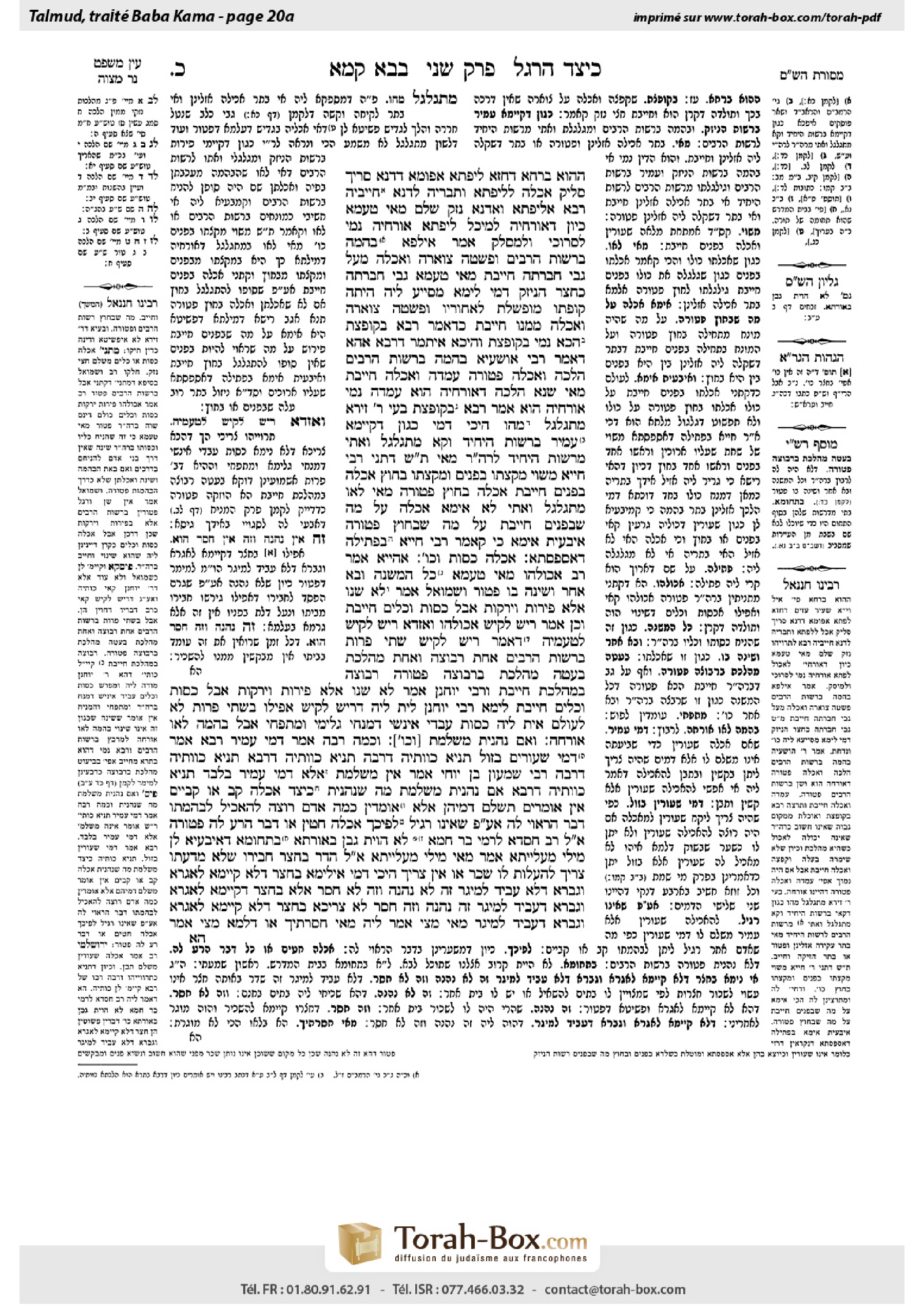
Bava Kamma 20a: Talmud study for Daf Yomi
Study the Talmud for Daf Yomi with scanned pages, Hebrew text, English translations from Sefaria and AI-generated French translations.
Passage selection and English or AI-generated French translation are available where the scan has annotations. Daf Study is independent of Torah-Box and Sefaria.
Browse Bava Kamma · בבא קמא · All tractatesBava Kamma 20a text and translations
This page of Bava Kamma includes the Aramaic text, an English translation and an AI-generated French translation, alongside the scan above.
בבא קמא כ׳ א · Aramaic and Hebrew text
הָהוּא בַּרְחָא דַּחֲזָא לִיפְתָּא אַפּוּמָּא דְּדַנָּא, סָרֵיךְ סְלֵיק, אַכְלַהּ לְלִיפְתָּא וְתַבְרֵיהּ לְדַנָּא. חַיְּיבֵיהּ רָבָא אַלִּיפְתָּא וְאַדַּנָּא נֶזֶק שָׁלֵם. מַאי טַעְמָא? כֵּיוָן דְּאוֹרְחֵיהּ לְמֵיכַל לִיפְתָּא, אוֹרְחֵיהּ נָמֵי לְסָרוֹכֵי וּלְמִסְלַק.
אָמַר אִילְפָא: בְּהֵמָה בִּרְשׁוּת הָרַבִּים, וּפָשְׁטָה צַוָּארָהּ וְאָכְלָה מֵעַל גַּבֵּי חֲבֶרְתָּהּ – חַיֶּיבֶת. מַאי טַעְמָא? גַּבֵּי חֲבֶרְתָּהּ – כַּחֲצַר הַנִּיזָּק דָּמֵי.
לֵימָא מְסַיַּיע לֵיהּ: הָיְתָה קוּפָּתוֹ מוּפְשֶׁלֶת לַאֲחוֹרָיו, וּפָשְׁטָה צַוָּארָהּ וְאָכְלָה מִמֶּנּוּ – חַיֶּיבֶת. כִּדְאָמַר רָבָא – בְּקוֹפֶצֶת, הָכָא נָמֵי בְּקוֹפֶצֶת.
וְהֵיכָא אִיתְּמַר דְּרָבָא? אַהָא – דְּאָמַר רַבִּי אוֹשַׁעְיָא: בְּהֵמָה בִּרְשׁוּת הָרַבִּים; הָלְכָה וְאָכְלָה – פְּטוּרָה, עָמְדָה וְאָכְלָה – חַיֶּיבֶת. מַאי שְׁנָא הָלְכָה – דְּאוֹרְחֵיהּ הוּא, עָמְדָה נָמֵי אוֹרְחֵיהּ הוּא! אָמַר רָבָא: בְּקוֹפֶצֶת.
בָּעֵי רַבִּי זֵירָא: מִתְגַּלְגֵּל מַהוּ? הֵיכִי דָּמֵי? כְּגוֹן דְּקָיְימָא עָמִיר בִּרְשׁוּת הַיָּחִיד – וְקָא מִתְגַּלְגַּל וְאָתֵי מֵרְשׁוּת הַיָּחִיד לִרְשׁוּת הָרַבִּים. מַאי?
תָּא שְׁמַע, דְּתָנֵי רַבִּי חִיָּיא: מַשּׂוֹי, מִקְצָתוֹ בִּפְנִים וּמִקְצָתוֹ בַּחוּץ; אָכְלָה בִּפְנִים – חַיֶּיבֶת, אָכְלָה בַּחוּץ – פְּטוּרָה. מַאי, לָאו מִתְגַּלְגַּל וְאָתֵי? לָא, אֵימָא: אָכְלָה – עַל מַה שֶּׁבִּפְנִים חַיֶּיבֶת, עַל מַה שֶּׁבַּחוּץ פְּטוּרָה.
אִיבָּעֵית אֵימָא: כִּי קָאָמַר רַבִּי חִיָּיא – בִּפְתִילָה דְּאַסְפַּסְתָּא.
אָכְלָה כְּסוּת וְכוּ׳.
אַהֵיָיא? אָמַר רַב: אַכּוּלְּהוּ. מַאי טַעְמָא? כׇּל הַמְשַׁנֶּה, וּבָא אַחֵר וְשִׁינָּה בּוֹ – פָּטוּר.
וּשְׁמוּאֵל אָמַר: לֹא שָׁנוּ אֶלָּא פֵּירוֹת וִירָקוֹת, אֲבָל כְּסוּת וְכֵלִים – חַיֶּיבֶת.
וְכֵן אָמַר רֵישׁ לָקִישׁ: אַכּוּלְּהוּ. וְאַזְדָּא רֵישׁ לָקִישׁ לְטַעְמֵיהּ, דְּאָמַר רֵישׁ לָקִישׁ: שְׁתֵּי פָרוֹת בִּרְשׁוּת הָרַבִּים, אַחַת רְבוּצָה וְאַחַת מְהַלֶּכֶת; בָּעֲטָה מְהַלֶּכֶת בָּרְבוּצָה – פְּטוּרָה, רְבוּצָה בַּמְּהַלֶּכֶת – חַיֶּיבֶת.
וְרַבִּי יוֹחָנָן אָמַר: לֹא שָׁנוּ אֶלָּא פֵּירוֹת וִירָקוֹת, אֲבָל כְּסוּת וְכֵלִים – חַיֶּיבֶת.
לֵימָא רַבִּי יוֹחָנָן לֵית לֵיהּ דְּרֵישׁ לָקִישׁ – אֲפִילּוּ בִּשְׁתֵּי פָרוֹת? לָא, לְעוֹלָם אִית לֵיהּ; כְּסוּת – עָבְדִי אִינָשֵׁי דְּמַנְּחִי גְּלִימֵי וּמִתַּפְחִי, אֲבָל בְּהֵמָה – לָאו אוֹרְחַהּ.
וְאִם נֶהֱנֵית – מְשַׁלֶּמֶת וְכוּ׳. וְכַמָּה? רַבָּה אָמַר: דְּמֵי עָמִיר. רָבָא אָמַר: דְּמֵי שְׂעוֹרִים בְּזוֹל.
תַּנְיָא כְּווֹתֵיהּ דְּרַבָּה, תַּנְיָא כְּווֹתֵיהּ דְּרָבָא. תַּנְיָא כְּווֹתֵיהּ דְּרַבָּה – רַבִּי שִׁמְעוֹן בֶּן יוֹחַי אָמַר: אֵין מְשַׁלֶּמֶת אֶלָּא דְּמֵי עָמִיר בִּלְבָד.
תַּנְיָא כְּווֹתֵיהּ דְּרָבָא – אִם נֶהֱנֵית, מְשַׁלֶּמֶת מַה שֶּׁנֶּהֱנֵית. כֵּיצַד? אָכְלָה קַב אוֹ קַבַּיִים – אֵין אוֹמְרִים תְּשַׁלֵּם דְּמֵיהֶן, אֶלָּא אוֹמְדִין כַּמָּה אָדָם רוֹצֶה לְהַאֲכִיל לִבְהֶמְתּוֹ דָּבָר הָרָאוּי לָהּ, אַף עַל פִּי שֶׁאֵינוֹ רָגִיל. לְפִיכָךְ, אָכְלָה חִטִּין אוֹ דָּבָר הָרַע לָהּ – פְּטוּרָה.
אֲמַר לֵיהּ רַב חִסְדָּא לְרָמֵי בַּר חָמָא: לָא הֲוֵית גַּבַּן בְּאוּרְתָּא בִּתְחוּמָא, דְּאִיבַּעְיָא לַן מִילֵּי מְעַלְּיָיתָא. אֲמַר: מַאי מִילֵּי מְעַלְּיָיתָא? אֲמַר לֵיהּ: הַדָּר בַּחֲצַר חֲבֵירוֹ שֶׁלֹּא מִדַּעְתּוֹ – צָרִיךְ לְהַעֲלוֹת לוֹ שָׂכָר, אוֹ אֵין צָרִיךְ?
הֵיכִי דָמֵי? אִילֵּימָא בְּחָצֵר דְּלָא קָיְימָא לְאַגְרָא, וְגַבְרָא דְּלָא עֲבִיד לְמֵיגַר – זֶה לֹא נֶהֱנֶה וְזֶה לֹא חָסֵר! אֶלָּא בְּחָצֵר דְּקָיְימָא לְאַגְרָא, וְגַבְרָא דַּעֲבִיד לְמֵיגַר – זֶה נֶהֱנֶה וְזֶה חָסֵר!
לָא צְרִיכָא – בְּחָצֵר דְּלָא קָיְימָא לְאַגְרָא, וְגַבְרָא דַּעֲבִיד לְמֵיגַר; מַאי? מָצֵי אֲמַר לֵיהּ: מַאי חַסַּרְתָּיךְ? אוֹ דִלְמָא, מָצֵי אָמַר:
Bava Kamma 20a · English translation
The Gemara relates: There was a certain goat that saw a turnip on top of a clay barrel [dedanna]. It climbed and went up and ate the turnip, and in doing so it broke the barrel. Rava obligated the owner of the goat to pay the full cost of the damage, both for the turnip and for the barrel. The Gemara explains: What is the reason that he held the owner fully liable for the clay barrel as well as for the turnip? After all, breaking barrels is not the typical behavior of a goat. The Gemara answers: Since it is typical for the goat to eat the turnip, it is also typical for it to climb and go up in order to get it. Consequently, breaking the vessel is categorized as Eating.
§ Ilfa says: If a domesticated animal was in the public domain, and it stretched out its neck and ate from a sack of produce that was loaded on the back of another animal, its owner is liable to pay the full cost of the damage. The Gemara asks: What is the reason for this? The Gemara explains: The back of the other animal is considered like the courtyard of the injured party, and for this reason the owner of the animal is liable for damage classified as Eating there.
The Gemara suggests: Let us say that the following baraita supports his opinion (Tosefta 1:7): If a person was standing in the public domain, and his basket containing food was slung behind his back, and an animal stretched out its neck and ate from it, its owner is liable. The Gemara rejects this: This baraita does not support Ilfa’s opinion, because one could explain that the case in that baraita is as Rava says in a different situation: The ruling is stated with regard to a jumping animal; here also it can be suggested that the ruling of the baraita is stated with regard to a jumping animal, and since the animal engaged in atypical behavior it is classified as a case of Goring as opposed to a case of Eating. For damage classified as Goring, the owner of the animal is liable for his animal’s actions in the public domain, although he pays only half the cost of the damage.
The Gemara asks: And where, i.e., in what context, was Rava’s interpretation initially stated? The Gemara answers: It was stated with regard to that which Rabbi Oshaya says: If a domesticated animal was walking along and eating in the public domain its owner is exempt, but if it was standing and eating he is liable. The Gemara questions this ruling: What is different if it was walking? Is it because eating while walking is the typical behavior of an animal? But standing and eating is also typical behavior. Rava says: Rabbi Oshaya’s ruling is stated with regard to a jumping animal, which is not typical behavior for the animal.
§ Rabbi Zeira raises a dilemma: If an animal was rolling, what is the halakha? The Gemara asks: What are the circumstances of the case about which Rabbi Zeira inquires? The Gemara answers: For example, if there was a sheaf of grain on private property, and it was rolled along by the animal and the sheaf went from the private property into the public domain, and the animal ate it there, what is the halakha? Should this be treated as a case of Eating on private property, rendering the owner of the animal liable, or should it be treated as a case of Eating in the public domain, thereby exempting him from liability?
The Gemara suggests: Come and hear a solution from a baraita, as Rabbi Ḥiyya taught: If a load of food was located partly inside the property of its owner and partly outside of his property, i.e., in the public domain, and an animal ate inside the private property, its owner is liable, as this is a case of damage classified as Eating on the property of the injured party. But if the animal ate outside, its owner is exempt, in accordance with the halakhot of Eating in the public domain. What, is it not that the case is one where the food was rolling along, and the halakha follows the location where it was actually eaten? The Gemara explains: No, say instead: It ate, and for that which was initially inside the private property, its owner is liable even if the food rolled out of the private property, and for that which was initially outside, its owner is exempt.
If you wish, say instead that there is a different resolution: When Rabbi Ḥiyya stated his ruling it was with regard to a long stalk of fodder [de’aspasta] that was partly inside and partly outside at the time it was consumed, and as the animal ate it the entire stalk was pulled to where the animal was standing.
§ The mishna teaches: If the animal ate garments or vessels, the owner must pay for half the cost of the damage. In what case is this statement said? It is said when the animal ate them while located on the property of the injured party, but if he ate them in the public domain the owner of the animal is exempt from liability.
The Gemara asks: To which case is this referring? In which case is one exempt from liability if the damage occurred in the public domain? Rav said: It is referring to all of the cases. One is exempt from liability in the public domain even if his animal ate garments or vessels, despite the fact that this is an unusual thing for the animal to do and therefore eating garments or vessels should be classified as a case of Goring, which would normally result in liability when it occurs in the public domain. What is the reason for this? Rav answers his own question by stating a principle: With regard to anyone who deviates from normative behavior in his actions, if another came along afterward and deviates from the norm with regard to the action the first has done and thereby causes damage to him, the one who causes the damage is exempt from liability. In this case, the injured party left his garments or vessels in the public domain and thereby deviated from normative behavior, and therefore the owner of the animal that acted atypically and ate them is exempt from liability.
And Shmuel said: They taught in the mishna that one is exempt from liability for damage caused in the public domain only in a case where his animal ate fruit or vegetables, in accordance with the halakhot of Eating in the public domain, but if the animal ate garments or vessels in the public domain, the owner is liable to pay for half the cost of the damage. Since this is atypical animal behavior, it is classified as a case of Goring, for which the owner of the animal is liable even if it occurs in the public domain.
And similarly, Reish Lakish said, in accordance with the opinion of Rav: The exemption discussed in the mishna was said in reference to all of the cases. And Reish Lakish follows his own line of reasoning, as Reish Lakish says: If there were two cows in the public domain, one prone and one walking, and the walking cow kicked the prone cow, its owner is exempt from liability; but if the prone cow kicked the walking cow, its owner is liable. This indicates that Reish Lakish accepts the principle: Anyone who deviates from normative behavior, if another came along afterward and deviates from the norm with regard to the action the first has done and thereby causes damage to him, the one who causes the damage is exempt. Since it is atypical behavior for a cow to lie down in the public domain, even if the walking cow also behaved atypically and kicked the prone cow, its owner is exempt from liability.
And Rabbi Yoḥanan says, in accordance with the opinion of Shmuel: They taught in the mishna that one is exempt from liability in the public domain only if his animal ate fruit or vegetables, but if the animal ate garments or vessels, the owner is liable to pay for half the cost of the damage.
The Gemara asks: Shall we say that Rabbi Yoḥanan does not accept Reish Lakish’s opinion even in the case of the two cows? The Gemara rejects this suggestion: No, actually it is possible that Rabbi Yoḥanan accepts the opinion of Reish Lakish, but he distinguishes between the cases. In the case of garments, it is common for people to put their cloaks down in the public domain in order to rest [umitpeḥi], and this is not considered atypical behavior. But it is not common for an animal to lie down in the public domain, and since this animal behaved in an atypical manner, no liability is borne by the owner of the walking cow for engaging in atypical behavior and kicking the prone cow.
§ The mishna teaches: And if the animal derives benefit from eating another’s produce in the public domain, although the owner is exempt from paying for the damage it caused, nevertheless the owner of the animal pays for the benefit that it derives. The Gemara asks: And how much is this payment, i.e., how is it calculated? Rabba says: It is the value of, i.e., the amount one would pay, for an equal quantity of stalks of hay or straw. This is because the owner can claim that had his animal not eaten the produce, he would have fed it inexpensive straw, so the animal’s benefit is limited to the cost of the straw that it would have eaten. Rava says: If the animal ate barley, his owner must pay the value of the barley, i.e., as that is typical animal food, but based on the cheapest price available in the market.
The Gemara notes: It is taught in a baraita in accordance with the opinion of Rabba and it is taught in a different baraita in accordance with the opinion of Rava. It is taught in a baraita in accordance with the opinion of Rabba: Rabbi Shimon ben Yoḥai said: The animal’s owner pays only the value of stalks of straw.
It is taught in a baraita in accordance with the opinion of Rava (Tosefta 1:7): If the animal derived benefit from eating another’s produce, the owner of the animal pays for the benefit that it derived. How so? If the animal ate one kav or two kav of grain, we do not say that he should pay their value. Rather, the court estimates how much a person would pay in order to feed his animal typical food fit for it to eat, even if this particular animal does not usually eat that food, as its owner gives it cheaper food. Therefore, if the animal ate barley, which is typical animal fare, even though it does not usually do so, its owner must pay compensation for the barley that was eaten, at its cheapest market price. Therefore, if the animal ate wheat or another item that is detrimental to it, so that it did not derive any benefit, if this occurred in the public domain the owner is exempt from all liability.
§ In connection to the principle stated in the mishna, that if the animal derives benefit the owner of the animal pays for the benefit that it derived, the Gemara relates: Rav Ḥisda said to Rami bar Ḥama: You were not with us at night within our boundary when we raised dilemmas concerning exceptional matters. Rami bar Ḥama said to him: What are the exceptional matters you discussed? Rav Ḥisda said to him: With regard to one who resides in another’s courtyard without his knowledge or permission, must he pay him rent for living there or does he not need to pay him rent?
The Gemara asks: What are the circumstances of this question? If we say that the case concerns a courtyard that does not stand to be rented out, i.e., if the squatter would not have lived there the owner would have kept it vacant, and the man squatting there is someone who would not have rented other living quarters because he has other lodgings available to him for free, then it is a case where this one, the squatter, does not derive benefit, and that one, the owner, does not suffer a loss; in that case certainly no payment is necessary. Rather, say that the discussion concerns a case of a courtyard that stands to be rented out, and the man squatting there would have rented other living quarters. If so, then this is a case where this one derives benefit and that one suffers a loss, and in that case he certainly must make payment. The dilemma was not with regard to either of these circumstances.
The Gemara explains: No, it is necessary to raise the dilemma in the case of a courtyard that does not stand to be rented out, but the man squatting there would have rented other living quarters had he not squatted in this property. What is the halakha in this case? Is the squatter legally able to say to the owner of the courtyard: What loss have I caused you, as you would not have rented it out anyway? Or perhaps the owner of the courtyard is legally able to say to the squatter:
Bava Kamma 20a · Traduction française (IA)
Le Guemara rapporte : Il y avait un certain bouc qui a vu un navet sur un tonneau de terre [dedanna]. Il est monté, est monté et a mangé le navet, et en le faisant, il a cassé le tonneau. Rav a imposé à l'propriétaire du bouc de payer le coût complet des dommages, tant pour le navet que pour le tonneau. Le Guemara explique : Quelle est la raison pour laquelle il a considéré l'propriétaire comme pleinement responsable du tonneau ainsi que du navet ? Après tout, casser des tonneaux n'est pas le comportement typique d'un bouc. Le Guemara répond : Puisque c'est typique pour le bouc de manger le navet, c'est aussi typique pour lui de monter et d'aller chercher le navet. Par conséquent, casser le récipient est catégorisé comme Manger.
§ Ilfa dit : Si un animal domestique était dans le domaine public, et s'il a tendu le cou pour manger d'une sac de produits qui était chargé sur le dos d'un autre animal, son propriétaire est tenu responsable de payer le coût complet des dommages. Le Guemara pose la question : Quelle est la raison de cela ? Le Guemara explique : Le dos de l'autre animal est considéré comme le courtil de la personne blessée, et pour cette raison, le propriétaire de l'animal est tenu responsable des dommages classés comme Manger là.
Le Guemara suggère : Disons que la baraïta suivante soutient son opinion (Tosefta 1:7) : Si une personne était debout dans le domaine public, et son panier contenant des aliments était suspendu derrière son dos, et un animal a tendu le cou pour manger de ce panier, son propriétaire est tenu responsable. Le Guemara rejette cela : Cette baraïta ne soutient pas l'opinion d'Ilfa, car on pourrait expliquer que le cas dans cette baraïta est comme Rava dit dans un autre contexte : La décision est formulée concernant un animal sautant ; ici aussi, on pourrait suggérer que la décision de la baraïta est formulée concernant un animal sautant, et puisque l'animal a agi de manière atypique, il est classé comme un cas de Goring, au lieu d'un cas de Manger. Pour les dommages classés comme Goring, le propriétaire de l'animal est tenu responsable de ses actions dans le domaine public, bien qu'il paie seulement la moitié du coût des dommages.
Le Guemara pose la question : Et où, c'est-à-dire dans quel contexte, cette interprétation de Rava a-t-elle été initialement formulée ? Le Guemara répond : Elle a été formulée concernant ce que Rabbi Oshaya dit : Si un animal domestique marchait en mangeant dans le domaine public, son propriétaire est exempt, mais si il était debout en mangeant, il est tenu responsable. Le Guemara questionne cette décision : Qu'est-ce qui diffère si il marchait ? Est-ce parce que manger en marchant est le comportement typique d'un animal ? Mais rester debout et manger est aussi un comportement typique. Rava dit : La décision de Rabbi Oshaya est formulée concernant un animal sautant, qui n'est pas un comportement typique pour l'animal.
§ Rabbi Zeira soulève un dilemme : Si un animal était en train de rouler, quelle est la halakha ? Le Guemara pose la question : Quelles sont les circonstances du cas dont Rabbi Zeira pose la question ? Le Guemara répond : Par exemple, s'il y avait un faisceau de blé sur une propriété privée, et s'il était roulé par l'animal et le faisceau est passé de la propriété privée dans le domaine public, et l'animal a mangé de ce faisceau là, quelle est la halakha ? Doit-on considérer cela comme un cas de Manger sur une propriété privée, ce qui rend le propriétaire de l'animal responsable, ou doit-on le considérer comme un cas de Manger dans le domaine public, ce qui exempterait le propriétaire de l'animal de responsabilité ?
Le Guemara suggère : Viens écouter une solution d'une baraïta, comme Rabbi Ḥiyya a enseigné : Si une charge de nourriture était située en partie dans la propriété de son propriétaire et en partie en dehors de sa propriété, c'est-à-dire dans le domaine public, et un animal a mangé à l'intérieur de la propriété, son propriétaire est tenu responsable, car c'est un cas de dommage classé comme Manger sur la propriété de la personne blessée. Mais si l'animal a mangé en dehors, son propriétaire est exempt, conformément aux halakhot de Manger dans le domaine public. Qu'est-ce que cela n'est pas que le cas est celui où la nourriture était en train de rouler, et la halakha suit la localisation où elle a été effectivement mangée ? Le Guemara explique : Non, disons plutôt : Il a mangé, et pour ce qui était initialement dans la propriété privée, son propriétaire est tenu responsable même si la nourriture est sortie de la propriété privée, et pour ce qui était initialement en dehors, son propriétaire est exempt.
Si tu veux, dis plutôt qu'il y a une autre résolution : Lorsque Rabbi Ḥiyya a formulé sa décision, c'était concernant un long tige de foin [de’aspasta] qui était en partie à l'intérieur et en partie à l'extérieur lorsqu'il a été mangé, et comme l'animal l'a mangé, l'ensemble de la tige a été tiré vers l'endroit où l'animal était debout.
La Michna enseigne : Si l'animal a mangé des vêtements ou des objets, le propriétaire doit payer la moitié du coût des dommages. Dans quel cas cette déclaration est-elle faite ? Elle est faite lorsque l'animal les a mangés sur la propriété de la personne blessée, mais si l'animal les a mangés dans le domaine public, le propriétaire de l'animal est exempt de responsabilité.
Le Guemara pose la question : À quel cas cela fait-il référence ? Dans quel cas est-on exempt de responsabilité si le dommage s'est produit dans le domaine public ? Rav dit : Cela fait référence à tous les cas. On est exempt de responsabilité dans le domaine public même si son animal a mangé des vêtements ou des objets, malgré le fait que cela est inhabituel pour l'animal de le faire et donc manger des vêtements ou des objets devrait être classé comme un cas de Goring, ce qui entraînerait normalement une responsabilité lorsqu'il se produit dans le domaine public. Quelle est la raison de cela ? Rav répond à sa propre question en énonçant un principe : Concernant quiconque dévient de son comportement normal dans ses actions, si un autre est venu après et a dévié du normale concernant l'action que l'autre a faite et a ainsi causé un dommage à lui, celui qui cause le dommage est exempt de responsabilité. Dans ce cas, la personne blessée a laissé ses vêtements ou ses objets dans le domaine public et a ainsi dévié de son comportement normal, et donc le propriétaire de l'animal qui a agi de manière atypique et a mangé ces objets est exempt de responsabilité.
Et Shmuel a dit : Ils enseignèrent dans la Michna que l'on est exempt de responsabilité pour les dommages causés dans le domaine public uniquement dans le cas où son animal a mangé des fruits ou des légumes, conformément aux halakhot de manger dans le domaine public, mais si l'animal a mangé des vêtements ou des objets dans le domaine public, le propriétaire est tenu de payer la moitié du coût des dommages. Puisque c'est un comportement atypique de l'animal, cela est classé comme un cas de bêlement, pour lequel le propriétaire de l'animal est tenu responsable même s'il se produit dans le domaine public.
Et de même, Reish Lakish a dit, conformément à l'opinion de Rav : L'exemption discutée dans la Michna a été établie en référence à tous les cas. Et Reish Lakish suit sa propre ligne de raisonnement, car Reish Lakish dit : Si deux vaches étaient dans le domaine public, l'une allongée et l'autre marchant, et que la vache marchant a frappé la vache allongée, son propriétaire est exempt de responsabilité ; mais si la vache allongée a frappé la vache marchant, son propriétaire est tenu responsable. Cela montre que Reish Lakish accepte le principe : Quiconque s'écarte du comportement normal, si un autre vient après et s'écarte également du normale concernant l'action que le premier a faite et y cause un dommage, celui qui cause le dommage est exempt. Puisque c'est un comportement atypique pour une vache d'être allongée dans le domaine public, même si la vache marchant a également comporté atypiquement et a frappé la vache allongée, son propriétaire est exempt de responsabilité.
Et Rabbi Yoḥanan dit, conformément à l'opinion de Shmuel : Ils enseignèrent dans la Michna que l'on est exempt de responsabilité dans le domaine public uniquement si son animal a mangé des fruits ou des légumes, mais si l'animal a mangé des vêtements ou des objets, le propriétaire est tenu de payer la moitié du coût des dommages.
La Guemara pose la question : Devons-nous dire que Rabbi Yoḥanan ne suit pas l'opinion de Reish Lakish même dans le cas des deux vaches ? La Guemara rejette cette suggestion : Non, en réalité, il est possible que Rabbi Yoḥanan accepte l'opinion de Reish Lakish, mais il fait une distinction entre les cas. Dans le cas des vêtements, il est courant que les gens mettent leurs manteaux en position horizontale dans le domaine public pour se reposer [umitpeḥi], et cela n'est pas considéré comme un comportement atypique. Mais il n'est pas courant qu'un animal se mette en position horizontale dans le domaine public, et puisque cet animal a comporté atypiquement, le propriétaire de la vache marchant n'est pas tenu responsable du dommage causé par son comportement atypique.
§ La mishna enseigne : Et si l'animal tire un bénéfice en mangeant les produits d'autrui dans le domaine public, bien que l'propriétaire soit exempt de payer pour les dommages qu'il a causés, néanmoins le propriétaire de l'animal paie le bénéfice qu'il a tiré. La Guemara pose la question : Et combien est ce paiement, c'est-à-dire comment est-il calculé ? Rabba dit : C'est la valeur, c'est-à-dire la quantité, qu'on paierait pour une quantité égale de tiges de foin ou de paille. Cela est parce que le propriétaire peut affirmer qu'il aurait nourri son animal à des pailles bon marché s'il n'avait pas mangé les produits, donc le bénéfice de l'animal est limité au coût des pailles qu'il aurait mangées. Rava dit : Si l'animal a mangé du blé, son propriétaire doit payer la valeur du blé, c'est-à-dire que c'est un aliment typique pour les animaux, mais basé sur le prix le plus bas disponible sur le marché.
La Guemara note : Il est enseigné dans une baraïta conformément à l'opinion de Rabba et il est enseigné dans une autre baraïta conformément à l'opinion de Rava. Il est enseigné dans une baraïta conformément à l'opinion de Rabba : Rabbi Shimon ben Yoḥai a dit : Le propriétaire paie seulement la valeur des tiges de paille.
Il est enseigné dans une baraïta conformément à l'opinion de Rava (Tosefta 1:7) : Si l'animal a tiré un bénéfice en mangeant les produits d'autrui, le propriétaire de l'animal paie le bénéfice qu'il a tiré. Comment cela fonctionne-t-il ? Si l'animal a mangé un kav ou deux kav de céréales, nous ne disons pas qu'il doive payer leur valeur. Plutôt, la cour estime combien un homme paierait pour nourrir son animal d'aliments typiques pour lui, même si cet animal particulier ne mange normalement pas ces aliments, car son propriétaire lui donne des aliments moins chers. Ainsi, si l'animal a mangé du blé, qui est un aliment typique pour les animaux, même s'il ne le fait pas normalement, son propriétaire doit payer la compensation pour le blé mangé, au prix le plus bas du marché. Ainsi, si l'animal a mangé du blé ou d'autres choses qui sont nuisibles pour lui, de sorte qu'il n'a pas tiré de bénéfice, et si cela s'est produit dans le domaine public, le propriétaire est exempt de toute responsabilité.
§ En lien avec le principe énoncé dans la mishna, que si l'animal tire un bénéfice, le propriétaire de l'animal paie le bénéfice qu'il a tiré, la Guemara rapporte : Rav Ḥisda dit à Rami bar Ḥama : Tu n'étais pas avec nous la nuit dans notre domaine quand nous avons soulevé des questions concernant des cas exceptionnels. Rami bar Ḥama dit à lui : Quels sont les cas exceptionnels que tu as discutés ? Rav Ḥisda dit à lui : Concernant une personne qui habite dans la cour d'autrui sans son savoir ou son accord, doit-il payer un loyer pour habiter là ou pas ?
La Guemara pose la question : Quelles sont les circonstances de cette question ? Si nous disons que le cas concerne une cour qui ne peut être louée, c'est-à-dire si le squatter ne serait pas resté là, l'propriétaire l'aurait laissée vide, et que la personne squattant là a d'autres logements disponibles gratuitement, alors c'est un cas où le squatter ne tire pas de bénéfice et l'propriétaire ne subit pas de perte ; dans ce cas, certainement, aucun paiement n'est nécessaire. Plutôt, disons que la discussion concerne un cas d'une cour pouvant être louée, et que la personne squattant là aurait loué d'autres logements. Si c'est le cas, alors c'est un cas où le squatter tire un bénéfice et l'propriétaire subit une perte, et dans ce cas, il doit certainement payer. La difficulté ne concernait pas l'un ou l'autre de ces cas.
La Guemara explique : Non, il est nécessaire de poser ce dilemme dans le cas d'un courtil qui ne peut pas être loué, mais l'homme qui squatte là ne serait pas allé louer d'autres logements s'il n'avait pas squatté cette propriété. Quelle est la halakha dans ce cas ? Le squatter est-il légalement en droit de dire à l'propriétaire du courtil : Quel préjudice ai-je causé à vous, puisque vous ne l'auriez pas loué de toute façon ? Ou peut-être l'propriétaire du courtil est-il légalement en droit de dire au squatter :
Traduction française générée par IA à partir de l’édition anglaise de Sefaria. Vérifie toujours un passage avec le texte source.
Text from Sefaria: William Davidson Edition - Vocalized Aramaic (CC BY NC); William Davidson Edition - English (CC BY NC).