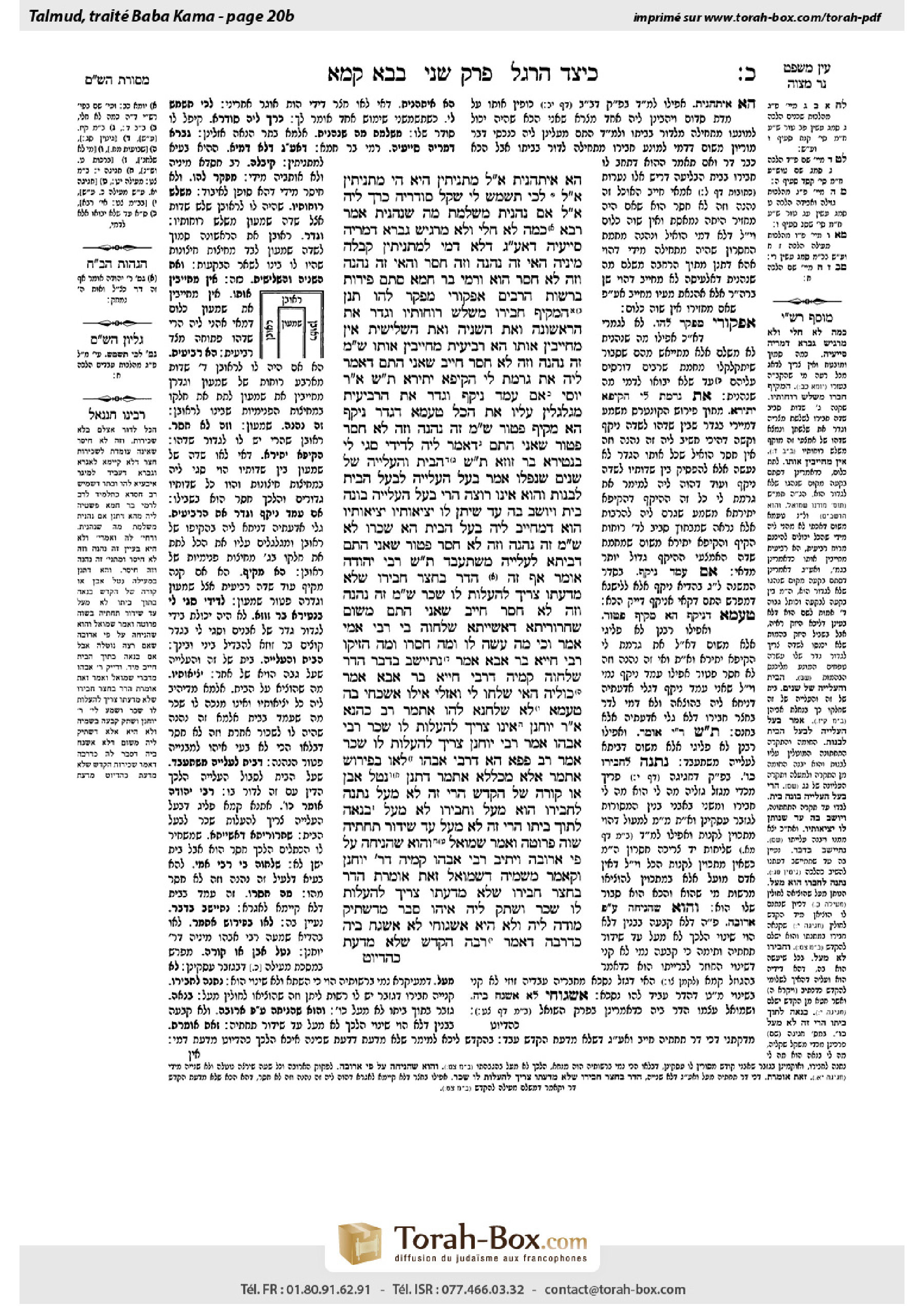
Bava Kamma 20b: Talmud study for Daf Yomi
Study the Talmud for Daf Yomi with scanned pages, Hebrew text, English translations from Sefaria and AI-generated French translations.
Passage selection and English or AI-generated French translation are available where the scan has annotations. Daf Study is independent of Torah-Box and Sefaria.
Browse Bava Kamma · בבא קמא · All tractatesBava Kamma 20b text and translations
This page of Bava Kamma includes the Aramaic text, an English translation and an AI-generated French translation, alongside the scan above.
בבא קמא כ׳ ב · Aramaic and Hebrew text
הָא אִיתְהֲנִית!
אֲמַר לֵיהּ: מַתְנִיתִין הִיא. הֵי מַתְנִיתִין? אֲמַר לֵיהּ: לְכִי תְּשַׁמֵּשׁ לִי. שְׁקַל סוּדָרֵיהּ כְּרַךְ לֵיהּ. אֲמַר לֵיהּ: אִם נֶהֱנֵית – מְשַׁלֶּמֶת מַה שֶּׁנֶּהֱנֵית.
אָמַר רָבָא: כַּמָּה לָא חָלֵי וְלָא מַרְגֵּישׁ גַּבְרָא דְּמָרֵיהּ סַיְּיעֵיהּ – דְּאַף עַל גַּב דְּלָא דָּמֵי לְמַתְנִיתִין, קַבְּלַהּ מִינֵּיהּ. הַאי זֶה נֶהֱנֶה וְזֶה חָסֵר, וְהַאי זֶה נֶהֱנֶה וְזֶה לֹא חָסֵר הוּא!
וְרָמֵי בַּר חָמָא – סְתַם פֵּירוֹת בִּרְשׁוּת הָרַבִּים, אַפְקוֹרֵי מַפְקַר לְהוּ.
תְּנַן: הַמַּקִּיף חֲבֵירוֹ מִשָּׁלֹשׁ רוּחוֹתָיו, וְגָדַר אֶת הָרִאשׁוֹנָה וְאֶת הַשְּׁנִיָּה וְאֶת הַשְּׁלִישִׁית – אֵין מְחַיְּיבִין אוֹתוֹ. הָא רְבִיעִית – מְחַיְּיבִין אוֹתוֹ;
שְׁמַע מִינַּהּ: זֶה נֶהֱנֶה וְזֶה לֹא חָסֵר – חַיָּיב! שָׁאנֵי הָתָם, דַּאֲמַר לֵיהּ: אַתְּ גְּרַמְתְּ לִי הֶקֵּיפָא יַתִּירָא.
תָּא שְׁמַע, אָמַר רַבִּי יוֹסֵי: אִם עָמַד נִיקָּף וְגָדַר אֶת הָרְבִיעִית – מְגַלְגְּלִין עָלָיו אֶת הַכֹּל. טַעְמָא דְּגָדַר נִיקָּף, הָא מַקִּיף – פָּטוּר;
שְׁמַע מִינַּהּ, זֶה נֶהֱנֶה וְזֶה לֹא חָסֵר – פָּטוּר! שָׁאנֵי הָתָם, דְּאָמַר לֵיהּ: לְדִידִי סַגִּי לִי בִּנְטִירָא בַּר זוּזָא.
תָּא שְׁמַע: הַבַּיִת וְהָעֲלִיָּיה שֶׁל שְׁנַיִם, שֶׁנָּפְלוּ; אָמַר בַּעַל הָעֲלִיָּיה לְבַעַל הַבַּיִת לִבְנוֹת, וְהוּא אֵינוֹ רוֹצֶה – הֲרֵי בַּעַל הָעֲלִיָּיה בּוֹנֶה בַּיִת וְיוֹשֵׁב בָּהּ, עַד שֶׁיִּתֵּן לוֹ יְצִיאוֹתָיו.
יְצִיאוֹתָיו הוּא דִּמְחַיֵּיב לֵיהּ בַּעַל הַבַּיִת, הָא שְׂכָרוֹ – לָא; שְׁמַע מִינַּהּ, זֶה נֶהֱנֶה וְזֶה לֹא חָסֵר – פָּטוּר! שָׁאנֵי הָתָם, דְּבֵיתָא לַעֲלִיָּיה מִשְׁתַּעְבַּד.
תָּא שְׁמַע, רַבִּי יְהוּדָה אוֹמֵר: אַף זֶה הַדָּר בַּחֲצַר חֲבֵירוֹ שֶׁלֹּא מִדַּעְתּוֹ – צָרִיךְ לְהַעֲלוֹת לוֹ שָׂכָר. שְׁמַע מִינַּהּ: זֶה נֶהֱנֶה וְזֶה לֹא חָסֵר – חַיָּיב! שָׁאנֵי הָתָם, מִשּׁוּם שַׁחְרוּרִיתָא דְאַשְׁיָיתָא.
שַׁלְּחוּהָ בֵּי רַבִּי אַמֵּי, אָמַר: וְכִי מָה עָשָׂה לוֹ, וּמָה חִסְּרוֹ, וּמָה הִזִּיקוֹ? רַבִּי חִיָּיא בַּר אַבָּא אָמַר: נִתְיַישֵּׁב בַּדָּבָר. הֲדַר שַׁלְּחוּהָ קַמֵּיהּ דְּרַבִּי חִיָּיא בַּר אַבָּא, אָמַר: כּוּלֵּיהּ הַאי שָׁלְחוּ לִי וְאָזְלִי! אִילּוּ אַשְׁכַּחִי בַּהּ טַעְמָא, לָא שָׁלַחְנָא לְהוּ?!
אִתְּמַר, רַב כָּהֲנָא אָמַר רַבִּי יוֹחָנָן: אֵינוֹ צָרִיךְ לְהַעֲלוֹת לוֹ שָׂכָר. רַבִּי אֲבָהוּ אָמַר רַבִּי יוֹחָנָן: צָרִיךְ לְהַעֲלוֹת לוֹ שָׂכָר.
אָמַר רַב פָּפָּא: הָא דְּרַבִּי אֲבָהוּ – לָאו בְּפֵירוּשׁ אִתְּמַר, אֶלָּא מִכְּלָלָא אִתְּמַר. דִּתְנַן: נָטַל אֶבֶן אוֹ קוֹרָה שֶׁל הֶקְדֵּשׁ – הֲרֵי זֶה לֹא מָעַל.
נְתָנָהּ לַחֲבֵירוֹ – הוּא מָעַל, וַחֲבֵירוֹ לֹא מָעַל. בְּנָאָהּ לְתוֹךְ בֵּיתוֹ – הֲרֵי זֶה לֹא מָעַל, עַד שֶׁיָּדוּר תַּחְתֶּיהָ שָׁוֶה פְּרוּטָה.
וְאָמַר שְׁמוּאֵל: וְהוּא שֶׁהִנִּיחָהּ עַל פִּי אֲרוּבָּה.
וְיָתֵיב רַבִּי אֲבָהוּ קַמֵּיהּ דְּרַבִּי יוֹחָנָן, וְקָאָמַר מִשְּׁמֵיהּ דִּשְׁמוּאֵל: זֹאת אוֹמֶרֶת, הַדָּר בַּחֲצַר חֲבֵירוֹ שֶׁלֹּא מִדַּעְתּוֹ – צָרִיךְ לְהַעֲלוֹת לוֹ שָׂכָר; וּשְׁתֵק לֵיהּ.
אִיהוּ סָבַר – מִדִּשְׁתֵיק, מוֹדֶה לֵיהּ. וְלָא הִיא, אַשְׁגּוֹחֵי לָא אַשְׁגַּח בֵּיהּ.
כִּדְרַבָּה, דְּאָמַר רַבָּה: הֶקְדֵּשׁ שֶׁלֹּא מִדַּעַת –
Bava Kamma 20b · English translation
You have derived benefit from my property, as by living there you saved the money you otherwise would have had to pay in order to rent out a different courtyard, and therefore you must pay me for the benefit you derived.
Rami bar Ḥama said to him: This dilemma is not new; rather, it is discussed in the mishna, and the mishna already provided a solution. Rav Ḥisda asked him: To which mishna are you referring? Rami bar Ḥama said to him: After you serve me, I will tell you. Rav Ḥisda took hold of Rami bar Ḥama’s scarf [suderei] and folded it, as an act of service. Rami bar Ḥama then said to him: This is the mishna: If the animal derives benefit, the owner of the animal pays for the benefit that the animal derived. This demonstrates that one who derives benefit must pay for the benefit he derives, even if the injured party is not entitled to payment for his loss.
Rava said: How little does a man who has the assistance of his Lord have to worry or be concerned about the possibility that his opinion may not be accepted, as even though the dilemma that was raised is in fact not similar to the case in the mishna quoted by Rami bar Ḥama, Rav Ḥisda nevertheless accepted it from him. This case in the mishna, about the animal eating produce in the public domain, is where this one derives benefit and that one suffers a loss, and that case of the squatter living in the courtyard, is where this one derives benefit and that one does not suffer a loss.
The Gemara asks: And what does Rami bar Ḥama think? Why does he equate the two cases? The Gemara explains: He holds that if produce is left in the public domain without specification with regard to its ownership, it is assumed that the owner has rendered it ownerless. The owner does not expect to derive benefit from the produce, and therefore when the animal ate it he suffered no loss. Consequently, it is a case where this one derives benefit and that one does not suffer a loss, and it is comparable to the case of the squatter in the courtyard.
The Gemara attempts to cite conclusive evidence from another case: We learned in a mishna (Bava Batra 4b): If one’s fields surround the fields of another on three sides, and he fenced in the first, the second, and the third field, thereby providing protection also to the other man’s field, the court does not obligate the owner of the inner field to share in the costs of the fence, as he can claim that he does not derive benefit from it, since his field remains exposed on the fourth side. The Gemara infers: But this indicates that if his fields surrounded the inner field on all four sides, and the owner of the outer fields fenced the field on the fourth side as well, the court does obligate the owner of the inner field to share in the expenses.
The Gemara suggests: Conclude from the mishna that where this one derives benefit and that one does not suffer a loss, the one who derives benefit is obligated to pay for that benefit. In this case, the owner of the inner field benefits from the fence while the owner of the outer field does not suffer a loss, because in any event he would have needed to build those fences, and the owner of the inner field is obligated to share in the expense. The Gemara rejects this: It is different there because the owner of the outer field can say to the owner of the inner field: Your field caused me to have to build the fence with a larger circumference than I would have otherwise needed to had your field not been there, and therefore your field caused me an additional expense. This case is therefore similar to those where this one derives benefit and that one suffers a loss.
The Gemara attempts another resolution: Come and hear a proof from the continuation of that mishna. Rabbi Yosei said: If the owner of the surrounded, i.e., inner, field arose and enclosed the fourth side on his own, the court imposes upon him the obligation to pay his share of all of it, as through his actions he demonstrated that he was interested in having the fence installed. The Gemara infers from this: The reason the court imposes upon him the obligation to pay his share of all of it is because the owner of the surrounded field arose and enclosed the fourth side himself. By inference, had the owner of the surrounding field built the fourth fence, the owner of the inner field would be exempt.
The Gemara suggests: Conclude from the mishna that where this one derives benefit and that one does not suffer a loss, the one who derives benefit is exempt. The Gemara rejects this: It is different there because the owner of the inner field can say to the owner of the surrounding fields: For me, the protection of a fence worth a dinar would have been sufficient; I did not wish to pay for such an expensive fence.
The Gemara attempts another resolution: Come and hear a proof from a mishna (Bava Metzia 117a): If a house and its upper story, which belonged to two separate people, collapsed, necessitating that the entire structure be rebuilt, and the owner of the upper story told the owner of the lower story of the house to build the lower story again so that he could rebuild the upper story, but the owner of the lower story does not want to do so, the owner of the upper story may build the lower story of the house and live in it until the owner of the lower story will pay him for his expenses, and only then will he be required to vacate the lower story of the house and build the upper story.
The Gemara infers: It is all of his expenses that the owner of the lower story of the house is obligated to pay him, and he does not subtract from the amount compensation for rent for the time that the owner of the upper story lived in the lower story of the house. Conclude from the mishna that where this one derives benefit and that one does not suffer a loss, the one who derives benefit is exempt, as the owner of the upper story derived benefit from living in the lower story, while the owner of the lower story did not suffer a loss, since he said he did not need it. The Gemara rejects this proof: It is different there because the lower story of the house is subjugated to the upper story, because it also serves as the foundation of the upper story, and therefore the owner of the lower story of the house is obligated to provide lodging to the owner of the upper story in the interim.
The Gemara attempts another resolution. Come and hear a proof from the continuation of the mishna, in which Rabbi Yehuda disagrees with the first tanna and holds that the owner of the upper story may not reside in the lower story of the house without payment. Rabbi Yehuda says: A proof that the owner of the upper story must pay rent is from the halakha that even this one who resides in another’s courtyard without his knowledge must pay him rent. Conclude from the mishna that when this one derives benefit and that one does not suffer a loss, the one who derives benefit is obligated to pay. The Gemara rejects this: It is different there, as there it is possible to claim that the owner of the lower story suffers a loss due to the blackening of the walls, as when a person lives in a home, the value of the house depreciates due to the use.
This dilemma was not successfully resolved so they sent it to the academy of Rabbi Ami to ask his opinion. Rabbi Ami said: And what did this squatter do to the owner? What loss did he cause him? How did he damage him? Rav Ami holds that if this one derives benefit and that one does not suffer a loss, no payment is necessary. When asked about this dilemma, Rabbi Ḥiyya bar Abba said: Let us consider the matter. After waiting and not receiving a response they sent the question to Rabbi Ḥiyya bar Abba again. He said: They keep sending me this dilemma; had I found a response to their question, would I not have sent them a reply? They should have realized that Rabbi Ḥiyya bar Abba did not have an answer for them.
It was stated that the amora’im discussed this matter: Rav Kahana says that Rabbi Yoḥanan says: He need not pay him rent, and Rabbi Abbahu says that Rabbi Yoḥanan says: He must pay him rent.
Rav Pappa said: This statement of Rabbi Abbahu, citing Rabbi Yoḥanan, was not stated explicitly; rather, it was stated from an inference that Rabbi Abbahu drew from something that Rabbi Yoḥanan said in a different context. As we learned in a mishna (Me’ila 5:4): If the treasurer of consecrated property took for himself a stone or a cross beam that had been consecrated, he has not violated the prohibition of misuse of consecrated property. This is because his act of taking the stone or the beam has not effectively removed it from within the jurisdiction of Temple property, as any item under his control is in the possession of the Temple treasury.
If the treasurer gave it to another as a gift, he has then misused consecrated property, as he removed it from the possession of the Temple and conveyed it into the possession of another. But the other man, who received the item, has not misused a consecrated item until he actually uses the item. If the treasurer himself built it into his house, he has not violated the prohibition of misuse of consecrated property until he has lived beneath it for an amount of time worth one peruta.
And Shmuel said: And this is the halakha provided that he placed it over the skylight, as were he to have built it into the actual structure of the house, he would have violated the prohibition of misuse with the very act of construction, as by doing so he effects a change in the stone itself. By contrast, when he places the stone in a place from which it is easy to remove it and give it back, then as long as he has not lived beneath it, he has not, as yet, misused consecrated property.
And Rabbi Abbahu sat before Rabbi Yoḥanan and was saying in the name of Shmuel: That is to say, one who resides in another’s courtyard without his knowledge must pay him rent, similar to the treasurer who resides beneath the consecrated beam without detracting from the value of the beam in any way but has nevertheless violated the prohibition of misuse since he has derived personal benefit from it. And Rabbi Yoḥanan remained silent and offered him no reply.
Rabbi Abbahu thought that since he was silent, this must mean he concedes to his conclusion, and therefore, from then on he would cite this opinion in the name of Rabbi Yoḥanan. But that is not so. The reason Rabbi Yoḥanan was silent was because he did not pay attention to Rabbi Abbahu and did not bother to contradict his opinion on the issue. In truth Rabbi Yoḥanan’s opinion is as was reported in his name by Rav Kahana, that a squatter living on someone else’s premises without his permission and without causing him any loss does not need to pay the owner any rent.
The Gemara explains the distinction between that case and the case of the consecrated stone or beam. The reason the treasurer of consecrated property is considered to have misused consecrated property by deriving benefit from it is in accordance with the statement of Rabba, as Rabba says: Consecrated property from which one derived benefit without the Temple treasury’s knowledge
Bava Kamma 20b · Traduction française (IA)
Vous avez tiré un bénéfice de ma propriété, car en habitant là vous avez préservé l'argent que vous auriez autrement dû payer pour louer un autre courtil, et donc vous devez me payer pour le bénéfice que vous avez tiré.
Rami bar Ḥama dit à lui : Ce dilemme n'est pas nouveau ; il est discuté dans la mitsna, et la mitsna a déjà fourni une solution. Rav Ḥisda lui demande : De quelle mitsna parlez-vous ? Rami bar Ḥama dit à lui : Après que vous m'ayez servi, je vous le dirai. Rav Ḥisda saisit le tissu de Rami bar Ḥama et le plia, comme un acte de service. Rami bar Ḥama dit alors à lui : C'est la mitsna : Si l'animal tire un bénéfice, l'propriétaire de l'animal paie le bénéfice que l'animal a tiré. Cela montre que celui qui tire un bénéfice doit payer pour le bénéfice qu'il a tiré, même si la partie blessée n'a pas droit à un paiement pour sa perte.
Rava dit : Combien peu un homme qui a l'aide de son Seigneur a à craindre ou à s'inquiéter que son opinion ne soit pas acceptée, car même si le dilemme soulevé n'est pas semblable au cas de la mitsna cité par Rami bar Ḥama, Rav Ḥisda l'a tout de même accepté. Ce cas de la mitsna, concernant l'animal mangeant les produits dans le domaine public, est celui où l'un tire un bénéfice et l'autre subit une perte, et ce cas du squatter vivant dans le courtil est celui où l'un tire un bénéfice et l'autre ne subit pas de perte.
Le Guemara demande : Et que pense Rami bar Ḥama ? Pourquoi égale-t-il les deux cas ? Le Guemara explique : Il considère que si des produits sont laissés dans le domaine public sans indication de leur propriétaire, on suppose que le propriétaire les a rendus propriété commune. Le propriétaire ne s'attend pas à tirer un bénéfice de ces produits, et donc quand l'animal les a mangés, il n'a subi aucune perte. Ainsi, c'est un cas où l'un tire un bénéfice et l'autre ne subit pas de perte, et il est comparable au cas du squatter dans le courtil.
Le Guemara tente d'apporter une preuve conclusive à partir d'un autre cas : Nous avons appris dans une mitsna (Bava Batra 4b) : Si les champs d'une personne entourent les champs d'un autre sur trois côtés, et qu'il a clôturé le premier, le second et le troisième champ, offrant ainsi une protection également au champ de l'autre homme, la cour ne rend pas obligatoire à l'propriétaire du champ intérieur de partager les coûts de la clôture, car il peut affirmer qu'il ne tire pas de bénéfice d'elle, car son champ reste exposé sur le quatrième côté. Le Guemara infère : Mais cela indique que si ses champs entourent le champ intérieur sur tous les quatre côtés, et que l'propriétaire des champs extérieurs clôture le quatrième côté également, la cour rend obligatoire à l'propriétaire du champ intérieur de partager les dépenses.
Le Guemara suggère : Conclure de la mitsna que dans le cas où l'un tire un bénéfice et l'autre ne subit pas de perte, celui qui tire un bénéfice est tenu de payer pour ce bénéfice. Dans ce cas, l'propriétaire du champ intérieur bénéficie de la clôture tandis que l'propriétaire du champ extérieur ne subit pas de perte, car il aurait de toute façon dû construire ces clôtures, et l'propriétaire du champ intérieur est tenu de partager les coûts. Le Guemara rejette cela : C'est différent là-bas, car l'propriétaire du champ extérieur peut dire à l'propriétaire du champ intérieur : Votre champ m'a obligé à construire une clôture plus grande que je n'aurais autrement dû construire si votre champ n'avait pas été là, et donc votre champ m'a causé un coût supplémentaire. Ce cas est donc comparable à ceux où l'un tire un bénéfice et l'autre subit une perte.
Le Guemara tente une autre résolution : Venez écouter une preuve à partir de la continuation de cette mitsna. Rabbi Yosei dit : Si l'propriétaire du champ entouré, c'est-à-dire du champ intérieur, se lève et clôture le quatrième côté lui-même, la cour impose à lui l'obligation de payer sa part de tout cela, car par ses actions il a montré qu'il était intéressé à ce que la clôture soit installée. Le Guemara infère de cela : La raison pour laquelle la cour impose à lui l'obligation de payer sa part de tout cela est que l'propriétaire du champ entouré s'est levé et a clôturé le quatrième côté lui-même. Par conséquent, si l'propriétaire des champs entourants avait construit la quatrième clôture, l'propriétaire du champ intérieur serait exempt.
Le Guemara suggère : Conclure de la mitsna que dans le cas où l'un tire un bénéfice et l'autre ne subit pas de perte, celui qui tire un bénéfice est exempt. Le Guemara rejette cela : C'est différent là-bas, car l'propriétaire du champ intérieur peut dire à l'propriétaire des champs entourants : Pour moi, la protection d'une clôture valant un dinar aurait suffi ; je n'avais pas envie de payer pour une clôture si coûteuse.
Le Guemara tente une autre résolution : Venez écouter une preuve tirée d'une mitsna (Bava Metzia 117a) : Si une maison et son étage supérieur, qui appartenaient à deux personnes différentes, s'effondraient, nécessitant la reconstruction de l'ensemble de la structure, et que l'propriétaire de l'étage supérieur informe l'propriétaire de la maison inférieure de reconstruire la partie inférieure afin qu'il puisse reconstruire l'étage supérieur, mais que l'propriétaire de la maison inférieure n'accepte pas cela, l'propriétaire de l'étage supérieur peut reconstruire la partie inférieure de la maison et y habiter jusqu'à ce que l'propriétaire de la maison inférieure lui paie ses dépenses, et seulement alors devra-t-il quitter la partie inférieure de la maison et reconstruire l'étage supérieur.
La Guemara déduit que l'propriétaire du rez-de-chaussée de la maison est tenu de payer toutes ses dépenses, et il ne retranche pas la somme correspondant à la location pour la période où l'propriétaire du premier étage a habité dans le rez-de-chaussée. Concluez de la mitsna que lorsque l'un tire un bénéfice et que l'autre ne subit pas de perte, celui qui tire un bénéfice est exempt, car l'propriétaire du premier étage a tiré un bénéfice en habitant dans le rez-de-chaussée, tandis que l'propriétaire du rez-de-chaussée n'a pas subi de perte, puisqu'il a dit qu'il n'en avait pas besoin. La Guemara rejette cette démonstration : C'est différent là, car le rez-de-chaussée est soumis au premier étage, car il sert également de fondation au premier étage, et donc l'propriétaire du rez-de-chaussée est tenu de fournir un logement à l'propriétaire du premier étage pendant la durée de l'occupation.
La Guemara tente une autre résolution. Venez écouter une démonstration à partir de la continuation de la mitsna, où Rabbi Yéhuda s'oppose au premier tanna et affirme que l'propriétaire du premier étage ne peut pas habiter dans le rez-de-chaussée sans paiement. Rabbi Yéhuda dit : Une démonstration que l'propriétaire du premier étage doit payer la location est tirée de la halakha selon laquelle même celui qui habite dans un cour de quelqu'un sans son consentement doit lui payer la location. Concluez de la mitsna que lorsque l'un tire un bénéfice et que l'autre ne subit pas de perte, celui qui tire un bénéfice est tenu de payer. La Guemara rejette cela : C'est différent là, car là on peut affirmer que l'propriétaire du rez-de-chaussée subit une perte en raison de la noirceur des murs, car quand une personne habite dans une maison, la valeur de la maison diminue en raison de l'utilisation.
Ce dilemme n'a pas été résolu avec succès, donc ils l'ont envoyé à l'académie de Rabbi Ami pour demander son avis. Rabbi Ami a dit : Et qu'a fait ce squatter à l'owner ? Quelle perte a-t-il causé ? Comment l'a-t-il endommagé ? Rabbi Ami affirme que si l'un tire un bénéfice et que l'autre ne subit pas de perte, aucun paiement n'est nécessaire. Lorsqu'on lui a posé cette question, Rabbi Chiyah bar Abba a dit : Examinons la question. Après avoir attendu et n'avoir pas reçu de réponse, ils ont à nouveau envoyé la question à Rabbi Chiyah bar Abba. Il a dit : Ils continuent à m'envoyer ce dilemme ; s'ils avaient trouvé une réponse à leur question, ne l'auraient-ils pas déjà envoyée ? Ils auraient dû comprendre que Rabbi Chiyah bar Abba n'avait pas de réponse pour eux.
Il a été dit que les amoraïm ont discuté de cette question : Rav Kahana dit que Rabbi Yéhochanan dit : Il n'a pas besoin de lui payer la location, et Rabbi Abbahou dit que Rabbi Yéhochanan dit : Il doit lui payer la location.
Rav Pappa a dit : Cette déclaration de Rabbi Abbahou, citant Rabbi Yéhochanan, n'a pas été formulée explicitement ; plutôt, elle a été émise à partir d'une déduction que Rabbi Abbahou a tirée d'une chose que Rabbi Yéhochanan a dit dans un contexte différent. Comme nous l'avons appris dans une mitsva (Meïla 5:4) : Si le trésorier des biens consacrés s'est approprié une pierre ou une poutre consacrée, il n'a pas violé l'interdiction de mauvais usage des biens consacrés. C'est parce que son acte d'appropriation de la pierre ou de la poutre n'a pas effectivement retiré ces objets de la juridiction des biens du Temple, car tout objet sous son contrôle est considéré comme appartenant au trésor du Temple.
Si le trésorier les a donnés à un autre comme cadeau, il a alors commis un mauvais usage des biens consacrés, car il a retiré ces objets de la possession du Temple et les a transférés à la possession d'un autre. Mais l'autre homme, qui a reçu l'objet, n'a pas commis un mauvais usage d'un bien consacré jusqu'à ce qu'il l'ait effectivement utilisé. Si le trésorier lui-même a construit l'objet dans sa maison, il n'a pas violé l'interdiction de mauvais usage des biens consacrés jusqu'à ce qu'il ait vécu sous l'objet pendant une durée égale à un peruta.
Et Shmuel a dit : Et c'est ainsi que la halakha est, à condition qu'il l'ait placé sur la lucarne, car s'il avait construit l'objet dans la structure de la maison, il aurait violé l'interdiction de mauvais usage avec l'acte même de la construction, car cela modifie l'objet lui-même. À l'inverse, lorsqu'il place la pierre dans un endroit facile à retirer et à rendre, tant qu'il n'a pas vécu sous l'objet, il n'a pas encore commis un mauvais usage des biens consacrés.
Et Rabbi Abbahu s'est assis devant Rabbi Yoḥanan et disait en nom de Shmuel : Cela signifie que celui qui habite dans le cour d'autrui sans son consentement doit lui payer la location, semblable au trésorier qui habite sous la poutre consacrée sans enlever de valeur à la poutre, mais a tout de même commis un mauvais usage, car il a tiré un bénéfice personnel de cela. Et Rabbi Yoḥanan a resté silencieux et n'a pas donné de réponse.
Rabbi Abbahu pensait que, puisqu'il était silencieux, cela signifiait qu'il acceptait sa conclusion, et donc, à partir de ce moment, il citerait cet avis en nom de Rabbi Yoḥanan. Mais ce n'est pas le cas. La raison pour laquelle Rabbi Yoḥanan était silencieux est qu'il n'avait pas prêté attention à Rabbi Abbahu et n'avait pas pris la peine de contester son avis sur la question. En réalité, l'avis de Rabbi Yoḥanan est celui rapporté par Rav Kahana, à savoir qu'un squatter vivant sur les terres d'autrui sans son autorisation et sans causer de perte n'a pas besoin de payer la location à l'propriétaire.
La Guemara explique la distinction entre ce cas et celui de la pierre ou de la poutre consacrée. La raison pour laquelle le trésorier des biens consacrés est considéré comme ayant mauvais usage des biens consacrés en tirant un bénéfice en est selon l'affirmation de Rabba, car Rabba dit : Les biens consacrés d'où l'on a tiré un bénéfice sans la connaissance du trésor du Temple
Traduction française générée par IA à partir de l’édition anglaise de Sefaria. Vérifie toujours un passage avec le texte source.
Text from Sefaria: William Davidson Edition - Vocalized Aramaic (CC BY NC); William Davidson Edition - English (CC BY NC).