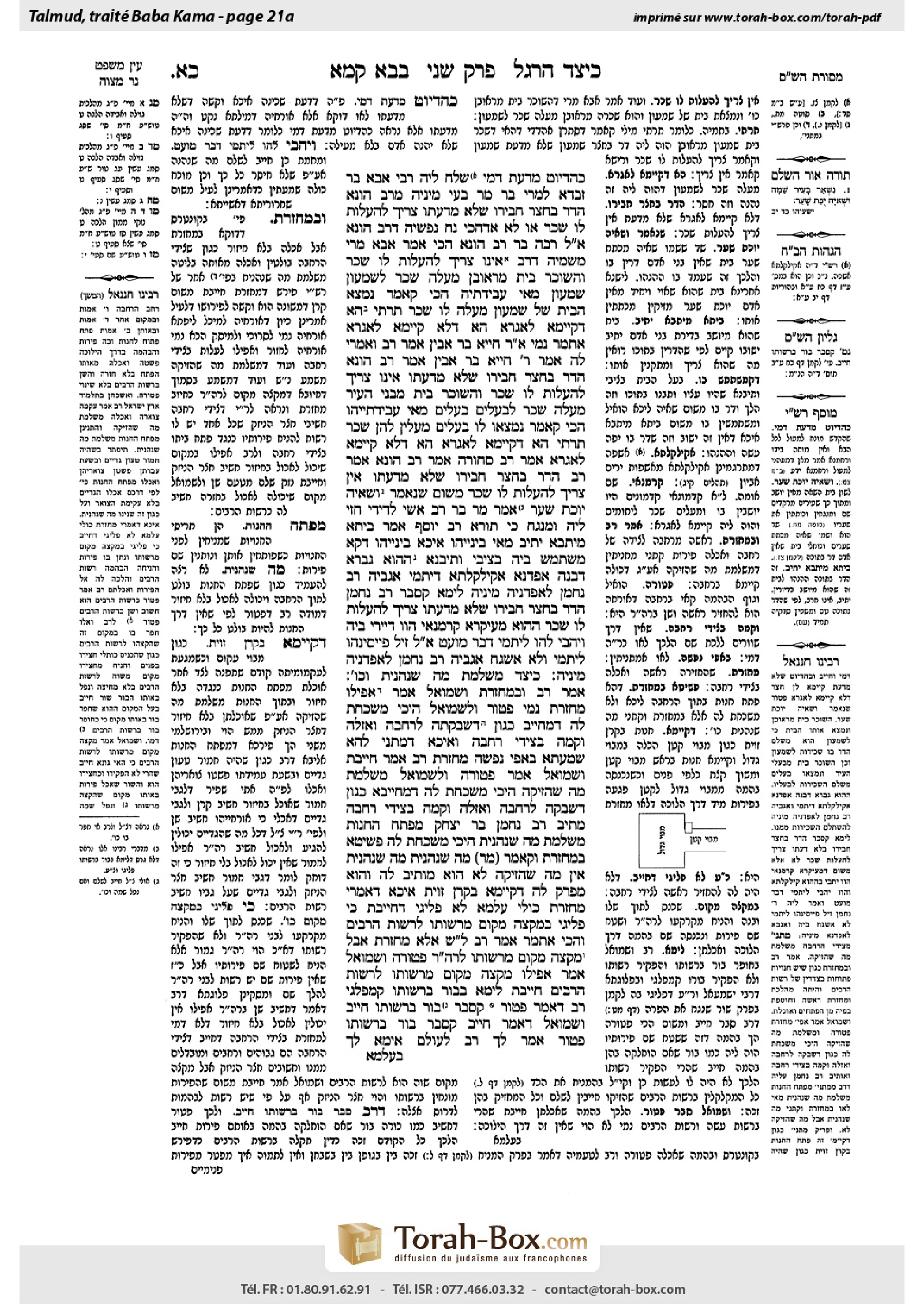
Bava Kamma 21a: Talmud study for Daf Yomi
Study the Talmud for Daf Yomi with scanned pages, Hebrew text, English translations from Sefaria and AI-generated French translations.
Passage selection and English or AI-generated French translation are available where the scan has annotations. Daf Study is independent of Torah-Box and Sefaria.
Browse Bava Kamma · בבא קמא · All tractatesBava Kamma 21a text and translations
This page of Bava Kamma includes the Aramaic text, an English translation and an AI-generated French translation, alongside the scan above.
בבא קמא כ״א א · Aramaic and Hebrew text
כְּהֶדְיוֹט מִדַּעַת דָּמֵי.
שְׁלַח לֵיהּ רַבִּי אַבָּא בַּר זַבְדָּא לְמָרֵי בַּר מָר, בְּעִי מִינֵּיהּ מֵרַב הוּנָא: הַדָּר בַּחֲצַר חֲבֵירוֹ שֶׁלֹּא מִדַּעְתּוֹ, צָרִיךְ לְהַעֲלוֹת לוֹ שָׂכָר, אוֹ לָא? אַדְּהָכִי – נָח נַפְשֵׁיהּ דְּרַב הוּנָא.
אֲמַר לֵיהּ רַבָּה בַּר רַב הוּנָא, הָכִי אָמַר אַבָּא מָרִי מִשְּׁמֵיהּ דְּרַב: אֵינוֹ צָרִיךְ לְהַעֲלוֹת לוֹ שָׂכָר, וְהַשּׂוֹכֵר בַּיִת מֵרְאוּבֵן – מַעֲלֶה שָׂכָר לְשִׁמְעוֹן. שִׁמְעוֹן מַאי עֲבִידְתֵּיהּ? הָכִי קָאָמַר: נִמְצָא הַבַּיִת שֶׁל שִׁמְעוֹן – מַעֲלֶה לוֹ שָׂכָר.
תַּרְתֵּי?! הָא – דְּקָיְימָא לְאַגְרָא, הָא – דְּלָא קָיְימָא לְאַגְרָא.
אִתְּמַר נָמֵי: אָמַר רַבִּי חִיָּיא בַּר אָבִין אָמַר רַב, וְאָמְרִי לַהּ אָמַר רַבִּי חִיָּיא בַּר אָבִין אָמַר רַב הוּנָא: הַדָּר בַּחֲצַר חֲבֵירוֹ שֶׁלֹּא מִדַּעְתּוֹ – אֵינוֹ צָרִיךְ לְהַעֲלוֹת לוֹ שָׂכָר, וְהַשּׂוֹכֵר בַּיִת מִבְּנֵי הָעִיר – מַעֲלֶה שָׂכָר לַבְּעָלִים. בְּעָלִים מַאי עֲבִידְתַּיְיהוּ? הָכִי קָאָמַר: נִמְצְאוּ לוֹ בְּעָלִים – מַעֲלִין לָהֶן שָׂכָר.
תַּרְתֵּי?! הָא דְּקָיְימָא לְאַגְרָא, הָא דְּלָא קָיְימָא לְאַגְרָא.
אָמַר רַב סְחוֹרָה אָמַר רַב הוּנָא אָמַר רַב: הַדָּר בַּחֲצַר חֲבֵירוֹ שֶׁלֹּא מִדַּעְתּוֹ – אֵין צָרִיךְ לְהַעֲלוֹת לוֹ שָׂכָר, מִשּׁוּם שֶׁנֶּאֱמַר: ״וּשְׁאִיָּה יוּכַּת שַׁעַר״. אָמַר מָר בַּר רַב אָשֵׁי: לְדִידִי חֲזֵי לֵיהּ, וּמְנַגַּח כִּי תוֹרָא. רַב יוֹסֵף אָמַר: בֵּיתָא מְיַתְּבָא – יָתֵיב.
מַאי בֵּינַיְיהוּ? אִיכָּא בֵּינַיְיהוּ – דְּקָא מִשְׁתַּמַּשׁ בֵּיהּ בְּצִיבֵי וְתִיבְנָא.
הָהוּא גַּבְרָא דִּבְנָה אַפַּדְנָא אַקִּילְקַלְתָּא דְיַתְמֵי. אַגְבְּיֵהּ רַב נַחְמָן לְאַפַּדְנֵיהּ מִינֵּיהּ. לֵימָא קָסָבַר רַב נַחְמָן: הַדָּר בַּחֲצַר חֲבֵירוֹ שֶׁלֹּא מִדַּעְתּוֹ, צָרִיךְ לְהַעֲלוֹת לוֹ שָׂכָר? הָהוּא – מֵעִיקָּרָא קַרְמְנָאֵי הֲווֹ דָּיְירִי בֵּיהּ, וְיָהֲבִי לְהוּ לְיַתְמֵי דָּבָר מוּעָט. אֲמַר לֵיהּ: זִיל פַּיְּיסִינְהוּ לְיַתְמֵי, וְלָא אַשְׁגַּח. אַגְבְּיֵהּ רַב נַחְמָן לְאַפַּדְנֵיהּ מִינֵּיהּ.
כֵּיצַד מְשַׁלֶּמֶת מַה שֶּׁנֶּהֱנֵית וְכוּ׳. אָמַר רַב: וּבְמַחְזֶרֶת. וּשְׁמוּאֵל אָמַר: אֲפִילּוּ מַחְזֶרֶת נָמֵי פָּטוּר.
וְלִשְׁמוּאֵל – הֵיכִי מַשְׁכַּחַתְּ לַהּ דִּמְחַיֵּיב? כְּגוֹן דִּשְׁבַקְתַּהּ לִרְחָבָה, וַאֲזַלָה וְקָמָה בְּצִידֵּי רְחָבָה.
וְאִיכָּא דְּמַתְנֵי לְהָא שְׁמַעְתָּא בְּאַפֵּי נַפְשָׁהּ: מַחְזֶרֶת – רַב אָמַר: חַיֶּיבֶת, וּשְׁמוּאֵל אָמַר: פְּטוּרָה. וְלִשְׁמוּאֵל, ״מְשַׁלֶּמֶת מַה שֶּׁהִזִּיקָה״ הֵיכִי מַשְׁכַּחַתְּ לַהּ דִּמְחַיְּיבָא? כְּגוֹן דִּשְׁבַקָה לִרְחָבָה, וַאֲזַלָה וְקָמָה בְּצִידֵּי רְחָבָה.
מֵתִיב רַב נַחְמָן בַּר יִצְחָק: מִפֶּתַח הַחֲנוּת – מְשַׁלֶּמֶת מַה שֶּׁנֶּהֱנֵית. הֵיכִי מַשְׁכַּחַתְּ לַהּ – פְּשִׁיטָא בְּמַחְזֶרֶת; וְקָאָמַר (מָר) ״מַה שֶּׁנֶּהֱנֵית״, מַה שֶּׁנֶּהֱנֵית – אִין, מַה שֶּׁהִזִּיקָה – לָא!
הוּא מוֹתֵיב לַהּ וְהוּא מְפָרֵק לַהּ: דְּקַיְימָא בְּקֶרֶן זָוִית.
אִיכָּא דְּאָמְרִי: מַחְזֶרֶת – כּוּלֵּי עָלְמָא לָא פְּלִיגִי דְּחַיֶּיבֶת. כִּי פְּלִיגִי, בְּמַקְצֶה מָקוֹם מֵרְשׁוּתוֹ לִרְשׁוּת הָרַבִּים.
וְהָכִי אִתְּמַר, אָמַר רַב: לֹא שָׁנוּ אֶלָּא מַחְזֶרֶת, אֲבָל מַקְצֶה מָקוֹם מֵרְשׁוּתוֹ לִרְשׁוּת הָרַבִּים – פְּטוּרָה. וּשְׁמוּאֵל אָמַר: אֲפִילּוּ מַקְצֶה מָקוֹם מֵרְשׁוּתוֹ לִרְשׁוּת הָרַבִּים – חַיֶּיבֶת.
לֵימָא בְּבוֹר בִּרְשׁוּתוֹ קָמִפַּלְגִי – רַב דְּאָמַר פָּטוּר, קָסָבַר: בּוֹר בִּרְשׁוּתוֹ – חַיָּיב.
וּשְׁמוּאֵל דְּאָמַר חַיָּיב, קָסָבַר: בּוֹר בִּרְשׁוּתוֹ – פָּטוּר?
אָמַר לְךָ רַב, לְעוֹלָם אֵימָא לָךְ:
Bava Kamma 21a · English translation
is similar to an action involving non-sacred property belonging to an ordinary person, which was performed with the owner’s knowledge and against his wishes. This is because consecrated property belongs to the Almighty, and it is therefore meaningless to speak of a situation where the owner is unaware of what is being done. Consequently, anyone who derives benefit from consecrated property is in violation of the prohibition of misuse, but it cannot be inferred from this that one who resides in another’s courtyard without his knowledge must pay him rent.
Rabbi Abba bar Zavda sent a message to Mari bar Mar saying: Raise the following dilemma before Rav Huna: Does one who resides in another’s courtyard without his knowledge need to pay him rent or not? In the meantime, before he was able to respond to the question, Rav Huna died.
Rabba, son of Rav Huna, said to him in response to the question that was asked of his father: So did my father, my Master, say in the name of Rav: He does not need to pay him rent. And he also stated another halakha: One who rents a house from Reuven must pay rent to Shimon. The Gemara is puzzled: Shimon? What does he have to do with this? The Gemara explains: This is what he is saying, i.e., what he means: If it is discovered that the house he rented did not actually belong to Reuven but rather it was Shimon’s, he must pay rent to Shimon.
The Gemara questions this statement: Did Rav Huna state two contradictory halakhot? On the one hand he says that one who resides in a courtyard without the owner’s knowledge does not need to pay rent, but on the other hand he says that if it is discovered that the true owner of a rented house was someone else, and therefore the tenant was living in another’s courtyard without the owner’s knowledge, he is obligated to pay him rent. The Gemara resolves the difficulty: This second halakha, which stated that he is obligated to pay rent, is referring to a courtyard that stands to be rented out, while that halakha, which stated that he is not obligated to pay rent, is referring to a courtyard that does not stand to be rented out.
It was also stated: Rabbi Ḥiyya bar Avin says that Rav says, and some say that Rabbi Ḥiyya bar Avin says that Rav Huna says: One who resides in another’s courtyard without his knowledge does not need to pay him rent, and one who rents a house from the residents of the city must pay rent to the owners. The Gemara is puzzled: Owners? What do they have to do with this? The case concerns one who rents a property from the residents of the city, i.e., the house is public property. The Gemara explains: This is what he said: If it is discovered that the house did have owners and was not public property, the renters must pay rent to those owners.
The Gemara wonders about this: Did he state two contradictory halakhot? The Gemara answers: This second halakha, which stated that he is obligated to pay rent, is referring to a courtyard that stands to be rented out, while that halakha, which stated that he does not need to pay rent, is referring to a courtyard that does not stand to be rented out.
Rav Seḥora says that Rav Huna says that Rav says: One who resides in another’s courtyard without his knowledge does not need to pay him rent because it is stated: “Desolation remains in the city, and the gate is stricken unto ruin” (Isaiah 24:12), i.e., a house that is not lived in will collapse at some point due to neglect. Consequently, one who lives inside an otherwise uninhabited house is providing a service to the homeowner, as he maintains the house and prevents it from falling apart. Mar bar Rav Ashi said: I saw this ruin and it gores like an ox, i.e., it is devastating. Rav Yosef stated a similar idea: A home that is lived in is settled and safeguarded, while a home that is not lived in has no one to look after it and maintain it.
The Gemara asks: What is the difference between what Rav said and what Rav Yosef said? The Gemara answers: The difference between them is with regard to a house that the homeowner uses to store wood and straw. The house is not empty and desolate but there is nobody living in it. According to Rav Yosef’s reasoning, a squatter there would not have to pay rent to the homeowner.
The Gemara relates: There was a certain man who built a mansion [apadna] on a garbage heap [akilkalta] belonging to orphans, and Rav Naḥman confiscated his mansion from him as he did not pay the owners of the property. The Gemara asks: Shall we say that Rav Naḥman holds that one who resides in another’s courtyard without his knowledge must pay him rent? The Gemara rejects this: No, there is no proof taken from this case, because it was a unique situation. In that case Carmanians, nomadic tribes, were initially living on the property, and they would pay the orphans a small amount for the use of the land, and when this man built his mansion he removed the Carmanians from there. Rav Naḥman had said to the man who built the mansion: Go and appease the orphans with regard to their lost income, but he did not pay attention to the ruling. Therefore, Rav Naḥman confiscated his mansion from him.
§ The mishna teaches: Under what circumstances does the owner of the animal pay for the benefit that his animal derived? If the animal ate produce in the public square in the area before the storefronts, the owner of the animal pays for the food from which it benefits. If the animal ate from food placed at the side of the public square, which is not a public thoroughfare, the owner of the animal pays for what it damaged, as the legal status of that area is like that of the property of the injured party. Rav said: When the mishna says that the owner of the animal pays for what it damaged, it is referring to a case where the animal turns its head to reach the food but the animal itself is standing completely inside the public domain and it eats while standing there. And Shmuel said: Even if it is standing in the public domain and it turns its head to eat from food placed at the side of the public square, its owner is also exempt, as the animal itself is in the public domain.
The Gemara asks: But according to the opinion of Shmuel, how can you find a case in which the owner is liable to pay for all of the damage caused when his animal ate from food placed at the side of the public square, as indicated by the mishna? The Gemara answers: For example, when an animal leaves the public square and goes and stands at the side of the public square, and eats the food stored there. In that case its owner certainly pays for what it damaged, as this area is comparable to the property of the injured party.
And there are those who teach this halakha as an independent dispute and not as an explanation of the mishna: If an animal is standing in the public domain and turns its head to eat from food placed at the side of the public square, Rav says: Its owner is liable, and Shmuel says: Its owner is exempt. The Sages asked: But according to the opinion of Shmuel, with regard to that which was said in the mishna, that its owner pays for what it damaged, how can you find a case in which its owner will be liable? The Gemara answers: For example, when an animal leaves the public square and goes and stands at the side of the public square, and eats the food stored there.
Rav Naḥman bar Yitzḥak raises an objection to this explanation of Rav’s opinion: The mishna says that if the animal ate produce from the entrance of the store, its owner pays for the benefit that the animal derived, as the status of a store entrance is like that of the public domain. How can you find these circumstances? It is obvious that the discussion in this case concerns an animal that turns its head from the public domain to the entrance of the store, and the Master says that the owner of the animal pays for the benefit that the animal derived. Evidently, for the benefit that the animal derived, yes, this is what the owner pays, but he does not pay for that which it damaged.
Rav Naḥman bar Yitzḥak raised the objection, and he resolved it by explaining that the case in the mishna is one where a store is located on a corner and it is situated in a way that some of the produce there would be in an animal’s path as it turns the corner, and therefore the animal would not need to turn its head away from the public domain in order to eat the produce.
There are those who state a different explanation of the dispute between Rav and Shmuel. In a case where it turns its head to eat from the sides of the public square, everyone agrees that its owner is liable to pay the full cost of the damage. When they disagree it is with regard to a case where one allocates space from his property, as he does not have a use for it, and he adds this space to the public domain by leaving it accessible for the public to use, and the damage took place in that area. The dispute is about whether the area is categorized as private property or the public domain.
And this is what was stated, meaning this was their dispute: Rav says that in the mishna, they taught that one is liable only in a case where his animal turns its head to the sides of the public square, as this area is categorized as private property, but if one allocated some space from his property and added it to the public domain and the damage happened there, the owner is exempt, as that area is treated as part of the public domain. And Shmuel says: Even if he allocates space from his property and adds it to the public domain, the owner of the animal is liable as the damage took place in an area with the legal status of private property.
The Gemara suggests: Shall we say they disagree with regard to the question of damage classified as Pit that one dug inside one’s own domain and then declared the area ownerless? Rav, who says that the owner of the animal is exempt for eating the produce placed in an area that the owner added to the public domain, holds that if one digs a pit or creates an obstacle that can cause damage within his own property and he then declares his property to be ownerless, he is liable for any damage that is caused by the pit, as now that it is in the public domain, he bears the responsibility for it. Similarly, the produce is viewed as if it is in the public domain, and the animal’s owner is exempt.
And Shmuel, who says that the owner of an animal is liable for eating the produce placed in an area that the owner added to the public domain, holds that if one digs a pit within his own property and he then declares his property to be ownerless, he is exempt, as he dug the pit when the property was his. Similarly, the produce is viewed as if it is in the property of the injured party, and the animal’s owner is liable.
The Gemara rejects this: Rav could have said to you: Actually, I will say to you
Bava Kamma 21a · Traduction française (IA)
Cela ressemble à une action impliquant une propriété non sacrée appartenant à un homme ordinaire, accomplie avec la connaissance de l'owner mais contre son gré. Cela est dû au fait que la propriété consacrée appartient à l'Almighty, et il est donc inutile de parler d'une situation où l'owner n'est pas conscient de ce qui est fait. Par conséquent, toute personne qui tire un bénéfice de la propriété consacrée transgresse la prohibition de mauvais usage, mais on ne peut pas en déduire que celui qui habite dans le courtyard d'autrui sans son consentement doive payer un loyer.
Rabbi Abba bar Zavda envoya un message à Mari bar Mar en disant : Posez cette question à Rav Huna : Celui qui habite dans le courtyard d'autrui sans son consentement doit-il payer un loyer ou non ? Avant qu'il ne puisse répondre à la question, Rav Huna mourut.
Rabba, fils de Rav Huna, répondit à la question posée à son père en disant : C'est ainsi que mon père, mon Maître, a dit en nom de Rav : Il n'a pas besoin de payer un loyer. Il a également énoncé une autre halakha : Celui qui loue une maison à Reuven doit payer un loyer à Shimon. La Guemara est perplexe : Shimon ? Qu'as-t-il à voir là-dedans ? La Guemara explique : C'est ce qu'il veut dire, c'est-à-dire ce qu'il entend : Si on découvre que la maison qu'il a louée n'appartenait pas réellement à Reuven mais à Shimon, il doit payer un loyer à Shimon.
La Guemara questionne cette déclaration : Rav Huna a-t-il énoncé deux halakhot contradictoires ? D'un côté, il dit que celui qui habite dans un courtyard sans la connaissance de l'propriétaire n'a pas besoin de payer un loyer, mais de l'autre côté, il dit que si on découvre que l'propriétaire réel de la maison louée était quelqu'un d'autre, et donc que le locataire habitait dans un courtyard sans la connaissance de l'propriétaire, il est tenu de payer un loyer. La Guemara résout cette difficulté : Cette deuxième halakha, qui dit qu'il est tenu de payer un loyer, fait référence à un courtyard qui peut être loué, tandis que celle qui dit qu'il n'a pas besoin de payer un loyer fait référence à un courtyard qui ne peut pas être loué.
Il a également été dit : Rabbi Ḥiyya bar Avin dit que Rav dit, et certains disent que Rabbi Ḥiyya bar Avin dit que Rav Huna dit : Celui qui habite dans le courtyard d'autrui sans sa connaissance n'a pas besoin de payer un loyer, et celui qui loue une maison aux habitants de la ville doit payer un loyer aux propriétaires. La Guemara est perplexe : Propriétaires ? Qu'ont-ils à voir là-dedans ? Le cas concerne celui qui loue une propriété aux habitants de la ville, c'est-à-dire que la maison est une propriété publique. La Guemara explique : C'est ce qu'il a dit : Si on découvre que la maison avait des propriétaires et n'était pas une propriété publique, les locataires doivent payer un loyer à ces propriétaires.
La Guemara se demande à ce sujet : A-t-il énoncé deux halakhot contradictoires ? La Guemara répond : Cette deuxième halakha, qui dit qu'il est tenu de payer un loyer, fait référence à un courtyard qui peut être loué, tandis que celle qui dit qu'il n'a pas besoin de payer un loyer fait référence à un courtyard qui ne peut pas être loué.
Rav Seḥora dit que Rav Huna dit que Rav dit : Celui qui habite dans le courtyard d'autrui sans sa connaissance n'a pas besoin de payer un loyer, car il est dit : « La désolation demeure dans la ville, et la porte est frappée à la ruine » (Isaïe 24:12), c'est-à-dire qu'une maison non habitée tombera un jour en ruine à cause de l'abandon. Par conséquent, celui qui habite dans une maison autrement inhabitable fournit un service à l'propriétaire, car il maintient la maison et l'empêche de s'effondrer. Mar bar Rav Ashi a dit : J'ai vu cette ruine et elle a frappé comme un bœuf, c'est-à-dire qu'elle est dévastatrice. Rav Yosef a énoncé une idée similaire : Une maison habitée est habitée et protégée, tandis qu'une maison non habitée n'a personne pour la surveiller et la maintenir.
La Guemara pose la question : Quelle est la différence entre ce que Rav a dit et ce que Rav Yosef a dit ? La Guemara répond : La différence entre eux concerne une maison que l'propriétaire utilise pour stocker du bois et des épis. La maison n'est pas vide et déserte mais il n'y a personne dedans. Selon la raison de Rav Yosef, un squatter là-bas ne devrait pas avoir besoin de payer un loyer à l'propriétaire.
La Guemara rapporte : Il y avait un certain homme qui a construit une maison sur un tas de déchets appartenant aux orphelins, et Rav Naḥman a confisqué sa maison à lui car il n'avait pas payé les propriétaires du terrain. La Guemara pose la question : Devons-nous dire que Rav Naḥman considère que celui qui habite dans le courtyard d'autrui sans sa connaissance doit payer un loyer ? La Guemara rejette cela : Non, il n'y a pas de preuve tirée de ce cas, car c'était une situation unique. À l'époque, les Carmanians, tribus nomades, vivaient initialement sur la propriété et payaient aux orphelins une petite somme pour l'utilisation du terrain, et quand cet homme a construit sa maison, il a expulsé les Carmanians de là. Rav Naḥman avait dit à l'homme qui avait construit la maison : Allez et appelez les orphelins pour leur compenser leur perte, mais il n'a pas pris en compte la décision. Par conséquent, Rav Naḥman a confisqué sa maison à lui.
§ La mishna enseigne : Dans quelles circonstances l'propriétaire de l'animal paie-t-il pour le bénéfice que son animal a tiré ? Si l'animal a mangé les produits dans la place publique avant les boutiques, l'propriétaire de l'animal paie pour la nourriture dont il a bénéficié. Si l'animal a mangé des aliments placés aux côtés de la place publique, qui n'est pas une voie publique, l'propriétaire de l'animal paie pour les dégâts qu'il a causés, car le statut juridique de cette zone est comme celui de la propriété de la personne blessée. Rav a dit : Quand la mishna dit que l'propriétaire de l'animal paie pour les dégâts, elle fait référence à un cas où l'animal tourne la tête pour atteindre la nourriture mais l'animal lui-même est entièrement à l'intérieur de la zone publique et mange tout en étant là. Et Shmuel a dit : Même si l'animal est dans la zone publique et tourne la tête pour manger des aliments placés aux côtés de la place publique, son propriétaire est également exempt, car l'animal lui-même est dans la zone publique.
La Guemara pose la question : Mais selon l'opinion de Shmuel, comment peut-on trouver un cas où l'propriétaire est tenu de payer pour tous les dommages causés par son animal qui a mangé des aliments placés aux côtés de la place publique, comme l'indique la mitsna ? La Guemara répond : Par exemple, lorsque l'animal quitte la place publique et se poste aux côtés de la place publique, et mange les aliments stockés là. Dans ce cas, son propriétaire paie certainement les dommages causés, car cette zone est comparable à la propriété de la personne blessée.
Et il y a ceux qui enseignent cette halakha comme un débat indépendant et non comme une explication de la mitsna : Si un animal est debout dans le domaine public et tourne la tête pour manger des aliments placés aux côtés de la place publique, Rav dit : Son propriétaire est tenu, et Shmuel dit : Son propriétaire est exempt. Les Sages ont demandé : Mais selon l'opinion de Shmuel, concernant ce qui a été dit dans la mitsna, que son propriétaire paie les dommages causés, comment peut-on trouver un cas où son propriétaire sera tenu ? La Guemara répond : Par exemple, lorsque l'animal quitte la place publique et se poste aux côtés de la place publique, et mange les aliments stockés là.
Rav Naḥman bar Yitzḥak soulève un objection contre cette explication de l'opinion de Rav : La mitsna dit que si l'animal a mangé des produits de l'entrée de la boutique, son propriétaire paie le bénéfice que l'animal a tiré, car l'état de l'entrée de la boutique est comme celui du domaine public. Comment peut-on trouver ces circonstances ? Il est évident que la discussion dans ce cas concerne un animal qui tourne la tête depuis le domaine public vers l'entrée de la boutique, et le Maître dit que le propriétaire de l'animal paie le bénéfice que l'animal a tiré. Évidemment, pour le bénéfice que l'animal a tiré, oui, c'est ce que le propriétaire paie, mais il ne paie pas pour ce que l'animal a endommagé.
Rav Naḥman bar Yitzḥak souleva l'objection, et il la résolut en expliquant que le cas mentionné dans la mitsna est celui d'une boutique située dans un coin, disposée de telle sorte que certains de ses produits soient dans le chemin de l'animal lorsqu'il tourne le coin, et donc l'animal n'aurait pas besoin de tourner la tête pour éviter le domaine public afin de manger les produits.
Certains donnent une autre explication du débat entre Rav et Shmuel. Dans un cas où l'animal tourne la tête pour manger des aliments aux côtés du domaine public, tout le monde convient que son propriétaire est tenu de payer le coût complet des dommages. Lorsqu'ils divergent, c'est concernant un cas où l'on libère un espace de sa propriété, car il n'en a pas besoin, et qu'on l'ajoute au domaine public en le rendant accessible au public, et les dommages ont eu lieu dans cette zone. Le débat porte sur le fait que cette zone est considérée comme une propriété privée ou un domaine public.
Et c'est ce qui a été dit, c'est-à-dire leur débat : Rav dit que dans la mitsna, ils ont enseigné que l'on est tenu seulement dans un cas où son animal tourne la tête vers les côtés du domaine public, car cette zone est considérée comme une propriété privée. Mais si l'on libère un espace de sa propriété et l'ajoute au domaine public et que les dommages ont eu lieu là, le propriétaire est exempt, car cette zone est traitée comme faisant partie du domaine public. Et Shmuel dit : Même si l'on libère un espace de sa propriété et l'ajoute au domaine public, le propriétaire de l'animal est tenu, car les dommages ont eu lieu dans une zone dont le statut juridique est celui d'une propriété privée.
La Guemara suggère : Devons-nous dire qu'ils divergent concernant la question des dommages classés comme un trou que l'on a creusé dans son propre domaine et qu'on a ensuite déclaré la zone sans propriétaire ? Rav, qui dit que le propriétaire de l'animal est exempt pour avoir mangé les produits placés dans une zone que le propriétaire a ajouté au domaine public, affirme que si l'on creuse un trou ou crée un obstacle qui peut causer des dommages dans sa propre propriété et qu'il déclare ensuite sa propriété sans propriétaire, il est tenu responsable de tout dommage causé par le trou, car maintenant qu'il est dans le domaine public, il assume la responsabilité. De même, les produits sont vus comme s'ils étaient dans le domaine public, et le propriétaire de l'animal est exempt.
Et Shmuel, qui dit que le propriétaire de l'animal est tenu pour avoir mangé les produits placés dans une zone que le propriétaire a ajouté au domaine public, affirme que si l'on creuse un trou dans sa propre propriété et qu'il déclare ensuite sa propriété sans propriétaire, il est exempt, car il a creusé le trou lorsque la propriété était à lui. De même, les produits sont vus comme s'ils appartenaient à la propriété de la personne blessée, et le propriétaire de l'animal est tenu.
La Guemara rejette cela : Rav pourrait avoir dit à vous : En réalité, je vais vous dire
Traduction française générée par IA à partir de l’édition anglaise de Sefaria. Vérifie toujours un passage avec le texte source.
Text from Sefaria: William Davidson Edition - Vocalized Aramaic (CC BY NC); William Davidson Edition - English (CC BY NC).