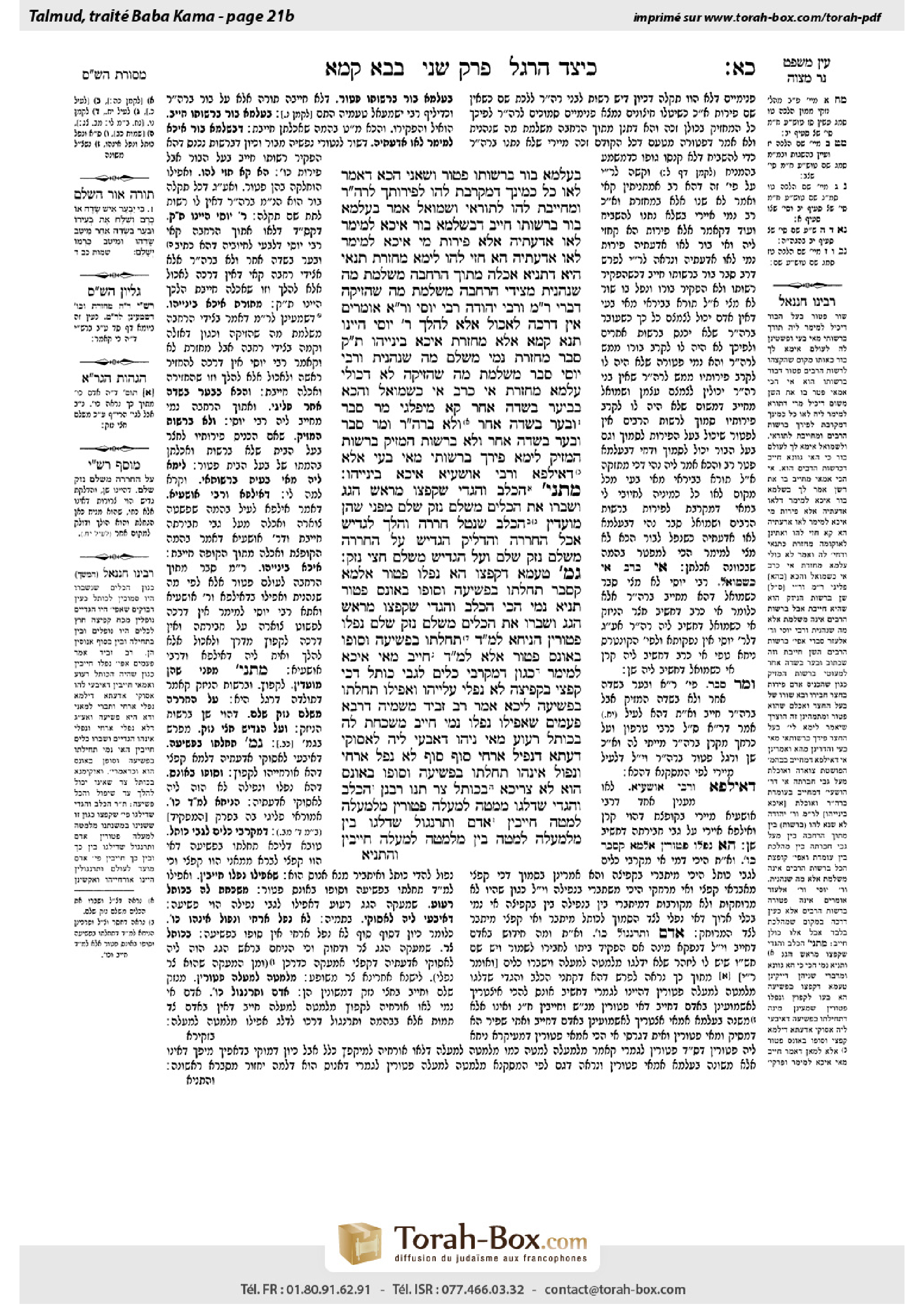
Bava Kamma 21b: Talmud study for Daf Yomi
Study the Talmud for Daf Yomi with scanned pages, Hebrew text, English translations from Sefaria and AI-generated French translations.
Passage selection and English or AI-generated French translation are available where the scan has annotations. Daf Study is independent of Torah-Box and Sefaria.
Browse Bava Kamma · בבא קמא · All tractatesBava Kamma 21b text and translations
This page of Bava Kamma includes the Aramaic text, an English translation and an AI-generated French translation, alongside the scan above.
בבא קמא כ״א ב · Aramaic and Hebrew text
בְּעָלְמָא – בּוֹר בִּרְשׁוּתוֹ פָּטוּר; וְשָׁאנֵי הָכָא, דְּאָמַר: לָאו כֹּל כְּמִינָךְ דִּמְקָרְבַתְּ לְהוּ לְפֵירוֹתָךְ לִרְשׁוּת הָרַבִּים, וּמְחַיְּיבַתְּ לְהוּ לְתוֹרַאי.
וּשְׁמוּאֵל אָמַר: בְּעָלְמָא – בּוֹר בִּרְשׁוּתוֹ חַיָּיב; דְּבִשְׁלָמָא בּוֹר, אִיכָּא לְמֵימַר לָאו אַדַּעְתֵּיהּ; אֶלָּא פֵּירוֹת, מִי אִיכָּא לְמֵימַר לָאו אַדַּעְתֵּיהּ?! הָא חָזֵי לְהוּ!
לֵימָא מַחְזֶרֶת תַּנָּאֵי הִיא – דְּתַנְיָא: אָכְלָה מִתּוֹךְ הָרְחָבָה – מְשַׁלֶּמֶת מַה שֶּׁנֶּהֱנֵית, מִצִּידֵּי הָרְחָבָה – מְשַׁלֶּמֶת מַה שֶּׁהִזִּיקָה; דִּבְרֵי רַבִּי מֵאִיר וְרַבִּי יְהוּדָה. רַבִּי יוֹסֵי וְרַבִּי אֶלְעָזָר אוֹמְרִים: אֵין דַּרְכָּהּ לֶאֱכוֹל, אֶלָּא לְהַלֵּךְ.
רַבִּי יוֹסֵי הַיְינוּ תַּנָּא קַמָּא! אֶלָּא מַחְזֶרֶת אִיכָּא בֵּינַיְיהוּ – תַּנָּא קַמָּא סָבַר: מַחְזֶרֶת נָמֵי – מְשַׁלֵּם מַה שֶּׁנֶּהֱנֵית, וְרַבִּי יוֹסֵי סָבַר: מְשַׁלֶּמֶת מַה שֶּׁהִזִּיקָה.
לָא; דְּכוּלֵּי עָלְמָא, מַחְזֶרֶת – אִי כְּרַב, אִי כִּשְׁמוּאֵל. וְהָכָא בְּ״בִעֵר בִּשְׂדֵה אַחֵר״ קָא מִיפַּלְגִי – מָר סָבַר: ״וּבִעֵר בִּשְׂדֵה אַחֵר״ – וְלֹא בִּרְשׁוּת הָרַבִּים; וּמָר סָבַר: ״וּבִעֵר בִּשְׂדֵה אַחֵר״ – וְלֹא בִּרְשׁוּת הַמַּזִּיק.
בִּרְשׁוּת הַמַּזִּיק – לֵימָא: פֵּירָךְ בִּרְשׁוּתִי מַאי בָּעֵי? אֶלָּא דְּאִילְפָא וְרַבִּי אוֹשַׁעְיָא אִיכָּא בֵּינַיְיהוּ.
מַתְנִי׳ הַכֶּלֶב וְהַגְּדִי שֶׁקָּפְצוּ מֵרֹאשׁ הַגָּג, וְשָׁבְרוּ אֶת הַכֵּלִים – מְשַׁלֵּם נֶזֶק שָׁלֵם, מִפְּנֵי שֶׁהֵן מוּעָדִין. הַכֶּלֶב שֶׁנָּטַל חֲרָרָה וְהָלַךְ לְגָדִישׁ, אָכַל הַחֲרָרָה וְהִדְלִיק הַגָּדִישׁ – עַל הַחֲרָרָה מְשַׁלֵּם נֶזֶק שָׁלֵם, וְעַל הַגָּדִישׁ מְשַׁלֵּם חֲצִי נֶזֶק.
גְּמָ׳ טַעְמָא דְּקָפְצוּ, הָא נָפְלוּ – פָּטוּר; אַלְמָא קָסָבַר: תְּחִלָּתוֹ בִּפְשִׁיעָה וְסוֹפוֹ בְּאוֹנֶס – פָּטוּר.
תַּנְיָא נָמֵי הָכִי: הַכֶּלֶב וְהַגְּדִי שֶׁקָּפְצוּ מֵרֹאשׁ הַגָּג וְשָׁבְרוּ אֶת הַכֵּלִים – מְשַׁלֵּם נֶזֶק שָׁלֵם. נָפְלוּ – פְּטוּרִין. הָנִיחָא לְמַאן דְּאָמַר: תְּחִלָּתוֹ בִּפְשִׁיעָה וְסוֹפוֹ בְּאוֹנֶס – פָּטוּר, אֶלָּא לְמַאן דְּאָמַר: חַיָּיב, מַאי אִיכָּא לְמֵימַר?
כְּגוֹן דִּמְקָרְבִי כֵּלִים לְגַבֵּי כוֹתֶל – דְּכִי קָפְצִי בִּקְפִיצָה, לָא נָפְלִי עֲלַיְיהוּ; וַאֲפִילּוּ תְּחִלָּתוֹ בִּפְשִׁיעָה לֵיכָּא.
אָמַר רַב זְבִיד מִשְּׁמֵיהּ דְּרָבָא: פְּעָמִים שֶׁאֲפִילּוּ נָפְלוּ נָמֵי חַיָּיב – מַשְׁכַּחַתְּ לַהּ בְּכוֹתֶל רָעוּעַ. מַאי נִיהוּ – דְּאִבְּעִי לֵיהּ לְאַסּוֹקֵי דַּעְתָּא דְּנָפְילִ[י] אַרְחֵי? סוֹף סוֹף, לָא נְפֻל אַרְחֵי – וּנְפוּל אִינְהוּ; תְּחִלָּתוֹ בִּפְשִׁיעָה וְסוֹפוֹ בְּאוֹנֶס הוּא! לָא צְרִיכָא, בְּכוֹתֶל צַר.
תָּנוּ רַבָּנַן: הַכֶּלֶב וְהַגְּדִי שֶׁדִּלְּגוּ מִמַּטָּה לְמַעְלָה – פְּטוּרִין. מִלְּמַעְלָה לְמַטָּה – חַיָּיבִין. אָדָם וְתַרְנְגוֹל שֶׁדִּלְּגוּ; בֵּין מִלְּמַעְלָה לְמַטָּה, בֵּין מִלְּמַטָּה לְמַעְלָה – חַיָּיבִין.
Bava Kamma 21b · English translation
that usually, if one digs a pit within his own property and he then declares his property to be ownerless, he is exempt, as he dug the pit when the property was his. But here it is different, because here the owner of the animal can say to the owner of the produce: It is not all in your power to bring your produce close to the public domain and to also hold my ox liable for eating it.
And Shmuel can say: Usually, if one digs a pit or creates an obstacle that can cause damage within his own property and he then declares his property to be ownerless, he is liable for any damage that is caused by the pit. As with regard to the pit, granted, it is possible to say that he was not aware, meaning the injured party was not thinking about the possibility that there may be a pit there that could cause him harm, and therefore the one who dug the pit is liable. But with regard to produce that is spread out over the ground, can it be said that the animal was not aware of it? It cannot be, because the animal sees the produce.
The Gemara suggests: Let us say that actually, the amoraic dispute about an animal that turns its head and eats produce at the side of the road is the subject of a dispute between tanna’im. As it is taught in a baraita: If an animal ate produce from the public square, the owner of the animal pays for the benefit that the animal derived; but if it ate from the sides of the public square, he pays for that which it damaged. This is the statement of Rabbi Meir and Rabbi Yehuda. But Rabbi Yosei and Rabbi Elazar say: It is not typical for an animal to eat in the public domain but only to walk there. Consequently, the owner is liable.
Initially, the Gemara understands Rabbi Yosei’s opinion as also referring to a situation in which the animal eats from the sides of the public square, and since this is so, it seems that the opinion of Rabbi Yosei is the same as that of the first tanna, Rabbi Meir, and the mishna presents their opinions as differing. Rather, it is clear that there is a difference between them with regard to a case in which the animal turns its head to eat. The first tanna holds that with regard to an animal that turns its head, the owner of the animal also pays for the benefit that the animal derived, while Rabbi Yosei holds that he pays for that which it damaged.
The Gemara rejects this: No, it is possible to say that everyone agrees about the halakha in the case of an animal that turns its head, either in accordance with the opinion of Rav or in accordance with the opinion of Shmuel. And here they disagree about the exemption inferred from the verse: “It consumed in the field of another” (Exodus 22:4), which renders the owner of an animal liable for damage classified as Eating. One Sage, Rabbi Meir, holds that only if it ate from private property is its owner liable, as the verse stating the owner’s liability means: “And it consumed in the field of another,” but not when it eats in the public domain. And one Sage, Rabbi Yosei, holds it means that even if it ate from the public domain its owner is liable, as the verse stating the owner’s liability means: “And it consumed in the field of another,” but not when it eats in the domain of the one responsible for the damage; only if the animal ate produce of another that was on the property of the animal’s owner, is its owner exempt.
The Gemara challenges this: But not when it eats in the domain of the one responsible for the damage? What is the novelty in this statement? Let the owner of the animal say to the owner of the produce: What is your produce doing on my property? The owner would certainly not be liable if the produce is damaged in that case. Rather, it must be that the difference between them is with regard to the dispute between Ilfa and Rabbi Oshaya concerning an animal that ate produce from the back of another animal or the like. Rabbi Meir holds that one is never liable for damage classified as Eating in the public domain, even if his animal ate from the back of another, and Rabbi Yosei holds that if it ate off the back of another animal, this is equivalent to Eating from the property of the injured party.
MISHNA: With regard to a dog or a goat that jumped from a rooftop and broke vessels while doing so, their owners must pay the full cost of the damage to the vessels because these animals are deemed forewarned concerning to jumping. With regard to a dog that took a cake that had been baked directly on hot coals, and went to a stack of grain to eat it, and it ate the cake and at the same time ignited the stack of grain with a coal that it had taken along with the cake, the owner of the dog must pay the full cost of the damage for the cake, and he must pay for half the cost of the damage to the stack of grain.
GEMARA: The Gemara infers from the mishna: The reason the owners must pay the full cost of the damage is because the animals jumped off the rooftop. This indicates that if they fell off the roof, they would be exempt from all liability despite his obligation to keep them from climbing onto the roof and jumping down from there. Apparently, the tanna holds that in an incident that begins with negligence, meaning carelessness or even an intention to cause damage, and ends in an accident, the one who caused the damage is exempt, as in this case the owner was careless in allowing the animals to go to the rooftop, but since they did not jump off the roof but rather fell accidentally, he is exempt.
The Gemara notes: This is also taught in a baraita: If a dog or a goat jumped from a rooftop and broke vessels while doing so, their owners must pay the full cost of the damage. If they fell from there, they are exempt from all liability. The Gemara asks: This works out well according to the one who says that if an incident begins with negligence and ends in an accident, the one who caused the damage is exempt, but according to the one who says that in such a case he is liable, what can be said? It seems that this baraita constitutes conclusive proof against that opinion.
The Gemara answers: The case in the baraita is a case where the vessels were brought close to the wall by their owners, so that when the animals jump off the rooftop in an ordinary leap they do not fall on top of them, and the vessels broke because the animal fell and didn’t jump. And since in an ordinary circumstance no damage should occur, this case does not even begin with negligence. Since the damage was caused by falling, the entire case is ruled an accident.
Rav Zevid said in the name of Rava: Sometimes one can be obligated to pay even in a case where the animals fell from the wall of their owner’s house. You find such a case where the wall was unstable, and the owner was negligent in allowing the animals to go up to the roof due to the danger of the wall collapsing. The Gemara asks: What is the reason for this? Is it because it should have occurred to him that bricks may fall from the wall and break the vessels? But ultimately, no bricks fell and instead the animals fell, so this is actually a case that begins with negligence and ends in an accident. The Gemara answers: No, it is necessary to state this halakha with regard to a case of a narrow wall, in which case it is clear that if they climb up there they will fall, and that is why he is liable for the damage they cause by falling.
The Sages taught in a baraita: If a dog or a goat jumped from below to something that was above them and thereby caused damage, their owners are exempt, as this is atypical behavior. But if they jumped from above to below, their owners are liable to pay the full cost of any damage they cause, as this is typical behavior. If a person or a chicken jumped and broke something, regardless of whether they jumped from above to below or from below to above, they are liable.
Bava Kamma 21b · Traduction française (IA)
que généralement, si l'on creuse un trou sur sa propre propriété et qu'il déclare ensuite sa propriété sans propriétaire, il est exempt, car il a creusé le trou lorsque la propriété était à lui. Mais ici, c'est différent, car l'propriétaire de l'animal peut dire à l'propriétaire des produits : Ce n'est pas à votre entière discrétion de ramener vos produits vers le domaine public et de tenir mon bœuf responsable de l'avoir mangé.
Et Shmuel peut dire : Généralement, si l'on creuse un trou ou qu'on crée un obstacle pouvant causer un dommage sur sa propre propriété et qu'on déclare ensuite sa propriété sans propriétaire, il est responsable de tout dommage causé par le trou. En ce qui concerne le trou, certes, on peut dire qu'il n'était pas conscient, c'est-à-dire que la personne blessée ne pensait pas à la possibilité qu'il y ait un trou là qui puisse le blesser, et donc celui qui a creusé le trou est responsable. Mais en ce qui concerne les produits étalés sur le sol, peut-on dire que l'animal n'était pas conscient ? Non, car l'animal voit les produits.
La Guemara suggère : Disons que, en réalité, le débat entre les amoraïm concernant un animal qui se tourne et mange des produits sur la route est la matière d'un débat entre les tannaïm. Comme il est enseigné dans une baraïta : Si un animal a mangé des produits du domaine public, l'propriétaire de l'animal paie le bénéfice que l'animal a tiré ; mais si l'animal a mangé des produits aux côtés du domaine public, il paie ce qu'il a endommagé. C'est l'opinion de Rabbi Meir et de Rabbi Yéhouda. Mais Rabbi Yosei et Rabbi Eléazar disent : Ce n'est pas typique qu'un animal mange dans le domaine public mais seulement qu'il y marche. Ainsi, l'propriétaire est responsable.
Initialement, la Guemara comprend l'opinion de Rabbi Yosei comme concernant également un cas où l'animal mange dans les lieux publics, et puisque c'est ainsi, cela semble que l'opinion de Rabbi Yosei soit la même que celle du premier tanna, Rabbi Meir, et la mitsna présente leurs opinions comme différentes. Plutôt, il est clair qu'il y a une différence entre eux concernant un cas où l'animal tourne la tête pour manger. Le premier tanna considère que dans le cas d'un animal qui tourne la tête, l'propriétaire de l'animal paie également le bénéfice que l'animal a tiré, tandis que Rabbi Yosei considère qu'il paie ce qu'il a endommagé.
La Guemara rejette cela : Non, on peut dire que tout le monde est d'accord sur la halakha dans le cas d'un animal qui tourne la tête, soit conformément à l'opinion de Rav, soit conformément à l'opinion de Shmuel. Et ici, ils divergent concernant l'exonération inférée du verset : « Il a mangé dans le champ d'autrui » (Exode 22:4), qui rend l'propriétaire d'un animal responsable du dommage classé comme Manger. Un Sage, Rabbi Meir, considère que seul si l'animal a mangé sur une propriété privée est son propriétaire responsable, car le verset indiquant la responsabilité de l'propriétaire signifie : « Et il a mangé dans le champ d'autrui », mais pas lorsqu'il mange dans le domaine public. Un autre Sage, Rabbi Yosei, considère qu'il signifie que même si l'animal a mangé dans le domaine public, son propriétaire est responsable, car le verset indiquant la responsabilité de l'propriétaire signifie : « Et il a mangé dans le champ d'autrui », mais pas lorsqu'il mange dans le domaine de celui responsable du dommage ; seulement si l'animal a mangé des produits d'autrui qui étaient sur la propriété de l'propriétaire de l'animal, son propriétaire est exempt.
La Guemara conteste cela : Mais pas lorsqu'il mange dans le domaine de celui responsable du dommage ? Quelle est la nouveauté dans cette déclaration ? Laissez l'propriétaire de l'animal dire à l'propriétaire des produits : Qu'est-ce que vos produits font sur ma propriété ? L'propriétaire ne serait certainement pas responsable si les produits sont endommagés dans ce cas. Plutôt, il doit être que la différence entre eux est concernant le débat entre Ilfa et Rabbi Oshaya concernant un animal qui a mangé des produits du dos d'un autre animal ou du genre. Rabbi Meir considère que l'on n'est jamais responsable du dommage classé comme manger dans le domaine public, même si son animal a mangé du dos d'un autre, et Rabbi Yosei considère que si l'animal a mangé du dos d'un autre animal, cela équivaut à manger dans la propriété de la personne blessée.
MICHNA : Concernant un chien ou un bouc qui sautait d'un toit et brisait des objets en le faisant, leurs propriétaires doivent payer le coût complet du dommage aux objets, car ces animaux sont considérés comme avertis concernant le saut. Concernant un chien qui a pris un gâteau qui avait été cuit directement sur des braises, et qui est allé à une pile de céréales pour le manger, et qu'il a mangé le gâteau et à la fois allumé la pile de céréales avec une braise qu'il avait emporté avec le gâteau, le propriétaire du chien doit payer le coût complet du dommage pour le gâteau, et il doit payer la moitié du coût du dommage à la pile de céréales.
GUEMARA : La Guemara tire la conclusion de la mitsva : La raison pour laquelle les propriétaires doivent payer le coût complet du dommage est que les animaux sont tombés du toit. Cela indique que si ils avaient été tombés du toit, ils auraient été exempt de toute responsabilité malgré son obligation de les garder loin du toit et de les empêcher de sauter dessus. Apparemment, le tanna considère que dans un incident qui commence par négligence, c'est-à-dire par négligence ou même une intention de causer un dommage, et qui se termine en accident, la personne qui a causé le dommage est exempt, car dans ce cas, l'propriétaire était négligent en permettant aux animaux d'aller sur le toit, mais puisque les animaux n'ont pas sauté du toit mais sont tombés accidentellement, il est exempt.
La Guemara note : Cela est également enseigné dans une baraïta : Si un chien ou un bouc saute d'un toit et brise des objets en le faisant, leurs propriétaires doivent payer le coût complet du dommage. Si ils tombent d'où ils sont, ils sont exempt de toute responsabilité. La Guemara pose la question : Cela fonctionne bien selon celui qui dit que dans un cas où un incident commence par négligence et se termine en accident, la personne qui a causé le dommage est exempt, mais selon celui qui dit que dans un tel cas il est responsable, que peut-on dire ? Il semble que cette baraïta constitue une preuve décisive contre cette opinion.
La Guemara répond : Le cas mentionné dans la baraïta est un cas où les récipients étaient placés près du mur par leurs propriétaires, de sorte que lorsqu'animaux sautent du toit d'une manière ordinaire, ils ne tombent pas sur eux, et les récipients se brisent parce que l'animal a sauté et n'a pas sauté correctement. Et puisque dans une situation ordinaire aucun dommage ne devrait survenir, ce cas ne commence même pas par négligence. Puisque le dommage a été causé par la chute, l'ensemble du cas est considéré comme un accident.
Rav Zevid a dit en nom de Rava : Parfois, on peut être tenu responsable même dans un cas où les animaux tombent du mur de la maison de leur propriétaire. Vous trouvez un cas où le mur était instable, et le propriétaire était négligent en permettant aux animaux d'aller sur le toit en raison du danger que représente la chute du mur. La Guemara demande : Quelle est la raison de cela ? Est-ce parce qu'il aurait dû se douter que des briques pourraient tomber du mur et briser les récipients ? Mais finalement, aucune brique n'a tombé et les animaux ont plutôt sauté, donc c'est en réalité un cas qui commence par négligence et se termine par un accident. La Guemara répond : Non, il est nécessaire d'énoncer cette halakha dans le cas d'un mur étroit, dans lequel cas il est clair que s'ils montent là-haut, ils tomberont, et c'est pourquoi il est responsable du dommage qu'ils causent en tombant.
Les Sages ont enseigné dans une baraïta : Si un chien ou une chèvre saute d'en dessous vers quelque chose qui est au-dessus d'eux et cause ainsi un dommage, leurs propriétaires sont exemptés, car cela constitue un comportement atypique. Mais si ils sautent d'en haut vers en dessous, leurs propriétaires sont tenus de payer le coût complet de tout dommage qu'ils causent, car cela constitue un comportement typique. Si une personne ou un poule saute et brise quelque chose, qu'ils sautent d'en haut vers en dessous ou d'en dessous vers en haut, ils sont responsables.
Traduction française générée par IA à partir de l’édition anglaise de Sefaria. Vérifie toujours un passage avec le texte source.
Text from Sefaria: William Davidson Edition - Vocalized Aramaic (CC BY NC); William Davidson Edition - English (CC BY NC).