Bava Kamma 22a: Talmud study for Daf Yomi
Study the Talmud for Daf Yomi with scanned pages, Hebrew text, English translations from Sefaria and AI-generated French translations.
Passage selection and English or AI-generated French translation are available where the scan has annotations. Daf Study is independent of Torah-Box and Sefaria.
Browse Bava Kamma · בבא קמא · All tractatesBava Kamma 22a text and translations
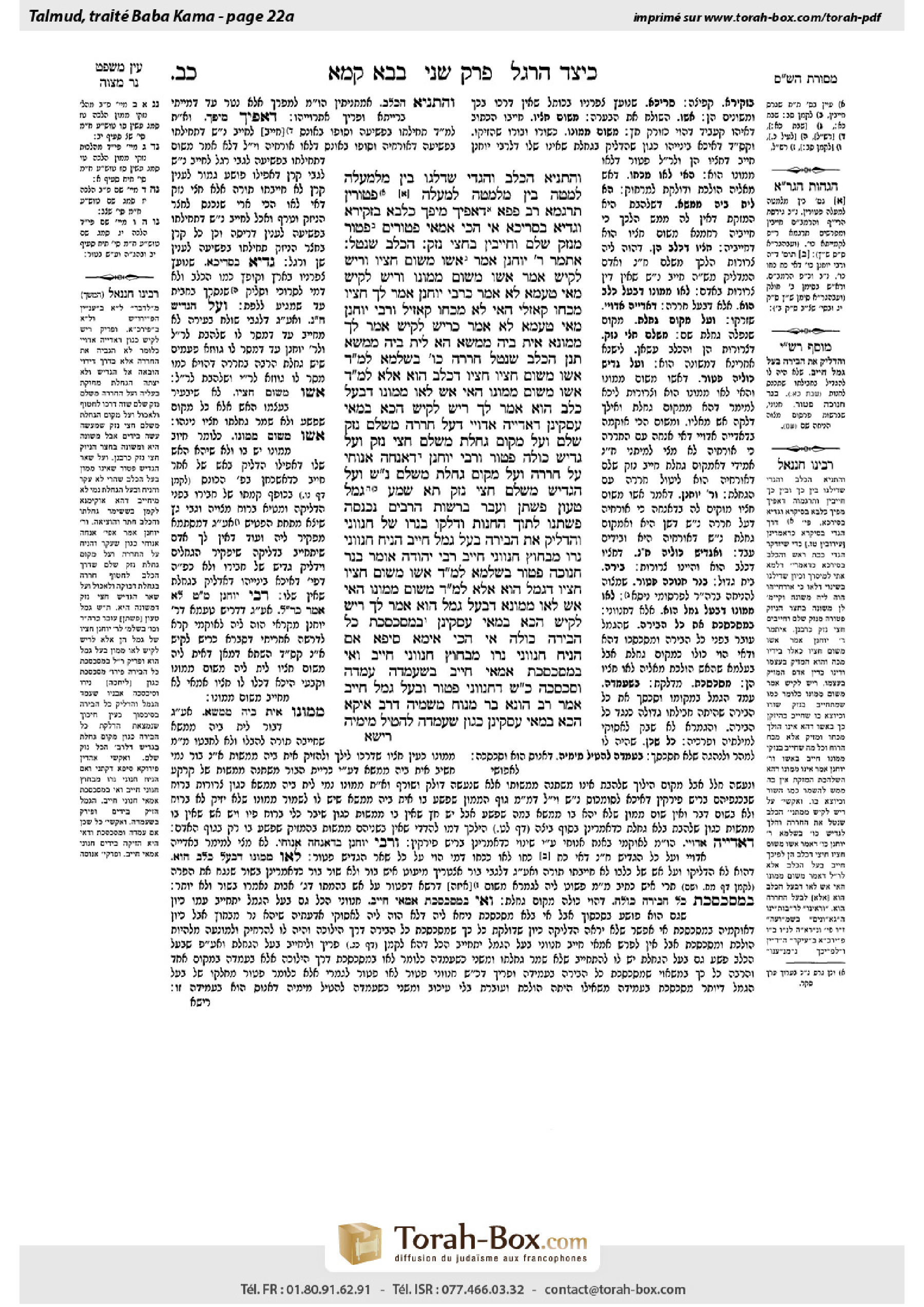
This page of Bava Kamma includes the Aramaic text, an English translation and an AI-generated French translation, alongside the scan above.
בבא קמא כ״ב א · Aramaic and Hebrew text
וְהָתַנְיָא: הַכֶּלֶב וְהַגְּדִי שֶׁדִּילְּגוּ; בֵּין מִלְּמַעְלָה לְמַטָּה, בֵּין מִלְּמַטָּה לְמַעְלָה – פְּטוּרִין! תַּרְגְּמַאּ רַב פָּפָּא: דְּאָפֵיךְ מֵיפָךְ – כַּלְבָּא בִּזְקִירָא וְגַדְיָא בִּסְרִיכָא. אִי הָכִי, אַמַּאי פְּטוּרִים? פָּטוּר מִנֶּזֶק שָׁלֵם, וְחַיָּיבִין בַּחֲצִי נֶזֶק.
הַכֶּלֶב שֶׁנָּטַל.
אִתְּמַר, רַבִּי יוֹחָנָן אָמַר: אִשּׁוֹ – מִשּׁוּם חִצָּיו. וְרֵישׁ לָקִישׁ אָמַר: אִשּׁוֹ – מִשּׁוּם מָמוֹנוֹ.
וְרֵישׁ לָקִישׁ – מַאי טַעְמָא לָא אָמַר כְּרַבִּי יוֹחָנָן? אָמַר לָךְ: חִצָּיו – מִכֹּחוֹ קָאָזְלִי, הַאי – לָא מִכֹּחוֹ קָאָזֵיל. וְרַבִּי יוֹחָנָן – מַאי טַעְמָא לָא אָמַר כְּרֵישׁ לָקִישׁ? אָמַר לָךְ: מָמוֹנָא – אִית בֵּיהּ מַמָּשָׁא, הָא – לֵית בֵּיהּ מַמָּשָׁא.
תְּנַן: הַכֶּלֶב שֶׁנָּטַל חֲרָרָה כּוּ׳. בִּשְׁלָמָא לְמַאן דְּאָמַר: אִשּׁוֹ מִשּׁוּם חִצָּיו – חִצָּיו דְּכֶלֶב הוּא;
אֶלָּא לְמַאן דְּאָמַר: אִשּׁוֹ מִשּׁוּם מָמוֹנוֹ – הַאי אֵשׁ, לָאו מָמוֹנוֹ דְּבַעַל כֶּלֶב הוּא!
אָמַר לָךְ רֵישׁ לָקִישׁ: הָכָא בְּמַאי עָסְקִינַן – דְּאַדְּיֵיהּ אַדּוֹיֵי; דְּעַל חֲרָרָה מְשַׁלֵּם נֶזֶק שָׁלֵם, וְעַל מָקוֹם גַּחֶלֶת מְשַׁלֵּם חֲצִי נֶזֶק, וְעַל גָּדִישׁ כּוּלֵּהּ פָּטוּר.
וְרַבִּי יוֹחָנָן – דְּאַנְּחַהּ אַנּוֹחֵי; עַל חֲרָרָה וְעַל מְקוֹם גַּחֶלֶת מְשַׁלֵּם נֶזֶק שָׁלֵם, וְעַל הַגָּדִישׁ מְשַׁלֵּם חֲצִי נֶזֶק.
תָּא שְׁמַע: גָּמָל טָעוּן פִּשְׁתָּן וְעָבַר בִּרְשׁוּת הָרַבִּים; נִכְנְסָה פִּשְׁתָּנוֹ לְתוֹךְ הַחֲנוּת (וְדָלְקוּ), [וְדָלְקָה] בְּנֵרוֹ שֶׁל חֶנְווֹנִי, וְהִדְלִיק אֶת הַבִּירָה – בַּעַל גָּמָל חַיָּיב. הִנִּיחַ חֶנְווֹנִי נֵרוֹ מִבַּחוּץ – חֶנְווֹנִי חַיָּיב. רַבִּי יְהוּדָה אוֹמֵר: בְּנֵר חֲנוּכָּה – פָּטוּר.
בִּשְׁלָמָא לְמַאן דְּאָמַר אִשּׁוֹ מִשּׁוּם חִצָּיו – חִצָּיו דְּגָמָל הוּא. אֶלָּא לְמַאן דְּאָמַר מִשּׁוּם מָמוֹנוֹ – הַאי אֵשׁ, לָאו מָמוֹנָא דְּבַעַל גָּמָל הוּא! אָמַר לָךְ רֵישׁ לָקִישׁ: הָכָא בְּמַאי עָסְקִינַן – בִּמְסַכְסֶכֶת כׇּל הַבִּירָה כּוּלָּהּ.
אִי הָכִי, אֵימָא סֵיפָא: אִם הִנִּיחַ חֶנְווֹנִי נֵרוֹ מִבַּחוּץ – חֶנְווֹנִי חַיָּיב. וְאִי בִּמְסַכְסֶכֶת – אַמַּאי חַיָּיב? בְּשֶׁעָמְדָה.
עָמְדָה וְסִכְסְכָה – כׇּל שֶׁכֵּן דְּחֶנְווֹנִי פָּטוּר וּבַעַל גָּמָל חַיָּיב! אָמַר רַב הוּנָא בַּר מָנוֹחַ מִשְּׁמֵיהּ דְּרַב אִיקָא: הָכָא בְּמַאי עָסְקִינַן – כְּגוֹן שֶׁעָמְדָה לְהַטִּיל מֵימֶיהָ;
Bava Kamma 22a · English translation
The Gemara asks: But isn’t it taught in a baraita: If a dog or a goat jumped, regardless of whether they jumped from above to below or from below to above, their owners are exempt from all liability? Rav Pappa interpreted it in the following way: Their manners of movement were changed from the typical manner of movement for their species. The dog moved by leaping [bizkira], while the goat moved by climbing [bisrikha]. The Gemara asks: If that is so, why are the owners exempt from liability? After all, they still caused damage. The Gemara answers: The baraita does not intend to say that they are completely exempt, but that they are exempt from paying the full cost of the damage; they are, however, liable to pay half the cost of the damage, as is the halakha in any case of damage caused by atypical behavior, as such acts are classified as Goring.
§ The mishna teaches: With regard to a dog that took a cake that had been baked directly on hot coals, and went to a stack of grain to eat it, and it ate the cake and at the same time ignited the stack of grain with a coal that it had taken along with the cake, the owner of the dog must pay the full cost of the damage for the cake, and he must pay for half the cost of the damage to the stack of grain.
With regard to damage caused by a fire lit by one person spreading to a location other than where it was lit, the Gemara cites a dispute among the amora’im: It was stated: Rabbi Yoḥanan says: His liability for damage caused by his fire is due to its similarity to his arrows, meaning that damage caused by a fire in a location other than where it was lit is comparable to damage caused by an arrow shot at a distant target. And Reish Lakish says: His liability for the damage caused by his fire is due to its similarity to his property; he is responsible for this damage just as he is responsible for damage caused elsewhere by any of his possessions, e.g., one of his animals.
The Gemara asks: And what is the reason that Reish Lakish did not state his opinion in accordance with the opinion of Rabbi Yoḥanan? The Gemara answers: He could have said to you that fire is not comparable to an arrow, as an arrow proceeds as a result of his direct force, while this fire does not proceed as a result of his direct force, but requires a wind to carry it from the location where it was lit to the location of the damage. The Gemara asks about the other opinion: And what is the reason that Rabbi Yoḥanan did not state his opinion in accordance with the opinion of Reish Lakish? The Gemara answers: He could have said to you that one’s fire is not comparable to his possessions, as property is a tangible substance but this fire is not a tangible substance.
The Gemara attempts to settle the dispute: We learned in the mishna: With regard to a dog that took a cake that had been baked directly on hot coals, and went to a stack of grain to eat it, and it ate the cake and at the same time ignited the stack of grain with a coal that it had taken along with the cake, the owner of the dog must pay the full cost of the damage for the cake, and he must pay for half the cost of the damage to the stack of grain. Granted, according to the one who says that one’s liability for damage caused by his fire is due to its similarity to his arrows, this fire is similar to the arrows of the dog, and therefore he must pay for half the cost of the damage caused by the dog’s force, as in a case of pebbles.
But according to the one who says that one’s liability for damage caused by his fire is due to its similarity to his property, this fire is not the property of the owner of the dog; rather, it is the property of the owner of the cake, so why is the owner of the dog liable?
The Gemara answers: Reish Lakish could have said to you: With what are we dealing here? We are dealing with a case where the dog took the coal and did not place the cake on the stack, rather it threw it onto the stack. The ruling of the mishna is: For the cake which the dog ate, the owner must pay the full cost of the damage, and for the specific spot on the stack of grain that was damaged by the throwing of the coal there, the owner must pay for half the cost of the damage as in a case of pebbles. And for the stack of grain as a whole, he is exempt, because his liability for damage caused by the spread of the fire is due to its similarity to his property, and in this case it was not his property.
But Rabbi Yoḥanan can explain the mishna in a more straightforward manner. It is discussing a case where the dog placed the cake with the coal directly on the stack of grain in order to eat the cake. Accordingly, the owner of the dog must pay the full cost of the damage for the cake and for the specific spot where the coal was put down, as these cases of damage were caused directly by the dog. And for the rest of the stack of grain, he must pay for half the cost of the damage, because in Rabbi Yoḥanan’s opinion one is liable for the damage caused by fire due to its similarity to arrows shot by his force. The damage to the rest of the stack of grain is an indirect result of the dog’s force, and therefore his liability is according the halakhot of pebbles.
The Gemara suggests: Come and hear a proof from a mishna (62b): In the case of a camel that was laden with flax and was passing through the public domain, and its flax extended into a store at the edge of the public domain, and the flax caught fire from a lamp in the store belonging to the storekeeper, and as a result of the burning flax the camel set fire to the building together with all its contents, the owner of the camel is liable for the damage. But if the storekeeper placed his lamp outside in the public domain, thereby causing the flax on the camel to catch fire, and consequently the building was set on fire, the storekeeper is liable. Rabbi Yehuda says: In a case where the lamp placed outside was a Hanukkah lamp, the storekeeper is exempt from liability, as there is a mitzva to place a Hanukkah lamp outside.
Granted, according to the one who says that one’s liability for the damage caused by his fire is due to its similarity to his arrows, the fire in the store is similar to the arrows of the camel, and that is why the camel’s owner is liable. But according to the one who says that liability for the damage is due to its similarity to his property, this fire is not the property of the owner of the camel. The Gemara answers: Reish Lakish could have said to you: With what are we dealing here? We are dealing with a case where the camel moved the burning flax around and ignited the entire building, lighting one spot after another. The fire did not need to spread since the camel directly set the building on fire in each of those spots, and therefore this case is comparable to that of a dog who moved the coal around from place to place.
The Gemara asks: If that is so, say the latter clause of the mishna: If the storekeeper placed his lamp outside, the storekeeper is liable. And if the case is one where the camel ignited the entire building, spot by spot, why is the storekeeper liable? His fire did not spread through the building; it was the camel that moved it around from one place to another. The Gemara answers: The case is one where the camel did not move around, but rather stood still, but since there was an extremely large load of flax on its back, once it caught fire it ignited the entire building simultaneously.
The Gemara asks: If the camel stood without moving from place to place, but did shift the load on its back and thereby ignited the entire building, all the more so it should be that the storekeeper should be exempt from any liability and the owner of the camel should be liable, as it was his responsibility to move the camel away from there. Rav Huna bar Manoah said in the name of Rav Ika: With what are we dealing here? We are dealing with a case where the camel stood still in order to urinate and while doing so set the building ablaze; in that case the incident is deemed an accident as the owner could not have moved the camel from the spot.
Bava Kamma 22a · Traduction française (IA)
Le Guemara pose la question : Mais n’est-il pas enseigné dans une baraïta : Si un chien ou une chèvre saute, qu’importe qu’ils sautent du haut vers le bas ou du bas vers le haut, leurs propriétaires sont exempts de toute responsabilité ? Rav Pappa l’interprète ainsi : Leur mode de mouvement a été modifié par rapport au mode habituel de leur espèce. Le chien se déplaçait par bonds [bizkira], tandis que la chèvre se déplaçait par escalade [bisrikha]. Le Guemara pose la question : Si c’est ainsi, pourquoi les propriétaires sont-ils exempts de responsabilité ? Après tout, ils ont encore causé un préjudice. Le Guemara répond : La baraïta ne veut pas dire qu’ils sont entièrement exempts, mais qu’ils sont exempts de payer le coût complet du préjudice ; ils sont cependant responsables de payer la moitié du coût du préjudice, comme c’est le cas dans tout cas de préjudice causé par un comportement atypique, car ces actes sont classés comme Goring.
§ La mitsna enseigne : En ce qui concerne un chien qui a pris un gâteau cuit directement sur des braises, et qui est allé vers un tas de céréales pour le manger, et qui a mangé le gâteau tout en allumant le tas de céréales avec une braise qu’il avait emporté avec le gâteau, le propriétaire du chien doit payer le coût complet du préjudice pour le gâteau, et il doit payer la moitié du coût du préjudice pour le tas de céréales.
En ce qui concerne les préjudices causés par un feu allumé par une personne qui se propage vers un lieu différent de celui où il a été allumé, le Guemara cite un désaccord entre les amoraïm : On a dit : Rabbi Yoḥanan dit : Sa responsabilité pour les préjudices causés par son feu est due à sa similitude avec ses flèches, c’est-à-dire que les préjudices causés par un feu dans un lieu différent de celui où il a été allumé sont comparables aux préjudices causés par une flèche tirée vers une cible éloignée. Et Reish Lakish dit : Sa responsabilité pour les préjudices causés par son feu est due à sa similitude avec ses biens ; il est responsable de ce préjudice comme il l’est pour les préjudices causés ailleurs par l’un de ses biens, par exemple l’un de ses animaux.
Le Guemara pose la question : Et quelle est la raison pour laquelle Reish Lakish n’a pas exprimé son opinion conformément à celle de Rabbi Yoḥanan ? Le Guemara répond : Il aurait pu te dire que le feu n’est pas comparable à une flèche, car une flèche progresse en raison de sa force directe, tandis que ce feu ne progresse pas en raison de sa force directe, mais nécessite un vent pour le porter du lieu où il a été allumé vers le lieu du préjudice. Le Guemara pose la question concernant l’autre opinion : Et quelle est la raison pour laquelle Rabbi Yoḥanan n’a pas exprimé son opinion conformément à celle de Reish Lakish ? Le Guemara répond : Il aurait pu te dire que le feu d’une personne n’est pas comparable à ses biens, car les biens sont une substance tangible, tandis que ce feu n’est pas une substance tangible.
Le Guemara tente de résoudre le désaccord : Nous avons appris dans la mitsna : En ce qui concerne un chien qui a pris un gâteau cuit directement sur des braises, et qui est allé vers un tas de céréales pour le manger, et qui a mangé le gâteau tout en allumant le tas de céréales avec une braise qu’il avait emporté avec le gâteau, le propriétaire du chien doit payer le coût complet du préjudice pour le gâteau, et il doit payer la moitié du coût du préjudice pour le tas de céréales. Admettons, selon celui qui dit que la responsabilité pour les préjudices causés par son feu est due à sa similitude avec ses flèches, ce feu est similaire aux flèches du chien, et donc il doit payer la moitié du coût du préjudice causé par la force du chien, comme dans le cas des cailloux.
Mais selon celui qui dit que la responsabilité pour les préjudices causés par son feu est due à sa similitude avec ses biens, ce feu n’est pas la propriété du propriétaire du chien ; plutôt, c’est la propriété du propriétaire du gâteau, donc pourquoi le propriétaire du chien est-il responsable ?
Le Guemara répond : Reish Lakish aurait pu te dire : Avec quoi sommes-nous en train de traiter ici ? Nous traitons d’un cas où le chien a pris la braise et n’a pas placé le gâteau sur le tas, mais l’a jeté sur le tas. Le jugement de la mitsna est : Pour le gâteau que le chien a mangé, le propriétaire doit payer le coût complet du préjudice, et pour la zone spécifique du tas de céréales endommagée par le jet de la braise, le propriétaire doit payer la moitié du coût du préjudice comme dans le cas des cailloux. Et pour le tas de céréales en tant que tel, il est exempt, car sa responsabilité pour les préjudices causés par la propagation du feu est due à sa similitude avec ses biens, et dans ce cas, ce n’était pas ses biens.
Mais Rabbi Yoḥanan peut expliquer la mitsna d’une manière plus directe. Il s’agit d’un cas où le chien a placé le gâteau avec la braise directement sur le tas de céréales pour manger le gâteau. Ainsi, le propriétaire du chien doit payer le coût complet du préjudice pour le gâteau et pour la zone spécifique où la braise a été posée, car ces cas de préjudice ont été causés directement par le chien. Et pour le reste du tas de céréales, il doit payer la moitié du coût du préjudice, car selon l’opinion de Rabbi Yoḥanan, on est responsable des préjudices causés par le feu en raison de sa similitude avec les flèches tirées par sa force. Le préjudice pour le reste du tas de céréales est un résultat indirect de la force du chien, et donc sa responsabilité est selon les halakhot des cailloux.
Le Guemara suggère : Viens entendre une preuve tirée d'une mitsva (62b) : Dans le cas d'un chameau chargé de lin passant par le domaine public, et dont le lin dépassait dans un magasin à la limite du domaine public, et le lin s'est enflammé à partir d'une lampe du magasin appartenant au propriétaire du magasin, et en conséquence du lin brûlant, le chameau a mis le feu au bâtiment avec tout son contenu, le propriétaire du chameau est responsable du préjudice. Mais si le propriétaire du magasin a placé sa lampe à l'extérieur dans le domaine public, causant ainsi que le lin du chameau s'enflamme, et en conséquence le bâtiment a pris feu, le propriétaire du magasin est responsable. Rabbi Yehuda dit : Dans un cas où la lampe placée à l'extérieur était une lampe de Hanouka, le propriétaire du magasin est exempt de responsabilité, car il y a une mitsva de placer une lampe de Hanouka à l'extérieur.
D'accord, selon celui qui affirme que la responsabilité pour les dommages causés par son feu est due à sa ressemblance avec ses flèches, le feu dans le magasin est semblable aux flèches du chameau, et c'est pourquoi l'owner du chameau est responsable. Mais selon celui qui affirme que la responsabilité pour les dommages est due à sa ressemblance avec ses biens, ce feu n'est pas le bien de l'owner du chameau. La Guemara répond : Reish Lakish aurait pu te dire : Avec quels cas sommes-nous en train de traiter ? Nous traitons d'un cas où le chameau a déplacé les tiges de lin brûlantes et a allumé l'ensemble du bâtiment, allumant un point après l'autre. Le feu n'avait pas besoin de se propager, car le chameau a directement mis le bâtiment à feu à chaque point, et donc ce cas est comparable à celui d'un chien qui a déplacé les braises d'un endroit à l'autre.
La Guemara demande : Si c'est ainsi, disons la seconde partie de la mitsna : Si le propriétaire du magasin a placé sa lampe à l'extérieur, le propriétaire du magasin est responsable. Et si le cas est celui où le chameau a allumé l'ensemble du bâtiment, point par point, pourquoi le propriétaire du magasin est-il responsable ? Son feu n'a pas se propagé dans le bâtiment ; c'était le chameau qui l'avait déplacé d'un endroit à l'autre. La Guemara répond : Le cas est celui où le chameau ne s'est pas déplacé, mais plutôt restait immobile, mais comme il y avait une charge extrêmement importante de lin sur son dos, une fois qu'il s'était mis à brûler, il a allumé l'ensemble du bâtiment en même temps.
La Guemara demande : Si le chameau restait sans se déplacer d'un endroit à l'autre, mais qu'il changeait la charge sur son dos et ainsi allumait l'ensemble du bâtiment, cela devrait encore plus être le cas que le propriétaire du magasin doive être exempt de toute responsabilité et que l'propriétaire du chameau doive être responsable, car c'était sa responsabilité de déplacer le chameau d'ici. Rav Huna bar Manoah a dit en nom de Rav Ika : Avec quels cas sommes-nous en train de traiter ? Nous traitons d'un cas où le chameau restait immobile pour uriner et, en le faisant, a allumé le bâtiment ; dans ce cas, l'incident est considéré comme un accident, car l'propriétaire n'avait pas pu déplacer le chameau de l'endroit.
Traduction française générée par IA à partir de l’édition anglaise de Sefaria. Vérifie toujours un passage avec le texte source.
Text from Sefaria: William Davidson Edition - Vocalized Aramaic (CC BY NC); William Davidson Edition - English (CC BY NC).