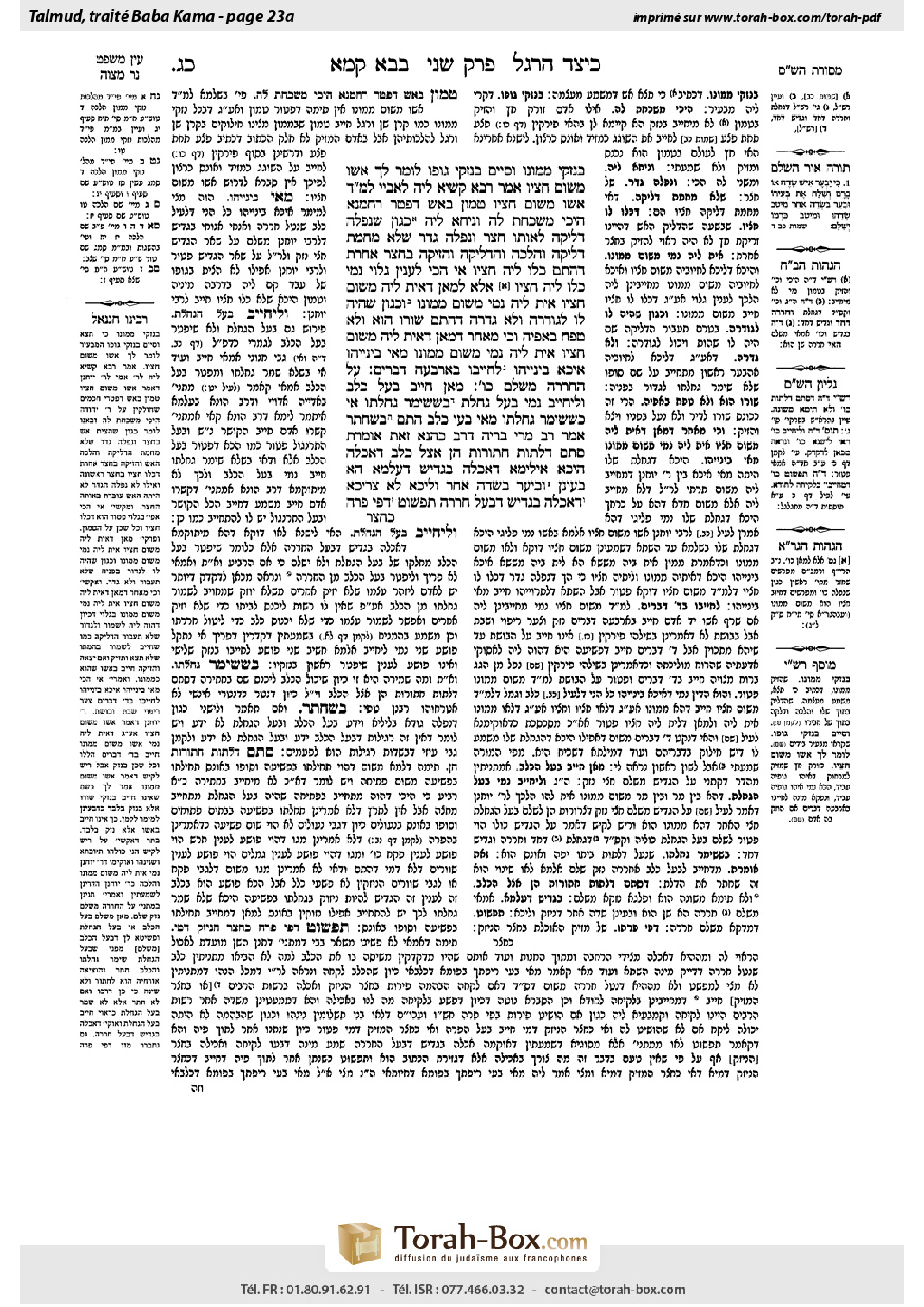
Bava Kamma 23a: Talmud study for Daf Yomi
Study the Talmud for Daf Yomi with scanned pages, Hebrew text, English translations from Sefaria and AI-generated French translations.
Passage selection and English or AI-generated French translation are available where the scan has annotations. Daf Study is independent of Torah-Box and Sefaria.
Browse Bava Kamma · בבא קמא · All tractatesBava Kamma 23a text and translations
This page of Bava Kamma includes the Aramaic text, an English translation and an AI-generated French translation, alongside the scan above.
בבא קמא כ״ג א · Aramaic and Hebrew text
בְּנִזְקֵי מָמוֹנוֹ, וְסִיֵּים בְּנִזְקֵי גוּפוֹ; לוֹמַר לְךָ: אִשּׁוֹ מִשּׁוּם חִצָּיו.
אָמַר רָבָא, קַשְׁיָא לֵיהּ לְאַבָּיֵי: לְמַאן דְּאָמַר אִשּׁוֹ מִשּׁוּם חִצָּיו, טָמוּן בָּאֵשׁ דִּפְטַר רַחֲמָנָא – הֵיכִי מַשְׁכַּחַתְּ לַהּ?
וְנִיחָא לֵיהּ: כְּגוֹן שֶׁנָּפְלָה דְּלֵיקָה לְאוֹתוֹ חָצֵר, וְנָפְלָה גָּדֵר שֶׁלֹּא מֵחֲמַת דְּלֵיקָה, וְהָלְכָה וְהִדְלִיקָה וְהִזִּיקָה בְּחָצֵר אַחֶרֶת. דְּהָתָם – כְּלוּ לֵיהּ חִצָּיו.
אִי הָכִי, לְעִנְיַן גָּלוּי נָמֵי כְּלוּ לֵיהּ חִצָּיו!
אֶלָּא לְמַאן דְּאִית לֵיהּ מִשּׁוּם חִצָּיו – אִית לֵיהּ נָמֵי מִשּׁוּם מָמוֹנוֹ; וּכְגוֹן שֶׁהָיָה לוֹ לְגוֹדְרָהּ וְלֹא גְּדָרָהּ; דְּהָתָם – שׁוֹרוֹ הוּא וְלָא טְפַח בְּאַפֵּיהּ.
וְכִי מֵאַחַר דְּמַאן דְּאִית לֵיהּ מִשּׁוּם חִצָּיו אִית לֵיהּ נָמֵי מִשּׁוּם מָמוֹנוֹ, מַאי בֵּינַיְיהוּ?
אִיכָּא בֵּינַיְיהוּ לְחַיְּיבוֹ בְּאַרְבָּעָה דְּבָרִים.
עַל הַחֲרָרָה מְשַׁלֵּם כּוּ׳. מַאן חַיָּיב – בַּעַל כֶּלֶב. וְלִיחַיַּיב נָמֵי בַּעַל גַּחֶלֶת! בְּשֶׁשִּׁימֵּר גַּחַלְתּוֹ.
אִי כְּשֶׁשִּׁימֵּר גַּחַלְתּוֹ, מַאי בָּעֵי כֶּלֶב הָתָם? בְּשֶׁחָתַר. אָמַר רַב מָרִי בְּרֵיהּ דְּרַב כָּהֲנָא: זֹאת אוֹמֶרֶת, סְתָם דְּלָתוֹת חֲתוּרוֹת הֵן אֵצֶל כֶּלֶב.
דְּאַכְלַהּ הֵיכָא? אִילֵּימָא דְּאַכְלַהּ בְּגָדִישׁ דְּעָלְמָא, הָא בָּעֵינַן ״וּבִעֵר בִּשְׂדֵה אַחֵר״, וְלֵיכָּא! לָא צְרִיכָא, דְּאַכְלַהּ בְּגָדִישׁ דְּבַעַל חֲרָרָה.
תִּפְשׁוֹט דְּפִי פָרָה –
Bava Kamma 23a · English translation
with a reference to damage caused by one’s possessions, as it is written: “If fire breaks out,” indicating that his responsibility for the fire is the same as his responsibility for any of his possessions that cause damage, and it concludes with a reference to damage caused by one’s body, as the verse refers to the person by calling him “the one who ignited the fire,” telling you that his liability for the damage caused by his fire is due to its similarity to his arrows.
Rava said that Abaye raised a difficulty: According to the one who says that one’s liability for the damage caused by his fire is due to its similarity to his arrows, how can you find that the Merciful One exempted one from liability for concealed items damaged by a fire? If one caused damage by shooting an arrow, he would be equally liable for damaging both exposed and concealed items. Consequently, if one’s liability for the damage caused by his fire is due to its similarity to his arrows, he should similarly be liable for concealed items damaged by a fire.
And it was satisfactory for him, i.e., Abaye resolved the difficulty. He explained that the exemption from liability for concealed items damaged by a fire applies in a case where a fire broke out in that same courtyard, and afterward the fence separating this courtyard from the neighbor’s courtyard collapsed, but not due to the fire, and therefore the fire spread and ignited items and caused damage in another courtyard. In such a circumstance he would be exempt because there, in this case, it is as if his arrows were depleted, i.e., he bears responsibility for the fire that he had started, which initially was confined to his courtyard alone. The fire that spread to the neighboring courtyard is not similar to his arrows, and therefore he is exempt.
The Gemara challenges this explanation: If that is so, he should be exempt not only with regard to concealed items but also with regard to exposed items that were damaged by the fire, as his arrows are also depleted when the fire spreads and causes damage. If his exemption is due to fact that the damage was caused because the wall that had separated the two courtyards had collapsed, there should be no distinction between exposed and concealed items.
Rather, it must be that the one who holds that one’s liability for the damage caused by his fire is due to its similarity to his arrows also holds that his liability is due to the fire’s similarity to his property. Consequently, it remains possible for a circumstance to exist in which one will be exempt from liability for damaging concealed items and yet be held liable for exposed items. For example, if he had the ability to repair the breach and fence in the courtyard again but he did not fence it in, he will be liable, as there, it is similar to a case where his ox was in danger of escaping from his property and he did not strike it in its face to hold it back, and therefore he is liable for any ensuing damage. In this case, however, the fire is not similar to his arrows since it was not responsible for the collapse of the fence, and therefore he is exempt from damage caused to concealed items, according to the halakhot of Fire.
The Gemara asks: But according to this conclusion, since the one who holds that one’s liability for the damage caused by his fire is due to its similarity to his arrows also holds that his liability is due to its similarity to his property, what is the difference between the opinions of Rabbi Yoḥanan and Reish Lakish?
The Gemara answers: The practical difference between them is with regard to holding him liable for the additional four types of indemnity in a case where the fire injured a person. In such an instance Rabbi Yoḥanan would require, in addition to the costs of the damage itself, payments for pain, medical costs, loss of livelihood, and humiliation, as in any case of personal injury, given that Rabbi Yoḥanan considers Fire to be no different than an arrow he had shot at the injured party.
§ The mishna teaches that he must pay the full cost of the damage for the cake the dog ate but must pay for only half the cost of the damage to the burned stack of grain. The Gemara elucidates: Who is the one obligated to pay for the cake? The owner of the dog. The Gemara challenges this: But why not let the owner of the coal also be liable, as he shares some of the responsibility, being that he did not safeguard his coal and it ultimately caused damage? The Gemara answers: The case under discussion is one where the owner of the coal safeguarded his coal properly.
The Gemara asks: If the case is one where he safeguarded his coal properly, what does the dog want, i.e., what is it doing there? If the dog was able to get in there, it cannot be that the owner of the coal safeguarded it properly. The Gemara answers: The case is one where the dog burrowed under the fence, entered the property, and took the cake and the coal. Rav Mari, son of Rav Kahana, said: That is to say that ordinary doors are deemed vulnerable to being burrowed under by a dog because if it would be atypical for a dog to burrow under the door, the owner of the dog would be exempt from payment. Therefore, it must be that it is typical behavior for a dog to burrow beneath a door, and therefore it was incumbent upon the owner of the door to prevent it from causing damage.
The Gemara asks: Where did it eat the cake? If we say that it ate it after placing it on a stack of grain belonging to another, i.e., someone other than the owner of the cake, then he should not be liable for the damage to the cake under the halakhot of Eating, as in order to hold someone liable we require fulfillment of scenario described in the verse: “And it consumed in the field of another” (Exodus 22:4), meaning that an act of damage classified as Eating must be caused on the property of the injured party, and that is not the case in this instance. The Gemara answers: No, it is necessary only in the case where the dog ate the cake after placing it on a stack of grain owned by the owner of the cake, and that is why the dog’s owner is liable, as it ate it while on the property of the injured party.
§ The Gemara suggests: From here it is possible to resolve a dilemma and prove that the mouth of a cow
Bava Kamma 23a · Traduction française (IA)
avec une référence aux dommages causés par ses biens, comme il est écrit : « Si un feu éclate », indiquant que sa responsabilité concernant le feu est la même que celle qu’il a pour tout autre de ses biens qui cause des dommages, et il conclut avec une référence aux dommages causés par son corps, comme la parabole fait référence à la personne en l'appelant « celui qui a allumé le feu », vous indiquant que sa responsabilité pour les dommages causés par son feu est due à sa similitude avec ses flèches.
Rava a dit que Abaye a soulevé un problème : Selon celui qui dit que la responsabilité pour les dommages causés par son feu est due à sa similitude avec ses flèches, comment pouvez-vous trouver que l'Éternel Miséricordieux exemptait de responsabilité les objets cachés endommagés par un feu ? Si l'on causait des dommages en lançant une flèche, il serait aussi responsable des objets exposés et cachés. Par conséquent, si la responsabilité pour les dommages causés par son feu est due à sa similitude avec ses flèches, il devrait être aussi responsable des objets cachés endommagés par un feu.
Et cela a été satisfaisant pour lui, c'est-à-dire Abaye a résolu le problème. Il a expliqué que l'exemption de responsabilité pour les objets cachés endommagés par un feu s'applique dans un cas où un feu s'est déclaré dans ce même jardin, et ensuite le mur séparant ce jardin du jardin du voisin s'est effondré, mais pas à cause du feu, et donc le feu s'est propagé et a allumé des objets, causant des dommages dans un autre jardin. Dans ce cas, il serait exempt car, dans ce cas, il est comme si ses flèches étaient épuisées, c'est-à-dire qu'il assume la responsabilité du feu qu'il avait allumé, qui était initialement confiné à son jardin. Le feu qui s'est propagé dans le jardin voisin n'est pas similaire à ses flèches, et donc il est exempt.
Le Guemara conteste cette explication : Si c'est ainsi, il devrait être exempt non seulement concernant les objets cachés mais aussi concernant les objets exposés endommagés par le feu, car ses flèches sont également épuisées lorsque le feu s'étend et cause des dommages. Si son exemption est due au fait que les dommages ont été causés parce que le mur qui séparait les deux courtyards s'était effondré, il ne devrait pas y avoir de distinction entre les objets exposés et les objets cachés.
Au contraire, il doit être que celui qui considère que la responsabilité pour les dommages causés par son feu est due à sa similitude avec ses flèches considère aussi que sa responsabilité est due à la similitude du feu avec ses biens. Par conséquent, il reste possible qu'un cas existe où l'on soit exempt de responsabilité pour les dommages causés aux objets cachés tout en étant tenu responsable des objets exposés. Par exemple, s'il avait la possibilité de réparer la brèche et de clôturer à nouveau le jardin mais qu'il n'a pas clôturé, il serait responsable, car c'est comme si son bœuf était en danger de s'échapper de ses terres et qu'il n'a pas frappé son visage pour le retenir, et donc il est responsable de tout dommage subséquent. Dans ce cas, cependant, le feu n'est pas similaire à ses flèches car ce n'était pas responsable de l'effondrement du mur, et donc il est exempt des dommages causés aux objets cachés, selon les halakhot du feu.
Le Guemara pose une question : Mais selon cette conclusion, puisque celui qui considère que la responsabilité pour les dommages causés par son feu est due à sa similitude avec ses flèches considère aussi que sa responsabilité est due à sa similitude avec ses biens, quelle est la différence entre les opinions de Rabbi Yoḥanan et de Reish Lakish ?
Le Guemara répond : La différence pratique entre eux concerne la responsabilité pour les quatre types supplémentaires de réparation dans le cas où le feu a blessé une personne. Dans ce cas, Rabbi Yoḥanan exigerait, en plus des coûts des dommages, des paiements pour la douleur, les frais médicaux, la perte de revenus et la humiliation, comme dans tout cas de blessure personnelle, étant donné que Rabbi Yoḥanan considère le feu comme n'étant pas différent d'une flèche qu'il avait tirée sur la personne blessée.
§ La mitsna enseigne qu'il doit payer le coût complet des dommages pour le gâteau que le chien a mangé mais doit payer seulement la moitié du coût des dommages au tas de blé brûlé. Le Guemara explique : Qui est tenu de payer pour le gâteau ? L'propriétaire du chien. Le Guemara conteste cela : Mais pourquoi ne pas tenir responsable de l'propriétaire du charbon, car il partage une partie de la responsabilité, étant donné qu'il n'a pas gardé son charbon et qu'il a finalement causé des dommages ? Le Guemara répond : Le cas en question est celui où l'propriétaire du charbon a gardé son charbon correctement.
Le Guemara pose une question : Si le cas est celui où il a gardé son charbon correctement, que veut le chien, c'est-à-dire que fait-il là ? Si le chien a pu entrer là, il ne peut pas être que l'propriétaire du charbon l'ait gardé correctement. Le Guemara répond : Le cas est celui où le chien a creusé sous le mur, est entré dans la propriété et a pris le gâteau et le charbon. Rav Mari, fils de Rav Kahana, a dit : Cela signifie que les portes ordinaires sont considérées comme vulnérables à être creusées par un chien, car si c'était atypique pour un chien de creuser sous la porte, l'propriétaire du chien serait exempt de paiement. Par conséquent, il doit être typique pour un chien de creuser sous une porte, et donc il était incumbent à l'propriétaire de la porte de prévenir les dommages.
Le Guemara pose une question : Où a-t-il mangé le gâteau ? Si nous disons qu'il l'a mangé après avoir mis le gâteau sur un tas de blé appartenant à quelqu'un d'autre, c'est-à-dire à quelqu'un d'autre que l'propriétaire du gâteau, alors il ne devrait pas être responsable des dommages au gâteau selon les halakhot de la consommation, car pour tenir quelqu'un responsable, nous exigeons la réalisation de la scène décrite dans la parabole : « Et il a mangé dans le champ d'un autre » (Exode 22:4), c'est-à-dire qu'un acte de dommage classé comme consommation doit être causé sur la propriété de la personne blessée, et ce n'est pas le cas dans cet exemple. Le Guemara répond : Non, il est nécessaire uniquement dans le cas où le chien a mangé le gâteau après avoir mis le gâteau sur un tas de blé appartenant à l'propriétaire du gâteau, et c'est pourquoi l'propriétaire du chien est responsable, car il l'a mangé sur la propriété de la personne blessée.
§ La Guemara suggère : D'ici, on peut résoudre un dilemme et prouver que la bouche d'une vache est un lieu de sanctification
Traduction française générée par IA à partir de l’édition anglaise de Sefaria. Vérifie toujours un passage avec le texte source.
Text from Sefaria: William Davidson Edition - Vocalized Aramaic (CC BY NC); William Davidson Edition - English (CC BY NC).