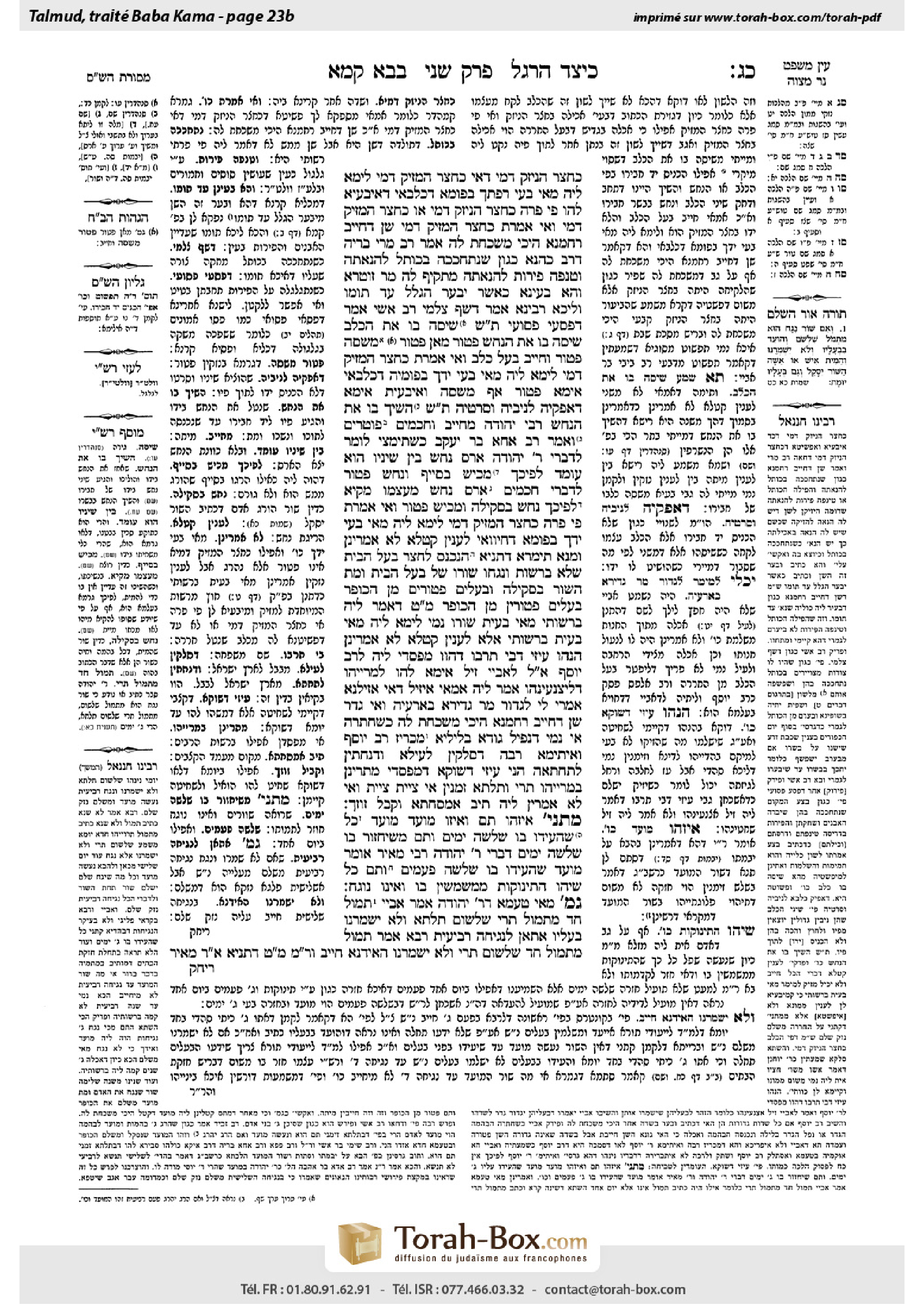
Bava Kamma 23b: Talmud study for Daf Yomi
Study the Talmud for Daf Yomi with scanned pages, Hebrew text, English translations from Sefaria and AI-generated French translations.
Passage selection and English or AI-generated French translation are available where the scan has annotations. Daf Study is independent of Torah-Box and Sefaria.
Browse Bava Kamma · בבא קמא · All tractatesBava Kamma 23b text and translations
This page of Bava Kamma includes the Aramaic text, an English translation and an AI-generated French translation, alongside the scan above.
בבא קמא כ״ג ב · Aramaic and Hebrew text
כַּחֲצַר הַנִּיזָּק דָּמֵי; דְּאִי כַּחֲצַר הַמַּזִּיק דָּמֵי, לֵימָא לֵיהּ: מַאי בָּעֵי רִפְתָּךְ בְּפוּמָּא דְּכַלְבַּאי?
דְּאִיבַּעְיָא לְהוּ: פִּי פָרָה – כַּחֲצַר הַנִּיזָּק דָּמֵי, אוֹ כַּחֲצַר הַמַּזִּיק דָּמֵי?
וְאִי אָמְרַתְּ כַּחֲצַר הַמַּזִּיק דָּמֵי, שֵׁן דְּחַיֵּיב רַחֲמָנָא הֵיכִי מַשְׁכַּחַתְּ לַהּ?
אָמַר רַב מָרִי בְּרֵיהּ דְּרַב כָּהֲנָא: כְּגוֹן שֶׁנִּתְחַכְּכָה בְּכוֹתֶל לַהֲנָאָתָהּ, וְטִנְּפָה פֵּירוֹת לַהֲנָאָתָהּ.
מַתְקֵיף לַהּ מָר זוּטְרָא: וְהָא בָּעֵינָא ״כַּאֲשֶׁר יְבַעֵר הַגָּלָל עַד תֻּמּוֹ״, וְלֵיכָּא! רָבִינָא אָמַר: דְּשָׁף צַלְמֵי, רַב אָשֵׁי אָמַר: דְּפַסַּעי פַּסּוֹעֵי.
תָּא שְׁמַע: שִׁיסָּה בּוֹ אֶת הַכֶּלֶב, שִׁיסָּה בּוֹ אֶת הַנָּחָשׁ – פָּטוּר. מַאן פָּטוּר – מְשַׁסֶּה פָּטוּר, וְחַיָּיב בַּעַל כֶּלֶב; וְאִי אָמְרַתְּ כַּחֲצַר הַמַּזִּיק דָּמֵי, לֵימָא לֵיהּ: מַאי בָּעֵי יְדָךְ בְּפוּמֵּיהּ דְּכַלְבַּאי?
אֵימָא: פָּטוּר אַף מְשַׁסֶּה. וְאִיבָּעֵית אֵימָא: דְּאַפְּקֵיהּ לְנִיבֵיהּ וְסַרְטֵיהּ.
תָּא שְׁמַע: הִשִּׁיךְ בּוֹ אֶת הַנָּחָשׁ – רַבִּי יְהוּדָה מְחַיֵּיב, וַחֲכָמִים פּוֹטְרִים.
וְאָמַר רַב אַחָא בַּר יַעֲקֹב: כְּשֶׁתִּימְצֵי לוֹמַר; לְדִבְרֵי רַבִּי יְהוּדָה, אֶרֶס נָחָשׁ – בֵּין שִׁינָּיו הוּא עוֹמֵד, לְפִיכָךְ מַכִּישׁ בְּסַיִיף, וְנָחָשׁ פָּטוּר. לְדִבְרֵי חֲכָמִים, אֶרֶס נָחָשׁ – מֵעַצְמוֹ מִקִּיא, לְפִיכָךְ נָחָשׁ בִּסְקִילָה, וּמַכִּישׁ פָּטוּר.
וְאִי אָמְרַתְּ פִּי פָרָה כַּחֲצַר הַמַּזִּיק דָּמֵי, לֵימָא לֵיהּ: מַאי בָּעֵי יְדָךְ בְּפוּמָּא דְחִיוַּואי? לְעִנְיַן קְטָלָא לָא אָמְרִינַן.
וּמְנָא תֵּימְרָא? דְּתַנְיָא: הַנִּכְנָס לַחֲצַר בַּעַל הַבַּיִת שֶׁלֹּא בִּרְשׁוּת, וּנְגָחוֹ שׁוֹרוֹ שֶׁל בַּעַל הַבַּיִת, וּמֵת – הַשּׁוֹר בִּסְקִילָה, וּבְעָלִים פְּטוּרִים מִן הַכּוֹפֶר.
בְּעָלִים פְּטוּרִין מִן הַכּוֹפֶר מַאי טַעְמָא – דְּאָמַר לֵיהּ: בִּרְשׁוּתִי מַאי בָּעֵית; שׁוֹרוֹ נָמֵי, לֵימָא לֵיהּ: מַאי בָּעֵית בִּרְשׁוּתִי! אֶלָּא לְעִנְיַן קְטָלָא לָא אָמְרִינַן.
הָנְהוּ עִיזֵּי דְּבֵי תַרְבּוּ דַּהֲווֹ מַפְסְדִי לֵיהּ לְרַב יוֹסֵף, אֲמַר לֵיהּ לְאַבָּיֵי: זִיל אֵימָא לְהוּ לְמָרַיְיהוּ דְּלַיצְנְעִינְהוּ. אֲמַר לֵיהּ: אַמַּאי אֵיזִיל? דְּאִי אָזֵילְנָא, אָמְרִי לִי: לִגְדּוֹר מָר גְּדֵירָא בְּאַרְעֵיהּ.
וְאִי גָּדַר, שֵׁן דְּחַיֵּיב רַחֲמָנָא הֵיכִי מַשְׁכַּחַתְּ לַהּ? כְּשֶׁחָתְרָה. אִי נָמֵי, דְּנָפֵיל גּוּדָּא בְּלֵילְיָא.
מַכְרֵיז רַב יוֹסֵף וְאִיתֵּימָא רַבָּה: דְּסָלְקִין לְעֵילָּא וּדְנָחֲתִין לְתַחְתָּאה – הָנֵי עִיזֵּי דְשׁוּקָא דְּמַפְסְדִי, מַתְרֵינַן בְּמָרַיְיהוּ תְּרֵי וּתְלָתָא זִמְנִין. אִי צָיֵית – צָיֵית. וְאִי לָא – אָמְרִינַן לֵיהּ: תִּיב אַמְּסַחְתָּא וְקַבֵּל זוּזָךְ.
מַתְנִי׳ אֵיזֶהוּ תָּם וְאֵיזֶהוּ מוּעָד? מוּעָד – כֹּל שֶׁהֵעִידוּ בּוֹ שְׁלֹשָׁה יָמִים, וְתָם – מִשֶּׁיַּחְזוֹר בּוֹ שְׁלֹשָׁה יָמִים; דִּבְרֵי רַבִּי יְהוּדָה. רַבִּי מֵאִיר אוֹמֵר: מוּעָד – שֶׁהֵעִידוּ בּוֹ שְׁלֹשָׁה פְּעָמִים, וְתָם – כֹּל שֶׁיְּהוּ הַתִּינוֹקוֹת מְמַשְׁמְשִׁין בּוֹ וְאֵינוֹ נוֹגֵחַ.
גְּמָ׳ מַאי טַעְמָא דְּרַבִּי יְהוּדָה? אָמַר אַבָּיֵי: ״תְּמֹל״ – חַד; ״מִתְּמֹל״ – תְּרֵי; ״שִׁלְשֹׁם״ – תְּלָתָא; ״וְלֹא יִשְׁמְרֶנּוּ בְּעָלָיו״ – אֲתָאן לִנְגִיחָה רְבִיעִית.
רָבָא אָמַר: ״תְּמֹל–מִתְּמֹל״ – חַד; ״שִׁלְשֹׁם״ – תְּרֵי; ״וְלָא יִשְׁמְרֶנּוּ״ הָאִידָּנָא – חַיָּיב.
וְרַבִּי מֵאִיר, מַאי טַעְמָא? דְּתַנְיָא, אָמַר רַבִּי מֵאִיר:
Bava Kamma 23b · English translation
is like the courtyard of the injured party, i.e., it is not a separate domain from the place in which the animal is eating. As if the mouth of the animal were to be considered like the courtyard of the one responsible for the damage, let the owner of the dog say to the injured party: What is your bread doing in my dog’s mouth? The dog’s mouth is my domain, and I am not liable for damage classified as Eating done to your property in my domain.
The Gemara notes: The need for this type of inference arises from the fact that a dilemma was raised before the Sages: Is the mouth of a cow like the courtyard of the injured party, or is it like the courtyard of the one responsible for the damage, i.e., the owner of the cow?
The Gemara asks: But if you say that the mouth of the cow is like the courtyard of the one responsible for the damage, how can you find a case of damage classified as Eating for which the Merciful One holds the owner of the animal liable? The halakha is that one must pay for damage classified as Eating only if it occurred on the property of the injured party. If the mouth of an animal is deemed the domain of the animal’s owner, damage caused by an animal eating would always take place in the domain of the animal’s owner and he would therefore be exempt from liability in every case.
Rav Mari, son of Rav Kahana, said: It is possible to describe a case of Eating that would render the animal’s owner liable according to the one who holds that the mouth of a cow is like the domain of its owner, for example, if the cow rubbed up against a wall for its pleasure and broke it, or if the cow soiled produce for its own pleasure. Any action in which an animal engages for its own pleasure is classified as Eating, and if the animal causes damage thereby within the domain belonging to the injured party, its owner will be held liable since nothing has entered the mouth of the animal.
Mar Zutra objects to these examples of Eating: But in order to create liability under the halakhot of Eating, I require fulfillment of the verse: “As consumes the tooth until it be all gone” (I Kings 14:10), meaning that the damaged item must be completely destroyed or consumed, and here that is not the case, as the stones of the broken wall and the soiled produce have not been destroyed. To answer Mar Zutra’s question, Ravina said: It is possible for a cow to cause complete destruction by rubbing against a wall, e.g., a cow that completely erases any decorative images that were adorning the wall. Rav Ashi said: It is possible for cow to cause complete destruction by soiling produce, e.g., a cow that trods on the produce and crushes it, thereby totally eradicating it. Consequently, the initial question about the status of the cow’s mouth remains.
The Gemara suggests: Come and hear a resolution from a baraita: If he incited a dog against another person, or if he incited a snake against another person, he is exempt (Sanhedrin 66b). The Gemara clarifies: Who is exempt? The one who incited the dog is exempt, but the owner of the dog is liable. And if you say that the mouth of the animal is like the courtyard of the one liable for the damage, let the owner of the dog say to the injured party: What does your hand want, i.e., what is it doing, in my dog’s mouth, which is my domain?
The Gemara answers: The mishna could be understood a different way. Say that even the one who incited the dog is exempt, as the dog is not his property, but the dog owner is also exempt because his dog’s mouth has a legal status similar to that of the dog owner’s courtyard. And if you wish, say instead that the case under discussion is one where the dog extended his canine teeth and scratched the victim, but the victim’s hand was not inside his mouth, and therefore this incident cannot be treated as if it took place in the domain of the owner of the dog.
The Gemara suggests: Come and hear a solution based on the continuation of the above mishna: If one caused the snake to bite a person by bringing the fangs of the snake to the victim’s body, and the snake killed him, Rabbi Yehuda deems the one who instigated the attack liable to receive the death penalty and the Rabbis exempt him.
And Rav Aḥa bar Ya’akov says in explanation of the dispute: When you analyze the matter you will find that according to the statement of Rabbi Yehuda, the venom of a snake is deemed to be constantly present between its fangs, and therefore when the snake is made to strike the victim it is not actively engaged in any action. Consequently, the person handling the snake is liable, similar to one who strikes a victim with a sword, while the snake itself is exempt as it has not done anything. And according to the statement of the Rabbis, the venom of a snake is not present between its fangs but rather the snake must secrete it of its own volition. Consequently, the snake receives the penalty of stoning like any animal that kills a person, while the one who instigated the attack and striking with it is exempt.
And if you say that the mouth of the cow is like the courtyard of the one responsible for the damage, let the owner of the snake metaphorically say to the injured party: What is your hand doing in my snake’s mouth? The Gemara answers: We do not say this principle with regard to matters relating to the death penalty; therefore, one who kills another is always liable, regardless of whether it occurred within the domain of the killer or within the domain of the victim.
And from where do you say this? As it is taught in a baraita (Tosefta 5:13): With regard to one who enters the courtyard of a property owner without his permission, and the property owner’s ox gores the intruder and he dies, the ox receives the penalty of stoning while the owner is exempt from having to pay ransom.
The Gemara clarifies: What is the reason that the owner is exempt from paying ransom? He is exempt because he can metaphorically say to the victim: What do you want in my domain, i.e., why were you there without permission? Since he entered the premises without authorization, he bears responsibility for his own fate. But if that is so, the same applies to his ox as well, and let the owner of the ox say to the victim: What do you want in my domain? Rather, it must be that we do not say that this principle applies with regard to matters relating to the death penalty. Consequently, these cases do not prove that the mouth of the cow is like the courtyard of the victim within the scope of the halakhot of damages.
§ The Gemara relates: There were these goats, belonging to the Tarbu family, that would frequently damage Rav Yosef’s property. Rav Yosef said to Abaye: Go and tell their owners that they must keep their goats enclosed within their own property. Abaye said to Rav Yosef in response: Why should I go? If I go and deliver this message, they will say to me: Let the Master put a fence up around his property so that the goats will not be able to get in there.
The Gemara questions this claim: And if an individual did put up a fence to safeguard his property from the Eating of other animals because he was required to do so, and had he not done so the owners of those animals would not be liable to pay for the damage caused by their animals, how can you find damage classified as Eating for which the Merciful One holds the owner of the animal liable? As, if it is the responsibility of the injured party to fence in his property, animals will not be able to get inside. The Gemara answers: A case in which the Torah holds the owner of the animal liable can be explained as one where the animal burrowed under the fence. Alternatively, it could be explained as a case where the separating fence collapsed in middle of the night and the owner of the fence did not have the opportunity to repair it before the animals caused damage.
The Gemara comments: Rav Yosef, and some say it was Rabba, would announce: Those that ascend to Eretz Yisrael from Babylonia, bringing with them the rulings of the Babylonian Sages, as well as those that descend to Babylonia from Eretz Yisrael, bringing the rulings of the sages of Eretz Yisrael with them, all agree to the following halakha: With regard to these goats that loiter in the market until they are slaughtered and in the meantime cause damage to others, we warn their owner two or three times. If the owner of the goats heeds the warning and safeguards his animals from damaging others, then he heeds it and no further action is necessary. But if not, we say to him: Go, sit next to the butcher shop and take your money, meaning we instruct him to slaughter his goats immediately. Since he in any event intends to slaughter them, the court can force him to do so immediately. Otherwise, he cannot be forced to slaughter them as a preventive measure.
MISHNA: Which type of ox is deemed innocuous and which is deemed forewarned? An ox is deemed forewarned in any case where witnesses testified about it that it gored on three different days. And it reverts back to its previous innocuous status from when it reverses its behavior and refrains from goring for three consecutive days; this is the statement of Rabbi Yehuda. Rabbi Meir says: It is deemed forewarned in any case where witnesses testified that it gored three times, regardless of the number of days on which this behavior occurred. And it reverts back to its previous innocuous status in any case where children pet it and play with it and it does not gore them.
GEMARA: The Gemara asks: What is the reason for the opinion of Rabbi Yehuda that an ox is deemed forewarned only if it gored on three separate days? Abaye said: It states in the verse: “Or if it is known that the ox was a goring ox from yesterday and the day before yesterday, and its owner has not secured it” (Exodus 21:36). This leads to the following inference: “Yesterday” indicates one day, “from yesterday” indicates two days, “the day before yesterday” indicates three days, “and its owner has not secured it”; here we arrive at a fourth incident of goring, for which the owner pays the full amount of damages.
Rava said: “Yesterday” and “from yesterday” are not to be expounded separately. Rather, the inference from this phrase is that “from yesterday” indicates one day, “the day before yesterday” indicates two days, “and its owner has not secured it” indicates now, the third incident of goring, as it is liable as a forewarned animal for the third goring.
The Gemara asks: And what is the reason for the opinion of Rabbi Meir, who does not determine the forewarned status of an ox by the number of days on which the animal gored but simply by the number of times? As it is taught in a baraita that Rabbi Meir said:
Bava Kamma 23b · Traduction française (IA)
Il est comme la cour de la partie blessée, c'est-à-dire qu'il n'est pas un domaine séparé du lieu où l'animal mange. Comme si la bouche de l'animal devait être considérée comme la cour du responsable du préjudice, que l'propriétaire du chien dise à la partie blessée : Qu'est-ce que votre pain fait dans la bouche de mon chien ? La bouche du chien est mon domaine, et je ne suis pas responsable des préjudices classés comme dégâts causés par la consommation sur votre propriété dans mon domaine.
La Guemara note : La nécessité de ce type d'inférence vient du fait qu'un dilemme a été soulevé devant les Sages : La bouche d'une vache est-elle comme la cour de la partie blessée, ou comme la cour du responsable du préjudice, c'est-à-dire l'propriétaire de la vache ?
La Guemara demande : Mais si vous dites que la bouche de la vache est comme la cour du responsable du préjudice, comment pouvez-vous trouver un cas de préjudice classé comme dégâts causés par la consommation pour lequel l'Éternel tient l'propriétaire de l'animal responsable ? La halakha est que l'on doit payer pour un préjudice classé comme dégâts causés par la consommation uniquement s'il s'est produit sur la propriété de la partie blessée. Si la bouche d'un animal est considérée comme le domaine de l'propriétaire de l'animal, les préjudices causés par l'animal en mangeant se produiront toujours dans le domaine de l'propriétaire de l'animal et il serait donc exempt de responsabilité dans tous les cas.
Rav Mari, fils de Rav Kahana, a dit : Il est possible de décrire un cas d'ingestion qui rendrait l'propriétaire de l'animal responsable selon celui qui considère que la bouche d'une vache est comme le domaine de son propriétaire, par exemple, si la vache s'appuyait contre un mur pour son plaisir et le brisait, ou si la vache souillait les produits pour son propre plaisir. Toute action dans laquelle un animal s'engage pour son propre plaisir est classée comme ingestion, et si l'animal cause un préjudice ainsi dans le domaine appartenant à la partie blessée, son propriétaire sera tenu responsable car rien n'a pénétré dans la bouche de l'animal.
Mar Zutra s'oppose à ces exemples de dégâts causés par la consommation : Mais afin de créer une responsabilité selon les halakhot de dégâts causés par la consommation, je dois exiger la réalisation de la parole : « Comme une dent se consume jusqu'à ce qu'elle disparaisse » (I Rois 14:10), c'est-à-dire que l'objet endommagé doit être complètement détruit ou consommé, et ici cela n'est pas le cas, car les pierres du mur brisé et les produits souillés n'ont pas été détruits. Pour répondre à la question de Mar Zutra, Ravina a dit : Il est possible qu'une vache cause une destruction totale en se frottant contre un mur, par exemple, une vache qui efface complètement toute image décorative qui ornait le mur. Rav Ashi a dit : Il est possible qu'une vache cause une destruction totale en souillant les produits, par exemple, une vache qui marche sur les produits et les écrase, ce qui éradique totalement ces produits. Ainsi, la question initiale sur le statut de la bouche de la vache reste.
La Guemara suggère : Viens entendre une résolution d'une baraïta : Si l'on a incité un chien contre une autre personne, ou si l'on a incité un serpent contre une autre personne, l'on est exempt (Sanhedrin 66b). La Guemara précise : Qui est exempt ? Celui qui a incité le chien est exempt, mais l'propriétaire du chien est responsable. Et si vous dites que la bouche de l'animal est comme la cour du responsable du préjudice, que l'propriétaire du chien dise à la partie blessée : Qu'est-ce que votre main fait, c'est-à-dire qu'est-ce qu'elle fait, dans la bouche de mon chien, qui est mon domaine ?
La Guemara répond : La mitsva pourrait être interprétée différemment. Dites que même celui qui a incité le chien est exempt, car le chien n'est pas sa propriété, mais l'propriétaire du chien est également exempt car la bouche de son chien a un statut juridique similaire à celui de sa cour. Et si vous le souhaitez, dites plutôt que le cas sous discussion est celui où le chien a étendu ses dents canines et a gratté la victime, mais la main de la victime n'était pas dans sa bouche, et par conséquent cet incident ne peut pas être traité comme s'il s'était produit dans le domaine de l'propriétaire du chien.
La Guemara suggère : Viens entendre une solution basée sur la continuation de la mitsva ci-dessus : Si l'on a causé à un serpent de mordre une personne en présentant les dents du serpent au corps de la victime, et que le serpent l'a tué, Rabbi Yehuda considère que celui qui a incité l'attaque est responsable de la peine de mort et les Rabbins l'exonèrent.
Et Rav Aḥa bar Ya’akov explique la dispute en disant : Lorsque vous analysez la question, vous trouverez que selon l'opinion de Rabbi Yehuda, le venin d'un serpent est considéré comme constamment présent entre ses dents, et par conséquent, lorsque le serpent est fait de mordre la victime, il n'est pas activement engagé dans une action. Ainsi, la personne qui manipule le serpent est responsable, comme celui qui frappe une victime avec une épée, tandis que le serpent lui-même est exempt car il n'a pas fait quoi que ce soit. Et selon l'opinion des Rabbins, le venin d'un serpent n'est pas présent entre ses dents, mais plutôt le serpent doit le sécréter de sa propre volonté. Ainsi, le serpent reçoit la peine de pierres comme tout animal qui tue une personne, tandis que celui qui a incité l'attaque et qui a frappé avec est exempt.
Et si vous dites que la bouche de la vache est comme la cour du responsable du préjudice, que l'propriétaire du serpent dise métaphoriquement à la partie blessée : Qu'est-ce que votre main fait dans la bouche de mon serpent ? La Guemara répond : Nous ne disons pas ce principe concernant les affaires liées à la peine de mort ; par conséquent, celui qui tue un autre est toujours responsable, indépendamment de ce que cela s'est produit dans le domaine du meurtrier ou dans le domaine de la victime.
Et d'où dis-tu cela ? Comme il est enseigné dans une baraïta (Tosefta 5:13) : Concernant celui qui entre dans la cour d'un propriétaire sans son autorisation, et l'ox du propriétaire blesse l'intrus et le tue, l'ox reçoit la peine de pierres tandis que l'propriétaire est exempt de payer la rançon.
La Guemara clarifie : Quel est le motif pour lequel l'owner est exempt de payer une rançon ? Il est exempt car il peut métaphoriquement dire au victime : Que veux-tu dans mon domaine, c'est-à-dire pourquoi étais-tu là sans autorisation ? Puisque l'individu a pénétré dans les lieux sans autorisation, il assume la responsabilité de son propre destin. Mais si c'est ainsi, cela s'applique également à son bœuf, et l'owner du bœuf pourrait dire au victime : Que veux-tu dans mon domaine ? Plutôt, il faut comprendre que ce principe ne s'applique pas concernant les affaires liées à la peine de mort. Ainsi, ces cas ne prouvent pas que la bouche du bœuf est comme le courtil du victime dans le cadre des halakhot des dommages.
§ La Guemara rapporte : Il y avait ces boucs appartenant à la famille Tarbu qui endommageaient fréquemment la propriété de Rav Yosef. Rav Yosef dit à Abaye : Va et dis à leurs propriétaires qu'ils doivent garder leurs boucs enfermés dans leur propre propriété. Abaye répondit à Rav Yosef : Pourquoi devrais-je y aller ? Si je vais et transmets ce message, ils diront à moi : Que le Maître érige une clôture autour de sa propriété afin que les boucs ne puissent pas entrer là-dedans.
La Guemara questionne cette affirmation : Et si un individu avait effectivement érigé une clôture pour protéger sa propriété contre l'ingestion d'autres animaux, car il était tenu de le faire, et s'il n'avait pas fait cela, les propriétaires de ces animaux ne seraient pas tenus de payer les dommages causés par leurs animaux, comment peut-on trouver un dommage classé comme ingestion pour lequel l'Éternel tient l'propriétaire de l'animal responsable ? Car, si c'est la responsabilité du partie blessé de clôturer sa propriété, les animaux ne pourront pas entrer. La Guemara répond : Un cas où la Torah tient l'propriétaire de l'animal responsable peut être expliqué comme un cas où l'animal a creusé sous la clôture. Alternativement, il pourrait être expliqué comme un cas où la clôture s'est effondrée pendant la nuit et que l'propriétaire de la clôture n'avait pas eu l'occasion de la réparer avant que les animaux n'aient causé des dommages.
La Guemara commente : Rav Yosef, et certains disent que c'était Rabba, annonçait : Ceux qui montent vers la Terre d'Israël depuis Babylone, apportant avec eux les décisions des Sages de Babylone, ainsi que ceux qui descendent vers Babylone depuis la Terre d'Israël, apportant les décisions des Sages de la Terre d'Israël avec eux, tous s'accordent sur la suivante halakha : Concernant ces boucs qui errant dans le marché jusqu'à ce qu'ils soient sacrifiés et en attendant causent des dommages à d'autres, nous avertissons leur propriétaire deux ou trois fois. Si le propriétaire des boucs écoute l'avertissement et protège ses animaux contre les dommages, alors il écoute et aucune autre action n'est nécessaire. Mais si non, nous disons à lui : Va, assieds-toi à côté de la boucherie et prends ton argent, c'est-à-dire nous lui ordonnons de sacrifier ses boucs immédiatement. Puisque de toute façon il a l'intention de les sacrifier, le tribunal peut le forcer à le faire immédiatement. Sinon, il ne peut pas être forcé à les sacrifier comme mesure préventive.
MICHNA : Quel type de bœuf est considéré comme inoffensif et quel est considéré comme averti ? Un bœuf est considéré comme averti dans tout cas où des témoins ont témoigné qu'il a renversé trois jours différents. Et il reprend son statut d'inoffensif à partir du moment où il change de comportement et ne renverse plus pendant trois jours consécutifs ; c'est l'opinion de Rabbi Yéhuda. Rabbi Méir dit : Il est considéré comme averti dans tout cas où des témoins ont témoigné qu'il a renversé trois fois, indépendamment du nombre de jours où ce comportement s'est produit. Et il reprend son statut d'inoffensif dans tout cas où des enfants le caressent et jouent avec lui et il ne les renverse pas.
GUEMARA : La Guemara pose la question : Quel est le motif de l'opinion de Rabbi Yéhuda selon laquelle un bœuf est considéré comme averti uniquement s'il a renversé trois jours différents ? Abaye dit : Il est écrit dans la Torah écrite : « Ou s'il est connu que l'ox était un ox renversant depuis hier et avant-hier, et son propriétaire n'a pas sécurisé l'ox » (Exode 21:36). Cela mène à l'inférence suivante : « Hier » indique un jour, « depuis hier » indique deux jours, « avant-hier » indique trois jours, « et son propriétaire n'a pas sécurisé l'ox » ; ici nous arrivons à un quatrième incident de renversement, pour lequel le propriétaire paie la totalité des dommages.
Rava dit : « Hier » et « depuis hier » ne doivent pas être interprétés séparément. Plutôt, l'inférence de cette phrase est que « depuis hier » indique un jour, « avant-hier » indique deux jours, « et son propriétaire n'a pas sécurisé l'ox » indique maintenant, le troisième incident de renversement, car il est tenu responsable comme un animal averti pour le troisième renversement.
La Guemara pose la question : Et quel est le motif de l'opinion de Rabbi Méir, qui ne détermine pas le statut d'avertissement d'un bœuf en fonction du nombre de jours où l'animal a blessé, mais simplement du nombre de fois ? Comme il est enseigné dans une baraïta que Rabbi Méir a dit :
Traduction française générée par IA à partir de l’édition anglaise de Sefaria. Vérifie toujours un passage avec le texte source.
Text from Sefaria: William Davidson Edition - Vocalized Aramaic (CC BY NC); William Davidson Edition - English (CC BY NC).