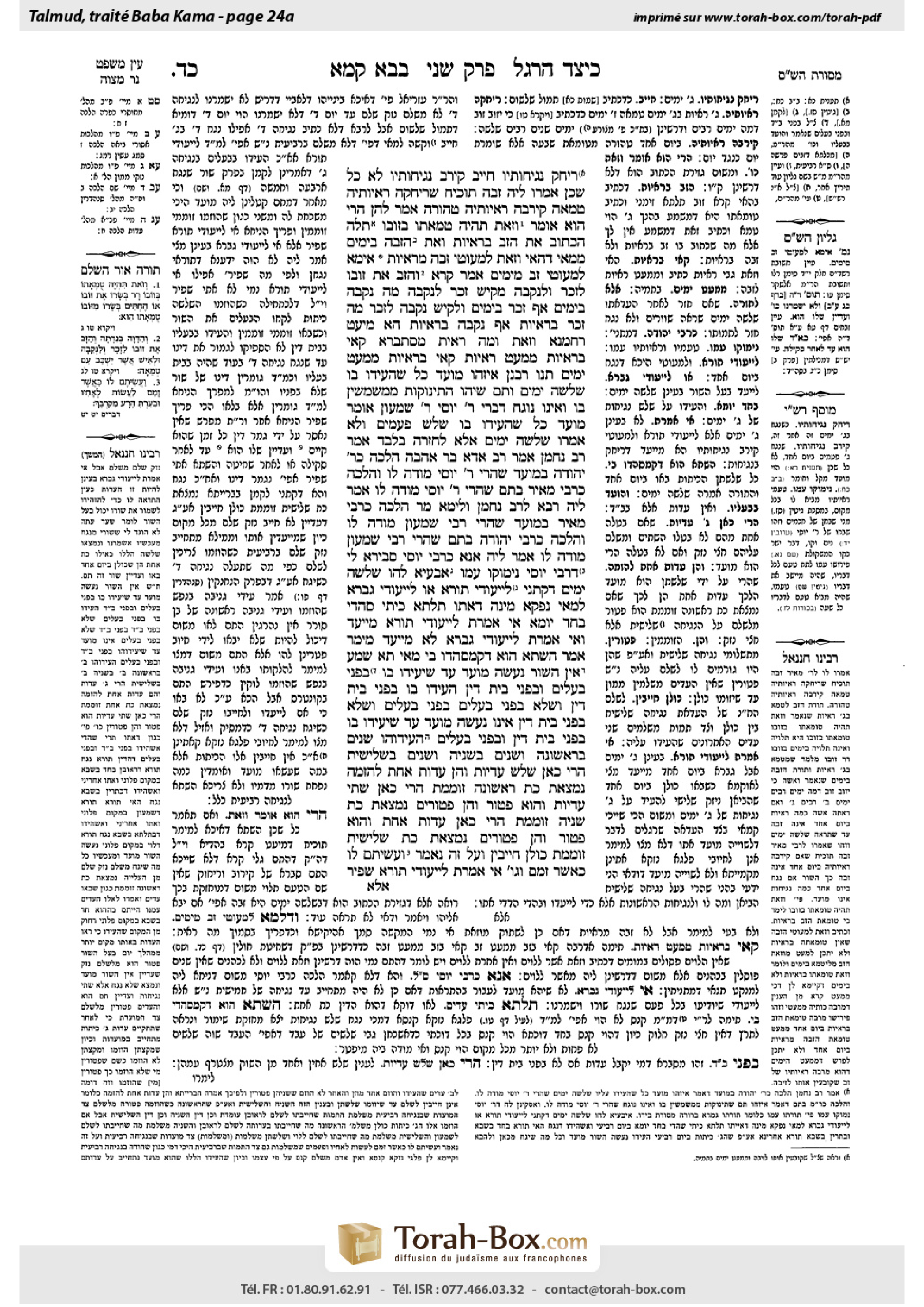
Bava Kamma 24a: Talmud study for Daf Yomi
Study the Talmud for Daf Yomi with scanned pages, Hebrew text, English translations from Sefaria and AI-generated French translations.
Passage selection and English or AI-generated French translation are available where the scan has annotations. Daf Study is independent of Torah-Box and Sefaria.
Browse Bava Kamma · בבא קמא · All tractatesBava Kamma 24a text and translations
This page of Bava Kamma includes the Aramaic text, an English translation and an AI-generated French translation, alongside the scan above.
בבא קמא כ״ד א · Aramaic and Hebrew text
רִיחֵק נְגִיחוֹתָיו – חַיָּיב; קֵירַב נְגִיחוֹתָיו לֹא כׇּל שֶׁכֵּן?! אֲמַרוּ לֵיהּ: זָבָה תּוֹכִיחַ, שֶׁרִיחֲקָה רְאִיּוֹתֶיהָ – טְמֵאָה, קֵירְבָה רְאִיּוֹתֶיהָ – טְהוֹרָה!
אָמַר לָהֶן, הֲרֵי הוּא אוֹמֵר: ״וְזֹאת תִּהְיֶה טֻמְאָתוֹ בְּזוֹבוֹ״ – תָּלָה הַכָּתוּב אֶת הַזָּב בִּרְאִיּוֹת, וְאֶת הַזָּבָה בְּיָמִים.
מִמַּאי דְּהַאי ״וְזֹאת״ – לְמַעוֹטֵי זָבָה מֵרְאִיּוֹת? אֵימָא לְמַעוֹטֵי זָב מִיָּמִים! אָמַר קְרָא: ״וְהַזָּב אֶת זוֹבוֹ לַזָּכָר וְלַנְּקֵבָה״ – מַקִּישׁ זָכָר לִנְקֵבָה; מָה נְקֵבָה בְּיָמִים, אַף זָכָר בְּיָמִים.
וְלַקֵּישׁ נְקֵבָה לְזָכָר – מָה זָכָר בִּרְאִיּוֹת, אַף נְקֵבָה בִּרְאִיּוֹת! הָא מַיעֵט רַחֲמָנָא ״וְזֹאת״.
וּמָה רָאִיתָ? מִסְתַּבְּרָא, קָאֵי בִּרְאִיּוֹת – מְמַעֵט רְאִיּוֹת; קָאֵי בִּרְאִיּוֹת – מְמַעֵט יָמִים?!
תָּנוּ רַבָּנַן: אֵיזֶהוּ מוּעָד – כֹּל שֶׁהֵעִידוּ בּוֹ שְׁלֹשָׁה יָמִים; וְתָם – שֶׁיְּהוּ הַתִּינוֹקוֹת מְמַשְׁמְשִׁין בּוֹ וְאֵינוֹ נוֹגֵחַ; דִּבְרֵי רַבִּי יוֹסֵי. רַבִּי שִׁמְעוֹן אוֹמֵר: מוּעָד – כֹּל שֶׁהֵעִידוּ בּוֹ שָׁלֹשׁ פְּעָמִים, וְלֹא אָמְרוּ שְׁלֹשָׁה יָמִים אֶלָּא לַחֲזָרָה בִּלְבָד.
אָמַר רַב נַחְמָן אָמַר רַב אַדָּא בַּר אַהֲבָה: הֲלָכָה כְּרַבִּי יְהוּדָה בְּמוּעָד, שֶׁהֲרֵי רַבִּי יוֹסֵי מוֹדֶה לוֹ; וַהֲלָכָה כְּרַבִּי מֵאִיר בְּתָם, שֶׁהֲרֵי רַבִּי יוֹסֵי מוֹדֶה לוֹ.
אֲמַר לֵיהּ רָבָא לְרַב נַחְמָן: וְלֵימָא מָר הֲלָכָה כְּרַבִּי מֵאִיר בְּמוּעָד, שֶׁהֲרֵי רַבִּי שִׁמְעוֹן מוֹדֶה לוֹ; וַהֲלָכָה כְּרַבִּי יְהוּדָה בְּתָם, שֶׁהֲרֵי רַבִּי שִׁמְעוֹן מוֹדֶה לוֹ! אֲמַר לֵיהּ: אֲנָא כְּרַבִּי יוֹסֵי סְבִירָא לִי, דְּרַבִּי יוֹסֵי נִימּוּקוֹ עִמּוֹ.
אִבַּעְיָא לְהוּ: ״שְׁלֹשָׁה יָמִים״ דְּקָתָנֵי – לְיַיעוֹדֵי תּוֹרָא, אוֹ לְיַיעוֹדֵי גַּבְרָא?
לְמַאי נָפְקָא מִינַּהּ? דְּאָתוּ תְּלָתָא כִּיתֵּי סָהֲדִי בְּחַד יוֹמָא. אִי אָמְרַתְּ לְיַיעוֹדֵי תּוֹרָא, מִיַּיעַד; וְאִי אָמְרַתְּ לְיַיעוֹדֵי גַּבְרָא, לָא מִיַּיעַד – מֵימָר אָמַר: הַשְׁתָּא הוּא דְּקָמַסְהֲדוּ בִּי. מַאי?
תָּא שְׁמַע: אֵין הַשּׁוֹר נַעֲשֶׂה מוּעָד, עַד שֶׁיָּעִידוּ בּוֹ בִּפְנֵי בְעָלִים וּבִפְנֵי בֵית דִּין. הֵעִידוּ בּוֹ בִּפְנֵי בֵית דִּין וְשֶׁלֹּא בִּפְנֵי בְעָלִים, בִּפְנֵי בְעָלִים וְשֶׁלֹּא בִּפְנֵי בֵית דִּין – אֵינוֹ נַעֲשֶׂה מוּעָד, עַד שֶׁיָּעִידוּ בּוֹ בִּפְנֵי בֵית דִּין וּבִפְנֵי בְעָלִים.
הֶעִידוּהוּ שְׁנַיִם בָּרִאשׁוֹנָה, וּשְׁנַיִם בַּשְּׁנִיָּה, וּשְׁנַיִם בַּשְּׁלִישִׁית – הֲרֵי כָּאן שָׁלֹשׁ עֵדִיּוֹת, וְהֵן עֵדוּת אַחַת לַהֲזָמָה.
נִמְצֵאת כַּת רִאשׁוֹנָה זוֹמֶמֶת – הֲרֵי כָּאן שְׁתֵּי עֵדִיּוֹת, וְהוּא פָּטוּר וְהֵן פְּטוּרִים. נִמְצֵאת כַּת שְׁנִיָּה זוֹמֶמֶת – הֲרֵי כָּאן עֵדוּת אַחַת, וְהוּא פָּטוּר וְהֵן פְּטוּרִים.
נִמְצֵאת כַּת שְׁלִישִׁית זוֹמֶמֶת – כּוּלָּן חַיָּיבִין. וְעַל זֶה נֶאֱמַר: ״וַעֲשִׂיתֶם לוֹ כַּאֲשֶׁר זָמַם וְגוֹ׳״.
אִי אָמְרַתְּ לְיַיעוֹדֵי תּוֹרָא – שַׁפִּיר.
Bava Kamma 24a · English translation
When the ox performs its gorings at intervals, its owner is liable; if it performs its gorings successively, is it not all the more so that its owner is liable? They said to Rabbi Meir: The halakha with regard to a woman who experiences a discharge of uterine blood after her menstrual period [zava] will prove that your a fortiori inference is invalid: If her sightings occur at intervals, i.e., if she sees a flow of uterine blood on three consecutive days, she becomes ritually impure; while if her sightings were consecutive, for example if all three occurred on the same day, she remains pure.
Rabbi Meir said to them: The case of the zava does not disprove my opinion, because the verse states in reference to the parallel halakha of a man who experiences a gonorrhea-like discharge [zav]: “And this shall be his ritual impurity when he has a discharge” (Leviticus 15:3). The word “this” emphasizes that in this matter the halakha requires following the instructions of the verse precisely as they were recorded, and in this case the verse associates the impurity of the zav with the number of sightings of discharges the man observed, and it associates the impurity of the zava with the number of days during which she experienced sightings of blood, as it says: “Many days” (Leviticus 15:25). By contrast, with regard to the goring ox, the a fortiori inference remains in place.
The Gemara asks about this interpretation: From where is it determined that this additional phrase: “And this,” serves to exclude a zava from having her status determined by individual sightings of blood, associating it instead with the number of days on which she experienced bleeding? Say instead that it serves to exclude the zav from having his status determined by sightings on separate days, indicating that he will be rendered a zav only if he experienced three discharges on a single day and not on separate days. The Gemara answers: The verse states elsewhere: “And one who has a discharge, whether it be a man or a woman” (Leviticus 15:33). The verse juxtaposes the ritual impurity of a male to that of a female to teach that just as the female’s ritual impurity is caused by sightings on multiple days, so too the ritual impurity of a male can be caused by sightings on multiple days.
The Gemara asks: The derivation from the verse could just as easily lead to the opposite conclusion. But let him compare the female to the male; just as a male becomes ritually impure based on the number of sightings, even if they all occur on the same day, so too should a female become ritually impure based on the number of sightings, even on the same day. The Gemara answers: But the Merciful One excluded this possibility by making use of the term “and this.”
The Gemara asks: And what did you see to make you exclude associating the ritual impurity of women with the number of sightings, rather than excluding associating the ritual impurity of men with the number of days? The Gemara answers: It stands to reason that this is so, as the context of the verse deals with sightings, and therefore an additional phrase serves to exclude sightings, but can you say that in a context where it deals with sightings it excludes days? The exclusionary term “and this” appears in the section discussing the halakhot of the zav, in the context of which it mentions sightings and not days, and therefore when it excludes something from these halakhot and limits them to specific cases, it will exclude it from being associated with sightings.
The Gemara returns to the subject of classifying an ox as innocuous or forewarned: The Sages taught in a baraita: Which type of ox is deemed forewarned? Any animal about which witnesses testified that it gored on three days is forewarned. And it reverts to its former innocuous status if children pet it and nevertheless it does not gore; this is the statement of Rabbi Yosei. Rabbi Shimon says: A forewarned ox is any ox about which witnesses testified that it gored three times, and the Sages spoke about three days only with regard to reversals, meaning that in order for an ox to revert to innocuous status, the ox must refrain from goring on three separate days. Each of these additional views on this subject combine aspects of both of the opinions mentioned in the mishna, those of Rabbi Yehuda and those of Rabbi Meir.
Rav Naḥman says that Rav Adda bar Ahava says: The halakha is in accordance with the opinion of Rabbi Yehuda concerning the criteria for deeming an animal forewarned, as Rabbi Yosei concedes to his opinion on this issue, and the halakha is in accordance with the opinion of Rabbi Meir concerning the criteria for reverting the status of an animal to innocuous, as Rabbi Yosei concedes to his opinion on that issue.
Rava said to Rav Naḥman: And let the Master say the reverse, that the halakha is in accordance with the opinion of Rabbi Meir concerning the criteria for deeming an animal forewarned, as Rabbi Shimon concedes to his opinion on this issue and the halakha is in accordance with the opinion of Rabbi Yehuda concerning the criteria for reverting the status of an ox to innocuous, as Rabbi Shimon concedes to his opinion on that issue. Rav Naḥman replied to Rava: I hold in accordance with the opinion of Rabbi Yosei, as Rabbi Yosei’s analysis [nimmuko] is with him, i.e., it is sound.
A dilemma was raised before the Sages: The three days that the mishna teaches in the context of Rabbi Yehuda’s opinion with regard to the testimony needed to assign the status of forewarned to an ox, are they needed in order to render the ox forewarned, or are they needed in order to forewarn the man who owns the ox, to inform him that he needs to take precautions to keep it from causing further harm?
The Gemara asks: What is the practical difference between the two possibilities? The Gemara answers: The practical difference is in a case where three groups of witnesses came to the court on one day, each testifying about a separate instance of goring caused by the ox on three separate days. If you say that their testimony serves to render the ox forewarned by determining that it gored on three separate days, then in this case the animal has been classified as forewarned on the basis of their testimony. But if you say that their testimony serves to forewarn the man, the ox has not been classified as forewarned on the basis of this testimony since the owner heard all of the testimony on a single day. This enables him to say: It is only now that they testified against me; and therefore his ox will not be deemed forewarned until he has been issued warnings over the course of three separate days. What, then, is the solution to the dilemma raised above?
The Gemara suggests: Come and hear a solution from a baraita (Tosefta 2:3): An ox does not become forewarned until witnesses testify against it in the presence of its owner and in the presence of a court. If they testified against it in the presence of a court but not in the presence of its owner, or in the presence of its owner but not in the presence of a court, it does not become forewarned until they testify against it in the presence of a court and in the presence of its owner.
Furthermore, if two witnesses testified against the ox concerning its first incident of goring, and two other witnesses testified against it concerning the second incident, and two other witnesses testified against it concerning the third incident, there are three separate testimonies here, but they are considered as one with regard to rendering their statements as conspiring testimony.
Therefore, if the first set of witnesses is determined to be conspiring witnesses, there are two testimonies remaining here that claim that the ox gored, and the owner must pay for half the cost of the damage in each case. But the owner of the ox is exempt from having to pay the full cost of the damage, and the conspiring witnesses are exempt from paying the owner what he would have had to pay were their testimony accepted and his ox deemed forewarned, as they testified only concerning the first incident of goring, and the ox would not have been deemed forewarned on the basis of this testimony alone. And similarly, if the second set of witnesses was also determined to be conspiring witnesses, there is one testimony remaining here that claims that the ox gored, the third. At this point too, the owner of the ox is exempt from having to pay the full cost of the damage and the conspiring witnesses are exempt from having to pay the owner the full cost of the damage.
If the third group of witnesses was also determined to be conspiring witnesses, all the witnesses become liable. The third group is liable to pay the owner of the animal the payment for half the cost of the damage they tried to make him pay for the third incident of goring, and all three groups must share in the payment of the other half of the damage for the final incident that they tried to charge him for by classifying his ox as forewarned. And concerning this it is stated: “And you shall do unto him as he had conspired to do unto his brother” (Deuteronomy 19:19).
The Gemara clarifies: If you say that the purpose of the testimony is to render the ox forewarned, the halakha presented in this baraita works out well, as according to this opinion it can be said that all of the witnesses came on the same day at the behest of the alleged victim of the third incident, and therefore they were all certainly aware of each other’s testimony. Consequently, the first set of witnesses shares in the responsibility for the testimony of the last group, as they are all co-witnesses in the effort to have the ox rendered forewarned.
Bava Kamma 24a · Traduction française (IA)
Lorsqu'un bœuf effectue ses coups à intervalles réguliers, son propriétaire est responsable ; si ces coups sont successifs, n'est-il pas encore plus clair que son propriétaire est responsable ? Ils dirent à Rabbi Meïr : La halakha concernant une femme qui a un dégagement de sang utérin après sa période menstruelle [zava] prouve que votre raisonnement par analogie est invalide : Si elle observe des dégagements à intervalles, c'est-à-dire si elle voit un dégagement de sang utérin sur trois jours consécutifs, elle devient impure rituellement ; tandis que si ses observations étaient successives, par exemple si les trois se produisaient le même jour, elle reste pure.
Rabbi Meïr répondit à eux : Le cas de la zava ne contredit pas mon opinion, car la Parashah dit concernant le halakha parallèle d'un homme qui a un dégagement similaire à la gonnorée [zav] : « Et c'est la pureté rituelle de lui lorsqu'il a un dégagement » (Lévitique 15:3). Le mot « ceci » souligne que dans cette affaire la halakha exige de suivre les instructions de la Parashah exactement telles qu'elles sont écrites, et dans ce cas la Parashah associe la pureté rituelle du zav au nombre d'observations de dégagements que l'homme a vues, et elle associe la pureté rituelle de la zava au nombre de jours durant lesquels elle a eu des observations de sang, comme il est dit : « De nombreux jours » (Lévitique 15:25). À l'inverse, concernant le bœuf qui attaque, l'analogie reste valable.
Le Guemara pose une question sur cette interprétation : D'où est-il déterminé que cette phrase supplémentaire : « Et ceci », sert à exclure la zava de voir son statut déterminé par des observations individuelles de sang, et l'associe plutôt au nombre de jours durant lesquels elle a eu des dégagements ? Dites plutôt qu'elle sert à exclure le zav de voir son statut déterminé par des observations sur des jours différents, indiquant qu'il sera rendu zav uniquement s'il a eu trois dégagements le même jour et non sur des jours différents. Le Guemara répond : La Parashah dit ailleurs : « Et celui qui a un dégagement, qu'il soit un homme ou une femme » (Lévitique 15:33). La Parashah juxtapose la pureté rituelle de l'homme à celle de la femme pour enseigner que tout comme la pureté rituelle de la femme est causée par des observations sur plusieurs jours, ainsi la pureté rituelle de l'homme peut être causée par des observations sur plusieurs jours.
Le Guemara pose une question : Cette dérivation de la Parashah pourrait tout aussi bien mener à la conclusion opposée. Mais comparez la femme à l'homme ; tout comme l'homme devient impur rituellement en fonction du nombre d'observations, même s'ils se produisent le même jour, ainsi la femme devrait aussi devenir impure rituellement en fonction du nombre d'observations, même le même jour. Le Guemara répond : Mais l'Éternel a exclu cette possibilité en utilisant le terme « et ceci ».
Le Guemara pose la question : Et qu'avez-vous vu pour exclure l'association de la souillure rituelle des femmes avec le nombre d'observations, plutôt que d'exclure l'association de la souillure rituelle des hommes avec le nombre de jours ? Le Guemara répond : Il est logique que cela soit ainsi, car le contexte de la parole traite des observations, et donc une phrase supplémentaire sert à exclure les observations, mais pouvez-vous dire que dans un contexte où il traite des observations, il exclut les jours ? Le terme excluant « et ceci » apparaît dans la section discutant les halakhot du zav, dans le contexte duquel il mentionne les observations et non les jours, et donc lorsque cela exclut quelque chose de ces halakhot et les limite à des cas spécifiques, il exclut cela d'être associé aux observations.
Le Guemara retourne à la question de classer un bœuf comme innocent ou averti : Les Sages enseignèrent dans une baraïta : Quel type de bœuf est considéré comme averti ? Tout animal dont des témoins ont attesté qu'il a attaqué trois jours est averti. Et il reprend son statut d'innocent s'il est caressé par des enfants et qu'il ne s'attaque pas ; c'est l'opinion de Rabbi Yosei. Rabbi Shimon dit : Un bœuf averti est tout bœuf dont des témoins ont attesté qu'il a attaqué trois fois, et les Sages parlent de trois jours uniquement concernant les réversions, c'est-à-dire qu'afin qu'un bœuf redevienne innocent, il doit s'abstenir d'attaquer sur trois jours différents. Chacune de ces opinions supplémentaires sur ce sujet combine des aspects des deux opinions mentionnées dans la mishna, celles de Rabbi Yehuda et celles de Rabbi Meir.
Rav Naḥman dit que Rav Adda bar Ahava dit : La halakha suit l'opinion de Rabbi Yehuda concernant les critères pour considérer un animal comme averti, car Rabbi Yosei reconnaît son opinion sur ce point, et la halakha suit l'opinion de Rabbi Meir concernant les critères pour rétablir le statut d'un animal comme innocent, car Rabbi Yosei reconnaît son opinion sur ce point.
Rava dit à Rav Naḥman : Et que le Maître dise l'inverse, c'est-à-dire que la halakha suit l'opinion de Rabbi Meir concernant les critères pour considérer un animal comme averti, car Rabbi Shimon reconnaît son opinion sur ce point, et la halakha suit l'opinion de Rabbi Yehuda concernant les critères pour rétablir le statut d'un bœuf comme innocent, car Rabbi Shimon reconnaît son opinion sur ce point. Rav Naḥman répondit à Rava : Je suis en accord avec l'opinion de Rabbi Yosei, car l'analyse [nimmuko] de Rabbi Yosei est avec lui, c'est-à-dire qu'elle est solide.
Un dilemme fut soulevé devant les Sages : Les trois jours que la mishna enseigne dans le contexte de l'opinion de Rabbi Yehuda concernant le témoignage nécessaire pour attribuer le statut d'averti à un bœuf, sont-ils nécessaires pour rendre le bœuf averti, ou sont-ils nécessaires pour avertir l'homme qui possède le bœuf, afin de l'informer qu'il doit prendre des précautions pour l'empêcher de causer d'autres dommages ?
La Guemara pose la question : Quelle est la différence pratique entre les deux possibilités ? La Guemara répond : La différence pratique réside dans le cas où trois groupes de témoins sont venus devant le tribunal en une seule journée, chacun témoignant sur un cas distinct de mordue causée par la bête sur trois jours différents. Si vous dites que leur témoignage sert à rendre la bête avertie en déterminant qu'elle a mordu sur trois jours différents, alors dans ce cas la bête a été classée comme avertie grâce à leur témoignage. Mais si vous dites que leur témoignage sert à avertir l'homme, la bête n'a pas été classée comme avertie grâce à ce témoignage, car l'propriétaire a entendu tous les témoignages en une seule journée. Cela lui permet de dire : C'est seulement maintenant qu'ils m'ont témoigné contre moi ; et par conséquent, sa bête ne sera pas considérée comme avertie jusqu'à ce qu'il ait reçu des avertissements sur une période de trois jours distincts. Quelle est alors la solution à l'antinomie soulevée ci-dessus ?
La Guemara suggère : Venez écouter une solution tirée d'une baraïta (Tosefta 2:3) : Une bête ne devient pas avertie jusqu'à ce que des témoins témoignent contre elle en présence de son propriétaire et en présence d'un tribunal. Si ils ont témoigné contre elle en présence d'un tribunal mais pas en présence de son propriétaire, ou en présence de son propriétaire mais pas en présence d'un tribunal, elle ne devient pas avertie jusqu'à ce qu'ils témoignent contre elle en présence d'un tribunal et en présence de son propriétaire.
De plus, si deux témoins ont témoigné contre la bête concernant son premier incident de mordue, et deux autres témoins ont témoigné contre elle concernant son deuxième incident, et deux autres témoins ont témoigné contre elle concernant son troisième incident, il y a ici trois témoignages distincts, mais ils sont considérés comme un seul en ce qui concerne la validation de leurs déclarations comme témoignages conjurés.
Ainsi, si le premier groupe de témoins est déterminé comme des témoins conjurés, il reste ici deux témoignages qui affirment que la bête a corné, et l'propriétaire doit payer la moitié du coût des dommages dans chaque cas. Mais l'propriétaire de la bête est exempt de devoir payer le coût total des dommages, et les témoins conjurés sont exemptés de devoir payer à l'propriétaire ce qu'il aurait dû payer si leurs témoignages avaient été acceptés et si sa bête avait été considérée comme avertie, car ils ont témoigné uniquement concernant le premier incident de cornage, et la bête n'aurait pas été considérée comme avertie grâce à ce témoignage seul. De même, si le deuxième groupe de témoins a également été déterminé comme des témoins conjurés, il reste un témoignage ici qui affirme que la bête a corné, le troisième. À ce moment-là également, l'propriétaire de la bête est exempt de devoir payer le coût total des dommages et les témoins conjurés sont exemptés de devoir payer à l'propriétaire le coût total des dommages.
Si le troisième groupe de témoins a également été déterminé comme des témoins conjurés, tous les témoins deviennent responsables. Le troisième groupe est responsable de payer à l'propriétaire de l'animal la somme correspondant à la moitié du coût des dommages qu'ils ont tenté de lui faire payer pour le troisième incident de cornage, et tous les trois groupes doivent partager le paiement de l'autre moitié des dommages pour l'incident final qu'ils ont tenté de lui faire payer en classant sa bête comme avertie. Et concernant cela, il est dit : « Et tu feras à lui comme il avait conspiré de faire à son frère » (Deutéronome 19:19).
La Guemara clarifie : Si vous dites que le but du témoignage est de rendre l'ox averti, la halakha présentée dans cette baraïta s'applique bien, car selon cet avis, on peut dire que tous les témoins sont venus le même jour à la demande de la victime de l'incident troisième, et par conséquent ils étaient tous certainement conscients de l'autre témoignage. Ainsi, le premier groupe de témoins partage la responsabilité du témoignage du dernier groupe, car ils sont tous témoins conjurés dans l'effort de rendre l'ox averti.
Traduction française générée par IA à partir de l’édition anglaise de Sefaria. Vérifie toujours un passage avec le texte source.
Text from Sefaria: William Davidson Edition - Vocalized Aramaic (CC BY NC); William Davidson Edition - English (CC BY NC).