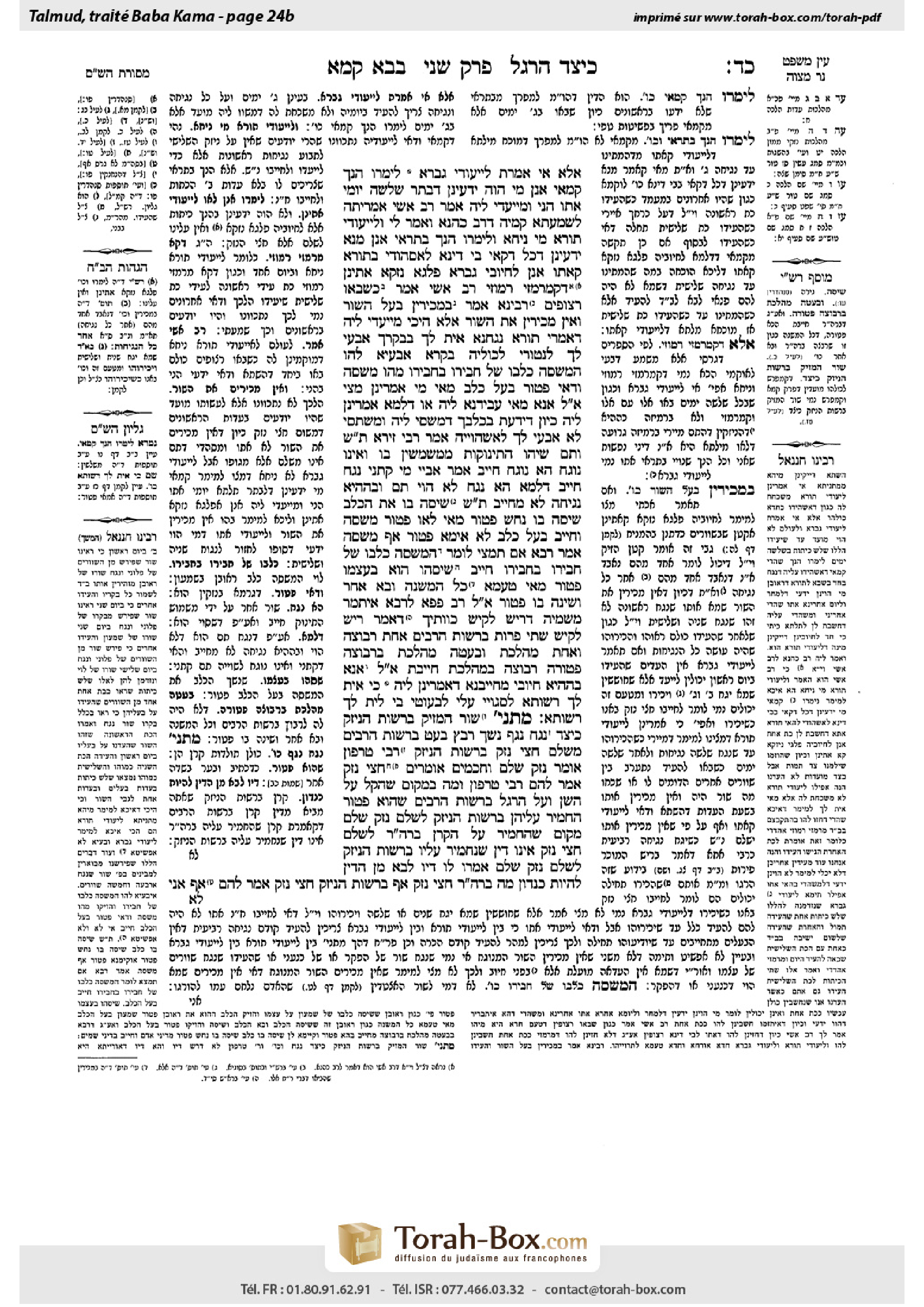
Bava Kamma 24b: Talmud study for Daf Yomi
Study the Talmud for Daf Yomi with scanned pages, Hebrew text, English translations from Sefaria and AI-generated French translations.
Passage selection and English or AI-generated French translation are available where the scan has annotations. Daf Study is independent of Torah-Box and Sefaria.
Browse Bava Kamma · בבא קמא · All tractatesBava Kamma 24b text and translations
This page of Bava Kamma includes the Aramaic text, an English translation and an AI-generated French translation, alongside the scan above.
בבא קמא כ״ד ב · Aramaic and Hebrew text
אֶלָּא אִי אָמְרַתְּ לְיַיעוֹדֵי גַּבְרָא, לֵימְרוּ הָנָךְ קַמָּאֵי: אֲנַן מִי הֲוָה יָדְעִינַן דְּבָתַר תְּלָתָא יוֹמֵי – אָתוּ הָנֵי וּמְיַיעֲדִי לֵיהּ?
אָמַר רַב אָשֵׁי: אַמְרִיתַהּ לִשְׁמַעְתָּא קַמֵּיהּ דְּרַב כָּהֲנָא, וַאֲמַר לִי: וּלְיַיעוֹדֵי תּוֹרָא מִי נִיחָא?! וְלֵימְרוּ הָנָךְ בָּתְרָאֵי: אֲנַן מְנָא יָדְעִינַן דְּכֹל דְּקָאֵי בֵּי דִינָא – לְאַסְהוֹדֵי בְּתוֹרָא קָאָתוּ? אֲנַן לְחַיּוֹבֵי גַּבְרָא פַּלְגָא נִזְקָא אָתֵינַן!
דְּקָמְרַמְּזִי רַמּוֹזֵי. רַב אָשֵׁי אָמַר: כְּשֶׁבָּאוּ רְצוּפִים.
רָבִינָא אָמַר: בְּמַכִּירִין בַּעַל הַשּׁוֹר, וְאֵין מַכִּירִין אֶת הַשּׁוֹר.
אֶלָּא הֵיכִי מְיַיעֲדִי לֵיהּ? דְּאָמְרִי: תּוֹרָא נַגְּחָנָא אִית לָךְ בְּבַקְרָךְ, אִבְּעִי לָךְ לְנַטּוֹרֵי לְכוּלֵּיהּ בַּקְרָא.
אִבַּעְיָא לְהוּ: הַמְשַׁסֶּה כַּלְבּוֹ שֶׁל חֲבֵירוֹ בַּחֲבֵירוֹ, מַהוּ? מְשַׁסֶּה – וַדַּאי פָּטוּר; בַּעַל כֶּלֶב – מַאי? מִי אָמְרִינַן מָצֵי אָמַר לֵיהּ: אֲנָא – מַאי עָבֵידְנָא לֵיהּ? אוֹ דִלְמָא, אָמְרִינַן לֵיהּ: כֵּיוָן דְּיָדְעַתְּ בְּכַלְבָּךְ דִּמְשַׁסֵּי לֵיהּ וּמִשְׁתַּסֵּי, לָא אִבְּעִי לָךְ לְאַשְׁהוֹיֵיהּ?
אָמַר רַבִּי זֵירָא, תָּא שְׁמַע: וְתָם – שֶׁיְּהוּ הַתִּינוֹקוֹת מְמַשְׁמְשִׁין בּוֹ, וְאֵינוֹ נוֹגֵחַ. הָא נוֹגֵחַ – חַיָּיב! אָמַר אַבָּיֵי, מִי קָתָנֵי: נָגַח חַיָּיב? דִּלְמָא הָא נָגַח – לָא הָוֵי תָּם; וּבְהָהִיא נְגִיחָה לָא מִחַיַּיב.
תָּא שְׁמַע: שִׁיסָּה בּוֹ אֶת הַכֶּלֶב, שִׁיסָּה בּוֹ נָחָשׁ – פָּטוּר. מַאי, לָאו פָּטוּר מְשַׁסֶּה, וְחַיָּיב בַּעַל כֶּלֶב? לָא; אֵימָא: פָּטוּר אַף מְשַׁסֶּה.
אָמַר רָבָא, אִם תִּמְצֵי לוֹמַר: הַמְשַׁסֶּה כַּלְבּוֹ שֶׁל חֲבֵירוֹ בַּחֲבֵירוֹ – חַיָּיב; שִׁיסָּהוּ הוּא בְּעַצְמוֹ – פָּטוּר. מַאי טַעְמָא? כׇּל הַמְשַׁנֶּה, וּבָא אַחֵר וְשִׁינָּה בּוֹ – פָּטוּר.
אֲמַר לֵיהּ רַב פָּפָּא לְרָבָא: אִיתְּמַר מִשְּׁמֵיהּ דְּרֵישׁ לָקִישׁ כְּווֹתָיךְ – דְּאָמַר רֵישׁ לָקִישׁ: שְׁתֵּי פָּרוֹת בִּרְשׁוּת הָרַבִּים, אַחַת רְבוּצָה וְאַחַת מְהַלֶּכֶת, וּבִעֲטָה מְהַלֶּכֶת בִּרְבוּצָה – פְּטוּרָה. רְבוּצָה בִּמְהַלֶּכֶת – חַיֶּיבֶת.
אֲמַר לֵיהּ: אֲנָא – בְּהָהִיא חַיּוֹבֵי מְחַיֵּיבְנָא, דְּאָמְרִינַן לֵיהּ: כִּי אִית לָךְ רְשׁוּתָא – לְסַגּוֹיֵי עֲלַי; לְבַעוֹטֵי בִּי לֵית לָךְ רְשׁוּתָא.
מַתְנִי׳ שׁוֹר הַמַּזִּיק בִּרְשׁוּת הַנִּיזָּק, כֵּיצַד? נָגַח, נָגַף, נָשַׁךְ, רָבַץ, בָּעַט; בִּרְשׁוּת הָרַבִּים – מְשַׁלֵּם חֲצִי נֶזֶק. בִּרְשׁוּת הַנִּיזָּק – רַבִּי טַרְפוֹן אוֹמֵר: נֶזֶק שָׁלֵם, וַחֲכָמִים אוֹמְרִים: חֲצִי נֶזֶק.
אֲמַר לָהֶם רַבִּי טַרְפוֹן: וּמָה בְּמָקוֹם שֶׁהֵקֵל עַל הַשֵּׁן וְעַל הָרֶגֶל – בִּרְשׁוּת הָרַבִּים, שֶׁהוּא פָּטוּר; הֶחְמִיר עֲלֵיהֶן בִּרְשׁוּת הַנִּיזָּק – לְשַׁלֵּם נֶזֶק שָׁלֵם; מְקוֹם שֶׁהֶחְמִיר עַל הַקֶּרֶן – בִּרְשׁוּת הָרַבִּים, לְשַׁלֵּם חֲצִי נֶזֶק; אֵינוֹ דִּין שֶׁנַּחְמִיר עָלָיו בִּרְשׁוּת הַנִּיזָּק – לְשַׁלֵּם נֶזֶק שָׁלֵם?
אָמְרוּ לוֹ: דַּיּוֹ לַבָּא מִן הַדִּין – לִהְיוֹת כַּנִּדּוֹן. מָה בִּרְשׁוּת הָרַבִּים – חֲצִי נֶזֶק, אַף בִּרְשׁוּת הַנִּיזָּק – חֲצִי נֶזֶק.
אָמַר לָהֶם: אַף אֲנִי
Bava Kamma 24b · English translation
But if you say that the witnesses came to forewarn the man, to caution him to safeguard his animal from causing harm, then they must have come on three separate days. And if so, let these first witnesses say: Did we know that after three days these other witnesses were going to come to testify about the animal? Therefore, it must be that the case in the baraita is one where the three groups of witnesses all came on the same day, and if that is so, the purpose of the testimony must be to render the ox forewarned.
Rav Ashi said: I recited this halakha before Rav Kahana and he replied to me in response to this proof: And does it work out well to say that they are coming to render the ox forewarned? Even in a case where all of the witnesses arrive in court on the same day, let these last witnesses say: From where were we to know that all those standing in court came to testify about the ox? We came to make this person liable to pay for half the cost of the damage his animal allegedly caused, but we are not responsible for the attempt to make him pay the full cost of the damage for the third incident.
The Gemara answers: It must be that the case concerns a situation where the different groups of witnesses were observed signaling to each other, and therefore it is clear that they were aware of each other’s testimony and that they came to the court for this purpose. Rav Ashi said: The case is one where they all came in succession, one following the other, and therefore it is clear that the latter witnesses are aware of the former.
Ravina said: In this case the witnesses said that they were acquainted with the owner of the goring ox but they were not familiar with the ox itself. This indicates that they were coming to court to render the ox forewarned, as the witnesses are not able to identify the goring ox and they would not be able to hold its owner liable to pay for half the cost of the damage, as this payment is paid only from the proceeds of the sale of the animal. Therefore, the only purpose of their testimony would be to hold the owner liable to pay the full cost of the damage for the third incident, as this payment is made from the owner’s superior-quality land.
The Gemara asks: But if they were not familiar with the ox, how could they render it forewarned? The Gemara answers: They said to the animal’s owner: You have a goring ox among your cattle, and therefore you need to safeguard all of the cattle.
§ A dilemma was raised before the Sages: In the case of one who incites another’s dog against another, i.e., a third person, and he is injured, what is the halakha? The one who incited the animal against him is certainly exempt, since he did not cause the damage directly and neither did his property; but what is the halakha with regard to the owner of the dog? The Gemara explains the different sides of the question: Do we say that the owner of the dog can say to the injured party: What did I do to the dog? Or perhaps we say to him: Since you were aware that if others incite your dog it is prone to being affected by the incitement and attacking, you ought not to have kept it in your possession. Since you did, you are liable for the damage and the injuries it causes.
Rabbi Zeira said: Come and hear a solution from the baraita: And an ox reverts to its former innocuous status if children pet it and nevertheless it does not gore. It can be inferred from this that if it gores when the children pet it, the owner would be liable to pay for the damage. An ox that gores because children pet it can be likened to one that gores because it was incited to do so, and nevertheless the mishna holds the owner liable. Abaye said: Is it taught in the baraita that if it gored the owner is liable? Perhaps that is not what the baraita means. It merely means that if it gored it does not revert to innocuous status; but the owner is not liable for any of the damage caused by that goring because the children incited the animal to do so, and therefore nothing can be conclusively demonstrated from the baraita.
The Gemara attempts to prove this point from another source: Come and hear a solution from a mishna (Sanhedrin 76b): If one incited a dog against another person, or incited a snake against another person, he is exempt. What, is it not that the one who incited the dog against him is exempt, but the owner of the dog is liable? The Gemara rejects this: No, say that even the one who incited the animal against him is exempt, as well as the owner.
Rava said: Even if you say that one who incites the dog of another against yet another person is liable, nevertheless if he incited the dog against himself, i.e., the dog bit the one who was inciting it to attack, he is exempt. What is the reason for this? Due to the principle that with regard to anyone who deviates from normative behavior in his actions, if another came along afterward and deviates from the norm with regard to the action the first has done and thereby causes damage to him, the one who causes the damage is exempt from liability. Since this individual deviated from the normative behavior and incited the dog against himself, the owner of the dog is not responsible for any damage the dog causes to him as a result, although generally speaking any time a dog bites it is in and of itself a deviation from its typical behavior and something for which its owner would normally be held liable.
Rav Pappa said to Rava: It was stated in the name of Reish Lakish in accordance with your opinion, that if anyone deviates from normative behavior in his actions, if another came along afterward and deviates from the norm with regard to the action the first has done and thereby causes damage to him, the one who causes the damage is exempt from liability. As Reish Lakish says: If there were two cows in the public domain, one prone in the street and the other one walking, if the walking cow kicked the prone cow, its owner is exempt from liability. But if the prone cow kicked the walking cow, its owner is liable. The rationale for this is that since it is typical behavior for cows to walk in the public domain and the prone cow deviated from this behavior, even if the walking cow also acted atypically and kicked the prone cow, the owner is exempt from liability.
Rava said back to Rav Pappa: That is not in accordance with my opinion, as I would have held the owner of the walking cow liable in that case, because in my opinion we say to him on behalf of the prone cow: It is true that you have the right to tread on me in the public domain but you do not have the right to kick me, and therefore Rava’s and Reish Lakish’s opinions are not exactly the same.
MISHNA: And what is the case of the ox that causes damage while on the property of the injured party, mentioned in an earlier mishna (15b) that listed animals that are forewarned? If the animal gored, pushed, bit, squatted upon, or kicked another animal in the public domain, the owner is liable to pay half the cost of the damage if the ox was innocuous, but if it acted while on the property of the injured party, Rabbi Tarfon says: He must pay the full cost of the damage, and the Rabbis say: He must pay half the cost of the damage, as in any other case classified as Goring.
Rabbi Tarfon said to the Rabbis: If in a place where the Torah was lenient with regard to damage classified as Eating and with regard to Trampling, specifically in the public domain, as the owner is exempt from liability, nevertheless the Torah was strict with regard to these forms of damage if they occurred on the property of the injured party, requiring him to pay the full cost of the damage, then in a place where the Torah was strict with regard to cases of damage classified as Goring, specifically in the public domain, requiring the owner to pay for half the cost of the damage, is it not right that we should be strict with regard to this form of damage if it occurs on the property of the injured party to likewise require the owner of the animal to pay the full cost of the damage?
The Rabbis said to him: Although there is an a fortiori inference being applied here, still it is sufficient for the conclusion that emerges from an a fortiori inference to be like its source, meaning that the halakha cannot be stricter with the inference than it is with the case that serves as the source of the inference. Therefore, just as one is liable to pay half the cost of the damage classified as Goring in the public domain, so too, for damage classified as Goring on the property of the injured party he is liable to pay only half the cost of the damage.
Rabbi Tarfon said to them: If that is your opinion, then I as well
Bava Kamma 24b · Traduction française (IA)
Mais si vous dites que les témoins sont venus avertir l'homme, afin de le mettre en garde pour qu'il protège son bétail contre les dommages, alors ils doivent avoir été trois jours différents. Et si c'est ainsi, que disent ces premiers témoins : Savions-nous que, après trois jours, ces autres témoins viendraient témoigner sur l'animal ? Ainsi, il faut que le cas mentionné dans la baraïta soit celui où les trois groupes de témoins sont arrivés le même jour, et si c'est ainsi, le but du témoignage doit être de mettre l'animal en garde.
Rav Ashi a dit : J'ai exposé cette halakha à Rav Kahana et il m'a répondu à propos de cette démonstration : Et cela fonctionne-t-il bien en disant qu'ils viennent mettre l'animal en garde ? Même dans un cas où tous les témoins arrivent en cour le même jour, que disent ces derniers témoins : D'où savions-nous que tous ceux présents en cour étaient là pour témoigner sur l'animal ? Nous étions là pour rendre cette personne responsable de la moitié du coût des dommages que son animal aurait pu causer, mais nous ne sommes pas responsables de l'effort de faire payer le coût total des dommages pour le troisième incident.
La Guemara répond : Il faut que le cas concerne une situation où les différents groupes de témoins se sont signalés les uns aux autres, et donc il est clair qu'ils étaient conscients des témoignages les uns des autres et qu'ils sont venus en cour à cet effet. Rav Ashi a dit : Le cas est celui où ils sont tous arrivés successivement, l'un après l'autre, et donc il est clair que les témoins ultérieurs sont conscients des premiers.
Ravina a dit : Dans ce cas, les témoins ont dit qu'ils connaissaient le propriétaire de l'ox qui a attaqué, mais ils ne connaissaient pas l'ox lui-même. Cela indique qu'ils étaient venus en cour afin d'avertir l'ox, car les témoins ne pouvaient pas identifier l'ox attaquant et ils ne pourraient pas rendre le propriétaire responsable de la moitié du coût des dommages, car ce paiement est uniquement effectué à partir des revenus de la vente de l'animal. Ainsi, le seul but de leur témoignage serait de rendre le propriétaire responsable du coût total des dommages pour le troisième incident, car ce paiement est effectué à partir des terres de qualité supérieure du propriétaire.
La Guemara pose la question : Mais si ils ne connaissaient pas l'ox, comment pouvaient-ils l'avertir ? La Guemara répond : Ils ont dit au propriétaire de l'ox : Vous avez un ox attaquant parmi vos bêtes, et donc vous devez protéger toutes vos bêtes.
§ Un dilemme a été soulevé devant les Sages : Dans le cas d'une personne qui incite le chien d'un autre contre un tiers, et qu'il est blessé, quelle est la halakha ? Celui qui a incité l'animal contre lui est certainement exempt, puisqu'il n'a pas causé directement le dommage et que sa propriété n'a pas non plus causé le dommage ; mais quelle est la halakha concernant le propriétaire du chien ? La Guemara explique les deux côtés de la question : Disons-nous que le propriétaire du chien peut dire à la personne blessée : Qu'ai-je fait au chien ? Ou peut-être disons-nous à lui : Puisque vous saviez que si d'autres incitent votre chien, il est sujet à l'incitation et à l'attaque, vous ne devriez pas avoir gardé ce chien. Puisque vous l'avez fait, vous êtes responsable du dommage et des blessures qu'il cause.
Rabbi Zeira a dit : Venez écouter une solution dans la baraïta : Un bœuf reprend son statut innocent s'il est caressé par des enfants et qu'il ne tue pas. On peut en déduire que si le bœuf tue alors que les enfants le caressent, le propriétaire serait responsable du dommage. Un bœuf qui tue à cause des enfants caressant peut être comparé à un bœuf qui tue à cause d'une incitation, et pourtant la mishna considère le propriétaire responsable. Abaye a dit : Est-ce que la baraïta enseigne que si le bœuf tue, le propriétaire est responsable ? Peut-être que ce n'est pas ce que la baraïta veut dire. Elle veut simplement dire que si le bœuf tue, il ne reprend pas son statut innocent ; mais le propriétaire n'est pas responsable de tout le dommage causé par cette attaque, car les enfants ont incité l'animal à agir, et donc rien ne peut être déduit de la baraïta.
La Guemara tente de prouver ce point à partir d'une autre source : Venez écouter une solution dans une mishna (Sanhedrin 76b) : Si l'on incite un chien contre une autre personne, ou un serpent contre une autre personne, il est exempt. Qu'est-ce que cela ne signifie pas que celui qui a incité le chien contre lui est exempt, mais que le propriétaire du chien est responsable ? La Guemara rejette cela : Non, disons que même celui qui a incité l'animal contre lui est exempt, ainsi que le propriétaire.
Rava a dit : Même si vous dites que celui qui incite le chien d'un autre contre une autre personne est responsable, néanmoins, si l'incitation est faite contre soi-même, c'est-à-dire que le chien a mordu celui qui l'incitait à attaquer, il est exempt. Quelle est la raison de cela ? En raison du principe selon lequel, concernant toute personne qui s'écarte du comportement normatif dans ses actions, si une autre personne vient après et s'écarte du normatif concernant l'action que la première a faite et cause ainsi un dommage, la personne qui cause le dommage est exemptée de responsabilité. Puisque cette personne s'est écartée du comportement normatif et a incité le chien contre lui-même, le propriétaire du chien n'est pas responsable des dommages que le chien cause à cause de cela, bien que généralement, chaque fois qu'un chien mord, c'est une déviation de son comportement normal et quelque chose pour lequel son propriétaire est normalement tenu responsable.
Rav Pappa a dit à Rava : Il a été dit en nom de Reïsh Lakish conformément à votre avis, que si quelqu'un s'écarte du comportement normatif dans ses actions, et si un autre vient après et s'écarte du normale par rapport à l'action que le premier a faite, causant ainsi un préjudice à celui-ci, celui qui cause le préjudice est exempt de responsabilité. Comme le dit Reïsh Lakish : Si deux vaches étaient dans le domaine public, l'une allongée sur la rue et l'autre marchant, et si la vache marchant avait frappé la vache allongée, son propriétaire est exempt de responsabilité. Mais si la vache allongée avait frappé la vache marchant, son propriétaire est responsable. La raison en est que c'est le comportement typique des vaches de marcher dans le domaine public et que la vache allongée s'est écartée de ce comportement, même si la vache marchant s'est également comportée atypiquement en frappant la vache allongée, le propriétaire est exempt de responsabilité.
Rava a répondu à Rav Pappa : Ce n'est pas conformément à mon avis, car je considère que le propriétaire de la vache marchant serait responsable dans ce cas, car selon mon avis, nous disons au propriétaire de la vache allongée : Il est vrai que vous avez le droit de marcher sur moi dans le domaine public, mais vous n'avez pas le droit de me frapper, et par conséquent, les avis de Rava et de Reïsh Lakish ne sont pas exactement les mêmes.
MICHNA : Et quel est le cas de l'âne qui cause un préjudice sur la propriété de la victime, mentionné dans une autre mishna (15b) qui listait les animaux avertis ? Si l'animal a renversé, poussé, mordu, s'est allongé sur, ou a frappé un autre animal dans le domaine public, le propriétaire est tenu de payer la moitié du coût du préjudice si l'âne était inoffensif, mais s'il s'est comporté sur la propriété de la victime, Rabbi Tarfon dit : Il doit payer le coût complet du préjudice, et les Rabbins disent : Il doit payer la moitié du coût du préjudice, comme dans tout autre cas classé comme Goring.
Rabbi Tarfon dit aux Rabbins : Si dans un lieu où la Torah est clémente concernant les préjudices classés comme Manger et Trampling, spécifiquement dans le domaine public, car le propriétaire est exempt de responsabilité, néanmoins la Torah est stricte concernant ces formes de préjudice si elles se produisent sur la propriété de la victime, exigeant qu'il paie le coût complet du préjudice, alors dans un lieu où la Torah est stricte concernant les cas de préjudice classés comme Goring, spécifiquement dans le domaine public, exigeant que le propriétaire paie la moitié du coût du préjudice, n'est-il pas juste que nous soyons stricte concernant cette forme de préjudice si elle se produit sur la propriété de la victime, exigeant que le propriétaire de l'animal paie le coût complet du préjudice ?
Les Rabbins ont dit à lui : Bien que l'inférence a fortiori soit appliquée ici, il est suffisant que la conclusion tirée de l'inférence a fortiori soit semblable à sa source, c'est-à-dire que la halakha ne peut pas être plus stricte que le cas qui sert de source à l'inférence. Par conséquent, tout comme l'on est tenu de payer la moitié du coût du préjudice classé comme Goring dans le domaine public, ainsi aussi, pour un préjudice classé comme Goring sur la propriété de la victime, l'on est tenu de payer seulement la moitié du coût du préjudice.
Rabbi Tarfon a dit à eux : Si c'est votre avis, alors moi aussi
Traduction française générée par IA à partir de l’édition anglaise de Sefaria. Vérifie toujours un passage avec le texte source.
Text from Sefaria: William Davidson Edition - Vocalized Aramaic (CC BY NC); William Davidson Edition - English (CC BY NC).