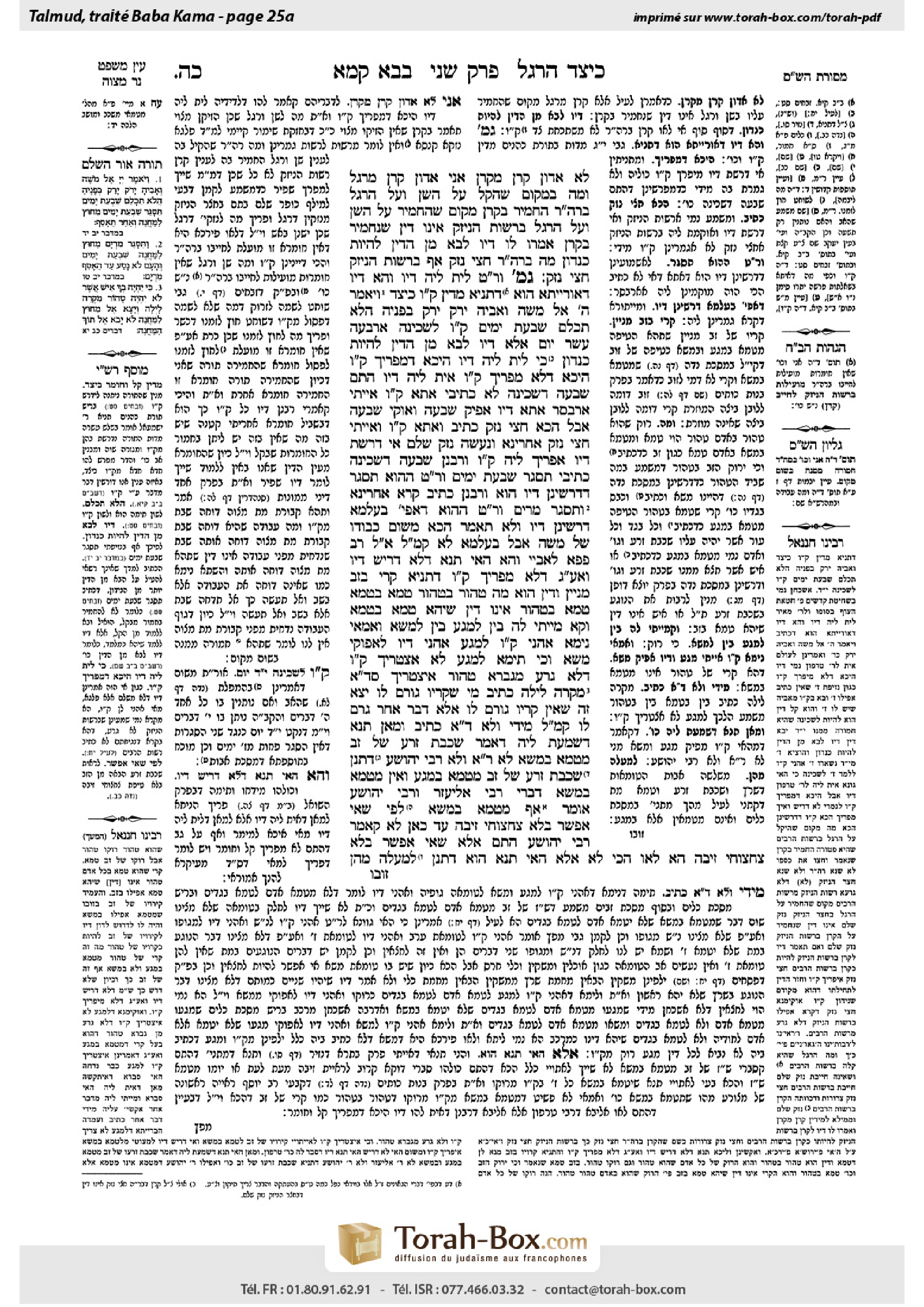
Bava Kamma 25a: Talmud study for Daf Yomi
Study the Talmud for Daf Yomi with scanned pages, Hebrew text, English translations from Sefaria and AI-generated French translations.
Passage selection and English or AI-generated French translation are available where the scan has annotations. Daf Study is independent of Torah-Box and Sefaria.
Browse Bava Kamma · בבא קמא · All tractatesBava Kamma 25a text and translations
This page of Bava Kamma includes the Aramaic text, an English translation and an AI-generated French translation, alongside the scan above.
בבא קמא כ״ה א · Aramaic and Hebrew text
לֹא אָדוּן קֶרֶן מִקֶּרֶן, אֲנִי אָדוּן קֶרֶן מֵרֶגֶל – וּמָה בְּמָקוֹם שֶׁהֵקֵל עַל הַשֵּׁן וְעַל הָרֶגֶל, בִּרְשׁוּת הָרַבִּים – הֶחְמִיר בַּקֶּרֶן; מָקוֹם שֶׁהֶחְמִיר עַל הַשֵּׁן וְעַל הָרֶגֶל, בִּרְשׁוּת הַנִּיזָּק – אֵינוֹ דִּין שֶׁנַּחְמִיר בַּקֶּרֶן?
אָמְרוּ לוֹ: דַּיּוֹ לַבָּא מִן הַדִּין – לִהְיוֹת כַּנִּדּוֹן. מָה בִּרְשׁוּת הָרַבִּים – חֲצִי נֶזֶק, אַף בִּרְשׁוּת הַנִּיזָּק – חֲצִי נֶזֶק.
גְּמָ׳ וְרַבִּי טַרְפוֹן לֵית לֵיהּ דַּיּוֹ?! וְהָא דַּיּוֹ דְּאוֹרָיְיתָא הוּא! דְּתַנְיָא: מִדִּין קַל וְחוֹמֶר – כֵּיצַד? ״וַיֹּאמֶר ה׳ אֶל מֹשֶׁה: וְאָבִיהָ יָרֹק יָרַק בְּפָנֶיהָ, הֲלֹא תִכָּלֵם שִׁבְעַת יָמִים?!״ – קַל וְחוֹמֶר לַשְּׁכִינָה, אַרְבָּעָה עָשָׂר יוֹם! אֶלָּא דַּיּוֹ לַבָּא מִן הַדִּין לִהְיוֹת כַּנִּדּוֹן.
כִּי לֵית לֵיהּ דַּיּוֹ – הֵיכָא דְּמִפְּרִיךְ קַל וָחוֹמֶר; הֵיכָא דְּלָא מִפְּרִיךְ קַל וָחוֹמֶר – אִית לֵיהּ דַּיּוֹ. הָתָם – שִׁבְעָה דִּשְׁכִינָה לָא כְּתִיבִי; אֲתָא קַל וָחוֹמֶר אַיְיתִי אַרְבֵּסַר, אֲתָא דַּיּוֹ אַפֵּיק שִׁבְעָה, וְאוֹקֵי שִׁבְעָה.
אֲבָל הָכָא – חֲצִי נֶזֶק כְּתִיב; וַאֲתָא קַל וָחוֹמֶר וְאַיְיתִי חֲצִי נֶזֶק אַחֲרִינָא, וְנַעֲשָׂה נֶזֶק שָׁלֵם; אִי דָּרְשַׁתְּ דַּיּוֹ – אִפְּרִיךְ לֵיהּ קַל וָחוֹמֶר!
וְרַבָּנַן, שִׁבְעָה דִשְׁכִינָה כְּתִיבִי – ״תִּסָּגֵר שִׁבְעַת יָמִים״.
וְרַבִּי טַרְפוֹן, הָהוּא ״תִּסָּגֵר״ – דְּדָרְשִׁינַן דַּיּוֹ הוּא.
וְרַבָּנַן, כְּתִיב קְרָא אַחֲרִינָא – ״וַתִּסָּגֵר מִרְיָם״. וְרַבִּי טַרְפוֹן, הָהוּא – דַּאֲפִילּוּ בְּעָלְמָא דָּרְשִׁינַן דַּיּוֹ, וְלֹא תֹּאמַר: הָכָא – מִשּׁוּם כְּבוֹדוֹ שֶׁל מֹשֶׁה, אֲבָל בְּעָלְמָא לָא; קָא מַשְׁמַע לַן.
אֲמַר לֵיהּ רַב פָּפָּא לְאַבָּיֵי: וְהָא הַאי תַּנָּא, דְּלָא דָּרֵישׁ דַּיּוֹ, וְאַף עַל גַּב דְּלָא מִפְּרִיךְ קַל וָחוֹמֶר! דְּתַנְיָא: קֶרִי בְּזָב מִנַּיִין? וְדִין הוּא, מָה טָהוֹר בְּטָהוֹר – טָמֵא בְּטָמֵא; טָמֵא בְּטָהוֹר – אֵינוֹ דִּין שֶׁיְּהֵא טָמֵא בְּטָמֵא?
וְקָא מַיְיתֵי לַהּ בֵּין לְמַגָּע בֵּין לְמַשָּׂא. וְאַמַּאי? נֵימָא: אַהֲנִי קַל וָחוֹמֶר לְמַגָּע, אַהֲנִי דַּיּוֹ לְאַפּוֹקֵי מַשָּׂא!
וְכִי תֵּימָא: לְמַגָּע לָא אִצְטְרִיךְ קַל וָחוֹמֶר, דְּלָא גָּרַע מִגַּבְרָא טָהוֹר; אִיצְטְרִיךְ, סָלְקָא דַּעְתָּךְ אָמֵינָא: ״מִקְּרֵה לָיְלָה״ כְּתִיב – מִי שֶׁקִּרְיוֹ גּוֹרֵם לוֹ; יָצָא זֶה, שֶׁאֵין קִרְיוֹ גּוֹרֵם לוֹ – אֶלָּא דָּבָר אַחֵר גָּרַם לוֹ; קָא מַשְׁמַע לַן.
מִידֵּי ״וְלֹא דָּבָר אַחֵר״ כְּתִיב?!
וּמַאן תַּנָּא דְּשָׁמְעַתְּ לֵיהּ דְּאָמַר: שִׁכְבַת זֶרַע שֶׁל זָב מְטַמְּאָה בְּמַשָּׂא? לָא רַבִּי אֱלִיעֶזֶר, וְלָא רַבִּי יְהוֹשֻׁעַ. דִּתְנַן: שִׁכְבַת זֶרַע שֶׁל זָב מְטַמְּאָה בְּמַגָּע, וְאֵין מְטַמְּאָה בְּמַשָּׂא; דִּבְרֵי רַבִּי אֱלִיעֶזֶר. וְרַבִּי יְהוֹשֻׁעַ אוֹמֵר: אַף מְטַמְּאָה בְּמַשָּׂא, לְפִי שֶׁאִי אֶפְשָׁר בְּלֹא צִחְצוּחֵי זִיבָה.
עַד כָּאן לָא קָאָמַר רַבִּי יְהוֹשֻׁעַ הָתָם – אֶלָּא שֶׁאִי אֶפְשָׁר בְּלֹא צִחְצוּחֵי זִיבָה, הָא לָאו הָכִי – לָא! אֶלָּא הַאי תַּנָּא הוּא – דִּתְנַן: לְמַעְלָה מֵהֶן
Bava Kamma 25a · English translation
will not derive an inference with regard to Goring from a different case of Goring. I will instead derive an inference with regard to Goring from Trampling: And if in a place where the Torah was lenient with regard to damage classified as Eating and Trampling, specifically in the public domain, as the owner is exempt from liability, nevertheless the Torah was strict with regard to damage classified as Goring, requiring him to pay half the cost of the damage, then in a place where the Torah was strict with regard to damage classified as Eating and Trampling, specifically on the property of the injured party as the animal’s owner is obligated to pay the full cost of the damage, is it not right that we should be equally strict with regard to damage classified as Goring and require payment of the full cost of the damage in this case as well?
The Rabbis said to him: Here as well, it is sufficient for the conclusion that emerges from an a fortiori inference to be like its source, and therefore, just as one is liable to pay half the cost of the damage classified as Goring in the public domain, so too, for damage classified as Goring on the property of the injured party he will be liable to pay only half the cost of the damage, as ultimately your inference still depends on the fact that for Goring in the public domain one pays half the cost of the damage.
GEMARA: And is it true that Rabbi Tarfon does not accept the principle of: It is sufficient for the conclusion that emerges from an a fortiori inference to be like its source? But that cannot be, as the principle that begins with: It is sufficient, is an aspect of Torah law, as it is taught in a baraita: The Sages said that one of the ways in which the Torah may be interpreted is by an a fortiori inference. How is this so? It is written (Numbers 12:14): “And the Lord said to Moses: If her father had but spit in her face, should she not hide in shame seven days? Let her be shut up seven days outside the camp, and after that she shall be brought in again,” and therefore, using an a fortiori inference it can be derived that if the Divine Presence reprimanded her, she should hide in shame for fourteen days. Why was Miriam banished for only seven days? Rather, it is because it is sufficient for the conclusion that emerged from the a fortiori inference to be like the source of the inference. Consequently, this principle is mandated by the Torah itself.
The Gemara answers: When Rabbi Tarfon does not accept the principle: It is sufficient, it is where this principle completely refutes the a fortiori inference, leaving no halakha derived from it. But where it does not completely refute the a fortiori inference, Rabbi Tarfon accepts the principle: It is sufficient. Consequently, there, with regard to Miriam, the seven days during which she deserved to be banished from the camp due to the rebuke of the Divine Presence were not written, so the a fortiori inference came and brought those days plus additional days, adding up to a total of fourteen, and then the principle: It is sufficient, came and removed seven days and left seven days intact. Consequently, the a fortiori inference was effective with regard to the seven days during which she was banished from the camp.
But here, payment for half the cost of the damage is written explicitly in the Torah with regard to the halakha of Goring in the public domain, and the a fortiori inference comes and brings an additional payment for half the cost of the damage, forming a payment of the full cost of the damage. If you interpret the halakha employing the principle: It is sufficient, to reduce the payment to half the cost of the damage, this completely refutes the a fortiori inference, as no halakha would be derived from the inference; the initial payment for half the cost of the damage was written explicitly in the Torah. Consequently, in this case, Rabbi Tarfon does not employ the principle: It is sufficient.
The Gemara asks: And how do the Rabbis understand this matter? How do they respond to Rabbi Tarfon’s reasoning? The Gemara answers: In their opinion, the seven days during which Miriam had to be banished due to the reprimand she received from the Divine Presence are in fact written in the Torah: “Let her be shut up seven days.” This indicates that the a fortiori inference is not required to teach the halakha of the seven days she was banished, as it would have added only the extra seven days. This means that according to the Rabbis, there is a source in the Torah that the principle: It is sufficient, is employed even when it refutes the a fortiori inference completely.
The Gemara asks: And what would Rabbi Tarfon say about that reasoning? The Gemara answers: He would say that this verse: “Let her be shut up seven days,” is necessary to teach us the basic fact that we interpret the halakha according to the principle: It is sufficient for the conclusion that emerges from an a fortiori inference to be like its source.
The Gemara asks: And what would the Rabbis say in response? The Gemara answers: They would point out that a different verse is written about Miriam: “And Miriam was shut up outside the camp seven days” (Numbers 12:15). The Gemara asks: And how would Rabbi Tarfon respond to that? The Gemara answers: That verse teaches that we interpret the halakha according to the principle: It is sufficient, even generally, and not only in this specific case. And this point is necessary so that you do not say: Here the principle: It is sufficient, is employed due to respect for Moses, but generally that is not done. This verse therefore teaches us that this is not so.
Rav Pappa said to Abaye: Is the fundamental principle: It is sufficient for the conclusion that emerges from an a fortiori inference to be like its source, actually accepted by all authorities? But there is this tanna, who does not interpret the halakha in accordance with the principle: It is sufficient, even though it is a case where the principle does not refute the a fortiori inference completely. As it is taught in a baraita: From where is it derived that the semen of a man who experiences a gonorrhea-like discharge [zav] imparts ritual impurity by someone carrying it as well as by coming into contact with it, just as the actual gonorrhea-like discharge does? It is a logical derivation from an a fortiori inference: Just as spittle, which is ritually pure when coming from a person who is ritually pure, is impure when coming from someone like a zav who is impure, is it not logical that semen, which is impure when coming from someone who is pure, should be impure when coming from someone who is impure?
And the tanna brings this derivation and applies it whether discussing ritual impurity imparted by contact or whether discussing impurity imparted by carrying. And why is this the case? Let us say: The a fortiori inference is effective in teaching that the semen of a zav imparts ritual impurity by contact alone, as is the halakha with regard to the semen of a pure man, and the principle: It is sufficient, is effective by limiting the scope of the a fortiori inference to exclude the semen of a zav from imparting ritual impurity by carrying. Since the tanna does not formulate his derivation in this manner, it appears that he rejects the principle: It is sufficient, in all situations.
And if you would say that the a fortiori inference was not necessary to teach that the seminal emission of the zav imparts ritual impurity by contact, as it is certainly no less impure than if it had come from a man who was pure, so the inference was necessary only to teach that the semen of a zav imparts impurity by carrying, this is not correct. In fact, it was necessary to teach this point, as it may enter your mind to say that since it is written in the verse: “If there be among you any man that is not clean because of something that happens to him by night” (Deuteronomy 23:11), this means that a seminal emission is ritually impure if it came from someone who had something happen to him, and this causes him to experience the emission, but the verse is excluding this zav, who did not have something happen to him to cause him to experience the emission, but rather another matter, i.e., his gonorrhea-like condition, caused him to experience the emission. Consequently, it teaches us that this is incorrect.
Abaye responded: In the verse “something that happens to him by night,” is it also written: But not another matter? This limiting clause is not written in the verse, and therefore the halakha that the semen of a zav imparts ritual impurity by contact can be understood from the explicit verse in the Torah, and there is no need to derive it from an a fortiori inference. Therefore, the only function of the a fortiori inference is to teach the halakha that the semen of a zav imparts impurity by carrying. Applying the principle: It is sufficient, would refute the a fortiori inference completely, so there is no proof that the tanna would apply the principle in all circumstances.
Once the Gemara raised the issue, it clarifies: And who is the tanna about whom you heard that he said: Semen of a zav imparts ritual impurity by carrying? It was not Rabbi Eliezer and not Rabbi Yehoshua. As we learned in a baraita: Semen of a zav imparts ritual impurity by contact but it does not impart ritual impurity by carrying; this is the statement of Rabbi Eliezer. And Rabbi Yehoshua says: It also imparts ritual impurity by carrying, as it is impossible for semen to emerge without small drops of gonorrhea-like discharge [ziva] accompanying it.
Rabbi Yehoshua says there that the semen of a zav imparts ritual impurity by carrying only because it is impossible for semen to emerge without small drops of ziva accompanying it. This indicates that if not for this reason, the semen would not impart ritual impurity by carrying, according to the opinions of both Rabbi Yehoshua and Rabbi Eliezer. The Gemara explains: Rather, it must be that this tanna is the one who holds the opinion that the semen of a zav imparts ritual impurity by carrying, as we learned in a mishna listing the sources of ritual impurity (Kelim 1:3): Of a greater degree than the ritual impurities listed previously in the mishna, i.e., the impurity of a creeping animal, semen, and one who contracted ritual impurity from a corpse,
Bava Kamma 25a · Traduction française (IA)
On ne peut pas tirer une conséquence concernant l'attaque d'un bétail à partir d'un cas différent d'attaque. Je tirerai plutôt une conséquence concernant l'attaque à partir de l'écrasement : Et si dans un lieu où la Torah est clémente concernant les dommages classés comme l'alimentation et l'écrasement, spécifiquement dans le domaine public, comme le propriétaire est exempt de responsabilité, néanmoins la Torah est stricte concernant les dommages classés comme l'attaque, exigeant qu'il paie la moitié du coût des dommages, alors dans un lieu où la Torah est stricte concernant les dommages classés comme l'alimentation et l'écrasement, spécifiquement sur la propriété de la personne blessée, comme le propriétaire de l'animal est tenu de payer le coût complet des dommages, n'est-il pas juste que nous soyons aussi stricts concernant les dommages classés comme l'attaque et exigeons le paiement du coût complet des dommages dans ce cas également ?
Les Sages dirent à lui : Ici aussi, il suffit que la conclusion tirée d'une inférence a fortiori soit semblable à sa source, et donc, tout comme l'on est tenu de payer la moitié du coût des dommages classés comme l'attaque dans le domaine public, ainsi l'on est tenu de payer seulement la moitié du coût des dommages classés comme l'attaque sur la propriété de la personne blessée, car finalement votre inférence dépend toujours du fait que pour l'attaque dans le domaine public, on paie la moitié du coût des dommages.
GUEMARA : Et est-ce vrai que Rabbi Tarfon ne reconnaît pas le principe : Il suffit que la conclusion tirée d'une inférence a fortiori soit semblable à sa source ? Mais cela ne peut pas être, car ce principe qui commence par : Il suffit, est une partie de la loi juive, comme il est enseigné dans une baraïta : Les Sages dirent que l'une des manières dont la Torah peut être interprétée est par une inférence a fortiori. Comment cela est-il ainsi ? Il est écrit (Nombres 12:14) : « Et l'Éternel dit à Moïse : Si son père avait seulement craché sur son visage, ne devrait-elle pas se cacher en honte sept jours ? Qu'elle soit enfermée sept jours en dehors du camp, et après cela, elle sera ramenée à l'intérieur », et donc, en utilisant une inférence a fortiori, on peut déduire que si la Présence divine l'avait réprimandée, elle devrait se cacher en honte quatorze jours. Pourquoi Miriam a-t-elle été expulsée pendant sept jours seulement ? Plutôt, c'est parce que il suffit que la conclusion tirée de l'inférence a fortiori soit semblable à la source de l'inférence. Ainsi, ce principe est prescrit par la Torah elle-même.
La Guemara répond : Lorsque Rabbi Tarfon ne reconnaît pas le principe : Il suffit, c'est là où ce principe réfute complètement l'inférence a fortiori, laissant aucune halakha dérivée d'elle. Mais là où il ne réfute pas complètement l'inférence a fortiori, Rabbi Tarfon accepte le principe : Il suffit. Ainsi, là, concernant Miriam, les sept jours pendant lesquels elle méritait d'être expulsée du camp en raison de la réprimande de la Présence divine n'étaient pas écrits, donc l'inférence a fortiori est venue et a ajouté ces sept jours supplémentaires, totalisant quatorze jours, et ensuite le principe : Il suffit, est venu et a retiré sept jours, laissant sept jours intacts. Ainsi, l'inférence a fortiori a été efficace concernant les sept jours pendant lesquels elle a été expulsée du camp.
Mais ici, le paiement de la moitié du coût des dommages est explicitement mentionné dans la Torah concernant la halakha de l'attaque dans le domaine public, et l'inférence a fortiori vient apporter un paiement supplémentaire de la moitié du coût des dommages, formant ainsi un paiement du coût complet des dommages. Si l'on interprète la halakha en utilisant le principe : Il suffit, pour réduire le paiement à la moitié du coût des dommages, cela réfute complètement l'inférence a fortiori, car aucune halakha ne serait dérivée de l'inférence ; le paiement initial de la moitié du coût des dommages était explicitement mentionné dans la Torah. Ainsi, dans ce cas, Rabbi Tarfon ne fait pas usage du principe : Il suffit.
La Guemara demande : Et comment les Sages comprennent-ils cette question ? Comment répondent-ils à la raison de Rabbi Tarfon ? La Guemara répond : Selon leur avis, les sept jours pendant lesquels Miriam devait être expulsée en raison de la réprimande qu'elle avait reçue de la Présence divine sont effectivement écrits dans la Torah : « Qu'elle soit enfermée sept jours. » Cela indique que l'inférence a fortiori n'était pas nécessaire pour enseigner la halakha des sept jours pendant lesquels elle a été expulsée du camp, car cela aurait ajouté seulement les sept jours supplémentaires. Cela signifie que selon les Sages, il existe une source dans la Torah selon laquelle le principe : Il suffit, est utilisé même lorsqu'il réfute complètement l'inférence a fortiori.
La Guemara demande : Et que dirait Rabbi Tarfon à ce raisonnement ? La Guemara répond : Il dirait que ce verset : « Qu'elle soit enfermée sept jours », est nécessaire pour nous apprendre le fait fondamental que nous interprétons la halakha selon le principe : Il suffit que la conclusion tirée d'une inférence a fortiori soit semblable à sa source.
La Guemara demande : Et que diraient les Sages en réponse ? La Guemara répond : Ils montreraient que d'autres versets sont écrits à propos de Miriam : « Et Miriam fut enfermée en dehors du camp sept jours » (Nombres 12:15). La Guemara demande : Et comment Rabbi Tarfon répondrait-il à cela ? La Guemara répond : Ce verset enseigne que nous interprétons la halakha selon le principe : Il suffit, même de manière générale, et non seulement dans ce cas spécifique. Ce point est nécessaire afin que vous ne disiez pas : Ici, le principe : Il suffit, est utilisé par respect pour Moïse, mais généralement cela n'est pas fait. Ce verset enseigne donc que cela n'est pas le cas.
Rav Pappa a dit à Abaye : Le principe fondamental est-il accepté par tous les autorités, à savoir que la conclusion tirée d'une inférence a fortiori suffit à être semblable à sa source ? Mais il y a ce tanna qui ne déduit la halakha selon ce principe : Il suffit, même dans un cas où ce principe ne contredit pas entièrement l'inférence a fortiori. Comme il est enseigné dans une baraïta : D'où est-il tiré que le sperme d'un homme qui a une émission de gonorrhée [zav] transmet l'impureté rituelle à celui qui le porte ainsi qu'à celui qui l'entre en contact, de la même manière que l'émission de gonorrhée elle-même ? C'est une déduction logique tirée d'une inférence a fortiori : Comme la salive, qui est pure rituellement lorsqu'elle vient d'une personne pure, est impure lorsqu'elle vient d'une personne comme un zav impure, n'est-il pas logique que le sperme, qui est impur lorsqu'il vient d'une personne pure, soit impur lorsqu'il vient d'une personne impure ?
Et le tanna présente cette déduction et l'applique qu'il s'agisse de l'impureté rituelle transmise par contact ou qu'il s'agisse de l'impureté transmise par le port. Et pourquoi est-ce ainsi ? Disons : L'inférence a fortiori est efficace pour enseigner que le sperme d'un zav transmet l'impureté rituelle par contact seul, comme c'est la halakha concernant le sperme d'un homme pur, et le principe : Il suffit, est efficace pour limiter la portée de l'inférence a fortiori afin d'exclure le sperme d'un zav de transmettre l'impureté rituelle par le port. Puisque le tanna ne formule pas sa déduction ainsi, il semble qu'il rejette le principe : Il suffit, dans tous les cas.
Et si vous disiez que l'inférence a fortiori n'était pas nécessaire pour enseigner que l'émission sémencière du zav transmet l'impureté rituelle par contact, car elle est certainement aussi impure que si elle venait d'un homme pur, alors l'inférence n'était nécessaire que pour enseigner que le sperme d'un zav transmet l'impureté par le port, cela n'est pas correct. En réalité, il était nécessaire d'enseigner ce point, car cela pourrait entrer en votre esprit de dire que puisque le texte dit : « Si parmi vous il y a un homme qui n'est pas propre à cause de quelque chose qui lui arrive la nuit » (Deutéronome 23:11), cela signifie que l'émission sémencière est impure rituellement si elle vient d'un homme qui a quelque chose qui lui arrive, et cela cause son émission, mais le texte exclut ce zav, qui n'a pas eu quelque chose qui lui arrive pour causer son émission, mais plutôt une autre chose, à savoir son état de gonorrhée, qui a causé son émission. Ainsi, il nous enseigne que cela n'est pas correct.
Abaye répondit : Dans le texte « quelque chose qui lui arrive la nuit », est-il aussi écrit : Mais pas une autre chose ? Cette clause limitante n'est pas écrite dans le texte, et donc la halakha que le sperme d'un zav transmet l'impureté rituelle par contact peut être comprise à partir du texte explicite de la Torah, et il n'y a pas besoin de le déduire d'une inférence a fortiori. Ainsi, la seule fonction de l'inférence a fortiori est d'enseigner la halakha que le sperme d'un zav transmet l'impureté par le port. L'application du principe : Il suffit, contredirait entièrement l'inférence a fortiori, donc il n'y a pas de preuve que le tanna applique ce principe dans tous les cas.
Une fois que la Guemara a soulevé cette question, elle clarifie : Et qui est ce tanna dont vous avez entendu dire qu'il dit : Le sperme d'un zav transmet l'impureté rituelle par le port ? Ce n'est pas Rabbi Eliezer et ce n'est pas Rabbi Yéhoshua. Comme nous avons appris dans une baraïta : Le sperme d'un zav transmet l'impureté rituelle par contact mais ne transmet pas l'impureté rituelle par le port ; c'est l'opinion de Rabbi Eliezer. Et Rabbi Yéhoshua dit : Il transmet aussi l'impureté rituelle par le port, car il est impossible que le sperme sorte sans que des petites gouttes de ziva l'accompagnent.
Rabbi Yéhoshua dit que le sperme d'un zav transmet l'impureté rituelle par le port uniquement parce qu'il est impossible que le sperme sorte sans que des petites gouttes de ziva l'accompagnent. Cela indique que, sans cette raison, le sperme ne transmettrait pas l'impureté rituelle par le port, selon les opinions de Rabbi Yéhoshua et de Rabbi Eliezer. La Guemara explique : En réalité, il doit être que ce tanna est celui qui adopte l'opinion que le sperme d'un zav transmet l'impureté rituelle par le port, comme nous l'avons appris dans une mitsva listant les sources d'impureté rituelle (Kelim 1:3) : Plus que les impuretés rituelles mentionnées précédemment dans la mitsva, c'est-à-dire l'impureté d'un animal rampant, le sperme et celui qui a contracté l'impureté d'un cadavre,
Traduction française générée par IA à partir de l’édition anglaise de Sefaria. Vérifie toujours un passage avec le texte source.
Text from Sefaria: William Davidson Edition - Vocalized Aramaic (CC BY NC); William Davidson Edition - English (CC BY NC).