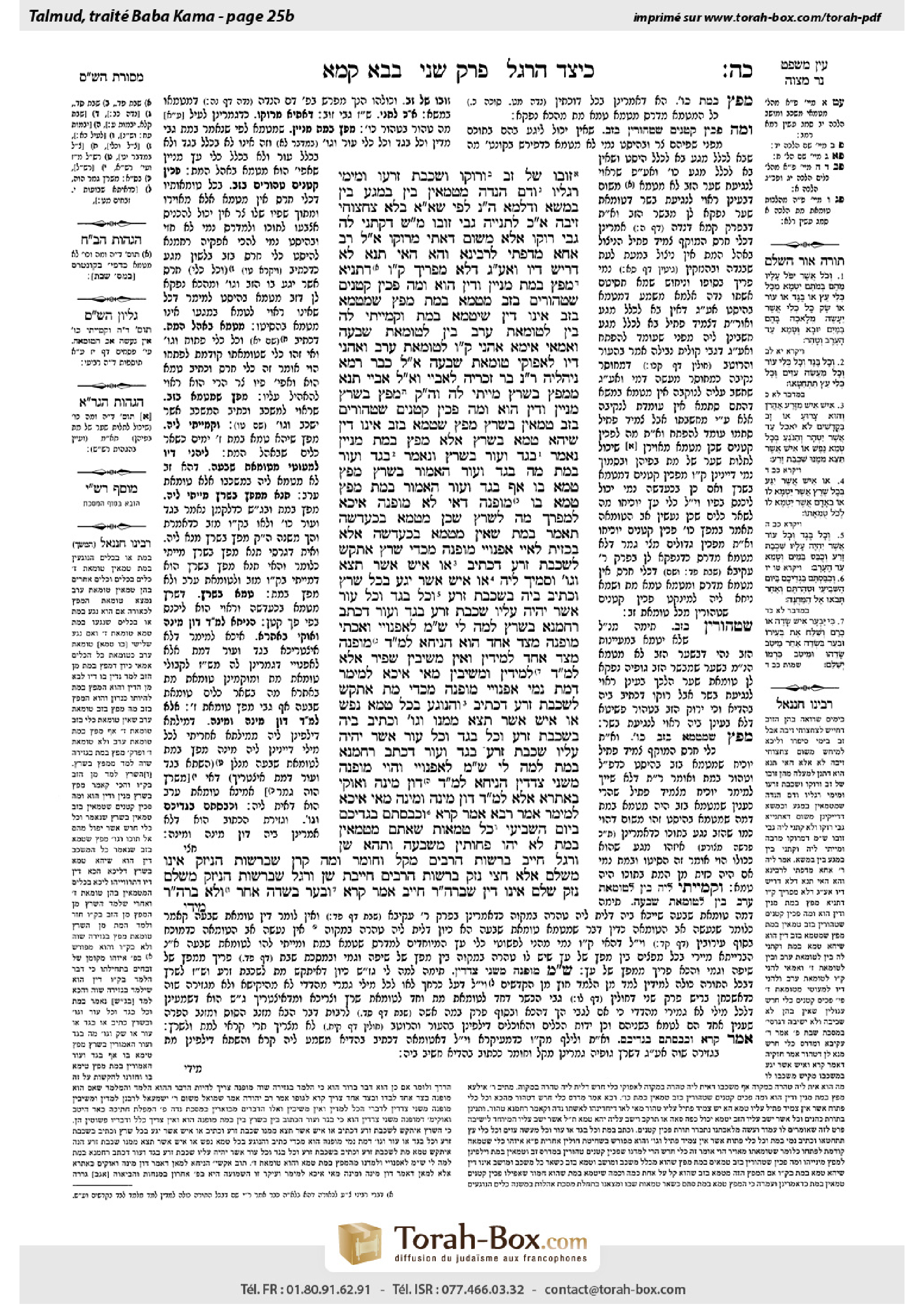
Bava Kamma 25b: Talmud study for Daf Yomi
Study the Talmud for Daf Yomi with scanned pages, Hebrew text, English translations from Sefaria and AI-generated French translations.
Passage selection and English or AI-generated French translation are available where the scan has annotations. Daf Study is independent of Torah-Box and Sefaria.
Browse Bava Kamma · בבא קמא · All tractatesBava Kamma 25b text and translations
This page of Bava Kamma includes the Aramaic text, an English translation and an AI-generated French translation, alongside the scan above.
בבא קמא כ״ה ב · Aramaic and Hebrew text
זוֹבוֹ שֶׁל זָב, וְרוּקּוֹ, וְשִׁכְבַת זַרְעוֹ, וּמֵימֵי רַגְלָיו, וְדַם הַנִּדָּה – מְטַמְּאִין בֵּין בְּמַגָּע בֵּין בְּמַשָּׂא.
וְדִלְמָא הָכִי נָמֵי – לְפִי שֶׁאִי אֶפְשָׁר בְּלֹא צִחְצוּחֵי זִיבָה! אִם כֵּן, לִתְנְיַיהּ גַּבֵּי זוֹבוֹ; מַאי שְׁנָא דְּקָתָנֵי לַהּ גַּבֵּי רוּקּוֹ? אֶלָּא מִשּׁוּם דְּאָתֵי מֵרוּקּוֹ.
אֲמַר לֵיהּ רַב אַחָא מִדִּפְתִּי לְרָבִינָא: וְהָא הַאי תַּנָּא לָא דָּרֵישׁ דַּיּוֹ, וְאַף עַל גַּב דְּלָא מִפְּרִיךְ קַל וָחוֹמֶר! דְּתַנְיָא: מַפָּץ בְּמֵת מִנַּיִין? וְדִין הוּא, וּמָה פַּכִּין קְטַנִּים – שֶׁטְּהוֹרִים בְּזָב, מְטַמֵּא בְּמֵת; מַפָּץ – שֶׁמְּטַמֵּא בְּזָב, אֵינוֹ דִּין שֶׁיְּטַמֵּא בְּמֵת?
וְקָמַיְיתֵי לַהּ בֵּין לְטוּמְאַת עֶרֶב, בֵּין לְטוּמְאַת שִׁבְעָה. וְאַמַּאי? אֵימָא: אַהֲנִי קַל וָחוֹמֶר לְטוּמְאַת עֶרֶב, וְאַהֲנִי דַּיּוֹ לְאַפּוֹקֵי טוּמְאַת שִׁבְעָה!
אֲמַר לֵיהּ: כְּבָר רְמָא נִיהֲלֵיהּ רַב נַחְמָן בַּר זְכַרְיָה לְאַבָּיֵי, וַאֲמַר לֵיהּ אַבָּיֵי: תַּנָּא – מִמַּפָּץ בְּשֶׁרֶץ מַיְיתֵי לַהּ, וְהָכִי קָאָמַר: מַפָּץ בְּשֶׁרֶץ מִנַּיִין? וְדִין הוּא, וּמָה פַּכִּין קְטַנִּים – שֶׁטְּהוֹרִים בְּזָב, טְמֵאִין בְּשֶׁרֶץ; מַפָּץ – שֶׁטָּמֵא בְּזָב, אֵינוֹ דִּין שֶׁיְּהֵא טָמֵא בְּשֶׁרֶץ?
אֶלָּא מַפָּץ בְּמֵת מִנַּיִין? נֶאֱמַר ״בֶּגֶד וָעוֹר״ בְּשֶׁרֶץ, וְנֶאֱמַר ״בֶּגֶד וָעוֹר״ בְּמֵת; מָה ״בֶּגֶד וָעוֹר״ הָאָמוּר בְּשֶׁרֶץ – מַפָּץ טָמֵא בּוֹ, אַף ״בֶּגֶד וָעוֹר״ הָאָמוּר בְּמֵת – מַפָּץ טָמֵא בּוֹ.
מוּפְנֶה; דְּאִי לָא מוּפְנֶה, אִיכָּא לְמִפְרַךְ: מָה לְשֶׁרֶץ – שֶׁכֵּן מְטַמֵּא בְּכַעֲדָשָׁה, תֹּאמַר בְּמֵת – שֶׁאֵין מְטַמֵּא בְּכַעֲדָשָׁה, אֶלָּא בִּכְזַיִת.
לָאיֵי אִפְּנוֹיֵי מוּפְנֶה – מִכְּדֵי שֶׁרֶץ אִתַּקַּשׁ לְשִׁכְבַת זֶרַע, דִּכְתִיב: ״אוֹ אִישׁ אֲשֶׁר תֵּצֵא וְגוֹ׳״, וּסְמִיךְ לֵיהּ: ״אוֹ אִישׁ אֲשֶׁר יִגַּע בְּכׇל שֶׁרֶץ״; וּכְתִיב בֵּיהּ בְּשִׁכְבַת זֶרַע: ״וְכׇל בֶּגֶד וְכׇל עוֹר אֲשֶׁר יִהְיֶה עָלָיו שִׁכְבַת זָרַע״.
״בֶּגֶד וָעוֹר״ דִּכְתַב רַחֲמָנָא בְּשֶׁרֶץ – לְמָה לִי? שְׁמַע מִינַּהּ לְאַפְנוֹיֵי.
וְאַכַּתִּי מוּפְנֶה מִצַּד אֶחָד הוּא! הָנִיחָא לְמַאן דְּאָמַר מוּפְנֶה מִצַּד אֶחָד – לְמֵידִין וְאֵין מְשִׁיבִין, שַׁפִּיר; אֶלָּא לְמַאן דְּאָמַר לְמֵידִין וּמְשִׁיבִין, מַאי אִיכָּא לְמֵימַר?
דְּמֵת נָמֵי אִפְּנוֹיֵי מוּפְנֶה – מִכְּדֵי מֵת אִתַּקַּשׁ לְשִׁכְבַת זֶרַע, דִּכְתִיב: ״וְהַנּוֹגֵעַ בְּכׇל טְמֵא נֶפֶשׁ, אוֹ אִישׁ אֲשֶׁר תֵּצֵא מִמֶּנּוּ וְגוֹ׳״; וּכְתִיב בֵּיהּ בְּשִׁכְבַת זֶרַע: ״וְכׇל בֶּגֶד וְכׇל עוֹר אֲשֶׁר יִהְיֶה עָלָיו שִׁכְבַת זָרַע״; ״בֶּגֶד וָעוֹר״ דִּכְתַב רַחֲמָנָא בְּמֵת – לְמָה לִי? שְׁמַע מִינַּהּ לְאַפְנוֹיֵי, וְהָוֵי מוּפְנֶה מִשְּׁנֵי צְדָדִין.
הָנִיחָא לְמַאן דְּאָמַר: דּוּן מִינַּהּ – וְאוֹקֵי בְּאַתְרַאּ; אֶלָּא לְמַאן דְּאָמַר: דּוּן מִינַּהּ וּמִינַּהּ, מַאי אִיכָּא לְמֵימַר?
אָמַר רָבָא, אָמַר קְרָא: ״וְכִבַּסְתֶּם בִּגְדֵיכֶם בַּיּוֹם הַשְּׁבִיעִי״ – כׇּל טְמָאוֹת שֶׁאַתֶּם מִטַּמְּאִין בְּמֵת, לֹא יְהוּ פְּחוּתִין מִשִּׁבְעָה.
וּתְהֵא שֵׁן וָרֶגֶל חַיָּיב בִּרְשׁוּת הָרַבִּים מִקַּל וָחוֹמֶר – וּמָה קֶרֶן, שֶׁבִּרְשׁוּת הַנִּיזָּק אֵינוֹ מְשַׁלֵּם אֶלָּא חֲצִי נֶזֶק – בִּרְשׁוּת הָרַבִּים חַיֶּיבֶת; שֵׁן וָרֶגֶל, שֶׁבִּרְשׁוּת הַנִּיזָּק מְשַׁלֵּם נֶזֶק שָׁלֵם – אֵינוֹ דִּין שֶׁבִּרְשׁוּת הָרַבִּים חַיָּיב?
אָמַר קְרָא: ״וּבִעֵר בִּשְׂדֵה אַחֵר״ – וְלֹא בִּרְשׁוּת הָרַבִּים.
Bava Kamma 25b · English translation
are the ziva of a zav, and his spittle, and his semen, and his urine, and the blood of a menstruating woman, all of which impart impurity both by touching and by carrying.
The Gemara questions this assertion: But perhaps here too the reason for the severity of ritual impurity of the semen is indeed because it is impossible for it to emerge without small drops of ziva accompanying it, but it is not due to the impurity of the semen itself. The Gemara rejects this opinion: If that would be so, let the tanna of the mishna teach it in the list of bodily fluids along with, meaning list it immediately following, his ziva. What is different about semen that he teaches it along with: His spittle? Rather, it is because its halakha comes from, i.e., it is derived from, that of his spittle, and therefore the semen itself imparts impurity by carrying, even if there would not be small drops of ziva accompanying it.
The Gemara returns to the primary discussion concerning the principle: It is sufficient for the conclusion that emerges from an a fortiori inference to be like its source. Rav Aḥa of Difti said to Ravina: But there is this tanna who does not apply the principle: It is sufficient, at all, even though such application would not refute the entire a fortiori inference. As it is taught in a baraita: From where is it derived that a thick mat can contract ritual impurity from a corpse? It is a logical derivation based on an a fortiori inference: And just as small clay vessels, into which even a finger cannot be inserted because of their narrow opening and which remain ritually pure despite contact with a zav, nevertheless become impure if present under one roof with a corpse, then is it not right that a mat, which can become impure due to contact with a zav, will similarly become impure if present under one roof with a corpse?
And the tanna cites this a fortiori inference both to derive the halakha that the mat becomes ritually impure with impurity that lasts until nightfall, as it would if it were to come into contact with a zav, and to derive that the mat becomes ritually impure with impurity that lasts for seven days, as would any vessel that contracted ritual impurity from a corpse. And why does he do so? Say instead that the a fortiori inference is effective in deriving the halakha that the mat can contract ritual impurity from a corpse, but only with regard to rendering it impure until nightfall, and also say that the principle: It is sufficient, is effective by limiting the scope of the a fortiori inference to exclude the possibility that the mat would be rendered impure for seven days.
Ravina said to Rav Aḥa: This question was already raised by Rav Naḥman bar Zekharya to Abaye, and Abaye said to him in response: This tanna does not derive the halakha with regard to the mat through an a fortiori inference from the case of a zav. Rather, he derives it from the halakha of a mat that came into contact with the carcass of a creeping animal, and this is what he is saying: The first derivation is as follows: From where is it derived that a mat is susceptible to impurity imparted by the carcass of a creeping animal? And it is a logical derivation based on an a fortiori inference: And just as small vessels, which remain pure despite contact with a zav, nevertheless become impure from contact with the carcass of a creeping animal, is it not right that a mat, which becomes impure from the impurity of a zav, will likewise become impure from contact with the carcass of a creeping animal?
The second derivation is as follows: But from where is it derived that a mat contracts impurity from a corpse? It is derived through a verbal analogy. With regard to impurity imparted by the carcass of a creeping animal, it is stated: “Or a garment or leather” (Leviticus 11:32), and with regard to impurity imparted by a corpse it is stated: “A garment, or anything made of leather” (Numbers 31:20). Just as with regard to the terms “garment” and “leather” stated with regard to a creeping animal, a mat becomes impure from it, so too with regard to the terms “garment” and “leather” stated with regard to a corpse, a mat becomes impure from it.
The Gemara notes: It must be that the words “garment” and “leather” are free, i.e., those terms must be extraneous in their contexts, and the Torah included them for the express purpose of establishing the verbal analogy, as a verbal analogy that is based on otherwise extraneous terms cannot be logically refuted. Because if these terms are not free, the verbal analogy can be refuted: What is unique about a creeping animal? It is unique in that it renders items impure even by means of contact with a lentil-bulk of a creeping animal. Shall you also say that this is the case with regard to a corpse, whose halakhot are less strict in that it does not render items impure by means of contact with a lentil-bulk of a corpse but rather by means of contact with an olive-bulk? Unless the terms are free, the analogy can be refuted.
The Gemara affirms: Indeed, the terms are free. The Gemara proves that the terms “garment” and “leather” are extraneous in their context. Now, since ritual impurity imparted by contact with a creeping animal is juxtaposed to ritual impurity imparted by contact with semen, as it is written: “And one who comes into contact with anyone impure with impurity imparted by a corpse, or a man from whom semen is emitted” (Leviticus 22:4), and juxtaposed to that verse is the verse: “Or a man who touches any creeping animal which makes him impure, or a person who may make him impure with any impurity that he has” (Leviticus 22:5); and it is written with regard to the impurity of semen: “And every garment and all leather that has semen on it shall be washed with water and will be impure until evening” (Leviticus 15:17), since the verses appear next to each other, the halakhot of each can be derived from the other.
Consequently, why do I need the words “garment” and “leather” that the Merciful One wrote with regard to a creeping animal? The relevant halakha could be derived from the halakhot of seminal impurity. Consequently, learn from it that “garment” and “leather” were mentioned to render them free, i.e., extraneous, but the Torah included them for the express purpose of establishing the verbal analogy.
The Gemara comments: And still, the terms “garment” and “leather” are free only from one side of the verbal analogy, because although the terms “garment” and “leather,” stated with regard to ritual impurity imparted by a creeping animal, are extraneous in their context, as the relevant halakha could have been derived in another manner, those terms stated with regard to impurity imparted by a corpse are not extraneous in their context. This works out well according to the one who says that with regard to a verbal analogy that is free from only one side, one can derive from it and one cannot refute it logically; it is well. But according to the one who says that one can derive a halakha from a verbal analogy of this kind and one can also refute it logically, what can be said? It has already been established that the carcass of a creeping animal is stricter in some senses than a corpse.
The Gemara answers: The terms “garment” and “leather,” as stated with regard to impurity imparted by a corpse, are also free. Since the impurity of a corpse is juxtaposed with that of semen, as it is written: “And one who comes into contact with anyone impure with impurity imparted by a corpse, or a man from whom semen is emitted” (Leviticus 22:4), and it is written with regard to semen: “And every garment and all leather that has semen on it” (Leviticus 15:17), why do I need the terms “garment” and “leather” that the Merciful One wrote with regard to impurity imparted by a corpse? Learn from it that they are mentioned in order to render them free, and therefore it is free from both sides.
The Gemara questions this from a different angle: This works out well according to the one who says: Infer the halakha from it and interpret it according to its new place. This would mean that the halakha that a mat becomes impure from a corpse is derived from the halakha that a mat becomes impure from semen, but the details of that impurity, i.e., the length of the time it is impure, are interpreted according to the halakhot of impurity imparted by a corpse, for seven days. But according to the one who says: Infer the halakha from it and infer the details of the halakha from it as well, which would mean that the details of the impurity would also be interpreted according to the halakhot of impurity imparted by semen, what can be said? According to the latter opinion, it should be concluded that just as the impurity imparted to a mat by the carcass of a creeping animal lasts only until nightfall, so too, a mat rendered impure by a corpse remains impure only until nightfall.
In response to this, Rava said: This opinion does not lead to that conclusion, as there is a Torah edict indicating otherwise. The verse states (Numbers 31:24): “And you shall wash your garments on the seventh day.” This teaches that any ritually impure items that you render impure due to contact with a corpse must remain impure for a period of no less than seven days. Therefore, since it has been inferred that the mat is susceptible to the impurity imparted by a corpse, it automatically falls into the same category of other items similarly rendered impure by a corpse and must remain impure for a period of at least seven days.
§ Up to this point, the Gemara discussed how to properly apply the principle: It is sufficient for the conclusion that emerges from an a fortiori inference to be like its source. It now returns to discussing the main subject of the mishna, which is the various views concerning Goring, the primary category of damage. The Gemara suggests: And let one be held liable for Eating and Trampling if these take place in the public domain. This can be inferred via an a fortiori inference, as follows: And if with regard to damage classified as Goring, for which, if it took place on the property of the injured party, according to the Rabbis one is liable to pay only half the cost of the damage, yet the owner of the animal is nevertheless liable for damage caused in the public domain, then with regard to damage classified as Eating and Trampling, whose halakhot are more strict, as one pays the full cost of the damage caused on the property of the injured party, is it not right that one should be liable for damage caused in the public domain?
The Gemara rejects this: The verse states with regard to Eating or Trampling (Exodus 22:4): “And it consumed in the field of another,” meaning that one’s liability for this form of damage is limited to damage caused on the property of the injured party, but not for damage caused in the public domain.
Bava Kamma 25b · Traduction française (IA)
sont la ziva d'un zav, son expectoration, son sperme, son urine, et le sang d'une femme en période de ménstruation, toutes ces substances transmettent l'impureté tant par contact que par transport.
La Guemara questionne cette affirmation : Mais peut-être que la sévérité de l'impureté rituelle du sperme provient en effet du fait qu'il est impossible qu'il sorte sans accompagner de petites gouttes de ziva, mais pas de l'impureté du sperme lui-même. La Guemara rejette cette opinion : Si c'était le cas, le tanna de la mitsva l'aurait enseigné dans la liste des liquides corporels, à savoir en la listant immédiatement après sa ziva. Qu'est-ce qui diffère dans le sperme qui le fait enseigner avec sa ziva : son expectoration ? Plutôt, c'est parce que sa halakha provient, c'est-à-dire qu'elle est dérivée, de celle de son expectoration, et donc le sperme lui-même transmet l'impureté par transport, même s'il n'y avait pas de petites gouttes de ziva l'accompagnant.
La Guemara retourne à la discussion principale concernant le principe : Il suffit que la conclusion tirée d'une inférence a fortiori soit semblable à sa source. Rav Aḥa de Difti dit à Ravina : Mais il y a ce tanna qui ne s'applique pas à ce principe : Il suffit, du tout, même si cette application ne contredirait pas l'inférence a fortiori. Comme il est enseigné dans une baraïta : D'où est-il dérivé que un tapis épais puisse contracter l'impureté rituelle d'un cadavre ? C'est une dérivation logique basée sur une inférence a fortiori : Et justement, comme des petits récipients, dans lesquels même un doigt ne peut être inséré à cause de leur ouverture étroite et qui restent rituellement purs malgré le contact avec un zav, néanmoins deviennent impurs s'ils sont présents sous le même toit avec un cadavre, n'est-ce pas raisonnable que un tapis, qui peut devenir impur par contact avec un zav, devienne également impur s'il est présent sous le même toit avec un cadavre ?
Et le tanna cite cette inférence a fortiori à la fois pour dériver la halakha que le tapis devient impur avec une impureté persistant jusqu'au crépuscule, comme s'il était en contact avec un zav, et pour dériver que le tapis devient impur avec une impureté persistant sept jours, comme tout récipient qui a contracté l'impureté rituelle d'un cadavre. Et pourquoi le fait-il ainsi ? Dis plutôt que l'inférence a fortiori est efficace pour dériver la halakha que le tapis peut contracter l'impureté d'un cadavre, mais seulement concernant la rendre impur jusqu'au crépuscule, et aussi dis que le principe : Il suffit, est efficace en limitant la portée de l'inférence a fortiori pour exclure la possibilité que le tapis soit rendu impur pendant sept jours.
Ravina dit à Rav Aḥa : Cette question a déjà été soulevée par Rav Naḥman bar Zekharya auprès d'Abaye, et Abaye lui répondit en disant : Ce tanna ne dérive pas la halakha concernant le tapis à partir d'une inférence a fortiori à partir du cas du zav. Plutôt, il la dérive à partir de la halakha d'un tapis ayant été en contact avec la carcasse d'un animal rampant, et c'est ce qu'il dit : La première dérivation est la suivante : D'où est-il dérivé que le tapis est susceptible d'impureté transmise par la carcasse d'un animal rampant ? Et c'est une dérivation logique basée sur une inférence a fortiori : Et justement, comme des petits récipients, qui restent purs malgré le contact avec un zav, néanmoins deviennent impurs par contact avec la carcasse d'un animal rampant, n'est-ce pas raisonnable que le tapis, qui devient impur par l'impureté d'un zav, devienne également impur par contact avec la carcasse d'un animal rampant ?
La deuxième dérivation est la suivante : Mais d'où est-il dérivé que le tapis contracte l'impureté d'un cadavre ? Il est dérivé par analogie verbale. Concernant l'impureté transmise par la carcasse d'un animal rampant, il est dit : « Ou une robe ou du cuir » (Lévitique 11:32), et concernant l'impureté transmise par un cadavre, il est dit : « Une robe, ou toute chose faite de cuir » (Nb 31:20). Justement, comme concernant les termes « robe » et « cuir » relatifs à un animal rampant, le tapis devient impur à cause de lui, ainsi aussi concernant les termes « robe » et « cuir » relatifs à un cadavre, le tapis devient impur à cause de lui.
La Guemara note : Il doit être que les termes « robe » et « cuir » sont libres, c'est-à-dire que ces termes doivent être superflus dans leur contexte, et la Torah les a inclus à cet effet pour établir l'analogie verbale, car une analogie verbale basée sur des termes superflus ne peut pas être logiquement réfutée. Car si ces termes ne sont pas libres, l'analogie verbale peut être réfutée : Qu'est-ce qui est particulier à un animal rampant ? C'est qu'il rend les objets impurs même par contact avec une quantité de lentilles d'un animal rampant. Diras-tu aussi cela concernant un cadavre, dont les halakhot sont moins strictes dans la mesure où il ne rend pas les objets impurs par contact avec une quantité de lentilles d'un cadavre, mais plutôt par contact avec une quantité d'olive ? À moins que les termes ne soient libres, l'analogie peut être réfutée.
La Guemara affirme : En effet, les termes sont libres. La Guemara démontre que les termes « robe » et « cuir » sont superflus dans leur contexte. Maintenant, puisque l'impureté transmise par contact avec un animal rampant est juxtaposée à l'impureté transmise par contact avec le sperme, comme il est écrit : « Et celui qui entre en contact avec quelqu'un impur par l'impureté transmise par un cadavre, ou un homme dont le sperme est émis » (Lévitique 22:4), et juxtaposé à cette verset est le verset : « Ou un homme qui touche tout animal rampant qui le rend impur, ou une personne qui peut le rendre impur par toute impureté qu'il a » (Lévitique 22:5) ; et il est écrit concernant l'impureté du sperme : « Et toute robe et tout cuir ayant du sperme dessus doit être lavé à l'eau et sera impur jusqu'au soir » (Lévitique 15:17), puisque les versets apparaissent côte à côte, les halakhot de chacun peuvent être dérivées les unes des autres.
Par conséquent, pourquoi ai-je besoin des termes « vêtement » et « cuir » que l'Éternel a inscrit concernant un animal rampant ? La halakha pertinente pourrait être déduite des halakhot de l'impureté sexuelle. Par conséquent, apprends-en que « vêtement » et « cuir » ont été mentionnés afin de les rendre étrangers, c'est-à-dire libres, mais la Torah les a inclus à des fins spécifiques d'établir l'analogie verbale.
Le Guemara commente : Et pourtant, les termes « vêtement » et « cuir » sont libres uniquement d'un côté de l'analogie verbale, car bien que les termes « vêtement » et « cuir », mentionnés concernant l'impureté imposée par un animal rampant, soient étrangers dans leur contexte, puisque la halakha pertinente aurait pu être déduite d'une autre manière, ces termes mentionnés concernant l'impureté imposée par un cadavre ne sont pas étrangers dans leur contexte. Cela s'aligne bien selon celui qui affirme qu'avec une analogie verbale libre d'un seul côté, on peut en déduire et on ne peut pas la réfuter logiquement ; c'est bien. Mais selon celui qui affirme qu'on peut déduire une halakha d'une telle analogie verbale et qu'on peut aussi la réfuter logiquement, que peut-on dire ? Il a déjà été établi que le cadavre d'un animal rampant est plus strict dans certains sens qu'un cadavre.
Le Guemara répond : Les termes « vêtement » et « cuir », mentionnés concernant l'impureté imposée par un cadavre, sont également libres. Puisque l'impureté d'un cadavre est juxtaposée à celle du sperme, comme il est écrit : « Et celui qui entre en contact avec quelqu'un impur par l'impureté imposée par un cadavre, ou un homme dont le sperme est émis » (Lévitique 22:4), et il est écrit concernant le sperme : « Et tout vêtement et tout cuir qui a du sperme dessus » (Lévitique 15:17), pourquoi les termes « vêtement » et « cuir » que l'Éternel a inscrit concernant l'impureté imposée par un cadavre sont-ils nécessaires ? Apprends-en que ces termes sont mentionnés afin de les rendre libres, et donc ils sont libres des deux côtés.
Le Guemara questionne cela d'un autre point de vue : Cela s'aligne bien selon celui qui affirme : Déduis la halakha d'elle et interprète-la selon un nouveau lieu. Cela signifierait que la halakha selon laquelle un tapis devient impur en contact avec un cadavre est déduite de la halakha selon laquelle un tapis devient impur en contact avec du sperme, mais les détails de cette impureté, c'est-à-dire la durée pendant laquelle il reste impur, sont interprétés selon les halakhot de l'impureté imposée par un cadavre, pendant sept jours. Mais selon celui qui affirme : Déduis la halakha d'elle et déduis les détails de la halakha d'elle aussi, ce qui signifierait que les détails de l'impureté seraient également interprétés selon les halakhot de l'impureté imposée par du sperme, que peut-on dire ? Selon l'opinion précédente, il devrait être conclu que tout comme l'impureté imposée à un tapis par le cadavre d'un animal rampant dure uniquement jusqu'au coucher du soleil, de même, un tapis rendu impur par un cadavre reste impur uniquement jusqu'au coucher du soleil.
En réponse à cela, Rava dit : Cette opinion ne mène pas à cette conclusion, car il existe un décret de la Torah indiquant le contraire. La Sainte Écriture stipule (Nb 31:24) : « Et vous laverez vos vêtements le septième jour. » Cela enseigne que tout objet rituellement impur que vous rendez impur en contact avec un cadavre doit rester impur pendant une période d'au moins sept jours. Par conséquent, puisque cela a été inféré que le tapis est susceptible de l'impureté imposée par un cadavre, il entre automatiquement dans la même catégorie d'autres objets rendus impurs par un cadavre et doit rester impur pendant une période d'au moins sept jours.
§ Jusqu'à présent, le Guemara a discuté de la manière correcte d'appliquer le principe : Il suffit que la conclusion qui découle d'une inférence a fortiori soit semblable à sa source. Il revient maintenant à discuter du sujet principal de la mitsva, qui est les divers points de vue concernant le Goring, la catégorie principale de dommage. Le Guemara suggère : Et l'on doit être tenu responsable de l'Alimentation et du Tâtonnement si ces actes ont lieu dans le domaine public. Cela peut être inféré par une inférence a fortiori, comme suit : Et si, concernant un dommage classé comme Goring, pour lequel, si cela s'est produit sur la propriété de la personne blessée, selon les Rabbins on est tenu responsable de payer seulement la moitié du coût du dommage, toutefois l'propriétaire de l'animal est tout de même tenu responsable du dommage causé dans le domaine public, alors concernant un dommage classé comme Alimentation et Tâtonnement, dont les halakhot sont plus strictes, comme on paie le coût complet du dommage causé sur la propriété de la personne blessée, n'est-il pas juste que l'on soit tenu responsable du dommage causé dans le domaine public ?
Le Guemara rejette cela : La Sainte Écriture stipule concernant l'Alimentation ou le Tâtonnement (Ex 22:4) : « Et il a dévoré dans le champ d'un autre », c'est-à-dire que la responsabilité de ce type de dommage est limitée aux dommages causés sur la propriété de la personne blessée, mais pas pour les dommages causés dans le domaine public.
Traduction française générée par IA à partir de l’édition anglaise de Sefaria. Vérifie toujours un passage avec le texte source.
Text from Sefaria: William Davidson Edition - Vocalized Aramaic (CC BY NC); William Davidson Edition - English (CC BY NC).