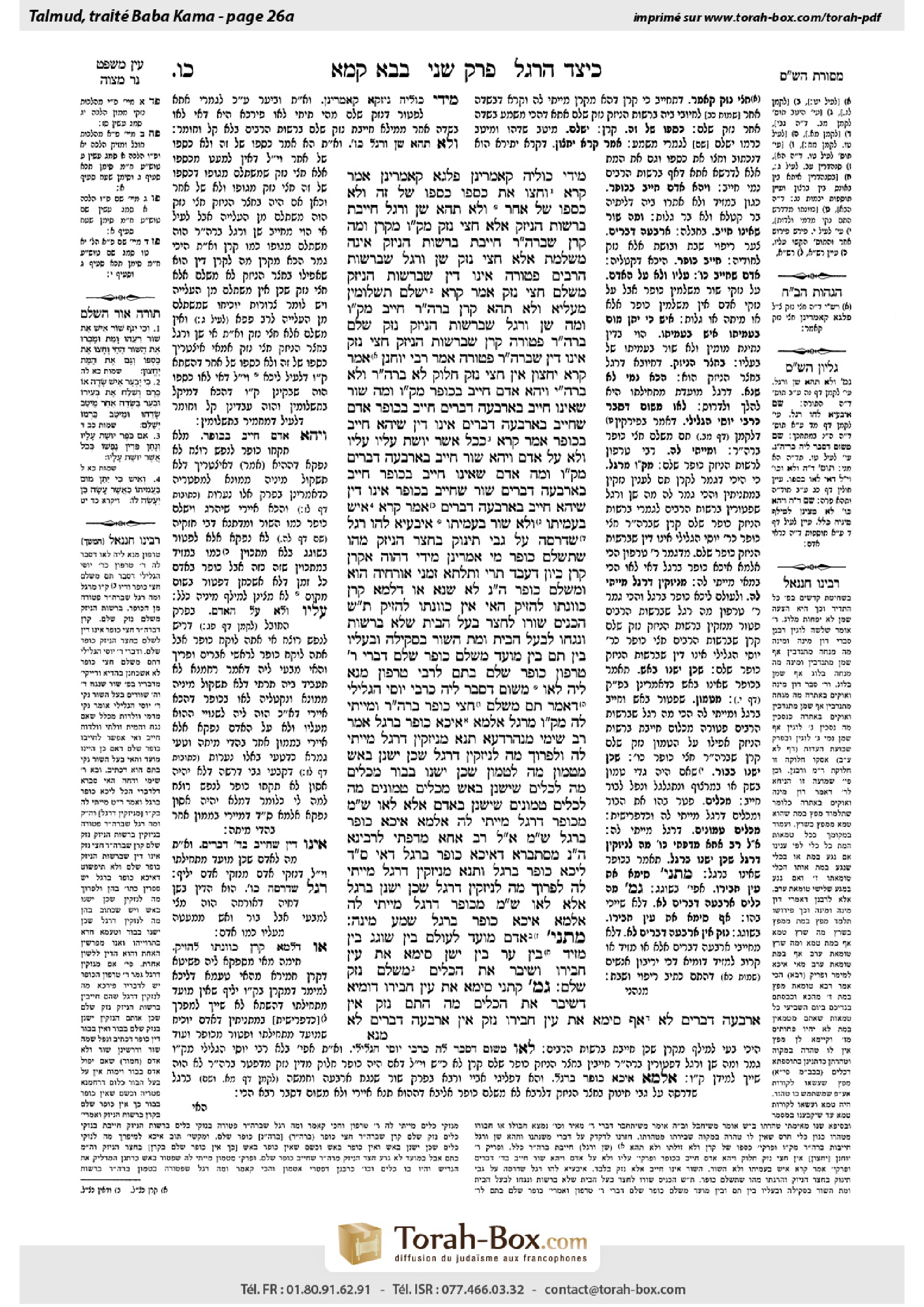
Bava Kamma 26a: Talmud study for Daf Yomi
Study the Talmud for Daf Yomi with scanned pages, Hebrew text, English translations from Sefaria and AI-generated French translations.
Passage selection and English or AI-generated French translation are available where the scan has annotations. Daf Study is independent of Torah-Box and Sefaria.
Browse Bava Kamma · בבא קמא · All tractatesBava Kamma 26a text and translations
This page of Bava Kamma includes the Aramaic text, an English translation and an AI-generated French translation, alongside the scan above.
בבא קמא כ״ו א · Aramaic and Hebrew text
מִידֵּי כּוּלֵּיהּ קָאָמְרִינַן?! פַּלְגָא קָאָמְרִינַן!
אָמַר קְרָא: ״וְחָצוּ אֶת כַּסְפּוֹ״ – כַּסְפּוֹ שֶׁל זֶה, וְלֹא כַּסְפּוֹ שֶׁל אַחֵר.
וְלֹא תְּהֵא שֵׁן וָרֶגֶל חַיֶּיבֶת בִּרְשׁוּת הַנִּיזָּק אֶלָּא חֲצִי נֶזֶק – מִקַּל וָחוֹמֶר מִקֶּרֶן; וּמָה קֶרֶן, שֶׁבִּרְשׁוּת הָרַבִּים חַיֶּיבֶת – בִּרְשׁוּת הַנִּיזָּק אֵינָהּ מְשַׁלֶּמֶת אֶלָּא חֲצִי נֶזֶק; שֵׁן וָרֶגֶל, שֶׁבִּרְשׁוּת הָרַבִּים פְּטוּרָה – אֵינוֹ דִּין שֶׁבִּרְשׁוּת הַנִּיזָּק מְשַׁלֵּם חֲצִי נֶזֶק?
אָמַר קְרָא: ״יְשַׁלֵּם״ – תַּשְׁלוּמִין מְעַלְּיָא.
וְלֹא תְּהֵא קֶרֶן בִּרְשׁוּת הָרַבִּים חַיָּיב – מִקַּל וָחוֹמֶר; וּמָה שֵׁן וָרֶגֶל, שֶׁבִּרְשׁוּת הַנִּיזָּק נֶזֶק שָׁלֵם – בִּרְשׁוּת הָרַבִּים פְּטוּרָה; קֶרֶן, שֶׁבִּרְשׁוּת הַנִּיזָּק חֲצִי נֶזֶק – אֵינוֹ דִּין שֶׁבִּרְשׁוּת הָרַבִּים פְּטוּרָה?
אָמַר רַבִּי יוֹחָנָן, אָמַר קְרָא: ״יֶחֱצוּן״ – אֵין חֲצִי נֶזֶק חָלוּק לֹא בִּרְשׁוּת הָרַבִּים וְלֹא בִּרְשׁוּת הַיָּחִיד.
וִיהֵא אָדָם חַיָּיב בְּכוֹפֶר – מִקַּל וָחוֹמֶר; וּמָה שׁוֹר, שֶׁאֵינוֹ חַיָּיב בְּאַרְבָּעָה דְּבָרִים – חַיָּיב בְּכוֹפֶר; אָדָם, שֶׁחַיָּיב בְּאַרְבָּעָה דְּבָרִים – אֵינוֹ דִּין שֶׁיְּהֵא חַיָּיב בְּכוֹפֶר?
אָמַר קְרָא: ״כְּכֹל אֲשֶׁר יוּשַׁת עָלָיו״; ״עָלָיו״ – וְלֹא עַל אָדָם.
וִיהֵא שׁוֹר חַיָּיב בְּאַרְבָּעָה דְּבָרִים – מִקַּל וְחוֹמֶר; וּמָה אָדָם, שֶׁאֵינוֹ חַיָּיב בְּכוֹפֶר – חַיָּיב בְּאַרְבָּעָה דְּבָרִים; שׁוֹר, שֶׁחַיָּיב בְּכוֹפֶר – אֵינוֹ דִּין שֶׁיְּהֵא חַיָּיב בְּאַרְבָּעָה דְּבָרִים?
אָמַר קְרָא: ״אִישׁ בַּעֲמִיתוֹ״ – וְלֹא שׁוֹר בַּעֲמִיתוֹ.
אִיבַּעְיָא לְהוּ: רֶגֶל שֶׁדָּרְסָה עַל גַּבֵּי תִּינוֹק בַּחֲצַר הַנִּיזָּק, מַהוּ שֶׁתְּשַׁלֵּם כּוֹפֶר? מִי אָמְרִינַן: מִידֵּי דְּהָוֵה אַקֶּרֶן – קֶרֶן, כֵּיוָן דַּעֲבַד תְּרֵי וּתְלָתָא זִמְנֵי – אוֹרְחֵיהּ הוּא, וּמְשַׁלֵּם כּוֹפֶר; הָכָא נָמֵי לָא שְׁנָא;
אוֹ דִלְמָא, קֶרֶן כַּוּוֹנָתוֹ לְהַזִּיק, הַאי אֵין כַּוּוֹנָתוֹ לְהַזִּיק?
תָּא שְׁמַע: הִכְנִיס שׁוֹרוֹ לַחֲצַר בַּעַל הַבַּיִת שֶׁלֹּא בִּרְשׁוּת, וּנְגָחוֹ לְבַעַל הַבַּיִת וָמֵת; הַשּׁוֹר – בִּסְקִילָה, וּבְעָלָיו – בֵּין תָּם בֵּין מוּעָד, מְשַׁלֵּם כּוֹפֶר שָׁלֵם; דִּבְרֵי רַבִּי טַרְפוֹן.
כּוֹפֶר שָׁלֵם בְּתָם, לְרַבִּי טַרְפוֹן – מְנָא לֵיהּ? לָאו מִשּׁוּם דְּסָבַר לֵיהּ כְּרַבִּי יוֹסֵי הַגְּלִילִי, דְּאָמַר: תָּם מְשַׁלֵּם חֲצִי כוֹפֶר בִּרְשׁוּת הָרַבִּים – וּמַיְיתֵי לַהּ מִקַּל וָחוֹמֶר מֵרֶגֶל? אַלְמָא אִיכָּא כּוֹפֶר בְּרֶגֶל!
אָמַר רַב שִׁימִי מִנְּהַרְדְּעָא: תַּנָּא – מִנְּזָקִין דְּרֶגֶל מַיְיתֵי לַהּ.
וְלִפְרוֹךְ: מָה לִנְזָקִין דְּרֶגֶל – שֶׁכֵּן יֶשְׁנָן בְּאֵשׁ! מִטָּמוּן.
מָה לְטָמוּן – שֶׁכֵּן יֶשְׁנוֹ בְּבוֹר! מִכֵּלִים.
מָה לְכֵלִים – שֶׁיֶּשְׁנָן בְּאֵשׁ! מִכֵּלִים טְמוּנִים. מָה לְכֵלִים טְמוּנִים – שֶׁיֶּשְׁנָן בְּאָדָם!
אֶלָּא לָאו שְׁמַע מִינַּהּ מִכּוֹפֶר דְּרֶגֶל מַיְיתֵי לַהּ? אַלְמָא אִיכָּא כּוֹפֶר בְּרֶגֶל! שְׁמַע מִינַּהּ.
אֲמַר לֵיהּ רַב אַחָא מִדִּפְתִּי לְרָבִינָא: הָכִי נָמֵי מִסְתַּבְּרָא – דְּאִיכָּא כּוֹפֶר בְּרֶגֶל; דְּאִי סָלְקָא דַעְתָּךְ לֵיכָּא כּוֹפֶר בְּרֶגֶל – וְתַנָּא מִנְּזָקִין דְּרֶגֶל מַיְיתֵי לַהּ, לִפְרוֹךְ: מָה לִנְזָקִין דְּרֶגֶל – שֶׁכֵּן יֶשְׁנָן בְּרֶגֶל!
אֶלָּא לָאו שְׁמַע מִינַּהּ מִכּוֹפֶר דְּרֶגֶל מַיְיתֵי לַהּ? אַלְמָא אִיכָּא כּוֹפֶר בְּרֶגֶל! שְׁמַע מִינַּהּ.
מַתְנִי׳ אָדָם מוּעָד לְעוֹלָם – בֵּין שׁוֹגֵג בֵּין מֵזִיד, בֵּין עֵר בֵּין יָשֵׁן. סִימֵּא אֶת עֵין חֲבֵירוֹ וְשִׁיבֵּר אֶת הַכֵּלִים – מְשַׁלֵּם נֶזֶק שָׁלֵם.
גְּמָ׳ קָתָנֵי ״סִימֵּא אֶת עֵין חֲבֵירוֹ״ דּוּמְיָא דְּ״שִׁיבֵּר אֶת הַכֵּלִים״; מָה הָתָם – נֶזֶק אִין, אַרְבָּעָה דְּבָרִים לָא; אַף סִימֵּא אֶת עֵין חֲבֵירוֹ – נֶזֶק אִין, אַרְבָּעָה דְּבָרִים לָא.
Bava Kamma 26a · English translation
The Gemara asks: Are we saying that based on the a fortiori inference one should have to pay the full cost of the damage caused in the public domain for Eating and Trampling? That would be false, as the verse indicating one’s liability to pay the full cost of the damage limits the application to damage caused in “the field of another.” We are saying only that he should be liable for half the cost of the damage there, just as with regard to Goring.
The Gemara rejects this as well: This is also incorrect, as the verse states with regard to the payment of half the damages: “And divide its monetary value” (Exodus 21:35). The use of the expression “its monetary value,” and not “the monetary value,” emphasizes that it is specifically the price of this ox that caused damage classified as Goring whose money will be divided, i.e., the owner of the ox will be obligated to pay half the cost of the damage, but not the price of another, i.e., not in other cases of damage caused by one’s ox.
The Gemara suggests a derivation from a different inference: And let one be held liable to pay only half the cost of the damage caused by Eating and Trampling even if the incident took place on the property of the injured party. This can be inferred via an a fortiori inference drawn from Goring, as follows: And if for damage classified as Goring, which is governed by a stricter halakha, as one is held liable for damage classified as Goring even if it occurs in the public domain, yet one nevertheless pays only half the cost of the damage caused on the property of the injured party, then with regard to damage classified as Eating and Trampling, which are governed by more lenient halakhot, as one is completely exempt from liability for damage caused in the public domain, is it not right that he should have to pay only half the cost of the damage caused on the property of the injured party?
The Gemara answers: The verse states with regard to Eating and Trampling: “The best of his field and the best of his vineyard he shall pay” (Exodus 22:4). The intent of the verse is to emphasize that the owner of the ox pays a proper, meaning complete, amount of payment, and not half the cost of the damage.
The Gemara suggests a derivation from a different inference: And let one not be held liable at all with regard to damage classified as Goring in the public domain. This can be inferred via an a fortiori inference, as follows: And if for damage classified as Eating and Trampling, for which one is liable to pay the full cost of the damage for incidents that took place on the property of the injured party, one is completely exempt for damage caused in the public domain, then with regard to damage classified as Goring, which is governed by a more lenient halakha, as one is held liable for only half the cost of the damage caused on the property of the injured party, is it not right that one should be exempt in the public domain?
Rabbi Yoḥanan said: The verse states in reference to an innocuous ox: “And the carcass they shall also divide” (Exodus 21:35), to indicate that there is no difference with regard to the payment of half the cost of the damage, whether the damage occurs in a public domain or whether it occurs on private property.
The Gemara suggests a derivation from a different inference: And let a person who inadvertently kills another be liable to pay ransom. This can be inferred via an a fortiori inference, as follows: And if the owner of an ox, who is not liable to pay the four types of indemnity, i.e., pain, medical costs, loss of livelihood, and humiliation, if his ox injures a person, is nevertheless liable to pay ransom if it killed someone, then with regard to a person, who is liable to pay the four types of indemnity if he injures another, is it not right that he should be liable to pay ransom if he were to kill him?
The Gemara answers: The verse states with regard to an ox killing a person: “He shall give for the redemption of his life whatever is imposed upon him” (Exodus 21:30). “Upon him”: This means upon the owner of an ox who kills a person, but not upon a person who kills another.
The Gemara suggests the reverse derivation: And let the owner of an ox that injured a person be liable to pay the four types of indemnity. This can be inferred via an a fortiori inference, as follows: And if a person, who is not obligated to pay ransom if he kills someone, is nevertheless liable to pay four types of indemnity if he injures another, then with regard to the owner of an ox, who is liable to pay ransom, is it not right that he should also be liable to pay the four types of indemnity?
The Gemara answers: The verse states with regard to this matter: “And if a man maims another” (Leviticus 24:19), from which it can be derived that this halakha applies when a man harms another person but not when an ox harms another person.
§ A dilemma was raised before the Sages: With regard to Trampling, in the case of an animal that tramples a child in the courtyard of the injured party and kills the child, what is the halakha with regard to the liability of the owner of the animal to pay ransom? The Gemara explains the different sides of the question: Do we say that this halakha is just as it is with regard to Goring? Accordingly, just as with regard to Goring, once an animal has gored two or three times this becomes defined as its usual manner and therefore it is deemed forewarned and the owner must pay ransom in the event that it kills a person by an act classified as Goring, here too it is not different, as with regard to the category of Trampling the owner is deemed forewarned from the start and he must therefore pay ransom.
Or perhaps, should we say that the halakha with regard to Goring is more stringent, as Goring requires the animal’s intent to cause damage, and that is why the owner must pay ransom in the event of a death; but in a case of Trampling, where there is no intent to cause damage, the owner would be exempt from paying ransom?
The Gemara suggests: Come and hear a solution to this dilemma from a baraita: If one brought his ox into the courtyard of a homeowner without his permission, and it gored the homeowner and he died, the ox is killed by stoning and the owner of the ox is obligated to pay the full amount of the ransom, regardless of whether the animal was innocuous or forewarned. This is the statement of Rabbi Tarfon.
The Gemara proceeds to clarify: From where does Rabbi Tarfon derive that with regard to an innocuous ox the owner must also pay the full amount of the ransom? Is it not because he holds in accordance with the opinion of Rabbi Yosei HaGelili, who says that the owner of an innocuous ox that killed a person pays half the ransom if the incident took place in the public domain? And he derived this ruling via an a fortiori inference from the halakhot of Trampling: And if in a case of Trampling, for which one is exempted entirely from liability when it occurs in the public domain, one must nevertheless pay the full ransom if the incident took place on the property of the injured party, with regard to Goring, for which one must pay half the ransom when it occurs in the public domain, is it not right that one should be obligated to pay full ransom for an incident that took place on the property of the injured party? Evidently, it is clear that there is a ransom payment in the case of Trampling.
Rav Shimi of Neharde’a said: It is possible to explain that the tanna derived his a fortiori inference from damage caused by Trampling: And if in a case of Trampling, for which one is completely exempt from liability when it happens in the public domain, one pays the full cost of the damage done on the property of the injured party, with regard to Goring, for which one must pay half the ransom payment if the ox kills a person in the public domain, is it not right that one would certainly be obligated to pay the full ransom if the person was killed on his own property? According to this reasoning there is no indication that one pays a ransom payment in the case of a child that was killed by Trampling.
The Gemara asks: But if this is the basis for Rabbi Tarfon’s opinion, let the Gemara refute it in this way: What can be learned about ransom from damage caused by Trampling? These same halakhot apply to Fire; nevertheless, there is no obligation to pay ransom when a person is killed by Fire, as was stated explicitly in a baraita above (10a). Consequently, the attempt to derive an a fortiori inference about ransom from Trampling is obviously flawed. The Gemara answers: The a fortiori inference can be based on the damage to concealed articles caused by Trampling on the property of the injured party. One would be exempt for damage such as this if it were caused by Fire.
The Gemara responds to this challenge with a different one: What is notable about damage to concealed articles caused by Trampling? It is notable in that these same halakhot apply to the category of Pit, but nevertheless there is no ransom paid if a person is killed by a pit. Consequently, an attempt to derive an a fortiori inference about ransom from this halakha is obviously flawed. The Gemara answers: The a fortiori inference can be based on damage caused to vessels by Trampling on the property of the injured party. One would be exempt for damage of this nature if it were caused by a pit.
The Gemara rejects this as well: What is notable about damage caused to vessels by Trampling? It is notable in that these same halakhot apply to the category of Fire. The Gemara answers: The a fortiori inference can be based on damage caused to concealed vessels by Trampling. In this case, one would be liable for Trampling but exempt from liability for both Fire and Pit, so this can be the basis for the ransom payment, via the a fortiori inference stated by Rav Shimi of Neharde’a. The Gemara rejects this as well: What is notable about damage caused to concealed vessels by Trampling? It is notable in that these same halakhot apply to the category of Man, as a person is liable for damage to these items but does not pay ransom if he inadvertently kills another person.
Rather, isn’t it correct to conclude from it that since the halakhot of the ransom payment with regard to Goring cannot be deduced from the halakhot of damages with regard to Trampling, the tanna derived his a fortiori inference based on the halakhot of ransom in a case of Trampling, and therefore it may be concluded that apparently there is ransom in a case of Trampling? The Gemara affirms: Conclude from it that this is so. Consequently, in the case of a child trampled to death by Trampling while on his parents’ property, the owner of the animal must pay ransom.
Rav Aḥa of Difti said to Ravina: So too, it is reasonable to say that there is an obligation to pay ransom in a case of Trampling, as, if it enters your mind to say that there is no obligation to pay ransom in a case of Trampling, and the tanna derived his a fortiori inference from damage caused by Trampling, let the Gemara refute it in this way: What is notable about damage caused by Trampling? It is notable in that these same halakhot apply to Trampling, while there is no obligation to pay ransom in a case of Trampling. In other words, it would be possible to derive the obligation to pay a full ransom where a person was killed by the Goring of an innocuous ox while on the property of the victim only if there is also an obligation to pay ransom where the person was killed by Trampling.
Rather, isn’t it correct to conclude from it that an a fortiori inference must be based on the obligation to pay ransom in a case of Trampling, and therefore it may be concluded that evidently, there is an obligation to pay ransom in a case of Trampling? The Gemara affirms: Conclude from it that this is so.
MISHNA: The legal status of a person is always that of one forewarned. Therefore, whether the damage was unintentional or intentional, whether he was awake while he caused the damage or asleep, whether he blinded another’s eye or broke vessels, he must pay the full cost of the damage.
GEMARA: The Gemara infers: It teaches in the mishna: He blinded another’s eye, and presumably this is similar to the other example: Broke vessels. From this it can be inferred that just as there, in the case of the broken vessels, yes, one must pay for the damage he caused but he does not pay the four types of indemnity, so too, in a case where he blinds another, yes, he must pay for the damage he caused, but he does not pay the four types of indemnity, since he caused the injury while asleep or unintentionally.
Bava Kamma 26a · Traduction française (IA)
La Guemara pose la question : Disons-nous que, selon l'inférence a fortiori, on devrait avoir à payer le coût complet des dommages causés dans le domaine public pour l'acte de manger et de piétiner ? Cela serait faux, car la versette indiquant la responsabilité de payer le coût complet des dommages limite l'application aux dommages causés dans « le champ d'autrui ». Nous disons seulement qu'il devrait être responsable de la moitié du coût des dommages là, tout comme dans le cas de l'attaque.
La Guemara rejette cela également : cela est également faux, car la versette stipule concernant le paiement de la moitié des dommages : « Et il partagera sa valeur monétaire » (Exode 21:35). L'expression « sa valeur monétaire », et non « la valeur monétaire », souligne que c'est spécifiquement le prix de cet bœuf qui a causé des dommages classés comme attaque, dont l'argent sera partagé, c'est-à-dire que l'propriétaire du bœuf sera tenu de payer la moitié du coût des dommages, mais pas le prix d'un autre, c'est-à-dire pas dans d'autres cas de dommages causés par son bœuf.
La Guemara suggère une dérivation d'une autre inférence : Et qu'on soit tenu responsable de payer seulement la moitié du coût des dommages causés par l'acte de manger et de piétiner même si l'incident s'est produit sur la propriété de la personne blessée. Cela peut être inféré via une inférence a fortiori tirée de l'attaque, comme suit : Et si pour les dommages classés comme attaque, qui sont régis par une halakha plus stricte, comme on est tenu responsable des dommages classés comme attaque même s'ils se produisent dans le domaine public, tout en payant seulement la moitié du coût des dommages causés sur la propriété de la personne blessée, alors concernant les dommages classés comme manger et piétiner, qui sont régis par des halakhot plus lenientes, comme on est totalement exempt de responsabilité pour les dommages causés dans le domaine public, n'est-il pas juste qu'il doive payer seulement la moitié du coût des dommages causés sur la propriété de la personne blessée ?
La Guemara répond : La versette stipule concernant l'alimentation et la piétinement : « Il paiera la meilleure de son champ et la meilleure de son vignoble » (Exode 22:4). L'intention de la versette est de souligner que l'propriétaire du bœuf paie une somme appropriée, c'est-à-dire complète, et non la moitié du coût des dommages.
La Guemara suggère une dérivation d'une autre inférence : Et qu'on ne soit pas tenu responsable du tout concernant les dommages classés comme attaque dans le domaine public. Cela peut être inféré via une inférence a fortiori, comme suit : Et si pour les dommages classés comme alimentation et piétinement, pour lesquels on est tenu de payer le coût complet des dommages pour les incidents survenus sur la propriété de la personne blessée, on est totalement exempt pour les dommages causés dans le domaine public, alors concernant les dommages classés comme attaque, qui sont régis par une halakha plus leniente, comme on est tenu responsable de la moitié du coût des dommages causés sur la propriété de la personne blessée, n'est-il pas juste qu'on soit exempt dans le domaine public ?
Rabbi Yoḥanan a dit : La versette stipule concernant un bœuf inoffensif : « Et ils partageront aussi son cadavre » (Exode 21:35), pour indiquer qu'il n'y a pas de différence concernant le paiement de la moitié du coût des dommages, que le dommage se produise dans un domaine public ou sur une propriété privée.
La Guemara suggère une dérivation d'une autre inférence : Et qu'une personne qui tue accidentellement une autre doive payer une rançon. Cela peut être inféré via une inférence a fortiori, comme suit : Et si l'propriétaire d'un bœuf, qui n'est pas tenu de payer les quatre types de réparation, c'est-à-dire la douleur, les frais médicaux, la perte de revenu et l'humiliation, si son bœuf blesse une personne, est toutefois tenu de payer une rançon si ce dernier a tué quelqu'un, alors concernant une personne, qui est tenu de payer les quatre types de réparation si elle blesse une autre, n'est-il pas juste qu'il doive payer une rançon s'il tue quelqu'un ?
La Guemara répond : La versette stipule concernant un bœuf qui tue une personne : « Il donnera pour la rançon de sa vie ce qui est imposé sur lui » (Exode 21:30). « Sur lui » : Cela signifie sur l'propriétaire d'un bœuf qui tue une personne, mais pas sur une personne qui tue une autre.
La Guemara suggère la dérivation inverse : Et que l'propriétaire d'un bœuf qui a blessé une personne doive payer les quatre types de réparation. Cela peut être inféré via une inférence a fortiori, comme suit : Et si une personne, qui n'est pas obligée de payer une rançon s'il tue quelqu'un, est toutefois tenu de payer les quatre types de réparation s'il blesse une autre personne, alors concernant l'propriétaire d'un bœuf, qui est tenu de payer une rançon, n'est-il pas juste qu'il doive également payer les quatre types de réparation ?
La Guemara répond : La versette stipule concernant cette affaire : « Et si un homme blesse un autre » (Lévitique 24:19), d'où on peut déduire que cette halakha s'applique lorsque l'homme blesse une autre personne, mais pas lorsque le bœuf blesse une autre personne.
§ Un dilemme a été soulevé devant les Sages : Concernant le piétinement, dans le cas d'un animal qui piétine un enfant dans la cour de la personne blessée et le tue, quelle est la halakha concernant la responsabilité de l'propriétaire de l'animal de payer une rançon ? La Guemara explique les deux côtés de la question : Disons-nous que cette halakha est la même que celle concernant l'attaque ? Ainsi, comme avec l'attaque, une fois qu'un animal a attaqué deux ou trois fois, cela est considéré comme sa manière habituelle et donc il est considéré comme averti, et l'propriétaire doit payer une rançon en cas de mort causée par un acte classé comme attaque, ici aussi il n'y a pas de différence, car concernant la catégorie du piétinement, l'propriétaire est considéré comme averti dès le départ et doit donc payer une rançon.
Ou peut-être, devons-nous dire que la halakha concernant l'attaque est plus stricte, car l'attaque exige l'intention de causer des dommages, et c'est pourquoi l'propriétaire doit payer une rançon en cas de mort ; mais dans le cas du piétinement, où il n'y a pas d'intention de causer des dommages, l'propriétaire serait exempt de payer une rançon ?
La Guemara suggère : Viens écouter une solution à ce dilemme tirée d'une baraïta : Si une personne amène son bœuf dans la cour d'un propriétaire sans son autorisation, et que ce bœuf tue le propriétaire et que ce dernier meurt, le bœuf est tué par la pierre et le propriétaire du bœuf est tenu de payer le montant plein de la rançon, indépendamment de ce que l'animal soit innocent ou avertis. C'est la déclaration du Rabbi Tarphon.
La Guemara poursuit en clarifiant : D'où le Rabbi Tarphon tire-t-il que, dans le cas d'un bœuf innocent, le propriétaire doit également payer la totalité de la rançon ? N'est-ce pas parce qu'il suit l'opinion du Rabbi Yosei HaGelili, qui dit que le propriétaire d'un bœuf innocent qui a tué une personne paie la moitié de la rançon si l'incident s'est produit dans le domaine public ? Et il a tiré cette décision d'une déduction a fortiori à partir des halakhot du piétinement : Et si, dans le cas de piétinement, on est entièrement exempt de responsabilité lorsqu'il s'agit d'un incident survenu dans le domaine public, on doit néanmoins payer la totalité de la rançon si l'incident s'est produit sur la propriété de la victime, avec regard au cas de mordue, pour lequel on doit payer la moitié de la rançon lorsqu'il s'agit d'une mort survenue dans le domaine public, n'est-ce pas raisonnable de dire qu'on doit être tenu de payer la totalité de la rançon dans le cas d'un incident survenu sur la propriété de la victime ? Évidemment, il est clair qu'il y a un paiement de rançon dans le cas de piétinement.
Rav Shimi de Neharde’a dit : Il est possible d'expliquer que le tanna a tiré sa déduction a fortiori à partir des dommages causés par le piétinement : Et si, dans le cas de piétinement, on est entièrement exempt de responsabilité lorsqu'il s'agit d'un incident survenu dans le domaine public, on paie la totalité du coût des dommages causés sur la propriété de la victime, avec regard au cas de mordue, pour lequel on doit payer la moitié de la rançon si un bœuf tue une personne dans le domaine public, n'est-ce pas raisonnable de dire qu'on doit certainement être tenu de payer la totalité de la rançon si la personne est morte sur sa propre propriété ? Selon cette déduction, il n'y a pas d'indication que l'on paie une rançon dans le cas d'un enfant tué par piétinement.
La Guemara pose la question : Mais si c'est la base de l'opinion du Rabbi Tarphon, la Guemara doit la réfuter ainsi : Quel peut-on apprendre sur la rançon à partir des dommages causés par le piétinement ? Ces mêmes halakhot s'appliquent au feu ; néanmoins, il n'y a pas d'obligation de payer la rançon lorsqu'une personne est tuée par le feu, comme cela a été dit explicitement dans une baraïta ci-dessus (10a). Ainsi, l'effort de tirer une déduction a fortiori sur la rançon à partir du piétinement est clairement erroné. La Guemara répond : La déduction a fortiori peut être basée sur les dommages causés à des objets cachés par le piétinement sur la propriété de la victime. On serait exempt de responsabilité pour ce genre de dommages si ce dernier était causé par le feu.
La Guemara répond à ce défi avec un autre : Qu'est-ce qui est notable sur les dommages causés à des objets cachés par le piétinement ? C'est notable dans le fait que ces mêmes halakhot s'appliquent à la catégorie du trou, mais néanmoins, il n'y a pas de rançon payée si une personne est tuée par un trou. Ainsi, l'effort de tirer une déduction a fortiori sur la rançon à partir de cette halakha est clairement erroné. La Guemara répond : La déduction a fortiori peut être basée sur les dommages causés aux objets par le piétinement sur la propriété de la victime. On serait exempt de responsabilité pour ce genre de dommages si ce dernier était causé par un trou.
La Guemara rejette cela également : Qu'est-ce qui est notable sur les dommages causés aux objets par le piétinement ? C'est notable dans le fait que ces mêmes halakhot s'appliquent à la catégorie du feu. La Guemara répond : La déduction a fortiori peut être basée sur les dommages causés aux objets cachés par le piétinement. Dans ce cas, on serait tenu de responsabilité pour le piétinement mais exempt de responsabilité pour le feu et le trou, donc cela peut être la base pour le paiement de rançon, via la déduction a fortiori énoncée par Rav Shimi de Neharde’a. La Guemara rejette cela également : Qu'est-ce qui est notable sur les dommages causés aux objets cachés par le piétinement ? C'est notable dans le fait que ces mêmes halakhot s'appliquent à la catégorie de l'homme, comme une personne est tenu de responsabilité pour les dommages causés à ces objets mais ne paie pas de rançon si elle tue accidentellement une autre personne.
Plutôt, n'est-ce pas correct de conclure de cela que puisque les halakhot du paiement de rançon concernant la mordue ne peuvent pas être déduites des halakhot des dommages concernant le piétinement, le tanna a tiré sa déduction a fortiori à partir des halakhot du paiement de rançon dans le cas de piétinement, et donc on peut conclure que visiblement il y a un paiement de rançon dans le cas de piétinement ? La Guemara confirme : Conclure de cela que c'est ainsi. Ainsi, dans le cas d'un enfant tué par piétinement sur la propriété de ses parents, le propriétaire de l'animal doit payer la rançon.
Rav Acha de Difti dit à Ravina : De même, il est raisonnable de dire qu'il y a une obligation de payer la rançon dans le cas de piétinement, car, si cela entre dans votre esprit de dire qu'il n'y a pas d'obligation de payer la rançon dans le cas de piétinement, et que le tanna a tiré sa déduction a fortiori à partir des dommages causés par le piétinement, la Guemara doit le réfuter ainsi : Qu'est-ce qui est notable sur les dommages causés par le piétinement ? C'est notable dans le fait que ces mêmes halakhot s'appliquent au piétinement, tandis qu'il n'y a pas d'obligation de payer la rançon dans le cas de piétinement. En d'autres termes, il serait possible de déduire l'obligation de payer une rançon pleine dans le cas où une personne est tuée par la mordue d'un bœuf innocent sur la propriété de la victime uniquement si il y a aussi une obligation de payer la rançon dans le cas où la personne est tuée par piétinement.
Plutôt, n'est-ce pas correct de conclure de cela que la déduction a fortiori doit être basée sur l'obligation de payer la rançon dans le cas de piétinement, et donc on peut conclure que visiblement, il y a une obligation de payer la rançon dans le cas de piétinement ? La Guemara confirme : Conclure de cela que c'est ainsi.
MICHNA : Le statut juridique d'une personne est toujours celui d'une personne avertisse. Ainsi, que le dommage ait été involontaire ou volontaire, que l'individu soit réveillé ou endormi lorsqu'il a causé le dommage, que l'individu ait perdu l'œil de quelqu'un ou que des objets aient été brisés, il doit payer le coût plein du dommage.
GUEMARA : La Guemara déduit que la mitsna enseigne : Il a fait aveugle l’œil d’un autre, et on suppose que cela est semblable à l’autre exemple : Il a brisé des vases. À partir de cela, on peut déduire que tout comme là, dans le cas des vases brisés, oui, on doit payer le préjudice causé, mais on ne paie pas les quatre types d’indemnité, de même, dans le cas où l’on fait aveugle un autre, oui, on doit payer le préjudice causé, mais on ne paie pas les quatre types d’indemnité, car l’injure a été causée pendant le sommeil ou de manière involontaire.
Traduction française générée par IA à partir de l’édition anglaise de Sefaria. Vérifie toujours un passage avec le texte source.
Text from Sefaria: William Davidson Edition - Vocalized Aramaic (CC BY NC); William Davidson Edition - English (CC BY NC).