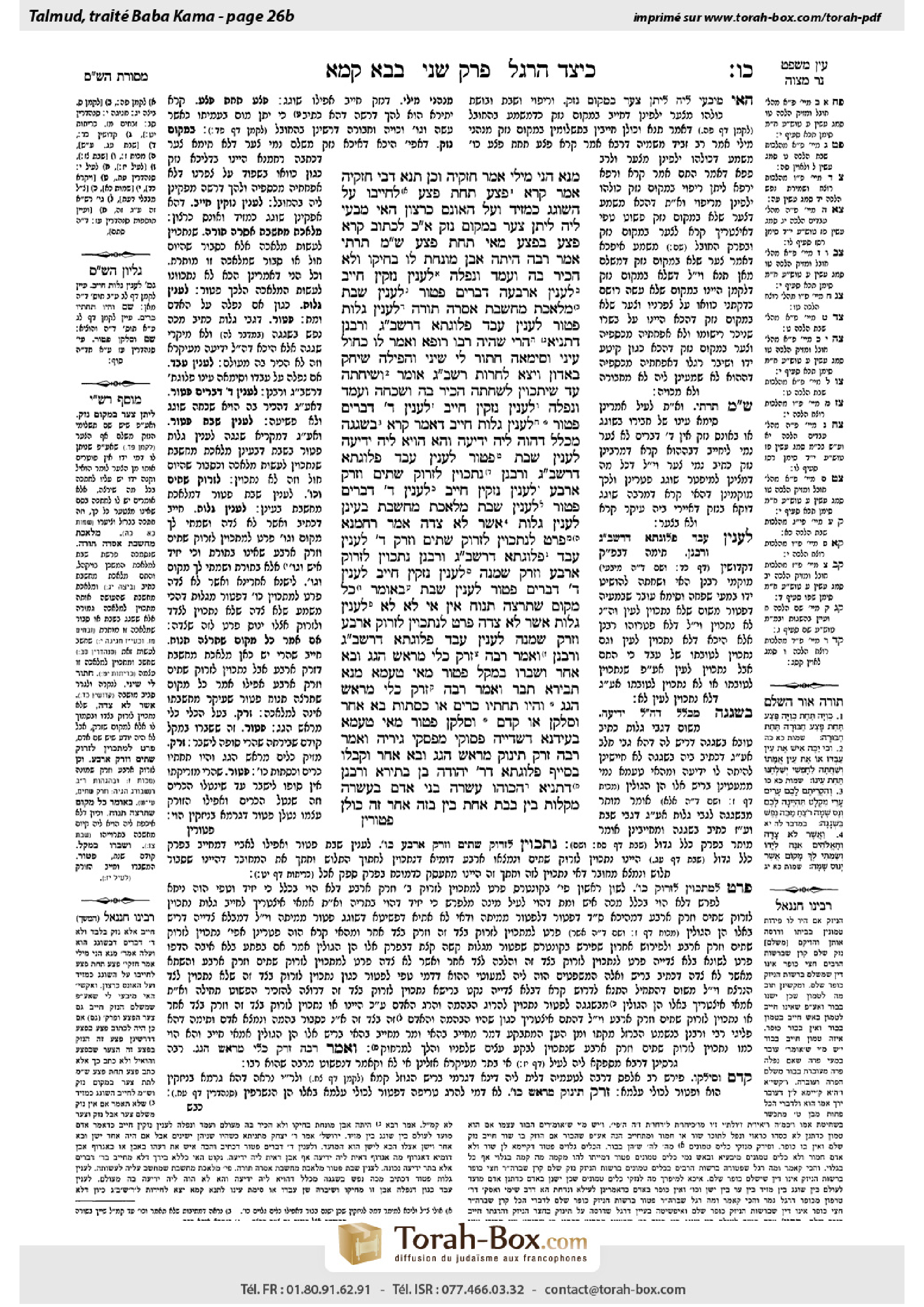
Bava Kamma 26b: Talmud study for Daf Yomi
Study the Talmud for Daf Yomi with scanned pages, Hebrew text, English translations from Sefaria and AI-generated French translations.
Passage selection and English or AI-generated French translation are available where the scan has annotations. Daf Study is independent of Torah-Box and Sefaria.
Browse Bava Kamma · בבא קמא · All tractatesBava Kamma 26b text and translations
This page of Bava Kamma includes the Aramaic text, an English translation and an AI-generated French translation, alongside the scan above.
בבא קמא כ״ו ב · Aramaic and Hebrew text
מְנָא הָנֵי מִילֵּי? אָמַר חִזְקִיָּה, וְכֵן תָּנָא דְּבֵי חִזְקִיָּה, אָמַר קְרָא: ״פֶּצַע תַּחַת פָּצַע״ – לְחַיְּיבוֹ עַל הַשּׁוֹגֵג כְּמֵזִיד, וְעַל הָאוֹנֶס כְּרָצוֹן.
הַאי מִבְּעֵי לֵיהּ לִיתֵּן צַעַר בִּמְקוֹם נֶזֶק! אִם כֵּן, לִכְתּוֹב קְרָא: ״פֶּצַע בְּפָצַע״; מַאי ״תַּחַת פָּצַע״ – שְׁמַע מִינַּהּ תַּרְתֵּי.
אָמַר רַבָּה: הָיְתָה אֶבֶן מוּנַּחַת לוֹ בְּחֵיקוֹ וְלֹא הִכִּיר בָּהּ, וְעָמַד וְנָפְלָה; לְעִנְיַן נְזָקִין – חַיָּיב, לְעִנְיַן אַרְבָּעָה דְּבָרִים – פָּטוּר, לְעִנְיַן שַׁבָּת – מְלֶאכֶת מַחְשֶׁבֶת אָסְרָה תּוֹרָה, לְעִנְיַן גָּלוּת – פָּטוּר,
לְעִנְיַן עֶבֶד – פְּלוּגְתָּא דְּרַבָּן שִׁמְעוֹן בֶּן גַּמְלִיאֵל וְרַבָּנַן. דְּתַנְיָא: הֲרֵי שֶׁהָיָה רַבּוֹ רוֹפֵא, וְאָמַר לוֹ: ״כְּחוֹל עֵינִי״, וְסִימְּאָהּ; ״חֲתוֹר לִי שִׁינִּי״, וְהִפִּילָהּ – שִׂיחֵק בָּאָדוֹן, וְיָצָא לְחֵרוּת.
רַבָּן שִׁמְעוֹן בֶּן גַּמְלִיאֵל אוֹמֵר: ״וְשִׁחֲתָהּ״ – עַד שֶׁיִּתְכַּוֵּין לְשַׁחֲתָהּ.
הִכִּיר בָּהּ וּשְׁכֵחָהּ, וְעָמַד וְנָפְלָה; לְעִנְיַן נְזָקִין – חַיָּיב. לְעִנְיַן אַרְבָּעָה דְּבָרִים – פָּטוּר. לְעִנְיַן גָּלוּת – חַיָּיב, דְּאָמַר קְרָא: ״בִּשְׁגָגָה״ – מִכְּלָל דַּהֲוָה לֵיהּ יְדִיעָה, וְהָא הַוְיָא לֵיהּ יְדִיעָה. לְעִנְיַן שַׁבָּת – פָּטוּר. לְעִנְיַן עֶבֶד – פְּלוּגְתָּא דְּרַבָּן שִׁמְעוֹן בֶּן גַּמְלִיאֵל וְרַבָּנַן.
נִתְכַּוֵּין לִזְרוֹק שְׁתַּיִם, וְזָרַק אַרְבַּע; לְעִנְיַן נְזָקִין – חַיָּיב. לְעִנְיַן אַרְבָּעָה דְּבָרִים – פָּטוּר. לְעִנְיַן שַׁבָּת – מְלֶאכֶת מַחְשֶׁבֶת בָּעֵינַן. לְעִנְיַן גָּלוּת – ״אֲשֶׁר לֹא צָדָה״ אָמַר רַחֲמָנָא, פְּרָט לְנִתְכַּוֵּין לִזְרוֹק שְׁתַּיִם וְזָרַק אַרְבַּע. לְעִנְיַן עֶבֶד – פְּלוּגְתָּא דְּרַבָּן שִׁמְעוֹן בֶּן גַּמְלִיאֵל וְרַבָּנַן.
נִתְכַּוֵּין לִזְרוֹק אַרְבַּע, וְזָרַק שְׁמֹנֶה; לְעִנְיַן נְזָקִין – חַיָּיב. לְעִנְיַן אַרְבָּעָה דְּבָרִים – פָּטוּר. לְעִנְיַן שַׁבָּת – בְּאוֹמֵר ״כׇּל מָקוֹם שֶׁתִּרְצֶה תָּנוּחַ״, אִין; אִי לָא, לָא. לְעִנְיַן גָּלוּת – ״אֲשֶׁר לֹא צָדָה״, פְּרָט לְנִתְכַּוֵּין לִזְרוֹק אַרְבַּע וְזָרַק שְׁמֹנֶה. לְעִנְיַן עֶבֶד – פְּלוּגְתָּא דְּרַבָּן שִׁמְעוֹן בֶּן גַּמְלִיאֵל וְרַבָּנַן.
וְאָמַר רַבָּה: זָרַק כְּלִי מֵרֹאשׁ הַגָּג, וּבָא אַחֵר וּשְׁבָרוֹ בְּמַקֵּל – פָּטוּר. מַאי טַעְמָא? מָנָא תְּבִירָא תָּבַר.
וְאָמַר רַבָּה: זָרַק כְּלִי מֵרֹאשׁ הַגָּג, וְהָיוּ תַּחְתָּיו כָּרִים אוֹ כְסָתוֹת; בָּא אַחֵר וְסִלְּקָן, אוֹ קָדַם [הוּא] וְסִלְּקָן – פָּטוּר. מַאי טַעְמָא? בְּעִידָּנָא דְּשַׁדְיֵיהּ – פַּסּוֹקֵי מְפַסְּקִי גִּירֵיהּ.
וְאָמַר רַבָּה: זָרַק תִּינוֹק מֵרֹאשׁ הַגָּג, וּבָא אַחֵר וְקִבְּלוֹ בְּסַיִיף – פְּלוּגְתָּא דְּרַבִּי יְהוּדָה בֶּן בְּתֵירָא וְרַבָּנַן. דְּתַנְיָא: הִכּוּהוּ עֲשָׂרָה בְּנֵי אָדָם בַּעֲשָׂרָה מַקְלוֹת – בֵּין בְּבַת אַחַת בֵּין בָּזֶה אַחַר זֶה, כּוּלָּן
Bava Kamma 26b · English translation
With regard to the halakha that one must pay the full cost of the damage in a case where there was no intent to cause damage, the Gemara asks: From where are these matters derived? Ḥizkiyya says, and similarly, the school of Ḥizkiyya taught: The verse states: “Wound for wound [petza taḥat patza]” (Exodus 21:25). This phrase is superfluous, as the Torah states elsewhere (see Leviticus 24:19) that one is liable to pay compensation when injuring another. This verse serves to render him liable to pay for the unintentional damage just as he pays for the intentional damage; and he pays for damage caused by accident just as he pays for damage caused willingly.
The Gemara asks: But this verse is necessary in order to indicate that one must pay compensation for pain, even in a case where he pays compensation for damage caused by the injury. Consequently, it seems that that verse cannot also be the source of the principle derived by the school of Ḥizkiyya. The Gemara answers: If it is so that the superfluous phrase is intended to teach only that, then let the verse write: Petza befatza, which carries the same meaning. What, then, is meant by the superfluous word taḥat in the phrase “petza taḥat patza”? It indicates that we must derive two conclusions from it: That one is liable to pay for pain even in a case where he pays compensation for damage, and that he is liable for unintentional damage as he is for intentional damage, and for damage caused by accident as for damage caused willingly.
§ Rabba says: If there was a stone lying in one’s lap and he was unaware of it, and he arose and it fell and caused damage, with regard to damages he is liable to pay the full cost of the damage caused by the stone. With regard to the four types of indemnity, he is exempt. With regard to Shabbat, if the falling stone caused him to violate one of the prohibited categories of labor; for example, if the stone fell from a private domain to the public domain, he is exempt. The reason is that the Torah prohibited only planned, constructive labor on Shabbat, and he did not plan to perform this labor. With regard to exile, the punishment prescribed for one who unintentionally but negligently kills another, were this stone to kill someone he is exempt, as the incident is deemed accidental.
With regard to a Canaanite slave whose tooth was destroyed or eye was blinded by the stone, potentially enabling the slave to earn his freedom (see Exodus 21:26–27), this is the subject of a dispute between Rabban Shimon ben Gamliel and the Rabbis, as it is taught in a baraita (Tosefta 9:25): If the master was a doctor and the slave said to him: Paint the lid of my eye in order to heal it, and the master blinded it during the procedure, or if the slave requested from his master: Scrape my tooth in order to heal it, and the master knocked out the tooth while scraping it, the slave has mocked the master, as he is emancipated due to the act of the master himself.
By contrast, Rabban Shimon ben Gamliel says: The slave is not emancipated in these cases because the verse states: “And destroy it” (Exodus 21:26), from which it is derived that the slave is emancipated only in a case where the master intends to destroy the eye or the tooth, but not if he intended to heal the slave. So too, in the case where a stone fell and accidentally blinded a slave’s eye or knocked out his tooth, according to the Rabbis the slave would be emancipated and according to Rabban Shimon ben Gamliel he would not. All of the above cases relate to situations where the individual did not know the stone was in his lap.
If he was initially aware of it but forgot about it and he arose and it fell, with regard to damages he is certainly liable, being that he is liable even if he was unaware of the stone. With regard to the four types of indemnity, here too he is exempt, as he did not intend to cause injury. With regard to exile he is liable, as the verse states: “One who unwittingly strikes a person mortally” (Numbers 35:11), indicating by inference that the assailant had some previous awareness, and in this case he was in fact previously aware of the stone in his lap. The term “unwittingly” is employed to describe someone who possessed knowledge of the potential transgression then forgot about it. With regard to Shabbat he is exempt, as this was not a planned, constructive labor. With regard to a slave, the same dispute between Rabban Shimon ben Gamliel and the Rabbis applies.
In a case where he intended to throw the stone, and he intended to throw it for a distance of only two cubits but instead he threw it a distance of four cubits, as it went farther than he wanted it to go, with regard to damages he is liable. With regard to the four types of indemnity he is exempt. With regard to Shabbat he is exempt, as we require planned, constructive labor as a condition for liability. With regard to exile he is liable, as the Merciful One states in the Torah: “If a man lie not in wait” (Exodus 21:13), which serves to exclude from the death penalty a situation where one intended to throw the stone for two cubits but he actually threw it for four cubits, as he did not intend to kill, so he is exiled. With regard to a slave, the same dispute between Rabban Shimon ben Gamliel and the Rabbis applies.
And if he intended to throw the stone four cubits but instead he threw it eight cubits, with regard to damages he is liable. With regard to the four types of indemnity he is exempt. With regard to Shabbat, if he said to himself when he threw the stone that he would be satisfied wherever it may land, then yes, he is liable, as he intended to throw it a distance of four cubits, which is the minimum necessary to violate the prohibited labor of carrying in the public domain. If he did not throw the stone aimlessly but rather had selected a target that was four cubits away, then he is not liable as he did not perform the precise planned, constructive labor that he had intended. With regard to exile, the Torah states: “If a man lie not in wait” (Exodus 21:13), which serves to exclude from the death penalty a situation where one intended to throw it four cubits but he actually threw it eight cubits, as he did not intend to kill, so he is exiled. With regard to a slave, the same dispute between Rabban Shimon ben Gamliel and the Rabbis applies.
§ Since the Gemara cited Rabba’s comments about various actions for which the perpetrator is liable with regard to certain matters but exempt with regard to others, the Gemara cites similar rulings: And Rabba says: If one threw a vessel, such as an earthenware jug, from a roof and another came along and broke it with a stick during its descent, the latter is exempt from liability. What is the reason? It is because he broke a broken vessel, meaning that once the vessel was thrown from the roof it was clear that it would be broken upon landing, and therefore it is considered as if it were already broken and the one who broke it while it was still in the air is not liable.
And Rabba says: If one threw a vessel from a roof and there were cushions or blankets below so that if the vessel would land on them it would not break, and then another came and removed the cushions or blankets, or if the individual who threw the vessel went quickly before it landed and removed the cushions or blankets himself, and as a result the vessel shattered, the one who threw the vessel is exempt from liability even though the vessel broke as a consequence of his actions. What is the reason? At the time that he threw the vessel, his arrows were stopped, i.e., what he did at the time he threw the vessel, which is an act comparable to the shooting of an arrow, did not have the capacity to break the vessel. Therefore, he is not viewed as having broken the vessel, and is exempt.
And Rabba says: If one threw a child from a roof and another came along and impaled him on his sword and the child died, the question of who is liable to receive the death penalty for killing the child is dependent upon the dispute between Rabbi Yehuda ben Beteira and the Rabbis. As it is taught in a baraita: If ten people beat a victim with ten sticks, whether they did so simultaneously or sequentially, they are all
Bava Kamma 26b · Traduction française (IA)
Concernant la halakha qui exige que l'on paie le coût complet des dommages dans un cas où il n'y avait pas l'intention de causer des dommages, le Guemara pose la question : D'où sont tirés ces enseignements ? Ḥizkiyya dit, et de même, l'école de Ḥizkiyya enseignait : La Parashah dit : « Blessure pour blessure [petza taḥat patza] » (Exode 21:25). Cette expression est superflue, car la Torah mentionne ailleurs (voir Lévitique 24:19) que l'on est tenu de payer une compensation lorsqu'on blesse un autre. Cette verset sert à rendre responsable de payer pour les dommages accidentels comme pour les dommages intentionnels ; et il paie pour les dommages causés par accident comme pour ceux causés volontairement.
Le Guemara pose la question : Mais ce verset est nécessaire afin d'indiquer que l'on doit payer une compensation pour la douleur, même dans un cas où l'on paie une compensation pour les dommages causés par l'injury. Ainsi, il semble que ce verset ne puisse pas être la source du principe tiré par l'école de Ḥizkiyya. Le Guemara répond : Si c'est ainsi que l'expression superflue est destinée à enseigner seulement cela, alors que la Parashah écrive : Petza befatza, qui a la même signification. Qu'est-ce donc que signifie le mot superflue « taḥat » dans l'expression « petza taḥat patza » ? Elle indique que nous devons tirer deux conclusions d'elle : que l'on est tenu de payer pour la douleur même dans un cas où l'on paie une compensation pour les dommages, et que l'on est tenu pour les dommages accidentels comme pour les dommages intentionnels, et pour les dommages causés par accident comme pour ceux causés volontairement.
§ Rabba dit : Si un caillou était posé dans les plis de son manteau et qu'il ne le savait pas, et qu'il se levait et qu'il tombait causant des dommages, concernant les dommages, il est tenu de payer le coût complet des dommages causés par le caillou. Concernant les quatre types d'indemnité, il est exempt. Concernant le Shabbat, si le caillou a causé qu'il viole l'une des catégories interdites de travail ; par exemple, si le caillou est tombé d'un domaine privé vers un domaine public, il est exempt. La raison est que la Torah interdit seulement le travail planifié et constructif le Shabbat, et il n'avait pas l'intention de faire ce travail. Concernant l'exil, la peine prescrite pour celui qui tue accidentellement mais négligemment un autre, si ce caillou tuait quelqu'un, il serait exempt, car l'incident est considéré comme accidentel.
Concernant un esclave cananéen dont un dents était détruite ou un œil aveuglé par le caillou, potentiellement permettant à l'esclave d'obtenir sa liberté (voir Exode 21:26–27), c'est la matière d'un débat entre Rabban Shimon ben Gamliel et les Rabbins, comme il est enseigné dans une baraïta (Tosefta 9:25) : Si le maître était un médecin et l'esclave lui disait : Peins le bord de mon œil afin de le guérir, et le maître l'avait aveuglé pendant la procédure, ou si l'esclave demandait à son maître : Griffe ma dent afin de le guérir, et le maître avait arraché la dent pendant la procédure, l'esclave a moqué le maître, car il est emancipé en raison de l'acte du maître lui-même.
Par contraste, Rabban Shimon ben Gamliel dit : L'esclave n'est pas emancipé dans ces cas car la Parashah dit : « Et détruis-le » (Exode 21:26), d'où il est tiré que l'esclave est emancipé seulement dans un cas où le maître a l'intention de détruire l'œil ou la dent, mais pas si l'intention était de guérir l'esclave. De même, dans le cas où un caillou est tombé et a accidentellement aveuglé l'œil d'un esclave ou a arraché sa dent, selon les Rabbins l'esclave serait emancipé et selon Rabban Shimon ben Gamliel il ne le serait pas. Tous les cas ci-dessus concernent des situations où la personne ne savait pas que le caillou était dans ses plis.
Si l'individu était initialement conscient de sa présence mais avait oublié et s'est levé et le caillou est tombé, concernant les dommages, il est certainement tenu, car il est tenu même s'il était inconscient du caillou. Concernant les quatre types de réparation, il est exempt, car il n'avait pas l'intention de causer des dommages. Concernant l'exil, il est tenu, car la Parashah dit : « Celui qui frappe accidentellement une personne mortellement » (Nombres 35:11), indiquant par l'inférence que l'agresseur avait une connaissance antérieure, et dans ce cas il était effectivement conscient du caillou dans ses plis. Le terme « accidentellement » est utilisé pour décrire quelqu'un qui avait connaissance du potentiel transgression puis avait oublié. Concernant le Shabbat, il est exempt, car ce n'était pas un travail planifié et constructif. Concernant l'esclave, le même débat entre Rabban Shimon ben Gamliel et les Rabbins s'applique.
Dans un cas où il avait l'intention de lancer le caillou, et il avait l'intention de le lancer à une distance de deux coudées mais il l'a lancé à une distance de quatre coudées, comme il est allé plus loin qu'il ne le voulait, concernant les dommages, il est tenu. Concernant les quatre types de réparation, il est exempt. Concernant le Shabbat, il est exempt, car nous exigeons un travail planifié et constructif comme condition pour la responsabilité. Concernant l'exil, il est tenu, car l'Éternel dit dans la Torah : « Si un homme ne se cache pas » (Exode 21:13), ce qui sert à exclure de la peine de mort un cas où l'on avait l'intention de lancer le caillou à deux coudées mais il est tombé à quatre coudées, car il n'avait pas l'intention de tuer, donc il est exilé. Concernant l'esclave, le même débat entre Rabban Shimon ben Gamliel et les Rabbins s'applique.
Et si l'individu avait l'intention de lancer le caillou à quatre coudées mais il l'a lancé à huit coudées, concernant les dommages, il est tenu. Concernant les quatre types de réparation, il est exempt. Concernant le Shabbat, si il s'était dit lorsqu'il lançait le caillou qu'il serait satisfait là où il atterrirait, alors oui, il est tenu, car il avait l'intention de le lancer à une distance de quatre coudées, qui est la distance minimale nécessaire pour violer le travail interdit de transport dans le domaine public. Si il n'avait pas lancé le caillou à l'aveugle mais avait sélectionné une cible à quatre coudées, alors il n'est pas tenu, car il n'a pas effectué le travail planifié et constructif qu'il avait l'intention de faire. Concernant l'exil, la Torah dit : « Si un homme ne se cache pas » (Exode 21:13), ce qui sert à exclure de la peine de mort un cas où l'on avait l'intention de le lancer à quatre coudées mais il est tombé à huit coudées, car il n'avait pas l'intention de tuer, donc il est exilé. Concernant l'esclave, le même débat entre Rabban Shimon ben Gamliel et les Rabbins s'applique.
§ Puisque la Guemara cite les remarques de Rabba concernant divers actes pour lesquels le coupable est responsable en ce qui concerne certains points mais exempt en ce qui concerne d'autres, la Guemara cite des décisions similaires : Rabba dit : Si l'on jette un récipient, tel qu'un jarre en terre, d'un toit et qu'un autre vient ensuite et le brise avec un bâton pendant sa chute, celui-ci est exempt de responsabilité. Pourquoi ? Parce qu'il a brisé un récipient déjà cassé, c'est-à-dire que dès que le récipient était jeté du toit, on savait qu'il allait être cassé à l'atterrissage, et donc on le considère comme s'il était déjà cassé, et celui qui l'a brisé pendant qu'il était encore en l'air n'est pas responsable.
Et Rabba dit encore : Si l'on jette un récipient d'un toit et qu'il y a des coussins ou des couvertures en dessous de sorte que si le récipient atterrissait dessus, il ne se briserait pas, et qu'un autre vient ensuite et retire les coussins ou les couvertures, ou si la personne qui a jeté le récipient s'en va rapidement avant qu'il n'atterrisse et retire lui-même les coussins ou les couvertures, et que le récipient se brise à cause de cela, celui qui a jeté le récipient est exempt de responsabilité même si le récipient s'est brisé en conséquence de ses actions. Pourquoi ? Au moment où il a jeté le récipient, ses flèches étaient arrêtées, c'est-à-dire que ce qu'il a fait au moment où il a jeté le récipient, qui est un acte comparable à lancer une flèche, n'avait pas la capacité de briser le récipient. Par conséquent, il n'est pas considéré comme ayant brisé le récipient et est exempt.
Et Rabba dit encore : Si l'on jette un enfant d'un toit et qu'un autre vient ensuite et le transperce avec son épée et que l'enfant meurt, la question de savoir qui est responsable de la peine de mort pour avoir tué l'enfant dépend du débat entre Rabbi Yéhouda ben Bétéira et les Rabbins. Comme il est enseigné dans une baraïta : Si dix personnes battent une victime avec dix bâtons, qu'ils le fassent simultanément ou successivement, ils sont tous considérés comme responsables.
Traduction française générée par IA à partir de l’édition anglaise de Sefaria. Vérifie toujours un passage avec le texte source.
Text from Sefaria: William Davidson Edition - Vocalized Aramaic (CC BY NC); William Davidson Edition - English (CC BY NC).