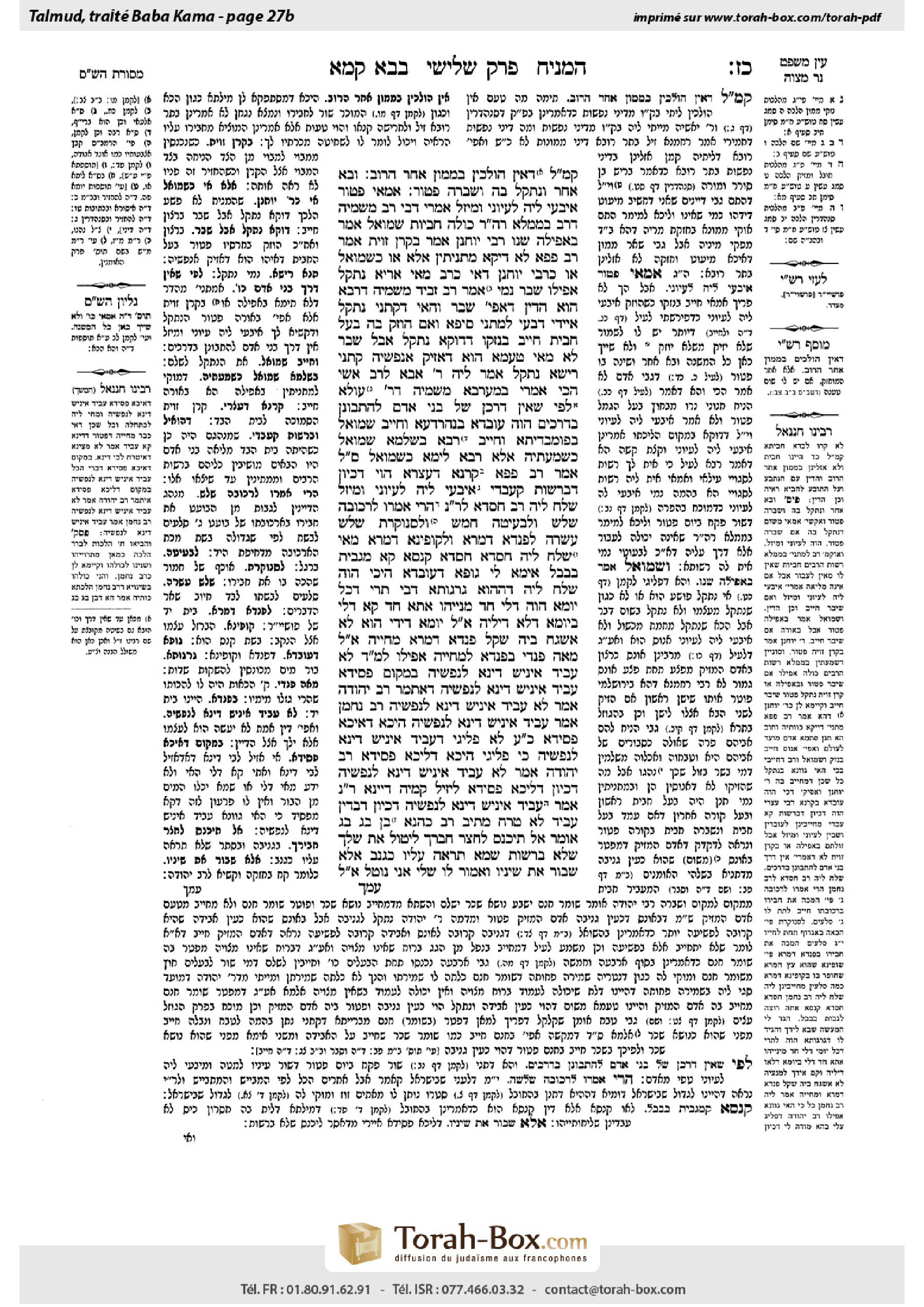
Bava Kamma 27b: Talmud study for Daf Yomi
Study the Talmud for Daf Yomi with scanned pages, Hebrew text, English translations from Sefaria and AI-generated French translations.
Passage selection and English or AI-generated French translation are available where the scan has annotations. Daf Study is independent of Torah-Box and Sefaria.
Browse Bava Kamma · בבא קמא · All tractatesBava Kamma 27b text and translations
This page of Bava Kamma includes the Aramaic text, an English translation and an AI-generated French translation, alongside the scan above.
בבא קמא כ״ז ב · Aramaic and Hebrew text
קָא מַשְׁמַע לַן דְּאֵין הוֹלְכִין בְּמָמוֹן אַחַר הָרוֹב.
וּבָא אַחֵר וְנִתְקַל בָּהּ וּשְׁבָרָהּ – פָּטוּר. אַמַּאי פָּטוּר? אִיבְּעִי לֵיהּ לְעַיּוֹנֵי וּמֵיזַל!
אָמְרִי דְּבֵי רַב מִשְּׁמֵיהּ דְּרַב: בִּמְמַלֵּא רְשׁוּת הָרַבִּים כּוּלָּהּ חָבִיּוֹת. שְׁמוּאֵל אָמַר: בַּאֲפֵילָה שָׁנוּ. רַבִּי יוֹחָנָן אָמַר: בְּקֶרֶן זָוִית.
אָמַר רַב פָּפָּא: לָא דַּיְקָא מַתְנִיתִין אֶלָּא אוֹ כִּשְׁמוּאֵל, אוֹ כְּרַבִּי יוֹחָנָן. דְּאִי כְּרַב, מַאי אִרְיָא נִתְקַל? אֲפִילּוּ שָׁבַר נָמֵי!
אָמַר רַב זְבִיד מִשְּׁמֵיהּ דְּרָבָא: הוּא הַדִּין דַּאֲפִילּוּ שָׁבַר; וְהַאי דְּקָתָנֵי ״נִתְקַל״ – אַיְּידֵי דְּבָעֵי לְמִתְנֵי סֵיפָא: ״וְאִם הוּזַּק בָּהּ – בַּעַל חָבִית חַיָּיב בְּנִזְקוֹ״, דְּדַוְקָא נִתְקַל, אֲבָל שָׁבַר – לָא, מַאי טַעְמָא? הוּא דְּאַזֵּיק אַנַּפְשֵׁיהּ; קָתָנֵי רֵישָׁא ״נִתְקַל״.
אֲמַר לֵיהּ רַבִּי אַבָּא לְרַב אָשֵׁי, הָכִי אָמְרִי בְּמַעְרְבָא מִשְּׁמֵיהּ דְּרַבִּי עוּלָּא: לְפִי שֶׁאֵין דַּרְכָּן שֶׁל בְּנֵי אָדָם לְהִתְבּוֹנֵן בַּדְּרָכִים.
הֲוָה עוֹבָדָא בִּנְהַרְדְּעָא, וְחַיֵּיב שְׁמוּאֵל. בְּפוּמְבְּדִיתָא, וְחַיֵּיב רָבָא.
בִּשְׁלָמָא שְׁמוּאֵל – כִּשְׁמַעְתֵּיהּ. אֶלָּא רָבָא – לֵימָא כִּשְׁמוּאֵל סְבִירָא לֵיהּ?
אָמַר רַב פָּפָּא: קַרְנָא דְּעַצְרָא הָוֵי, דְּכֵיוָן דְּבִרְשׁוּת קָעָבְדִי – אִיבְּעִי לֵיהּ לְעַיּוֹנֵי וּמֵיזַל.
שְׁלַח לֵיהּ רַב חִסְדָּא לְרַב נַחְמָן, הֲרֵי אָמְרוּ: לִרְכוּבָּה – שָׁלֹשׁ, וְלִבְעִיטָה – חָמֵשׁ, וְלִסְנוֹקֶרֶת – שְׁלֹשׁ עֶשְׂרֵה. לְפַנְדָּא דְמָרָא וּלְקוֹפִינָא דְּמָרָא, מַאי?
שְׁלַח לֵיהּ: חִסְדָּא חִסְדָּא, קְנָסָא קָא מַגְבֵּית בְּבָבֶל? אֵימָא לִי גּוּפָא דְעוֹבָדָא הֵיכִי הֲוָה.
שְׁלַח לֵיהּ: דְּהָהוּא גַּרְגּוּתָא דְּבֵי תְרֵי, דְּכׇל יוֹמָא הֲוָה דָּלֵי חַד מִנַּיְיהוּ. אֲתָא חַד, קָא דָלֵי בְּיוֹמָא דְּלָא דִּילֵיהּ. אֲמַר לֵיהּ: יוֹמָא דִּידִי הוּא! לָא אַשְׁגַּח בֵּיהּ. שְׁקַל פַּנְדָּא דְּמָרָא, מַחְיֵיהּ.
אֲמַר לֵיהּ: מְאָה פַּנְדֵי בְּפַנְדָּא לִמְחֲיֵיהּ! אֲפִילּוּ לְמַאן דְּאָמַר: לָא עָבֵיד אִינִישׁ דִּינָא לְנַפְשֵׁיהּ; בִּמְקוֹם פְּסֵידָא – עָבֵיד אִינִישׁ דִּינָא לְנַפְשֵׁיהּ.
דְּאִתְּמַר, רַב יְהוּדָה אָמַר: לָא עָבֵיד אִינִישׁ דִּינָא לְנַפְשֵׁיהּ. רַב נַחְמָן אָמַר: עָבֵיד אִינִישׁ דִּינָא לְנַפְשֵׁיהּ.
הֵיכָא דְּאִיכָּא פְּסֵידָא – כּוּלֵּי עָלְמָא לָא פְּלִיגִי, דְּעָבֵיד אִינִישׁ דִּינָא לְנַפְשֵׁיהּ. כִּי פְּלִיגִי – הֵיכָא דְּלֵיכָּא פְּסֵידָא; רַב יְהוּדָה אָמַר: לָא עָבֵיד אִינִישׁ דִּינָא לְנַפְשֵׁיהּ, דְּכֵיוָן דְּלֵיכָּא פְּסֵידָא – לֵיזִיל קַמֵּיהּ דַּיָּינָא. רַב נַחְמָן אָמַר: עָבֵיד אִינִישׁ דִּינָא לְנַפְשֵׁיהּ, דְּכֵיוָן דִּבְדִין עָבֵיד – לָא טָרַח.
מֵתִיב רַב כָּהֲנָא, בֶּן בַּג בַּג אוֹמֵר: אַל תִּיכָּנֵס לַחֲצַר חֲבֵרְךָ לִיטּוֹל אֶת שֶׁלְּךָ שֶׁלֹּא בִּרְשׁוּת, שֶׁמָּא תֵּרָאֶה עָלָיו כְּגַנָּב. אֶלָּא שְׁבוֹר אֶת שִׁינָּיו, וֶאֱמוֹר לוֹ: שֶׁלִּי אֲנִי נוֹטֵל.
אֲמַר לֵיהּ:
Bava Kamma 27b · English translation
the mishna teaches us that the court does not follow the majority with regard to monetary matters, and in cases of uncertainty the burden of proof rests upon the claimant.
§ The mishna teaches concerning the vessel placed in the public domain: If another person came and stumbled on it and broke it, he is exempt. The Gemara asks: Why is he exempt? Although this happened in the public domain, he should examine the road and then continue walking.
The Sages of the school of Rav said in the name of Rav: The ruling of the mishna is taught with regard to one who placed not just one barrel in the road, but rather filled the entire public domain with barrels, blocking the path. Since the public domain belongs to everyone, a pedestrian is entitled to traverse the road even if it necessitates breaking the vessels. Shmuel says: The ruling of the mishna is taught with regard to a case where he broke it in the dark. Therefore, he could not have avoided breaking the barrel by examining the road in front of him. Rabbi Yoḥanan says: The ruling of the mishna is taught with regard to a case where the barrel was placed at the corner of the road, and so the pedestrian could not have seen it, as he rounded the corner, before stumbling on it.
Rav Pappa said: The mishna is precise only according to either the explanation of Shmuel or that of Rabbi Yoḥanan, but not that of Rav. As, if the mishna is explained in accordance with the explanation of Rav, what is the reason it refers specifically to a case where one stumbled on the barrel? Even if he broke the barrel intentionally he should not be liable to pay, as the owner of the barrel had no right to block the public road.
Rav Zevid said in the name of Rava in defense of Rav’s explanation: The same is true even if he broke the barrel intentionally. And as for this fact, that the tanna of the mishna teaches a case where he stumbled, it is because he wants to teach in the last clause: And if he incurred damage due to the vessel, the owner of the ḥavit is liable to pay for his damage. As this ruling applies specifically when he stumbled, but if he broke the barrel intentionally and incurred damage in the process, the owner of the barrel is not required to compensate him. What is the reason for this? Although the pedestrian had the right to break the barrel, it is he who damaged himself, by not being careful while breaking it. Therefore, in the first clause the mishna teaches a case where he stumbled. Accordingly, the mishna’s wording is precise according to Rav’s explanation as well.
Rabbi Abba said to Rav Ashi that this is what they say in the West, Eretz Yisrael, in the name of Rabbi Ulla, in explanation of the mishna: Even if the barrel is clearly visible, one who stumbles on it is exempt from liability because the typical manner of people is not to examine the roads, as they assume that the road is unobstructed. Therefore, one who breaks an item placed in the road as a result of not watching is not liable to pay restitution.
The Gemara relates: There was an incident in Neharde’a where a pedestrian stumbled on a jug in an open area and broke it, and Shmuel deemed him liable to pay for the damage. A similar incident took place in Pumbedita, and Rava deemed the person liable to pay.
The Gemara asks: Granted, Shmuel ruled in accordance with his halakhic opinion that the exemption stated in the mishna refers specifically to a case where one stumbles in the dark, as otherwise he is liable for breaking the barrel, since he should have examined the road. But with regard to Rava, shall we say that he holds in accordance with Shmuel’s opinion that one who breaks an item in the public domain is exempt from paying for it only if it was dark?
Rav Pappa said: That inference is not necessary, as this incident was at the corner where there was an olive press [de’atzera], where it is known that people put their jugs down while waiting for oil. Consequently, since they were acting with permission, a pedestrian should examine the road and then continue walking.
§ Rav Ḥisda sent the following question to Rav Naḥman: The Sages said that when one strikes another, humiliating him, the judges determine liability according to the following formula: For kneeing [rekhuva] him, he must pay three sela; for kicking, five; and for punching [velisnokeret] him, thirteen. The Gemara asks: If so for hitting him with the handle of a hoe [demara] and for hitting him with the top [ulkofina] of a hoe, what amount is one liable to pay him?
Rav Naḥman sent him the following response: Ḥisda, Ḥisda, are you collecting a fine for humiliation in Babylonia, where judges are not authorized to collect fines? Tell me how the incident itself transpired.
Rav Ḥisda sent him in response: There is a certain cistern belonging to two people whose arrangement was to alternate its use so that every day one of them would draw from it in turn. It happened that one of them came and was drawing water on a day that was not his turn. His co-owner said to him: This is my day to draw, not yours. His colleague did not pay attention to him. The person whose turn it was therefore took the handle of a hoe and struck the person who was stealing his water, who then sued for damages.
Rav Naḥman said to him: In that case, he was right to do so, and he should have hit him even a hundred times with the hoe. Even according to the one who says that a person may not take justice into his own hands but should go to court, in a case where there would be a loss involved if no immediate action is taken, a person may take justice into his own hands.
This is as it was stated, that Rav Yehuda says: A person may not take justice into his own hands, whereas Rav Naḥman says: A person may take justice into his own hands.
Where there is an imminent loss that will be suffered if the injured party does not take action, everyone agrees that a person may take justice into his own hands. They disagree only when there is no imminent loss that will be suffered. Rav Yehuda says that a person may not take justice into his own hands, because since there is no loss, he should go before the judge to have him enforce the law. Rav Naḥman says that a person may take justice into his own hands. Since he is acting lawfully, as he is clearly in the right, he need not trouble himself to go before the judge to have him enforce the law.
Rav Kahana raises an objection to Rav Yehuda’s opinion based on a baraita: Ben Bag Bag says: Do not enter another person’s courtyard secretly to take what is rightfully yours without permission, lest you appear to him as a thief trying to steal his property. Rather, break his teeth, i.e., take it by force, and say to him: I am taking what is mine. Evidently one may take justice into his own hands.
Rav Yehuda said to him:
Bava Kamma 27b · Traduction française (IA)
la Michna nous apprend que la cour ne suit pas la majorité en matière de choses monétaires, et en cas d'incertitude, la charge de la preuve incombe au plaignant.
§ La Michna enseigne concernant un récipient placé dans le domaine public : Si une autre personne est venue et est tombée dessus et l'a cassé, il est exempt. La Guemara demande : Pourquoi est-il exempt ? Bien que cela se soit produit dans le domaine public, il devrait examiner le chemin et continuer à marcher.
Les Sages de l'école de Rav dirent en nom de Rav : La décision de la Michna est enseignée concernant celui qui n'a pas mis qu'un seul tonneau sur la route, mais plutôt a rempli tout le domaine public de tonneaux, bloquant le passage. Puisque le domaine public appartient à tous, un marcheur a le droit de traverser la route même s'il faut casser les récipients. Shmuel dit : La décision de la Michna est enseignée concernant un cas où il l'a cassé dans l'obscurité. Ainsi, il ne pouvait pas éviter de casser le tonneau en examinant le chemin devant lui. Rabbi Yoḥanan dit : La décision de la Michna est enseignée concernant un cas où le tonneau était placé au coin de la route, et donc le marcheur n'avait pas pu le voir, car il tournait le coin avant de s'y heurter.
Rav Pappa dit : La Michna est précise uniquement selon l'explication de Shmuel ou celle de Rabbi Yoḥanan, mais pas celle de Rav. Car, si la Michna est expliquée selon l'explication de Rav, pourquoi mentionne-t-elle spécifiquement le cas où l'on est tombé sur le tonneau ? Même s'il l'a cassé intentionnellement, il ne devrait pas être tenu responsable, car le propriétaire du tonneau n'avait pas le droit de bloquer la route publique.
Rav Zevid dit en nom de Rava en défense de l'explication de Rav : C'est pareil même s'il a cassé le tonneau intentionnellement. Et quant à ce fait que le tanna de la Michna enseigne un cas où il est tombé, c'est parce qu'il veut enseigner dans la dernière clause : Et s'il a subi un préjudice en raison du récipient, le propriétaire du récipient est tenu de réparer son préjudice. Car cette décision s'applique spécifiquement lorsqu'il est tombé, mais si l'on a cassé le tonneau intentionnellement et a subi un préjudice en conséquence, le propriétaire du tonneau n'est pas tenu de le réparer. Pourquoi ? Bien que le marcheur ait le droit de casser le tonneau, c'est lui qui s'est endetté, en ne prenant pas garde lors de la cassure. Ainsi, dans la première clause, la Michna enseigne un cas où il est tombé. Par conséquent, le texte de la Michna est précis selon l'explication de Rav également.
Rabbi Abba dit à Rav Ashi que c'est ce qu'ils disent dans l'Ouest, Eretz Yisrael, en nom de Rabbi Ulla, en explication de la Michna : Même si le tonneau est clairement visible, celui qui s'y heurte est exempt de responsabilité, car la manière habituelle des gens est de ne pas examiner les routes, car ils supposent que la route est libre. Ainsi, celui qui casse un objet placé sur la route en raison de négligence n'est pas tenu de réparer le préjudice.
La Guemara rapporte : Il y avait un incident à Neharde’a où un marcheur est tombé sur un bidon dans un espace ouvert et l’a cassé, et Shmuel a estimé qu’il était tenu responsable de la dégradation. Un incident similaire s’est produit à Pumbedita, et Rava a estimé que la personne était tenu responsable.
La Guemara demande : D’accord, Shmuel a décidé selon son opinion halakhique que l’exemption mentionnée dans la Michna s’applique spécifiquement à un cas où l’on trébuche dans l’obscurité, car autrement il est tenu responsable de casser le tonneau, car il aurait dû examiner le chemin. Mais concernant Rava, devons-nous dire qu’il suit l’opinion de Shmuel, selon laquelle celui qui casse un objet dans le domaine public est exempt de payer pour cela uniquement s’il faisait noir ?
Rav Pappa dit : Cette déduction n’est pas nécessaire, car cet incident était au coin où il y avait une presse d’olive [de’atzera], où il est connu que les gens mettaient leurs bidons en attente d’huile. Ainsi, puisque c’étaient des actions autorisées, un marcheur devrait examiner le chemin et continuer à marcher.
§ Rav Ḥisda envoya la question suivante à Rav Naḥman : Les Sages dirent que lorsqu'on humilie un autre en le frappant, les juges déterminent la responsabilité selon la formule suivante : Pour le genouiller [rekhuva], il doit payer trois sela ; pour le frapper [kikha], cinq ; et pour le poingner [velisnokeret], treize. La Guemara demande : Si c'est ainsi pour frapper avec la tige d'une houe [demara] et pour frapper avec la partie supérieure [ulkofina] d'une houe, quelle somme est-on tenu de payer ?
Rav Naḥman envoya la réponse suivante : Ḥisda, Ḥisda, est-ce que vous collectez une amende pour la humiliation en Babylone, où les juges n'ont pas le pouvoir de collecter des amendes ? Dites-moi comment l'incident s'est produit.
Rav Ḥisda envoya en réponse : Il y a un certain puits appartenant à deux personnes, dont l'arrangement était de tourner à tour l'utilisation, de sorte que chaque jour l'un d'eux tirait de lui à son tour. Il s'est produit que l'un d'eux est venu et tirait de l'eau un jour où ce n'était pas son tour. Son co-propriétaire lui a dit : C'est mon tour de tirer, pas le tien. Son collègue n'a pas prêté attention à lui. La personne dont c'était le tour a donc pris la tige d'une houe et a frappé la personne qui volait son eau, qui a ensuite intenté une action en justice.
Rav Naḥman a dit à lui : Dans ce cas, il avait raison de le faire, et il aurait dû le frapper cent fois avec la houe. Même selon celui qui dit qu'une personne ne peut pas prendre la justice en main mais doit aller en cour, dans un cas où il y aurait une perte si aucune action immédiate n'était prise, une personne peut prendre la justice en main.
C'est comme il a été dit, que Rav Yehuda dit : Une personne ne peut pas prendre la justice en main, tandis que Rav Naḥman dit : Une personne peut prendre la justice en main.
Lorsqu'il y a une perte imminente que la partie blessée subirait si elle ne prenait pas d'initiative, tout le monde convient qu'une personne peut prendre la justice en main. Ils ne s'entendent que lorsque la perte n'est pas imminente. Rav Yehuda dit qu'une personne ne peut pas prendre la justice en main, car, puisque la perte n'est pas imminente, il devrait aller devant le juge afin qu'il applique la loi. Rav Naḥman dit qu'une personne peut prendre la justice en main. Puisqu'il agit légalement, puisqu'il est clairement dans le droit, il n'a pas besoin de se fatiguer à aller devant le juge afin qu'il applique la loi.
Rav Kahana soulève un contre-argument contre l'opinion de Rav Yehuda, fondé sur une baraïta : Ben Bag Bag dit : Ne pénètre pas discrètement dans le jardin d'autrui pour prendre ce qui t'appartient sans permission, de peur qu'on te prenne pour un voleur cherchant à voler ses biens. Au contraire, brise ses dents, c'est-à-dire prends-le par la force, et dis-lui : Je prends ce qui m'appartient. Il est évident qu'on peut prendre la justice en main.
Rav Yehuda dit à lui :
Traduction française générée par IA à partir de l’édition anglaise de Sefaria. Vérifie toujours un passage avec le texte source.
Text from Sefaria: William Davidson Edition - Vocalized Aramaic (CC BY NC); William Davidson Edition - English (CC BY NC).