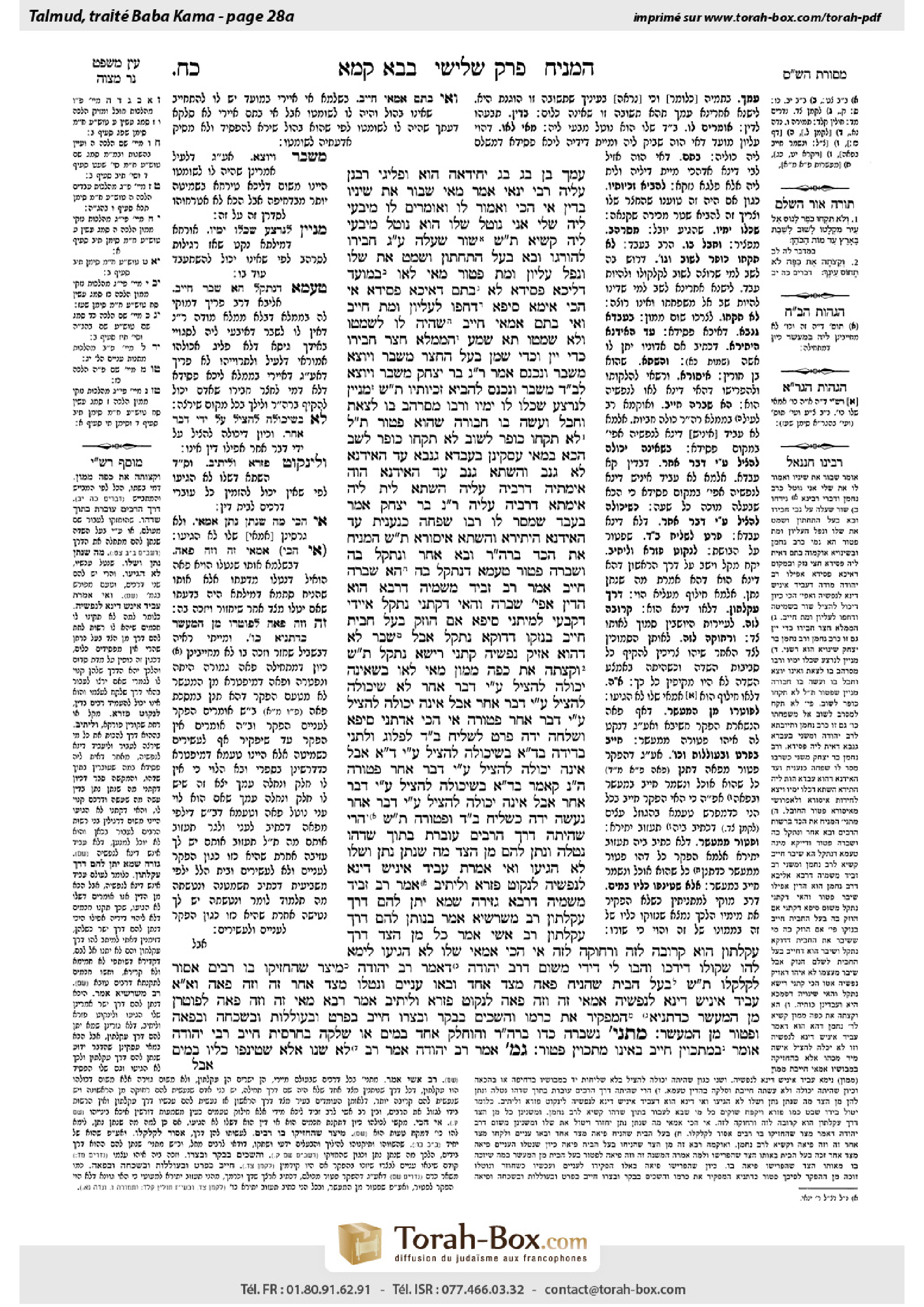
Bava Kamma 28a: Talmud study for Daf Yomi
Study the Talmud for Daf Yomi with scanned pages, Hebrew text, English translations from Sefaria and AI-generated French translations.
Passage selection and English or AI-generated French translation are available where the scan has annotations. Daf Study is independent of Torah-Box and Sefaria.
Browse Bava Kamma · בבא קמא · All tractatesBava Kamma 28a text and translations
This page of Bava Kamma includes the Aramaic text, an English translation and an AI-generated French translation, alongside the scan above.
בבא קמא כ״ח א · Aramaic and Hebrew text
עִמָּךְ?! בֶּן בַּג בַּג יְחִידָאָה הוּא, וּפְלִיגִי רַבָּנַן עֲלֵיהּ.
רַבִּי יַנַּאי אָמַר: מַאי ״שְׁבוֹר אֶת שִׁינָּיו״ – בַּדִּין.
אִי הָכִי, ״וֶאֱמוֹר לוֹ״?! ״וְאוֹמְרִים לוֹ״ מִיבְּעֵי לֵיהּ! ״שֶׁלִּי אֲנִי נוֹטֵל״?! ״שֶׁלּוֹ הוּא נוֹטֵל״ מִיבְּעֵי לֵיהּ! קַשְׁיָא.
תָּא שְׁמַע: שׁוֹר שֶׁעָלָה עַל גַּבֵּי חֲבֵירוֹ לְהוֹרְגוֹ, וּבָא בַּעַל הַתַּחְתּוֹן וְשָׁמַט אֶת שֶׁלּוֹ, וְנָפַל עֶלְיוֹן וָמֵת – פָּטוּר. מַאי, לָאו בְּמוּעָד – דְּלֵיכָּא פְּסֵידָא?
לָא, בְּתָם – דְּאִיכָּא פְּסֵידָא.
אִי הָכִי, אֵימָא סֵיפָא: דְּחָפוֹ לָעֶלְיוֹן וָמֵת – חַיָּיב. וְאִי בְּתָם, אַמַּאי חַיָּיב?
שֶׁהָיָה לוֹ לְשׇׁמְטוֹ, וְלֹא שְׁמָטוֹ.
תָּא שְׁמַע: הַמְמַלֵּא חֲצַר חֲבֵירוֹ כַּדֵּי יַיִן וְכַדֵּי שֶׁמֶן – בַּעַל הֶחָצֵר מְשַׁבֵּר וְיוֹצֵא, מְשַׁבֵּר וְנִכְנָס!
אָמַר רַב נַחְמָן בַּר יִצְחָק: מְשַׁבֵּר וְיוֹצֵא לְבֵית דִּין, מְשַׁבֵּר וְנִכְנָס לְהָבִיא זְכִיּוֹתָיו.
תָּא שְׁמַע: מִנַּיִין לְנִרְצָע שֶׁכָּלוּ לוֹ יָמָיו, וְרַבּוֹ מְסַרְהֵב בּוֹ לָצֵאת, וְחָבַל וְעָשָׂה בּוֹ חַבּוּרָה, שֶׁהוּא פָּטוּר –
תַּלְמוּד לוֹמַר: ״לֹא תִקְּחוּ כֹפֶר״ ״לָשׁוּב״ – לֹא תִּקְחוּ כּוֹפֶר לַשָּׁב!
הָכָא בְּמַאי עָסְקִינַן – בְּעַבְדָּא גַּנָּבָא.
עַד הָאִידָּנָא לָא גְּנַב, וְהַשְׁתָּא גָּנֵב?! עַד הָאִידָּנָא הֲוָה אֵימְתֵיהּ דְּרַבֵּיהּ עֲלֵיהּ, הַשְׁתָּא לֵית לֵיהּ אֵימְתָא דְּרַבֵּיהּ עֲלֵיהּ.
רַב נַחְמָן בַּר יִצְחָק אָמַר: בְּעֶבֶד שֶׁמָּסַר לוֹ רַבּוֹ שִׁפְחָה כְּנַעֲנִית; עַד הָאִידָּנָא הֶיתֵּירָא, וְהַשְׁתָּא אִיסּוּרָא.
תָּא שְׁמַע: הַמַּנִּיחַ אֶת הַכַּד בִּרְשׁוּת הָרַבִּים, וּבָא אַחֵר וְנִתְקַל בָּהּ וּשְׁבָרָהּ – פָּטוּר. טַעְמָא דְּנִתְקַל בָּהּ, הָא שְׁבָרָהּ – חַיָּיב!
אָמַר רַב זְבִיד מִשְּׁמֵיהּ דְּרָבָא: הוּא הַדִּין אֲפִילּוּ שְׁבָרָהּ; וְהַאי דְּקָתָנֵי ״נִתְקַל״ – אַיְּידֵי דְּקָבָעֵי לְמִיתְנֵי סֵיפָא: אִם הוּזַּק – בַּעַל חָבִית חַיָּיב בְּנִזְקוֹ, דְּדַוְקָא נִתְקַל אֲבָל שָׁבַר לָא, דְּהוּא אַזֵּיק נַפְשֵׁיהּ; קָתָנֵי רֵישָׁא נִתְקַל.
תָּא שְׁמַע: ״וְקַצֹּתָה אֶת כַּפָּהּ״ – מָמוֹן. מַאי, לָאו בְּשֶׁאֵינָהּ יְכוֹלָה לְהַצִּיל עַל יְדֵי דָּבָר אַחֵר? לֹא, שֶׁיְּכוֹלָה לְהַצִּיל עַל יְדֵי דָּבָר אַחֵר.
אֲבָל אֵינָהּ יְכוֹלָה לְהַצִּיל עַל יְדֵי דָּבָר אַחֵר – פְּטוּרָה? אִי הָכִי, אַדְּתָנֵי סֵיפָא: ״וְשָׁלְחָה יָדָהּ״ – פְּרָט לִשְׁלִיחַ בֵּית דִּין; לִפְלוֹג וְלִתְנֵי בְּדִידַהּ: בַּמֶּה דְּבָרִים אֲמוּרִים – בְּשֶׁיְּכוֹלָה לְהַצִּיל עַל יְדֵי דָּבָר אַחֵר, אֲבָל אֵינָהּ יְכוֹלָה לְהַצִּיל עַל יְדֵי דָּבָר אַחֵר – פְּטוּרָה!
הָכִי נָמֵי קָאָמַר: בַּמֶּה דְּבָרִים אֲמוּרִים – בְּשֶׁיְּכוֹלָה לְהַצִּיל עַל יְדֵי דָּבָר אַחֵר, אֲבָל אֵינָהּ יְכוֹלָה לְהַצִּיל עַל יְדֵי דָּבָר אַחֵר – נַעֲשָׂה יָדָהּ כִּשְׁלִיחַ בֵּית דִּין, וּפְטוּרָה.
תָּא שְׁמַע: הֲרֵי שֶׁהָיְתָה דֶּרֶךְ הָרַבִּים עוֹבֶרֶת בְּתוֹךְ שָׂדֵהוּ; נְטָלָהּ, וְנָתַן לָהֶם מִן הַצַּד – מַה שֶּׁנָּתַן נָתַן, וְשֶׁלּוֹ לֹא הִגִּיעוֹ.
וְאִי אָמְרַתְּ עָבֵיד אִינִישׁ דִּינָא לְנַפְשֵׁיהּ, לִנְקוֹט פַּזְרָא וְלִיתֵיב!
אָמַר רַב זְבִיד מִשְּׁמֵיהּ דְּרָבָא: גְּזֵירָה שֶׁמָּא יִתֵּן לָהֶם דֶּרֶךְ עֲקַלָּתוֹן.
רַב מְשַׁרְשְׁיָא אָמַר: בְּנוֹתֵן לָהֶם דֶּרֶךְ עֲקַלָּתוֹן.
רַב אָשֵׁי אָמַר: כֹּל מִן הַצַּד – דֶּרֶךְ עֲקַלָּתוֹן הוּא, קְרוֹבָה לָזֶה וּרְחוֹקָה לָזֶה.
אִי הָכִי, אַמַּאי שֶׁלּוֹ לֹא הִגִּיעוֹ? לֵימָא לְהוּ: שְׁקוּלוּ דִּידְכוּ, וְהַבוּ לִי דִּידִי!
מִשּׁוּם דְּרַב יְהוּדָה – דְּאָמַר רַב יְהוּדָה: מֵיצַר שֶׁהֶחֱזִיקוּ בּוֹ רַבִּים – אָסוּר לְקַלְקְלוֹ.
תָּא שְׁמַע: בַּעַל הַבַּיִת שֶׁהִנִּיחַ פֵּאָה מִצַּד אֶחָד, וּבָאוּ עֲנִיִּים וְנָטְלוּ מִצַּד אַחֵר – זֶה וָזֶה פֵּאָה. וְאִי אָמְרַתְּ עָבֵיד אִינִישׁ דִּינָא לְנַפְשֵׁיהּ, אַמַּאי זֶה וָזֶה פֵּאָה? לִנְקוֹט פַּזְרָא וְלִיתֵיב!
אָמַר רָבָא: מַאי ״זֶה וָזֶה פֵּאָה״ – לְפוֹטְרָן מִן הַמַּעֲשֵׂר.
כִּדְתַנְיָא: הַמַּפְקִיר אֶת כַּרְמוֹ, וְהִשְׁכִּים בַּבֹּקֶר וּבְצָרוֹ – חַיָּיב בְּפֶרֶט וּבְעוֹלֵלוֹת וּבְשִׁכְחָה וּבְפֵאָה, וּפָטוּר מִן הַמַּעֲשֵׂר.
מַתְנִי׳ נִשְׁבְּרָה כַּדּוֹ בִּרְשׁוּת הָרַבִּים, וְהוּחְלַק אֶחָד בַּמַּיִם אוֹ שֶׁלָּקָה בְּחַרְסִית – חַיָּיב. רַבִּי יְהוּדָה אוֹמֵר: בְּמִתְכַּוֵּין – חַיָּיב, בְּאֵינוֹ מִתְכַּוֵּין – פָּטוּר.
גְּמָ׳ אָמַר רַב יְהוּדָה אָמַר רַב: לֹא שָׁנוּ אֶלָּא שֶׁטִּינְּפוּ כֵּלָיו בַּמַּיִם,
Bava Kamma 28a · English translation
You can keep this question to yourself, as it poses no difficulty at all. Ben Bag Bag states an individual opinion in this regard, and the Rabbis disagree with him.
Rabbi Yannai says an alternative response to Rav Kahana’s objection: What does the baraita mean by the phrase: Break his teeth? It means sue him in judgment.
The Gemara asks: If so, the subsequent statement in the baraita: And say to him, is inaccurate. It should have stated: And they, the court, say to him. Likewise, the wording: I am taking what is mine, is inaccurate. Since it is the court who makes this statement, the baraita should have stated: He is taking what is his. The Gemara concludes: Indeed, this poses a difficulty for Rav Yehuda’s version of the response.
The Gemara suggests: Come and hear an alternative proof for Rav Naḥman’s opinion. It is stated in a baraita: With regard to an ox that climbed on the back of another ox to kill it, and the owner of the ox on the bottom came and removed his ox, and the ox on top consequently fell and died, the owner of the ox on the bottom is exempt from paying for the dead ox. What, is this ruling not stated with regard to a case where the attacker is a forewarned ox, where there is no loss to the owner of the bottom ox, since even if the owner of the ox on the bottom does not remove his ox, he will eventually receive full restitution from the owner of the belligerent ox? Yet he is exempt from paying restitution for causing the death of the belligerent ox. Evidently, he had the right to take justice into his own hands.
The Gemara rejects this proof: No, the ruling is with regard to a case where the attacker is an innocuous ox, where there is a loss for the owner of the ox on the bottom if he does not save it, since the owner of an innocuous ox pays for only half the damages resulting from his ox’s attack.
The Gemara asks: If so, say the latter clause of that baraita: If, instead of removing his own ox, the owner of the ox on the bottom pushed the one on top and it died, he is liable. And if it is referring to an innocuous ox, why is he liable? He is defending his property so as not to incur a loss.
The Gemara answers: He is liable because he should have removed his ox from underneath the belligerent ox, and he did not remove it. Instead, he pushed the belligerent ox and caused it to die. Although one may take justice into his own hands, if he damages another person’s property when he could have protected his own property in a harmless manner he is liable.
The Gemara suggests: Come and hear a proof for Rav Naḥman’s opinion from a baraita: With regard to one who fills another’s courtyard with jugs of wine and jugs of oil, the owner of the courtyard may break his way through them and exit his courtyard or he may break his way through them and enter his courtyard. Since the one who put the jugs there had no right to do so, the owner of the courtyard may take justice into his own hands. This is apparently the ruling even where there is no loss involved to the owner of the courtyard.
Rav Naḥman bar Yitzḥak said in response that the baraita can be explained as follows: The owner of the courtyard may break the jugs and exit to court, and he may break the jugs and enter his house to bring proof of his rights, i.e., documents proving that the courtyard belongs to him. Since by refraining from doing so he would sustain a loss, he may break the jugs when exiting and entering. He may not take justice into his own hands beyond this extent. Therefore, no proof for Rav Naḥman’s opinion can be inferred from this baraita.
The Gemara suggests: Come and hear an alternative proof from a baraita: From where is it derived with regard to a Hebrew slave who had his ear pierced with an awl to extend his tenure as a slave, but whose days of servitude have now ended with the arrival of the Jubilee Year; and his master is urging [mesarhev] him to leave but he insists on remaining; and the master injured the slave and inflicted an injury on him in the process of forcing him out, that the master is exempt from paying for this injury?
To counter this, the verse states: “You shall take no ransom…that he should return” (Numbers 35:32). Although this verse is referring to the prohibition against an unintentional killer paying a ransom instead of going to a city of refuge, this verse is also interpreted to mean that you shall take no ransom for a Hebrew slave who is obligated to return to his family. In other words, if the slave refuses to return to his family and is injured in the process of his eviction, he does not receive compensation. This seems to indicate that the master may take justice into his own hands even for a matter that involves no loss to him.
The Gemara responds to this proof: With what are we dealing here? We are dealing with a slave who is a thief, and consequently, if he remains a slave, his master will sustain a loss. Therefore, it is permitted for the master to take justice into his own hands and evict the slave by force.
The Gemara questions this explanation: Until now he did not steal, and now he will begin to steal? Why would the master be worried about this just when the slave’s tenure ends? The Gemara answers: Until now, while he was still a slave, the awe of his master was upon him, so he did not steal from him. Now that he may go free he does not have the awe of his master upon him, and the master is therefore worried that he might steal from him.
Rav Naḥman bar Yitzḥak said an alternative explanation: The baraita is referring to a slave whose master provided a Canaanite maidservant to him as a wife and he wishes to remain with her. Until now, it was permitted for him to engage in sexual intercourse with her, but now that he is free, it is prohibited for him to do so. In this case, his master may evict him forcefully, assuming the role of an emissary of the court, to prevent him from violating the prohibition. Therefore, this is not considered taking justice into his own hands.
The Gemara suggests a proof for Rav Yehuda’s opinion from the mishna. Come and hear: In the case of one who places a jug in the public domain and another person comes and stumbles on it and breaks it, he is exempt. It may be inferred that the reason he is exempt is that he stumbled on it. But if he broke it intentionally, he is liable. This indicates that one may not take justice into his own hands.
Rav Zevid said in the name of Rava: That is not a proof, as the same is true even if he broke the barrel intentionally. And as for this fact that the tanna of the mishna teaches a case where he stumbled, it is because he wants to teach in the last clause: And if he incurred damage due to the vessel, the owner of the ḥavit is liable to pay for his damages. As this ruling applies specifically when he stumbled, but if he broke the barrel intentionally and incurred damage in the process, the owner of the barrel is not required to compensate him. Although the pedestrian had the right to break the barrel, it is he who damaged himself, by not being careful while breaking it. Therefore, in the first clause the mishna teaches a case where he stumbled.
The Gemara suggests: Come and hear a proof from a baraita, which relates to the case of a woman who, during a fight between her husband and another man, grabs the other man’s genitals: The verse that states: “Then you shall cut off her hand” (Deuteronomy 25:12), should not be taken literally; rather, it is referring to monetary restitution. What, is it not referring to a case where she cannot save her husband from his attacker by a means other than grabbing the attacker’s genitals, and nevertheless she is punished? This indicates that one may not take justice into his own hands. The Gemara answers: No, the verse is referring to a case where she can save him by other means. Otherwise she is exempt from paying restitution.
The Gemara asks: But if she cannot save him by other means, is it possible that she is exempt? If so, instead of teaching in the latter clause of that baraita that the expression mentioned in the previous verse: “And extended her hand” (Deuteronomy 25:11), excludes an emissary of the court, who is authorized to act in this manner and is therefore exempt from paying restitution, let the baraita distinguish and teach within the case under discussion in the verse itself, as follows: In what case is this statement that the wife is liable said? It is in a case where she can save her husband by another means. But if she cannot save him by other means, she is exempt.
The Gemara answers: That is also what the baraita is saying: In what case is this statement said? It is said in a case where she can save him by other means. But if she cannot save him by other means, her hand is rendered like an emissary of the court, and she is exempt.
The Gemara suggests: Come and hear a proof for Rav Yehuda’s opinion from a mishna (Bava Batra 99b): In a case where a public thoroughfare would pass through one’s field, and he appropriated it and instead gave the public an alternative route on the side of his property, the halakha is that the route that he has given is the route that he gave them, and they may use it. But his property, which he appropriated, has not reached him, i.e., he cannot appropriate it for his personal use since it was already in public use.
And if you say that a person may take justice into his own hands, why does the owner of the field not have the right to close the thoroughfare? Since it is his property and he gave the public an alternative route, let him take a stick [pazra] in his hand and sit by the side of the road, preventing the public from passing through.
Rav Zevid said in the name of Rava: It is a rabbinic decree, lest he give them a circuitous route. Since the public has the right to pass through his field, as the Gemara will soon explain, the owner cannot appropriate their thoroughfare without giving the public a similar alternative route. Therefore, the Sages decreed that he cannot appropriate it without their consent, lest he provide an inadequate route.
Rav Mesharshiyya said: The mishna is referring to a case where he actually gave them a circuitous route. If one in fact gives the public a straight path, he need not surrender his rights, and he may take justice into his own hands by blocking the original thoroughfare.
Rav Ashi said: Any route on the side that the property owner might give them is necessarily considered a circuitous route, as it is close for this person, and it is far for that person. While some will benefit from the change, it will be detrimental for others.
The Gemara asks: If so, why has his property not reached him? If he cannot make the change, why can he not reclaim the path that he intended to turn over to the public? Let him say to them: Take your original route and give me back my property, so that he will not lose both pieces of land.
The Gemara answers that he cannot reclaim it due to Rav Yehuda’s statement, as Rav Yehuda says: With regard to a path that the masses established as a public thoroughfare, it is prohibited to destroy it for them. Therefore, since the public already began using the alternative route, the owner cannot appropriate it from them.
The Gemara suggests: Come and hear an alternative proof from a baraita: With regard to the owner of a field who left produce in the corner of the field, which is given to the poor [pe’a], on one side of the field, and poor people came and took from another side, this produce and that produce are both considered pe’a. And if you say that a person may take justice into his own hands, why are this and that both considered pe’a? Let him take a stick and sit in his field on the side from which the poor people are taking produce without his permission, and let him warn them to take only from the side that he allocated.
Rava said: In terms of monetary law he can prevent them from taking pe’a from the side that he did not allocate. What is meant by the ruling of: This produce and that produce are both considered pe’a? It means that they are considered pe’a with regard to exempting both portions of produce from tithes. Just as the portion that the poor people took is exempt from tithes, so is the portion that he allocated initially.
This is as it is taught in a baraita: In the case of one who renounces ownership of his vineyard and arose early in the morning before anyone else took possession of it and harvested it, the one who renounces ownership is obligated in the mitzva of individual fallen grapes left for the poor [peret], and in the mitzva of incompletely formed clusters of grapes left for the poor [olelot], and in the mitzva of forgotten clusters of grapes left for the poor, and in the mitzva of pe’a, the four gifts to the poor that the Torah requires one to give from a vineyard (see Leviticus 19:9–10). But he is exempt from the mitzva to tithe his produce, because this requirement does not apply to an ownerless field. Likewise, in the above case the portion of the field that was allocated for pe’a is exempt from tithes even after the owner reclaims it, as pe’a is considered ownerless property in this regard.
MISHNA: If one’s jug broke in the public domain and another person slipped in the water from the jug and was injured from the fall, or if he was injured by the shards of the broken jug, the owner of the jug is liable. Rabbi Yehuda says: In a case where the owner of the jug acted with intent, he is liable, and in a case where he acted without intent, he is exempt.
GEMARA: Rav Yehuda says that Rav says: They taught that the owner of the jug is liable only when the clothes of the one who slipped were soiled by the dirty water.
Bava Kamma 28a · Traduction française (IA)
Vous pouvez garder cette question pour vous-même, car elle ne pose aucune difficulté. Ben Bag Bag exprime un avis personnel à ce sujet, et les Rabbins s'y opposent.
Rabbi Yannai dit une réponse alternative à l'objection de Rav Kahana : Qu'entend la baraïta par la phrase : Casser ses dents ? Cela signifie engager une action en justice contre lui.
Le Guemara pose la question : Si c'est ainsi, l'affirmation suivante dans la baraïta : Et dis-lui, est inexacte. Elle aurait dû dire : Et ils, le tribunal, disent-lui. De même, la formulation : Je prends ce qui m'appartient, est inexacte. Puisque c'est le tribunal qui fait cette déclaration, la baraïta aurait dû dire : Il prend ce qui est à lui. Le Guemara conclut : En effet, cela pose une difficulté pour la version de Rav Yehuda de la réponse.
Le Guemara suggère : Viens écouter une preuve alternative pour l'opinion de Rav Naḥman. Il est dit dans une baraïta : Concernant un bœuf qui est monté sur le dos d'un autre bœuf pour le tuer, et l'propriétaire du bœuf en bas est venu et a retiré son bœuf, et le bœuf en haut est tombé et est mort, l'propriétaire du bœuf en bas est exempt de payer pour le bœuf mort. Qu'est-ce que cela ne serait pas dit concernant un cas où l'agresseur est un bœuf averti, où il n'y a pas de perte pour l'propriétaire du bœuf en bas, puisque même si l'propriétaire du bœuf en bas ne retire pas son bœuf, il recevra finalement une réparation complète de l'propriétaire du bœuf belliqueux ? Cependant, il est exempt de payer une réparation pour avoir causé la mort du bœuf belliqueux. Évidemment, il avait le droit de prendre justice en sa propre main.
Le Guemara rejette cette preuve : Non, la décision est concernant un cas où l'agresseur est un bœuf inoffensif, où il y a une perte pour l'propriétaire du bœuf en bas s'il ne le sauvait pas, puisque l'propriétaire d'un bœuf inoffensif paie seulement la moitié des dommages résultant de son attaque.
Le Guemara pose la question : Si c'est ainsi, disons la dernière partie de cette baraïta : Si, au lieu de retirer son propre bœuf, l'propriétaire du bœuf en bas poussait celui en haut et il mourait, il est responsable. Et si cela se réfère à un bœuf inoffensif, pourquoi est-il responsable ? Il défend son propre bien afin d'éviter une perte.
Le Guemara répond : Il est responsable car il aurait dû retirer son bœuf du dessous du bœuf belliqueux et ne l'a pas fait. Au lieu de cela, il a poussé le bœuf belliqueux et l'a fait mourir. Bien qu'on puisse prendre justice en sa propre main, s'il endommage la propriété d'une autre personne alors qu'il aurait pu protéger sa propre propriété de manière inoffensive, il est responsable.
Le Guemara suggère : Viens écouter une preuve pour l'opinion de Rav Naḥman à partir d'une baraïta : Concernant celui qui remplit le courtil d'un autre avec des jarres de vin et des jarres d'huile, l'propriétaire du courtil peut briser le passage pour sortir de son courtil ou il peut briser le passage pour entrer dans son courtil. Puisque celui qui a mis les jarres là n'avait pas le droit de le faire, l'propriétaire du courtil peut prendre justice en sa propre main. Cela semble être la décision même dans un cas où il n'y a pas de perte impliquée pour l'propriétaire du courtil.
Rav Naḥman bar Yitzḥak répondit en disant que la baraïta peut être expliquée ainsi : L'propriétaire du courtil peut briser les jarres et sortir vers le tribunal, et il peut briser les jarres et entrer dans sa maison pour apporter des preuves de ses droits, c'est-à-dire des documents prouvant que le courtil lui appartient. Puisque s'il ne faisait pas cela il subirait une perte, il peut briser les jarres lorsqu'il sort et entre. Il ne peut pas prendre justice en sa propre main au-delà de ce point. Par conséquent, aucune preuve pour l'opinion de Rav Naḥman ne peut être tirée de cette baraïta.
Le Guemara suggère : Viens écouter une preuve alternative tirée d'une baraïta : D'où est-il tiré concernant un serviteur hébreu qui a eu son oreille percée avec un foret afin de prolonger son temps de servitude, mais dont les jours de servitude ont maintenant pris fin avec l'arrivée de l'année du Jubilé ; et son maître l'incite à partirir, mais il insiste pour rester ; et le maître a blessé le serviteur et l'a blessé lors du processus d'expulsion, que le maître est exempt de payer pour cette blessure ?
Pour contrecarrer cela, la versette dit : « Tu ne prendras pas de rançon… qu'il revienne » (Nombres 35:32). Bien que cette versette fasse référence à l'interdiction d'un meurtrier involontaire de payer un rançon au lieu de se rendre dans une ville de refuge, cette versette est aussi interprétée pour signifier que tu ne prendras pas de rançon pour un serviteur hébreu tenu de retourner chez lui. En d'autres termes, si le serviteur refuse de retourner chez lui et est blessé lors de son expulsion, il ne reçoit pas de compensation. Cela semble indiquer que le maître peut prendre justice en sa propre main même pour une affaire où il n'y a pas de perte impliquée pour lui.
Le Guemara répond à cette preuve : Avec quel genre de serviteur sommes-nous occupés ici ? Nous sommes occupés avec un serviteur qui est un voleur, et par conséquent, s'il reste un serviteur, son maître subira une perte. Par conséquent, il est permis au maître de prendre justice en sa propre main et d'expulser le serviteur par la force.
Le Guemara questionne cette explication : Jusqu'à présent, il n'avait pas volé, et maintenant il va commencer à voler ? Pourquoi le maître s'inquiète-t-il de cela juste quand la durée de servitude du serviteur s'achève ? Le Guemara répond : Jusqu'à présent, pendant qu'il était encore un serviteur, l'effroi de son maître était sur lui, donc il n'avait pas volé de lui. Maintenant qu'il peut être libre, il n'a plus l'effroi de son maître sur lui, et le maître s'inquiète donc qu'il puisse voler de lui.
Rav Naḥman bar Yitzḥak a dit une autre explication : La baraïta fait référence à un esclave dont le maître lui avait donné une servante cananéenne en épouse et qui souhaite rester avec elle. Jusqu'à présent, il était permis à cet esclave d'engager des relations sexuelles avec elle, mais désormais qu'il est libre, il est interdit de le faire. Dans ce cas, son maître peut l'expulser fortement, en prenant le rôle d'un messager du tribunal, afin de l'empêcher de violer l'interdiction. Ainsi, cela ne constitue pas une prise de justice en main propre.
Le Guemara suggère un argument en faveur de l'opinion de Rav Yehuda à partir de la mishna. Viens écouter : Dans le cas où une personne place un récipient dans le domaine public et que quelqu'un d'autre vient et trébuche sur celui-ci et le brise, il est exempt. On peut en déduire que la raison pour laquelle il est exempt est qu'il a trébuché sur celui-ci. Mais si l'on a brisé le récipient intentionnellement, il est responsable. Cela indique que l'on ne peut pas prendre la justice en main propre.
Rav Zevid a dit en nom de Rava : Ce n'est pas une preuve, car cela est vrai même si l'on a brisé le tonneau intentionnellement. Et quant à ce fait que le tanna de la mishna enseigne un cas où il a trébuché, c'est parce qu'il veut enseigner dans la dernière clause : Et si l'on a subi un préjudice à cause du récipient, l'propriétaire du récipient est responsable de ses préjudices. Comme cette décision s'applique spécifiquement lorsqu'il a trébuché, mais si l'on a brisé le tonneau intentionnellement et a subi un préjudice en conséquence, l'propriétaire du tonneau n'est pas tenu de le compenser. Bien que le passant ait le droit de briser le tonneau, c'est lui qui s'est endetté, en ne prenant pas soin de le briser. Ainsi, dans la première clause, la mishna enseigne un cas où il a trébuché.
Le Guemara suggère : Viens écouter une preuve tirée d'une baraïta, qui relate le cas d'une femme qui, lors d'une bagarre entre son mari et un autre homme, saisit les organes génitaux de l'autre homme : Le verset qui dit : « Alors tu couperas la main d'elle » (Deutéronome 25:12), ne doit pas être pris littéralement ; il fait référence à une réparation monétaire. Qu'est-ce que cela ne signifie pas qu'il s'agit d'un cas où elle ne peut pas sauver son mari de son agresseur par un moyen autre que de saisir les organes génitaux de l'agresseur, et pourtant elle est punie ? Cela montre que l'on ne doit pas prendre la justice en main propre. Le Guemara répond : Non, le verset fait référence à un cas où elle peut sauver son mari par d'autres moyens. Sinon, elle est exemptée de payer la réparation.
Le Guemara pose la question : Mais si elle ne peut pas le sauver par d'autres moyens, est-il possible qu'elle soit exemptée ? Si c'est le cas, au lieu d'enseigner dans la dernière clause de cette baraïta que l'expression mentionnée dans le verset précédent : « Et elle étendit sa main » (Deutéronome 25:11), exclut un messager du tribunal, qui est autorisé à agir ainsi et est donc exempt de payer la réparation, la baraïta devrait distinguer et enseigner dans le cas sous discussion du verset lui-même, comme suit : Dans quel cas cette déclaration que la femme est responsable est-elle dite ? C'est dans un cas où elle peut sauver son mari par d'autres moyens. Mais si elle ne peut pas le sauver par d'autres moyens, elle est exemptée.
Le Guemara répond : C'est aussi ce que la baraïta dit : Dans quel cas cette déclaration est-elle dite ? C'est dans un cas où elle peut sauver son mari par d'autres moyens. Mais si elle ne peut pas le sauver par d'autres moyens, sa main est considérée comme un messager du tribunal, et elle est exemptée.
Le Guemara suggère : Viens écouter une preuve en faveur de l'opinion de Rav Yehuda à partir d'une mishna (Bava Batra 99b) : Dans le cas où un chemin public passerait par un champ, et qu'il l'a approprié et a donné au public un autre chemin sur le côté de sa propriété, la halakha est que le chemin qu'il a donné est celui qu'il a donné, et ils peuvent l'utiliser. Mais sa propriété, qu'il a approprié, n'a pas atteint lui, c'est-à-dire qu'il ne peut pas l'approprier pour son usage personnel, car elle était déjà en usage public.
Et si tu dis qu'une personne peut prendre la justice en main propre, pourquoi l'propriétaire du champ n'a-t-il pas le droit de fermer le chemin public ? Puisque c'est sa propriété et qu'il a donné au public un autre chemin, laisse-le prendre un bâton [pazra] en main et s'asseoir à côté du chemin, empêchant le public de passer.
Rav Zevid a dit en nom de Rava : C'est un décret rabbinique, afin qu'il ne leur donne pas un chemin détourné. Puisque le public a le droit de passer par son champ, comme le Guemara l'expliquera bientôt, l'propriétaire ne peut pas approprier leur chemin public sans leur donner un autre chemin similaire. Ainsi, les Sages ont décrété qu'il ne peut l'approprier sans leur consentement, afin qu'il ne leur donne pas un chemin insuffisant.
Rav Mesharshiyya a dit : La Michna fait référence à un cas où il a effectivement donné un chemin détourné. Si l'on donne effectivement au public un chemin droit, il n'a pas besoin de renoncer à ses droits, et il peut prendre la justice en main propre en bloquant le chemin original.
Rav Ashi a dit : Tout chemin sur le côté que l'propriétaire du terrain pourrait leur donner est nécessairement considéré comme un chemin détourné, car il est proche pour cette personne et loin pour celle-ci. Bien que certains en bénéficient du changement, cela sera préjudiciable pour d'autres.
Le Guemara pose la question : Si c'est le cas, pourquoi sa propriété n'a-t-elle pas atteint lui ? Si il ne peut pas faire le changement, pourquoi ne peut-il pas récupérer le chemin qu'il avait l'intention de donner au public ? Laisse-le dire à eux : Prenez votre chemin original et donnez-moi mon terrain, afin qu'il ne perde pas les deux parcelles de terrain.
Le Guemara répond qu'il ne peut pas le récupérer en raison de l'affirmation de Rav Yehuda, car Rav Yehuda dit : En ce qui concerne un chemin que la foule a établi comme un chemin public, il est interdit de le détruire pour eux. Ainsi, puisque la foule a déjà commencé à utiliser le chemin alternatif, l'propriétaire ne peut pas l'approprier à leur encontre.
La Guemara suggère : Viens écouter une preuve alternative tirée d’une baraïta : En ce qui concerne l’propriétaire d’un champ qui a laissé des produits dans la bordure du champ, qui sont donnés aux pauvres [pe’a], du côté d’un champ, et des pauvres sont venus prendre des produits du côté opposé, ces produits et ceux-ci sont tous deux considérés comme pe’a. Et si l’on dit qu’une personne peut prendre justice en sa propre main, pourquoi ces deux produits sont-ils tous deux considérés comme pe’a ? Que l’on lui donne un bâton et qu’il s’assoie dans son champ du côté d’où les pauvres prennent les produits sans son autorisation, et qu’il avertisse les pauvres de ne prendre que du côté qu’il a désigné.
Rava dit : En matière de droit des biens, il peut empêcher les pauvres de prendre le pe’a du côté qu’il n’a pas désigné. Qu’entend-on par la décision : Ces produits et ceux-ci sont tous deux considérés comme pe’a ? Cela signifie qu’ils sont considérés comme pe’a en ce qui concerne l’exonération des deux portions de produits de la dîme. Tout comme la portion que les pauvres ont prise est exempte de dîme, ainsi est la portion qu’il a désigné initialement.
C’est ce qui est enseigné dans une baraïta : Dans le cas d’une personne qui renonce à la propriété de son vignoble et qui s’est levé tôt en matinée avant que personne ne prenne possession de lui et ne le récolte, la personne qui renonce à la propriété est tenue de la Mitsva des raisins tombés pour les pauvres [peret], et de la Mitsva des grappes incomplètes laissées pour les pauvres [olelot], et de la Mitsva des grappes oubliées laissées pour les pauvres, et de la Mitsva du pe’a, les quatre dons aux pauvres que la Torah exige de donner d’un vignoble (voir Lévitique 19 : 9–10). Mais il est exempt de la Mitsva de dîmer ses produits, car cette exigence ne s’applique pas à un champ sans propriétaire. De même, dans le cas mentionné ci-dessus, la portion du champ désignée pour le pe’a est exempte de dîme même après que l’propriétaire ait récupéré son champ, car le pe’a est considéré comme une propriété sans propriétaire à cet égard.
MICHNA : Si une outre de quelqu’un se brise dans le domaine public et que quelqu’un glisse dans l’eau provenant de l’outre et est blessé par la chute, ou s’il est blessé par les fragments de l’outre brisée, l’propriétaire de l’outre est responsable. Rabbi Yéhuda dit : Dans le cas où l’propriétaire de l’outre agit avec l’intention, il est responsable, et dans le cas où il agit sans intention, il est exempt.
GUEMARA : Rav Yéhuda dit que Rav dit : Ils ont enseigné que l’propriétaire de l’outre est responsable uniquement lorsque les vêtements de celui qui a glissé ont été souillés par l’eau sale.
Traduction française générée par IA à partir de l’édition anglaise de Sefaria. Vérifie toujours un passage avec le texte source.
Text from Sefaria: William Davidson Edition - Vocalized Aramaic (CC BY NC); William Davidson Edition - English (CC BY NC).