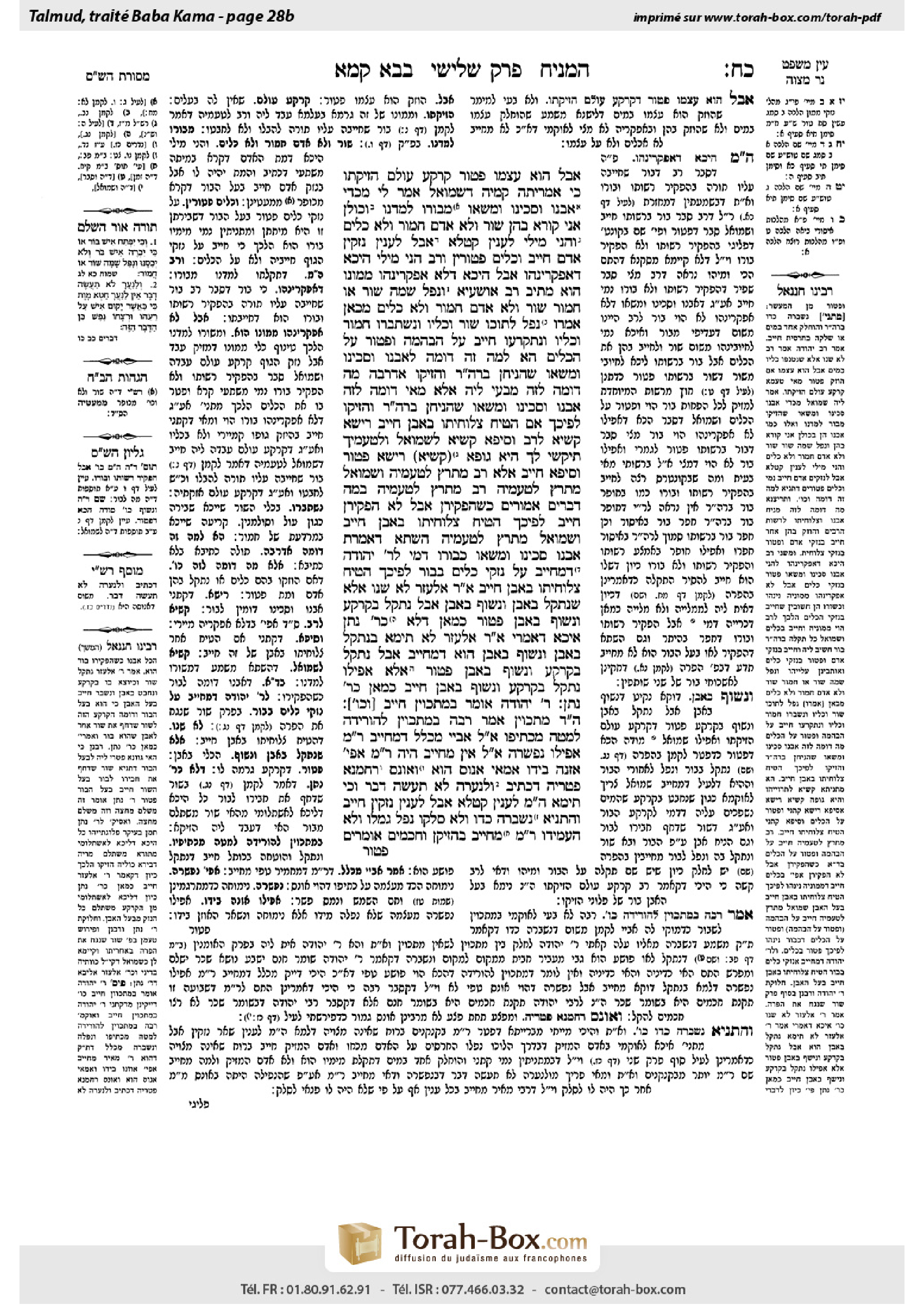
Bava Kamma 28b: Talmud study for Daf Yomi
Study the Talmud for Daf Yomi with scanned pages, Hebrew text, English translations from Sefaria and AI-generated French translations.
Passage selection and English or AI-generated French translation are available where the scan has annotations. Daf Study is independent of Torah-Box and Sefaria.
Browse Bava Kamma · בבא קמא · All tractatesBava Kamma 28b text and translations
This page of Bava Kamma includes the Aramaic text, an English translation and an AI-generated French translation, alongside the scan above.
בבא קמא כ״ח ב · Aramaic and Hebrew text
אֲבָל הוּא עַצְמוֹ – פָּטוּר; קַרְקַע עוֹלָם הִזִּיקַתּוּ.
כִּי אַמְרִיתַהּ קַמֵּיהּ דִּשְׁמוּאֵל, אָמַר לִי: מִכְּדֵי אַבְנוֹ וְסַכִּינוֹ וּמַשָּׂאוֹ – מִבּוֹרוֹ לָמַדְנוּ, וְכוּלָּן אֲנִי קוֹרֵא בָּהֶן: ״שׁוֹר״ – וְלֹא אָדָם, ״חֲמוֹר״ – וְלֹא כֵּלִים.
וְהָנֵי מִילֵּי לְעִנְיַן קְטָלָא, אֲבָל לְעִנְיַן נְזָקִין – אָדָם חַיָּיב, וְכֵלִים פְּטוּרִין.
וְרַב – הָנֵי מִילֵּי הֵיכָא דְּאַפְקְרִינְהוּ, אֲבָל הֵיכָא דְּלָא אַפְקְרִינְהוּ – מָמוֹנוֹ הוּא.
מֵתִיב רַב אוֹשַׁעְיָא: ״וְנָפַל שָׁמָּה שּׁוֹר אוֹ חֲמוֹר״; ״שׁוֹר״ – וְלֹא ״אָדָם״, ״חֲמוֹר״ – וְלֹא כֵּלִים. מִכָּאן אָמְרוּ: נָפַל לְתוֹכוֹ שׁוֹר וְכֵלָיו וְנִשְׁתַּבְּרוּ, חֲמוֹר וְכֵלָיו וְנִתְקָרְעוּ – חַיָּיב עַל הַבְּהֵמָה, וּפָטוּר עַל הַכֵּלִים. הָא לְמָה זֶה דּוֹמֶה – לְאַבְנוֹ וְסַכִּינוֹ וּמַשָּׂאוֹ שֶׁהִנִּיחָן בִּרְשׁוּת הָרַבִּים וְהִזִּיקוּ.
אַדְּרַבָּה, ״מָה דּוֹמֶה לָזֶה״ מִבְּעֵי לֵיהּ! אֶלָּא מַאי דּוֹמֶה לָזֶה – אַבְנוֹ וְסַכִּינוֹ וּמַשָּׂאוֹ שֶׁהִנִּיחָן בִּרְשׁוּת הָרַבִּים וְהִזִּיקוּ.
לְפִיכָךְ, אִם הֵטִיחַ צְלוֹחִיתוֹ בְּאֶבֶן – חַיָּיב.
רֵישָׁא קַשְׁיָא לְרַב, וְסֵיפָא קַשְׁיָא לִשְׁמוּאֵל!
וּלְטַעְמָיךְ, תִּיקְשֵׁי לָךְ הִיא גּוּפָא – (קַשְׁיָא) רֵישָׁא פָּטוּר, וְסֵיפָא חַיָּיב!
אֶלָּא רַב מְתָרֵץ לְטַעְמֵיהּ, וּשְׁמוּאֵל מְתָרֵץ לְטַעְמֵיהּ.
רַב מְתָרֵץ לְטַעְמֵיהּ, בַּמֶּה דְּבָרִים אֲמוּרִים – כְּשֶׁהִפְקִירָן, אֲבָל לֹא הִפְקִירָן – חַיָּיב. לְפִיכָךְ הֵטִיחַ צְלוֹחִיתוֹ בְּאֶבֶן – חַיָּיב.
וּשְׁמוּאֵל מְתָרֵץ לְטַעְמֵיהּ, הַשְׁתָּא דְּאָמְרַתְּ אַבְנוֹ סַכִּינוֹ וּמַשָּׂאוֹ – כְּבוֹרוֹ דָּמֵי; לְרַבִּי יְהוּדָה דִּמְחַיֵּיב עַל נִזְקֵי כֵלִים בְּבוֹר, לְפִיכָךְ הֵטִיחַ צְלוֹחִיתוֹ בְּאֶבֶן – חַיָּיב.
אָמַר רַבִּי אֶלְעָזָר: לֹא שָׁנוּ אֶלָּא שֶׁנִּתְקַל בָּאֶבֶן, וְנִשּׁוֹף בָּאֶבֶן. אֲבָל נִתְקַל בַּקַּרְקַע וְנִשּׁוֹף בָּאֶבֶן – פָּטוּר.
כְּמַאן – דְּלָא כְּרַבִּי נָתָן.
אִיכָּא דְּאָמְרִי, אָמַר רַבִּי אֶלְעָזָר: לָא תֵּימָא בְּנִתְקַל בָּאֶבֶן וְנִשּׁוֹף בָּאֶבֶן הוּא דְּמִחַיַּיב, אֲבָל נִתְקַל בַּקַּרְקַע וְנִשּׁוֹף בָּאֶבֶן – פָּטוּר; אֶלָּא אֲפִילּוּ נִתְקַל בַּקַּרְקַע וְנִשּׁוֹף בָּאֶבֶן – חַיָּיב. כְּמַאן – כְּרַבִּי נָתָן.
רַבִּי יְהוּדָה אוֹמֵר: בְּמִתְכַּוֵּין חַיָּיב וְכוּ׳. הֵיכִי דָּמֵי מִתְכַּוֵּין?
אָמַר רַבָּה: בְּמִתְכַּוֵּין לְהוֹרִידָהּ לְמַטָּה מִכְּתֵיפוֹ. אֲמַר לֵיהּ אַבָּיֵי: מִכְּלָל דִּמְחַיֵּיב רַבִּי מֵאִיר אֲפִילּוּ נִפְשְׁרָה? אֲמַר לֵיהּ: אִין, מְחַיֵּיב הָיָה רַבִּי מֵאִיר אֲפִילּוּ אׇזְנָהּ בְּיָדוֹ.
אַמַּאי? אָנוּס הוּא, וְאוֹנֶס רַחֲמָנָא פַּטְרֵיהּ – דִּכְתִיב: ״וְלַנַּעֲרָה לֹא תַעֲשֶׂה דָבָר״!
וְכִי תֵּימָא הָנֵי מִילֵּי לְעִנְיַן קְטָלָא, אֲבָל לְעִנְיַן נְזָקִין – חַיָּיב; וְהָתַנְיָא: נִשְׁבְּרָה כַּדּוֹ וְלֹא סִלְּקָהּ, נָפְלָה גְּמַלּוֹ וְלֹא הֶעֱמִידָה – רַבִּי מֵאִיר מְחַיֵּיב בְּהֶזֵּיקָן, וַחֲכָמִים אוֹמְרִים:
Bava Kamma 28b · English translation
But if the person himself was injured, the owner of the jug is exempt, as it is the ground that caused his injury, not the jug or the water.
Rav Yehuda continued: When I stated this ruling of Rav before Shmuel, he said to me: After all, we derive the cases of damage caused by leaving one’s stone, one’s knife, or one’s load in the public domain from the case of one’s pit, and I therefore read, i.e., apply, with regard to all of them the inference of the Sages from the verse: “And an ox or a donkey fall therein” (Exodus 21:33), that the one who dug the pit is liable only if what incurred damage is an ox, but not a person, or a donkey, but not vessels.
And this statement applies with regard to a situation where the person is killed, i.e., if one fell into a pit and was killed, the person who dug it is exempt from paying restitution, since the verse refers exclusively to an animal that was killed. But with regard to damage, the digger of the pit is liable to pay restitution for injury to a person, but exempt from paying restitution for damage to vessels, for which no distinction between death and injury can be applied. Therefore, the ruling in the case of the jug that broke in the public domain should be the opposite. The owner of the jug is liable to pay restitution for injury caused to another, as Shmuel holds that he is liable even if the injury is caused by the impact with the ground, but that he is exempt from paying restitution for the damage done to the clothes of the one who slipped.
The Gemara asks: And how would Rav answer this difficulty? The Gemara answers: This presumption that liability for damage caused by one’s stone, knife, or load is derived from the category of Pit, thereby exempting him from payment for damage to vessels, applies only in a case where he renounced ownership of them. But in a case where he did not renounce ownership of them, it is considered to be like any other case where his property causes damage. Therefore, he is liable to pay for damage caused to the vessels.
Rav Oshaya raises an objection from a baraita discussing Pit: It is derived from the verse: “And if a man shall open a pit, or if a man shall dig a pit and not cover it, and an ox or a donkey fall therein” (Exodus 21:33), that the digger is liable to pay restitution only if what incurred damage is an ox but not a person, or a donkey but not vessels. From here the Sages stated that if an ox with its equipment fell into a pit, and the ox was wounded and the equipment broke; or if a donkey with its equipment fell in, and the donkey was wounded and the equipment tore, then the one who dug the pit is liable to pay restitution for any injury sustained by the animal but exempt from paying restitution for the damaged equipment. To what case is this similar? It is similar to the case of his stone, or his knife, or his load that he left in the public domain, and they caused damage.
The Gemara questions the wording of the baraita: On the contrary, it should have stated: What is similar to this, since the cases of one’s stone, knife, or load are not mentioned in the Torah, but are derived from the case of Pit. Rather, the wording should be emended as follows: What is similar to this? It is the case of his stone, or his knife, or his load that he left in the public domain, and they caused damage.
The baraita continues: Therefore, if one dropped his flask on a stone that was left in the public domain, breaking the flask, the owner of the stone is liable.
The first clause of this baraita is difficult according to the opinion of Rav, since it compares the cases of a stone, a knife, and a load to the case of Pit, and it does not distinguish between a situation in which he renounced ownership of them or one where he did not. And the last clause of the baraita, which deems the owner of a stone in the public domain liable to pay restitution for the damage to the broken flask, is difficult according to the opinion of Shmuel. According to him, the owner should be liable only for causing injury and not for damaging vessels.
The Gemara responds to this objection: And according to your reasoning, the baraita itself should pose a difficulty for you, since the first clause states that one is exempt from liability for damage to vessels, and the last clause states that he is liable.
Rather, Rav resolves the contradiction according to his line of reasoning, and Shmuel resolves it according to his line of reasoning.
Rav resolves it according to his line of reasoning as follows: In what case is this statement said? Concerning what case does the baraita rule that a stone, a knife, and a load are analogous to Pit, exempting their owner from liability for breakage to vessels caused by them? It is where he renounced ownership of them. But if he did not renounce ownership of them he is liable. Therefore, if one dropped his flask on a stone belonging to another person in the public domain, the owner of the stone is liable to pay for the damage to the flask.
And Shmuel resolves the contradiction according to his line of reasoning: Now that you said that the cases of one’s stone, one’s knife, and one’s load are similar to one’s pit, then according to Rabbi Yehuda, who deems one liable to pay for damage caused to vessels by falling into a pit that he dug, one is therefore liable in a case where someone dropped his flask on a stone belonging to him, and the flask broke.
§ Rabbi Elazar says: They taught that the owner of the stone is liable only in a case where the pedestrian stumbled on the stone and the flask scraped against the stone and broke. But if he stumbled on the ground, not the stone, and the flask consequently fell and scraped against the stone, causing the flask to break, the owner of the stone is exempt from liability for the damage.
In accordance with whose opinion is this statement? It is not in accordance with the opinion of Rabbi Natan, who maintains that if damage is caused by two people and one of them is exempt from paying compensation, the other must pay the entire amount. Similarly here, since there is no liability for damage caused by stumbling on the ground, compensation should be collected from the owner of the stone.
There are those who say an alternative version of this discourse: Rabbi Elazar says: Do not say that it is only in a case where the pedestrian stumbled on the stone and the flask scraped against the stone, causing the flask to break, that he is deemed liable, but that if he stumbled on the ground and the flask scraped against the stone, causing the flask to break, he is exempt. Rather, even if the pedestrian stumbled on the ground and the flask scraped against the stone, causing the flask to break, he is liable. In accordance with whose opinion is this statement? It is in accordance with the opinion of Rabbi Natan.
§ The mishna teaches that if someone’s jug broke in the public domain and one slipped in the water from the jug and was injured from the fall, or if he was injured by the shards of the broken jug, the owner of the jug is liable. Rabbi Yehuda says: In a case where the owner of the jug acted with intent, he is liable, and in a case where he acted without intent, he is exempt. The Gemara asks: What are the circumstances in which it is considered that he acted with intent?
Rabba says: Even where he just intends to lower the jug off his shoulder and accidentally breaks it, he is liable to pay for the damage he causes, according to Rabbi Yehuda. Abaye said to him: By inference, does Rabbi Meir, who is the anonymous first tanna of the mishna, deem him liable even if the jug cracked by itself? Rabba said to him: Indeed, Rabbi Meir would deem him liable even if he were holding the handle of the jug in his hand, the optimal manner for holding it, and the handle snapped, causing the jug to fall and break, an accident clearly beyond his control.
The Gemara asks: Why is this so? Isn’t he the victim of circumstances beyond his control? And the Merciful One exempts a victim of circumstances beyond his control from punishment, as it is written with regard to a betrothed young woman who is raped: “But to the young woman you shall do nothing” (Deuteronomy 22:26).
And if you would say that this matter applies only with regard to exemption from the death penalty, but with regard to damages one is liable even for circumstances beyond his control, but isn’t it taught in a baraita: If one’s jug broke and he did not remove its shards, or if his camel fell and he did not stand it up, Rabbi Meir deems him liable to pay for any damage they cause, and the Rabbis say that
Bava Kamma 28b · Traduction française (IA)
Mais si la personne elle-même a été blessée, l'owner du récipient est exempt, car c'est le sol qui a causé son blessure, pas le récipient ou l'eau.
Rav Yehuda continua : Lorsque j'ai énoncé cette décision de Rav devant Shmuel, il m'a dit : Après tout, nous dérivons les cas de dommages causés par laisser un caillou, un couteau ou un chargement dans le domaine public du cas d'un puits, et je lis donc, c'est-à-dire applique, concernant tous ceux-ci l'inférence des Sages à partir de la parole : « Et un bœuf ou un âne y tombent » (Exode 21:33), que celui qui a creusé le puits est responsable uniquement si ce qui a causé le dommage est un bœuf, mais pas une personne, ou un âne, mais pas les objets.
Et cette déclaration s'applique à un cas où la personne est tuée, c'est-à-dire si l'on est tombé dans un puits et est mort, l'owner du puits est exempt de payer la réparation, car la parole fait référence uniquement à un animal qui a été tué. Mais concernant le dommage, l'owner du puits est responsable de la réparation pour la blessure à une personne, mais exempt de payer la réparation pour le dommage aux objets, car il n'y a pas de distinction entre la mort et la blessure. Par conséquent, la décision dans le cas du récipient qui s'est brisé dans le domaine public devrait être l'inverse. L'owner du récipient est responsable de la réparation pour la blessure causée à un autre, car Shmuel considère qu'il est responsable même si la blessure est causée par l'impact avec le sol, mais qu'il est exempt de payer la réparation pour le dommage causé aux vêtements de celui qui est tombé.
Le Guemara pose la question : Et comment Rav répondrait-il à cette difficulté ? Le Guemara répond : Cette présomption que la responsabilité pour les dommages causés par son caillou, son couteau ou son chargement est dérivée de la catégorie du puits, exemptant ainsi de la réparation pour les dommages aux objets, s'applique uniquement dans un cas où il a renoncé à la propriété de ces objets. Mais dans un cas où il n'a pas renoncé à la propriété de ces objets, il est considéré comme tout autre cas où sa propriété cause un dommage. Par conséquent, il est responsable de la réparation pour les dommages causés aux objets.
Rav Oshaya soulève un objection à partir d'une baraïta discutant du puits : Il est dérivé de la parole : « Et si un homme ouvre un puits, ou si un homme creuse un puits et ne le recouvre pas, et un bœuf ou un âne y tombent » (Exode 21:33), que celui qui a creusé le puits est responsable de la réparation uniquement si ce qui a causé le dommage est un bœuf mais pas une personne, ou un âne mais pas les objets. D'après cela, les Sages ont déclaré que si un bœuf avec son attelage est tombé dans un puits, et que le bœuf a été blessé et que l'attelage s'est brisé ; ou si un âne avec son attelage est tombé, et que l'âne a été blessé et que l'attelage s'est déchiré, alors celui qui a creusé le puits est responsable de la réparation pour toute blessure subie par l'animal mais exempt de la réparation pour les objets endommagés. À quel cas cela ressemble-t-il ? C'est le cas de son caillou, ou de son couteau, ou de son chargement qu'il a laissé dans le domaine public, et qui ont causé un dommage.
Le Guemara questionne le wording de la baraïta : Au contraire, il aurait dû dire : Quel cas est semblable à cela, car les cas de son caillou, son couteau ou son chargement ne sont pas mentionnés dans la Torah, mais sont dérivés du cas du puits. Plutôt, le wording devrait être corrigé comme suit : Quel cas est semblable à cela ? C'est le cas de son caillou, ou de son couteau, ou de son chargement qu'il a laissé dans le domaine public, et qui ont causé un dommage.
La baraïta continue : Par conséquent, si l'on fait tomber son flacon sur un caillou laissé dans le domaine public, brisant le flacon, l'propriétaire du caillou est responsable.
La première clause de cette baraïta est difficile selon l'opinion de Rav, car elle compare les cas d'un caillou, d'un couteau et d'un chargement à celui du puits, et ne distingue pas entre un cas où il a renoncé à la propriété de ces objets ou un cas où il n'a pas renoncé. Et la dernière clause de la baraïta, qui considère que l'propriétaire d'un caillou dans le domaine public est responsable de la réparation pour le dommage au flacon brisé, est difficile selon l'opinion de Shmuel. Selon lui, l'propriétaire devrait être responsable uniquement pour la cause de la blessure et non pour le dommage aux objets.
Le Guemara répond à cette objection : Et selon votre raisonnement, la baraïta elle-même devrait poser une difficulté pour vous, car la première clause indique que l'on est exempt de responsabilité pour le dommage aux objets, et la dernière clause indique qu'on est responsable.
Plutôt, Rav résout le paradoxe selon sa ligne de raisonnement, et Shmuel résout selon la sienne.
Rav résout selon sa ligne de raisonnement comme suit : Dans quel cas cette déclaration est-elle dite ? Concernant quel cas la baraïta déclare que le caillou, le couteau et le chargement sont analogues au puits, exemptant ainsi leur propriétaire de la responsabilité pour la casse aux objets causée par eux ? C'est là où il a renoncé à la propriété de ces objets. Mais si il n'a pas renoncé à la propriété de ces objets, il est responsable. Par conséquent, si l'on a fait tomber son flacon sur un caillou appartenant à un autre dans le domaine public, l'propriétaire du caillou est responsable de la réparation pour le dommage au flacon.
Et Shmuel résout le paradoxe selon sa ligne de raisonnement : Maintenant que vous dites que les cas de son caillou, son couteau et son chargement sont semblables à celui de son puits, alors selon Rabbi Yehuda, qui considère que l'on est responsable de la réparation pour le dommage causé aux objets par la chute dans un puits qu'il a creusé, l'on est donc responsable dans le cas où quelqu'un a fait tomber son flacon sur un caillou qui lui appartient, et que le flacon s'est brisé.
§ Rabbi Elazar dit : Ils ont enseigné que l'propriétaire de la pierre est responsable uniquement dans le cas où le marcheur a trébuché sur la pierre et le flacon a frotté contre la pierre et s'est brisé. Mais si le marcheur a trébuché sur le sol, pas sur la pierre, et que le flacon a ensuite tombé et a frotté contre la pierre, causant la casse du flacon, l'propriétaire de la pierre est exempt de responsabilité pour le dommage.
Selon l'opinion de qui est cette déclaration ? Ce n'est pas selon l'opinion du Rabbi Natan, qui affirme que si un dommage est causé par deux personnes et que l'une d'entre elles est exemptée de payer une compensation, l'autre doit payer l'intégralité de la somme. De même ici, puisque la responsabilité n'est pas engagée pour un dommage causé par un éboulement sur le sol, la compensation doit être réclamée auprès du propriétaire de la pierre.
Certains affirment une autre version de ce discours : le Rabbi Elazar dit : Ne dites pas que cela s'applique uniquement dans le cas où le marcheur a trébuché sur la pierre et que la bouteille a frotté contre la pierre, provoquant la casse de la bouteille, mais que s'il a trébuché sur le sol et que la bouteille a frotté contre la pierre, provoquant la casse de la bouteille, il est exempt. En réalité, même si le marcheur a trébuché sur le sol et que la bouteille a frotté contre la pierre, provoquant la casse de la bouteille, il est responsable. Selon l'opinion de qui est cette déclaration ? C'est selon l'opinion du Rabbi Natan.
§ La mitsva enseigne que si une jarre d'une personne se brise dans le domaine public et que quelqu'un glisse dans l'eau de la jarre et se blesse à cause de la chute, ou s'il est blessé par les fragments de la jarre brisée, le propriétaire de la jarre est responsable. Le Rabbi Yéhuda dit : Dans le cas où le propriétaire de la jarre agit avec l'intention, il est responsable, et dans le cas où il agit sans intention, il est exempt. La Guemara demande : Quelles sont les circonstances dans lesquelles on considère qu'il agit avec l'intention ?
Rabba dit : Même dans le cas où il n'intend qu'à descendre la jarre de son épaule et qu'il la brise accidentellement, il est responsable de payer le dommage qu'il cause, selon le Rabbi Yéhuda. Abaye dit à Rabba : Par déduction, le Rabbi Méir, qui est le tanna anonyme premier de la mitsna, considère-t-il qu'il est responsable même si la jarre se brise toute seule ? Rabba dit à Abaye : En effet, le Rabbi Méir considérerait qu'il est responsable même s'il tenait le manche de la jarre dans sa main, la manière optimale de le tenir, et que le manche se brise, provoquant la chute et la casse de la jarre, un accident clairement au-delà de son contrôle.
La Guemara demande : Pourquoi est-ce ainsi ? N'est-ce pas qu'il est la victime de circonstances au-delà de son contrôle ? Et le Très Miséricordieux exempte une victime de circonstances au-delà de son contrôle de la punition, comme il est écrit concernant une jeune femme fiancée qui est violée : « Mais à la jeune femme vous ne ferez rien » (Lévitique 22:26).
Et si vous dites que cette affaire s'applique uniquement en ce qui concerne l'exemption de la peine de mort, mais en ce qui concerne les dommages, on est responsable même pour des circonstances au-delà de son contrôle, mais n'est-il pas enseigné dans une baraïta : Si la jarre d'une personne se brise et qu'il n'a pas retiré ses fragments, ou si son chameau tombe et qu'il n'a pas relevé son pied, le Rabbi Méir considère qu'il est responsable de payer tout le dommage qu'ils causent, et les Rabbins disent que
Traduction française générée par IA à partir de l’édition anglaise de Sefaria. Vérifie toujours un passage avec le texte source.
Text from Sefaria: William Davidson Edition - Vocalized Aramaic (CC BY NC); William Davidson Edition - English (CC BY NC).