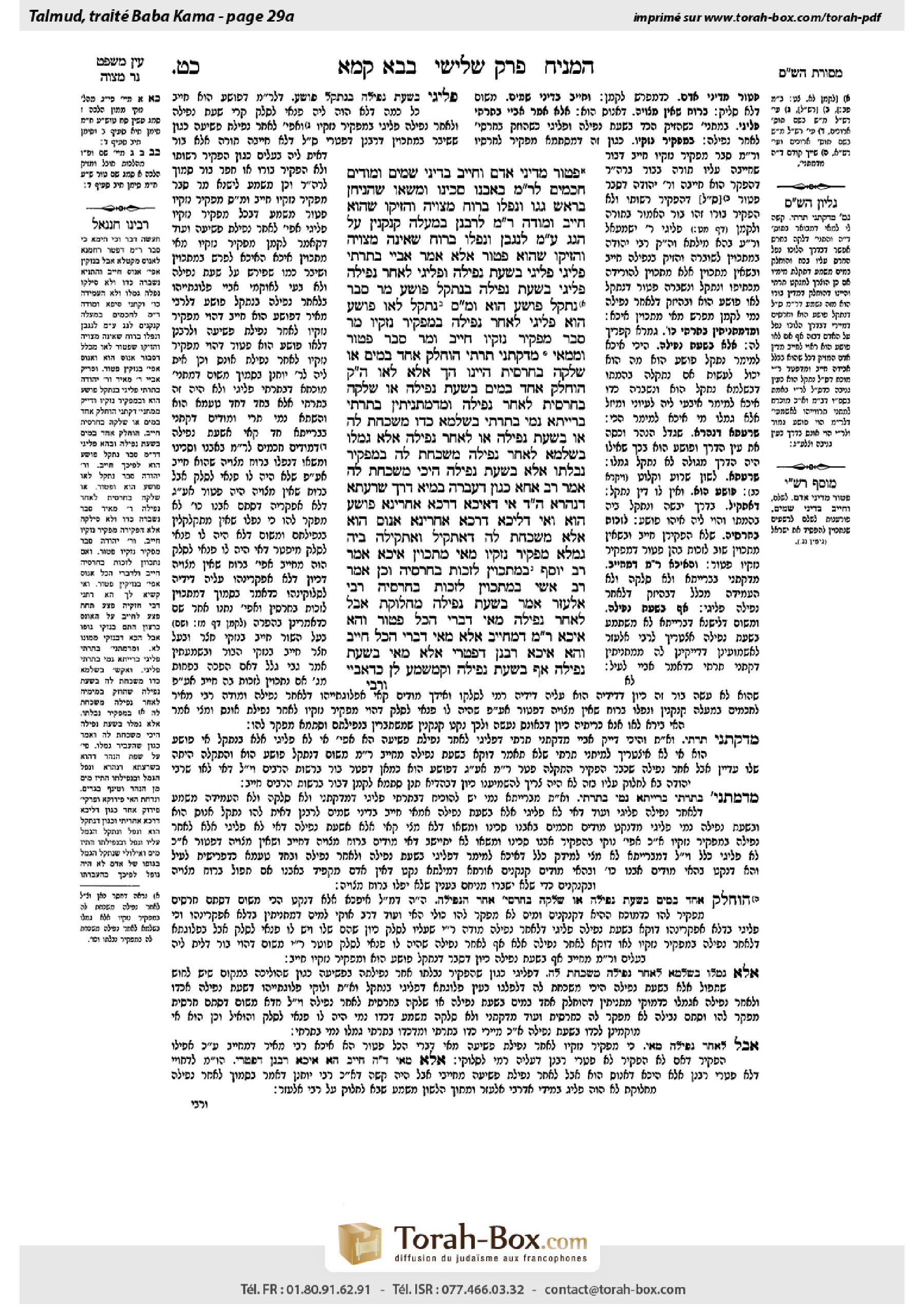
Bava Kamma 29a: Talmud study for Daf Yomi
Study the Talmud for Daf Yomi with scanned pages, Hebrew text, English translations from Sefaria and AI-generated French translations.
Passage selection and English or AI-generated French translation are available where the scan has annotations. Daf Study is independent of Torah-Box and Sefaria.
Browse Bava Kamma · בבא קמא · All tractatesBava Kamma 29a text and translations
This page of Bava Kamma includes the Aramaic text, an English translation and an AI-generated French translation, alongside the scan above.
בבא קמא כ״ט א · Aramaic and Hebrew text
פָּטוּר מִדִּינֵי אָדָם, וְחַיָּיב בְּדִינֵי שָׁמַיִם.
וּמוֹדִים חֲכָמִים לְרַבִּי מֵאִיר, בְּאַבְנוֹ סַכִּינוֹ וּמַשָּׂאוֹ שֶׁהִנִּיחָן בְּרֹאשׁ גַּגּוֹ, וְנָפְלוּ בְּרוּחַ מְצוּיָה וְהִזִּיקוּ – שֶׁהוּא חַיָּיב. וּמוֹדֶה רַבִּי מֵאִיר לְרַבָּנַן, בְּמַעֲלֵה קַנְקַנִּין עַל הַגָּג עַל מְנָת לְנַגְּבָן, וְנָפְלוּ בְּרוּחַ שֶׁאֵינָהּ מְצוּיָה וְהִזִּיקוּ – שֶׁהוּא פָּטוּר.
אֶלָּא אָמַר אַבָּיֵי: בְּתַרְתֵּי פְּלִיגִי; פְּלִיגִי בִּשְׁעַת נְפִילָה, וּפְלִיגִי לְאַחַר נְפִילָה.
פְּלִיגִי בִּשְׁעַת נְפִילָה – בְּנִתְקָל פּוֹשֵׁעַ. מָר סָבַר: נִתְקָל פּוֹשֵׁעַ הוּא, וּמָר סָבַר: נִתְקַל לָאו פּוֹשֵׁעַ הוּא.
פְּלִיגִי לְאַחַר נְפִילָה – בְּמַפְקִיר נְזָקָיו; מָר סָבַר: מַפְקִיר נְזָקָיו חַיָּיב, וּמָר סָבַר: פָּטוּר.
וּמִמַּאי? מִדְּקָתָנֵי תַּרְתֵּי: הוּחְלַק אֶחָד בַּמַּיִם, אוֹ שֶׁלָּקָה בַּחַרְסִית. הַיְינוּ הָךְ! אֶלָּא לָאו הָכִי קָאָמַר – הוּחְלַק אֶחָד בַּמַּיִם בִּשְׁעַת נְפִילָה, אוֹ שֶׁלָּקָה בַּחַרְסִית לְאַחַר נְפִילָה.
וּמִדְּמַתְנִיתִין בְּתַרְתֵּי, בָּרַיְיתָא נָמֵי בְּתַרְתֵּי.
בִּשְׁלָמָא כַּדּוֹ – מַשְׁכַּחַתְּ לַהּ אוֹ בִּשְׁעַת נְפִילָה, אוֹ לְאַחַר נְפִילָה. אֶלָּא גְּמַלּוֹ – בִּשְׁלָמָא לְאַחַר נְפִילָה, מַשְׁכַּחַתְּ לַהּ בְּמַפְקִיר נִבְלָתוֹ. אֶלָּא בִּשְׁעַת נְפִילָה, הֵיכִי מַשְׁכַּחַתְּ לַהּ?
אָמַר רַב אַחָא: כְּגוֹן דְּעַבְּרַהּ (בְּמַיָּא) דֶּרֶךְ שְׂרַעְתָּא דְנַהֲרָא.
הֵיכִי דָּמֵי? אִי דְּאִיכָּא דַּרְכָּא אַחֲרִינָא – פּוֹשֵׁעַ הוּא! וְאִי דְּלֵיכָּא דַּרְכָּא אַחֲרִינָא – אָנוּס הוּא!
אֶלָּא מַשְׁכַּחַתְּ לַהּ דְּאִתְּקִיל, וְאִתְּקִילָה בֵּיהּ גַּמְלָא.
מַפְקִיר נְזָקָיו – מַאי מִתְכַּוֵּין אִיכָּא?
אָמַר רַב יוֹסֵף: בְּמִתְכַּוֵּין לִזְכּוֹת בַּחֲרָסֶיהָ. וְכֵן אָמַר רַב אָשֵׁי: בְּמִתְכַּוֵּין לִזְכּוֹת בַּחֲרָסֶיהָ.
רַבִּי אֶלְעָזָר אָמַר: בִּשְׁעַת נְפִילָה מַחְלוֹקֶת.
אֲבָל לְאַחַר נְפִילָה מַאי – דִּבְרֵי הַכֹּל פָּטוּר? וְהָא אִיכָּא רַבִּי מֵאִיר דִּמְחַיֵּיב! אֶלָּא מַאי – דִּבְרֵי הַכֹּל חַיָּיב? וְהָא אִיכָּא רַבָּנַן דְּפָטְרִי!
אֶלָּא מַאי ״בִּשְׁעַת נְפִילָה״ – אַף בִּשְׁעַת נְפִילָה, וְקָמַשְׁמַע לַן כִּדְאַבָּיֵי.
Bava Kamma 29a · English translation
he is exempt according to human laws but liable according to the laws of Heaven.
The Gemara comments: And the Rabbis concede to the opinion of Rabbi Meir in the cases of one’s stone, one’s knife, or one’s load, that if he placed them on top of his roof and they fell as a result of being blown off by a typical wind, i.e., one of ordinary force, and they caused damage, that he is liable. And Rabbi Meir concedes to the opinion of the Rabbis in the case of one who puts pitchers [kankanin] on the roof in order to dry them, and they fell as a result of being blown off by an atypical wind, i.e., one of unusual force, and they caused damage, that he is exempt. Evidently, even Rabbi Meir concedes that if one’s property causes damage due to circumstances completely beyond his control, he is exempt.
Accordingly, Abaye rejects Rabba’s explanation of Rabbi Yehuda’s statement, that he deems the owner of the jug liable even if he merely attempted to take it off his shoulder and it broke, and offers another explanation. Rather, Abaye said that Rabbi Meir and Rabbi Yehuda disagree with regard to two different situations. They disagree with regard to a situation where the damage was caused at the time of the person’s fall, and they disagree with regard to a situation where the damage was caused after the person’s fall.
They disagree in a situation where the damage was caused at the time of the person’s fall, with regard to whether or not one who stumbles, thereby causing his jug to break, is considered negligent. One Sage, Rabbi Meir, holds that one who stumbles is considered negligent, as his carelessness caused him to stumble. Therefore, he is liable to pay for damage caused by the shards of the jug, which broke as result of his stumbling. And one Sage, Rabbi Yehuda, holds that one who stumbles is not considered negligent.
They disagree in a situation where the damage was caused after the person’s fall, with regard to one who renounces ownership of his hazardous property. Presumably, the owner of the jug has no interest in keeping the shards, and it is considered as though he renounced his ownership of them. One Sage, Rabbi Meir, holds that one who renounces ownership of his hazardous property is liable to pay restitution for damage caused by it, despite the fact that it no longer belongs to him. And one Sage, Rabbi Yehuda, holds that he is exempt from paying restitution, as it does not belong to him anymore.
And from where is this interpretation derived? It is derived from the fact that the mishna teaches two possible cases of damage, stating: Another person slipped in the water or was injured by the shards. This case, slipping in the water, is seemingly identical to that case, injured by the shards. Rather, is it not necessary to explain that this is what the mishna is saying: Another person slipped in the water at the time of the person’s fall, or was injured by the shards after the person’s fall?
The Gemara infers: And since the dispute in the mishna is with regard to two situations, the dispute in the baraita between Rabbi Meir and the Rabbis must also relate to two situations, as there too, two cases are mentioned, a case where one’s jug broke and a case where one’s camel fell. Apparently, the dispute is with regard to damage caused both at the time of the fall and after the fall. Rabbi Meir holds that one who stumbles and breaks his jug, causing damage to others, is considered negligent and that one who renounces ownership of his hazardous property is liable, and the Rabbis disagree with regard to both issues.
The Gemara asks: Granted, with regard to the case where one’s jug broke, you find these circumstances either at the time of the fall or after the fall. But with regard to the case where his camel fell, granted, you find this circumstance after the fall, when he renounces his ownership of the carcass, not considering it worth keeping, but how can you find these circumstances at the time of the fall? How can the camel’s falling be considered to be due to the owner’s negligence, possibly rendering him liable to pay for injuries caused by it?
Rav Aḥa said: For example, in a case where the camel crossed through water, through the inundation [serata] of a river that overflowed its banks, and it stumbled there, the owner was negligent, as he should not have gone this way.
The Gemara asks: What are the circumstances? If there was another route, and he nevertheless chose this one, he is clearly negligent according to all opinions. And if there was no other route, he is a victim of circumstances beyond his control, and he is exempt from liability according to all opinions.
Rather, you find this circumstance in a case where the owner stumbled and the camel then stumbled on him. In this case, the Sages engage in a dispute whether or not one who stumbles is considered negligent.
The Gemara asks: According to Abaye’s explanation that the dispute between Rabbi Meir and Rabbi Yehuda is with regard to a situation where the owner of the jug renounces ownership of his hazardous property after it falls, what is the meaning of Rabbi Yehuda’s statement that if the owner of the jug acted with intent he is liable? What intention is there after the jug fell and broke?
Rav Yosef said: It is a situation where he intends to acquire the shards of the broken jug, and he does not renounce his ownership of them. It is specifically in that case that Rabbi Yehuda holds him liable to pay for damage caused by the shards. And similarly, Rav Ashi said: It is a situation where he intends to acquire the shards.
§ Rabbi Elazar says: The dispute in the baraita is with regard to a situation where the damage occurred at the time of the person’s fall.
The Gemara asks: But after the fall, according to this statement, what is the halakha? Does everyone agree that the owner of the jug is exempt from liability? But isn’t there Rabbi Meir, who deems him liable, since he did not remove the shards? Rather, what is the halakha? Does everyone agree that he is liable? But aren’t there the Rabbis, who deem him exempt?
The Gemara answers: Rather, what is the explanation of the phrase: At the time of the person’s fall? It means even at the time of the person’s fall, and it teaches us that the dispute is referring to a situation where the damage occurred after the fall and also to a situation where it occurred at the time of the fall, in accordance with Abaye’s explanation of the mishna.
Bava Kamma 29a · Traduction française (IA)
il est exempt selon les lois humaines mais soumis aux lois du Royaume des Cieux.
La Guemara commente : Et les Rabbins reconnaissent l'opinion de Rabbi Meir dans les cas d'une pierre, d'un couteau ou d'une charge appartenant à quelqu'un, si celui-ci les place sur le toit et qu'ils tombent en raison d'un vent normal, c'est-à-dire d'un vent de force ordinaire, et qu'ils causent un préjudice, il est responsable. Et Rabbi Meir reconnaît l'opinion des Rabbins dans le cas d'une personne qui place des seaux [kankanin] sur le toit pour les sécher, et qu'ils tombent en raison d'un vent inhabituel, c'est-à-dire d'un vent de force inhabituelle, et qu'ils causent un préjudice, il est exempt. Évidemment, même Rabbi Meir reconnaît que si la propriété d'une personne cause un préjudice en raison de circonstances entièrement hors de son contrôle, il est exempt.
Ainsi, Abaye rejette l'explication de Rabba concernant l'affirmation de Rabbi Yehuda, qui considère le propriétaire du récipient comme responsable même s'il n'a fait qu'essayer de le retirer de son épaule et qu'il s'est brisé, et propose une autre explication. Plutôt, Abaye dit que Rabbi Meir et Rabbi Yehuda divergent concernant deux situations différentes. Ils divergent concernant une situation où le préjudice a été causé au moment de la chute de la personne, et ils divergent concernant une situation où le préjudice a été causé après la chute de la personne.
Ils divergent dans une situation où le préjudice a été causé au moment de la chute de la personne, concernant la question de savoir si celui qui trébuche, causant ainsi la rupture de son récipient, est considéré comme négligent. Un Sage, Rabbi Meir, considère que celui qui trébuche est négligent, car son négligence a causé sa chute. Par conséquent, il est responsable de payer le préjudice causé par les éclats du récipient, qui se sont brisés en raison de sa chute. Et un autre Sage, Rabbi Yehuda, considère que celui qui trébuche n'est pas considéré comme négligent.
Ils divergent dans une situation où le préjudice a été causé après la chute de la personne, concernant celui qui renonce à la propriété de son bien dangereux. Presumably, le propriétaire du récipient n'a plus d'intérêt à conserver les éclats, et cela est considéré comme s'il avait renoncé à sa propriété. Un Sage, Rabbi Meir, considère que celui qui renonce à la propriété de son bien dangereux est responsable de payer la réparation du préjudice causé par ce bien, même s'il n'appartient plus à lui. Et un autre Sage, Rabbi Yehuda, considère qu'il est exempt de payer la réparation, car il n'appartient plus à lui.
Et d'où cette interprétation est-elle tirée ? C'est à partir du fait que la Michna enseigne deux cas possibles de préjudice, en disant : Une autre personne a glissé dans l'eau ou a été blessée par les éclats. Ce cas, glisser dans l'eau, semble être identique à celui, blessé par les éclats. Plutôt, n'est-ce pas nécessaire d'expliquer que c'est ce que la Michna dit : Une autre personne a glissé dans l'eau au moment de la chute de la personne, ou a été blessée par les éclats après la chute de la personne ?
La Guemara déduit : Et puisque le désaccord dans la Michna est relatif à deux situations, le désaccord dans la baraïta entre Rabbi Meir et les Rabbins doit aussi être relatif à deux situations, car là aussi, deux cas sont mentionnés, un cas où le récipient de quelqu'un s'est brisé et un cas où le chameau de quelqu'un s'est écrasé. Apparemment, le désaccord est relatif au préjudice causé à l'époque de la chute et après la chute. Rabbi Meir considère que celui qui trébuche et brise son récipient, causant un préjudice à autrui, est négligent et que celui qui renonce à la propriété de son bien dangereux est responsable, et les Rabbins divergent sur les deux points.
La Guemara pose la question : D'accord, concernant le cas où le récipient de quelqu'un s'est brisé, vous trouvez ces circonstances soit au moment de la chute soit après la chute. Mais concernant le cas où le chameau de quelqu'un s'est écrasé, d'accord, vous trouvez cette circonstance après la chute, lorsque l'homme renonce à la propriété du cadavre, ne considérant pas qu'il vaut la peine d'être conservé, mais comment pouvez-vous trouver ces circonstances au moment de la chute ? Comment la chute du chameau peut-elle être considérée comme due à la négligence de l'propriétaire, ce qui pourrait le rendre responsable des blessures causées par ce chameau ?
Rav Aḥa dit : Par exemple, dans un cas où le chameau traverse de l'eau, à travers l'inondation [serata] d'un fleuve qui a débordé ses rives, et qu'il trébuche là, l'propriétaire est négligent, car il ne devrait pas avoir pris ce chemin.
La Guemara pose la question : Quelles sont les circonstances ? Si un autre chemin existait et qu'il a tout de même choisi celui-ci, il est clairement négligent selon toutes les opinions. Et si aucun autre chemin n'existait, il est victime de circonstances hors de son contrôle, et il est exempt de responsabilité selon toutes les opinions.
Plutôt, vous trouvez cette circonstance dans un cas où l'propriétaire trébuche et le chameau trébuche sur lui. Dans ce cas, les Sages divergent concernant la question de savoir si celui qui trébuche est considéré comme négligent.
La Guemara pose la question : Selon l'explication d'Abaye que le désaccord entre Rabbi Meir et Rabbi Yehuda est concernant une situation où le propriétaire du récipient renonce à la propriété de son bien dangereux après qu'il est tombé, quelle est la signification de l'affirmation de Rabbi Yehuda qui dit que si l'propriétaire du récipient agit avec l'intention, il est responsable ? Quelle intention peut-il avoir après que le récipient est tombé et s'est brisé ?
Rav Yosef dit : C'est une situation où il veut acquérir les éclats du récipient brisé, et il ne renonce pas à sa propriété. C'est précisément dans ce cas que Rabbi Yehuda considère qu'il est tenu responsable de payer le préjudice causé par les éclats. De même, Rav Ashi dit : C'est une situation où il veut acquérir les éclats.
§ Rabbi Elazar dit : Le désaccord dans la baraïta concerne une situation où le préjudice a eu lieu au moment de la chute de la personne.
La Guemara pose la question : Mais après la chute, selon cette déclaration, quelle est la halakha ? Tout le monde est-il d'accord sur le fait que le propriétaire du récipient est exempt de responsabilité ? Mais n'y a-t-il pas Rabbi Meïr, qui le considère comme responsable, puisqu'il n'a pas retiré les éclats ? Plutôt, quelle est la halakha ? Tout le monde est-il d'accord sur le fait qu'il est responsable ? Mais n'y a-t-il pas les Rabbins, qui le considèrent comme exempt ?
La Guemara répond : Plutôt, quelle est l'explication de la phrase : À l'époque de la chute de la personne ? Cela signifie même à l'époque de la chute de la personne, et cela nous apprend que le débat concerne une situation où le dommage s'est produit après la chute et également une situation où il s'est produit à l'époque de la chute, conformément à l'explication d'Abaye sur la mitsna.
Traduction française générée par IA à partir de l’édition anglaise de Sefaria. Vérifie toujours un passage avec le texte source.
Text from Sefaria: William Davidson Edition - Vocalized Aramaic (CC BY NC); William Davidson Edition - English (CC BY NC).