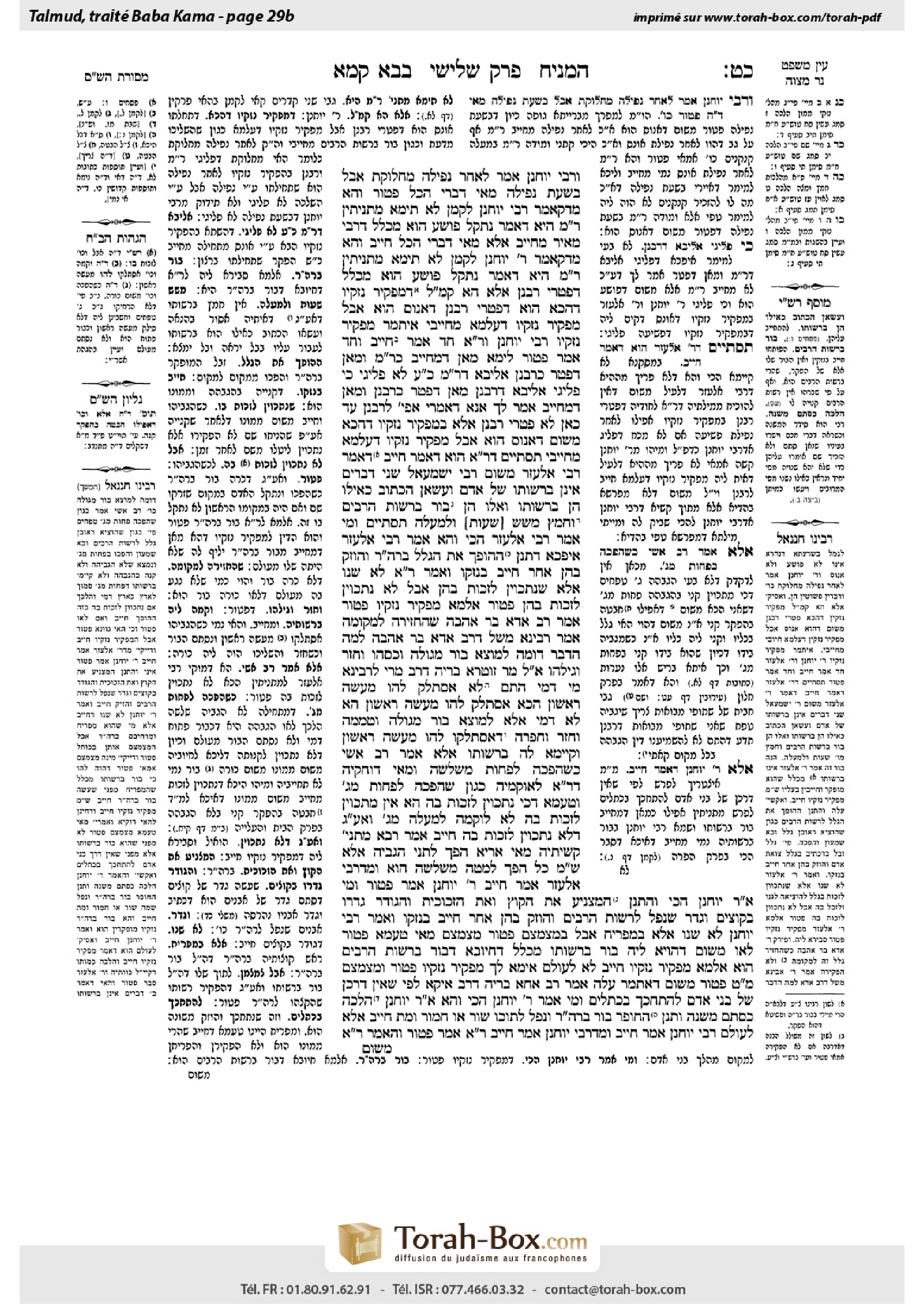
Bava Kamma 29b: Talmud study for Daf Yomi
Study the Talmud for Daf Yomi with scanned pages, Hebrew text, English translations from Sefaria and AI-generated French translations.
Passage selection and English or AI-generated French translation are available where the scan has annotations. Daf Study is independent of Torah-Box and Sefaria.
Browse Bava Kamma · בבא קמא · All tractatesBava Kamma 29b text and translations
This page of Bava Kamma includes the Aramaic text, an English translation and an AI-generated French translation, alongside the scan above.
בבא קמא כ״ט ב · Aramaic and Hebrew text
וְרַבִּי יוֹחָנָן אָמַר: לְאַחַר נְפִילָה מַחְלוֹקֶת.
אֲבָל בִּשְׁעַת נְפִילָה מַאי – דִּבְרֵי הַכֹּל פָּטוּר? וְהָא מִדְּקָאָמַר רַבִּי יוֹחָנָן לְקַמַּן: לָא תֵּימָא מַתְנִיתִין רַבִּי מֵאִיר הִיא, דְּאָמַר נִתְקָל פּוֹשֵׁעַ הוּא; מִכְּלָל דְּרַבִּי מֵאִיר מְחַיֵּיב!
אֶלָּא מַאי – דִּבְרֵי הַכֹּל חַיָּיב? וְהָא מִדְּקָאָמַר רַבִּי יוֹחָנָן לְקַמַּן: לָא תֵּימָא מַתְנִיתִין רַבִּי מֵאִיר הִיא, דְּאָמַר נִתְקָל פּוֹשֵׁעַ הוּא; מִכְּלָל דְּפָטְרִי רַבָּנַן!
אֶלָּא הָא קָא מַשְׁמַע לַן – דְּמַפְקִיר נְזָקָיו דְּהָכָא הוּא דְּפָטְרִי רַבָּנַן, דְּאָנוּס הוּא; אֲבָל מַפְקִיר נְזָקָיו דְּעָלְמָא – מְחַיְּיבִי.
אִיתְּמַר: מַפְקִיר נְזָקָיו; רַבִּי יוֹחָנָן וְרַבִּי אֶלְעָזָר – חַד אָמַר: חַיָּיב, וְחַד אָמַר: פָּטוּר.
לֵימָא מַאן דִּמְחַיֵּיב – כְּרַבִּי מֵאִיר, וּמַאן דְּפָטַר – כְּרַבָּנַן?
אַלִּיבָּא דְּרַבִּי מֵאִיר – כּוּלֵּי עָלְמָא לָא פְּלִיגִי, כִּי פְּלִיגִי – אַלִּיבָּא דְּרַבָּנַן. מַאן דְּפָטַר – כְּרַבָּנַן; וּמַאן דִּמְחַיֵּיב אָמַר לָךְ: אֲנָא דַּאֲמַרִי – אֲפִילּוּ לְרַבָּנַן, עַד כָּאן לָא פָּטְרִי רַבָּנַן, אֶלָּא בְּמַפְקִיר נְזָקָיו דְּהָכָא, מִשּׁוּם דְּאָנוּס הוּא; אֲבָל מַפְקִיר נְזָקָיו דְּעָלְמָא – מְחַיְּיבִי.
תִּסְתַּיֵּים דְּרַבִּי אֶלְעָזָר הוּא דְּאָמַר חַיָּיב – דְּאָמַר רַבִּי אֶלְעָזָר מִשּׁוּם רַבִּי יִשְׁמָעֵאל: שְׁנֵי דְּבָרִים אֵינָן בִּרְשׁוּתוֹ שֶׁל אָדָם, וַעֲשָׂאָן הַכָּתוּב כְּאִילּוּ הֵן בִּרְשׁוּתוֹ; וְאֵלּוּ הֵן: בּוֹר בִּרְשׁוּת הָרַבִּים, וְחָמֵץ מִשֵּׁשׁ שָׁעוֹת וּלְמַעְלָה. תִּסְתַּיֵּים.
וּמִי אָמַר רַבִּי אֶלְעָזָר הָכִי? וְהָא אָמַר רַבִּי אֶלְעָזָר אִיפְּכָא! דִּתְנַן: הַהוֹפֵךְ אֶת הַגָּלָל בִּרְשׁוּת הָרַבִּים, וְהוּזַּק בָּהֶן אַחֵר – חַיָּיב בְּנִזְקוֹ. וְאָמַר רַבִּי אֶלְעָזָר: לֹא שָׁנוּ אֶלָּא שֶׁנִּתְכַּוֵּין לִזְכּוֹת בָּהֶן, אֲבָל לֹא נִתְכַּוֵּין לִזְכּוֹת בָּהֶן – פָּטוּר. אַלְמָא מַפְקִיר נְזָקָיו – פָּטוּר!
אָמַר רַב אַדָּא בַּר אַהֲבָה: שֶׁהֶחְזִירָהּ לִמְקוֹמָהּ. אָמַר רָבִינָא: מָשָׁל דְּרַב אַדָּא בַּר אַהֲבָה לָמָּה הַדָּבָר דּוֹמֶה – לְמוֹצֵא בּוֹר מְגוּלֶּה, וְכִסָּהוּ, וְחָזַר וְגִילָּהוּ.
אֲמַר לֵיהּ מָר זוּטְרָא בְּרֵיהּ דְּרַב מָרִי לְרָבִינָא: מִי דָּמֵי?! הָתָם – לָא אִסְתַּלֻּק לְהוּ מַעֲשֵׂה רִאשׁוֹן, הָכָא – אִסְתַּלֻּק לְהוּ מַעֲשֵׂה רִאשׁוֹן.
הָא לָא דָּמֵי אֶלָּא לְמוֹצֵא בּוֹר מְגוּלָּה, וּטְמָמָהּ וְחָזַר וַחֲפָרָהּ – דְּאִסְתַּלִּקוּ לְהוּ מַעֲשֵׂה רִאשׁוֹן, וְקָיְימָא לַהּ בִּרְשׁוּתוֹ!
אֶלָּא אָמַר רַב אָשֵׁי: כְּשֶׁהֲפָכָהּ לְפָחוֹת מִשְּׁלֹשָׁה.
וּמַאי דּוּחְקֵיהּ דְּרַבִּי אֶלְעָזָר לְאוֹקֹמַיהּ כְּגוֹן שֶׁהֲפָכָהּ לְפָחוֹת מִשְּׁלֹשָׁה – וְטַעְמָא דְּכִי נִתְכַּוֵּין לִזְכּוֹת בָּהּ, הָא אֵין מִתְכַּוֵּין לִזְכּוֹת בָּהּ – לָא? לוֹקְמַהּ לְמַעְלָה מִשְּׁלֹשָׁה, וְאַף עַל גַּב דְּלָא נִתְכַּוֵּין לִזְכּוֹת בָּהּ – חַיָּיב!
אָמַר רָבָא: מַתְנִיתִין קְשִׁיתֵיהּ – מַאי אִרְיָא ״הָפַךְ״? לִתְנֵי ״הִגְבִּיהַּ״! אֶלָּא שְׁמַע מִינַּהּ, כֹּל ״הָפַךְ״ – לְמַטָּה מִשְּׁלֹשָׁה הוּא.
וּמִדְּרַבִּי אֶלְעָזָר אָמַר חַיָּיב, רַבִּי יוֹחָנָן אָמַר פָּטוּר.
וּמִי אָמַר רַבִּי יוֹחָנָן הָכִי?! וְהָתְנַן: הַמַּצְנִיעַ אֶת הַקּוֹץ וְאֶת הַזְּכוּכִית; וְהַגּוֹדֵר גְּדֵרוֹ בְּקוֹצִים; וְגָדֵר שֶׁנָּפַל לִרְשׁוּת הָרַבִּים; וְהוּזַּק בָּהֶן אַחֵר – חַיָּיב בְּנִזְקוֹ.
וְאָמַר רַבִּי יוֹחָנָן: לֹא שָׁנוּ אֶלָּא בְּמַפְרִיחַ, אֲבָל בִּמְצַמְצֵם – פָּטוּר. מְצַמְצֵם מַאי טַעְמָא פָּטוּר – לָאו מִשּׁוּם דְּהָוְיָא לֵיהּ בּוֹר בִּרְשׁוּתוֹ? מִכְּלַל דְּחִיּוּבָא דְבוֹר – בִּרְשׁוּת הָרַבִּים הוּא; אַלְמָא מַפְקִיר נְזָקָיו חַיָּיב!
לָא, לְעוֹלָם אֵימָא לָךְ: מַפְקִיר נְזָקָיו פָּטוּר; וּמְצַמְצֵם מַאי טַעְמָא פָּטוּר – מִשּׁוּם דְּאִתְּמַר עֲלַהּ, אָמַר רַב אַחָא בְּרֵיהּ דְּרַב אִיקָא: לְפִי שֶׁאֵין דַּרְכָּן שֶׁל בְּנֵי אָדָם לְהִתְחַכֵּךְ בַּכְּתָלִים.
וּמִי אָמַר רַבִּי יוֹחָנָן הָכִי? וְהָא אָמַר רַבִּי יוֹחָנָן: הֲלָכָה כִּסְתַם מִשְׁנָה, וּתְנַן: הַחוֹפֵר בּוֹר בִּרְשׁוּת הָרַבִּים, וְנָפַל לְתוֹכוֹ שׁוֹר אוֹ חֲמוֹר וָמֵת – חַיָּיב!
אֶלָּא לְעוֹלָם רַבִּי יוֹחָנָן אָמַר חַיָּיב.
וּמִדְּרַבִּי יוֹחָנָן אָמַר חַיָּיב – רַבִּי אֶלְעָזָר אָמַר פָּטוּר?! וְהָאָמַר רַבִּי אֶלְעָזָר
Bava Kamma 29b · English translation
And Rabbi Yoḥanan says: The dispute is with regard to a situation where the damage occurred after the fall.
The Gemara asks: But at the time of the person’s fall, according to this statement, what is the halakha? Does everyone agree that the owner of the jug is exempt from liability? But from the fact that Rabbi Yoḥanan says later (31a), with regard to another mishna in this chapter: Do not say that the mishna is the opinion of Rabbi Meir, who says that one who stumbles is considered negligent, by inference it is clear that he holds that Rabbi Meir deems one who stumbles liable to pay damages. Evidently, it is not unanimously agreed upon that he is exempt.
Rather, what is the halakha in this case? Does he say that everyone agrees that he is liable? But from the fact that Rabbi Yoḥanan says later: Do not say that the mishna is the opinion of Rabbi Meir, who says that one who stumbles is considered negligent, by inference it is clear that he holds that the Rabbis deem him exempt.
The Gemara answers: Rather, this is what Rabbi Yoḥanan teaches us: That the circumstance in which the Rabbis deem one who renounces ownership of his hazardous property exempt is only the situation stated here, i.e., where he stumbled, as he is the victim of circumstances beyond his control. But in the general case of one who renounces ownership of his hazardous property, they deem him liable to pay for damage caused by it.
§ It was stated: With regard to one who renounces ownership of his hazardous property that he left in the public domain, there is a dispute between the amora’im Rabbi Yoḥanan and Rabbi Elazar. One said that he is liable, and one said that he is exempt.
The Gemara suggests: Shall we say that the one who deems him liable holds in accordance with the opinion of Rabbi Meir, and the one who deems him exempt holds in accordance with the opinion of the Rabbis?
The Gemara responds: No; in accordance with the opinion of Rabbi Meir, everyone agrees that one who renounces ownership over his hazardous property is liable. Rather, when they disagree it is in accordance with the opinion of the Rabbis. They disagree as to what the opinion of the Rabbis is. The one who deems him exempt holds that his opinion is in accordance with the opinion of the Rabbis. And the one who deems him liable could have said to you: I maintain that what I say is correct even according to the opinion of the Rabbis; the Rabbis deem one who renounces ownership over his hazardous property exempt only in the situation here, because he is a victim of circumstances beyond his control. But in a general case of one who renounces ownership of his hazardous property, they deem him liable.
The Gemara suggests: It may be concluded that Rabbi Elazar is the one who says that he is liable, as Rabbi Elazar says in the name of Rabbi Yishmael: There are two entities that are not in a person’s legal possession and nevertheless the verse rendered them as though they were in his possession with regard to certain halakhic responsibilities. And these are: A pit that he dug in the public domain and leavened bread remaining in his possession on the eve of Passover from six hours, i.e., noon, onward. Although deriving any benefit from the bread is prohibited, and it is therefore no longer in its owner’s legal possession, nevertheless he is commanded to destroy it. The Gemara concludes: It may be concluded that Rabbi Elazar is the one who says that he is liable.
The Gemara asks: And did Rabbi Elazar actually say this, that one who renounces ownership of his hazardous objects is liable? But didn’t Rabbi Elazar say the opposite? As we learned in a mishna (30a): In the case of one who turns over dung in the public domain and another person incurred damage due to it, he is liable to pay for his damage. And Rabbi Elazar says: They taught this ruling only in a case where the one who turned over the dung intended to acquire it, but in a case where he did not intend to acquire it he is exempt. Apparently, according to Rabbi Elazar, one who renounces ownership of his hazardous property is exempt, since he is liable only if he intends to take possession of the dung, even if he moved it significantly.
Rav Adda bar Ahava said: Rabbi Elazar was referring to a case where he returned the dung to its prior place. Therefore, he is exempt unless he intended to acquire it. Ravina said: This can be explained by means of a parable: To what is the statement of Rav Adda bar Ahava comparable? To one who finds an uncovered pit in the public domain and covers it, and then uncovers it again. Since he left the pit as he found it, he is exempt from paying damages, and the liability lies with the one who dug the pit.
Mar Zutra, son of Rav Mari, said to Ravina: Is this comparable? There, in the case of the pit, the result of the initial act of digging the pit was not removed, since even when he covered the pit, the pit itself still existed. But here, the result of the initial act was removed, since once the dung was moved from its prior place, there was no longer any hazardous object there. Therefore, by returning it to its place, the hazard is created anew.
Rather, it is comparable only to one who finds an uncovered pit and fills it with dirt and then digs it up again, as in this case the result of the initial act is removed, and the new pit therefore exists in his possession and he is liable. Likewise, one who moves dung in the public domain and then restores it to its prior place is deemed liable whether or not he intends to acquire it.
Rather, Rav Ashi said that Rabbi Elazar was referring to a case when he turned it over at a height of less than three handbreadths, which is not considered removal of the dung from its place.
The Gemara asks: But according to this explanation, what forced Rabbi Elazar to interpret the mishna as referring specifically to the unique case where he turned over the dung at a height of less than three handbreadths, and consequently the reason he is liable is that he intended to acquire it, but if he does not intend to acquire it he is not liable? Let him interpret the mishna as referring to a case where he turned over the dung at a height above three handbreadths, in which case even if he did not intend to acquire it, he is liable.
Rava said: What forced him was that the mishna was difficult for him. Why does it state specifically that he turned over the dung? Let it teach that he lifted the dung. Rather, learn from the fact that the mishna does not use the term: Lifted, which generally is referring to the act of lifting an object three handbreadths for the purpose of acquisition, that whenever the term turned over is used, it is referring to an act in which the object is lifted to a height of under three handbreadths from the ground.
The Gemara concludes: And from the fact that Rabbi Elazar was evidently the one who said that one who renounces ownership of his hazardous object in the public domain is still liable to pay for any damage it causes, Rabbi Yoḥanan is clearly the one who said he is exempt.
The Gemara asks: And did Rabbi Yoḥanan actually say this, that if one renounces ownership of his object he is exempt from liability for any damage it causes? But didn’t we learn in a mishna (30a): With regard to one who conceals a thorn or a piece of glass, or who puts up a fence of thorns, or who puts up a fence that subsequently fell into the public domain, and another person incurred damage due to any of these, he is liable to pay for this person’s damage.
And Rabbi Yoḥanan says: With regard to one who puts up a fence of thorns, they taught that he is liable only in a case where he projects the thorns out into the public domain, but in a case where he restricts them to his own property, he is exempt. The Gemara infers: In a case where he restricts them, what is the reason that he is exempt? Is it not because it is considered a pit on his own property? By inference, the liability in the category of Pit, according to Rabbi Yoḥanan, is in the public domain, where a pit generally does not belong to the one who dug it. Apparently, Rabbi Yoḥanan holds that one who renounces ownership of his hazardous property is liable.
The Gemara answers: No, actually I could say to you that in principle, one who renounces ownership of his hazardous property is exempt. Nevertheless, one who puts up a fence of thorns is liable, because he does not renounce ownership of the thorns that protrude into the public domain. And in a case where he restricts the thorns to his own property, what is the reason he is exempt? The reason is not that he is not liable to pay for the damage of a pit in his own property, but rather because it was stated about this case that Rav Aḥa, son of Rav Ika, said: He is exempt because it is not the typical manner of people to rub against walls, but to keep a small distance from them. Therefore, if a pedestrian is injured by the thorns, it is considered an unusual accident, for which the owner of the fence is not liable.
The Gemara asks: And did Rabbi Yoḥanan actually say that one who renounces ownership of his hazardous objects is exempt? But didn’t Rabbi Yoḥanan say that in general, the halakha is in accordance with an unattributed mishna, and we learned in an unattributed mishna (50b): In the case of one who digs a pit in the public domain and an ox or a donkey fell into it and died, he is liable. This mishna is referring to one who digs a pit in the public domain, where it is not owned by the one who dug it, yet the mishna deems him liable.
The Gemara concludes: Rather, Rabbi Yoḥanan is actually the one who said that one who renounces ownership of his hazardous objects is liable.
The Gemara asks: And from the fact that Rabbi Yoḥanan said that he is liable, is it evident that Rabbi Elazar said that he is exempt? But doesn’t Rabbi Elazar say
Bava Kamma 29b · Traduction française (IA)
Et le maître Yochanan dit : La discussion porte sur un cas où le préjudice s'est produit après la chute.
La Guemara demande : Mais à l'époque de la chute de la personne, selon cette déclaration, quelle est la halakha ? Tout le monde est-il d'accord sur le fait que le propriétaire du récipient est exempt de responsabilité ? Mais du fait que le maître Yochanan dit plus tard (31a), concernant une autre mitsva de ce chapitre : Ne dites pas que la mitsva est l'opinion du maître Méir, qui dit qu'une personne qui trébuche est considérée comme négligente, par déduction il est clair qu'il considère que les docteurs le considèrent comme exempt. Évidemment, il n'est pas unanimement d'accord sur le fait qu'il soit exempt.
Plutôt, quelle est la halakha dans ce cas ? Dit-il que tout le monde est d'accord sur le fait qu'il est responsable ? Mais du fait que le maître Yochanan dit plus tard : Ne dites pas que la mitsva est l'opinion du maître Méir, qui dit qu'une personne qui trébuche est considérée comme négligente, par déduction il est clair qu'il considère que les docteurs le considèrent comme exempt.
La Guemara répond : Plutôt, c'est ce que le maître Yochanan nous enseigne : que le cas où les docteurs considèrent une personne qui renonce à la propriété de son objet dangereux comme exempt est seulement le cas évoqué ici, c'est-à-dire où il a trébuché, car il est la victime de circonstances hors de son contrôle. Mais dans le cas général d'une personne qui renonce à la propriété de son objet dangereux, ils considèrent qu'il est responsable des dommages causés par celui-ci.
§ Il a été dit : Concernant une personne qui renonce à la propriété de son objet dangereux laissé dans le domaine public, il y a un débat entre les amoraïm, le maître Yochanan et le maître Elazar. L'un dit qu'il est responsable, l'autre dit qu'il est exempt.
La Guemara suggère : Devons-nous dire que celui qui considère qu'il est responsable suit l'opinion du maître Méir, et celui qui considère qu'il est exempt suit l'opinion des docteurs ?
La Guemara répond : Non ; selon l'opinion du maître Méir, tout le monde est d'accord sur le fait qu'une personne qui renonce à la propriété de son objet dangereux est responsable. Cependant, quand ils divergent, c'est selon l'opinion des docteurs. Ils divergent sur la nature de l'opinion des docteurs. Celui qui considère qu'il est exempt considère que son opinion est conforme à celle des docteurs. Et celui qui considère qu'il est responsable aurait pu dire : Je maintiens que ce que je dis est correct même selon l'opinion des docteurs ; les docteurs considèrent qu'une personne qui renonce à la propriété de son objet dangereux est exempt seulement dans le cas présent, car il est la victime de circonstances hors de son contrôle. Mais dans le cas général d'une personne qui renonce à la propriété de son objet dangereux, ils considèrent qu'il est responsable.
La Guemara suggère : On peut conclure que le maître Elazar est celui qui affirme qu'il est responsable, car le maître Elazar cite le maître Yishmael en ces termes : Il y a deux entités qui ne sont pas dans la possession légale d'une personne, mais la Torah les considère comme si elles étaient dans sa possession concernant certaines obligations halakhiques. Ces deux entités sont : Un trou qu'il a creusé dans le domaine public et du pain aisé restant en sa possession la veille de Pessah à partir de midi, c'est-à-dire de l'après-midi. Bien que l'exploitation de ce pain soit interdite, et qu'il n'ait donc plus la possession légale de son propriétaire, il est néanmoins tenu de le détruire. La Guemara conclut : On peut conclure que le maître Elazar est celui qui affirme qu'il est responsable.
La Guemara demande : Et le maître Elazar a-t-il vraiment dit cela, que la personne qui renonce à la propriété de ses objets dangereux est responsable ? Mais n'a-t-il pas dit l'opposé ? Comme nous l'avons appris dans une mitsva (30a) : Dans le cas d'une personne qui jette de l'ordure dans le domaine public et une autre personne subit un préjudice à cause d'elle, il est responsable de payer son préjudice. Et le maître Elazar dit : Ils ont enseigné cette décision seulement dans le cas où la personne qui a jeté l'ordure avait l'intention d'en acquérir, mais dans le cas où elle n'avait pas l'intention d'en acquérir, elle est exemptée. Apparemment, selon le maître Elazar, une personne qui renonce à la propriété de son objet dangereux est exemptée, car elle est responsable seulement si elle a l'intention d'acquérir l'ordure, même s'il l'a déplacé considérablement.
Rav Adda bar Ahava dit : Le maître Elazar faisait référence à un cas où il a rendu l'ordure à son lieu d'origine. Par conséquent, il est exempt à moins qu'il n'ait l'intention d'en acquérir. Ravina dit : Cela peut être expliqué par une comparaison : À quoi est comparable la déclaration de Rav Adda bar Ahava ? À celui qui trouve un trou découvert dans le domaine public et le recouvre, puis le découvre à nouveau. Puisqu'il a laissé le trou tel qu'il l'avait trouvé, il est exempt de payer des dommages, et la responsabilité incombe à celui qui a creusé le trou.
Mar Zutra, fils de Rav Mari, dit à Ravina : Est-ce comparable ? Là, dans le cas du trou, le résultat de l'acte initial de creusement du trou n'a pas été supprimé, car même quand il a recouvert le trou, le trou lui-même existait encore. Ici, le résultat de l'acte initial a été supprimé, car une fois que l'ordure avait été déplacée de son lieu d'origine, il n'y avait plus d'objet dangereux là. Par conséquent, en le rendant à son lieu d'origine, le danger est créé à nouveau.
Plutôt, cela est comparable à celui qui découvre un trou découvert et le remplit de terre, puis le déterre à nouveau, car là, le résultat de l'acte initial est supprimé, et le nouveau trou existe donc dans sa possession et il est responsable. De même, celui qui déplace de l'ordure dans le domaine public et restaure son lieu d'origine est considéré comme responsable, qu'il ait l'intention d'en acquérir ou non.
Plutôt, Rav Ashi dit que Rabbi Elazar faisait référence à un cas où il l'a déplacé à une hauteur inférieure à trois paumes, ce qui n'est pas considéré comme un déplacement de l'ordure de son lieu d'origine.
La Guemara pose la question : Mais selon cette explication, que forçait le Rabbi Eléazar à interpréter la mitsva en ce sens précis, à savoir le cas unique où il retournait les crottins à une hauteur inférieure à trois paumes, et par conséquent la raison pour laquelle il est responsable est qu'il avait l'intention d'acquérir, mais si il n'avait pas l'intention d'acquérir, il ne serait pas responsable ? Que le Rabbi Eléazar interprète la mitsva en ce sens, à savoir le cas où il retournait les crottins à une hauteur supérieure à trois paumes, dans lequel cas même s'il n'avait pas l'intention d'acquérir, il serait responsable.
Rava dit : Ce qui le força était que la mitsva était difficile pour lui. Pourquoi la mitsva précise-t-elle qu'il retournait les crottins ? Que la mitsva enseigne qu'il levait les crottins. Plutôt, apprends-en que la mitsva ne mentionne pas le terme : levé, qui désigne généralement l'action de lever un objet à trois paumes de hauteur pour l'acquisition, que chaque fois que le terme retourné est utilisé, il désigne une action où l'objet est levé à une hauteur inférieure à trois paumes du sol.
La Guemara conclut : Et du fait que le Rabbi Eléazar était évidemment celui qui a dit qu'une personne qui renonce à la propriété de son objet dangereux dans le domaine public est encore responsable de tout dommage qu'il cause, le Rabbi Yochanan est clairement celui qui a dit qu'il est exempt.
La Guemara pose la question : Et le Rabbi Yochanan a-t-il vraiment dit cela, à savoir que si une personne renonce à la propriété de son objet, il est exempt de responsabilité pour tout dommage qu'il cause ? Mais n'avons-nous pas appris dans une mitsva (30a) : Concernant celui qui cache une épine ou un morceau de verre, ou qui érige un mur d'épines, ou qui érige un mur qui tombe ensuite dans le domaine public, et une autre personne subit un dommage à cause de l'un de ces éléments, il est responsable de ce dommage.
Et le Rabbi Yochanan dit : Concernant celui qui érige un mur d'épines, on a appris qu'il est responsable uniquement dans le cas où il projette les épines dans le domaine public, mais dans le cas où il les restreint à sa propriété, il est exempt. La Guemara en déduit : Dans le cas où il les restreint, quelle est la raison pour laquelle il est exempt ? N'est-ce pas parce qu'il est considéré comme un trou sur sa propre propriété ? Par déduction, la responsabilité dans la catégorie du trou, selon le Rabbi Yochanan, est dans le domaine public, où un trou ne appartient généralement pas à celui qui l'a creusé. Apparemment, le Rabbi Yochanan considère que celui qui renonce à la propriété de son objet dangereux est responsable.
La Guemara répond : Non, en réalité je pourrais te dire que, en principe, celui qui renonce à la propriété de son objet dangereux est exempt. Cependant, celui qui érige un mur d'épines est responsable, car il ne renonce pas à la propriété des épines qui pénètrent dans le domaine public. Et dans le cas où il restreint les épines à sa propre propriété, quelle est la raison pour laquelle il est exempt ? La raison n'est pas que la responsabilité pour le dommage d'un trou sur sa propre propriété n'existe pas, mais plutôt parce que cela a été dit à propos de ce cas que Rav Acha, fils de Rav Ika, a dit : Il est exempt car ce n'est pas la manière habituelle des gens de frôler les murs, mais de garder une petite distance. Par conséquent, si un passant est blessé par les épines, cela est considéré comme un accident inhabituel, pour lequel le propriétaire du mur n'est pas responsable.
La Guemara pose la question : Et le Rabbi Yochanan a-t-il vraiment dit que celui qui renonce à la propriété de ses objets dangereux est exempt ? Mais n'avons-nous pas appris que le Rabbi Yochanan a dit que, en général, la halakha suit une mitsva non attribuée, et nous avons appris dans une mitsva non attribuée (50b) : Dans le cas où l'on creuse un trou dans le domaine public et un bœuf ou un âne tombe dedans et meurt, il est responsable. Cette mitsva se réfère à celui qui creuse un trou dans le domaine public, où il n'appartient pas à celui qui l'a creusé, mais la mitsva considère qu'il est responsable.
La Guemara conclut : Plutôt, le Rabbi Yochanan est en réalité celui qui a dit que celui qui renonce à la propriété de ses objets dangereux est responsable.
La Guemara pose la question : Et du fait que le Rabbi Yochanan a dit qu'il est responsable, est-ce évident que le Rabbi Eléazar a dit qu'il est exempt ? Mais n'a-t-il pas dit le Rabbi Eléazar
Traduction française générée par IA à partir de l’édition anglaise de Sefaria. Vérifie toujours un passage avec le texte source.
Text from Sefaria: William Davidson Edition - Vocalized Aramaic (CC BY NC); William Davidson Edition - English (CC BY NC).