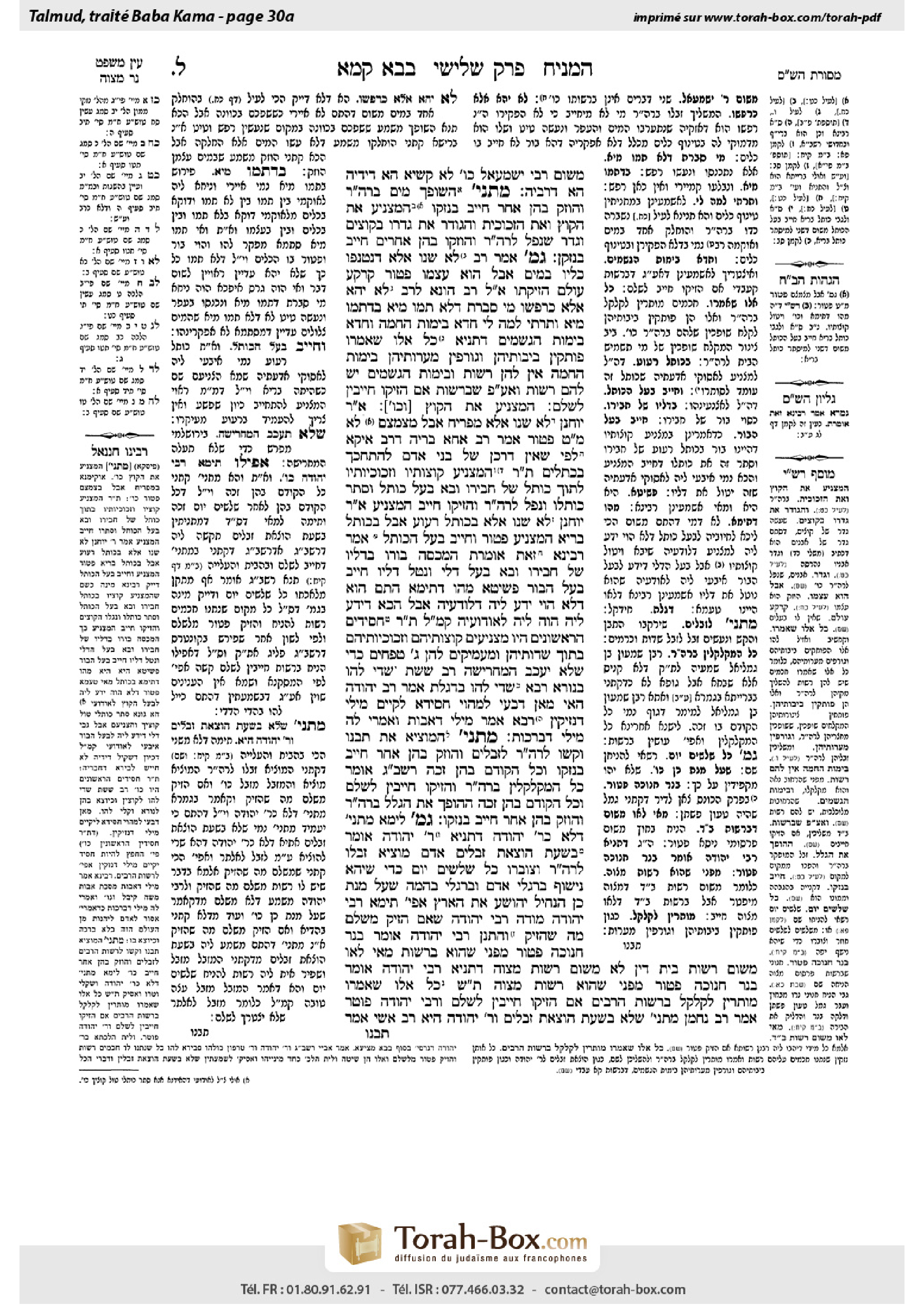
Bava Kamma 30a: Talmud study for Daf Yomi
Study the Talmud for Daf Yomi with scanned pages, Hebrew text, English translations from Sefaria and AI-generated French translations.
Passage selection and English or AI-generated French translation are available where the scan has annotations. Daf Study is independent of Torah-Box and Sefaria.
Browse Bava Kamma · בבא קמא · All tractatesBava Kamma 30a text and translations
This page of Bava Kamma includes the Aramaic text, an English translation and an AI-generated French translation, alongside the scan above.
בבא קמא ל׳ א · Aramaic and Hebrew text
מִשּׁוּם רַבִּי יִשְׁמָעֵאל כּוּ׳!
לָא קַשְׁיָא; הָא דִידֵיהּ. הָא דְרַבֵּיהּ.
מַתְנִי׳ הַשּׁוֹפֵךְ מַיִם בִּרְשׁוּת הָרַבִּים, וְהוּזַּק בָּהֶן אַחֵר – חַיָּיב בְּנִזְקוֹ. הַמַּצְנִיעַ אֶת הַקּוֹץ וְאֶת הַזְּכוּכִית; וְהַגּוֹדֵר אֶת גְּדֵרוֹ בְּקוֹצִים; וְגָדֵר שֶׁנָּפַל לִרְשׁוּת הָרַבִּים; וְהוּזְּקוּ בָּהֶן אֲחֵרִים – חַיָּיב בְּנִזְקָן.
גְּמָ׳ אָמַר רַב: לֹא שָׁנוּ אֶלָּא דְּנִטְנְפוּ כֵּלָיו בְּמַיִם, אֲבָל הוּא עַצְמוֹ – פָּטוּר; קַרְקַע עוֹלָם הִזִּיקַתּוּ.
אֲמַר לֵיהּ רַב הוּנָא לְרַב: לֹא יְהֵא אֶלָּא כְּרִפְשׁוֹ!
מִי סָבְרַתְּ דְּלָא תַּמּוּ מַיָּא?! בִּדְתַמּוּ מַיָּא.
וְתַרְתֵּי לְמָה לִי?
חֲדָא בִּימוֹת הַחַמָּה, וַחֲדָא בִּימוֹת הַגְּשָׁמִים.
דְּתַנְיָא: כׇּל אֵלּוּ שֶׁאָמְרוּ פּוֹתְקִין בִּיבוֹתֵיהֶן וְגוֹרְפִין מְעָרוֹתֵיהֶן – בִּימוֹת הַחַמָּה אֵין לָהֶן רְשׁוּת, וּבִימוֹת הַגְּשָׁמִים יֵשׁ לָהֶם רְשׁוּת. וְאַף עַל פִּי שֶׁבִּרְשׁוּת – אִם הִזִּיקוּ, חַיָּיבִין לְשַׁלֵּם.
הַמַּצְנִיעַ אֶת הַקּוֹץ [וְכוּ׳]. אָמַר רַבִּי יוֹחָנָן: לֹא שָׁנוּ אֶלָּא מַפְרִיחַ, אֲבָל מְצַמְצֵם לָא. מַאי טַעְמָא פָּטוּר? אָמַר רַב אַחָא בְּרֵיהּ דְּרַב אִיקָא: לְפִי שֶׁאֵין דַּרְכָּן שֶׁל בְּנֵי אָדָם לְהִתְחַכֵּךְ בַּכְּתָלִים.
תָּנוּ רַבָּנַן: הַמַּצְנִיעַ קוֹצוֹתָיו וּזְכוּכִיּוֹתָיו לְתוֹךְ כּוֹתֶל שֶׁל חֲבֵירוֹ, וּבָא בַּעַל כּוֹתֶל וְסָתַר כּוֹתְלוֹ וְנָפַל לִרְשׁוּת הָרַבִּים, וְהִזִּיקוּ – חַיָּיב הַמַּצְנִיעַ.
אָמַר רַבִּי יוֹחָנָן: לֹא שָׁנוּ אֶלָּא בְּכוֹתֶל רָעוּעַ, אֲבָל בְּכוֹתֶל בָּרִיא – הַמַּצְנִיעַ פָּטוּר, וְחַיָּיב בַּעַל הַכּוֹתֶל.
אָמַר רָבִינָא, זֹאת אוֹמֶרֶת: הַמְכַסָּה בּוֹרוֹ בְּדׇלְיוֹ שֶׁל חֲבֵירוֹ, וּבָא בַּעַל דְּלִי וְנָטַל דׇּלְיוֹ – חַיָּיב בַּעַל הַבּוֹר.
פְּשִׁיטָא!
מַהוּ דְּתֵימָא: הָתָם הוּא דְּלָא הֲוִי יָדַע לֵיהּ – דְּלוֹדְעֵיהּ; אֲבָל הָכָא, דְּיָדַע לֵיהּ, הֲוָה לֵיהּ לְאוֹדוֹעֵיהּ; קָא מַשְׁמַע לַן.
תָּנוּ רַבָּנַן: חֲסִידִים הָרִאשׁוֹנִים הָיוּ מַצְנִיעִים קוֹצוֹתֵיהֶם וּזְכוּכִיּוֹתֵיהֶם בְּתוֹךְ שְׂדוֹתֵיהֶן, וּמַעֲמִיקִים לָהֶן שְׁלֹשָׁה טְפָחִים כְּדֵי שֶׁלֹּא יְעַכֵּב הַמַּחֲרֵישָׁה.
רַב שֵׁשֶׁת שָׁדֵי לְהוּ בְּנוּרָא. רָבָא שָׁדֵי לְהוּ בְּדִגְלַת.
אָמַר רַב יְהוּדָה: הַאי מַאן דְּבָעֵי לְמֶהֱוֵי חֲסִידָא – לְקַיֵּים מִילֵּי דִּנְזִיקִין. רָבָא אָמַר: מִילֵּי דְאָבוֹת. וְאָמְרִי לַהּ: מִילֵּי דִּבְרָכוֹת.
מַתְנִי׳ הַמּוֹצִיא אֶת תִּבְנוֹ וְקַשּׁוֹ לִרְשׁוּת הָרַבִּים לִזְבָלִים, וְהוּזַּק בָּהֶן אַחֵר – חַיָּיב בְּנִזְקוֹ, וְכׇל הַקּוֹדֵם בָּהֶן זָכָה. רַבָּן שִׁמְעוֹן בֶּן גַּמְלִיאֵל אוֹמֵר: כׇּל הַמְקַלְקְלִין בִּרְשׁוּת הָרַבִּים וְהִזִּיקוּ – חַיָּיבִין לְשַׁלֵּם, וְכׇל הַקּוֹדֵם בָּהֶן זָכָה.
הַהוֹפֵךְ אֶת הַגָּלָל בִּרְשׁוּת הָרַבִּים, וְהוּזַּק בָּהֶן אַחֵר – חַיָּיב בְּנִזְקוֹ.
גְּמָ׳ לֵימָא מַתְנִיתִין דְּלָא כְּרַבִּי יְהוּדָה?
דְּתַנְיָא, רַבִּי יְהוּדָה אוֹמֵר: בִּשְׁעַת הוֹצָאַת זְבָלִים, אָדָם מוֹצִיא זִבְלוֹ לִרְשׁוּת הָרַבִּים וְצוֹבְרוֹ כׇּל שְׁלֹשִׁים יוֹם, כְּדֵי שֶׁיְּהֵא נִישּׁוֹף בְּרַגְלֵי אָדָם וּבְרַגְלֵי בְּהֵמָה. שֶׁעַל מְנָת כֵּן הִנְחִיל יְהוֹשֻׁעַ אֶת הָאָרֶץ.
אֲפִילּוּ תֵּימָא רַבִּי יְהוּדָה, מוֹדֶה רַבִּי יְהוּדָה שֶׁאִם הִזִּיק – מְשַׁלֵּם מַה שֶּׁהִזִּיק.
וְהָתְנַן, רַבִּי יְהוּדָה אוֹמֵר: בְּנֵר חֲנוּכָּה – פָּטוּר, מִפְּנֵי שֶׁהוּא בִּרְשׁוּת. מַאי, לָאו מִשּׁוּם רְשׁוּת בֵּית דִּין?
לָא, מִשּׁוּם רְשׁוּת מִצְוָה. דְּתַנְיָא, רַבִּי יְהוּדָה אוֹמֵר: בְּנֵר חֲנוּכָּה – פָּטוּר, מִפְּנֵי שֶׁהוּא רְשׁוּת מִצְוָה.
תָּא שְׁמַע: כׇּל אֵלּוּ שֶׁאָמְרוּ מוּתָּרִין לְקַלְקֵל בִּרְשׁוּת הָרַבִּים – אִם הִזִּיקוּ, חַיָּיבִין לְשַׁלֵּם; וְרַבִּי יְהוּדָה פּוֹטֵר!
אָמַר רַב נַחְמָן: מַתְנִיתִין – שֶׁלֹּא בִּשְׁעַת הוֹצָאַת זְבָלִים, וְרַבִּי יְהוּדָה הִיא.
רַב אָשֵׁי אָמַר:
Bava Kamma 30a · English translation
in the name of Rabbi Yishmael that one is liable to pay for damage caused by a pit that he dug in the public domain, even if it is not his personal property?
The Gemara answers: This is not difficult. This ruling, that he is exempt, is his own opinion, whereas that ruling, that he is liable, is the opinion of his teacher Rabbi Yishmael, and he disagrees with it.
MISHNA: In the case of one who pours water in the public domain, and another person incurred damage due to it, the one who poured water is liable to pay for his damage. In the case of one who conceals a thorn or a piece of glass in his wall adjacent to the public domain, or one who puts up a fence of thorns, or one who puts up a fence that subsequently fell into the public domain, and others incurred damage due to any of these, he is liable to pay for their damage.
GEMARA: With regard to the case of one who pours water in the public domain, Rav says: They taught that he is liable only when the clothes of one who slipped were soiled by the dirty water, but if the one who slipped himself was injured, the one who poured the water is exempt, as it is the impact with the ground that injured him, not the water.
Rav Huna said to Rav: Why should he be exempt from paying restitution for the injury? Even if the water that he poured is considered only like his filth that he tossed in the public domain, he should be liable. Since the muddy ground caused the injury, and the mud belongs to him, as it results from the addition of his water to the dirt, he should be liable.
Rav responded: Do you maintain that this is a case where the water was not absorbed into the ground? It is a case where the water was absorbed, leaving only moist dirt. Since there is no mud there that can be deemed as belonging to the one who spilled the water, he is exempt from liability.
The Gemara asks: But if the mishna’s ruling refers only to the soiling of the pedestrian’s clothes, why do I need two mishnayot to state this halakha? According to Rav, this halakha was already addressed in the previous mishna, with regard to a jug that broke, causing a pedestrian to fall and his clothes to become soiled.
The Gemara answers: One halakha was stated with regard to a case where this occurred in the summer, the dry season, and one with regard to a case where it occurred in the rainy season.
As it is taught in a baraita: With regard to all those people who engage in activities that the Sages stated are permitted, i.e., those who open [potkin] their gutters and drain the sewage from their houses into the public domain, and those who flush out the water from their caves, where foul-smelling water was stored, into the public domain, during the summer they do not have permission to do so, while during the rainy season they have permission to do so, since the street is rained upon in any event and thereby washed. And although all these people perform their actions with permission, if they cause damage they are liable to pay for it. Because of the difference between the summer and the rainy season with regard to whether it is permitted for one to pour water into the public domain, both mishnayot are necessary, one for each season. This is in order to teach that even in the rainy season, when it is permitted to pour water into the public domain, one is nevertheless liable to pay for damage resulting from the water.
§ It is stated in the mishna that one who conceals a thorn or a piece of glass, or one who puts up a fence of thorns, is liable to pay for damage resulting from them. Rabbi Yoḥanan says: They taught that he is liable only in a case where he projects these obstacles into the public domain, but if he restricts them to his own property, he is not liable. The Gemara asks: What is the reason that he is exempt? Rav Aḥa, son of Rav Ika, says: It is because it is not the typical manner of people to rub against walls, but to keep a certain distance from them. Therefore, if a pedestrian is wounded by the thorns, it is considered an unusual accident, for which the owner of the fence is not liable.
The Sages taught (Tosefta 2:6): With regard to one who conceals his thorns or his pieces of glass in another’s wall, and the owner of the wall came and demolished his wall and it fell into the public domain, and the thorns or glass caused damage, the one who concealed them is liable.
Rabbi Yoḥanan says: They taught this only in the case of an unstable wall, since the one who concealed his items should have anticipated that the owner of the wall would soon demolish it, but in the case of a stable wall, the one who concealed his items is exempt, and the owner of the wall is liable.
Ravina says: That is to say that in the case of one who covers his pit with another’s bucket, and the owner of the bucket came and took his bucket, and the pit causes damage, the owner of the pit is liable.
The Gemara asks: Isn’t this obvious? This is exactly the same halakha as Rabbi Yoḥanan’s statement with regard to one who conceals thorns in an unstable wall, i.e., that the hazardous item was likely to be revealed from the moment that it was concealed, and therefore its owner is liable to pay for any damage that it causes. What is the novel element in Ravina’s statement?
The Gemara answers: It is necessary. Lest you say: It is only there, in the case of the thorns, that the owner of the wall is exempt, since he did not know who concealed the hazardous item in order to inform him that he should remove them, but here, since the owner of the bucket knew who dug the pit, he should have informed him that he was taking his bucket and is consequently liable to pay for damage caused by the pit, Ravina therefore, teaches us that he is not required to inform the owner of the pit, and he bears no responsibility for any damage caused.
The Sages taught: The early pious people would conceal their thorns and their pieces of glass in their fields, and would dig to the depth of at least three handbreadths in order to bury them, so that they would not obstruct the plow.
The Gemara relates: Rav Sheshet would toss his thorns into fire, so they would not cause damage to others. Rava would toss them into the Tigris [Diglat] River.
Rav Yehuda says: One who wants to be pious should observe the matters of tractate Nezikin, so as to avoid causing damage to others. Rava said he should observe the matters of tractate Avot. And some say he should observe the matters of tractate Berakhot.
MISHNA: In the case of one who takes out his straw [teven] and his hay [kash] to the public domain to use afterward as fertilizer and another person incurred damage due to them, he is liable to pay for his damage, and whoever takes possession of the hay and straw first acquires them for himself. Rabban Shimon ben Gamliel says: With regard to anyone who places obstacles in the public domain and they cause damage, he is liable to pay damages, and whoever takes possession of them first acquires them.
In the case of one who turns over dung in the public domain and another person incurred damage due to it, the former is liable to pay for his damage.
GEMARA: Let us say that the ruling in the mishna that one is liable to pay for damage caused by straw or hay that he put in the public domain is not in accordance with the opinion of Rabbi Yehuda.
As it is taught in a baraita that Rabbi Yehuda says: During the period when fertilizer is taken out, a person may take his fertilizer out to the public domain and let it accumulate there for a full thirty days, so that it gets trampled by people’s feet and by animals’ feet, as it was on this condition that Joshua bequeathed Eretz Yisrael to the Jewish people (see 80b). In other words, people do not have the right to prevent someone from taking out his straw to the public domain, since they received their portion of Eretz Yisrael following Joshua’s conquest on this condition. Apparently, since one has the right to take out his straw, he is not held liable to pay for damage caused by it.
The Gemara rejects this suggestion: You can even say that the mishna is in accordance with the opinion of Rabbi Yehuda, since Rabbi Yehuda possibly concedes that if the fertilizer caused damage, he is liable to pay for the damage it caused, although he acted within his rights.
The Gemara asks: But didn’t we learn in a baraita that Rabbi Yehuda says: If a pile of straw on the back of an animal that was passing through the public domain catches fire from a Hanukkah lamp that was placed outside a store, the owner of the lamp is exempt, since he put it there with permission (see 62b)? What, is it not because he put it there with the permission of the court and is therefore exempt from paying for damage caused by it?
The Gemara answers: No, it is because he put it there with the permission granted to those performing a mitzva. Permission of the court is not sufficient to exempt him from paying damages, unless, in addition, permission was granted for the purpose of performing a mitzva. As it is taught in a baraita: Rabbi Yehuda says that if it caught fire from a Hanukkah lamp he is exempt because he had permission to put it there in order to perform a mitzva.
Come and hear an alternative proof from a baraita: With regard to all these cases in which the Sages said that it is permitted for people to place obstacles in the public domain, if they caused damage, these people are liable to pay, and Rabbi Yehuda exempts them. Evidently, according to Rabbi Yehuda, if one has the permission of the court to put an item in the public domain, he is exempt from paying damages.
Rav Naḥman said: The mishna is referring to a case where one put his fertilizer outside not during the period when fertilizer is taken out. Therefore, he did not have permission to do so. And it is in accordance with the opinion of Rabbi Yehuda, who holds that one is liable only if he acts without permission.
Rav Ashi said an alternative explanation of the mishna according to Rabbi Yehuda:
Bava Kamma 30a · Traduction française (IA)
Dans le nom de Rabbi Yishmael, est-on tenu de payer pour un dommage causé par un trou que l'on a creusé dans le domaine public, même s'il ne s'agit pas de sa propriété personnelle ?
La Guemara répond : Ce n'est pas difficile. Cette décision, selon laquelle il est exempt, est son propre avis, tandis que cette décision, selon laquelle il est tenu, est l'avis de son maître Rabbi Yishmael, et il s'y oppose.
MICHNA : Dans le cas où l'on verse de l'eau dans le domaine public, et que quelqu'un subit un dommage en raison de cela, celui qui a versé l'eau est tenu de payer pour son dommage. Dans le cas où l'on cache une épine ou un morceau de verre dans son mur adjacent au domaine public, ou l'on érige un mur d'épines, ou l'on érige un mur qui tombe ensuite dans le domaine public, et d'autres subissent un dommage en raison de l'un de ces cas, il est tenu de payer pour leur dommage.
GUEMARA : En ce qui concerne le cas où l'on verse de l'eau dans le domaine public, Rav dit : On a enseigné qu'il est tenu seulement lorsque les vêtements de celui qui a glissé sont souillés par l'eau sale, mais si celui qui a glissé lui-même est blessé, celui qui a versé l'eau est exempt, car c'est l'impact avec le sol qui l'a blessé, pas l'eau.
Rav Huna dit à Rav : Pourquoi devrait-il être exempt de payer la réparation pour la blessure ? Même si l'eau qu'il a versée est considérée comme seulement son excreta qu'il a jeté dans le domaine public, il devrait être tenu. Puisque le sol boueux a causé la blessure, et que la boue appartient à lui, car elle résulte de l'ajout de son eau au sol, il devrait être tenu.
Rav répondit : Maintenez-vous que ce cas est celui où l'eau n'a pas été absorbée dans le sol ? C'est un cas où l'eau a été absorbée, laissant seulement un sol humide. Puisque il n'y a pas de boue là qui puisse être considérée comme appartenant à celui qui a versé l'eau, il est exempt de responsabilité.
La Guemara pose la question : Mais si la décision de la Michna se rapporte uniquement à la souillure des vêtements du marcheur, pourquoi ai-je besoin de deux Michnayot pour énoncer cette halakha ? Selon Rav, cette halakha a déjà été abordée dans la Michna précédente, concernant un récipient qui s'est brisé, causant à un marcheur de tomber et ses vêtements de se salir.
La Guemara répond : Une halakha a été énoncée concernant un cas où cela s'est produit en été, la saison sèche, et une autre concernant un cas où cela s'est produit en saison des pluies.
Comme il est enseigné dans une baraïta : Concernant tous ceux qui s'engagent dans des activités que les Sages ont déclaré permises, c'est-à-dire ceux qui ouvrent leurs gouttières et drainent les eaux de leurs maisons dans le domaine public, et ceux qui évacuent l'eau de leurs grottes, où de l'eau malodorante était stockée, dans l'été, ils n'ont pas le droit de le faire, tandis qu'en saison des pluies, ils ont le droit de le faire, car la rue est inondée en tout cas et donc nettoyée. Et bien que tous ces gens accomplissent leurs actions avec le droit, s'ils causent un dommage, ils sont tenu de le payer. En raison de la différence entre l'été et la saison des pluies concernant si l'on a le droit de verser de l'eau dans le domaine public, les deux Mishnayot sont nécessaires, l'une pour chaque saison. Cela est afin d'enseigner que même en saison des pluies, lorsque l'on a le droit de verser de l'eau dans le domaine public, l'on est tout de même tenu de payer pour un dommage résultant de l'eau.
§ Il est dit dans la Michna que celui qui cache une épine ou un morceau de verre, ou celui qui érige un mur d'épines, est tenu de payer pour un dommage résultant d'eux. Rabbi Yoḥanan dit : On a enseigné qu'il est tenu seulement dans le cas où il projette ces obstacles dans le domaine public, mais s'il les restreint à sa propre propriété, il n'est pas tenu. La Guemara pose la question : Quelle est la raison pour laquelle il est exempt ? Rav Aḥa, fils de Rav Ika, dit : C'est parce que ce n'est pas la manière habituelle des gens de frotter contre les murs, mais de garder une certaine distance. Ainsi, si un marcheur est blessé par les épines, cela est considéré comme un accident inhabituel, pour lequel le propriétaire du mur n'est pas tenu.
Les Sages ont enseigné (Tosefta 2:6) : Concernant celui qui cache ses épines ou ses morceaux de verre dans le mur d'autrui, et que l'propriétaire du mur est venu et a détruit son mur, et que les épines ou le verre ont causé un dommage, celui qui les a cachés est tenu.
Rabbi Yoḥanan dit : On a enseigné cela seulement dans le cas d'un mur instable, car celui qui a caché ses objets devrait avoir anticipé que l'propriétaire du mur détruirait bientôt le mur, mais dans le cas d'un mur stable, celui qui a caché ses objets est exempt, et l'propriétaire du mur est tenu.
Ravina dit : Cela signifie que dans le cas où l'on couvre son trou avec le seau d'autrui, et que l'propriétaire du seau vient et le récupère, et que le trou cause un dommage, l'propriétaire du trou est tenu.
La Guemara pose la question : N'est-ce pas évident ? C'est exactement la même halakha que celle de Rabbi Yoḥanan concernant celui qui cache des épines dans un mur instable, c'est-à-dire que l'objet dangereux était susceptible d'être révélé dès qu'il a été caché, et donc son propriétaire est tenu de payer pour tout dommage qu'il cause. Quel est l'élément nouveau dans l'affirmation de Ravina ?
La Guemara répond : Il est nécessaire. Afin de ne pas dire : C'est seulement là, dans le cas des épines, que l'propriétaire du mur est exempt, car il ne savait pas qui a caché l'objet dangereux afin de l'informer qu'il devait le retirer, mais ici, puisque l'propriétaire du seau savait qui a creusé le trou, il devrait l'avertir qu'il prenait son seau et est donc tenu de payer pour le dommage causé par le trou, Ravina enseigne donc que l'on n'est pas tenu d'avertir l'propriétaire du trou, et qu'il ne porte aucune responsabilité pour tout dommage causé.
Les Sages enseignent : Les gens pieux du temps passé cachaient leurs épineux et leurs morceaux de verre dans leurs champs, et creusaient à une profondeur d'au moins trois paumes afin de les enterrer, afin qu'ils ne gênent pas la charrue.
La Guemara rapporte : Rav Sheshet jetait ses épineux dans le feu afin qu'ils ne causent pas de dommages aux autres. Rava les jetait dans le fleuve Tigris [Diglat].
Rav Yéhuda dit : Celui qui veut être pieux devrait observer les affaires du traité Nezikin, afin d'éviter de causer des dommages aux autres. Rava disait qu'il devrait observer les affaires du traité Avot. Et certains disent qu'il devrait observer les affaires du traité Berakhot.
MICHNA : Dans le cas d'une personne qui sort son foin [teven] et son fumier [kash] dans le domaine public pour les utiliser plus tard comme engrais, et que quelqu'un subit un dommage à cause d'eux, il est tenu responsable de son dommage, et celui qui s'empare du foin et du fumier en premier s'acquiert eux pour lui-même. Rabban Shimon ben Gamliel dit : En ce qui concerne toute personne qui place des obstacles dans le domaine public et qu'ils causent un dommage, il est tenu responsable de dommages, et celui qui s'empare d'eux en premier s'acquiert eux.
Dans le cas d'une personne qui retourne des crottins dans le domaine public et que quelqu'un subit un dommage à cause d'eux, le premier est tenu responsable de son dommage.
GUEMARA : Disons que la décision de la Michna selon laquelle l'on est tenu responsable du dommage causé par du foin ou du fumier que l'on a mis dans le domaine public ne correspond pas à l'opinion de Rabbi Yéhuda.
Comme il est enseigné dans une baraïta que Rabbi Yéhuda dit : Pendant la période où l'engrais est sorti, une personne peut sortir son engrais dans le domaine public et le laisser s'accumuler là pendant trente jours, afin qu'il soit foulé par les pieds des gens et des animaux, comme c'était sur cette condition que Josué a légué la Terre d'Israël au peuple juif (voir 80b). En d'autres termes, les gens n'ont pas le droit d'empêcher quelqu'un de sortir son foin dans le domaine public, puisqu'ils ont reçu leur part de la Terre d'Israël suivant la conquête de Josué sur cette condition. Apparemment, puisqu'on a le droit de sortir son foin, on n'est pas tenu responsable du dommage causé par celui-ci.
La Guemara rejette cette suggestion : Vous pouvez même dire que la Michna correspond à l'opinion de Rabbi Yéhuda, puisque Rabbi Yéhuda pourrait reconnaître que si l'engrais a causé un dommage, il est tenu responsable du dommage qu'il a causé, bien qu'il ait agi dans ses droits.
La Guemara pose la question : Mais n'avons-nous pas appris dans une baraïta que Rabbi Yéhuda dit : Si un tas de foin sur le dos d'un animal qui passait dans le domaine public prend feu à cause d'une lampe de Hanouka placée en dehors d'une boutique, l'propriétaire de la lampe est exempt, puisqu'il l'a placé là avec l'autorisation (voir 62b) ? Qu'est-ce que cela signifie, n'est-ce pas parce qu'il l'a placé là avec l'autorisation du tribunal et qu'il est donc exempt de payer le dommage causé par cela ?
La Guemara répond : Non, c'est parce qu'il l'a placé là avec l'autorisation accordée à ceux qui accomplissent une mitsva. L'autorisation du tribunal n'est pas suffisante pour l' exempter de payer des dommages, sauf si, en plus, l'autorisation a été accordée pour l'accomplissement d'une mitsva. Comme il est enseigné dans une baraïta : Rabbi Yéhuda dit que s'il a pris feu à cause d'une lampe de Hanouka, il est exempt parce qu'il avait l'autorisation de le placer là afin d'accomplir une mitsva.
Venez écouter une preuve alternative dans une baraïta : En ce qui concerne tous ces cas où les Sages ont dit que c'est permis aux gens de placer des obstacles dans le domaine public, si ils causent un dommage, ces gens sont tenus responsables, et Rabbi Yéhuda les exempt. Évidemment, selon Rabbi Yéhuda, si l'on a l'autorisation du tribunal de placer un objet dans le domaine public, il est exempt de payer des dommages.
Rav Naḥman dit : La Michna fait référence à un cas où l'on a mis son engrais en dehors non pendant la période où l'engrais est sorti. Ainsi, il n'avait pas l'autorisation de le faire. Et c'est selon l'opinion de Rabbi Yéhuda, qui considère que l'on est tenu responsable uniquement si l'on agit sans autorisation.
Rav Ashi dit une autre explication de la Michna selon Rabbi Yéhuda :
Traduction française générée par IA à partir de l’édition anglaise de Sefaria. Vérifie toujours un passage avec le texte source.
Text from Sefaria: William Davidson Edition - Vocalized Aramaic (CC BY NC); William Davidson Edition - English (CC BY NC).