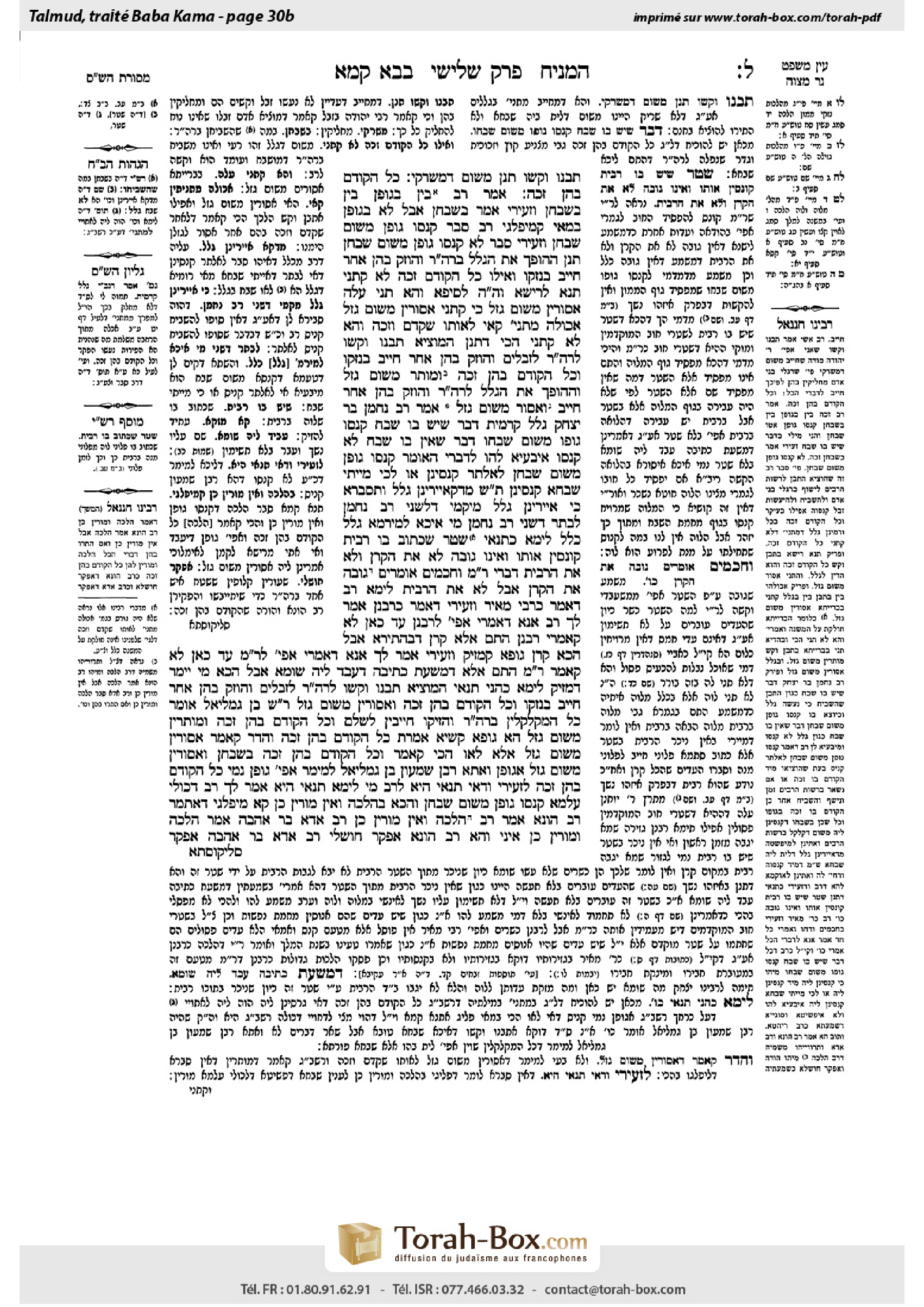
Bava Kamma 30b: Talmud study for Daf Yomi
Study the Talmud for Daf Yomi with scanned pages, Hebrew text, English translations from Sefaria and AI-generated French translations.
Passage selection and English or AI-generated French translation are available where the scan has annotations. Daf Study is independent of Torah-Box and Sefaria.
Browse Bava Kamma · בבא קמא · All tractatesBava Kamma 30b text and translations
This page of Bava Kamma includes the Aramaic text, an English translation and an AI-generated French translation, alongside the scan above.
בבא קמא ל׳ ב · Aramaic and Hebrew text
״תִּבְנוֹ וְקַשּׁוֹ״ תְּנַן, מִשּׁוּם דְּמַשְׁרְקִי.
כׇּל הַקּוֹדֵם בָּהֶן זָכָה. אָמַר רַב: בֵּין בְּגוּפָן, בֵּין בְּשִׁבְחָן. וּזְעֵירִי אָמַר: בְּשִׁבְחָן אֲבָל לֹא בְּגוּפָן.
בְּמַאי קָמִיפַּלְגִי? רַב סָבַר: קָנְסוּ גּוּפָן מִשּׁוּם שִׁבְחָן, וּזְעֵירִי סָבַר: לֹא קָנְסוּ גּוּפָן מִשּׁוּם שִׁבְחָן.
תְּנַן: הַהוֹפֵךְ אֶת הַגָּלָל בִּרְשׁוּת הָרַבִּים, וְהוּזַּק בָּהֶן אַחֵר – חַיָּיב בְּנִזְקוֹ. וְאִילּוּ ״כׇּל הַקּוֹדֵם זָכָה״ לָא קָתָנֵי!
תְּנָא לְרֵישָׁא, וְהוּא הַדִּין לְסֵיפָא.
וְהָא תָּנֵי עֲלַהּ: אֲסוּרִין מִשּׁוּם גָּזֵל!
כִּי קָתָנֵי ״אֲסוּרִין מִשּׁוּם גָּזֵל״ – אַכּוּלַּהּ מַתְנִיתִין קָאֵי, לְאוֹתוֹ שֶׁקָּדַם וְזָכָה.
וְהָא לָא קָתָנֵי הָכִי, דִּתְנַן: הַמּוֹצִיא תִּבְנוֹ וְקַשּׁוֹ לִרְשׁוּת הָרַבִּים לִזְבָלִים, וְהוּזַּק בָּהֶן אַחֵר – חַיָּיב בְּנִזְקוֹ, וְכׇל הַקּוֹדֵם בָּהֶן זָכָה, וּמוּתָּר מִשּׁוּם גָּזֵל. וְהַהוֹפֵךְ אֶת הַגָּלָל לִרְשׁוּת הָרַבִּים, וְהוּזַּק בָּהֶן אַחֵר – חַיָּיב, וְאָסוּר מִשּׁוּם גָּזֵל!
אָמַר רַב נַחְמָן בַּר יִצְחָק: גָּלָל קָרָמֵית?! דָּבָר שֶׁיֵּשׁ בּוֹ שֶׁבַח – קָנְסוּ גּוּפוֹ מִשּׁוּם שִׁבְחוֹ, דָּבָר שֶׁאֵין בּוֹ שֶׁבַח – לֹא קָנְסוּ.
אִיבַּעְיָא לְהוּ: לְדִבְרֵי הָאוֹמֵר קָנְסוּ גּוּפָן מִשּׁוּם שִׁבְחָן; לְאַלְתַּר קָנְסִינַן, אוֹ לְכִי מַיְיתִי שְׁבָחָא קָנְסִינַן?
תָּא שְׁמַע, מִדְּקָאָיְירִינַן גָּלָל!
וְתִסְבְּרָא?! כִּי אַיְירִינַן גָּלָל – מִיקַּמֵּי דִּלְשַׁנֵּי רַב נַחְמָן; לְבָתַר דְּשַׁנִּי רַב נַחְמָן – מִי אִיכָּא לְמִירְמֵא גָּלָל כְּלָל?
לֵימָא כְּתַנָּאֵי: שְׁטָר שֶׁכָּתוּב בּוֹ רִבִּית – קוֹנְסִין אוֹתוֹ, וְאֵינוֹ גּוֹבֶה לֹא אֶת הַקֶּרֶן וְלֹא אֶת הָרִבִּית; דִּבְרֵי רַבִּי מֵאִיר. וַחֲכָמִים אוֹמְרִים: גּוֹבֶה אֶת הַקֶּרֶן, אֲבָל לֹא אֶת הָרִבִּית. לֵימָא רַב דְּאָמַר כְּרַבִּי מֵאִיר, וּזְעֵירִי דְּאָמַר כְּרַבָּנַן?
אָמַר לְךָ רַב: אֲנָא דַּאֲמַרִי – אֲפִילּוּ לְרַבָּנַן, עַד כָּאן לָא קָאָמְרִי רַבָּנַן הָתָם, אֶלָּא קֶרֶן דִּבְהֶתֵּירָא. אֲבָל הָכָא, קֶרֶן גּוּפָא קָמַזֵּיק.
וּזְעֵירִי אָמַר לָךְ: אֲנָא דַּאֲמַרִי אֲפִילּוּ לְרַבִּי מֵאִיר – עַד כָּאן לָא קָאָמַר רַבִּי מֵאִיר הָתָם, אֶלָּא דְּמִשְּׁעַת כְּתִיבָה דַּעֲבַד לֵיהּ שׂוּמָא; אֲבָל הָכָא – מִי יֵימַר דְּמַזֵּיק?
לֵימָא כְּהָנֵי תַּנָּאֵי: הַמּוֹצִיא תִּבְנוֹ וְקַשּׁוֹ לִרְשׁוּת הָרַבִּים לִזְבָלִים, וְהוּזַּק בָּהֶן אַחֵר – חַיָּיב בְּנִזְקוֹ, וְכׇל הַקּוֹדֵם בָּהֶן זָכָה, וַאֲסוּרִין מִשּׁוּם גָּזֵל. רַבָּן שִׁמְעוֹן בֶּן גַּמְלִיאֵל אוֹמֵר: כׇּל הַמְקַלְקְלִין בִּרְשׁוּת הָרַבִּים וְהִזִּיקוּ – חַיָּיבִין לְשַׁלֵּם, וְכׇל הַקּוֹדֵם בָּהֶן זָכָה, וּמוּתָּרִין מִשּׁוּם גָּזֵל.
הָא גוּפָא קַשְׁיָא – אָמְרַתְּ כׇּל הַקּוֹדֵם בָּהֶן זָכָה, וַהֲדַר קָאָמַר אֲסוּרִין מִשּׁוּם גָּזֵל! אֶלָּא לָאו הָכִי קָאָמַר: וְכׇל הַקּוֹדֵם בָּהֶן זָכָה – בְּשִׁבְחָן, וַאֲסוּרִין מִשּׁוּם גָּזֵל – אַגּוּפָן; וַאֲתָא רַבָּן שִׁמְעוֹן בֶּן גַּמְלִיאֵל לְמֵימַר: אֲפִילּוּ גּוּפָן נָמֵי – כׇּל הַקּוֹדֵם בָּהֶן זָכָה!
לִזְעֵירִי – וַדַּאי תַּנָּאֵי הִיא. לְרַב – מִי לֵימָא תַּנָּאֵי הִיא?
אָמַר לְךָ רַב: דְּכוּלֵּי עָלְמָא – קָנְסוּ גּוּפָן מִשּׁוּם שִׁבְחָן; וְהָכָא, בַּהֲלָכָה וְאֵין מוֹרִין כֵּן קָא מִיפַּלְגִי – דְּאִתְּמַר, רַב הוּנָא אָמַר רַב: הֲלָכָה, וְאֵין מוֹרִין כֵּן. רַב אַדָּא בַּר אַהֲבָה אָמַר: הֲלָכָה, וּמוֹרִין כֵּן.
אִינִי?! וְהָא רַב הוּנָא אַפְקַר חוּשְׁלֵי, רַב אַדָּא בַּר אַהֲבָה אַפְקַר
Bava Kamma 30b · English translation
What we learned in the mishna was specifically with regard to a case where one put out his straw and his hay, which are more likely to cause injury than fertilizer and other objects, because they are particularly slippery. Therefore, Rabbi Yehuda agrees that in this case he is liable to pay for damage they cause.
§ It is stated in the mishna that if one puts his straw and hay out in the public domain, whoever takes possession of them first acquires them. The Sages disagreed with regard to the extent of this acquisition. Rav says: He acquires them both with regard to the items themselves and with regard to the value of their enhancement, which took place while they were in the public domain. And Ze’eiri says: He acquires them with regard to the value of their enhancement but not with regard to the items themselves, and he must pay the owner of the straw according to their value at the time he placed them in the public domain.
With regard to what do they disagree? Rav holds that the Sages penalized the owner by revoking his ownership of the items themselves due to the value of their enhancement that he stands to earn by putting them in the public domain, whereas Ze’eiri holds that they did not penalize him by revoking his ownership of the items themselves due to the value of their enhancement. Rather, he loses only the increase in their value due to their enhancement.
The Gemara attempts to prove that Ze’eiri’s opinion is correct from a case where there is no enhancement at all. We learned in the continuation of the mishna that in the case of one who turns over dung in the public domain and another person incurred damage due to it, the former is liable to pay for his damage. But it does not teach in this clause that whoever takes possession of it first acquires it. Apparently the Sages did not revoke his ownership of the dung, as it has no enhanced value. This does not seem to accord with Rav’s opinion.
The Gemara answers: The halakha that whoever takes possession of it acquires it is taught in the first clause, with regard to one who puts out straw, and the same is true in the last clause, with regard to one who turns over dung. It is unnecessary to repeat it. Therefore, no support for the opinion of Ze’eiri can be derived from here.
The Gemara asks: But isn’t it taught in a baraita in that regard, i.e., a baraita that discusses the same cases as the mishna, that the hay and straw are forbidden due to the prohibition against robbery, which apparently means that one may not take possession of the dung, contrary to Rav’s opinion?
The Gemara answers: When it is taught in the baraita that they are forbidden due to the prohibition against robbery, it applies to the entire mishna, not just to this particular clause, and it is referring to taking the items from the one who came first and acquired them. In other words, once someone takes possession of them, it is forbidden for anyone else to take them from him, as that is considered robbery.
The Gemara asks: But it is not taught in this manner elsewhere, as we learned in a baraita: In the case of one who takes out his straw and his hay to the public domain to use afterward as fertilizer and another person incurred damage due to them, he is liable to pay for his damage. And furthermore, whoever takes possession of them first acquires them, and is permitted to do so with regard to the prohibition against robbery. And in the case of one who turns over dung in the public domain and another incurred damage due to it, he is liable, but it is forbidden to take possession of it due to the prohibition against robbery.
Rav Naḥman bar Yitzḥak said: Is it from the case of dung that you raise a contradiction to Rav’s opinion that one may take possession of straw and hay in the public domain? With regard to an item that has added value due to enhancement over time as a result of lying in the public domain, Rav holds that the Sages penalized one who leaves it in the public domain, revoking his ownership of the item itself because of its added value due to enhancement, but with regard to an item that does not have added value due to enhancement by lying in the public domain, such as dung, perhaps Rav concedes that they did not penalize him in this manner.
A dilemma was raised before the Sages: According to the statement of Rav, who says that they penalized him by revoking his ownership of the items themselves because of its added value due to enhancement, do we impose this penalty immediately when he takes the straw out, allowing one to take possession of it even before it has time for its value to become enhanced, or do we impose the penalty only when its enhancement in value emerges?
Come and hear a proof that the penalty is imposed immediately from the fact that we spoke of a difficulty to Rav’s opinion from the case of dung, whose value does not become enhanced, indicating that according to Rav the penalty is imposed before there is any enhancement.
The Gemara responds: And how can you understand this proof? When we spoke of dung, this was before Rav Naḥman bar Yitzḥak resolved the difficulty, explaining that perhaps Rav concedes that there is no penalty in this case. But after Rav Naḥman resolved it, is it at all possible to raise an objection to Rav’s opinion from the case of dung? Therefore, no proof can be brought from there.
The Gemara suggests: Let us say that this dispute is parallel to a dispute between tanna’im, as it is stated in a baraita: With regard to a document in which a loan with interest is written, we penalize the lender, and he therefore collects neither the principal nor the interest; this is the statement of Rabbi Meir. And the Rabbis say: He collects the principal but not the interest. Shall we say that Rav stated his opinion in accordance with the opinion of Rabbi Meir, whose penalty applies to the value of the loan itself due to its enhancement, i.e., the interest, which is prohibited, and that Ze’eiri stated his opinion in accordance with the opinion of the Rabbis, who impose the penalty only on the interest?
The Gemara answers that Rav could have said to you: I stated my opinion even according to the opinion of the Rabbis. The Rabbis were saying there that the principal is not forfeited by the lender only because the principal was loaned in a permissible manner, as the prohibition applies only to the interest. But here, in the case of one who put his straw in the public domain, the principal, i.e., the hazardous object itself, causes damage. Therefore, the penalty should relate to the object itself.
And conversely, Ze’eiri could have said to you: I stated my opinion even according to the opinion of Rabbi Meir. The reason Rabbi Meir was saying there, in the case of a loan with interest, that the principal is also forfeited is only that the prohibition was already violated from the time of the writing of the document, by making an appraisal [shuma] of how much money is to be repaid, which included interest. But here, in the case of straw that one placed in the public domain, who can say that it will cause damage? Since the damage was not inevitable at the time that the straw was placed there, there is no justification for revoking the ownership of the straw itself.
The Gemara suggests alternatively: Let us say that the dispute between Rav and Ze’eiri is parallel to a dispute between these tanna’im, as it is stated in a baraita: In the case of one who takes his straw and his hay out to the public domain to use afterward as fertilizer, and another incurred damage due to them, he is liable to pay for his damage. And whoever takes possession of them first acquires them, but they are forbidden due to the prohibition against robbery. Rabban Shimon ben Gamliel says: In the case of anyone who places obstacles in the public domain and they cause damage, he is liable to pay. And whoever takes possession of them first acquires them and they are permitted to him with regard to the prohibition against robbery.
The Gemara clarifies: This matter itself is difficult. First you said that whoever takes possession of them first acquires them, and then it says that they are forbidden due to the prohibition against robbery, indicating that one may not take possession of them. Rather, is this not what the baraita is saying: This statement: And whoever takes possession of them first acquires them, is stated with regard to the value of their enhancement. And this statement: But they are forbidden due to the prohibition against robbery, is stated with regard to the items themselves? And Rabban Shimon ben Gamliel came to say that even with regard to the items themselves, whoever takes possession of them first acquires them. Therefore, this tannaitic dispute apparently relates to whether the penalty applies to the items themselves or just to the value of their enhancement.
The Gemara comments: According to Ze’eiri, it is certainly a dispute between tanna’im, since Rabban Shimon ben Gamliel explicitly deems it permitted for one to take possession of the items. According to Rav, shall we say that it is a dispute between tanna’im?
The Gemara responds that Rav could have said to you: According to all opinions, the Sages imposed a penalty revoking his ownership of the items themselves due to the value of their enhancement. And here in the baraita the tanna’im disagree with regard to whether or not it is ruled that this is the halakha but a public ruling is not issued to that effect, as it was stated that amora’im disagreed as to whether the halakha revoking his ownership of the items themselves should be taught to the public. Rav Huna says that Rav says: This is the halakha, but a public ruling is not issued to that effect. In other words, although it is permitted for one to take possession of the straw, halakhic authorities should not publicly rule that people may do so, lest people become accustomed to taking items that belong to others. This is the opinion of the first tanna in the baraita. Rav Adda bar Ahava says: This is the halakha and a public ruling is issued to that effect. This, Rav could have said, is the opinion of Rabban Shimon ben Gamliel.
The Gemara asks: Is that so? But didn’t Rav Huna declare dried barley [ḥushelei] that people laid out in the public domain ownerless? Similarly, didn’t Rav Adda bar Ahava declare ownerless
Bava Kamma 30b · Traduction française (IA)
Ce que nous avons appris dans la Michna était spécifiquement concernant un cas où l'on mettait ses pailles et son foin, qui sont plus propices à causer des dommages que les engrais et d'autres objets, car elles sont particulièrement glissantes. Ainsi, Rabbi Yéhuda est d'accord avec le fait que dans ce cas, il est tenu responsable des dommages qu'ils causent.
§ Il est dit dans la Michna que si l'on met ses pailles et son foin dans le domaine public, celui qui les prend en possession les acquiert. Les Sages s'entendaient sur l'étendue de cette acquisition. Rav dit : Il les acquiert à la fois concernant les objets eux-mêmes et concernant la valeur de leur amélioration, qui s'est produite pendant qu'ils étaient dans le domaine public. Et Zé'iri dit : Il les acquiert concernant la valeur de leur amélioration, mais pas concernant les objets eux-mêmes, et il doit payer au propriétaire des pailles selon leur valeur au moment où il les a mis dans le domaine public.
Sur quel point s'entendaient-ils ? Rav considère que les Sages ont pénalisé le propriétaire en révoquant son droit de propriété sur les objets eux-mêmes en raison de la valeur de leur amélioration qu'il pourrait gagner en les laissant dans le domaine public, tandis que Zé'iri considère qu'ils n'ont pas pénalisé le propriétaire en révoquant son droit de propriété sur les objets eux-mêmes en raison de la valeur de leur amélioration. Il perd uniquement la valeur augmentée due à leur amélioration.
La Guemara tente de prouver que l'opinion de Zé'iri est correcte à partir d'un cas où il n'y a aucune amélioration. Nous avons appris dans la continuation du mitsva que dans le cas où l'on retourne des crottins dans le domaine public et que quelqu'un subit un dommage à cause d'eux, le premier est tenu responsable de son dommage. Mais il ne nous apprend pas dans cette clause que celui qui les prend en possession les acquiert. Apparemment, les Sages n'ont pas révoqué la propriété du propriétaire, car ces crottins n'ont pas de valeur améliorée. Cela ne semble pas correspondre à l'opinion de Rav.
La Guemara répond : La halakha selon laquelle celui qui les prend en possession les acquiert est enseignée dans la première clause, concernant celui qui sort des pailles, et c'est la même chose dans la dernière clause, concernant celui qui retourne des crottins. Il n'est pas nécessaire de le répéter. Ainsi, aucun soutien pour l'opinion de Zé'iri ne peut être tiré de là.
La Guemara demande : Mais n'est-il pas enseigné dans une baraïta à ce sujet, c'est-à-dire une baraïta qui discute des mêmes cas que la mitsva, que les pailles et le foin sont interdits en raison de l'interdiction de vol, ce qui semble signifier que l'on ne peut pas prendre possession des crottins, contrairement à l'opinion de Rav ?
La Guemara répond : Lorsqu'il est enseigné dans la baraïta qu'ils sont interdits en raison de l'interdiction de vol, cela s'applique à l'ensemble de la mitsna, pas seulement à cette clause particulière, et il s'agit de prendre les objets du premier qui les a acquis. En d'autres termes, une fois que quelqu'un les prend en possession, il est interdit à quiconque d'en prendre possession de lui, car cela est considéré comme un vol.
La Guemara demande : Mais cela n'est pas enseigné ainsi ailleurs, comme nous l'avons appris dans une baraïta : Dans le cas où l'on sort ses pailles et son foin dans le domaine public pour les utiliser plus tard comme engrais et que quelqu'un subit un dommage à cause d'eux, il est tenu responsable de son dommage. Et de plus, celui qui les prend en possession les acquiert, et il est autorisé à le faire en raison de l'interdiction de vol. Et dans le cas où l'on retourne des crottins dans le domaine public et que quelqu'un subit un dommage à cause d'eux, il est tenu responsable, mais il est interdit de prendre possession d'eux en raison de l'interdiction de vol.
Rav Naḥman bar Yitzḥak dit : Est-ce à partir du cas des crottins que vous élevez une contradiction contre l'opinion de Rav qui dit qu'on peut prendre possession des pailles et du foin dans le domaine public ? Concernant un objet dont la valeur s'élève en raison d'une amélioration au fil du temps en raison de son séjour dans le domaine public, Rav considère que les Sages ont pénalisé celui qui le laisse dans le domaine public en révoquant sa propriété sur l'objet lui-même en raison de sa valeur augmentée, mais concernant un objet dont la valeur ne s'élève pas en raison d'une amélioration par son séjour dans le domaine public, comme les crottins, peut-être Rav reconnaît-il que les Sages n'ont pas pénalisé ainsi.
Un dilemme a été soulevé devant les Sages : Selon l'affirmation de Rav, qui dit qu'ils ont pénalisé celui qui les laisse dans le domaine public en révoquant sa propriété sur les objets eux-mêmes en raison de leur valeur augmentée, imposons-nous cette pénalité immédiatement lorsqu'il retire les pailles, permettant à quelqu'un de les prendre en possession même avant qu'elles n'aient eu le temps de s'améliorer en valeur, ou imposons-nous cette pénalité uniquement lorsque leur valeur s'améliore ?
Venez écouter une preuve que la pénalité est imposée immédiatement, du fait que nous avons parlé d'une difficulté pour l'opinion de Rav à partir du cas des crottins, dont la valeur ne s'améliore pas, indiquant que selon Rav, la pénalité est imposée avant toute amélioration de valeur.
La Guemara répond : Et comment pouvez-vous comprendre cette preuve ? Lorsque nous avons parlé des crottins, cela était avant que Rav Naḥman bar Yitzḥak ne résolve la difficulté, expliquant que peut-être Rav reconnaît qu'il n'y a pas de pénalité dans ce cas. Mais après que Rav Naḥman ait résolu cela, est-il possible de soulever une objection contre l'opinion de Rav à partir du cas des crottins ? Ainsi, aucune preuve ne peut être tirée de là.
La Guemara suggère : Disons que ce débat est parallèle à un débat entre des tannaïm, car il est dit dans une baraïta : En ce qui concerne un document dans lequel un prêt à intérêt est inscrit, nous pénalisons le prêteur, et il ne récupère donc ni le principal ni les intérêts ; c'est l'opinion de Rabbi Meïr. Et les Sages disent : Il récupère le principal mais pas les intérêts. Devons-nous dire que Rav a exprimé son opinion conformément à l'opinion de Rabbi Meïr, dont la pénalité s'applique à la valeur du prêt lui-même, en raison de son accroissement, c'est-à-dire les intérêts, qui sont interdits, et que Zé'iri a exprimé son opinion conformément à l'opinion des Sages, qui imposent la pénalité uniquement sur les intérêts ?
La Guemara répond que Rav aurait pu dire à vous : J'ai exprimé mon opinion même selon l'opinion des Sages. Les Sages disaient là que le principal n'est pas perdu par le prêteur uniquement parce que le principal a été prêté de manière permise, car l'interdiction s'applique uniquement aux intérêts. Mais ici, dans le cas d'une personne qui a mis son foin dans le domaine public, le principal, c'est-à-dire l'objet dangereux lui-même, cause des dommages. Par conséquent, la pénalité devrait s'appliquer à l'objet lui-même.
Et inversement, Zé'iri aurait pu dire à vous : J'ai exprimé mon opinion même selon l'opinion de Rabbi Meïr. La raison pour laquelle Rabbi Meïr disait là, dans le cas d'un prêt à intérêt, que le principal est également perdu est uniquement parce que l'interdiction avait déjà été violée dès l'époque de l'écriture du document, en faisant une estimation [shuma] de la somme à rembourser, qui comprenait les intérêts. Mais ici, dans le cas du foin que l'on a mis dans le domaine public, qui peut dire qu'il causera des dommages ? Puisque les dommages n'étaient pas inévitables au moment où le foin a été placé là, il n'y a pas de justification pour révoquer la propriété du foin lui-même.
La Guemara suggère une alternative : Disons que le débat entre Rav et Zé'iri est parallèle à un débat entre ces tannaïm, car il est dit dans une baraïta : Dans le cas d'une personne qui sort son foin et son fumier dans le domaine public pour les utiliser plus tard comme engrais, et une autre subit des dommages à cause d'eux, il est tenu responsable de ses dommages. Et celui qui s'empare d'eux en premier les acquiert, mais ils sont interdits en raison de l'interdiction de vol. Rabban Shimon ben Gamliel dit : Dans le cas d'une personne qui place des obstacles dans le domaine public et qu'ils causent des dommages, il est tenu responsable de ces dommages. Et celui qui s'empare d'eux en premier les acquiert et ils sont permis à lui en ce qui concerne l'interdiction de vol.
La Guemara clarifie : Cette question elle-même est difficile. D'abord vous disiez que celui qui s'empare d'eux en premier les acquiert, et ensuite il dit qu'ils sont interdits en raison de l'interdiction de vol, indiquant que l'on ne peut pas s'emparger d'eux. Plutôt, n'est-ce pas ce que la baraïta dit : Cette déclaration : Et celui qui s'empare d'eux en premier les acquiert, est dite en ce qui concerne la valeur de leur accroissement. Et cette déclaration : Mais ils sont interdits en raison de l'interdiction de vol, est dite en ce qui concerne les objets eux-mêmes ? Et Rabban Shimon ben Gamliel est venu dire que même en ce qui concerne les objets eux-mêmes, celui qui s'empare d'eux en premier les acquiert. Par conséquent, ce débat tannaitique semble concerner si la pénalité s'applique aux objets eux-mêmes ou uniquement à la valeur de leur accroissement.
La Guemara commente : Selon Zé'iri, il s'agit certainement d'un débat entre tannaïm, car Rabban Shimon ben Gamliel déclare explicitement qu'il est permis à une personne de s'emparger des objets. Selon Rav, devons-nous dire qu'il s'agit d'un débat entre tannaïm ?
La Guemara répond que Rav aurait pu dire à vous : Selon toutes les opinions, les Sages ont imposé une pénalité révoquant la propriété des objets eux-mêmes en raison de la valeur de leur accroissement. Et ici, dans la baraïta, les tannaïm divergent en ce qui concerne la question de savoir si cela est considéré comme la halakha, mais qu'une décision publique n'est pas rendue à cet effet, car il a été dit que les amoraïm divergent en ce qui concerne la question de savoir si la halakha révoquant la propriété des objets eux-mêmes devrait être enseignée au public. Rav Huna dit que Rav dit : C'est la halakha, mais une décision publique n'est pas rendue à cet effet. En d'autres termes, bien que ce soit permis à une personne de s'emparger du foin, les autorités halakhiques ne devraient pas publiquement décider que les gens peuvent le faire, de peur que les gens s'habituent à prendre des objets appartenant aux autres. C'est l'opinion du premier tanna de la baraïta. Rav Adda bar Ahava dit : C'est la halakha et une décision publique est rendue à cet effet. Cela, Rav aurait pu dire, est l'opinion de Rabban Shimon ben Gamliel.
La Guemara demande : Est-ce ainsi ? Mais n'a-t-il pas déclaré Rav Huna le blé sec [ḥushelei] que les gens avaient mis dans le domaine public comme propriété commune ? De même, n'a-t-il pas déclaré propriété commune Rav Adda bar Ahava ?
Traduction française générée par IA à partir de l’édition anglaise de Sefaria. Vérifie toujours un passage avec le texte source.
Text from Sefaria: William Davidson Edition - Vocalized Aramaic (CC BY NC); William Davidson Edition - English (CC BY NC).