Bava Kamma 31a: Talmud study for Daf Yomi
Study the Talmud for Daf Yomi with scanned pages, Hebrew text, English translations from Sefaria and AI-generated French translations.
Passage selection and English or AI-generated French translation are available where the scan has annotations. Daf Study is independent of Torah-Box and Sefaria.
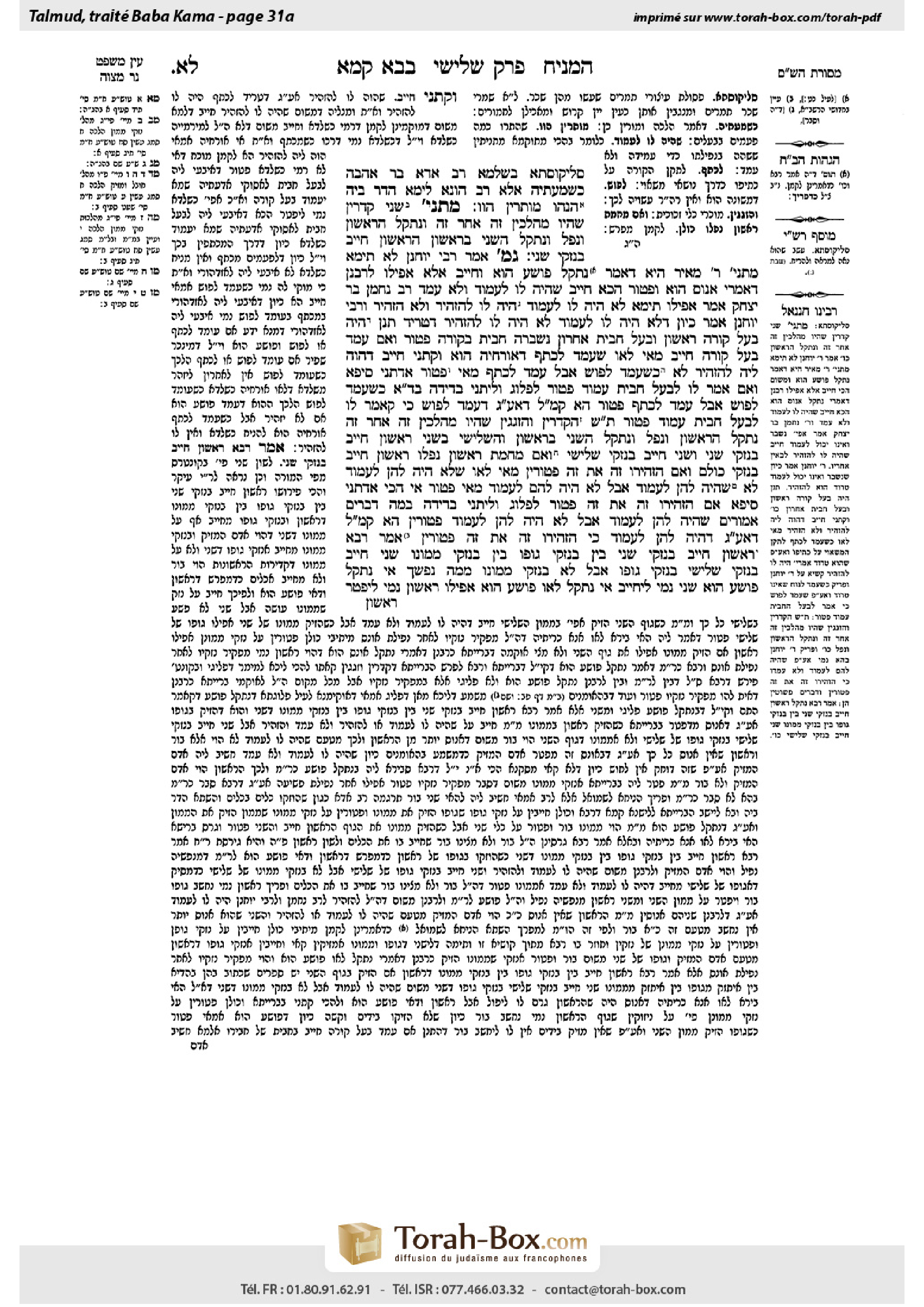
Browse Bava Kamma · בבא קמא · All tractatesBava Kamma 31a text and translations
This page of Bava Kamma includes the Aramaic text, an English translation and an AI-generated French translation, alongside the scan above.
בבא קמא ל״א א · Aramaic and Hebrew text
סְלִיקוּסְתָּא!
בִּשְׁלָמָא רַב אַדָּא בַּר אַהֲבָה – כִּשְׁמַעְתֵּיהּ. אֶלָּא רַב הוּנָא, לֵימָא הֲדַר בֵּיהּ?
הָנְהוּ – מוּתְרִין הֲווֹ.
מַתְנִי׳ שְׁנֵי קַדָּרִין שֶׁהָיוּ מְהַלְּכִין זֶה אַחַר זֶה, וְנִתְקַל הָרִאשׁוֹן וְנָפַל, וְנִתְקַל הַשֵּׁנִי בָּרִאשׁוֹן – הָרִאשׁוֹן חַיָּיב בְּנִזְקֵי שֵׁנִי.
גְּמָ׳ אָמַר רַבִּי יוֹחָנָן: לָא תֵּימָא מַתְנִיתִין רַבִּי מֵאִיר הִיא, דְּאָמַר: נִתְקָל פּוֹשֵׁעַ הוּא – וְחַיָּיב; אֶלָּא אֲפִילּוּ לְרַבָּנַן, דְאָמְרִי אָנוּס הוּא, וּפָטוּר – הָכָא חַיָּיב; שֶׁהָיָה לוֹ לַעֲמוֹד, וְלֹא עָמַד.
רַב נַחְמָן בַּר יִצְחָק אָמַר: אֲפִילּוּ תֵּימָא לֹא הָיָה לוֹ לַעֲמוֹד; הָיָה לוֹ לְהַזְהִיר, וְלֹא הִזְהִיר.
וְרַבִּי יוֹחָנָן אָמַר: כֵּיוָן דְּלֹא הָיָה לוֹ לַעֲמוֹד – לֹא הָיָה לוֹ לְהַזְהִיר; דִּטְרִיד.
תְּנַן: הָיָה בַּעַל קוֹרָה רִאשׁוֹן וּבַעַל חָבִית אַחֲרוֹן, נִשְׁבְּרָה חָבִית בַּקּוֹרָה – פָּטוּר, וְאִם עָמַד בַּעַל קוֹרָה – חַיָּיב.
מַאי, לָאו שֶׁעָמַד לְכַתֵּף – דְּאוֹרְחֵיהּ הוּא, וְקָתָנֵי חַיָּיב, דַּהֲוָה לֵיהּ לְהַזְהִיר?
לֹא, כְּשֶׁעָמַד לָפוּשׁ.
אֲבָל עָמַד לְכַתֵּף מַאי, פָּטוּר? אַדְּתָנֵי סֵיפָא: וְאִם אָמַר לוֹ לְבַעַל חָבִית ״עֲמוֹד״ – פָּטוּר, לִפְלוֹג וְלִיתְנֵי בְּדִידַהּ: בַּמֶּה דְּבָרִים אֲמוּרִים – כְּשֶׁעָמַד לָפוּשׁ, אֲבָל עָמַד לְכַתֵּף – פָּטוּר!
הָא קָא מַשְׁמַע לַן – דְּאַף עַל גַּב דְּעָמַד לָפוּשׁ, כִּי קָאָמַר לוֹ לְבַעַל חָבִית: ״עֲמוֹד״ – פָּטוּר.
תָּא שְׁמַע: הַקַּדָּרִין וְהַזַּגָּגִין שֶׁהָיוּ מְהַלְּכִין זֶה אַחַר זֶה; נִתְקַל הָרִאשׁוֹן וְנָפַל, וְנִתְקַל הַשֵּׁנִי בָּרִאשׁוֹן, וְהַשְּׁלִישִׁי בַּשֵּׁנִי – רִאשׁוֹן חַיָּיב בְּנִזְקֵי שֵׁנִי, וְשֵׁנִי חַיָּיב בְּנִזְקֵי שְׁלִישִׁי. וְאִם מֵחֲמַת רִאשׁוֹן נָפְלוּ – רִאשׁוֹן חַיָּיב בְּנִזְקֵי כּוּלָּם. וְאִם הִזְהִירוּ זֶה אֶת זֶה – פְּטוּרִין. מַאי, לָאו שֶׁלֹּא הָיָה לָהֶן לַעֲמוֹד?
לֹא, שֶׁהָיָה לָהֶן לַעֲמוֹד.
אֲבָל לֹא הָיָה לָהֶם לַעֲמוֹד מַאי, פָּטוּר? אִי הָכִי, אַדְּתָנֵי סֵיפָא: אִם הִזְהִירוּ זֶה אֶת זֶה – פָּטוּר; לִפְלוֹג וְלִיתְנֵי בְּדִידַהּ: בַּמֶּה דְּבָרִים אֲמוּרִים – שֶׁהָיָה לָהֶן לַעֲמוֹד, אֲבָל לֹא הָיָה לָהֶן לַעֲמוֹד – פְּטוּרִין!
הָא קָא מַשְׁמַע לַן – דְּאַף עַל גַּב דְּהָיָה לָהֶן לַעֲמוֹד, כִּי הִזְהִירוּ זֶה אֶת זֶה – פְּטוּרִין.
אָמַר רָבָא: רִאשׁוֹן חַיָּיב בְּנִזְקֵי שֵׁנִי – בֵּין בְּנִזְקֵי גוּפוֹ, בֵּין בְּנִזְקֵי מָמוֹנוֹ. שֵׁנִי חַיָּיב בְּנִזְקֵי שְׁלִישִׁי – בְּנִזְקֵי גוּפוֹ, אֲבָל לֹא בְּנִזְקֵי מָמוֹנוֹ.
מִמָּה נַפְשָׁךְ? אִי נִתְקָל פּוֹשֵׁעַ הוּא – שֵׁנִי נָמֵי לִיחַיַּיב! אִי נִתְקָל לָאו פּוֹשֵׁעַ הוּא – אֲפִילּוּ רִאשׁוֹן נָמֵי לִיפְּטַר!
Bava Kamma 31a · English translation
residue from dates?
The Gemara comments: Granted, Rav Adda bar Ahava acted in accordance with his halakhic opinion that this is the halakha, and a public ruling is issued to that effect. But with regard to Rav Huna, shall we say that he retracted his prior opinion?
The Gemara answers: Those owners of the barley were forewarned to remove the barley from the public domain, and they did not comply. Therefore, they were penalized by Rav Huna declaring publicly that their barley was ownerless.
MISHNA: In the case of two potters carrying pots who were walking one after the other in the public domain, and the first stumbled on a bump and fell, and the second stumbled over the first and fell too, the first is liable to pay for the damage incurred by the second.
GEMARA: Rabbi Yoḥanan said: Do not say that the mishna is the opinion of Rabbi Meir, who says that one who stumbles is considered negligent and therefore liable. Rather, even according to the Rabbis, who say that one who stumbles is generally a victim of circumstances beyond his control and is consequently exempt, here, in the case in the mishna, he is liable, since after falling he had the opportunity to stand up, and he did not stand up.
Rav Naḥman bar Yitzḥak said: Even if you say that he did not have the opportunity to stand up, he had the opportunity to warn the person behind him, and he did not warn him.
And Rabbi Yoḥanan could have said in response that since he did not have the opportunity to stand up, he did not have the opportunity to warn the other person either, as he was busy trying to stand up. Therefore, the mishna, which holds him liable, must be referring to a case where he could have stood up.
The Gemara attempts to prove that the opinion of Rav Naḥman bar Yitzḥak is correct. We learned in the next mishna (31b): If the owner of a cross beam was walking in the public domain carrying his beam first, and the owner of a barrel was walking with his barrel last, i.e., behind him, and the barrel was broken by the cross beam, the one who carried the cross beam is exempt. But if the owner of the cross beam stopped, he is liable, since the accident was caused by his stopping.
The Gemara asks: What, is it not referring to a situation where the one carrying the cross beam stopped in order to adjust the load on his shoulder, which is the normative behavior of one carrying a beam, and is not considered negligence? And nevertheless the tanna teaches that he is liable, as, although he had the opportunity to warn the person behind him that he was about to stop, he did not warn him. This supports the opinion of Rav Naḥman bar Yitzḥak.
The Gemara responds: No, it is referring to a situation where he stopped to rest, which could not have been anticipated by the person walking behind him. Consequently, he is liable.
The Gemara asks: But according to this interpretation, if he stopped to adjust the load on his shoulder, what is the halakha? Is he exempt? If so, rather than teaching in the latter clause of that mishna: But if he said to the owner of the barrel: Stop, he is exempt, let the tanna distinguish and teach within the former case itself, as follows: In what case is this statement, that he is liable, said? In a case when he stopped to rest. But in a case where he stopped to adjust the load on his shoulder, he is exempt.
The Gemara answers: The mishna is presented in this manner because it teaches us this novelty, that even if he stopped to rest, in a case when he says to the owner of the barrel: Stop, he is exempt.
Come and hear an alternative proof from what is taught in a baraita: With regard to potters and glaziers who were walking one after the other, and the first stumbled and fell, and the second stumbled over the first, sustaining damage, and the third stumbled over the second, also falling and sustaining damage, in this case, the first person is liable to pay for the damage of the second, and the second is liable to pay for the damage of the third. But if they all fell because of the first, the first is liable to pay for the damage of them all. And if they warned each other, i.e., each one warned the next, they are all exempt. The Gemara concludes: What, is it not a case where they did not have the opportunity to stand up, and they are nevertheless liable to pay for not warning the people behind them, in accordance with the opinion of Rav Naḥman bar Yitzḥak?
The Gemara answers: No, it is a case where they had the opportunity to stand up and they did not do so.
The Gemara asks: But according to this interpretation, if they did not have the opportunity to stand up, what would be the halakha? Would they be exempt? If so, rather than teaching in the latter clause of the baraita: If they warned one another, they are exempt, let the tanna distinguish and teach within the former case itself, as follows: In what case is this statement, that they are liable, said? It is a case where they had the opportunity to stand up, but if they did not have the opportunity to stand up, they are exempt.
The Gemara answers: The baraita is presented in this manner because it teaches us this novelty, that even if they had the opportunity to stand up, in a case when they warned each other they are exempt.
§ With regard to this halakha, Rava said: The first one who stumbled is liable to pay for the damage of the second, both for damage caused to the second person by his body and for damage caused to him by his property. By contrast, the second is liable to pay for the damage of the third only with regard to damage caused by his body as result of the fall, and not with regard to damage caused by his property.
The Gemara questions Rava’s statement: Whichever way you look at it, this is difficult to understand. If Rava maintains that one who stumbles is considered negligent, the second person should also be liable to pay for all forms of damage caused by his negligence. And if Rava maintains that one who stumbles is not considered negligent, even the first should be exempt from liability for the damage incurred by the second.
Bava Kamma 31a · Traduction française (IA)
du résidu des dattes ?
La Guemara commente : Bien sûr, Rav Adda bar Ahava agissait selon son opinion halakhique selon laquelle c'est la halakha, et un arrêt public est rendu à cet effet. Mais concernant Rav Huna, devons-nous dire qu'il a rétracté son opinion antérieure ?
La Guemara répond : Ces propriétaires de l'orge avaient été avertis de retirer l'orge du domaine public, mais ils n'ont pas obéi. Par conséquent, ils ont été sanctionnés par Rav Huna en déclarant publiquement que leur orge était sans propriétaire.
MICHNA : Dans le cas de deux potiers transportant des pots qui marchaient l'un après l'autre dans le domaine public, et le premier trébuche sur un obstacle et tombe, et le second trébuche sur le premier et tombe également, le premier est tenu responsable du préjudice subi par le second.
GUEMARA : Rabbi Yoḥanan a dit : Ne dis pas que la mishna est l'opinion de Rabbi Meir, qui affirme qu'une personne qui trébuche est considérée comme négligente et donc responsable. Plutôt, même selon les Rabbins, qui affirment qu'une personne qui trébuche est généralement victime de circonstances hors de son contrôle et est donc exemptée, ici, dans le cas de la mishna, il est responsable, car après avoir chuté, il avait l'opportunité de se relever et n'a pas fait cela.
Rav Naḥman bar Yitzḥak a dit : Même si vous dites qu'il n'avait pas l'opportunité de se relever, il avait l'opportunité d'avertir la personne qui le suivait, et il n'a pas averti.
Et Rabbi Yoḥanan aurait pu répondre que puisqu'il n'avait pas l'opportunité de se lever, il n'avait pas non plus l'opportunité d'avertir l'autre personne, car il était occupé à se lever. Par conséquent, la mishna, qui le tient responsable, doit se référer à un cas où il pouvait se lever.
La Guemara tente de prouver que l'opinion de Rav Naḥman bar Yitzḥak est correcte. Nous avons appris dans la mishna suivante (31b) : Si l'propriétaire d'une poutre marchait dans le domaine public en portant sa poutre en premier, et l'propriétaire d'un tonneau marchait avec son tonneau en dernier, c'est-à-dire derrière lui, et le tonneau était cassé par la poutre, celui qui portait la poutre est exempt. Mais si l'propriétaire de la poutre s'est arrêté, il est responsable, car l'accident a été causé par son arrêt.
La Guemara demande : Qu'est-ce que cela signifie, n'est-ce pas un cas où l'propriétaire de la poutre s'est arrêté pour ajuster le fardeau sur son épaule, qui est le comportement normal de celui qui porte une poutre, et n'est pas considéré comme négligence ? Et pourtant, le tanna enseigne qu'il est responsable, car, bien qu'il ait eu l'opportunité d'avertir la personne qui le suivait qu'il allait s'arrêter, il n'a pas averti. Cela soutient l'opinion de Rav Naḥman bar Yitzḥak.
La Guemara répond : Non, cela se réfère à un cas où il s'est arrêté pour se reposer, ce qui ne pouvait pas être anticipé par la personne qui marchait derrière lui. Par conséquent, il est responsable.
La Guemara demande : Mais selon cette interprétation, si il s'est arrêté pour ajuster le fardeau sur son épaule, quelle est la halakha ? Est-il exempt ? Si oui, plutôt que d'enseigner dans la clause ultérieure de cette mishna : Mais si il a dit à l'owner du tonneau : Arrête, il est exempt, que le tanna distingue et enseigne à l'intérieur même du cas initial, comme suit : Dans quel cas cette déclaration, qu'il est responsable, est-elle faite ? Dans un cas où il s'est arrêté pour se reposer. Mais dans un cas où il s'est arrêté pour ajuster le fardeau sur son épaule, il est exempt.
La Guemara répond : La mishna est présentée ainsi parce qu'elle nous enseigne cette nouveauté, que même si il s'est arrêté pour se reposer, dans un cas où il a dit à l'owner du tonneau : Arrête, il est exempt.
Viens écouter une autre preuve tirée de ce qui est enseigné dans une baraïta : Concernant des potiers et des vitriers qui marchaient l'un après l'autre, et le premier trébuche et tombe, et le second trébuche sur le premier, subissant des dommages, et le troisième trébuche sur le second, tombant également et subissant des dommages, dans ce cas, la première personne est responsable des dommages subis par la deuxième, et la deuxième est responsable des dommages subis par la troisième. Mais si tous sont tombés à cause du premier, le premier est responsable des dommages subis par tous. Et si chacun avertissait le suivant, c'est-à-dire que chacun avertissait le suivant, ils sont tous exemptés. La Guemara conclut : Qu'est-ce que cela signifie, n'est-ce pas un cas où ils n'avaient pas l'opportunité de se relever, et pourtant ils sont responsables de ne pas avoir averti les personnes qui les suivaient, selon l'opinion de Rav Naḥman bar Yitzḥak ?
La Guemara répond : Non, c'est un cas où ils avaient l'opportunité de se relever et n'ont pas fait cela.
La Guemara demande : Mais selon cette interprétation, si ils n'avaient pas l'opportunité de se relever, quelle serait la halakha ? Serait-il exempt ? Si oui, plutôt que d'enseigner dans la clause ultérieure de la baraïta : Si ils s'étaient avertis mutuellement, ils sont exemptés, que le tanna distingue et enseigne à l'intérieur même du cas initial, comme suit : Dans quel cas cette déclaration, qu'ils sont responsables, est-elle faite ? Dans un cas où ils avaient l'opportunité de se relever, mais si ils n'avaient pas l'opportunité de se relever, ils sont exemptés.
La Guemara répond : La baraïta est présentée ainsi parce qu'elle nous enseigne cette nouveauté, que même s'ils avaient l'opportunité de se relever, dans un cas où ils s'étaient avertis mutuellement, ils sont exemptés.
§ Concernant cette halakha, Rava a dit : La première personne qui a trébuché est responsable des dommages subis par la deuxième, tant pour les dommages causés à la deuxième personne par son corps que pour les dommages causés à lui-même par ses biens. En revanche, la deuxième est responsable des dommages subis par la troisième uniquement concernant les dommages causés par son corps en raison de la chute, et non concernant les dommages causés par ses biens.
La Guemara questionne la déclaration de Rava : Quel que soit le point de vue, cela est difficile à comprendre. Si Rava considère que celui qui trébuche est négligent, la deuxième personne devrait être tenue responsable de tous les types de dommages causés par cette négligence. Et si Rava considère que celui qui trébuche n'est pas négligent, même le premier devrait être exempt de responsabilité pour les dommages subis par le second.
Traduction française générée par IA à partir de l’édition anglaise de Sefaria. Vérifie toujours un passage avec le texte source.
Text from Sefaria: William Davidson Edition - Vocalized Aramaic (CC BY NC); William Davidson Edition - English (CC BY NC).