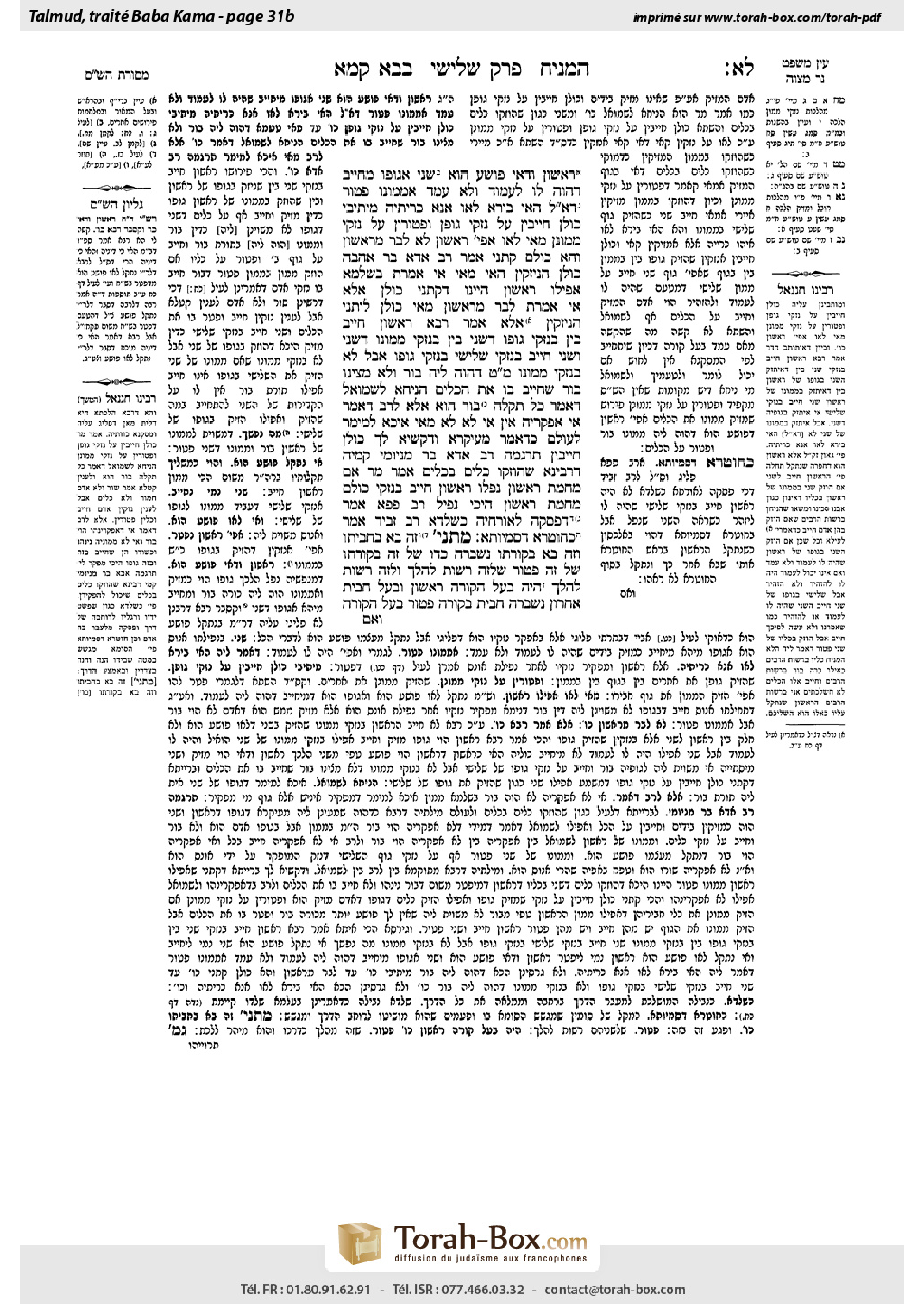
Bava Kamma 31b: Talmud study for Daf Yomi
Study the Talmud for Daf Yomi with scanned pages, Hebrew text, English translations from Sefaria and AI-generated French translations.
Passage selection and English or AI-generated French translation are available where the scan has annotations. Daf Study is independent of Torah-Box and Sefaria.
Browse Bava Kamma · בבא קמא · All tractatesBava Kamma 31b text and translations
This page of Bava Kamma includes the Aramaic text, an English translation and an AI-generated French translation, alongside the scan above.
בבא קמא ל״א ב · Aramaic and Hebrew text
רִאשׁוֹן – וַדַּאי פּוֹשֵׁעַ הוּא. שְׁנִי – אַגּוּפוֹ מִחַיַּיב, דְּהָיָה לוֹ לַעֲמוֹד וְלֹא עָמַד. אַמָּמוֹנוֹ פָּטוּר, דְּאָמַר לֵיהּ: הַאי בֵּירָא – לָאו אֲנָא כְּרִיתֵיהּ.
מֵיתִיבִי: כּוּלָּן חַיָּיבִין עַל נִזְקֵי גּוּפָן, וּפְטוּרִין עַל נִזְקֵי מָמוֹנָן. מַאי, לָאו אֲפִילּוּ רִאשׁוֹן?
לָא, לְבַר מֵרִאשׁוֹן. וְהָא ״כּוּלָּם״ קָתָנֵי! אָמַר רַב אַדָּא בַּר אַהֲבָה: ״כּוּלָּן״ – הַנִּיזָּקִין.
הַאי מַאי? אִי אָמְרַתְּ בִּשְׁלָמָא אֲפִילּוּ רִאשׁוֹן – הַיְינוּ דְּקָתָנֵי ״כּוּלָּן״; אֶלָּא אִי אָמְרַתְּ לְבַר מֵרִאשׁוֹן, מַאי ״כּוּלָּן״? לִיתְנֵי ״הַנִּיזָּקִין״!
אֶלָּא אָמַר רָבָא: רִאשׁוֹן חַיָּיב – בֵּין בְּנִזְקֵי גוּפוֹ דְּשֵׁנִי, בֵּין בְּנִזְקֵי מָמוֹנוֹ דְּשֵׁנִי; וְשֵׁנִי חַיָּיב בְּנִזְקֵי שְׁלִישִׁי – בְּנִזְקֵי גוּפוֹ, אֲבָל לֹא בְּנִזְקֵי מָמוֹנוֹ. מַאי טַעְמָא? דְּהָוֵה לֵיהּ בּוֹר, וְלֹא מָצִינוּ בּוֹר שֶׁחִיֵּיב בּוֹ אֶת הַכֵּלִים.
הָנִיחָא לִשְׁמוּאֵל, דְּאָמַר: כֹּל תַּקָּלָה – בּוֹר הוּא; אֶלָּא לְרַב, דְּאָמַר: אִי אַפְקְרֵיהּ אִין, אִי לָא לָא; מַאי אִיכָּא לְמֵימַר?
לְעוֹלָם – כִּדְאָמַר מֵעִיקָּרָא, וּדְקַשְׁיָא לָךְ ״כּוּלָּן חַיָּיבִין״ – תַּרְגְּמַהּ רַב אַדָּא בַּר מִנְיוֹמֵי קַמֵּיהּ דְּרָבִינָא: שֶׁהוּזְּקוּ כֵּלִים בְּכֵלִים.
אָמַר מָר: אִם מֵחֲמַת רִאשׁוֹן נָפְלוּ – רִאשׁוֹן חַיָּיב בְּנִזְקֵי כוּלָּם. מֵחֲמַת רִאשׁוֹן הֵיכִי נָפֵיל? רַב פָּפָּא אָמַר: דְּפַסְקֵהּ לְאוֹרְחֵיהּ כְּשִׁלְדָּא. רַב זְבִיד אָמַר: כְּחוּטְרָא דְסַמְיוּתָא.
מַתְנִי׳ זֶה בָּא בְּחָבִיתוֹ וְזֶה בָּא בְּקוֹרָתוֹ, נִשְׁבְּרָה כַּדּוֹ שֶׁל זֶה בְּקוֹרָתוֹ שֶׁל זֶה – פָּטוּר; שֶׁלָּזֶה רְשׁוּת לְהַלֵּךְ, וְלָזֶה רְשׁוּת לְהַלֵּךְ.
הָיָה בַּעַל הַקּוֹרָה רִאשׁוֹן וּבַעַל חָבִית אַחֲרוֹן; נִשְׁבְּרָה חָבִית בְּקוֹרָה – פָּטוּר בַּעַל הַקּוֹרָה.
Bava Kamma 31b · English translation
The Gemara explains: The first is certainly considered negligent, and is therefore liable to pay for damage caused by both his body and his property. The second is deemed liable to pay for damage caused by his body, as he had the opportunity to stand up and he did not stand up. For damage caused by his property that was lying there and that caused the third person to stumble and fall, he is exempt, as he can say to him: I did not dig this pit, i.e., I did not cause this obstacle. Since it was the first person who stumbled and brought about the situation where the items of the second were lying on the ground, the second is not deemed liable.
The Gemara raises an objection to Rava’s statement from a baraita that comments on this case: All of them are liable to pay for damage caused by their bodies and exempt from paying restitution for damage caused by their property. What, does this not refer even to the first, indicating that even he is exempt from damage caused by his property?
The Gemara answers: No, it is referring to all of them except for the first. The Gemara asks: But doesn’t the baraita teach the term all of them, indicating that the first is also included? Rav Adda bar Ahava said: The term all of them refers only to those who incurred damage, and excludes the first one, who only caused damage to others.
The Gemara questions this answer: What is this interpretation? Granted, if you say that the term includes even the first, this explanation is consistent with that which is taught: All of them. But if you say that it is referring to all of them except for the first, what is the reason that the misleading term: All of them is used? Let the baraita teach more accurately that those who incurred damage are liable in turn for the damage caused by their bodies, but are exempt from paying restitution for damage caused by their property.
Rather, this entire explanation of Rava’s statement should be rejected, and it should be explained as follows: Rava said that the first is liable both for injury caused to the body of the second and for damage caused to the property of the second, and the second is liable to pay for damage incurred by the third with regard to injury to his body but not with regard to damage to his property. What is the reason for the exemption in the last case? It is because after his fall, the body of the second person is effectively a pit, and we do not find that in the category of Pit one is liable to pay restitution for damage caused to vessels.
The Gemara asks: This works out well according to Shmuel, who says that any obstacle that was placed in the public domain constitutes a pit, i.e., the halakhot of a pit apply to it. But according to Rav, who says that if the one who placed it there renounces ownership of the hazardous object it is considered a pit, but if he does not renounce ownership of it then it is not considered a pit, what is there to say? The second one who fell obviously did not renounce ownership of his body, so why is he exempt from damage he caused to vessels as though he were a pit?
The Gemara answers: Actually, Rava’s statement should be explained as he was understood to have said initially, i.e., that he distinguishes between damage caused by another’s body and damage caused by his property. And as for your difficulty from the statement in the baraita that all of them are liable to pay for the damage caused by their bodies but exempt from paying restitution for the damage caused by their property, apparently including even the first one, contrary to Rava’s opinion, Rav Adda bar Minyumi interpreted it before Ravina as referring to a case where vessels were damaged by vessels. In other words, it is not the body, but the vessels of the second that were damaged by the property of the first, and since the broken vessels of the first have the status of a pit, the owner is exempt from liability for damage caused to the vessels of others.
The Master said above: If they all fell because of the first, the first is liable to pay for the damage of them all. The Gemara asks: How did they all fall because of the first? Rav Pappa said: It is a case where he blocked the road like a skeleton [keshilda], filling the entire width of the road and causing the rest to stumble over different parts of his body. Rav Zevid said: He fell diagonally like a blind man’s cane, and they all stumbled over him.
MISHNA: If this person came in the public domain with his barrel, and that person came from the opposite direction with his cross beam, and this one’s jug was broken by that one’s cross beam, the one carrying the cross beam is exempt, because this one had permission to walk in the public domain, and that one also had permission to walk there.
If they were walking in the same direction, so that the owner of the cross beam was walking first, in front, and the owner of a barrel last, behind him, and the barrel was broken by the cross beam, the owner of the cross beam is exempt, since the owner of the barrel saw him in front of him and should have been more careful.
Bava Kamma 31b · Traduction française (IA)
La Guemara explique : Le premier est certainement considéré comme négligent, et est donc tenu responsable de l'endommagement causé par son corps et ses biens. Le second est considéré comme responsable de l'endommagement causé par son corps, car il avait l'occasion de se lever et n'a pas levé. Pour l'endommagement causé par ses biens qui étaient là et qui a fait tomber le troisième, il est exempt, car il peut dire au troisième : Je n'ai pas creusé ce trou, c'est-à-dire je n'ai pas créé cet obstacle. Puisque c'est le premier qui est tombé et a créé la situation où les biens du second étaient sur le sol, le second n'est pas considéré comme responsable.
La Guemara soulève une objection contre l'assertion de Rava, à partir d'une baraïta qui commente ce cas : Tous sont responsables de l'endommagement causé par leur corps et exemptés de la restitution de l'endommagement causé par leurs biens. Qu'est-ce que cela ne signifie pas même pour le premier, indiquant que même lui est exempt de l'endommagement causé par ses biens ?
La Guemara répond : Non, cela se réfère à tous sauf le premier. La Guemara demande : Mais ne dit pas la baraïta le terme « tous », indiquant que le premier est également inclus ? Rav Adda bar Ahava dit : Le terme « tous » se réfère uniquement à ceux qui ont subi un préjudice, et exclut le premier, qui a seulement causé un préjudice aux autres.
La Guemara questionne cette réponse : Quelle est cette interprétation ? En admettant que vous disiez que le terme inclut même le premier, cette explication est cohérente avec ce qui est enseigné : « Tous ». Mais si vous disiez que cela se réfère à tous sauf le premier, quelle est la raison d'utiliser le terme trompeur : « Tous » ? Que la baraïta enseigne plus précisément que ceux qui ont subi un préjudice sont responsables de l'endommagement causé par leur corps, mais exemptés de la restitution de l'endommagement causé par leurs biens.
Plutôt, cette explication entière de l'assertion de Rava devrait être rejetée, et il devrait être expliqué comme suit : Rava a dit que le premier est responsable à la fois de l'injury causée au corps du second et de l'endommagement causé aux biens du second, et le second est responsable de l'endommagement subi par le troisième concernant l'injury à son corps mais pas concernant l'endommagement de ses biens. Quelle est la raison de l'exemption dans le dernier cas ? C'est parce que, après sa chute, le corps du second est effectivement un trou, et nous ne trouvons pas que dans la catégorie de trou, une personne est responsable de la restitution de l'endommagement causé aux objets.
La Guemara demande : Cela s'aligne bien selon Shmuel, qui dit que tout obstacle placé dans le domaine public constitue un trou, c'est-à-dire que les halakhot du trou s'appliquent à lui. Mais selon Rav, qui dit que si celui qui l'a placé y renonce à la propriété de l'objet dangereux, il est considéré comme un trou, mais si il ne renonce pas à la propriété, il n'est pas considéré comme un trou, qu'est-ce que cela signifie ? Le second qui est tombé n'a évidemment pas renoncé à la propriété de son corps, donc pourquoi est-il exempt de l'endommagement qu'il a causé aux objets comme s'il était un trou ?
La Guemara répond : En réalité, l'assertion de Rava devrait être expliquée comme il l'avait compris initialement, c'est-à-dire qu'il distingue entre l'endommagement causé par le corps d'autrui et l'endommagement causé par ses biens. Et concernant votre difficulté à partir de l'assertion dans la baraïta que tous sont responsables de l'endommagement causé par leur corps mais exemptés de la restitution de l'endommagement causé par leurs biens, apparemment incluant même le premier, contrairement à l'opinion de Rava, Rav Adda bar Minyumi l'a interprété avant Ravina comme se référant à un cas où les objets ont été endommagés par des objets. En d'autres termes, ce n'est pas le corps, mais les objets du second qui ont été endommagés par les biens du premier, et puisque les objets brisés du premier ont le statut de trou, l'propriétaire est exempt de responsabilité pour l'endommagement causé aux objets d'autrui.
Le Maître a dit ci-dessus : Si tous sont tombés à cause du premier, le premier est responsable de l'endommagement de tous. La Guemara demande : Comment tous sont-ils tombés à cause du premier ? Rav Pappa a dit : C'est un cas où il a bloqué le chemin comme un squelette [keshilda], remplissant toute la largeur du chemin et causant aux autres de tomber sur différentes parties de son corps. Rav Zevid a dit : Il est tombé diagonalement comme une canne pour aveugle, et tous sont tombés sur lui.
MICHNA : Si cette personne est entrée dans le domaine public avec son tonneau, et que cette autre personne est venue de l'autre direction avec son poutre, et que le tonneau de ce dernier a été brisé par la poutre de l'autre, celui qui portait la poutre est exempt, car cette personne avait le droit de marcher dans le domaine public, et celle-ci aussi avait le droit de marcher là.
Si ils marchaient dans la même direction, de sorte que l'propriétaire de la poutre marchait en premier, devant, et l'propriétaire du tonneau derrière lui, et que le tonneau a été brisé par la poutre, l'propriétaire de la poutre est exempt, car l'propriétaire du tonneau l'a vu devant lui et aurait dû être plus prudent.
Traduction française générée par IA à partir de l’édition anglaise de Sefaria. Vérifie toujours un passage avec le texte source.
Text from Sefaria: William Davidson Edition - Vocalized Aramaic (CC BY NC); William Davidson Edition - English (CC BY NC).