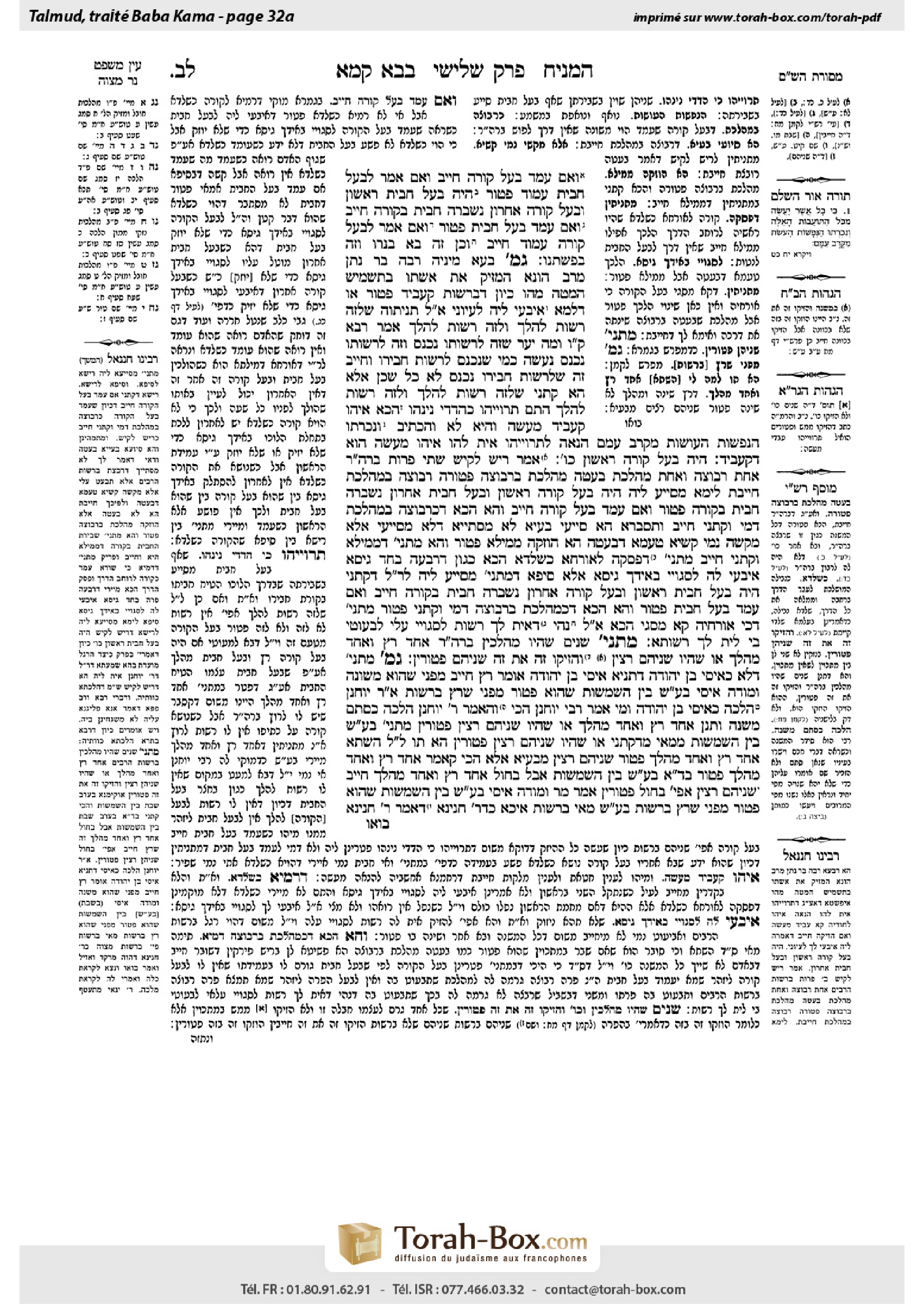
Bava Kamma 32a: Talmud study for Daf Yomi
Study the Talmud for Daf Yomi with scanned pages, Hebrew text, English translations from Sefaria and AI-generated French translations.
Passage selection and English or AI-generated French translation are available where the scan has annotations. Daf Study is independent of Torah-Box and Sefaria.
Browse Bava Kamma · בבא קמא · All tractatesBava Kamma 32a text and translations
This page of Bava Kamma includes the Aramaic text, an English translation and an AI-generated French translation, alongside the scan above.
בבא קמא ל״ב א · Aramaic and Hebrew text
וְאִם עָמַד בַּעַל קוֹרָה – חַיָּיב. וְאִם אָמַר לְבַעַל חָבִית ״עֲמוֹד״ – פָּטוּר.
הָיָה בַּעַל חָבִית רִאשׁוֹן וּבַעַל קוֹרָה אַחֲרוֹן; נִשְׁבְּרָה חָבִית בַּקּוֹרָה – חַיָּיב. וְאִם עָמַד בַּעַל חָבִית – פָּטוּר. וְאִם אָמַר לְבַעַל קוֹרָה: ״עֲמוֹד״ – חַיָּיב. וְכֵן זֶה בָּא בְּנֵרוֹ וְזֶה בְּפִשְׁתָּנוֹ.
גְּמָ׳ בְּעָא מִינֵּיהּ רַבָּהּ בַּר נָתָן מֵרַב הוּנָא: הַמַּזִּיק אֶת אִשְׁתּוֹ בְּתַשְׁמִישׁ הַמִּטָּה, מַהוּ? כֵּיוָן דְּבִרְשׁוּת קָעָבֵיד – פָּטוּר, אוֹ דִילְמָא, אִיבְּעִי לֵיהּ לְעַיּוֹנֵי?
אֲמַר לֵיהּ, תְּנֵיתוּהָ: שֶׁלָּזֶה רְשׁוּת לְהַלֵּךְ, וְלָזֶה רְשׁוּת לְהַלֵּךְ.
אָמַר רָבָא: קַל וָחוֹמֶר. וּמָה יַעַר – שֶׁזֶּה לִרְשׁוּתוֹ נִכְנָס וְזֶה לִרְשׁוּתוֹ נִכְנָס, נַעֲשָׂה כְּמִי שֶׁנִּכְנַס לִרְשׁוּת חֲבֵירוֹ – וְחַיָּיב; זֶה, שֶׁלִּרְשׁוּת חֲבֵירוֹ נִכְנַס, לֹא כׇּל שֶׁכֵּן?
אֶלָּא הָא קָתָנֵי שֶׁלָּזֶה רְשׁוּת לְהַלֵּךְ וְלָזֶה רְשׁוּת לְהַלֵּךְ!
הָתָם – תַּרְוַיְיהוּ כַּהֲדָדֵי נִינְהוּ; הָכָא – אִיהוּ קָעָבֵיד מַעֲשֶׂה.
וְהִיא לָא?! וְהָכְתִיב: ״וְנִכְרְתוּ הַנְּפָשׁוֹת הָעֹשֹׂת מִקֶּרֶב עַמָּם״!
הֲנָאָה – לְתַרְוַיְיהוּ אִית לְהוּ, אִיהוּ מַעֲשֶׂה הוּא דְּקָעָבֵיד.
הָיָה בַּעַל קוֹרָה רִאשׁוֹן כּוּ׳. אָמַר רֵישׁ לָקִישׁ: שְׁתֵּי פָּרוֹת בִּרְשׁוּת הָרַבִּים, אַחַת רְבוּצָה וְאַחַת מְהַלֶּכֶת; בָּעֲטָה מְהַלֶּכֶת בָּרְבוּצָה – פְּטוּרָה. בָּעֲטָה רְבוּצָה בַּמְּהַלֶּכֶת – חַיֶּיבֶת.
לֵימָא מְסַיַּיע לֵיהּ: הָיָה בַּעַל קוֹרָה רִאשׁוֹן וּבַעַל חָבִית אַחֲרוֹן, נִשְׁבְּרָה הֶחָבִית בַּקוֹרָה – פָּטוּר. וְאִם עָמַד בַּעַל קוֹרָה – חַיָּיב. וְהָא הָכָא, דְּכִרְבוּצָה בַּמְּהַלֶּכֶת דָּמֵי, וְקָתָנֵי חַיָּיב.
וְתִסְבְּרָא?! הָא סַיֹּיעֵי בָּעֲיָא; לָא מִסָּתְיָיא דְּלָא מְסַיְּיעִי, אֶלָּא מִקְשָׁה נָמֵי קַשְׁיָא! טַעְמָא דְּבָעֲטָה, הָא הוּזְּקָה מִמֵּילָא – פָּטוּר; וְהָא מַתְנִיתִין דְּמִמֵּילָא, וְקָתָנֵי חַיָּיב.
מַתְנִיתִין – דִּפְסַקָה לְאוֹרְחָא כְּשִׁלְדָּא; הָכָא – כְּגוֹן דִּרְבַעָה בְּחַד גִּיסָא, אִיבְּעִי לַהּ לְסַגּוֹיֵי בְּאִידַּךְ גִּיסָא.
אֶלָּא סֵיפָא דְּמַתְנִיתִין מְסַיַּיע לֵיהּ לְרֵישׁ לָקִישׁ – דְּקָתָנֵי: הָיָה בַּעַל חָבִית רִאשׁוֹן וּבַעַל קוֹרָה אַחֲרוֹן, נִשְׁבְּרָה חָבִית בַּקּוֹרָה – חַיָּיב. וְאִם עָמַד בַּעַל חָבִית – פָּטוּר. וְהָא הָכָא, דְּכִמְהַלֶּכֶת בָּרְבוּצָה דָּמֵי, וְקָתָנֵי פָּטוּר.
מַתְנִיתִין – דְּכִי אוֹרְחֵיהּ קָא מְסַגֵּי; הָכָא – אָמְרָה לַהּ: נְהִי דְּאִית לִךְ רְשׁוּת לְסַגּוֹיֵי עֲלַי, לְבַעוֹטֵי בִּי לֵית לִךְ רְשׁוּתָא.
מַתְנִי׳ שְׁנַיִם שֶׁהָיוּ מְהַלְּכִין בִּרְשׁוּת הָרַבִּים, אֶחָד רָץ וְאֶחָד מְהַלֵּךְ, אוֹ שֶׁהָיוּ שְׁנֵיהֶם רָצִין, וְהִזִּיקוּ זֶה אֶת זֶה – שְׁנֵיהֶם פְּטוּרִין.
גְּמָ׳ מַתְנִיתִין דְּלָא כְּאִיסִי בֶּן יְהוּדָה. דְּתַנְיָא, אִיסִי בֶּן יְהוּדָה אוֹמֵר: רָץ – חַיָּיב, מִפְּנֵי שֶׁהוּא מְשׁוּנֶּה. וּמוֹדֶה אִיסִי בְּעֶרֶב שַׁבָּת בֵּין הַשְּׁמָשׁוֹת שֶׁהוּא פָּטוּר, מִפְּנֵי שֶׁרָץ בִּרְשׁוּת.
אָמַר רַבִּי יוֹחָנָן: הֲלָכָה כְּאִיסִי בֶּן יְהוּדָה. וּמִי אָמַר רַבִּי יוֹחָנָן הָכִי? וְהָאָמַר רַבִּי יוֹחָנָן: הֲלָכָה כִּסְתַם מִשְׁנָה, וּתְנַן: אֶחָד רָץ וְאֶחָד מְהַלֵּךְ, אוֹ שֶׁהָיוּ שְׁנֵיהֶם רָצִין – פְּטוּרִין!
מַתְנִיתִין בְּעֶרֶב שַׁבָּת בֵּין הַשְּׁמָשׁוֹת.
מִמַּאי? מִדְּקָתָנֵי: אוֹ שֶׁהָיוּ שְׁנֵיהֶם רָצִין – פְּטוּרִין. הָא תּוּ לְמָה לִי? הַשְׁתָּא אֶחָד רָץ וְאֶחָד מְהַלֵּךְ – פָּטוּר, שְׁנֵיהֶם רָצִין מִיבַּעְיָא? אֶלָּא הָכִי קָאָמַר: אֶחָד רָץ וְאֶחָד מְהַלֵּךְ – פָּטוּר. בַּמֶּה דְּבָרִים אֲמוּרִים – בְּעֶרֶב שַׁבָּת בֵּין הַשְּׁמָשׁוֹת, אֲבָל בַּחוֹל – אֶחָד רָץ וְאֶחָד מְהַלֵּךְ, חַיָּיב. שְׁנֵיהֶם רָצִין – אֲפִילּוּ בַּחוֹל פְּטוּרִין.
אָמַר מָר: וּמוֹדֶה אִיסִי בְּעֶרֶב שַׁבָּת בֵּין הַשְּׁמָשׁוֹת שֶׁהוּא פָּטוּר, מִפְּנֵי שֶׁרָץ בִּרְשׁוּת. בְּעֶרֶב שַׁבָּת מַאי בִּרְשׁוּת אִיכָּא?
כִּדְרַבִּי חֲנִינָא – דְּאָמַר רַבִּי חֲנִינָא:
Bava Kamma 32a · English translation
But if the owner of the cross beam stopped, causing the barrel to collide with the beam and break, the former is liable, since the latter had no way of anticipating that he would stop. And if he said to the owner of the barrel: Stop, he is exempt from liability for breaking the barrel.
Conversely, if the owner of the barrel was walking first and the owner of the cross beam last, and the barrel was broken by the cross beam, the owner of the cross beam is liable. But if owner of the barrel stopped, the owner of the cross beam is exempt from liability for breaking the barrel. And if he said to the owner of the cross beam: Stop, the owner of the cross beam is liable. And similarly, these halakhot apply in a case where this one came with his lamp and that one came with his flax, and the lamp set fire to the flax.
GEMARA: Rabba bar Natan asked Rav Huna: With regard to one who causes injury to his wife during sexual intercourse, what is the halakha? Is he liable to pay damages? Is it reasoned that since he is acting in a permitted manner he is exempt, or perhaps he should pay attention and be more careful?
Rav Huna said to Rabba bar Natan: You learned this halakha in the mishna concerning one person walking with a cross beam and another with a barrel, which rules that the owner of the cross beam is exempt because this one had permission to walk and that one also had permission to walk. Similarly, since the husband has permission to engage in intercourse with his wife, if he injures her in the process he is exempt.
Rava disagreed with Rav Huna’s opinion and said: The husband is liable due to an a fortiori inference from the halakha with regard to manslaughter, as it is stated in the Torah: “As when a man goes into the forest with his neighbor to chop wood…and the head slips off the helve, and finds his neighbor, and he dies; he shall flee to one of these cities and live” (Deuteronomy 19:5). And just as in the forest, where this person entered his domain and that person entered his domain, as it is the domain of the public, and nevertheless the one who kills unintentionally is considered like one who entered another’s domain and is therefore liable to be exiled to a city of refuge, then with regard to this husband, who actually enters another’s domain, all the more so is it not clear that he should be liable for the injury he causes her?
The Gemara raises an objection to Rava’s opinion: But what of this mishna, which teaches that the owner of the cross beam is exempt, as this one had permission to walk and that one had permission to walk, and Rav Huna inferred from here that the husband is likewise exempt.
The Gemara answers: The two cases are different. There, in the case in the mishna, both sides were similarly walking, and the one who caused the damage is therefore exempt due to his right to walk there. By contrast, here, the husband is the only active participant in the intercourse. Therefore, since he is the one performing an action, he is liable even though he is acting with permission.
The Gemara asks: And is she not considered an active participant? But isn’t it written with regard to forbidden sexual intercourse: “Even the souls that do them shall be cut off from among their people” (Leviticus 18:29), indicating that both the man and woman are considered to be performing an action?
The Gemara answers: The verse is referring to the fact that they both have pleasure from the act. The woman’s pleasure is tantamount to active transgression, and she is therefore punished if she participates willfully. But with regard to a wife’s injury, he is the one who is considered to be performing an action, and he is therefore liable.
§ The mishna teaches: In a case where the owner of the cross beam was walking first and the owner of the barrel was walking behind him, if the barrel was broken by the cross beam, the owner of the cross beam is exempt. Reish Lakish says: If two cows were in the public domain, one of them prone and one walking, and the cow that was walking kicked the cow that was prone, its owner is exempt. If the prone cow kicked the cow that was walking, its owner is liable to pay.
Let us say that the mishna supports this statement, as it states: If the owner of the cross beam was first and the owner of the barrel was last, and the barrel was broken by the cross beam, he is exempt. But if the owner of the cross beam stopped, the owner of the cross beam is liable. The Gemara explains the proof: But here, it is clear that it is like a case where the prone cow kicked the cow that was walking, since the one carrying the barrel was walking and the one carrying the cross beam stopped in the public domain, causing damage to the former. And the mishna teaches in this case that the owner of the cross beam is liable.
The Gemara responds: And how can you understand that reasoning? You wanted to support the statement of Reish Lakish from the mishna. Not only does it not support Reish Lakish; it even raises a difficulty to his opinion. The reason Reish Lakish stated that the owner of the prone cow is liable is that it kicked the walking cow; but if the walking cow was damaged because by itself it collided with the prone cow, he would be exempt. But the mishna discusses a case where the one carrying the barrel ran into the cross beam by himself, without the one carrying the cross beam actively hitting it, and it teaches that the owner of the cross beam is nevertheless liable.
The Gemara explains: The mishna is referring to a case where the cross beam blocked the entire width of the road like a carcass. Since the one carrying the barrel could not avoid it, the one carrying the cross beam is liable although he did not actively break the barrel. By contrast, here, Reish Lakish’s statement is referring to a case where the cow was lying down on one side of the public domain, and the other cow should have walked on the other, unobstructed side. Therefore, if the damage is caused only as a result of their collision, the owner of the prone cow is exempt.
The Gemara suggests: Rather, it is the latter clause of the mishna that supports Reish Lakish’s statement, as it teaches: Conversely, if the owner of the barrel was walking first and the owner of the cross beam last, and the barrel was broken by the cross beam, the owner of the cross beam is liable. But if the owner of the barrel stopped, the owner of the cross beam is exempt from liability for breaking the barrel. But here, it is clear that it is like a case where the walking cow kicked the prone cow. And the mishna teaches that the owner of the cross beam is exempt, lending support to Reish Lakish’s ruling.
The Gemara rejects this suggestion: The mishna exempts the one carrying the cross beam because he was walking in his normal manner when he hit the barrel. Here, perhaps the owner of the prone cow can say to the owner of the walking cow: Although you have permission to walk over me, i.e., for your cow to walk over my cow, you have no permission to kick me, i.e., for your cow to kick my cow.
MISHNA: With regard to two people who were walking in the public domain, or one who was running and another one who was walking, or who were both running, and they damaged one another, both of them are exempt.
GEMARA: The Gemara comments: The mishna is not in accordance with the opinion of Isi ben Yehuda. As it is taught in a baraita: Isi ben Yehuda says that one who runs in the public domain and causes damage is liable to pay for any damage he causes because his behavior is unusual in the public domain. And Isi concedes with regard to one who runs and causes damage at twilight on the eve of Shabbat that he is exempt, because he is running with permission.
Rabbi Yoḥanan says: The halakha is in accordance with the opinion of Isi ben Yehuda. The Gemara asks: And did Rabbi Yoḥanan actually say this, that if one runs and causes damage he is liable? But doesn’t Rabbi Yoḥanan say, as a principle, that the halakha is in accordance with an unattributed mishna? And we learned in this mishna that if one was running and the other one was walking, or if they were both running, they are exempt.
The Gemara answers: The mishna, which exempts one who was running, is referring to twilight on the eve of Shabbat, when people are permitted to run in the public domain.
The Gemara explains: From where is it inferred that the mishna is referring to twilight on the eve of Shabbat? It is inferred from the fact that it teaches: Or who were both running, they are exempt. Why do I need this case as well? Now that the mishna teaches that if one was running and the other one was walking, the one running is exempt, is it necessary to state that he is exempt when both of them were running? Rather, this is what the mishna is saying: If one was running and the other one was walking, he is exempt. In what case is this statement said? It is said with regard to twilight on the eve of Shabbat, when running in the public domain is permitted. But on a weekday, if one was running and the other one was walking, the one who was running is liable. If both were running, even on a weekday, they are exempt. This emendation explains the need to mention the case where both were running.
The Master said above: And Isi concedes with regard to one who runs and causes damage at twilight on the eve of Shabbat that he is exempt, because he is running with permission. The Gemara asks: What is the reason that running at twilight on the eve of Shabbat is considered to be with permission?
The Gemara answers: It is like that which Rabbi Ḥanina would say, as Rabbi Ḥanina would say at twilight on the eve of Shabbat:
Bava Kamma 32a · Traduction française (IA)
Mais si l'propriétaire de la poutre s'est arrêté, causant la collision du tonneau avec la poutre et sa rupture, l'ancien est responsable, car l'autre n'avait aucun moyen de prévoir qu'il s'arrêterait. Et si l'propriétaire du tonneau a dit à l'propriétaire de la poutre : Arrête, il est exempt de responsabilité pour la rupture du tonneau.
Inversement, si l'propriétaire du tonneau marchait en premier et l'propriétaire de la poutre en dernier, et que le tonneau était brisé par la poutre, l'propriétaire de la poutre est responsable. Mais si l'propriétaire du tonneau s'est arrêté, l'propriétaire de la poutre est exempt de responsabilité pour la rupture du tonneau. Et si l'propriétaire du tonneau a dit à l'propriétaire de la poutre : Arrête, l'propriétaire de la poutre est responsable. Et de même, ces halakhot s'appliquent dans un cas où l'un venait avec sa lampe et l'autre avec son lin, et la lampe a mis le feu au lin.
GUEMARA : Rabba bar Natan a demandé à Rav Huna : Concernant celui qui cause un préjudice à sa femme pendant l'acte sexuel, quelle est la halakha ? Est-il responsable de payer des dommages ? Est-ce que l'on raisonne que, puisqu'il agit dans un mode permis, il est exempt, ou peut-être devrait-il être plus prudent ?
Rav Huna a répondu à Rabba bar Natan : Tu as appris cette halakha dans la mishna concernant une personne marchant avec une poutre et une autre avec un tonneau, qui règle que l'propriétaire de la poutre est exempt, car l'un avait le droit de marcher et l'autre aussi. De même, puisque le mari a le droit d'engager l'acte sexuel avec sa femme, s'il la blesse en cours d'acte, il est exempt.
Rava s'est opposé à l'opinion de Rav Huna et a dit : Le mari est responsable par une inférence a fortiori à partir de la halakha concernant l'assassinat, comme il est dit dans la Torah : « Comme lorsqu'un homme entre dans la forêt avec son voisin pour couper du bois, et la tête tombe du manche, et il trouve son voisin, et il meurt ; il doit fuir vers l'une de ces villes et demeurer » (Deutéronome 19:5). Et tout comme dans la forêt, où cette personne est entrée dans son domaine et que celle-ci est entrée dans son domaine, comme c'est le domaine public, et pourtant celui qui tue accidentellement est considéré comme celui qui est entré dans le domaine d'autrui et est donc responsable d'être exilé dans une ville de refuge, alors concernant ce mari, qui entre effectivement dans le domaine d'autrui, n'est-ce pas clair qu'il devrait être responsable du préjudice qu'il cause ?
La Guemara soulève un objet contre l'opinion de Rava : Mais que devons-nous penser de cette mishna, qui enseigne que l'propriétaire de la poutre est exempt, car l'un avait le droit de marcher et l'autre aussi, et Rav Huna a inféré d'ici que le mari est également exempt.
La Guemara répond : Ces deux cas sont différents. Là, dans le cas de la mishna, les deux parties marchaient de la même manière, et celui qui a causé le préjudice est donc exempt en raison de son droit de marcher là. En revanche, ici, le mari est le seul acteur de l'acte sexuel. Par conséquent, puisqu'il est celui qui effectue l'action, il est responsable même s'il agit avec le droit.
La Guemara demande : Et n'est-elle pas considérée comme une actrice active ? Mais n'est-il pas écrit concernant l'acte sexuel interdit : « Même les âmes qui les font seront coupées de leur peuple » (Lévitique 18:29), indiquant que les deux, l'homme et la femme, sont considérés comme effectuant l'action ?
La Guemara répond : La verset fait référence au fait qu'ils trouvent du plaisir dans l'acte. Le plaisir de la femme est équivalent à une transgression active, et elle est donc punie si elle participe volontairement. Mais concernant la blessure de la femme, c'est lui qui est considéré comme l'acteur de l'action, et c'est donc lui qui est responsable.
§ La mishna enseigne : Dans un cas où l'propriétaire de la poutre marchait en premier et l'propriétaire du tonneau marchait derrière lui, si le tonneau était brisé par la poutre, l'propriétaire de la poutre est exempt. Reish Lakish dit : Si deux vaches étaient dans le domaine public, l'une allongée et l'autre marchant, et que la vache marchant a frappé la vache allongée, son propriétaire est exempt. Si la vache allongée a frappé la vache marchant, son propriétaire est responsable de payer.
Disons que la mishna soutient cette déclaration, car elle dit : Si l'propriétaire de la poutre marchait en premier et l'propriétaire du tonneau marchait en dernier, et que le tonneau était brisé par la poutre, il est exempt. Mais si l'propriétaire de la poutre s'est arrêté, l'propriétaire de la poutre est responsable. La Guemara explique la preuve : Mais ici, il est clair que c'est comme un cas où la vache allongée a frappé la vache marchant, car l'un qui portait le tonneau marchait et l'un qui portait la poutre s'est arrêté dans le domaine public, causant un préjudice à l'autre. Et la mishna enseigne dans ce cas que l'propriétaire de la poutre est responsable.
La Guemara répond : Et comment peux-tu comprendre cette raisonnement ? Tu voulais soutenir l'opinion de Reish Lakish à partir de la mishna. Non seulement cela ne soutient pas Reish Lakish, mais cela soulève même une difficulté à son opinion. La raison pour laquelle Reish Lakish a dit que l'propriétaire de la vache allongée est responsable est qu'elle a frappé la vache marchant ; mais si la vache marchant a été endommagée parce qu'elle a elle-même heurté la vache allongée, il serait exempt. Mais la mishna discute d'un cas où le porteur du tonneau a heurté la poutre par lui-même, sans que le porteur de la poutre n'ait activement frappé, et il enseigne que l'propriétaire de la poutre est néanmoins responsable.
La Guemara explique : La mitsna fait référence à un cas où la traverse bloquait toute la largeur de la route comme un cadavre. Puisque celui qui portait le tonneau ne pouvait pas éviter cela, celui qui portait la traverse est responsable, même s'il n'a pas activement cassé le tonneau. À l'inverse, ici, la déclaration de Rachi Lakish fait référence à un cas où la vache était allongée du côté d'un domaine public, et l'autre vache aurait dû marcher sur le côté non obstrué. Ainsi, si le dommage est causé uniquement en raison de leur collision, l'propriétaire de la vache allongée est exempté.
La Guemara suggère : Plutôt, c'est la seconde partie de la mitsna qui soutient la déclaration de Rachi Lakish, car elle enseigne : À l'inverse, si l'propriétaire du tonneau marchait en premier et l'propriétaire de la traverse en dernier, et que le tonneau était cassé par la traverse, l'propriétaire de la traverse est responsable. Mais si l'propriétaire du tonneau s'est arrêté, l'propriétaire de la traverse est exempté de responsabilité pour avoir cassé le tonneau. Mais ici, il est clair que c'est un cas où la vache marchant a frappé la vache allongée. Et la mitsna enseigne que l'propriétaire de la traverse est exempté, ce qui soutient la décision de Rachi Lakish.
La Guemara rejette cette suggestion : La mitsna exempté celui qui portait la traverse car il marchait normalement lorsqu'il a frappé le tonneau. Ici, peut-être l'propriétaire de la vache allongée peut dire à l'propriétaire de la vache marchant : Bien que vous ayez le droit de marcher sur moi, c'est-à-dire pour que votre vache marche sur ma vache, vous n'avez pas le droit de me frapper, c'est-à-dire pour que votre vache frappe ma vache.
MICHNA: Concernant deux personnes qui marchaient dans le domaine public, ou une qui courait et l'autre qui marchait, ou qui couraient toutes les deux, et qui ont causé un dommage l'un à l'autre, les deux sont exemptés.
GUEMARA: La Guemara commente : La mitsva ne suit pas l'opinion d'Isi ben Yehuda. Comme il est enseigné dans une baraïta : Isi ben Yehuda dit qu'une personne qui court dans le domaine public et cause un dommage est responsable de tout dommage qu'elle cause, car son comportement est inhabituel dans le domaine public. Et Isi reconnaît concernant une personne qui court et cause un dommage à l'aube du sabbat que l'individu est exempté, car il court avec la permission.
Rabbi Yoḥanan dit : La halakha suit l'opinion d'Isi ben Yehuda. La Guemara demande : Et Rabbi Yoḥanan a-t-il vraiment dit cela, que si l'on court et cause un dommage, l'individu est responsable ? Mais ne dit-il pas Rabbi Yoḥanan, comme un principe, que la halakha suit une mitsva non attribuée ? Et nous avons appris dans cette mitsva que si l'un courait et l'autre marchait, ou s'ils couraient tous les deux, ils sont exemptés.
La Guemara répond : La mitsva, qui exempté celui qui courait, fait référence à l'heure du crépuscule de la veille du sabbat, lorsque les gens sont autorisés à courir dans le domaine public.
La Guemara explique : D'où infère-t-on que la mitsva fait référence à l'heure du crépuscule de la veille du sabbat ? C'est d'après le fait qu'elle enseigne : Ou qui couraient tous les deux, ils sont exemptés. Pourquoi ai-je besoin de ce cas également ? Maintenant que la mitsva enseigne que si l'un courait et l'autre marchait, l'un qui courait est exempté, est-il nécessaire de dire qu'il est exempté lorsqu'ils couraient tous les deux ? Plutôt, c'est ce que la mitsva dit : Si l'un courait et l'autre marchait, il est exempté. Dans quel cas cette déclaration est-elle dite ? Elle est dite à l'heure du crépuscule de la veille du sabbat, lorsque courir dans le domaine public est autorisé. Mais un jour de semaine, si l'un courait et l'autre marchait, l'un qui courait est responsable. Si les deux couraient, même un jour de semaine, ils sont exemptés. Cette édition explique la nécessité de mentionner le cas où les deux couraient.
Le Maître a dit ci-dessus : Et Isi reconnaît concernant une personne qui court et cause un dommage à l'heure du crépuscule de la veille du sabbat que l'individu est exempté, car il court avec la permission. La Guemara demande : Quelle est la raison pour laquelle courir à l'heure du crépuscule de la veille du sabbat est considéré comme avec la permission ?
La Guemara répond : C'est comme ce que Rabbi Ḥanina disait, comme Rabbi Ḥanina disait à l'heure du crépuscule de la veille du sabbat :
Traduction française générée par IA à partir de l’édition anglaise de Sefaria. Vérifie toujours un passage avec le texte source.
Text from Sefaria: William Davidson Edition - Vocalized Aramaic (CC BY NC); William Davidson Edition - English (CC BY NC).