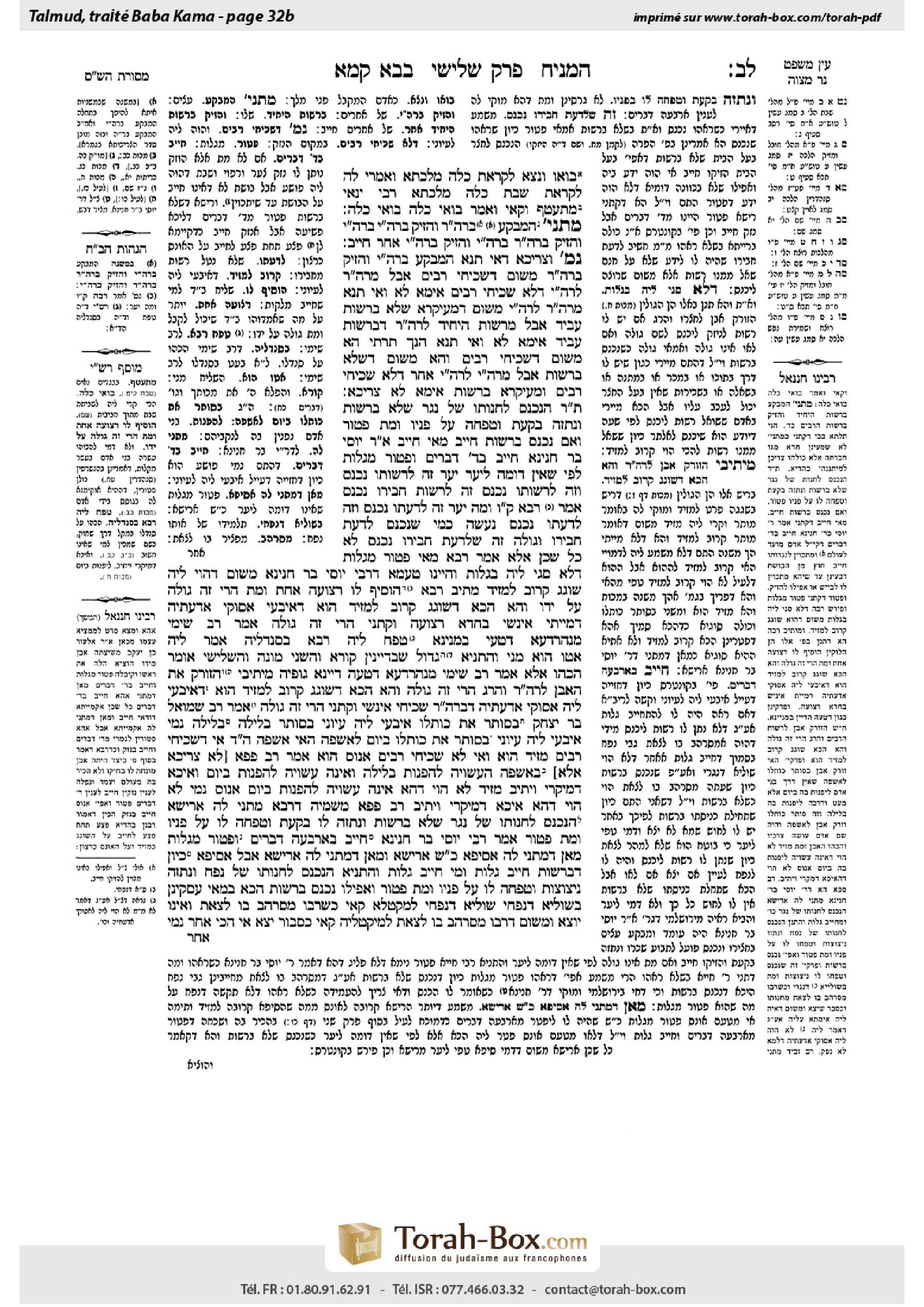
Bava Kamma 32b: Talmud study for Daf Yomi
Study the Talmud for Daf Yomi with scanned pages, Hebrew text, English translations from Sefaria and AI-generated French translations.
Passage selection and English or AI-generated French translation are available where the scan has annotations. Daf Study is independent of Torah-Box and Sefaria.
Browse Bava Kamma · בבא קמא · All tractatesBava Kamma 32b text and translations
This page of Bava Kamma includes the Aramaic text, an English translation and an AI-generated French translation, alongside the scan above.
בבא קמא ל״ב ב · Aramaic and Hebrew text
״בּוֹאוּ וְנֵצֵא לִקְרַאת כַּלָּה מַלְכְּתָא״. וְאָמְרִי לַהּ: ״לִקְרַאת שַׁבָּת – כַּלָּה מַלְכְּתָא״. רַבִּי יַנַּאי מִתְעַטֵּף וְקָאֵי, וְאָמַר: ״בּוֹאִי כַלָּה, בּוֹאִי כַלָּה״.
מַתְנִי׳ הַמְבַקֵּעַ בִּרְשׁוּת הָרַבִּים – וְהִזִּיק בִּרְשׁוּת הַיָּחִיד; בִּרְשׁוּת הַיָּחִיד – וְהִזִּיק בִּרְשׁוּת הָרַבִּים; בִּרְשׁוּת הַיָּחִיד – וְהִזִּיק בִּרְשׁוּת הַיָּחִיד אַחֵר, חַיָּיב.
גְּמָ׳ וּצְרִיכָא; דְּאִי תְּנָא: הַמְבַקֵּעַ בִּרְשׁוּת הַיָּחִיד וְהִזִּיק בִּרְשׁוּת הָרַבִּים – מִשּׁוּם דִּשְׁכִיחִי רַבִּים; אֲבָל מֵרְשׁוּת הָרַבִּים לִרְשׁוּת הַיָּחִיד, דְּלָא שְׁכִיחִי רַבִּים – אֵימָא לָא.
וְאִי תְּנָא: מֵרְשׁוּת הָרַבִּים לִרְשׁוּת הַיָּחִיד – מִשּׁוּם דְּמֵעִיקָּרָא שֶׁלֹּא בִּרְשׁוּת עָבֵיד; אֲבָל מֵרְשׁוּת הַיָּחִיד לִרְשׁוּת הָרַבִּים, דְּבִרְשׁוּת עָבֵיד – אֵימָא לָא.
וְאִי תְּנָא הָנָךְ תַּרְתֵּי – הָא מִשּׁוּם דִּשְׁכִיחִי רַבִּים, וְהָא מִשּׁוּם דְּשֶׁלֹּא בִּרְשׁוּת; אֲבָל מֵרְשׁוּת הַיָּחִיד לִרְשׁוּת הַיָּחִיד אַחֵר – דְּלָא שְׁכִיחִי רַבִּים, וּמֵעִיקָּרָא בִּרְשׁוּת – אֵימָא לָא; צְרִיכָא.
תָּנוּ רַבָּנַן: הַנִּכְנָס לַחֲנוּתוֹ שֶׁל נַגָּר שֶׁלֹּא בִּרְשׁוּת, וְנִתְּזָה בְּקַעַת וְטָפְחָה עַל פָּנָיו, וָמֵת – פָּטוּר. וְאִם נִכְנַס בִּרְשׁוּת – חַיָּיב.
מַאי חַיָּיב? אָמַר רַבִּי יוֹסֵי בַּר חֲנִינָא: חַיָּיב בְּאַרְבָּעָה דְּבָרִים. וּפָטוּר מִגָּלוּת,
לְפִי שֶׁאֵין דּוֹמֶה לְיַעַר. יַעַר – זֶה לִרְשׁוּתוֹ נִכְנָס, וְזֶה לִרְשׁוּתוֹ נִכְנָס; זֶה – לִרְשׁוּת חֲבֵירוֹ נִכְנַס.
אָמַר רָבָא: קַל וָחוֹמֶר; וּמָה יַעַר – זֶה לְדַעְתּוֹ נִכְנָס וְזֶה לְדַעְתּוֹ נִכְנָס, נַעֲשָׂה כְּמִי שֶׁנִּכְנַס לְדַעַת חֲבֵירוֹ – וְגוֹלֶה; זֶה – שֶׁלְּדַעַת חֲבֵירוֹ נִכְנָס, לֹא כׇּל שֶׁכֵּן?!
אֶלָּא אָמַר רָבָא: מַאי פָּטוּר מִגָּלוּת? דְּלָא סַגִּי לֵיהּ בְּגָלוּת. וְהַיְינוּ טַעְמָא דְּרַבִּי יוֹסֵי בַּר חֲנִינָא, מִשּׁוּם דְּהָוֵי לֵיהּ שׁוֹגֵג קָרוֹב לְמֵזִיד.
מֵתִיב רָבָא: הוֹסִיף לוֹ רְצוּעָה אַחַת, וָמֵת – הֲרֵי זֶה גּוֹלֶה עַל יָדוֹ. וְהָא הָכָא דְּשׁוֹגֵג קָרוֹב לְמֵזִיד הוּא, דְּאִיבְּעִי אַסּוֹקֵי אַדַּעְתֵּיהּ דְּמַיְיתֵי אִינָשֵׁי בַּחֲדָא רְצוּעָה, וְקָתָנֵי: הֲרֵי זֶה גּוֹלֶה! אָמַר רַב שִׁימִי מִנְּהַרְדְּעָא: דְּטָעֵי בְּמִנְיָנָא.
טְפַח לֵיהּ רָבָא בְּסַנְדָּלֵיהּ, אֲמַר לֵיהּ: אַטּוּ הוּא מָנֵי?! וְהָתַנְיָא: גָּדוֹל שֶׁבְּדַיָּינִין קוֹרֵא, וְהַשֵּׁנִי מוֹנֶה, וְהַשְּׁלִישִׁי אוֹמֵר: ״הַכֵּהוּ״!
אֶלָּא אָמַר רַב שִׁימִי מִנְּהַרְדְּעָא: דִּטְעָה דַּיָּינָא גּוּפֵיהּ.
מֵיתִיבִי: הַזּוֹרֵק אֶת הָאֶבֶן לִרְשׁוּת הָרַבִּים, וְהָרַג – הֲרֵי זֶה גּוֹלֶה. וְהָא הָכָא, דְּשׁוֹגֵג קָרוֹב לְמֵזִיד הוּא – דְּאִיבְּעִי לֵיהּ אַסּוֹקֵי אַדַּעְתֵּיהּ דְּבִרְשׁוּת הָרַבִּים שְׁכִיחִי אִינָשֵׁי; וְקָתָנֵי: הֲרֵי זֶה גּוֹלֶה!
אָמַר רַב שְׁמוּאֵל בַּר יִצְחָק: בְּסוֹתֵר אֶת כּוֹתְלוֹ.
אִיבְּעִי לֵיהּ עַיּוֹנֵי! בְּסוֹתֵר בַּלַּיְלָה.
בַּלַּיְלָה נָמֵי אִיבְּעִי לֵיהּ עַיּוֹנֵי! בְּסוֹתֵר אֶת כּוֹתְלוֹ בַּיּוֹם – לְאַשְׁפָּה.
הַאי אַשְׁפָּה הֵיכִי דָמֵי? אִי דִּשְׁכִיחִי רַבִּים – מֵזִיד הוּא! וְאִי לָא שְׁכִיחִי רַבִּים – אָנוּס הוּא!
אָמַר רַב פָּפָּא: [לָא צְרִיכָא, אֶלָּא] בְּאַשְׁפָּה הָעֲשׂוּיָה לְהִפָּנוֹת בַּלַּיְלָה, וְאֵינָהּ עֲשׂוּיָה לְהִפָּנוֹת בַּיּוֹם, וְאִיכָּא דְּמִיקְּרֵי וְיָתֵיב; מֵזִיד לָא הָוֵי – דְּהָא אֵינָהּ עֲשׂוּיָה לְהִפָּנוֹת בַּיּוֹם, אָנוּס נָמֵי לָא הָוֵי – דְּהָא אִיכָּא דְּמִיקְּרֵי וְיָתֵיב.
רַב פָּפָּא מִשְּׁמֵיהּ דְּרָבָא מַתְנִי לַהּ אַרֵישָׁא: הַנִּכְנָס לַחֲנוּתוֹ שֶׁל נַגָּר שֶׁלֹּא בִּרְשׁוּת, וְנִתְּזָה לוֹ בְּקַעַת וְטָפְחָה לוֹ עַל פָּנָיו, וָמֵת – פָּטוּר. אָמַר רַבִּי יוֹסֵי בַּר חֲנִינָא: חַיָּיב בְּאַרְבָּעָה דְּבָרִים, וּפָטוּר מִגָּלוּת.
מַאן דְּמַתְנֵי לַהּ אַסֵּיפָא – כׇּל שֶׁכֵּן אַרֵישָׁא; וּמַאן דְּמַתְנֵי לַהּ אַרֵישָׁא – אֲבָל אַסֵּיפָא, כֵּיוָן דְּבִרְשׁוּת – חַיָּיב גָּלוּת.
וּמִי חַיָּיב גָּלוּת? וְהָתַנְיָא: הַנִּכְנָס לַחֲנוּתוֹ שֶׁל נַפָּח, וְנִתְּזוּ נִיצוֹצוֹת וְטָפְחוּ לוֹ עַל פָּנָיו וָמֵת – פָּטוּר, וַאֲפִילּוּ נִכְנַס בִּרְשׁוּת!
הָכָא בְּמַאי עָסְקִינַן – בִּשְׁוַלְיָא דְנַפָּחֵי. שְׁוַלְיָא דְנַפָּחֵי לְמִקְטְלֵאּ קָאֵי? כְּשֶׁרַבּוֹ מְסַרְהֵב בּוֹ לָצֵאת, וְאֵינוֹ יוֹצֵא.
וּמִשּׁוּם דְּרַבּוֹ מְסַרְהֵב בּוֹ לָצֵאת – לְמִיקְטְלֵיהּ קָאֵי?! כְּסָבוּר יָצָא. אִי הָכִי, אַחֵר נָמֵי!
Bava Kamma 32b · English translation
Come and let us go out to greet the bride, the queen. And some say that this is what he would say: Come and let us go out to greet Shabbat, the bride, the queen. Rabbi Yannai would wrap himself in his tallit and stand at the eve of Shabbat at twilight, saying: Come, bride; come, bride. Similarly, it is appropriate for one to run out in honor of Shabbat.
MISHNA: With regard to one who was chopping wood in the public domain and a chip flew off and caused damage in the private property of another person, or one who was chopping wood in his private property and caused damage in the public domain, or one who was chopping wood in his private property and caused damage in the private property of another, in all these cases he is liable.
GEMARA: The Gemara comments: And it is necessary for the mishna to teach that he is liable in all these cases because in each one there is a novel element. As if it had taught only the case of one who was chopping wood in his private property and caused damage in the public domain, it might have been reasoned that he is liable, despite the fact that he was working in his private property, because it is common for the multitudes to be there. But if a chip flew from the public domain to another person’s private property, where it is not common for the multitudes to be, one might say that he is not liable. Therefore, it is necessary to teach this case as well.
And conversely, if it had taught that he is liable where the chip flew from the public domain to another’s private property, it might have been reasoned that he is liable because at the outset he was acting without permission by chopping wood in the public domain. But if it flew from his private property to the public domain, since he was acting with permission by chopping wood in his private property, one might say that he is not liable. Therefore, it is necessary to teach both cases.
And if the mishna had taught only that he is liable in these two cases, it might have been reasoned that in this case, where the damage was caused in the public domain, he is liable because it is common for the multitudes to be there, and in that case, where he was chopping in the public domain, he is liable because he was acting without permission. But in the last case, where the chip flew from his private property to another’s private property, where neither of the above reasons applies, as it is not common for the multitudes to be in the place where the damage was caused and he was acting with permission at the outset, one might say he is not liable. Therefore, it is necessary for the mishna to teach all these cases.
§ The Sages taught (Tosefta 6:25): With regard to one who entered the workshop of a carpenter without the latter’s permission, and a chip of wood flew off and hit him in the face and he died, the carpenter is exempt. But if he entered the shop with permission, the carpenter is liable.
The Gemara asks: What does the baraita mean when it rules that the carpenter is liable? Rabbi Yosei bar Ḥanina says: If the other person was injured, he is liable to pay four types of indemnity that one who injures another must pay. These are: Cost of the damage, pain, medical costs, and loss of livelihood. But if the one who entered was killed, he is exempt from exile.
The Gemara explains that he is exempt because this case is not similar to the case of a forest, which is the archetypal case stated in the Torah requiring one who kills unintentionally to be exiled, as it is written: “As when a man goes into the forest with his neighbor to chop wood, and his hand fetches a stroke with the axe to cut down the tree, and the head slips off the helve, and finds his neighbor, and he dies” (Deuteronomy 19:5). This is because in the case of the forest, both this one entered his domain and that one entered his domain, as anyone may use the public domain, whereas in this case, the victim entered another’s property. Therefore, the carpenter is not exiled.
Rava said: On the contrary; it can be inferred a fortiori that he is exiled. And if in the case of the forest, where this one entered of his own accord and that one entered of his own accord, neither asking for the other’s permission, nevertheless the victim is considered like one who entered with the other’s consent and therefore the one who kills unintentionally is exiled, all the more so is it not clear that in this case, where the victim entered another’s workshop with his consent, the carpenter should be exiled?
Rather, Rava said: What is the reason he is exempt from exile? As exile is not sufficient for him, and this is the reason of Rabbi Yosei bar Ḥanina, who exempts him from exile: Because it is an unintentional killing that is approaching intentional manslaughter. The purpose of exile is to atone for one who kills another completely unintentionally; if he was exceedingly negligent, exile is not sufficient to atone for him.
Rava raises an objection to his own explanation from a mishna: If one is sentenced to be flogged in court and the doctors assessed that he would be able to endure only a certain number of lashes, but the one administering the lashes added one lash to his punishment and he died, the agent of the court is exiled on account of him (Makkot 22b). But here, it is clear that it is a case of an unintentional killing that is approaching intentional manslaughter, as it should have entered his mind that people can die by one additional lash. And the tanna teaches that the agent of the court is exiled. Rav Shimi of Neharde’a said in response: It is a case where he erred in the counting, which is not considered approaching intentional manslaughter.
Rava slapped Rav Shimi on his sandal, a gesture of disparagement, and said to him: Is that to say that the one administering the lashes is the one who counts them? But isn’t it taught in a baraita that the eldest of the judges recites the verses that are read to a person while he receives lashes, and the second judge counts, and the third says to the one administering the lashes: Strike him? Accordingly, it is not the one administering the lashes who erred in counting.
Rather, Rav Shimi of Neharde’a said: It is a case where the judge himself erred in counting, and the one administering the lashes did not notice this error and meted out an extra lash, causing the person to die. It is therefore considered a completely unintentional killing. Consequently, he is exiled.
The Gemara raises an objection from another mishna: With regard to one who throws a stone into the public domain and kills someone, he is exiled. But here, it is clear that it is a case of an unintentional killing that is approaching intentional manslaughter, as it should have entered his mind that people are commonly found in the public domain. And the tanna teaches that he is exiled.
Rav Shmuel bar Yitzḥak said: It is not a case where one threw a stone into the public domain for no purpose, but rather where he demolishes his wall, which borders on the public domain, and stones fall into the public domain. Therefore, it is not considered to be approaching intentional manslaughter.
The Gemara questions this assertion: Nevertheless, he should have paid attention to see if there was anyone there, and therefore it should be considered an unintentional killing that approaches intentional manslaughter. The Gemara answers: It is a case where he demolishes the wall at night.
The Gemara asks: Even at night, he should also have paid attention to see if there was anyone there. The Gemara suggests an alternative interpretation: It is a case where he demolishes his wall during the day into a garbage dump, where people are not commonly found.
The Gemara asks: What are the circumstances of this garbage dump? If it is a garbage dump where the multitudes are commonly found, it is considered intentional manslaughter. And if the multitudes are not commonly found there, he should be considered not only one who kills unintentionally, but a victim of circumstances beyond his control, since he could not have anticipated that someone would be there. Therefore, he should be exempt from exile.
Rav Pappa said: This halakha is necessary only in the case of a garbage dump where people are given to relieve themselves at night and are not given to relieve themselves during the day, as it is near the public domain. But there are those who chance by and sit there for this purpose even during the day. On the one hand, he is not one who kills intentionally, as people are not given to relieve themselves there during the day. On the other hand, he is not a victim of circumstances beyond his control either, as there are those who chance by and sit there. Therefore, he is considered one who kills unintentionally and is liable to be exiled.
Rav Pappa taught in the name of Rava that this aforementioned statement of Rabbi Yosei bar Ḥanina is in reference not to the latter clause of the baraita but is in reference to the first clause: With regard to one who enters the workshop of a carpenter without permission, and a chip of wood flies off and strikes him in the face and he dies, the carpenter is exempt. In reference to this clause Rabbi Yosei bar Ḥanina says: If the one who entered was merely injured, the carpenter is liable to pay four types of indemnity. But if the one who entered was killed, he is exempt from exile.
The Gemara comments: With regard to the one who teaches this statement in reference to the last clause of the baraita, where one enters with permission, all the more so would he teach it in reference to the first clause, where one enters without permission. But the one who teaches this statement in reference to the first clause teaches it only in reference to that clause. But in the case of the last clause, since he entered with permission the carpenter is liable to go into exile.
The Gemara asks: But is he liable to go into exile when the victim had permission to enter? But isn’t it taught in a baraita that with regard to one who enters the workshop of a welder, and sparks [nitzotzot] fly off and strike him in his face and he dies, the welder is exempt, and this is the halakha even if the victim entered with permission?
The Gemara answers: With what are we dealing here, in this baraita? We are dealing with the welder’s apprentice who enters his workshop. The Gemara asks: Does the welder’s apprentice stand to be killed, i.e., is it permitted to kill him? The Gemara answers: It is a case where his mentor is urging him to leave, and he does not leave.
The Gemara asks: And because his mentor is urging him to leave, does he stand to be killed? The welder should be careful until his apprentice leaves. The Gemara answers: The welder thought that he had already left when the accident happened. The Gemara asks: If so, why establish that the baraita refers specifically to an apprentice? The welder would be exempt if it were any other person also.
Bava Kamma 32b · Traduction française (IA)
Venez, allons rejoindre la mariée, la reine. Et certains disent que c'est ce qu'il disait : Venez, allons rejoindre la Shabbat, la mariée, la reine. Rabbi Yannai se couvrait avec son tallit et se tenait à la veille du Shabbat à l'heure du crépuscule, disant : Venez, mariée ; venez, mariée. De même, il est approprié que l'on sorte en honneur du Shabbat.
MICHNA : Concernant celui qui coupait du bois dans le domaine public et un éclat vola et causa un préjudice dans la propriété privée d'une autre personne, ou celui qui coupait du bois dans son propre domaine privé et causa un préjudice dans le domaine public, ou celui qui coupait du bois dans son propre domaine privé et causa un préjudice dans la propriété privée d'une autre personne, dans tous ces cas, il est responsable.
GUEMARA : La Guemara commente : Et il est nécessaire que la Michna enseigne qu'il est responsable dans tous ces cas, car dans chaque cas, il y a un élément nouveau. Comme si elle avait enseigné seulement le cas où l'on coupait du bois dans son propre domaine privé et causa un préjudice dans le domaine public, on pourrait penser qu'il est responsable, malgré le fait qu'il travaillait dans son propre domaine, car c'est commun que la foule y soit. Mais si un éclat vint du domaine public vers la propriété privée d'une autre personne, où la foule n'y est pas commune, on pourrait dire qu'il n'est pas responsable. Par conséquent, il est nécessaire d'enseigner ce cas également.
Et inversement, si la Michna avait enseigné qu'il est responsable lorsque l'éclat vint du domaine public vers la propriété privée d'une autre personne, on pourrait penser qu'il est responsable car, au départ, il agissait sans autorisation en coupant du bois dans le domaine public. Mais si l'éclat vint de son propre domaine privé vers le domaine public, puisque, dans ce cas, il agissait avec autorisation en coupant du bois dans son propre domaine, on pourrait dire qu'il n'est pas responsable. Par conséquent, il est nécessaire d'enseigner ces deux cas.
Et si la Michna avait enseigné seulement qu'il est responsable dans ces deux cas, on pourrait penser qu'en ce cas, où le préjudice a été causé dans le domaine public, il est responsable car c'est commun que la foule y soit, et dans ce cas, où il coupait du bois dans le domaine public, il est responsable car il agissait sans autorisation. Mais dans le dernier cas, où l'éclat vint de son propre domaine privé vers la propriété privée d'une autre personne, où ni l'un ni l'autre des raisons ci-dessus ne s'applique, puisque la foule n'y est pas commune et qu'il agissait avec autorisation au départ, on pourrait dire qu'il n'est pas responsable. Par conséquent, il est nécessaire que la Michna enseigne tous ces cas.
§ Les Sages enseignent (Tosefta 6:25) : Concernant celui qui entra dans l'atelier d'un charpentier sans son autorisation, et un éclat de bois vint et frappa son visage et il mourut, le charpentier est exempt. Mais si l'individu entra dans l'atelier avec l'autorisation, le charpentier est responsable.
La Guemara demande : De quoi la baraïta veut-elle dire lorsqu'elle règle que le charpentier est responsable ? Rabbi Yosei bar Ḥanina dit : Si l'autre personne a été blessée, il est responsable de payer quatre types de réparation que l'on doit payer à celui qui blesse un autre. Ce sont : le coût du préjudice, la douleur, les frais médicaux et la perte de revenu. Mais si l'individu qui est entré est mort, il est exempt de l'exil.
La Guemara explique qu'il est exempt car ce cas n'est pas semblable au cas d'un bois, qui est le cas archétypal énoncé dans la Torah exigeant que celui qui tue accidentellement soit exilé, comme il est écrit : « Comme lorsqu'un homme entre dans la forêt avec son voisin pour couper du bois, et sa main saisit un coup avec le marteau pour couper l'arbre, et la tête tombe du manche, et il trouve son voisin, et il meurt » (Deutéronome 19:5). C'est parce que dans le cas du bois, ce dernier est entré dans la propriété de l'autre et celui-ci dans la sienne, car tout le monde peut utiliser le domaine public, tandis que dans ce cas, la victime est entrée dans la propriété d'autrui. Par conséquent, le charpentier n'est pas exilé.
Rava dit : Au contraire ; on peut en déduire a fortiori qu'il est exilé. Et si dans le cas du bois, où ce dernier est entré de son propre chef et celui-ci également, sans demander l'autorisation de l'autre, néanmoins la victime est considérée comme ayant entré avec l'autorisation de l'autre et donc celui qui tue accidentellement est exilé, beaucoup plus encore est-il clair que dans ce cas, où la victime est entré dans l'atelier d'autrui avec son accord, le charpentier devrait être exilé ?
Plutôt, Rava dit : De quelle raison est-il exempt de l'exil ? Parce que l'exil n'est pas suffisant pour lui, et c'est la raison de Rabbi Yosei bar Ḥanina qui l'exempte de l'exil : Parce que c'est un meurtre accidentel qui approche du meurtre intentionnel. L'objectif de l'exil est d'at-onner celui qui tue un autre de manière totalement accidentelle ; si l'on était négligent, l'exil n'est pas suffisant pour l'at-onner.
Rava soulève une objection contre son propre explication à partir d'une Michna : Si l'on est condamné à être battu en cour et les médecins ont estimé qu'il pouvait endurer seulement un certain nombre de coups de fouet, mais celui qui administre les coups ajoute un coup supplémentaire et il meurt, l'agent de la cour est exilé à cause de lui (Makkot 22b). Mais ici, il est clair que c'est un cas de meurtre accidentel qui approche du meurtre intentionnel, car il aurait dû entrer dans son esprit que les gens peuvent mourir d'un seul coup supplémentaire. Et le tanna enseigne que l'agent de la cour est exilé. Rav Shimi de Neharde’a répond : C'est un cas où il s'est trompé dans le comptage, ce qui n'est pas considéré comme approchant du meurtre intentionnel.
Rava frappa Rav Shimi sur sa sandale, geste de dénigrement, et lui dit : Est-ce que cela signifie que celui qui administre les coups compte les coups ? Mais n’est-ce pas enseigné dans une baraïta que le plus âgé des juges récite les versets qui sont lus à une personne pendant qu’elle reçoit les coups, et le second juge compte, et le troisième dit à celui qui administre les coups : Frappe-le ? Ainsi, ce n’est pas celui qui administre les coups qui a commis l’erreur dans le comptage.
Plutôt, Rav Shimi de Neharde’a dit : C’est un cas où le juge lui-même a commis l’erreur dans le comptage, et celui qui administre les coups n’a pas remarqué cette erreur et a administré un coup supplémentaire, causant la mort de la personne. C’est pourquoi il est considéré comme un meurtre totalement involontaire. En conséquence, il est exilé.
La Guemara soulève une objection à partir d’une autre mitsva : Concernant celui qui jette une pierre dans le domaine public et tue quelqu’un, il est exilé. Mais ici, il est clair que c’est un cas de meurtre involontaire qui s’approche du meurtre intentionnel, car il aurait dû entrer en son esprit que les gens sont souvent présents dans le domaine public. Et le tanna enseigne qu’il est exilé.
Rav Shmuel bar Yitzḥak dit : Ce n’est pas un cas où l’on jette une pierre dans le domaine public sans but, mais plutôt où l’on détruit son mur, qui touche le domaine public, et des pierres tombent dans le domaine public. Ainsi, cela n’est pas considéré comme s’approchant du meurtre intentionnel.
La Guemara questionne cette affirmation : Néanmoins, il aurait dû prendre garde pour voir s’il y avait quelqu’un là, et donc cela devrait être considéré comme un meurtre involontaire qui s’approche du meurtre intentionnel. La Guemara répond : C’est un cas où l’on détruit le mur la nuit.
La Guemara demande : Même la nuit, il aurait aussi dû prendre garde pour voir s’il y avait quelqu’un là. La Guemara suggère une autre interprétation : C’est un cas où l’on détruit son mur pendant la journée dans un lieu de déchets, où les gens ne sont pas souvent présents.
La Guemara demande : Quelles sont les circonstances de ce lieu de déchets ? Si c’est un lieu de déchets où les multitudes sont souvent présentes, il est considéré comme meurtre intentionnel. Et si les multitudes ne sont pas souvent présentes là, il devrait être considéré non seulement comme un meurtre involontaire, mais comme une victime des circonstances hors de son contrôle, puisqu’il ne pouvait pas anticiper que quelqu’un serait là. Ainsi, il devrait être exempt d’exil.
Rav Pappa dit : Cette halakha est nécessaire uniquement dans le cas d’un lieu de déchets où les gens sont autorisés à s’écrotter la nuit et ne le sont pas pendant la journée, car il est proche du domaine public. Mais il y a ceux qui passent par hasard et s’y asseyent à cette fin même pendant la journée. D’un côté, il n’est pas celui qui tue intentionnellement, car les gens ne sont pas autorisés à s’écrotter là pendant la journée. De l’autre côté, il n’est pas une victime des circonstances hors de son contrôle non plus, car il y a ceux qui passent par hasard et s’y asseyent. Ainsi, il est considéré comme celui qui tue involontairement et est tenu responsable d’exil.
Rav Pappa enseigna en nom de Rava que cette déclaration précédente de Rabbi Yosei bar Ḥanina fait référence non à la dernière clause de la baraïta, mais à la première clause : Concernant celui qui entre dans l’atelier d’un charpentier sans permission, et un fragment de bois s’envole et frappe son visage et il meurt, le charpentier est exempt. En référence à cette clause, Rabbi Yosei bar Ḥanina dit : Si celui qui est entré a été simplement blessé, le charpentier est tenu responsable de payer quatre types de réparation. Mais si celui qui est entré est mort, il est exempt d’exil.
La Guemara commente : Concernant celui qui enseigne cette déclaration en référence à la dernière clause de la baraïta, où l’on entre avec permission, encore plus encore serait-il enseigné en référence à la première clause, où l’on entre sans permission. Mais celui qui enseigne cette déclaration en référence à la première clause l’enseigne uniquement en référence à cette clause. Mais dans le cas de la dernière clause, puisque l’on entre avec permission, le charpentier est tenu d’exil.
La Guemara demande : Mais est-il tenu d’exil lorsque la victime a eu la permission d’entrer ? Mais n’est-ce pas enseigné dans une baraïta que concernant celui qui entre dans l’atelier d’un forgeur, et des étincelles s’envolent et frappent son visage et il meurt, le forgeur est exempt, et c’est la halakha même si la victime a eu la permission d’entrer ?
La Guemara répond : Avec quels sommes-nous occupés ici, dans cette baraïta ? Nous sommes occupés par l’apprenti du forgeur qui entre dans son atelier. La Guemara demande : L’apprenti du forgeur est-il tenu de mourir, c’est-à-dire est-il permis de le tuer ? La Guemara répond : C’est un cas où son maître l’incite à partir, et il ne part pas.
La Guemara demande : Et parce que son maître l’incite à partir, est-il tenu de mourir ? Le forgeur devrait être prudent jusqu’à ce que son apprenti parte. La Guemara répond : Le forgeur pensait qu’il avait déjà parti lors de l’accident. La Guemara demande : Si tel est le cas, pourquoi établir que la baraïta fait spécifiquement référence à un apprenti ? Le forgeur serait exempt même si c’était une autre personne.
Traduction française générée par IA à partir de l’édition anglaise de Sefaria. Vérifie toujours un passage avec le texte source.
Text from Sefaria: William Davidson Edition - Vocalized Aramaic (CC BY NC); William Davidson Edition - English (CC BY NC).