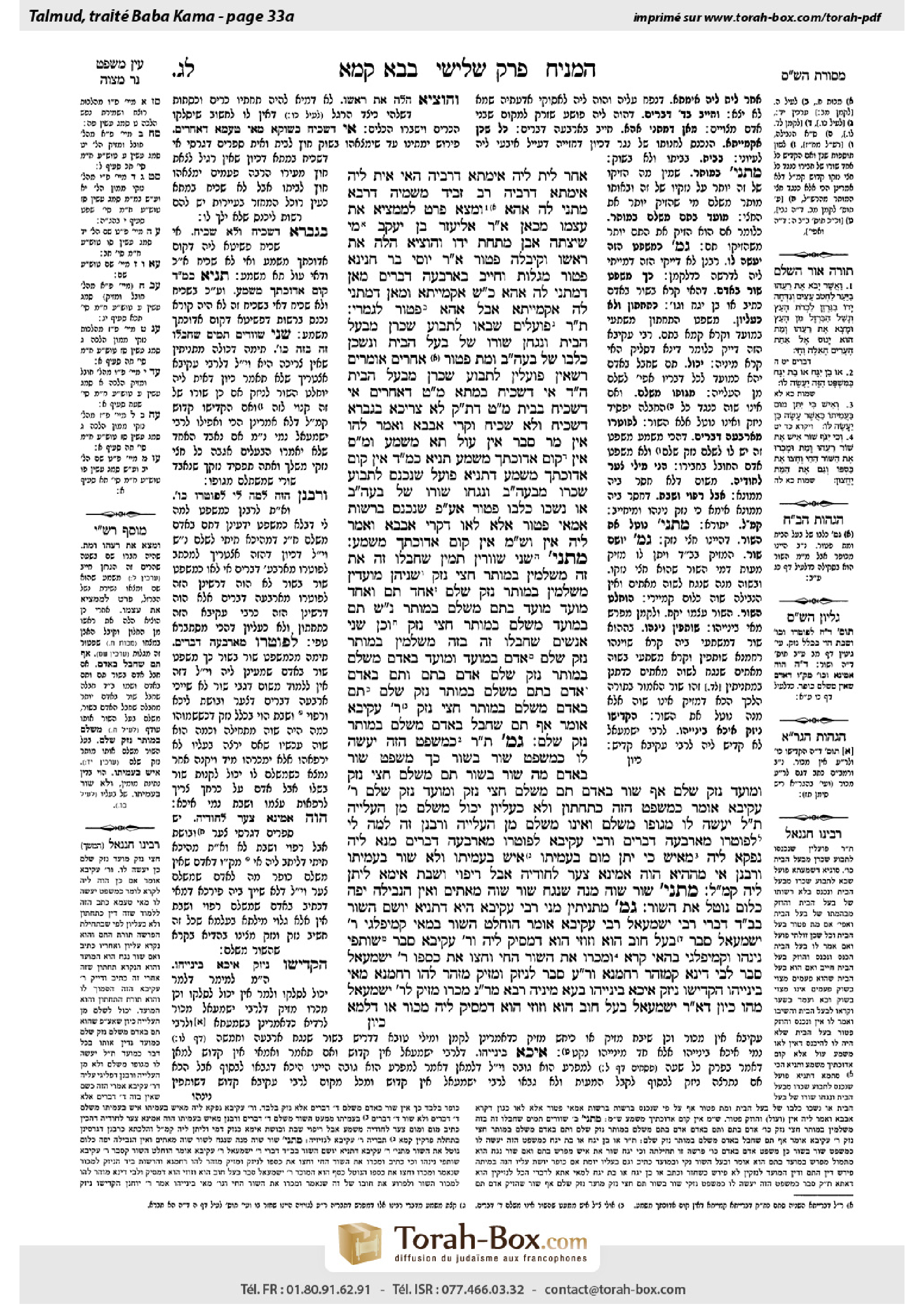
Bava Kamma 33a: Talmud study for Daf Yomi
Study the Talmud for Daf Yomi with scanned pages, Hebrew text, English translations from Sefaria and AI-generated French translations.
Passage selection and English or AI-generated French translation are available where the scan has annotations. Daf Study is independent of Torah-Box and Sefaria.
Browse Bava Kamma · בבא קמא · All tractatesBava Kamma 33a text and translations
This page of Bava Kamma includes the Aramaic text, an English translation and an AI-generated French translation, alongside the scan above.
בבא קמא ל״ג א · Aramaic and Hebrew text
אַחֵר – לֵית לֵיהּ אֵימְתָא דְרַבֵּיהּ, הַאי – אִית לֵיהּ אֵימְתָא דְרַבֵּיהּ.
רַב זְבִיד מִשְּׁמֵיהּ דְּרָבָא מַתְנֵי לַהּ אַהָא: ״וּמָצָא״ – פְּרָט לְמַמְצִיא אֶת עַצְמוֹ. מִכָּאן אָמַר רַבִּי אֱלִיעֶזֶר בֶּן יַעֲקֹב: מִי שֶׁיָּצְתָה אֶבֶן מִתַּחַת יָדוֹ, וְהוֹצִיא הַלָּה אֶת רֹאשׁוֹ וְקִיבְּלָהּ – פָּטוּר. אָמַר רַבִּי יוֹסֵי בַּר חֲנִינָא: פָּטוּר מִגָּלוּת, וְחַיָּיב בְּאַרְבָּעָה דְּבָרִים.
מַאן דְּמַתְנֵי לַהּ אַהָא – כׇּל שֶׁכֵּן אַקַּמַּיְיתָא; וּמַאן דְּמַתְנֵי לַהּ אַקַּמַּיְיתָא – אֲבָל אַהָא פָּטוּר לִגְמָרֵי.
תָּנוּ רַבָּנַן: פּוֹעֲלִים שֶׁבָּאוּ לִתְבּוֹעַ שְׂכָרָן מִבַּעַל הַבַּיִת, וּנְגָחָן שׁוֹרוֹ שֶׁל בַּעַל הַבַּיִת וּנְשָׁכָן כַּלְבּוֹ שֶׁל בַּעַל הַבַּיִת, וָמֵת – פָּטוּר. אֲחֵרִים אוֹמְרִים: רַשָּׁאִין פּוֹעֲלִין לִתְבּוֹעַ שְׂכָרָן מִבַּעַל הַבַּיִת.
הֵיכִי דָמֵי? אִי דִּשְׁכִיחַ בְּמָתָא – מַאי טַעְמָא דַּאֲחֵרִים? אִי דִּשְׁכִיחַ בַּבַּיִת – מַאי טַעְמָא דְּתַנָּא קַמָּא?
לָא צְרִיכָא, בְּגַבְרָא דִּשְׁכִיחַ וְלָא שְׁכִיחַ, וְקָרֵי אַבָּבָא וַאֲמַר לְהוּ ״אִין״; מַר סָבַר: ״אִין״ – ״עוּל תָּא״ מַשְׁמַע. וּמַר סָבַר: ״אִין״ – ״קוּם אַדּוּכְתָּךְ״ מַשְׁמַע.
תַּנְיָא כְּמַאן דְּאָמַר ״אִין״ – ״קוּם אַדּוּכְתָּךְ״ מַשְׁמַע, דְּתַנְיָא: פּוֹעֵל שֶׁנִּכְנַס לִתְבּוֹעַ שְׂכָרוֹ מִבַּעַל הַבַּיִת, וּנְגָחוֹ שׁוֹרוֹ שֶׁל בַּעַל הַבַּיִת אוֹ נְשָׁכוֹ כַּלְבּוֹ, פָּטוּר – אַף עַל פִּי שֶׁנִּכְנַס בִּרְשׁוּת. אַמַּאי פָּטוּר? אֶלָּא לָאו דְּקָרֵי אַבָּבָא, וְאָמַר לֵיהּ ״אִין״, וּשְׁמַע מִינַּהּ ״אִין״ – ״קוּם אַדּוּכְתָּךְ״ מַשְׁמַע.
מַתְנִי׳ שְׁנֵי שְׁווֹרִין תַּמִּין שֶׁחָבְלוּ זֶה אֶת זֶה – מְשַׁלְּמִין בַּמּוֹתָר חֲצִי נֶזֶק. שְׁנֵיהֶן מוּעָדִין – מְשַׁלְּמִין בַּמּוֹתָר נֶזֶק שָׁלֵם.
אֶחָד תָּם וְאֶחָד מוּעָד – מוּעָד בַּתָּם מְשַׁלֵּם בַּמּוֹתָר נֶזֶק שָׁלֵם, תָּם בַּמוּעָד מְשַׁלֵּם בַּמּוֹתָר חֲצִי נֶזֶק.
וְכֵן שְׁנֵי אֲנָשִׁים שֶׁחָבְלוּ זֶה בָּזֶה – מְשַׁלְּמִין בַּמּוֹתָר נֶזֶק שָׁלֵם.
אָדָם בַּמוּעָד וּמוּעָד בָּאָדָם – מְשַׁלֵּם בַּמּוֹתָר נֶזֶק שָׁלֵם. אָדָם בַּתָּם וְתָם בָּאָדָם – אָדָם בַּתָּם מְשַׁלֵּם בַּמּוֹתָר נֶזֶק שָׁלֵם, תָּם בָּאָדָם מְשַׁלֵּם בַּמּוֹתָר חֲצִי נֶזֶק. רַבִּי עֲקִיבָא אוֹמֵר: אַף תָּם שֶׁחָבַל בָּאָדָם – מְשַׁלֵּם בַּמּוֹתָר נֶזֶק שָׁלֵם.
גְּמָ׳ תָּנוּ רַבָּנַן: ״כַּמִּשְׁפָּט הַזֶּה יֵעָשֶׂה לּוֹ״ – כְּמִשְׁפַּט שׁוֹר בְּשׁוֹר, כָּךְ מִשְׁפַּט שׁוֹר בְּאָדָם. מָה שׁוֹר בְּשׁוֹר – תָּם מְשַׁלֵּם חֲצִי נֶזֶק, וּמוּעָד נֶזֶק שָׁלֵם, אַף שׁוֹר בְּאָדָם – תָּם מְשַׁלֵּם חֲצִי נֶזֶק, וּמוּעָד נֶזֶק שָׁלֵם.
רַבִּי עֲקִיבָא אוֹמֵר: ״כַּמִּשְׁפָּט הַזֶּה״ – כַּתַּחְתּוֹן, וְלֹא כָּעֶלְיוֹן.
יָכוֹל מְשַׁלֵּם מִן הָעֲלִיָּיה, תַּלְמוּד לוֹמַר: ״יֵעָשֶׂה לוֹ״ – מִגּוּפוֹ מְשַׁלֵּם, וְאֵינוֹ מְשַׁלֵּם מִן הָעֲלִיָּיה.
וְרַבָּנַן – ״זֶה״ לְמָה לִי? לְפוֹטְרוֹ מֵאַרְבָּעָה דְּבָרִים.
וְרַבִּי עֲקִיבָא – לְפוֹטְרוֹ מֵאַרְבָּעָה דְּבָרִים מְנָא לֵיהּ? נָפְקָא לֵיהּ מֵ״אִישׁ כִּי יִתֵּן מוּם בַּעֲמִיתוֹ״; ״אִישׁ בַּעֲמִיתוֹ״ – וְלֹא שׁוֹר בַּעֲמִיתוֹ.
וְרַבָּנַן – אִי מֵהַהִיא הֲוָה אָמֵינָא צַעַר לְחוֹדֵיהּ, אֲבָל רִיפּוּי וָשֶׁבֶת אֵימָא לִיתֵּן לֵיהּ; קָא מַשְׁמַע לַן.
מַתְנִי׳ שׁוֹר שָׁוֶה מָנֶה שֶׁנָּגַח שׁוֹר שָׁוֶה מָאתַיִם, וְאֵין הַנְּבֵילָה יָפָה כְּלוּם – נוֹטֵל אֶת הַשּׁוֹר.
גְּמָ׳ מַתְנִיתִין מַנִּי – רַבִּי עֲקִיבָא הִיא. דְּתַנְיָא: יוּשַׁם הַשּׁוֹר בְּבֵית דִּין, דִּבְרֵי רַבִּי יִשְׁמָעֵאל. רַבִּי עֲקִיבָא אוֹמֵר: הוּחְלַט הַשּׁוֹר.
בְּמַאי קָמִיפַּלְגִי? רַבִּי יִשְׁמָעֵאל סָבַר: בַּעַל חוֹב הוּא, וְזוּזֵי הוּא דְּמַסֵּיק לֵיהּ. וְרַבִּי עֲקִיבָא סָבַר: שׁוּתָּפֵי נִינְהוּ.
וְקָמִיפַּלְגִי בְּהַאי קְרָא: ״וּמָכְרוּ אֶת הַשּׁוֹר הַחַי וְחָצוּ אֶת כַּסְפּוֹ״ – רַבִּי יִשְׁמָעֵאל סָבַר: לְבֵי דִינָא קָמַזְהַר רַחֲמָנָא; וְרַבִּי עֲקִיבָא סָבַר: לְנִיזָּק וּמַזִּיק מַזְהַר לְהוּ רַחֲמָנָא.
מַאי בֵּינַיְיהוּ? הִקְדִּישׁוֹ נִיזָּק אִיכָּא בֵּינַיְיהוּ.
בְּעָא מִינֵּיהּ רָבָא מֵרַב נַחְמָן: מְכָרוֹ מַזִּיק, לְרַבִּי יִשְׁמָעֵאל מַהוּ? כֵּיוָן דְּאָמַר רַבִּי יִשְׁמָעֵאל בַּעַל חוֹב הוּא, וְזוּזֵי הוּא דְּמַסֵּיק לֵיהּ – מָכוּר; אוֹ דִלְמָא,
Bava Kamma 33a · English translation
The Gemara answers: Another person does not have awe of his mentor. Therefore, even if the welder urges another person to leave, he must ascertain that that person actually did so, and otherwise he is liable to be exiled. By contrast, this apprentice has awe of his mentor, and so the welder may assume that if he instructed him to leave, he certainly did. Therefore, if in reality the apprentice did not leave and is killed by the sparks, the welder is not liable to be exiled, as he is not held accountable.
Rav Zevid taught in the name of Rava that this aforementioned statement of Rabbi Yosei bar Ḥanina is in reference not to the above baraita but is in reference to this baraita: It is stated in the verse concerning one who kills unintentionally: “And the head slips off the helve, and finds his neighbor, and he dies” (Deuteronomy 19:5); this serves to exclude one who introduces himself into an area of danger, in which case the one who kills unintentionally is exempt from exile. From here Rabbi Eliezer ben Ya’akov says: With regard to one whom a stone departed from his hand, and another person stuck out his head and received a blow from it and died, the one who threw the stone is exempt from exile. It is in reference to this statement that Rabbi Yosei bar Ḥanina says: He is exempt from exile for killing him. But if the victim was merely injured, he is liable to pay four types of indemnity.
The Gemara comments: The one who teaches this statement in reference to this baraita, all the more so he would teach it in reference to the first baraita, where one entered the workshop of the carpenter. But the one who teaches it with regard to the first baraita teaches it only in reference to that baraita. But in this baraita he is entirely exempt from liability for injury, as one could claim that he is completely blameless.
§ The Sages taught: With regard to salaried laborers who came into their employer’s courtyard to claim their wages from the homeowner, and the homeowner’s ox gored them, or the homeowner’s dog bit them, and a laborer died, the homeowner is exempt. Others say that he is liable, as salaried laborers are allowed to enter their employer’s property to claim their wages from the homeowner.
The Gemara asks: What are the circumstances? If the employer can be found in the city, what is the reason of the others, who hold him liable? The laborers could have met him in the city to claim their wages and did not need to enter his courtyard. If he can be found only at home, what is the reason of the first tanna, who exempts him? Clearly they are entitled to claim their wages.
The Gemara answers: No, these are not the circumstances under discussion. This halakha is necessary only with regard to a man who can sometimes be found in town and sometimes cannot be found in town, and the laborers called to him at the gate of his courtyard, and he said to them: Yes. One Sage, referred to as the others, holds that the term yes in this context indicates: Come in. Therefore, he is liable for their death. And one Sage, the first tanna, holds that the term yes in this context indicates: Stand in your place and I will come out to you. Since he did not give them permission to enter, he is exempt.
It is taught in a baraita in accordance with the opinion of the one who says that yes in this context indicates: Stand in your place. As it is taught in a baraita: With regard to a salaried laborer who entered his employer’s courtyard to claim his wages from the homeowner, and the homeowner’s ox gored him, or his dog bit him, the homeowner is exempt, although the laborer entered with permission. The Gemara asks: Why is he exempt if the laborer entered with permission? Rather, is it not because it is a case where the laborer called him at the gate, and he said to him: Yes? Conclude from it that yes in this context indicates: Stand in your place.
MISHNA: With regard to two innocuous oxen that injured each other, the respective damages are evaluated, and if one amount is more than the other, the owner pays half the damages with regard to the difference. In other words, the owner of the ox that caused the greater damage pays the other owner half the difference. If both oxen were forewarned, the owner of the ox that caused the greater damage pays the full cost of the damage with regard to the difference.
In a case where one of the oxen was innocuous and the other one was forewarned, if the forewarned ox caused greater damage to the innocuous ox than the reverse, the owner of the forewarned ox pays the full cost of the damage with regard to the difference. If the innocuous ox caused greater damage to the forewarned ox, its owner pays half the damage with regard to the difference.
And similarly, with regard to two people who injured each other, the one who did greater damage pays the full cost of the damage with regard to the difference, since one is always considered forewarned with regard to damage he causes.
If a person caused damage to a forewarned ox and the forewarned ox caused damage to the person, whichever side caused the greater damage pays the full cost of the damage with regard to the difference. In a case where a person caused damage to an innocuous ox and the innocuous ox caused damage to the person, if the person caused greater financial damage to the innocuous ox he pays the full cost of the damage with regard to the difference. If the innocuous ox caused greater damage to the person, its owner pays only half the damage with regard to the difference. Rabbi Akiva says: The owner of the innocuous ox that injured a person also pays the full cost of the damage with regard to the difference. Rabbi Akiva does not distinguish between an innocuous and a forewarned ox in a case where an ox injures a person.
GEMARA: With regard to the dispute between Rabbi Akiva and the Rabbis about a case where an ox injures a person, the Sages taught: It is derived from the verse: “Whether it has gored a son, or has gored a daughter, according to this judgment shall it be done to him” (Exodus 21:31), that as is the judgment concerning an ox that causes damage to an ox, so is the judgment with regard to an ox that causes damage to a person. Just as with regard to an ox that causes damage to an ox, if it is innocuous its owner pays half the cost of the damage and if it is forewarned he pays the full cost of the damage, so too, with regard to an ox that causes damage to a person, if it is an innocuous ox its owner pays half the cost of the damage and if it is a forewarned ox the owner pays the full cost of the damage.
Rabbi Akiva says: It is derived from the phrase “according to this judgment” that the halakha with regard to an ox that gores a person is judged like the case that appears in the lower verse, i.e., the case of a forewarned ox, which appears in Exodus 21:29, and not like the case that appears in the upper verse, i.e., the case of an innocuous ox, which appears in Exodus 21:28.
One might have thought that since the case of an ox that gored a person is compared to the case of a forewarned ox, the owner also pays from his superior-quality property. Therefore, the verse states: “Shall it be done to him [lo],” indicating he pays restitution exclusively from the proceeds of the sale of the body of his belligerent ox and does not pay from his superior-quality property, as the word lo can also be understood as referring to the ox. In this manner the case of an innocuous ox that gores a person is compared to the halakha of an innocuous ox that gores another ox, whereas with regard to the amount of restitution, it is compared to the case of a forewarned ox.
The Gemara asks: And according to the opinion of the Rabbis, who do not differentiate between an ox that gores a person and one that gores an animal, inasmuch as the distinction between an innocuous and a forewarned ox applies in both cases, why do I need the seemingly superfluous word “this”? The Gemara answers: The word is stated to exempt him from the four types of indemnity that one who injures another person is liable to pay, thereby emphasizing the comparison to the case of an ox that gores an ox.
The Gemara asks: And from where does Rabbi Akiva derive the halakha exempting him from paying these four types of indemnity? The Gemara answers: He derives it from the verse: “And if a man maims his neighbor, as he has done, so shall be done to him” (Leviticus 24:19). Rabbi Akiva derives from here that only when a man injures his neighbor is he liable to pay these four types of indemnity, but not when an ox injures his neighbor.
The Gemara asks: And why do the Rabbis not derive this halakha from that verse? The Gemara answers: If it would have been derived from that verse, I would have said that he is exempt only from paying for pain, but for medical costs and loss of livelihood, I would say that he is liable to give him compensation. Therefore, the phrase “according to this judgment” teaches us that he is not liable to pay compensation for anything other than the damage itself.
MISHNA: With regard to an innocuous ox worth one hundred dinars that gored an ox worth two hundred dinars, and the carcass of the dead ox is not worth anything, its owner takes the entire ox that gored it, since it is worth half the value of the damage.
GEMARA: Whose opinion is expressed in the mishna, which rules that the injured party takes the ox immediately? It is the opinion of Rabbi Akiva, as it is taught in a baraita: After it gores another ox, the belligerent ox shall be appraised in court before it is taken by the injured party, this is the statement of Rabbi Yishmael. Rabbi Akiva says: The ox was already assigned to the owner of the dead ox as payment, and if the amount of damages is not contested by the owner of the goring ox, no further legal steps are required.
The Gemara explains: With regard to what principle do they disagree? Rabbi Yishmael holds that the owner of the dead ox is considered a creditor of the owner of the belligerent ox, and it is money that he is claiming from him, but he has no ownership of the body of the belligerent ox. And Rabbi Akiva holds that they are partners, i.e., from the time the innocuous ox killed the other ox, the owner of the dead ox has a share of ownership in the belligerent ox.
And they disagree with regard to the meaning of this verse: “Then they shall sell the live ox, and divide its monetary value” (Exodus 21:35). Rabbi Yishmael holds that the Merciful One is commanding the court to evaluate the damages in this manner, and Rabbi Akiva holds that the Merciful One is commanding the injured party and the one liable for damage to split ownership of the live ox, without the involvement of the court.
The Gemara asks: What is the practical difference between the two opinions as to whether or not they are considered partners? The Gemara answers: There is a practical difference between them in a case where the injured party consecrated the ox to the Temple. According to the opinion of Rabbi Yishmael, until the court transfers the ox to the injured party, it still belongs to its owner, and therefore the injured party cannot consecrate it. According to the opinion of Rabbi Akiva, the injured party owns the ox from the time the damage was inflicted, and he can therefore consecrate it.
Rava asked Rav Naḥman: If the one liable for damage sold the ox, what is the halakha according to Rabbi Yishmael? Is it that since Rabbi Yishmael says that the injured party is considered a creditor, and it is merely money that he is claiming from him, it is sold? Or perhaps
Bava Kamma 33a · Traduction française (IA)
Le Guemara répond : Un autre individu n’a pas d’effroi envers son maître. Par conséquent, même si le soudeur exige qu’un autre individu sorte, il doit s’assurer que cet individu a effectivement quitté, sinon il est tenu responsable d’être exilé. En revanche, cet apprenti a de l’effroi envers son maître, et donc le soudeur peut supposer que s’il l’a ordonné de partir, il a certainement fait. Par conséquent, si en réalité l’apprenti n’a pas quitté et est tué par les étincelles, le soudeur n’est pas tenu responsable d’être exilé, car il n’est pas tenu compte de cela.
Rav Zevid a enseigné en nom de Rava que cette déclaration précédente du Rabbi Yosei bar Ḥanina fait référence non à la baraïta mentionnée ci-dessus, mais à cette baraïta : Il est dit dans la parabole concernant celui qui tue accidentellement : « Et la tête tombe du manche, et il trouve son voisin, et il meurt » (Deutéronome 19:5) ; cela sert à exclure celui qui s’introduit dans un lieu dangereux, dans ce cas le tueur accidentel est exempt d’exil. De là, le Rabbi Eliezer ben Ya’akov dit : Concernant celui dont une pierre est sortie de sa main, et un autre individu a levé la tête et a reçu un coup de cette pierre et est mort, celui qui a lancé la pierre est exempt d’exil. C’est à propos de cette déclaration que le Rabbi Yosei bar Ḥanina dit : Il est exempt d’exil pour avoir tué. Mais si la victime n’a été que blessée, il est tenu responsable de payer quatre types de réparation.
Le Guemara commente : Celui qui enseigne cette déclaration en référence à cette baraïta, encore plus il l’enseignerait en référence à la première baraïta, où l’on entre dans l’atelier du charpentier. Mais celui qui l’enseigne en référence à la première baraïta l’enseigne uniquement en référence à cette baraïta. Mais dans cette baraïta, il est entièrement exempt de responsabilité pour les dommages, car on pourrait affirmer qu’il est totalement sans faute.
§ Les Sages enseignent : Concernant les travailleurs salariés qui sont entrés dans le jardin de leur employeur pour réclamer leur salaire au propriétaire, et l’ox de ce dernier a blessé un travailleur ou le chien de ce dernier a mordu un travailleur, et un travailleur est mort, le propriétaire est exempt. D’autres disent qu’il est responsable, car les travailleurs salariés sont autorisés à entrer dans la propriété de leur employeur pour réclamer leur salaire au propriétaire.
Le Guemara pose la question : Quelles sont les circonstances ? Si l’employeur peut être trouvé en ville, quelle est la raison des autres, qui considèrent qu’il est responsable ? Les travailleurs pourraient avoir rencontré lui en ville pour réclamer leur salaire et n’auraient pas besoin d’entrer dans son jardin. Si il peut être trouvé uniquement à la maison, quelle est la raison du premier tanna, qui l’exonère ? Évidemment, ils sont autorisés à réclamer leur salaire.
Le Guemara répond : Non, ces circonstances ne sont pas celles en discussion. Cette halakha est nécessaire uniquement concernant un homme qui peut parfois être trouvé en ville et parfois ne pas être trouvé en ville, et les travailleurs ont appelé à lui à la porte de son jardin, et il a dit à eux : Oui. Un Sage, désigné comme les autres, considère que le mot « oui » dans ce contexte indique : Entrez. Par conséquent, il est responsable de leur mort. Et un autre Sage, le premier tanna, considère que le mot « oui » dans ce contexte indique : Restez à votre place et je viendrai vers vous. Comme il n’a pas donné leur permission d’entrer, il est exempt.
Il est enseigné dans une baraïta selon l’opinion de celui qui considère que le mot « oui » dans ce contexte indique : Restez à votre place. Comme il est enseigné dans une baraïta : Concernant un travailleur salarié qui est entré dans le jardin de son employeur pour réclamer son salaire au propriétaire, et l’ox de ce dernier a blessé le travailleur ou le chien de ce dernier a mordu le travailleur, le propriétaire est exempt, même si le travailleur est entré avec la permission. Le Guemara pose la question : Pourquoi est-il exempt si le travailleur est entré avec la permission ? Plutôt, n’est-ce pas parce que c’est un cas où le travailleur a appelé à lui à la porte, et il a dit à lui : Oui ? Concluez-en que le mot « oui » dans ce contexte indique : Restez à votre place.
MICHNA : Concernant deux bœufs innocents qui ont blessé l’un l’autre, les dommages sont évalués, et si l’un des montants est supérieur à l’autre, l’propriétaire paie la moitié des dommages concernant la différence. En d’autres termes, l’propriétaire du bœuf qui a causé le dommage plus important paie à l’autre propriétaire la moitié de la différence. Si les deux bœufs étaient avertis, l’propriétaire du bœuf qui a causé le dommage plus important paie le coût complet du dommage concernant la différence.
Dans un cas où l’un des bœufs était innocent et l’autre était averti, si le bœuf averti a causé un dommage plus important au bœuf innocent que l’inverse, l’propriétaire du bœuf averti paie le coût complet du dommage concernant la différence. Si le bœuf innocent a causé un dommage plus important au bœuf averti, son propriétaire paie la moitié du dommage concernant la différence.
Et de même, concernant deux personnes qui se sont mutuellement causé des dommages, celui qui a causé le dommage plus important paie le coût complet du dommage concernant la différence, car l’un est toujours considéré comme averti concernant le dommage qu’il cause.
Si une personne a causé un dommage à un bœuf averti et le bœuf averti a causé un dommage à la personne, celui qui a causé le dommage plus important paie le coût complet du dommage concernant la différence. Dans un cas où une personne a causé un dommage à un bœuf innocent et le bœuf innocent a causé un dommage à la personne, si la personne a causé un dommage financier plus important au bœuf innocent, elle paie le coût complet du dommage concernant la différence. Si le bœuf innocent a causé un dommage plus important à la personne, son propriétaire paie seulement la moitié du dommage concernant la différence. Le Rabbi Akiva dit : Le propriétaire du bœuf innocent qui a blessé une personne paie également le coût complet du dommage concernant la différence. Le Rabbi Akiva ne distingue pas entre un bœuf innocent et un bœuf averti dans un cas où un bœuf blessé une personne.
GUEMARA : Concernant le débat entre Rabbi Akiva et les Rabbins sur le cas d’un bœuf qui blesse une personne, les Sages enseignent : Il est tiré de la parole : « Qu’il ait taillé un fils, ou qu’il ait taillé une fille, selon ce jugement sera fait à lui » (Exode 21:31), que comme est le jugement concernant un bœuf qui cause un préjudice à un bœuf, ainsi est le jugement concernant un bœuf qui cause un préjudice à une personne. Aussi bien que dans le cas d’un bœuf qui cause un préjudice à un bœuf, si c’est un bœuf inoffensif son propriétaire paie la moitié du coût du préjudice et si c’est un bœuf averti il paie le coût complet du préjudice, ainsi aussi dans le cas d’un bœuf qui cause un préjudice à une personne, si c’est un bœuf inoffensif son propriétaire paie la moitié du coût du préjudice et si c’est un bœuf averti il paie le coût complet du préjudice.
Rabbi Akiva dit : Il est tiré de la phrase « selon ce jugement » que la halakha concernant un bœuf qui blesse une personne est jugée comme le cas qui apparaît dans la parole suivante, c’est-à-dire le cas d’un bœuf averti, qui apparaît dans Exode 21:29, et non comme le cas qui apparaît dans la parole précédente, c’est-à-dire le cas d’un bœuf inoffensif, qui apparaît dans Exode 21:28.
On aurait pu penser que puisque le cas d’un bœuf qui blesse une personne est comparé au cas d’un bœuf averti, le propriétaire paie également à partir de ses biens de qualité supérieure. Ainsi, la parole « sera fait à lui [lo] » indique qu’il paie la réparation exclusivement à partir des revenus de la vente du corps de son bœuf belliqueux et ne paie pas à partir de ses biens de qualité supérieure, car le mot « lo » peut aussi être compris comme se référant au bœuf. Ainsi, le cas d’un bœuf inoffensif qui blesse une personne est comparé à la halakha d’un bœuf inoffensif qui blesse un autre bœuf, tandis que concernant la quantité de réparation, il est comparé au cas d’un bœuf averti.
La Guemara pose la question : Et selon l’opinion des Rabbins, qui n’ont pas de distinction entre un bœuf qui blesse une personne et un bœuf qui blesse un animal, puisque la distinction entre un bœuf inoffensif et un bœuf averti s’applique aux deux cas, pourquoi a-t-on besoin du mot « ce » qui semble superflu ? La Guemara répond : Ce mot est dit pour exempter de ces quatre types de réparation que l’on est tenu de payer lorsqu’on blesse une autre personne, ce qui souligne la comparaison avec le cas d’un bœuf qui blesse un autre bœuf.
La Guemara pose la question : Et d’où Rabbi Akiva tire-t-il la halakha exemptant de ces quatre types de réparation ? La Guemara répond : Il tire cela de la parole : « Et si un homme blesse son prochain, comme il l’a fait, ainsi sera fait à lui » (Lévitique 24:19). Rabbi Akiva tire de là que seul lorsqu’un homme blesse son prochain est-il tenu de payer ces quatre types de réparation, mais pas lorsqu’un bœuf blesse son prochain.
La Guemara pose la question : Et pourquoi les Rabbins ne tirent-ils pas cette halakha de cette parole ? La Guemara répond : Si elle avait été tirée de cette parole, j’aurais dit que l’on est exempt seulement de la réparation pour la douleur, mais pour les frais médicaux et la perte de revenus, j’aurais dit que l’on est tenu de donner une compensation. Ainsi, la phrase « selon ce jugement » nous apprend que l’on n’est pas tenu de payer une compensation pour quoi que ce soit d’autre que le préjudice lui-même.
MICHNA : Concernant un bœuf inoffensif valant cent drachmes qui a tué un bœuf valant deux cents drachmes, et dont le cadavre du bœuf mort n’a aucune valeur, son propriétaire prend l’ensemble du bœuf qui l’a tué, car il est d’une valeur égale à la moitié du préjudice.
GUEMARA : De quel opinion exprimée dans la mitsva, qui règle que la partie blessée prend le bœuf immédiatement ? C’est l’opinion de Rabbi Akiva, comme il est enseigné dans une baraïta : Après qu’il ait tué un autre bœuf, le bœuf belliqueux sera évalué devant le tribunal avant d’être pris par la partie blessée, c’est la déclaration de Rabbi Yishmael. Rabbi Akiva dit : Le bœuf était déjà assigné au propriétaire du bœuf mort comme réparation, et si la quantité de préjudice n’est pas contestée par le propriétaire du bœuf belliqueux, aucune autre démarche légale n’est nécessaire.
La Guemara explique : Concernant quel principe se déclinent-ils ? Rabbi Yishmael considère que le propriétaire du bœuf mort est considéré comme un créancier du propriétaire du bœuf belliqueux, et ce qu’il réclame est de l’argent, mais il n’a pas la propriété du corps du bœuf belliqueux. Et Rabbi Akiva considère qu’ils sont associés, c’est-à-dire depuis que le bœuf inoffensif a tué l’autre bœuf, le propriétaire du bœuf mort a une part de propriété dans le bœuf belliqueux.
Et ils divergent quant à la signification de cette parole : « Puis ils vendront le bœuf vivant, et ils partageront sa valeur monétaire » (Exode 21:35). Rabbi Yishmael affirme que l’Éternel commande au tribunal d’évaluer les préjudices ainsi, et Rabbi Akiva affirme que l’Éternel commande à la partie blessée et à celui responsable du préjudice de partager la propriété du bœuf vivant, sans l’intervention du tribunal.
La Guemara pose la question : Quelle est la différence pratique entre les deux opinions concernant le fait qu’ils soient considérés comme associés ? La Guemara répond : Il y a une différence pratique entre eux dans le cas où la partie blessée a consacré le bœuf au Temple. Selon l’opinion de Rabbi Yishmael, jusqu’au moment où le tribunal transfère le bœuf à la partie blessée, il appartient encore à son propriétaire, et par conséquent la partie blessée ne peut pas le consacrer. Selon l’opinion de Rabbi Akiva, la partie blessée possède le bœuf dès que le préjudice a été causé, et il peut donc le consacrer.
Rava demanda à Rav Naḥman : Si le responsable du préjudice a vendu le bœuf, quelle est la halakha selon Rabbi Yishmael ? Est-ce que, puisque Rabbi Yishmael dit que la partie blessée est considérée comme un créancier, et qu’il réclame simplement de l’argent, il est vendu ? Ou peut-être
Traduction française générée par IA à partir de l’édition anglaise de Sefaria. Vérifie toujours un passage avec le texte source.
Text from Sefaria: William Davidson Edition - Vocalized Aramaic (CC BY NC); William Davidson Edition - English (CC BY NC).