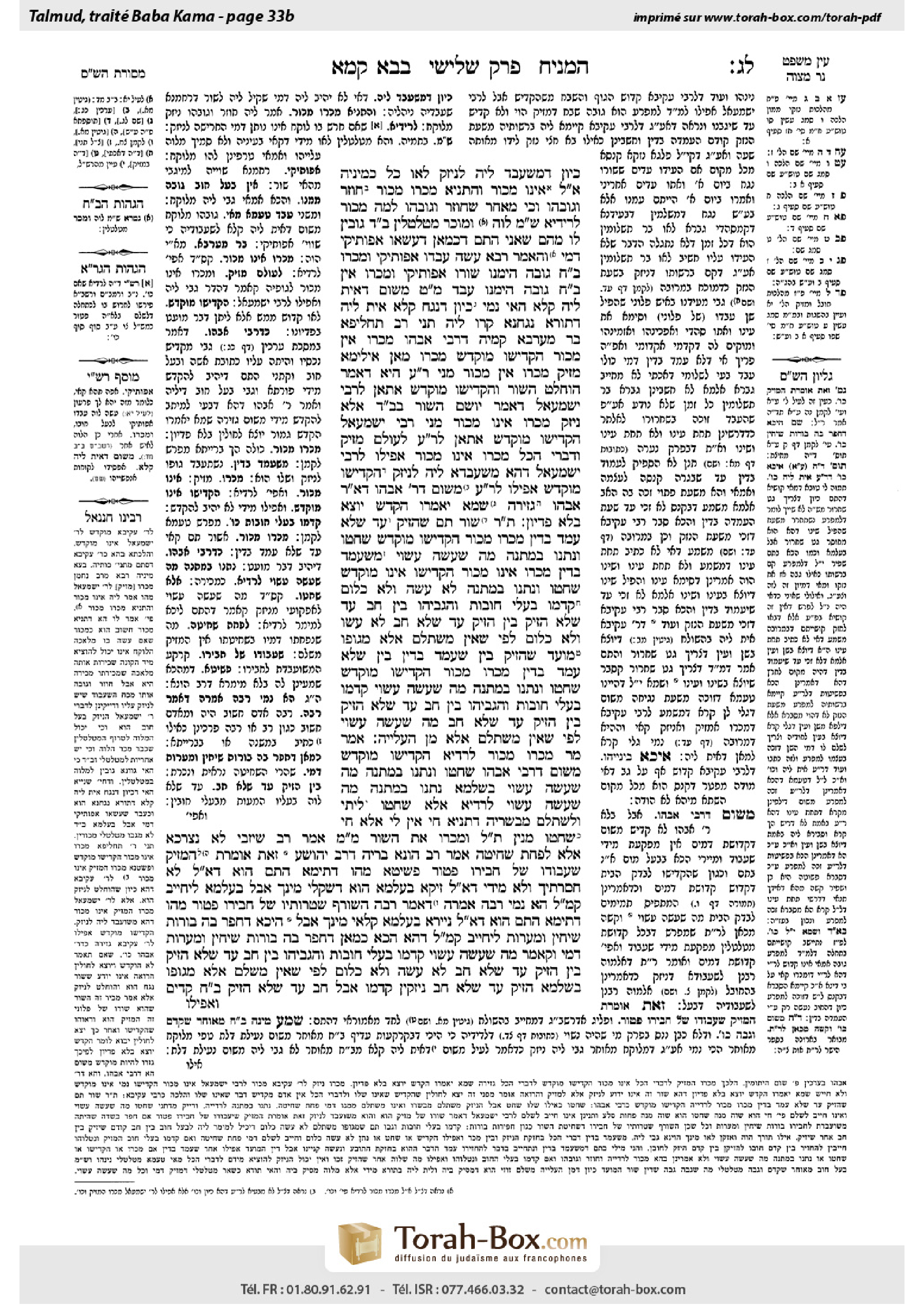
Bava Kamma 33b: Talmud study for Daf Yomi
Study the Talmud for Daf Yomi with scanned pages, Hebrew text, English translations from Sefaria and AI-generated French translations.
Passage selection and English or AI-generated French translation are available where the scan has annotations. Daf Study is independent of Torah-Box and Sefaria.
Browse Bava Kamma · בבא קמא · All tractatesBava Kamma 33b text and translations
This page of Bava Kamma includes the Aramaic text, an English translation and an AI-generated French translation, alongside the scan above.
בבא קמא ל״ג ב · Aramaic and Hebrew text
כֵּיוָן דִּמְשַׁעְבַּד לֵיהּ לְנִיזָּק – לָאו כֹּל כְּמִינֵּיהּ? אֲמַר לֵיהּ: אֵינוֹ מָכוּר.
וְהָתַנְיָא: מְכָרוֹ – מָכוּר! חוֹזֵר וְגוֹבֵהוּ. וְכִי מֵאַחַר שֶׁחוֹזֵר וְגוֹבֵהוּ, לָמָּה מָכוּר? לְרִידְיָא.
שְׁמַע מִינַּהּ: לֹוֶה וּמוֹכֵר מִטַּלְטְלִין – בֵּית דִּין גּוֹבִין לוֹ מֵהֶם? שָׁאנֵי הָתָם, דִּכְמַאן דַּעֲשָׂאוֹ אַפּוֹתֵיקֵי דָּמֵי.
וְהָאָמַר רָבָא: עָשָׂה עַבְדּוֹ אַפּוֹתֵיקֵי, וּמְכָרוֹ – בַּעַל חוֹב גּוֹבֶה הֵימֶנּוּ. שׁוֹרוֹ אַפּוֹתֵיקֵי וּמְכָרוֹ – אֵין בַּעַל חוֹב גּוֹבֶה הֵימֶנּוּ!
עֶבֶד מַאי טַעְמָא – מִשּׁוּם דְּאִית לֵיהּ קָלָא; הַאי נָמֵי, כֵּיוָן דִּנְגַח – קָלָא אִית לֵיהּ, דְּ״תוֹרָא נַגְחָנָא״ קָרוּ לֵיהּ.
תָּנֵי רַב תַּחְלִיפָא בַּר מַעְרְבָא קַמֵּיהּ דְּרַבִּי אֲבָהוּ: מְכָרוֹ – אֵין מָכוּר, הִקְדִּישׁוֹ – מוּקְדָּשׁ.
מְכָרוֹ מַאן? אִילֵימָא מַזִּיק, ״מְכָרוֹ אֵין מָכוּר״ מַנִּי – רַבִּי עֲקִיבָא הִיא, דְּאָמַר: הוּחְלַט הַשּׁוֹר; וְ״הִקְדִּישׁוֹ מוּקְדָּשׁ״ – אֲתָאן לְרַבִּי יִשְׁמָעֵאל, דְּאָמַר: יוּשַׁם הַשּׁוֹר בְּבֵית דִּין!
אֶלָּא נִיזָּק? ״מְכָרוֹ אֵינוֹ מָכוּר״ מַנִּי – רַבִּי יִשְׁמָעֵאל, ״הִקְדִּישׁוֹ מוּקְדָּשׁ״ אֲתָאן לְרַבִּי עֲקִיבָא!
לְעוֹלָם מַזִּיק, וְדִבְרֵי הַכֹּל; ״מְכָרוֹ אֵינוֹ מָכוּר״ – אֲפִילּוּ לְרַבִּי יִשְׁמָעֵאל, דְּהָא מְשַׁעְבְּדָא לֵיהּ לְנִיזָּק.
״הִקְדִּישׁוֹ מוּקְדָּשׁ״ – אֲפִילּוּ לְרַבִּי עֲקִיבָא, מִשּׁוּם דְּרַבִּי אֲבָהוּ; דְּאָמַר רַבִּי אֲבָהוּ: גְּזֵירָה שֶׁמָּא יֹאמְרוּ הֶקְדֵּשׁ יוֹצֵא בְּלֹא פִּדְיוֹן.
תָּנוּ רַבָּנַן: שׁוֹר תָּם שֶׁהִזִּיק; עַד שֶׁלֹּא עָמַד בַּדִּין – מְכָרוֹ מָכוּר, הִקְדִּישׁוֹ מוּקְדָּשׁ, שְׁחָטוֹ וּנְתָנוֹ בְּמַתָּנָה – מַה שֶּׁעָשָׂה עָשׂוּי. מִשֶּׁעָמַד בַּדִּין – מְכָרוֹ אֵינוֹ מָכוּר, הִקְדִּישׁוֹ אֵינוֹ מוּקְדָּשׁ, שְׁחָטוֹ וּנְתָנוֹ בְּמַתָּנָה – לֹא עָשָׂה וְלֹא כְלוּם.
קָדְמוּ בַּעֲלֵי חוֹבוֹת (וְהִגְבִּיהוֹ) [וְגָבוּהוּ]; בֵּין חָב עַד שֶׁלֹּא הִזִּיק, בֵּין הִזִּיק עַד שֶׁלֹּא חָב – לֹא עָשׂוּ וְלֹא כְּלוּם, לְפִי שֶׁאֵין מִשְׁתַּלֵּם אֶלָּא מִגּוּפוֹ.
מוּעָד שֶׁהִזִּיק – בֵּין שֶׁעָמַד בַּדִּין, בֵּין שֶׁלֹּא עָמַד בַּדִּין; מְכָרוֹ מָכוּר, הִקְדִּישׁוֹ מוּקְדָּשׁ, שְׁחָטוֹ וּנְתָנוֹ בְּמַתָּנָה – מָה שֶּׁעָשָׂה עָשׂוּי. קָדְמוּ בַּעֲלֵי חוֹבוֹת (וְהִגְבִּיהוּ) [וְגָבוּהוּ]; בֵּין חָב עַד שֶׁלֹּא הִזִּיק, בֵּין הִזִּיק עַד שֶׁלֹּא חָב – מַה שֶּׁעָשָׂה עָשׂוּי, לְפִי שֶׁאֵין מִשְׁתַּלֵּם אֶלָּא מִן הָעֲלִיָּיה.
אָמַר מָר: ״מְכָרוֹ מָכוּר״ – לְרִדְיָא.
״הִקְדִּישׁוֹ מוּקְדָּשׁ״ – מִשּׁוּם דְּרַבִּי אֲבָהוּ.
״שְׁחָטוֹ וּנְתָנוֹ בְּמַתָּנָה, מַה שֶּׁעָשָׂה עָשׂוּי״; בִּשְׁלָמָא נְתָנוֹ בְּמַתָּנָה, מַה שֶּׁעָשָׂה עָשׂוּי – לְרִדְיָא; אֶלָּא שְׁחָטוֹ – לֵיתֵי וְלִשְׁתַּלַּם מִבִּשְׂרֵיהּ!
דְּתַנְיָא: ״חַי״ – אֵין לִי אֶלָּא חַי, שְׁחָטוֹ מִנַּיִן? תַּלְמוּד לוֹמַר: ״וּמָכְרוּ אֶת הַשּׁוֹר״ מִכׇּל מָקוֹם.
אָמַר רַב שֵׁיזְבִי: לֹא נִצְרְכָא אֶלָּא לִפְחַת שְׁחִיטָה.
אָמַר רַב הוּנָא בְּרֵיהּ דְּרַב יְהוֹשֻׁעַ: זֹאת אוֹמֶרֶת, הַמַּזִּיק שִׁעְבּוּדוֹ שֶׁל חֲבֵירוֹ – פָּטוּר.
פְּשִׁיטָא! מַהוּ דְּתֵימָא, הָתָם הוּא דְּאָמַר לֵיהּ: לָא חַסַּרְתָּיךְ וְלָא מִידֵּי – דְּאָמַר לֵיהּ: זִיקָא בְּעָלְמָא הוּא דִּשְׁקַלִי מִינָּךְ; אֲבָל בְּעָלְמָא לִיחַיַּיב; קָא מַשְׁמַע לַן.
הָא נָמֵי רַבָּה אַמְרַהּ – דְּאָמַר רַבָּה: הַשּׂוֹרֵף שְׁטָרוֹתָיו שֶׁל חֲבֵירוֹ – פָּטוּר!
מַהוּ דְּתֵימָא, הָתָם הוּא דְּאָמַר לֵיהּ: נְיָירָא בְּעָלְמָא קְלַאי מִינָּךְ; אֲבָל הֵיכָא דְּחָפַר בָּהּ בּוֹרוֹת שִׁיחִין וּמְעָרוֹת, לִיחַיַּיב; קָא מַשְׁמַע לַן – דְּהָא הָכָא כְּמַאן דְּחָפַר בָּהּ בּוֹרוֹת שִׁיחִין וּמְעָרוֹת דָּמֵי, וְקָאָמַר: מַה שֶּׁעָשָׂה עָשׂוּי.
קָדְמוּ בַּעֲלֵי חוֹבוֹת (וְהִגְבִּיהוּ) [וְגָבוּהוּ]; בֵּין חָב עַד שֶׁלֹּא הִזִּיק, בֵּין הִזִּיק עַד שֶׁלֹּא חָב – לֹא עָשָׂה וְלֹא כְלוּם, לְפִי שֶׁאֵין מְשַׁלֵּם אֶלָּא מִגּוּפוֹ.
בִּשְׁלָמָא הִזִּיק עַד שֶׁלֹּא חָב – נִיזָּקִין קָדְמוּ. אֲבָל חָב עַד שֶׁלֹּא הִזִּיק – בַּעַל חוֹב קְדֵים!
Bava Kamma 33b · English translation
does he say that since the ox is liened to the debt to the injured party, who will collect it should the ox’s owner not have sufficient funds, it is not in his power to sell it? Rav Naḥman said to him: It is not sold.
Rava asked him: But isn’t it taught in a baraita that if he sold it, it is sold? Rav Naḥman replied: Nevertheless, the injured party then collects it from the purchaser. The Gemara asks: Since the injured party then collects it from the purchaser, with regard to what matter is it sold? His right to collect it negates the effectiveness of the sale. The Gemara answers: It is sold for the purpose of plowing [ridya]. The purchaser may use the ox for plowing until the injured party collects it from him, and the purchaser is not required to reimburse the injured party for the use of his ox.
The Gemara asks: Should one conclude from this ruling that with regard to one who borrows money and then sells his movable property, the court can collect the debt from this property on behalf of the creditor, as according to Rabbi Yishmael the belligerent ox is only a lien for the debt owed to the injured party? The Gemara answers: There, in the case of the belligerent ox, it is different, as the owner of the ox is considered like one who rendered it designated payment of the debt, since the Torah specifies that the injured party collects damages from the ox. In general, however, movable property that is sold by a debtor cannot be collected by the creditor.
The Gemara asks: But doesn’t Rava say that if one rendered his slave as designated repayment for a debt and subsequently sold him, the creditor collects payment from the purchaser, whereas if one rendered his ox as designated repayment and then sold it, the creditor cannot collect it from the purchaser? This contradicts the previous statement that the belligerent ox is considered designated repayment, and therefore even if it is sold the injured party can collect it from the purchaser.
The Gemara answers: The distinction made in Rava’s statement answers this question. What is the reason that a slave who was rendered as designated repayment can be collected from the purchaser? It is because rendering a slave as designated repayment is not common and generates publicity. The purchaser was therefore aware of this when he bought the slave. Similarly, with regard to this ox as well, since it gored an animal, it generates publicity, as it is publicly called a goring ox, and so the purchaser was aware of the lien attached to it. Therefore, the injured party can collect it from the purchaser.
Rav Taḥalifa from the West, Eretz Yisrael, taught the following baraita with regard to the belligerent ox before Rabbi Abbahu: If he sold it, it is not sold, but if he consecrated it, it is consecrated.
The Gemara asks: Who sold it? Is it the injured party or the liable party? If we say it is the one liable for the damage, whose opinion is it that if he sold it, it is not sold? It is the opinion of Rabbi Akiva, who says that the ox was already assigned to the injured party. But in the following statement of the baraita, that if he consecrated it, it is consecrated, we arrive at the opinion of Rabbi Yishmael, who says that the ox shall be appraised in court.
If, rather, it is referring to the injured party selling it, whose opinion is it that if he sold it, it is not sold? It is the opinion of Rabbi Yishmael, who holds that the injured party has no share of ownership in the ox until it is transferred to him by the court. But in the statement that if he consecrated it, it is consecrated, we arrive at the opinion of Rabbi Akiva. The baraita does not seem to accord with either opinion.
The Gemara answers: Actually, it is referring to the one liable for the damage, and everyone agrees with its ruling. The ruling that if he sold it, it is not sold is the halakha even according to the opinion of Rabbi Yishmael, as the ox is liened to the injured party, precluding the owner from selling it.
The statement that if he consecrated it, it is consecrated, is the halakha even according to Rabbi Akiva, since it is not actually consecrated but is considered so only due to the statement of Rabbi Abbahu. As Rabbi Abbahu says that if one consecrates liened property, although the consecration does not take effect, nevertheless he is required to redeem it, due to a rabbinic decree lest people say that consecrated property can be removed from the ownership of the Temple treasury without redemption. Therefore, the ineffectiveness of the ox’s consecration notwithstanding, he is still required to redeem it, by means of minimal payment, so as not to cause the denigration of Temple property.
§ The Sages taught in a baraita: With regard to an innocuous ox that caused damage, if, before its owner stood trial, he sold it, it is sold. If he consecrated it, it is consecrated. If he slaughtered it or gave it as a gift, what he did is done, i.e., takes effect. By contrast, once he stood trial and is now obligated to pay the injured party, if he sold it, it is not sold; if he consecrated it, it is not consecrated; if he slaughtered it or gave it is a gift, he has done nothing.
If creditors of the ox’s owner collected the ox first, whether he owed the creditors before his ox caused the damage or whether it caused the damage before he owed them, they have done nothing. Their collection is void, because compensation to the injured party is paid only from the body of the ox, as it was innocuous, and it is therefore designated exclusively for this compensation.
The baraita continues: With regard to a forewarned ox that caused damage, whether its owner stood trial or whether he did not stand trial, if he sold it, it is sold; if he consecrated it, it is consecrated; if he slaughtered it or gave it as a gift, what he did is done. Likewise, if creditors collected the ox first, whether he owed them before it caused the damage, or whether it caused the damage before he owed them, what they did is done. This is because the restitution is paid only from his superior-quality property, not from the body of the ox. Therefore, what he or his creditors do with the ox takes effect.
The Gemara explains the baraita: The Master said above, with regard to an innocuous ox, that if he sold it, it is sold. As explained above, the sale is valid only with regard to the purchaser using the ox for plowing in the interim, until the injured party collects it.
The statement that if he consecrated it, it is consecrated does not mean that it is actually consecrated, but rather that it must be redeemed through payment of a minimal sum, due to Rabbi Abbahu’s statement mentioned above.
With regard to the statement that if he slaughtered it or gave it as a present, what he did is done, the Gemara asks: Granted, if he gave it as a present, what he did is done with regard to the recipient’s permission to use it for plowing. But if he slaughtered it, how does that affect the injured party’s rights? Let him come and receive payment from the slaughtered ox’s meat.
This is as it is taught in a baraita: It is stated in the Torah: “Then they shall sell the live ox” (Exodus 21:35). I have derived only that the injured party receives a share of ownership if the belligerent ox is alive. From where do I derive that this applies even if the ox’s owner slaughtered it? The verse states: “Then they shall sell the live ox,” indicating that in any case, whatever the circumstances, the injured party is paid from proceeds of the sale of the belligerent ox.
Rav Sheizevi said: This statement is necessary only with regard to the diminished value of the ox due to its slaughter. Although the value of the ox may no longer cover the damage, its owner is not liable to compensate the injured party beyond the ox’s current value.
Rav Huna, son of Rav Yehoshua, said: That is to say that one who causes damage to another’s liened property is exempt from paying compensation, since the property does not actually belong to the one who holds the lien.
The Gemara asks: Isn’t this inference from the baraita obvious? The Gemara answers: Rav Huna, son of Rav Yehoshua, states this halakha lest you say that it is specifically there, in the case where one slaughters a liened ox, that he is exempt, as he can say to him: I have not detracted anything from what is yours, as he can say to him: I took only spirit from what is yours. He detracted only the life of the ox, not its physical body, and one who causes damage to another’s liened property might be exempt from liability for this intangible damage. But generally one who causes damage to another’s lien should be liable. Therefore, Rav Huna, son of Rav Yehoshua, teaches us that one is exempt from liability for all types of damage he causes to another’s liened property.
The Gemara challenges this explanation: Rabba stated this principle, as well, and there would be no need for Rav Huna, son of Rav Yehoshua, to state it. As Rabba says: One who burns another’s documents, in which other people’s debts to him are recorded, is exempt, although the owner of the documents can no longer collect payment from liened property.
The Gemara answers: Rav Huna, son of Rav Yehoshua, states this principle lest you say that it is specifically there that he is exempt, as the perpetrator of the damage can say to the owner of the documents: I burned your mere paper, for which I am prepared to pay. But in a case where one dug pits, ditches, or caves on liened land, causing substantial damage, he should be liable to compensate the one holding the lien. Therefore, Rav Huna, son of Rav Yehoshua, teaches us that even in a case of substantial damage he is exempt, as the case here, where the ox was slaughtered, is like one who dug pits, ditches, or caves, as slaughter is considered substantial damage, and the tanna said that in this case what he did is done.
The Gemara continues to explain the baraita, which states: If creditors collected the innocuous ox first, whether its owner owed them before his ox caused damage or whether it caused damage before he owed them, they have done nothing, because restitution is paid only from the body of the ox.
The Gemara asks: Granted, in the case where it caused damage before he owed them, the injured parties came first, and the ox is liened to the debt. But in the case where he owed them before it caused damage, the creditor collected it first, so why does he not have the preemptive right to the ox?
Bava Kamma 33b · Traduction française (IA)
Est-ce qu'il dit que puisque l'ox est lié au débit envers la partie blessée, celui qui collectera le débit si l'propriétaire de l'ox n'a pas suffisamment d'argent, il n'est pas en son pouvoir de le vendre ? Rav Naḥman dit à lui : Il n'est pas vendu.
Rava lui demande : Mais n'est-il pas enseigné dans une baraïta que si on le vend, il est vendu ? Rav Naḥman répond : Cependant, la partie blessée le récupère alors auprès de l'acheteur. La Guemara demande : Puisque la partie blessée le récupère alors auprès de l'acheteur, à propos de quelle affaire est-il vendu ? Son droit de récupérer annule l'efficacité de la vente. La Guemara répond : Il est vendu à l'intention de labourer [ridya]. L'acheteur peut utiliser l'ox pour labourer jusqu'à ce que la partie blessée le récupère auprès de lui, et l'acheteur n'est pas tenu de rembourser la partie blessée pour l'utilisation de son ox.
La Guemara demande : Doit-on conclure de cette décision que concernant celui qui emprunte de l'argent et ensuite vend ses biens mobiliers, le tribunal peut récupérer le débit auprès de ces biens en nom du créancier, comme selon Rabbi Yishmael l'ox belliqueux est seulement un droit de gage envers le débit envers la partie blessée ? La Guemara répond : Là, dans le cas de l'ox belliqueux, c'est différent, car l'propriétaire de l'ox est considéré comme celui qui l'a rendu comme paiement désigné du débit, puisque la Torah spécifie que la partie blessée récupère les dommages de l'ox. En général, cependant, les biens mobiliers vendus par un débiteur ne peuvent pas être récupérés par le créancier.
La Guemara demande : Mais n'est-ce pas ce que Rava dit, que si l'on a rendu son esclave comme paiement désigné pour un débit et qu'ensuite on le vend, le créancier récupère le paiement auprès de l'acheteur, tandis que si l'on a rendu son bœuf comme paiement désigné et qu'ensuite on le vend, le créancier ne peut pas le récupérer auprès de l'acheteur ? Cela contredit l'affirmation précédente que le bœuf belliqueux est considéré comme paiement désigné, et donc même s'il est vendu, la partie blessée peut le récupérer auprès de l'acheteur.
La Guemara répond : La distinction faite dans l'affirmation de Rava répond à cette question. Quelle est la raison que l'esclave rendu comme paiement désigné puisse être récupéré auprès de l'acheteur ? C'est parce que rendre un esclave comme paiement désigné n'est pas commun et génère de la publicité. L'acheteur était donc conscient de cela lorsqu'il a acheté l'esclave. De même, concernant ce bœuf, puisqu'il a blessé un animal, il génère de la publicité, car il est publicement appelé un bœuf belliqueux, et donc l'acheteur était conscient du droit de gage attaché à lui. Ainsi, la partie blessée peut le récupérer auprès de l'acheteur.
Rav Taḥalifa de l'Ouest, Eretz Yisrael, enseigna la suivante baraïta concernant le bœuf belliqueux avant Rabbi Abbahu : Si on le vend, il n'est pas vendu, mais si on le consacre, il est consacré.
La Guemara demande : Qui l'a vendu ? Est-ce la partie blessée ou la partie responsable ? Si nous disons que c'est la partie responsable du dommage, dont l'opinion est-ce qui dit que si on le vend, il n'est pas vendu ? C'est l'opinion de Rabbi Akiva, qui dit que l'ox était déjà assigné à la partie blessée. Mais dans l'affirmation suivante de la baraïta, que si on le consacre, il est consacré, nous arrivons à l'opinion de Rabbi Yishmael, qui dit que l'ox doit être évalué en cour.
Si, plutôt, il s'agit de la partie blessée qui l'a vendu, dont l'opinion est-ce qui dit que si on le vend, il n'est pas vendu ? C'est l'opinion de Rabbi Yishmael, qui considère que la partie blessée n'a pas de part de propriété dans l'ox jusqu'à ce qu'il soit transféré à lui par la cour. Mais dans l'affirmation que si on le consacre, il est consacré, nous arrivons à l'opinion de Rabbi Akiva. La baraïta ne semble pas s'accorder avec l'une ou l'autre opinion.
La Guemara répond : En réalité, il s'agit de la partie responsable du dommage, et tout le monde s'accorde sur son jugement. Le jugement que si on le vend, il n'est pas vendu est la halakha même selon l'opinion de Rabbi Yishmael, car l'ox est lié à la partie blessée, empêchant l'propriétaire de le vendre.
L'affirmation que si on le consacre, il est consacré est la halakha même selon l'opinion de Rabbi Akiva, car il n'est pas réellement consacré mais est considéré comme tel seulement en raison de l'affirmation de Rabbi Abbahu. Comme Rabbi Abbahu dit que si l'on consacre un bien lié, bien que la consécration ne prenne pas effet, néanmoins il est tenu de le racheter, en raison d'un décret rabbinique afin que les gens ne disent pas que les biens consacrés peuvent être retirés de la propriété du trésor du Temple sans rachat. Ainsi, malgré l'inéfficacité de la consécration de l'ox, il est encore tenu de le racheter, par un paiement minimal, afin de ne pas dégrader les biens du Temple.
§ Les Sages enseignèrent dans une baraïta : Concernant un taureau innocent qui a causé des dommages, si, avant que son propriétaire ne soit jugé, il le vend, il est vendu. Si on le consacre, il est consacré. Si on le tue ou le donne en cadeau, ce qu'on a fait est effectif, c'est-à-dire prend effet. En revanche, une fois qu'il a été jugé et est maintenant tenu de payer la partie blessée, si on le vend, il n'est pas vendu ; si on le consacre, il n'est pas consacré ; si on le tue ou le donne en cadeau, on a fait rien.
Si les créanciers de l'propriétaire du taureau ont récupéré le taureau en premier, que ce soit qu'il devait aux créanciers avant que le taureau ne cause le dommage ou que le taureau a causé le dommage avant qu'il ne doive aux créanciers, ils ont fait rien. Leur récupération est nulle, car la compensation à la partie blessée est payée uniquement du corps du taureau, car il était innocent, et il est donc désigné exclusivement pour cette compensation.
La baraïta continue : Concernant un bœuf averti qui a causé un préjudice, que l'propriétaire ait été jugé ou non, si l'on vend ce bœuf, il est vendu ; si l'on le consacre, il est consacré ; si l'on le sacrifie ou qu'on le donne en cadeau, ce qu'on a fait est accompli. De même, si les créanciers ont récupéré le bœuf en premier, que l'propriétaire ait dû quelque chose avant que le bœuf ne cause le préjudice, ou que le bœuf ait causé le préjudice avant qu'il ne doive quelque chose, ce qu'ils ont fait est accompli. Cela est dû au fait que la réparation est payée uniquement à partir de ses biens de meilleure qualité, pas du corps du bœuf lui-même. Par conséquent, ce que l'propriétaire ou ses créanciers font avec le bœuf est effectif.
Le Guemara explique la baraïta : Le Maître a dit ci-dessus, concernant un bœuf inoffensif, que si l'on vend ce bœuf, il est vendu. Comme expliqué ci-dessus, la vente est valide uniquement concernant l'utilisation du bœuf par l'acheteur pour la moisson, jusqu'à ce que la partie blessée le récupère.
La déclaration que si l'on consacre ce bœuf, il est consacré ne signifie pas qu'il est effectivement consacré, mais plutôt qu'il doit être racheté par un paiement minimal, en raison de la déclaration du Rabbi Abbahu mentionnée ci-dessus.
Concernant la déclaration que si l'on sacrifie ce bœuf ou qu'on le donne en cadeau, ce qu'on a fait est accompli, le Guemara pose la question : Cela est évident, si l'on donne ce bœuf en cadeau, ce qu'on a fait est accompli concernant l'autorisation de l'homme qui reçoit le bœuf pour l'utiliser à la moisson. Mais si l'on sacrifie ce bœuf, comment cela affecte-t-il les droits de la partie blessée ? Laissez-le venir et recevoir le paiement à partir de la viande du bœuf sacrifié.
C'est ce qui est enseigné dans une baraïta : Il est dit dans la Torah : « Alors ils vendront le bœuf vivant » (Exode 21:35). J'ai déduit seulement que la partie blessée reçoit une part de propriété si le bœuf belliqueux est vivant. D'où déduis-je que cela s'applique même si l'propriétaire a sacrifié le bœuf ? La versette dit : « Alors ils vendront le bœuf vivant », indiquant que dans tous les cas, quelles que soient les circonstances, la partie blessée est payée à partir des recettes de la vente du bœuf belliqueux.
Rav Sheizevi a dit : Cette déclaration est nécessaire uniquement concernant la diminution de valeur du bœuf en raison de son sacrifice. Bien que la valeur du bœuf puisse ne plus couvrir le préjudice, l'propriétaire n'est pas tenu de compenser la partie blessée au-delà de la valeur actuelle du bœuf.
Rav Huna, fils de Rav Yehoshua, a dit : Cela signifie que celui qui cause un préjudice à la propriété liée d'un autre est exempt de payer la compensation, car la propriété ne revient pas réellement à celui qui détient le droit de garantie.
Le Guemara pose la question : N'est-ce pas une déduction évidente de la baraïta ? Le Guemara répond : Rav Huna, fils de Rav Yehoshua, énonce cette halakha afin que vous ne disiez pas qu'il s'agit spécifiquement du cas où l'on sacrifie un bœuf lié, qu'il est exempt, car il peut dire à l'propriétaire : Je n'ai pas détourné quoi que ce soit de ce qui est à toi, car il peut dire à l'propriétaire : J'ai pris seulement l'esprit de ce qui est à toi. Il a détourné seulement la vie du bœuf, pas son corps physique, et celui qui cause un préjudice à la propriété liée d'autrui pourrait être exempt de responsabilité pour ce préjudice intangible. Mais généralement, celui qui cause un préjudice à la propriété liée d'autrui devrait être tenu responsable. Par conséquent, Rav Huna, fils de Rav Yehoshua, nous enseigne que l'on est exempt de responsabilité pour tous les types de préjudice que l'on cause à la propriété liée d'autrui.
Le Guemara conteste cette explication : Rabba a énoncé ce principe également, et il n'y aurait pas besoin que Rav Huna, fils de Rav Yehoshua, l'ait énoncé. Comme Rabba dit : Celui qui brûle les documents d'autrui, dans lesquels les dettes d'autres personnes lui sont enregistrées, est exempt, même si l'propriétaire des documents ne peut plus récupérer le paiement des biens liés.
Le Guemara répond : Rav Huna, fils de Rav Yehoshua, énonce ce principe afin que vous ne disiez pas qu'il s'agit spécifiquement de ce cas où l'on sacrifie un bœuf lié, qu'il est exempt, car le responsable du préjudice peut dire à l'owner des documents : J'ai brûlé votre simple papier, pour lequel je suis prêt à payer. Mais dans le cas où l'on creuse des fossés, des canyons ou des grottes sur un terrain lié, causant un préjudice considérable, il devrait être tenu responsable de compenser celui qui détient le droit de garantie. Par conséquent, Rav Huna, fils de Rav Yehoshua, nous enseigne que même dans un cas de préjudice considérable, il est exempt, car le cas ici, où le bœuf a été sacrifié, est comme celui qui creuse des fossés, des canyons ou des grottes, car le sacrifice est considéré comme un préjudice considérable, et le tanna a dit que dans ce cas, ce qu'il a fait est accompli.
Le Guemara continue à expliquer la baraïta, qui dit : Si les créanciers ont récupéré le bœuf inoffensif en premier, que l'owner ait dû quelque chose avant que le bœuf ne cause le préjudice ou que le bœuf ait causé le préjudice avant qu'il ne doive quelque chose, ils n'ont rien fait, car la réparation est payée uniquement à partir du corps du bœuf.
Le Guemara pose la question : Cela est évident, dans le cas où le bœuf a causé le préjudice avant qu'il ne doive quelque chose, les parties blessées sont venues en premier, et le bœuf est lié à la dette. Mais dans le cas où il a dû quelque chose avant que le bœuf ne cause le préjudice, le créancier a récupéré le bœuf en premier, pourquoi l'owner n'a-t-il pas le droit préférentiel au bœuf ?
Traduction française générée par IA à partir de l’édition anglaise de Sefaria. Vérifie toujours un passage avec le texte source.
Text from Sefaria: William Davidson Edition - Vocalized Aramaic (CC BY NC); William Davidson Edition - English (CC BY NC).